Court, Citadel, Gas & Brewery – 1990

Court, Citadel, Gas & Brewery continues the occasional series on my walk on Sunday 4th March 1990 had begun at Clapham Junction in Battersea with St John’s Road & East Hill, Battersea – 1990. The previous post, Quakers, Beer, a Palace and the Wandle – 1990 had ended with me at the north end of Garratt Lane in the centre of Wandsworth.

Courthouse Community Centre, Garratt Lane, Wandsworth, 1990, 90-3b-42
Courthouse Community Centre, 11, Garratt Lane, Wandsworth, 1990, 90-3b-42

This was built in 1858 apparently as one of the first courts under the 1846 County Courts Act and is Grade II listed.

It was alleged to be near-derelict in the 1970s when it was first Grade II listed and was handed over to Wandsworth Council, becoming a community centre for the Arndale Estate. Then it became the Wandsworth Museum but that was closed in 2008 to turn it into Wandworth Library. The museum was moved West Hill Library then closed in 2015. In 2014 the council decided to move the library and to sell or let the building . I think it is now offices.

Salvation Army Citadel, Ram St, Wandsworth, 1990, 90-3b-43

I crossed Wandsworth High Street and walked up Ram Street. stopping to take this view of the Salvation Army Citadel, built in 1907, but now replaced in 2008 by a more modern building. Doubtless a much more functional building its rounded lines have nothing of the military features of the old with its castellated tower.

The Wandsworth Gas Company gasholder is no longer visible. Gasholders such as this were still in use for storage and to regulate gas pressure for some years after the changeover to natural gas and the closure of our gas works. Once a common feature of our townscapes, most have now gone, with just a few of the guide frames of particular interest being listed and saved, some converted to contain flats.

I think this one was dismantled around 15 years ago, but at least until recently its base could be seen from the railway line to the north.

Gas Holder, Swandon Way, Wandsworth, 1990, 90-3a-54

A closer view of the gasholder which clearly shows the three sections which would be lifted up inside each other by the gas as more gas was pumped into the holder (and were known as lifts.) The first ‘telescopic’ gasholder was invented in 1824. This example was built in 1972 and was said to be the largest of its type in the UK. Gas was stored at only a little above atmospheric pressure

Gas Holder, Houses, Barchard St, Ram St, Wandsworth, 1990, 90-3b-44

Controversial plans were approved by Wandsworth council for the redevelopment of the gas works site to include a 29 storey tower – rather taller than the old gasholder. I think that the massive concrete base which held the water to seal the bottom of the gas holder is to be retained to save the huge environmental cost of its removal.

I rather liked the way the old gasholders – here and elsewhere – contributed to the townscape, and they were certainly local landmarks. But the Wandsworth Society and other objectors are correct to point out the main tower block of the development with a height of 29 storeys, “is quite ‘out of context’ next to the River Wandle. The site of the tower cannot be considered to be a ‘town centre’ site nor is it close to a ‘cluster’ of buildings of a similar nature. The application cannot be considered to ‘make a positive contribution to local character and context’“.

Gas Holder, Armoury Way, Wandsworth, 1990, 90-3b-31

A final picture of the gas holder.

Ram Brewery, River Wandle, Wandsworth High St, Wandsworth, 1990, 90-3c-12

The rest of the area north of the town centre has also seen massive redevelopment, though at least the major historic elements of the Ram Brewery have been retained – and now contain the Sambrook Brewery.

Here you can see one of the more modern parts of the brewery, which looked more like a chemical plant than how I imagine real beer being made.

The area is now covered by large bocks of around 4-7 storeys and I think the only thing visible in this image that remains is the brewery chimney. There is now a walk alongside the Wandle, but little of interest to see from it.

Ram Brewery, River Wandle, Wandsworth High St, Wandsworth, 1990, 90-3c-15

Young’s beers are now brewed by Carlsberg Marston’s Brewing Company in Bedford, though they have re-branded them to include London in their names.

River Wandle, Armoury Way, Wandsworth, 1990, 90-3b-32

More from around the Wandle in a later post.


FlickrFacebookMy London DiaryHull PhotosLea ValleyParis
London’s Industrial HeritageLondon Photos

All photographs on this page are copyright © Peter Marshall.
Contact me to buy prints or licence to reproduce.
Manor Gardens and Hackney Wick – 2007

Manor Gardens and Hackney Wick: The allotment holders at Manor Gardens Allotments were still fighting to be allowed to keep their allotments on a site next to the River Lea inside the London 2012 Olympic site. On Sunday 4th March 2007 I went to the community centre at Hackney Wick where the Olympic delivery authority had agreed to meet with the plot holders to discuss their future and later went on to take more pictures on the allotment site. It was a cold, dull and wet day and the pictures reflect the weather and the mood. Here us the piece I wrote in 2007 with the usual minor corrections.

Manor Gardens Allotments Meeting

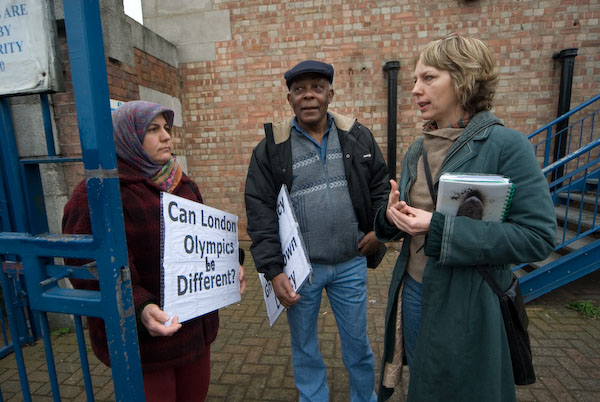
Plot holders outside the community centre before the meeting

Sunday I went back to Hackney Wick, where the London Delivery Authority for the Olympics had arranged to meet with the plot holders from Manor Gardens Allotments. But hearing that the media were likely to be around, the LDA had pulled out, leaving the plot holders to hold their meeting on their own – which they did, without the other supporters or the media present.

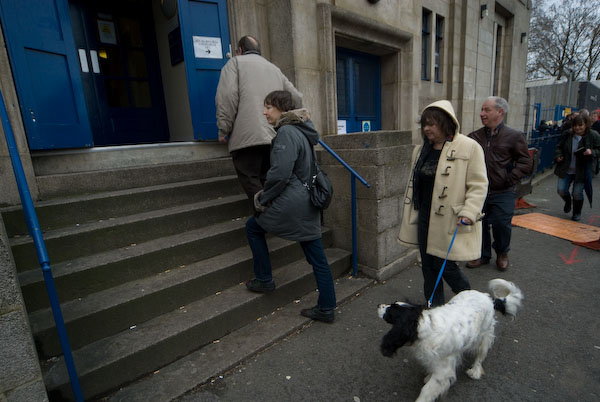
The plotholders go into the community centre for their meeting; the press and supporters are left to demonstrate outside

The situation is a mess, and the LDA appear unable to make any suitable provision for plot-holders, or to accept the idea of a green heart to the Olympics with the allotments in place.

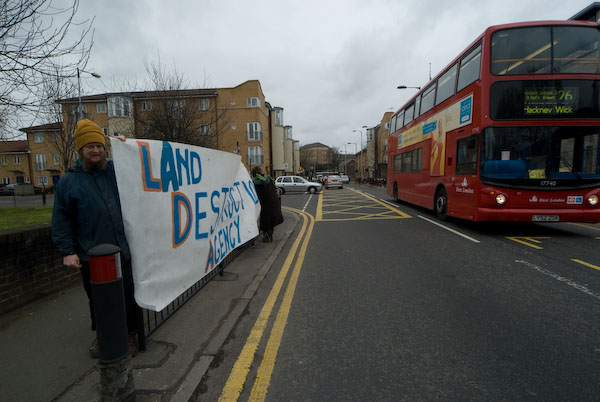
LDA = Land Destruction Agency

The LDA don’t actually seem to have any real use for the allotment site – possibly a footpath may run through it – but I think feel that its presence would sit oddly with the mass corporate sponsorship they rely on. One of their ideas is to put a giant scoreboard advertising Coca-Cola in its place.

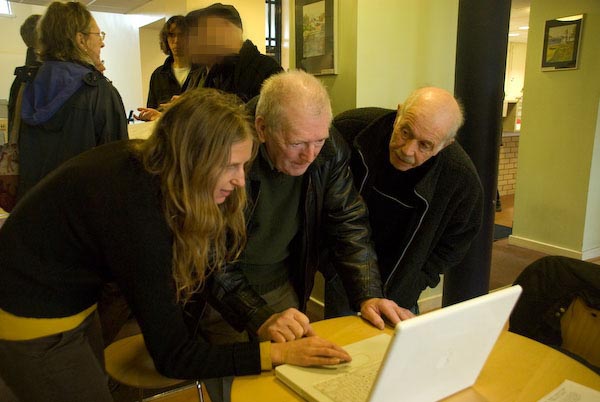
After their meeting, plot holders look at the Manor Gardens website

Eventually we were too cold and wet, so we came inside to wait for the meeting to end.

more pictures

Manor Gardens Allotments

After the meeting, we went with the plot holders to look at the Manor Gardens allotments.

A bridge led to the allotments were on an island between the River Lee and the fiChannelsea River, both tidal.The water was fairly high. The bushes are in blossom – some is wild plum which apparently makes fine jam. Fray Bentos once made pies and puddings in the factories to the right of the river.
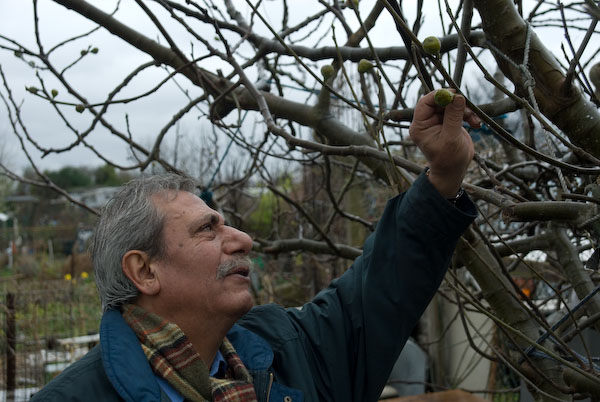
These figs will be ripe in August if allowed to grow

At the allotments, I was able to take pictures of a few plot holders at work, clearing their plots. A few are still planting in the hope that they will be able to continue there.

Some were still planting crops, hoping they will be able to harvest.

Films were being screened in the community hut, and I watched one about the fight to keep urban gardens in New York; although some were lost, the fight led to others being protected.

A film show in the community hut on saving the gardens of New York

Only 4 weeks remain until the date set for the site to be vacated. The LDA have failed to come up with a replacement. It is just possible they may change their mind at the last minute, or at least delay the closure, but unless the Manor Gardens Plot holders come up with a credible legal challenge the chances seem poor.

Many have comfortable areas where they can enjoy their work – and eat the vegetables – Jerusalem artichokes are being peeled ready to cook

Manor Gardens raises many questions about the kind of democracy we live in and the kind of future we want. If it goes it will be a powerful message that regeneration will be at the expense of the local community and at the expense of the environment. If were are to have a future it needs to be considerably more green than our present, and places like Manor Gardens are the models on which we need to grow and develop.

Ready for planting – but when and where, plot holders ask. Will Mayor Ken have any answers?

The question really isn’t a matter of deciding between a green or a brown future. Increasingly I’m convinced there isn’t a future unless we go green. More than that, we also need to move rapidly from a top-down society to a bottom up one, where people have more control over their lives rather than being controlled.

Work stops for tea in the shed on one of the plots

Manor Gardens is a site that is more important than the few acres of land and the small community who grow there. It is a part of our battle for survival.

I say goodbye to everyone and hope to come back and photograph when the weather is better. Manor Gardens is a great resource, and was bequeathed in perpetuity for growing food. It would be a great loss and a great missed opportunity if it isn’t still there in 2012 and beyond.

more pictures

Hackney Wick

Waterden Road in the rain – all this will be demolished

As I walked back to the station and the North London Line I took a few pictures of Hackney Wick.


FlickrFacebookMy London DiaryHull PhotosLea ValleyParis
London’s Industrial HeritageLondon Photos

All photographs on this page are copyright © Peter Marshall.
Contact me to buy prints or licence to reproduce.

Charterhouse, A Diary, School, Church & Houses

Charterhouse, A Diary, School, Church & Houses continues my walk on Friday 4th August 1989 in Battersea from the previous post, St Peter & St Paul, Candles, A Pub & Distillery. My walk began with Council flats, Piles of Bricks, A House Hospital and Brasserie.

Charterhouse Works, Eltringham St, Battersea, Wandsworth, 1989 89-8c-65

I turned south from York Road into Petergate and turned int Eltringham Street where I think I took this picture of the Charterhouse Works. It’s hard to read the peeling paint of the notice on the side, but I think these were once the works of Sandle Brothers, Manufacturing Stationers, Wholesale & Export with City Offices & Showroom at 4 Snow Hill EC4. You can see more about them on Spitalfields Life.

There appears to be a very long list of current occupants on the front of the building and on the full size image I can make out some of the names of what appear to be small businesses with workshops or offices in the building.

I think this is now the site of Charterhouse Appartments at 21 Eltringham St, a large modern block.

Nicholson & Co, 115, 119, Plough Rd, Battersea, Wandsworth, 1989 89-8c-52

I made my way through the back streets to Plough Road, probably going along the footpath beside the railway line, Tours Passage. On the way I passed a heap of black sacks of rubbish with horse that had come from a fair roundabout, which I photographed but have not yet digitised.

Going under a railway bridge and walking down the road took me opposite the works of Nicholson & Co Ltd at 115-7 Plough Road, Heating – Ventilating – Air Conditioning Engineers established in 1904. Next door at 119 is a rather more ornate building with the date 1902 in its gable. The 2013 Survey of London tells me this was a former diary “designed by William Clinch Poole for the Dairy Supply Company Ltd.”

Plough Road School, Plough Terrace, Battersea, Wandsworth, 1989 89-8c-53

Plough Road School is Grade II listed as Highview Primary School and was built in 1889-90 (the date 1890 appears on it though not in my picture) designed for the London School Board by its architect T J Bailey who was proud of his work and exbibted the designs at the Royal Academy in 1891.

My view is of the back of the building, probably because much of the rest was covered by scaffolding when I made it, but perhaps becuase I thought the architectural influence was more evident. At the right of my picture is a little of the schoolkeeper’s house built at the same time.

St Pauls, Church, Community Centre, Vardens Rd, St John's Hill, Wandsworth, 1989 89-8c-54
St Pauls, Church, Community Centre, Vardens Rd, St John’s Hill, Wandsworth, 1989 89-8c-54

At the bottom of Plough Road I turned right into St John’s Hill and took this picture of St Paul’s Church from the corner of Vardens Road, I think to contrast the slender spire with the pillars of the corner doorway of 129 St John’s Hill. This block, shops with flats above has a rather more delicate entrance to the flats, Harvard Mansions, on Vardens Road. Those pillars seemed unusual in that they clearly were not supporting anything – with a top looking like a chimney. The block was built in the late 1890s in an Arts and Crafts style.

Although this is on St John’s Hill it was built in 1868 as St Paul’s church, as a part of the parish of St John’s Battersea which was on Usk Road. It was needed to accommodate the growing number of worshippers in the area which was beginning to expand rapidly. Later numbers fell and St John’s closed in 1950. This church became part of the parish of St. Peter & St Paul Battersea. Chad Varah who founded the Samaritans was its vicar from 1949-53.

Designed by H E Coe this Victorian Gothic church was build in a Decorated style using Kentish ragstone. Despite some on-line statements it appears to be only locally listed. When I made this picture it was in use as a community centre for the local residents association and as a nursery and it seems only to have been formally de-consecrated in 2013 to allow parts to be converted to flats.

Houses, 13-17, Spencer Rd, Wandsworth, 1989 89-8c-55

I walked west to the next turning on St John’s Hill and went down Spencer Road where a short distance down I found these splendid Victorian villas. Much of the housing in the road is interesting but I was particularly interested in these for their combination of Victorian Gothic and Dutch gables.

Spencer Road presumably gets its name from the various Spencers who were Lords of the Manor in this area. The street was laid out before 1871 but was developed piecemeal and these houses are I think probably a little later.

This walk will conclude in a later post.


FlickrFacebookMy London DiaryHull PhotosLea ValleyParis
London’s Industrial HeritageLondon Photos

All photographs on this page are copyright © Peter Marshall.
Contact me to buy prints or licence to reproduce.


EDL Saved by Police in Slough

EDL Saved by Police in Slough – 1st February 2014.

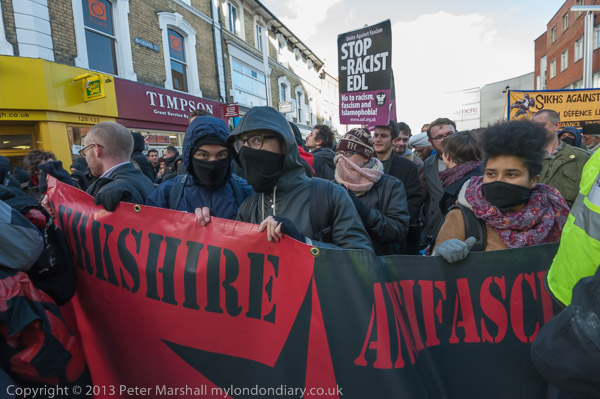
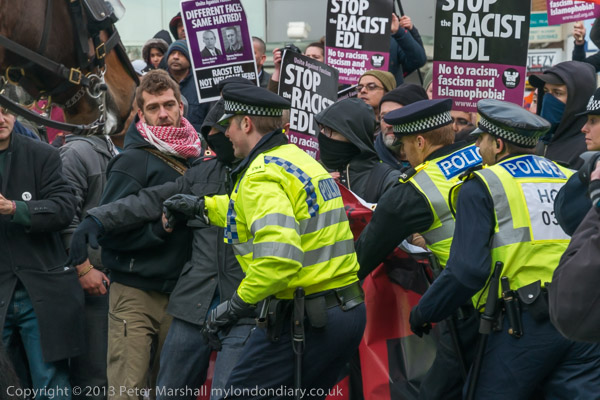
Berkshire Anti-Fascists were among those trying to stop the EDL marching

I don’t often go to Slough. While I wouldn’t entirely share John Betjeman’s sentiments “Come, friendly bombs, and fall on Slough! It isn’t fit for humans now” it isn’t one of my favourite places, and although its only a fairly short bike ride or bus journey away, I seldom feel moved to go there.

Back in the 1990s I did go to take pictures, particularly on the trading estate, the largest industrial estate in single private ownership in Europe. I was then working on a project related to Thatcher’s de-industrialisation of the UK, as well as beefing up the almost non-existent selection of industrial buildings in one of our national collections.

And later in the 2000’s I rode there a couple of April Sunday mornings to photograph the annual Sikh Vaisakhi procession from the Gurdwara in the north of the town, always a very enjoyable experience. Most recently I went to reclaim my phone which I’d dropped on a bus journey and was handed in at the bus station after the driver found it at the end of the route. And I’ve been driven through Slough a few times on the way back from walks in Burnham Beeches and other sylvan walks in the countryside on its fringes.

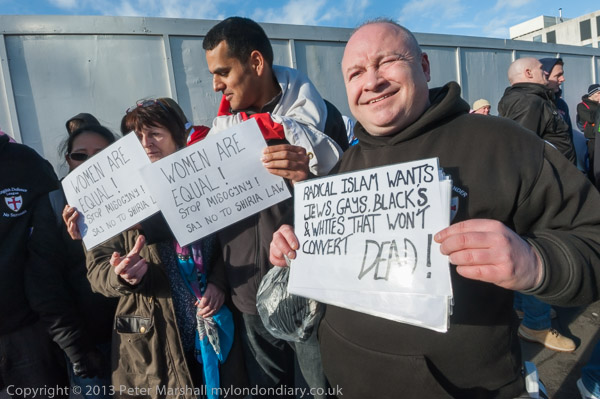
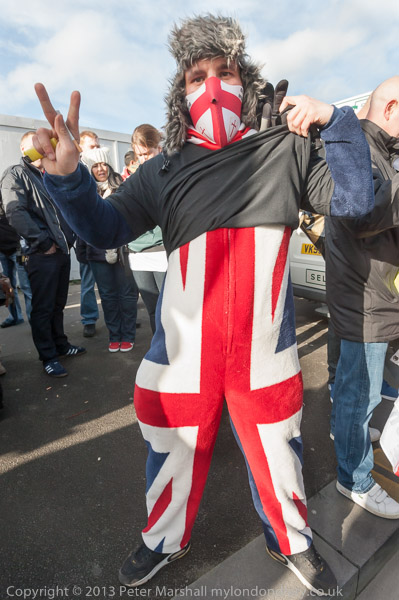
But on February 1st eight years ago I was there for a very different reason. A couple of hundred EDL supporters from around the country had come to march to a rally in the centre of Slough in an anti-Muslim protest over plans for a new mosque and Islamic community centre.

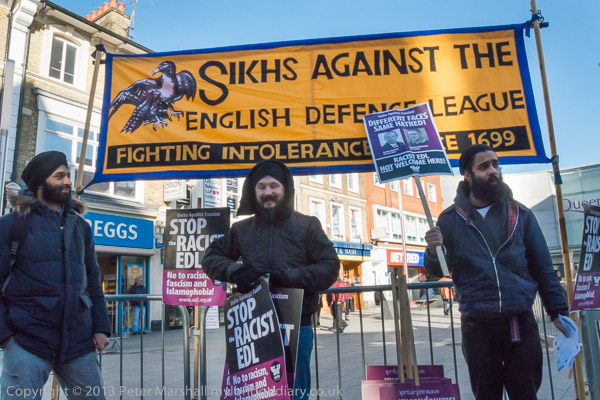
Large numbers of local people along with a few activists had gathered to opposed them, probably outnumbering them by around 10 to 1. As well as local Asian youths and trade unionists there were black-clad anti-fascists and supporters of Unite Against Fascism. There were two distinct large groups both holding rallies and hoping to prevent the EDL from marching through the centre of the town to hold their rally.

Unusually, as I wrote:

The EDL seemed determined to show they could behave rather better than on many previous occasions, and had banned drinking on the protest. There were plenty of EDL stewards on hand having an occasional word with anyone who seemed to be getting out of hand. A man who started to shout out their well-known chant “Allah is a pedo” was greeted by shouts to stop and quickly grabbed, though later things seemed to get a little out of hand with a large group if not the entire protest joining in with chanting “Allah, Allah, who the f**k is Allah.”

EDL Saved by Police in Slough

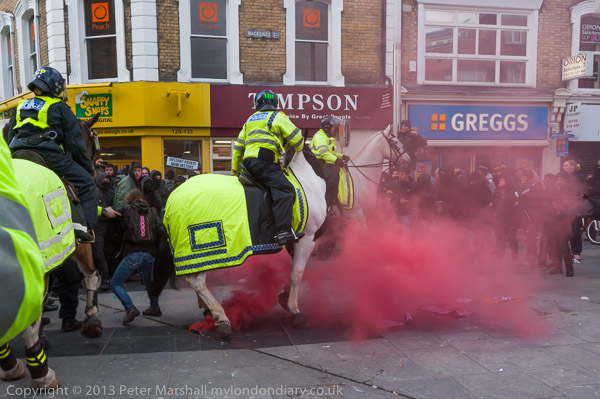
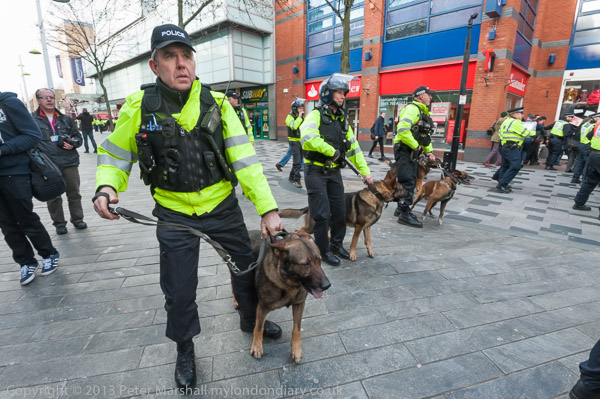
There was also a very large police presence, including a number of mounted police, and they very physically cleared a way for the march, with a number of charges by police horses and some very rough handling. As I wrote: “There were a number of minor injuries caused by police and protesters, and I was hit by a barrier thrown over by EDL supporters as well as a plastic bottle thrown by an Asian youth, as well as getting a few bruises from the pushing, mainly by police.”

The barrier hit me as I was attempting to photograph the EDL rally from outside the barriers and police around it. It hit me on one ankle and was extremely painful, and for a few minutes I could hardly walk. But soon I decided nothing seemed to be broken and managed to hobble around and take just a few more pictures.

Then I decided I’d done enough and needed to rest my ankle. Fortunately I’d come by bus, as cycling home would have been agony, and I was able to leave the town centre and sit on the bus for the longish ride home. Fortunately it isn’t a very long walk from the bus stop.

More on My London Diary at EDL Saved by Police in Slough.