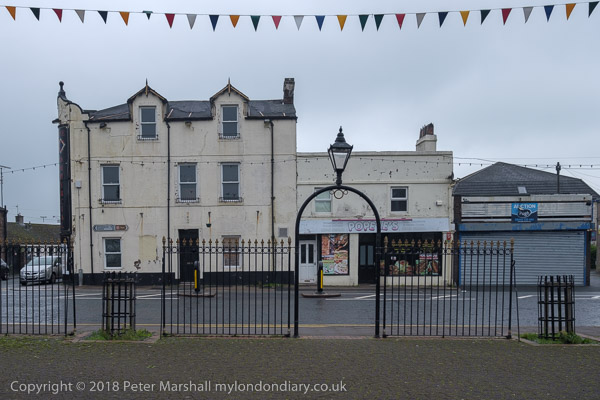
National Gallery, Trayvon Martin & Dykes – 2012

National Gallery, Trayvon Martin & Dykes: Saturday 31 March 2012 I began outside the National Gallery were the Campaign Against the Arms Trade (CAAT) were demanding that the gallery stopped hosting events for the arms trade. From there I went to the US Embassy in Grosvenor Square for a protest about the US failure to prosecute the killer of black teenager Trayvon Martin. Finally I went to London’s first Dyke March since the 1980s.


Disarm The National Gallery

Trafalgar Square
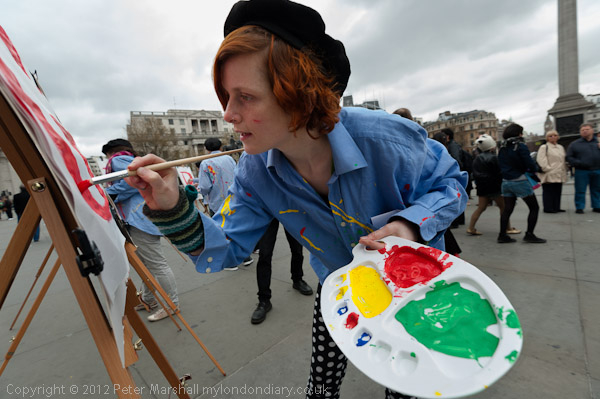
Around 20 protesters had come to Trafalgar square as ‘artists’, dressed in blue paint-stained smocks and equipped with moustaches, berets, paint brushes, palettes and easels with large sheets of paper and a smattering of Franglais.
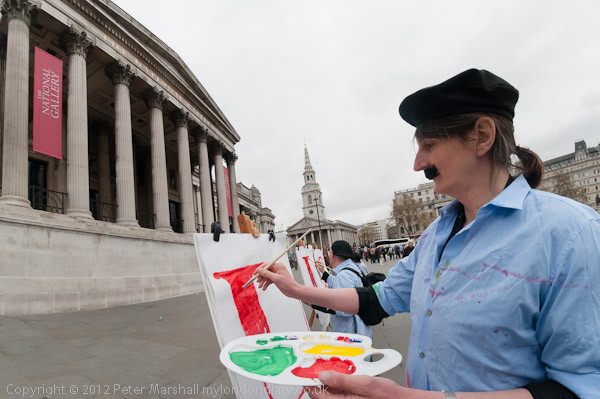
They erected their easels in a line on the North Terrace in front of the National Gallery and painted the letters D, I, S, A, R, M, T, H, E, G, A, L, L, E, R and Y anbefore standing with them in front of the gallery.
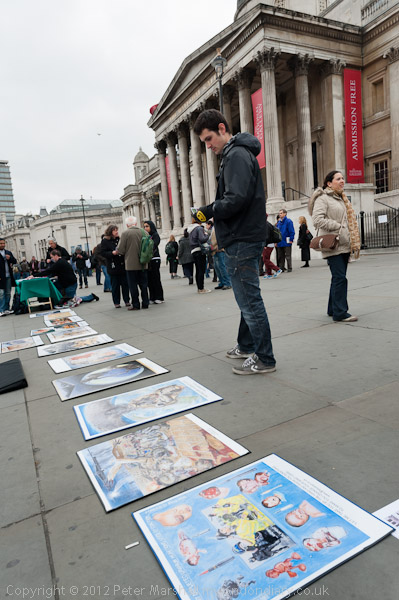
There also brought other anti-war artworks to display and handed out postcards for onlookers to sign calling on Nicholas Penny, Director of the National Gallery, to end his support of the arms trade.
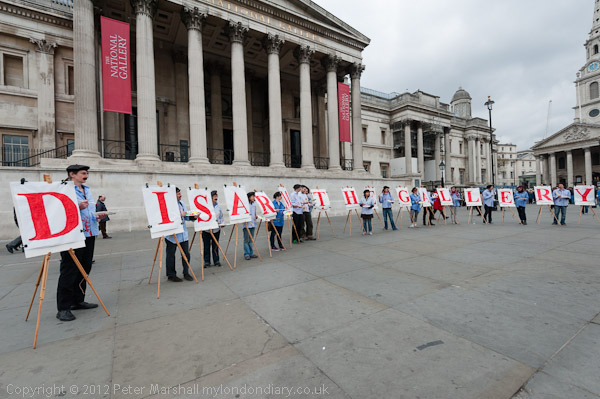
The main entrances of the gallery were closed during the protest and a long queue built up at the lower entrance. Many in that line were amazed to find that an art gallery was supporting arms sales. As the postcard says – and people overwhelmingly agreed – Art and arms don’t mix.

The Disarm the Gallery protest was organised by the Campaign Against the Arms Trade (CAAT) as the during the DSEi arms fair the previous September, weapons manufacturer Finmeccanica had paid the gallery £30,000 to hold events there.

DSEi is the worlds largest arms fair with buyers and sellers from around the world including many corrupt and tyrannical regimes, selling the equipment used by dictators around the world to equip armies and police to keep order and fuelling conflicts which kill thousands if not millions.

Disarm The National Gallery


Protest for Trayvon Martin

US Embassy, Grosvenor Square
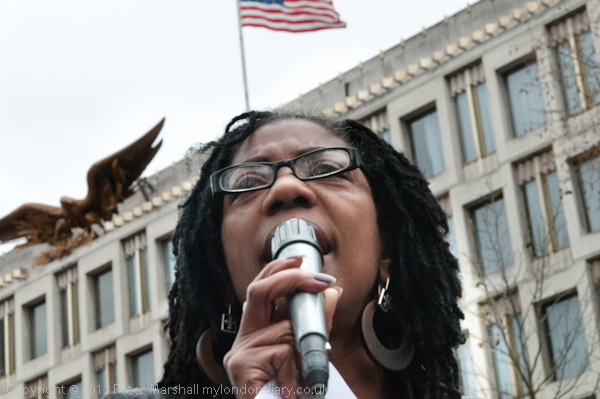
Marcia, sister of Sean Rigg, killed by police in Brixton police station speaks at the US embassy protest

Black teenager Trayvon Martin was walking back from a local convenience store to the house in Florida where he was staying with this father when he was stopped and then shot dead by George Zimmerman, a self appointed neighbourhood watchman who claimed he had felt threatened by a black teenager wearing a hoodie.
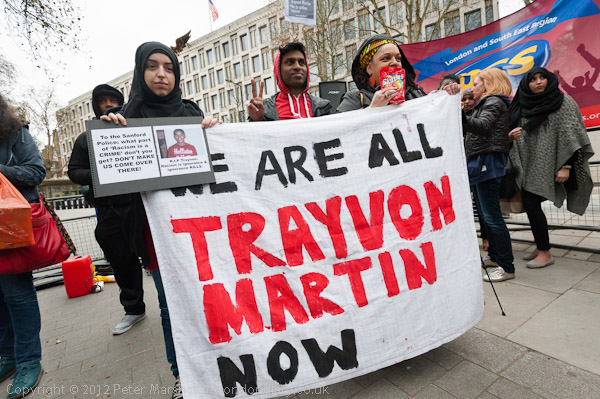
He had gone to the shop to buy a soft drink and some Skittle sweets and many at the protest wore hoodies and carried packets of Skittles and soft drinks.
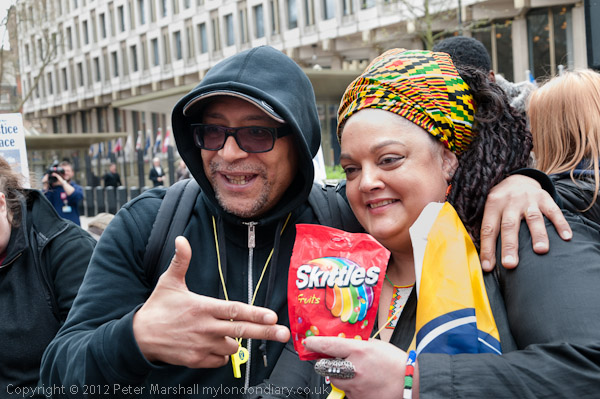
Lee Jasper and Zita Holbourne of BARAC

Florida police backed Zimmerman’s story that he had acted in self-defence and refused to arrest or charge him. Later the pressure from protests like this across America and around the world led to him being brought to trial, but a Florida jury acquitted him.
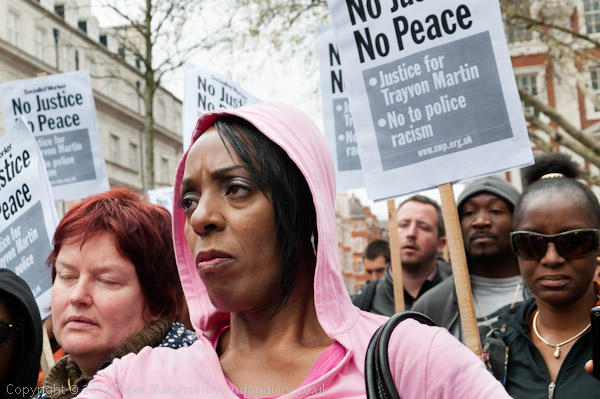
People stressed that the killing of Trayvon Martin very much reflects the treatment of black people not just in the USA but elsewhere including the UK

The embassy protest was was chaired by Merlin Emmanuel, brother of Smiley Culture, killed by police in his own kitchen, and speakers included Marcia, the brother of Sean Rigg, murdered in Brixton Police Station. Other speakers also brought up cases of deaths and discriminaton by police in the UK.

More pictures at Protest for Trayvon Martin.


London Dyke March 2012

Soho Square – South Bank
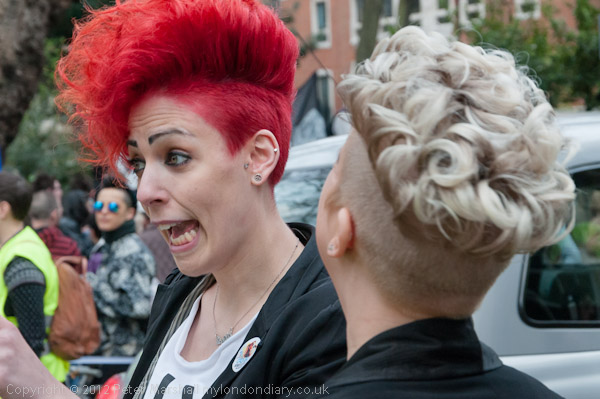
Stella and Lucy of DIVA magazine in Soho Square for the London Dyke March

After a rally in Soho Square over 600 women marched through Soho and Trafalgar Square to the National Theatre.
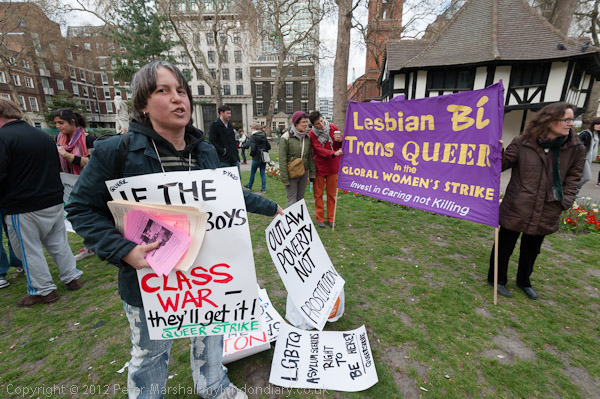
The march was the first dyke march since the 1980s and set out to support dyke visibility and welcomed “dykes, queers, bisexuals, transwomen, genderqueers and allies” and “all folk who want to support dykes to march with us” in “a grassroots, non-commercial, anti-racist, community-centred, accessible, inclusive event.”
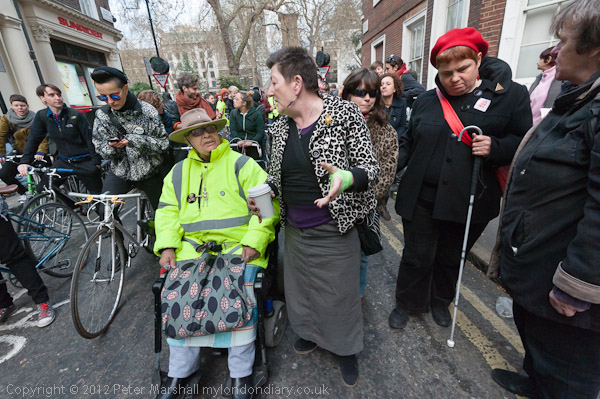
Speakers at the rally “were Kirstean Hearn, the chair of Inclusion London and someone who as a member of Equality 2005 gives disability equality advice to government, Lady Phyll Opoku, co-founder and Managing Director of UK Black Pride, journalist and founding editor of METQ magazine Paris Lees, Shi tou, an artist and film-maker who was the first lesbian to come out on Chinese TV and one of China’s most prominent lesbian activists, and Clare B Dimyon, awarded a MBE in 2010 for her work supporting LGBT people in Central and Eastern Europe.”

You can view many more pictures of the march and rally on My London Diary, including pictures of most or all of the speakers at London Dyke March 2012.


FlickrFacebookMy London DiaryHull PhotosLea ValleyParis
London’s Industrial HeritageLondon Photos

All photographs on this page are copyright © Peter Marshall.
Contact me to buy prints or licence to reproduce.
Cleator Moor & Loweswater – 2018

Cleator Moor & Loweswater: I do sometimes leave London and at the beginning of September 2018 I was on holiday with a group of friends in Ennerdale at the west of the Lake District.

Cleator Moor & Loweswater

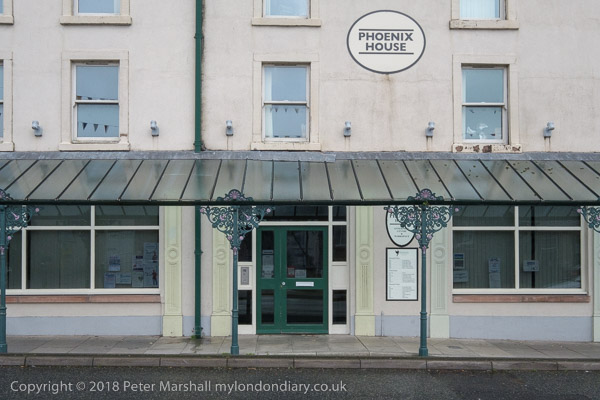
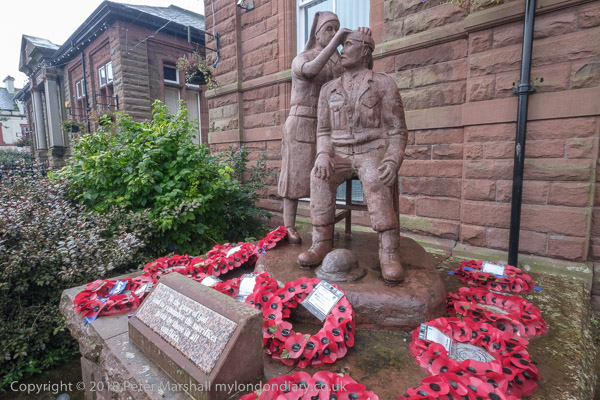
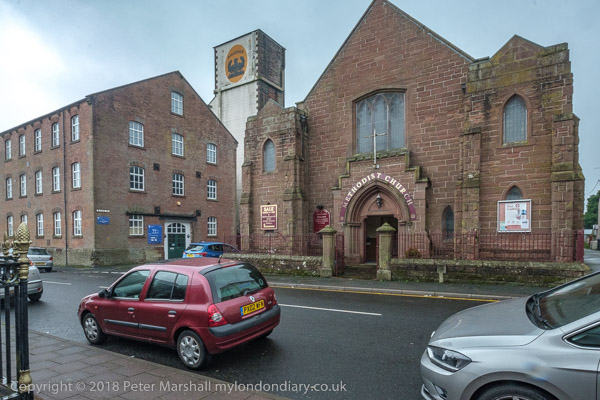
On Sunday 2nd September some of our party wanted to go to a morning service at the Methodist Church in Cleator Moor. It wasn’t my cup of tea but there was a spare seat in the car and I went along for the ride, and while they worshipped took a walk around the town and made some pictures.

Cleator Moor & Loweswater

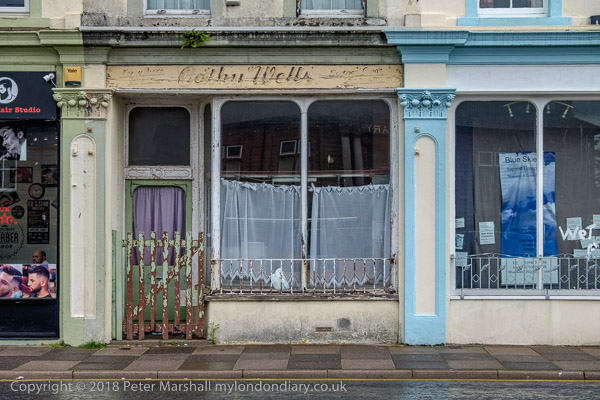
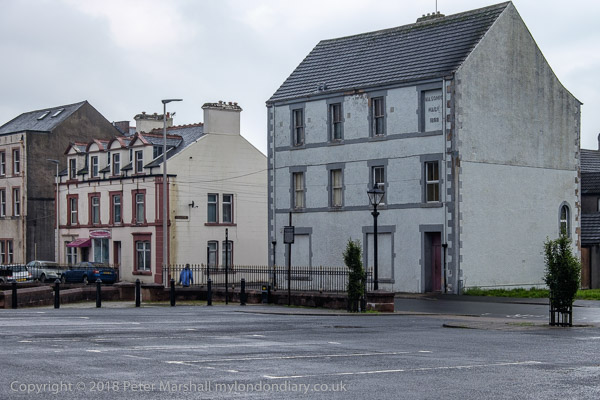
It perhaps wasn’t the kind of weather most people would choose for making photographs, dull and with occasional light rain, but as I wrote, this “seemed to be in keeping with the mood of the place“.

Cleator Moor & Loweswater

Cleator Moor was once a prosperous mining town, now rather desolate and depressed. It’s a small town, with a population now of around 7,000 but was built on a rather grander scale than that might suggest. In its heyday the population would have been rather higher.

Cleator Moor & Loweswater

This was an important area in the early days of the industrial revolution as the local mines supplied both coal and the iron ore haematite and there was local limestone – all that was needed to make iron and steel. Cleator Moor had long produced iron but got its first coke-fired blast furnace in 1841 though output again went up considerably with improved furnaces in the 1860s. It was one of many pig iron producers in the area, particularly around Workington which became a major port.

As demand for coal and iron ore increased in the second half of the nineteenth century many migrants came to the town to work in the mines and iron works, with the population increasing in the 30 years between 1841 and 1871 from 763 to 10, 420. Over a third came from Ireland and the town became known as ‘Little Ireland’.

Most of the Irish were Catholic, but there were also Protestants from Ireland and Scotland and Cleator Moor saw a great deal of sectarian violence from the 1860s to the 1890s. Among the town’s 15 Grade II listed buildings is the Roman Catholic St Mary’s Church, designed by noted church architect Edwarde Welby Pugin and consecrated in 1872, replacing a mission church built in 1853.

In it’s heyday the town was served by two railway lines, each with its own station, though both lines were mainly used for mineral traffic. Passenger services ended around1930 though goods services continued for some years. In the early years of the 20th century the local iron ore ran out and the coal became too expensive to mine and the town began to go into decline.

It received a boost in 1938 with the coming of Kangol, founded by Jakob Henryk Spreiregen (1894 – 1982). Born in Warsaw he moved with his family to France in 1910 and coming to the UK in 1915 and serving in the Medical Corps in the war and was naturalised in 1920. The Kangol brand name came in 1930, from Knitting ANGora WooL.

Spreiregen had begun manufacturing hats in London in 1916 as well as importing basque berets from France. In 1938 seeing another war coming he realised there would be a great demand for miltary berets and leased a mill in Cleator, importing machinery from a French beret factory. Kangol opened a new factory in Cleator in 1950, then employing 110 people. Kangol diversified into crash helmets, seat belts and ladies fashion hats and enjoyed great success, but was acquire by a US company in 1972.

Kangol continued to grow but more and more production shifted abroad. They became the largest hat producer in the world and the Cleator site employing 690 people the largest hat factory in Britain. But in 1997 the factory was closed, remaining just a small distribution site until finally closing with the loss of 32 jobs there in 2009. Cleator had lost its second major industry.

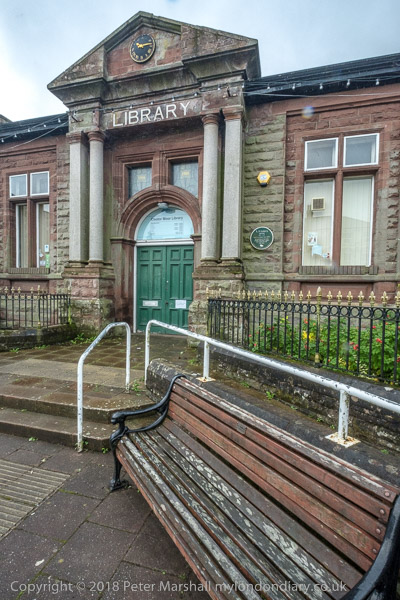
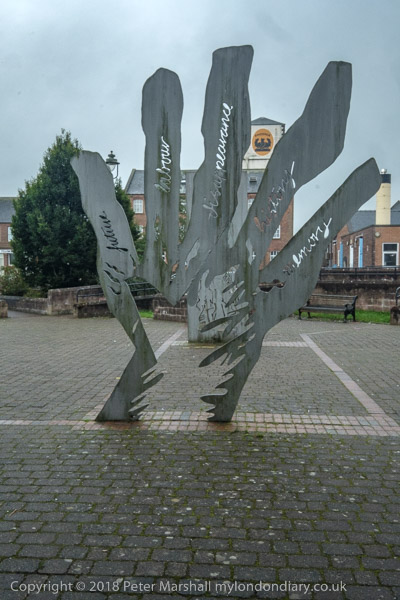
As I wrote in 2018, “The town conveys a strong feeling of depression, though lifted somewhat by a number of buildings of some quality, and parts of the main street have a pleasing uniformity, with simple terraced housing, its doors opening directly on the pavement. The central square, with library, municipal offices and a couple of fine parades, as well as some interesting sculptures by Conrad Atkinson who was born in the town. One of L S Lowry’s close friends was a bank manager here, and he often came to stay, making a number of paintings, and I could see why the place interested him.”

It was still raining intermittently after lunch when we drove to Loweswater for a rather wet circular walk from Fangs Brow – rather typical of the Lake District. Though we did have some fine days during our week there.

More on My London Diary:
Loweswater
Cleator Moor


FlickrFacebookMy London DiaryHull PhotosLea ValleyParis
London’s Industrial HeritageLondon Photos

All photographs on this page are copyright © Peter Marshall.
Contact me to buy prints or licence to reproduce.