National Gallery, Trayvon Martin & Dykes – 2012

National Gallery, Trayvon Martin & Dykes: Saturday 31 March 2012 I began outside the National Gallery were the Campaign Against the Arms Trade (CAAT) were demanding that the gallery stopped hosting events for the arms trade. From there I went to the US Embassy in Grosvenor Square for a protest about the US failure to prosecute the killer of black teenager Trayvon Martin. Finally I went to London’s first Dyke March since the 1980s.


Disarm The National Gallery

Trafalgar Square
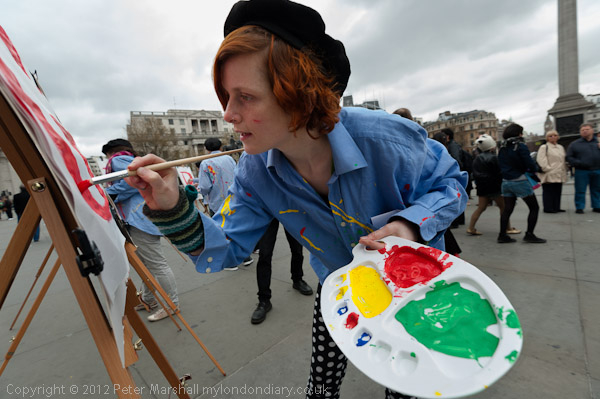
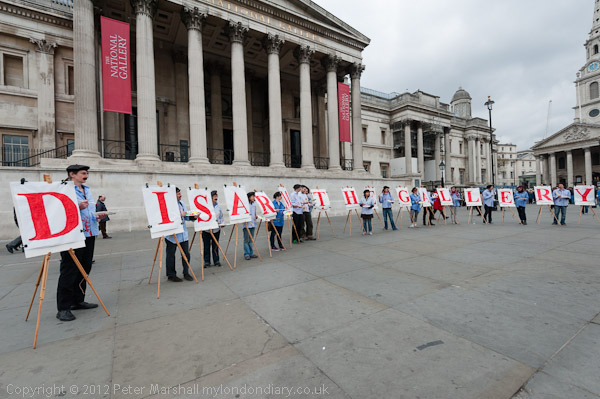
Around 20 protesters had come to Trafalgar square as ‘artists’, dressed in blue paint-stained smocks and equipped with moustaches, berets, paint brushes, palettes and easels with large sheets of paper and a smattering of Franglais.
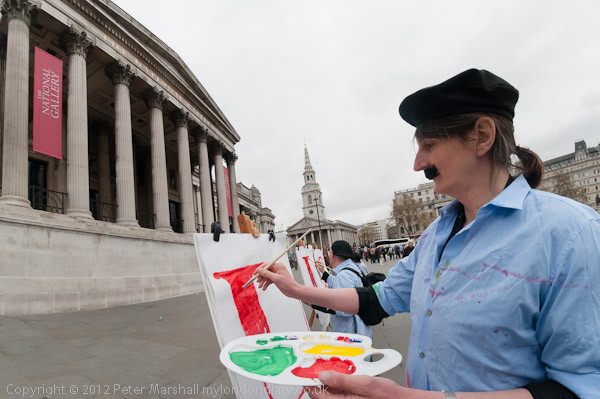
They erected their easels in a line on the North Terrace in front of the National Gallery and painted the letters D, I, S, A, R, M, T, H, E, G, A, L, L, E, R and Y anbefore standing with them in front of the gallery.
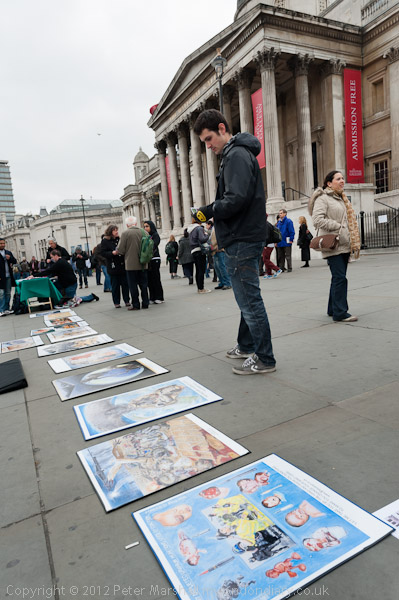
There also brought other anti-war artworks to display and handed out postcards for onlookers to sign calling on Nicholas Penny, Director of the National Gallery, to end his support of the arms trade.
The main entrances of the gallery were closed during the protest and a long queue built up at the lower entrance. Many in that line were amazed to find that an art gallery was supporting arms sales. As the postcard says – and people overwhelmingly agreed – Art and arms don’t mix.

The Disarm the Gallery protest was organised by the Campaign Against the Arms Trade (CAAT) as the during the DSEi arms fair the previous September, weapons manufacturer Finmeccanica had paid the gallery £30,000 to hold events there.

DSEi is the worlds largest arms fair with buyers and sellers from around the world including many corrupt and tyrannical regimes, selling the equipment used by dictators around the world to equip armies and police to keep order and fuelling conflicts which kill thousands if not millions.

Disarm The National Gallery


Protest for Trayvon Martin

US Embassy, Grosvenor Square
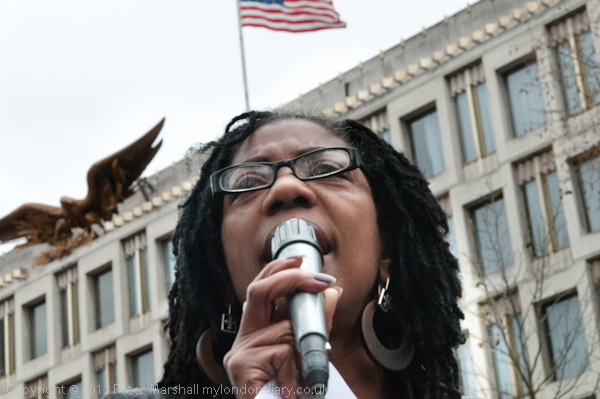
Marcia, sister of Sean Rigg, killed by police in Brixton police station speaks at the US embassy protest

Black teenager Trayvon Martin was walking back from a local convenience store to the house in Florida where he was staying with this father when he was stopped and then shot dead by George Zimmerman, a self appointed neighbourhood watchman who claimed he had felt threatened by a black teenager wearing a hoodie.
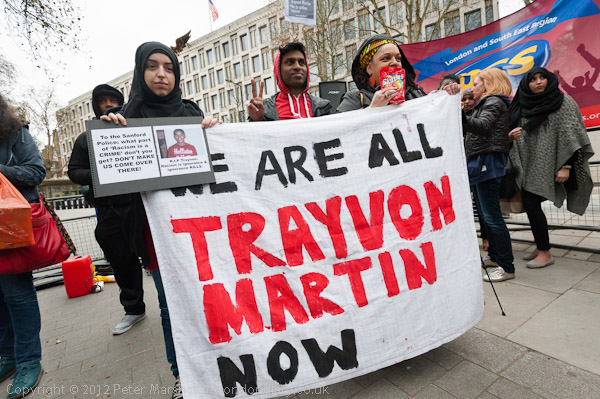
He had gone to the shop to buy a soft drink and some Skittle sweets and many at the protest wore hoodies and carried packets of Skittles and soft drinks.
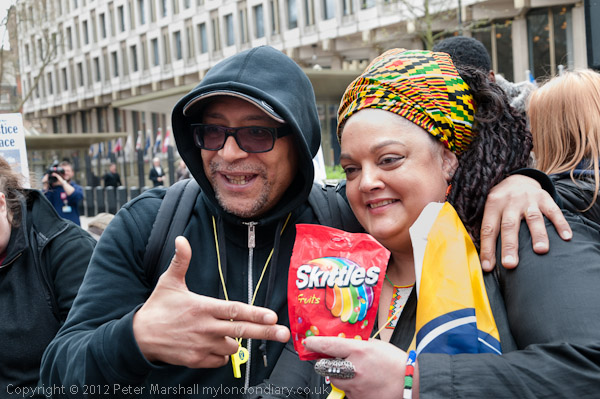
Lee Jasper and Zita Holbourne of BARAC

Florida police backed Zimmerman’s story that he had acted in self-defence and refused to arrest or charge him. Later the pressure from protests like this across America and around the world led to him being brought to trial, but a Florida jury acquitted him.
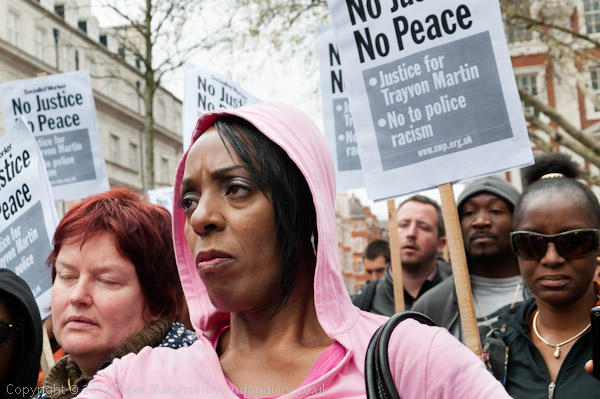
People stressed that the killing of Trayvon Martin very much reflects the treatment of black people not just in the USA but elsewhere including the UK

The embassy protest was was chaired by Merlin Emmanuel, brother of Smiley Culture, killed by police in his own kitchen, and speakers included Marcia, the brother of Sean Rigg, murdered in Brixton Police Station. Other speakers also brought up cases of deaths and discriminaton by police in the UK.

More pictures at Protest for Trayvon Martin.


London Dyke March 2012

Soho Square – South Bank
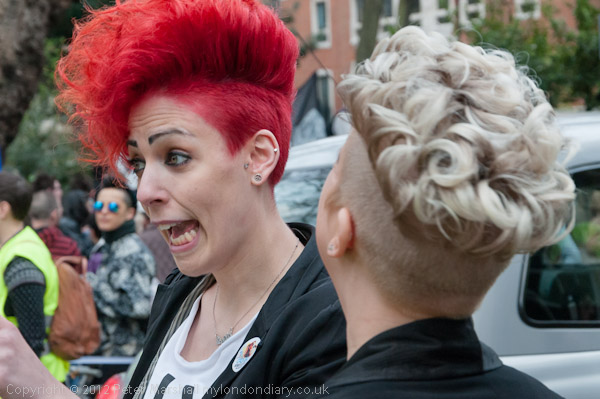
Stella and Lucy of DIVA magazine in Soho Square for the London Dyke March

After a rally in Soho Square over 600 women marched through Soho and Trafalgar Square to the National Theatre.
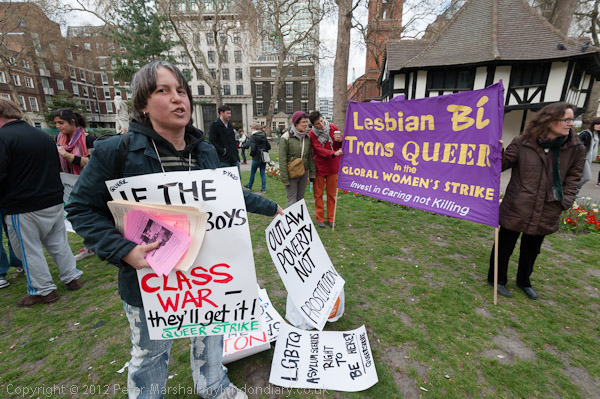
The march was the first dyke march since the 1980s and set out to support dyke visibility and welcomed “dykes, queers, bisexuals, transwomen, genderqueers and allies” and “all folk who want to support dykes to march with us” in “a grassroots, non-commercial, anti-racist, community-centred, accessible, inclusive event.”
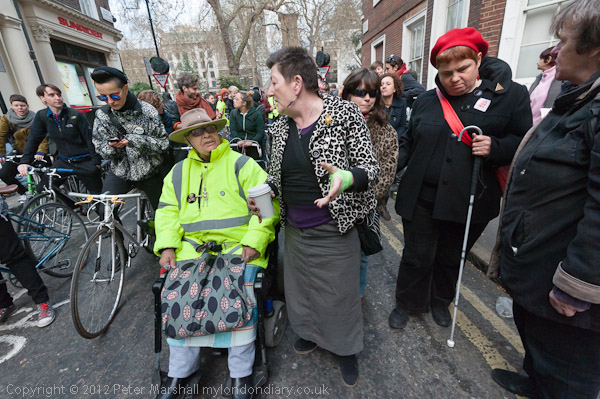
Speakers at the rally “were Kirstean Hearn, the chair of Inclusion London and someone who as a member of Equality 2005 gives disability equality advice to government, Lady Phyll Opoku, co-founder and Managing Director of UK Black Pride, journalist and founding editor of METQ magazine Paris Lees, Shi tou, an artist and film-maker who was the first lesbian to come out on Chinese TV and one of China’s most prominent lesbian activists, and Clare B Dimyon, awarded a MBE in 2010 for her work supporting LGBT people in Central and Eastern Europe.”

You can view many more pictures of the march and rally on My London Diary, including pictures of most or all of the speakers at London Dyke March 2012.


FlickrFacebookMy London DiaryHull PhotosLea ValleyParis
London’s Industrial HeritageLondon Photos

All photographs on this page are copyright © Peter Marshall.
Contact me to buy prints or licence to reproduce.

NT Racism Protest & Eid Milad-Un-Nabi – 2009

NT Racism Protest & Eid Milad-Un-Nabi: I began work on Saturday 21st March 2009 outside the National Theatre . A protest by East End artists and community activists was calling for an open debate at the National Theatre over a play there which they say was racist. I then went to Tooting where I had been invited by the Sunni Muslim Association to photograph their annual Eid Milad-Un-Nabi celebrations.


Love Theatre Hate Racism Protest NT Play

National Theatre

NT Racism Protest & Eid Milad-Un-Nabi - 2009
East-Enders object to racial stereotyping in ‘England People Very Nice’ and call for a public debate

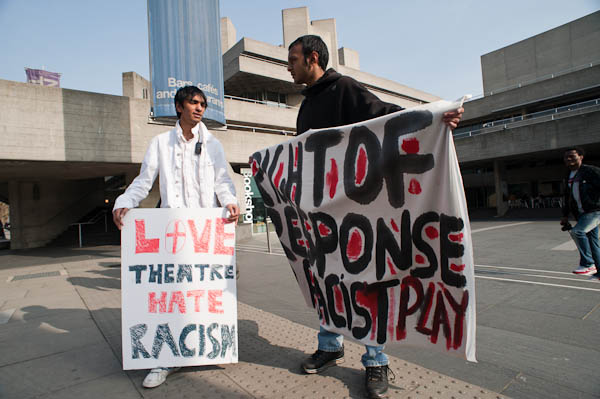
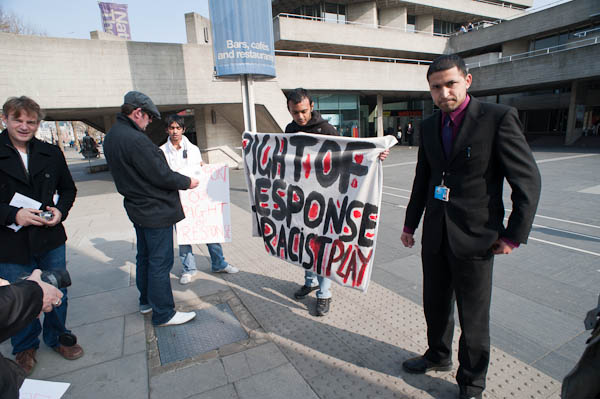
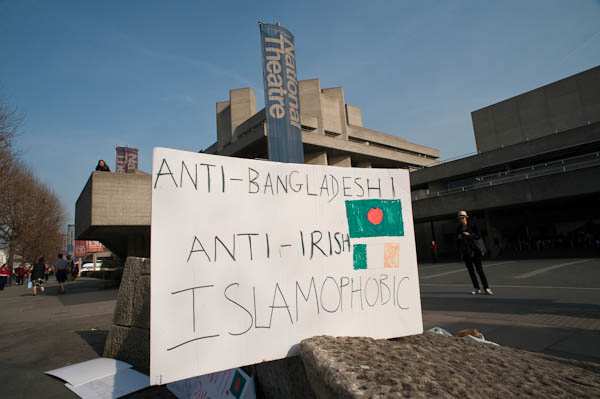
A small group of East End artists and community activists protested outside the National theatre calling for an open debate on the play ‘England People Very Nice‘ which was being performed there.

NT Racism Protest & Eid Milad-Un-Nabi - 2009

They say the play, set in Bethnal Green and covering three centuries is anti-Bangladeshi, anti-Irish, and Islamophobic, and in February East-End playwright Hussain Ismail and teacher Keith Kinsella had walked on stage during a talk by the play’s author to make their views clear, interupting the talk for around 10 minutes before they were removed by security.

NT Racism Protest & Eid Milad-Un-Nabi - 2009

And National Theatre security tried to stop this protest on a public walkway in front of the theatre too, telling the protesters they could not protest there and a cameraman who was videoing the event that he was not allowed to take pictures. But the protesters refused to leave and we kept videoing and photographing and after a few minutes he left.

NT Racism Protest & Eid Milad-Un-Nabi - 2009

I’ve not seen the play, though I did read a number of reviews and it certainly caused a great deal of distress, and the publicity over this made it a box office hit for the NT who extended its run. As I commented in 2009, I think it is a proper part of the NT’s remit to be controversial, but it should also – as the protesters were demanding “provide a proper forum to explore that controversy. I very much support the protesters who challenge what they see to be racism and the motives of the playwright and the NT in putting on this work.”

The link to the Institute of Race Relations article from May 2009 gives a good indication of why this play became so controversial.

Love Theatre Hate Racism Protest at NT


Eid Milad-Un-Nabi Celebrations

Sunni Muslim Association, Tooting

NT Racism Protest & Eid Milad-Un-Nabi - 2009

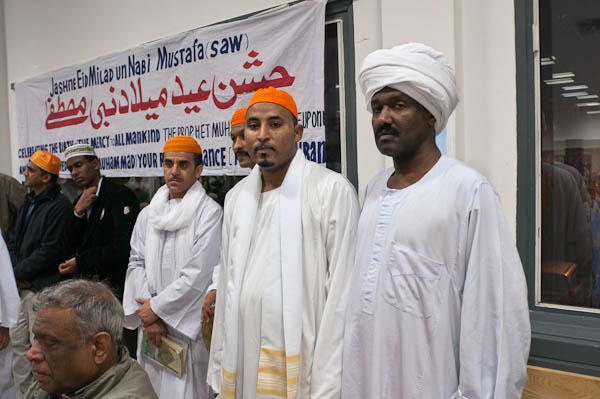
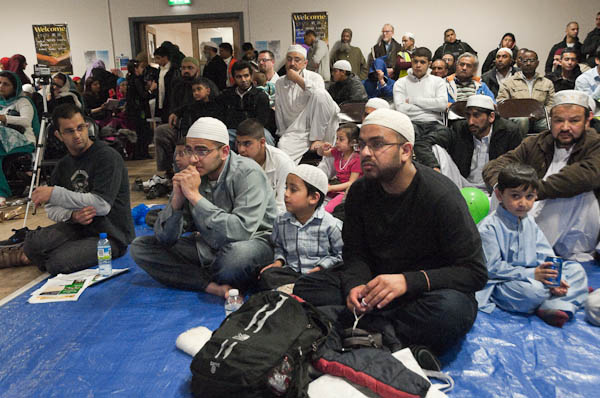
I was pleased to have been invited by the Sunni Muslim Association to photograph their Eid Milad-Un-Nabi celebrations to mark the anniversary of the birthday of the Prophet Muhammad.

Sadiq Khan MP received a warm welcome

It was publicised as a a community event to which all – Muslim and non-Muslim – were invited, although unfortunately few non-Muslims took the opportunity to attend. I think many more would have enjoyed it.

The personal invitation came after I had photographed a couple of their annual processions and had attended an earlier cultural event by the SMA at Tooting Leisure Centre, run by the London Borough of Wandsworth.

As I commented, “It was a very friendly event and although much of the first half was in Urdu or Arabic, there were some fine voices to listen to in the recitations. There was also a very well-produced exhibition about Islam.”

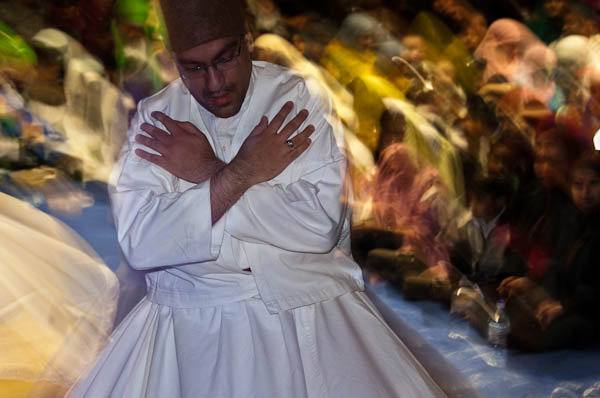
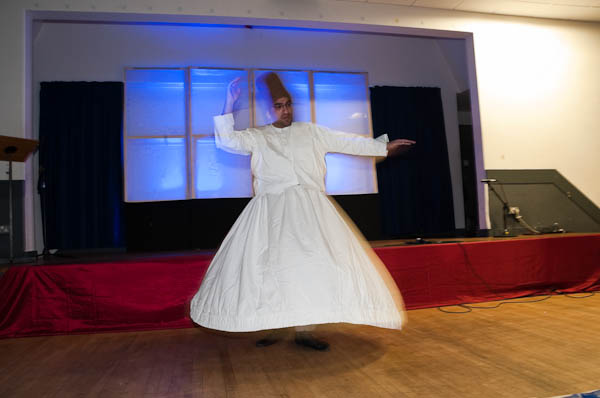
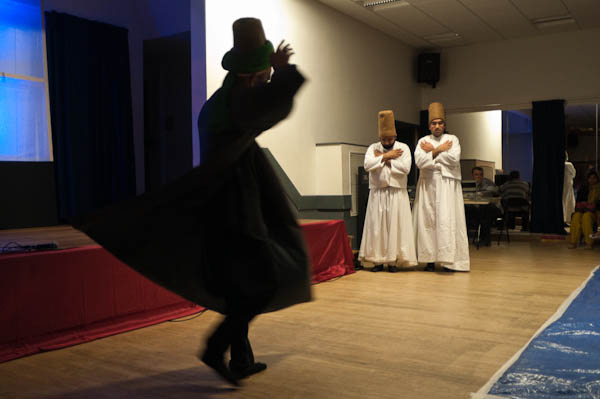
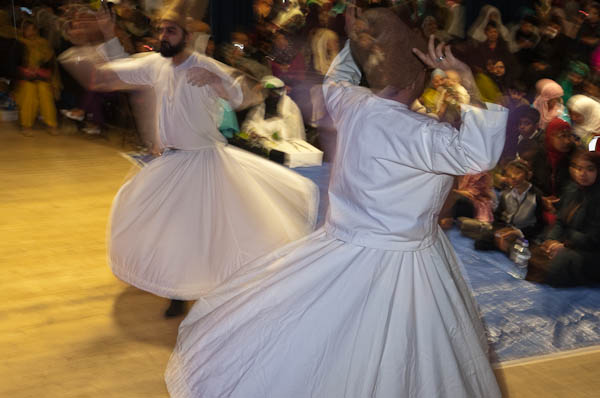
But many outside of the Muslim community would have found the second half more enjoyable. A Sudanese group give some fine performances of religious songs, Muslim comedian Prince Abdi was extremely funny and the Whirling Dervishes were just amazing.

Their dance is “a kind of spiritual rebirth, with their tall hats representing the ‘tombstone of the ego’ and the wide white skirt it’s shroud. The right arm lifts towards the sky to receive God’s blessings and the left palm on which he directs his gaze is turned towards the earthAnd they do whirl and whirl, making me dizzy just watching them.”

Photographing them was something of a challenge as the lighting was low and there was a delicate balance between freezing the movement with flash and allowing a certain blur to indicate their movement. I didn’t always get it right.

On My London Diary I list the other performances that follow with my comments. I particularly enjoyed an a capella performance about life in Gaza by Muslim convert rap poet and activist Spitz, but all were excellent.

As I concluded, “It was a fine night’s entertainment – and one that showed (unlike some religious events I’ve attended in the past) that being profoundly spiritual doesn’t mean not being highly talented or not having a good time.”

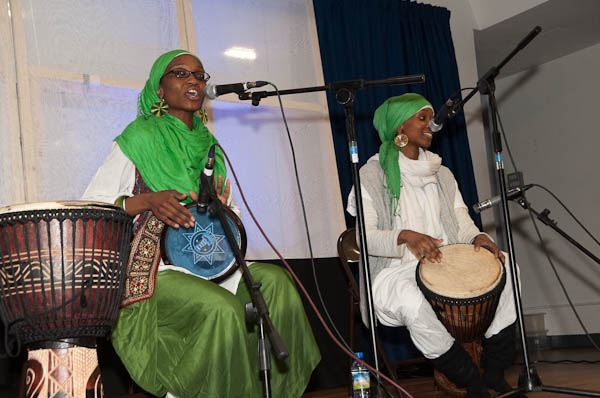
The Pearls of Islam – two spendid Afro-Caribbean performers from East London

Among others invited to the event were Sadiq Khan, then MP for Tooting who spoke at athe event and several of the neighbourhood police, one of whom as on the jury of four which awarded the prize for the evening’s entertainment to the two remarkable Afro-Caribbean women from East London, ‘The Pearls of Islam’, drumming and performing their own poetry and songs.

More about the event and many more pictures on My London Diary at Eid Milad-Un-Nabi Celebrations.


FlickrFacebookMy London DiaryHull PhotosLea ValleyParis
London’s Industrial HeritageLondon Photos

All photographs on this page are copyright © Peter Marshall.
Contact me to buy prints or licence to reproduce.

London Walk January 2006

London Walk January 2006: I now have no idea why I spent around two and a half hours wandering around London on the afternoon of 20th January 2006, but the pictures tell the story of my route. These images are a selection from a rather larger number I actually made. [The pictures are larger than they appear in this post and you may download them, but like all pictures on this blog are copyright; they must be attributed if posted on social media and a licence is required for any commercial use.]

London Walk January 2006
© 2006, Peter Marshall

I suspect I was going to some evening event and simply took advantage of some fine weather to go up earlier and take some pictures. The first one shows some of the sculptural detail above the outpatients entrance of the former Royal Waterloo Hospital for Children and Women on Waterloo Road the roundabout close to the station, where I will have arrived by train.

London Walk January 2006
© 2006, Peter Marshall

I then walked on to Waterloo Bridge, pausing to take a picture of the National Theatre, with the roof of the film museum in the foreground.

London Walk January 2006
© 2006, Peter Marshall

There was an exhibition ‘after the wave’ on square pillars in front of the National Theatre which rather seemed to echo the shape of the building.

London Walk January 2006
© 2006, Peter Marshall

On Waterloo Bridge I took several pictures looking downstream across the River Thames, this one concentrating on the north bank and St Paul’s Cathedral.

© 2006, Peter Marshall

A wider view shows boats moored in the river and the skyline of London, now rather more crowded.

© 2006, Peter Marshall

Another with St Paul’s at the left .

© 2006, Peter Marshall

On Strand I photographed this lion and two Chinese men relaxing above Twinings, providers of tea to the Queen.

© 2006, Peter Marshall

And these fine fish on Lloyds Bank Law Court Branch at 222 Strand, then still open as a bank – it closed in 2017. It had been called the most beautiful bank in the country. The fish are presumably because this Grade II listed building was built in 1882 by Goymour Cuthbert and W Wimble for the Palsgave Restaurant for the Royal Courts of Justice opposite and was only taken over by Lloyds in 1894.

© 2006, Peter Marshall

Some fine ironwork and a beehive above the doorway to the bank.

© 2006, Peter Marshall

Above the doorway at 193 Fleet Street is this figure of statue of Kaled, the page of Byron’s Count Lara by Giuseppe Grandi, dating from 1872. More about it on Ornamental Passions.

© 2006, Peter Marshall

The building was built for pawnbrokers George Attenborough and Son in 1883 and has some fine sculptural detail including these winged lions, on either side of the wrought iron support from which originally the pawnbrokers three balls were hung. The Latin motto underneath is ‘Sub Hoc floresco‘, Under This I flourish.

© 2006, Peter Marshall

On each side of the clock of St Dunstan’s in the West on Fleet Street are the two mythical giants, Gog and Magog (Corineus and Gogmagog) described in the biblical book of Revelation as the allies of Satan against God when we come to the end of days, but also the guardians of London – and the City is surely on Satan’s side as the money laundering capital of the world. They strike the chimes for the clock here, said to be the oldest public clock in London.

My walk continued – and I’ll post some more from it at some later date. You can already see some of the pictures on My London Diary.


FlickrFacebookMy London DiaryHull PhotosLea ValleyParis
London’s Industrial HeritageLondon Photos

All photographs on this page are copyright © Peter Marshall.
Contact me to buy prints or licence to reproduce.