Workers Memorial Day, HS2 Protest: Every year since 1989, April 28th has been International Workers’ Memorial Day, and on Monday 28th April 2014 I once more attended the event commemorating this at the statue of the Building Worker on Tower Hill in London, later going to Parliament Square where protesters called on MPs to vote against the HS2 Bill being debated in the House of Commons.
Workers Memorial Day
Tower Hill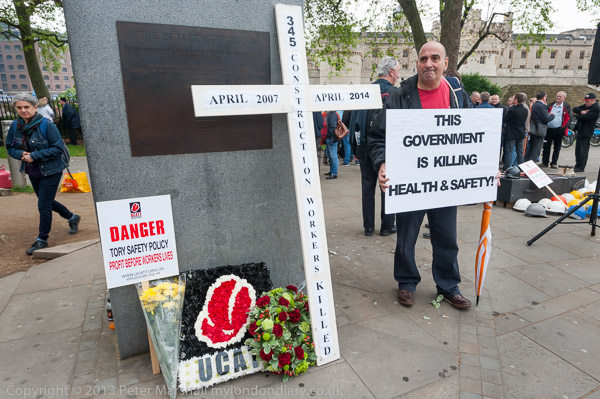
One of the more hazardous industries in the UK is construction, and the annual Workers Memorial Day points this out. There had been over 50 deaths on construction sites in the previous year and the rally place around a coffin with boots, work gloves and hard hats.
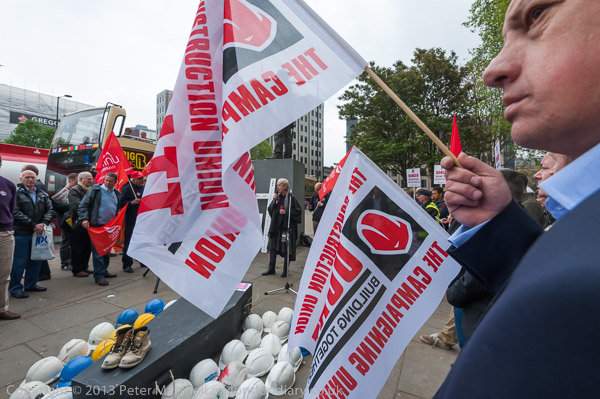
A TUC report published for the day, ‘Toxic, Corrosive and Hazardous: The government’s record on health and safety‘ pointed out that since the coalition government came to power in 2010 it had “drastically cut Health and Safety Executive (HSE) inspections, cut funding to the HSE by 40 per cent, blocked new regulations and removed vital existing protections, prevented improved European regulation on health and safety, cut support for employers and health and safety reps, seen local authorities reduce their workplace inspections by 93 per cent, and made it much harder for workers to claim compensation if they are injured or made ill at work following employer negligence.”
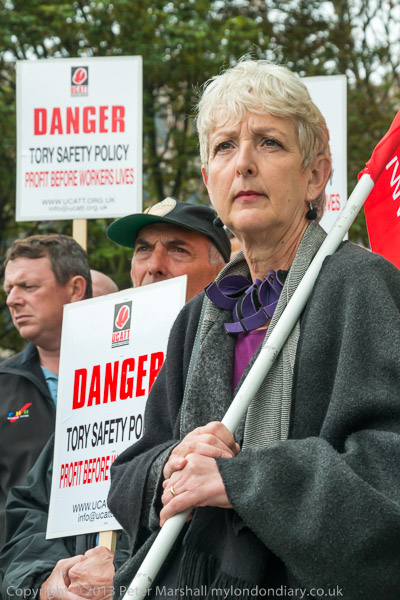
The government was now planning to exempt many ‘self-employed workers’ from health and safety protection – despite them being twice as likely to be killed at work than other workers.
This attack on health and safety, carried out under the title of ‘reducing red tape’ also played an important role in providing the environment which allowed the disastrous fire at Grenfell Tower.
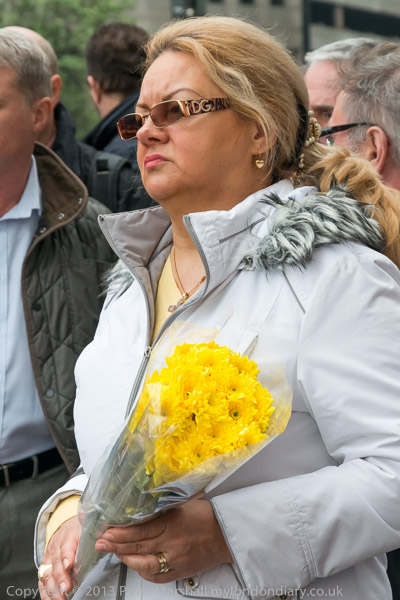
The theme for the 2014 events from the ITUC, the global union body coordinating the event worldwide, is ‘Protecting workers around the world through strong regulation, enforcement and union rights’ and it encouraged unions to use the slogan, ‘Unions make work safer’.
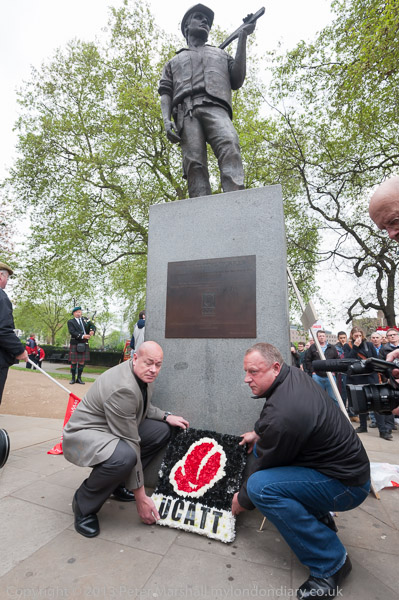
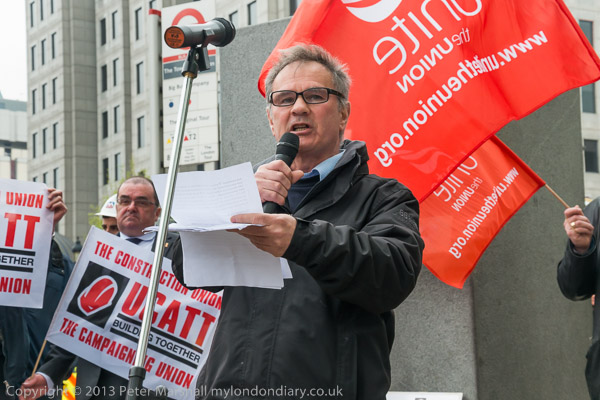
There were speeches including by Gail Cartmail, Assistant General Secretary of Unite, Tony O’Brien of the Construction Safety Campaign and Jerry Swain Regional Secretary for UCATT’s London and South East Region, after which wreaths and flowers were laid at the base of the statue by UCATT, Tower Hamlets Mayor Lutfur Rahman and Liliana Alexa who founded the Battersea Crane Disaster Action Group after her son Michael was killed by a falling crane as he walked past a building site near his Battersea home.
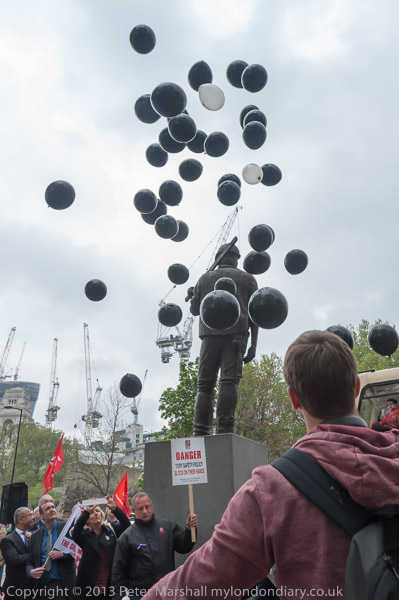
The event ended with the release of black balloons, for the 50 workers killed in the last year and a period of silence around the coffin with its boots, hard hat and work gloves and a hard hat for each one of them.
More pictures from Workers Memorial Day
Stop HS2 Rally at Parliament
Old Palace Yard, Westminster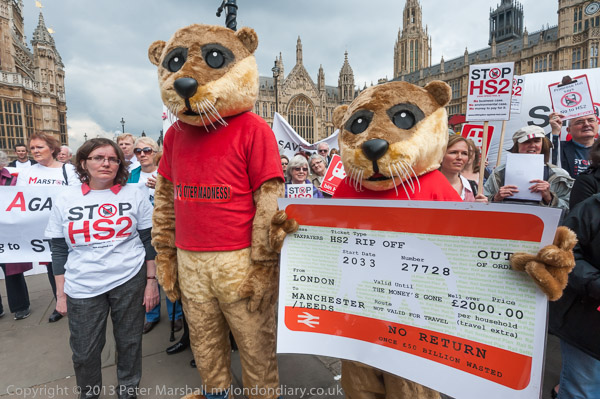
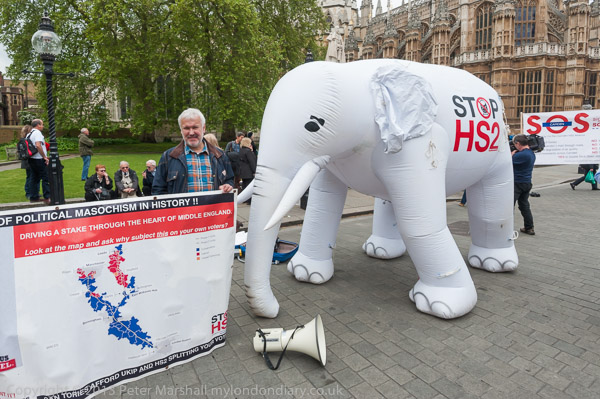
HS2 is generally seen now as an expensive disaster, failing to achieve its aims and becoming something of a white elephant. It doesn’t go to where it was intended and will have to run rather slower than planned.
Despite the plans to run to Manchester and Leeds having been dropped the scheme has had a massive increase in costs. It still remains doubtful if it will ever actually reach its intended destination in London, Euston or simply serve its temporary terminus at Old Oak Common, six miles out in the middle of nowhere very much, where it will largely rely on a connection to the Elizabeth Line.
The project was almost certainly doomed from the start in 2009 under Labour, but its position was worsened by decisions by each successive government. There are various detailed studies of where it went wrong on-line, including by Graham Winch of the Productivity Institute.
The London to Birmingham section we may one day get was only a minor aspect of the original scheme and a part that offers relatively little gain – nobody really needs to get to Birmingham 20 minutes faster. Its route was poorly chosen and bound to result in the kind of local opposition that has greatly put up costs, and the whole project was severely over-specified – and in a way that makes it incompatible with the existing network.
Others, such as High Speed UK have developed much more coherent plans for the future UK rail network which governments have refused to consider seriously – and were one of those supporting and speaking at this protest. Their plans in 2014 would have avoided “damage to the Chilterns by following the M1 and would be 25% cheaper than HS2, while offering time savings on average of 40% for most intercity services – not just those on the high speed route.“

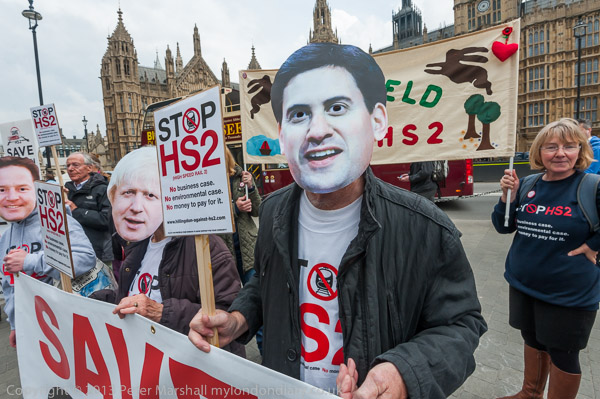
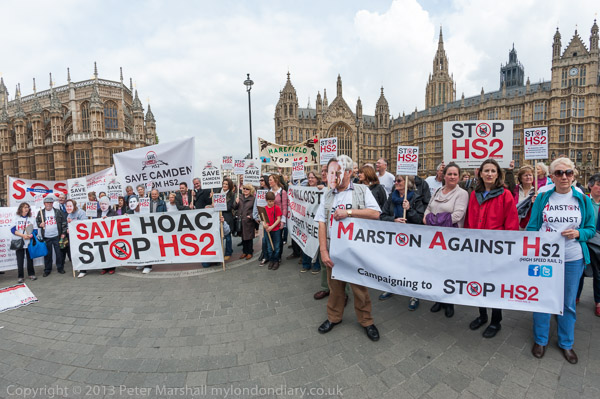
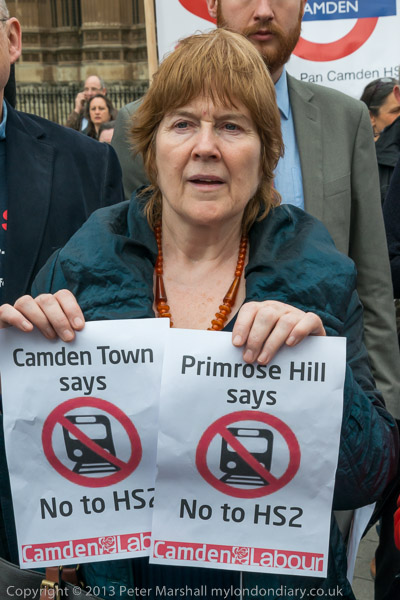
This was a relatively small demonstration with perhaps a couple of hundred people, but a colourful one, with a large inflatable white elephant and a couple of bears with a very large rail ticket about the £50 billion rip-off of HS2. There were speeches including from several MPs and campaigners.
More at Stop HS2 Rally at Parliament.
Flickr – Facebook – My London Diary – Hull Photos – Lea Valley – Paris
London’s Industrial Heritage – London Photos
All photographs on this page are copyright © Peter Marshall.
Contact me to buy prints or licence to reproduce.