Cut the Carbon March – 2007

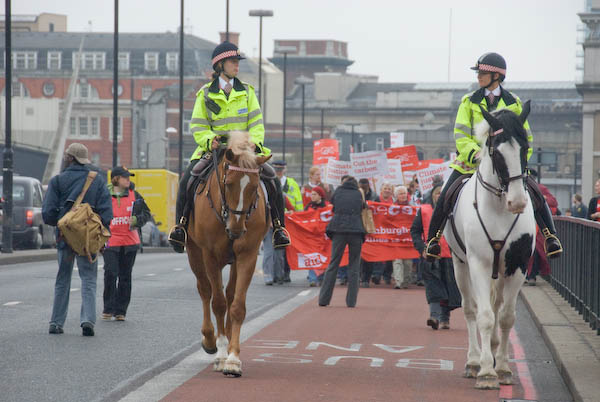
Cut the Carbon March: Tuesday 2nd October 2007 saw the final stage of Christian Aid’s Cut the Carbon March of a thousand miles by marchers from around the world as well as the UK which had begun 80 days earlier in Northern Ireland. The march aimed to increase awareness of the growing danger of global heating with world temperatures increasing as we continue to put greenhouse gases into the air by burning fossil fuels, and to prompt the New Labour government led by George Brown into decisive action to end fossil fuel use. Among those who took part in 2007 were groups from countries already suffering from the effects of climate change.

Unfortunately although it did something to increase awareness it led to little real action and now when we in the UK are beginning to feel the heat we have a Labour government which is likely to approve the production of natural gas from the Jackdaw North Sea field and oil from Rosebank north-west of the Shetlands.

Here from My London Diary is my 2007 account of the Final Mile of the Christian Aid march with a few of the pictures – you can see more at christian aid cut the carbon march – final mile.


Christian Aid – Cut the Carbon March – The Final Mile

City Hall to St Paul’s Cathedral
The final mile took marchers from a rally at City Hall to St Paul’s Cathedral – the end of their 1000 mile walk

Around a thousand supporters turned up on a dull damp Tuesday morning to accompany the Christian Aid ‘Cut The Carbon’ marchers on the final mile of a walk that had started in Bangor, Northern Ireland, then took them a thousand miles via Edinburgh, Newcastle On Tyne, Leeds, Birmingham, Cardiff, Bournemouth (for a meeting with George Brown at the Labour Party conference) and on to London (including a picnic at Battersea the previous Sunday.)

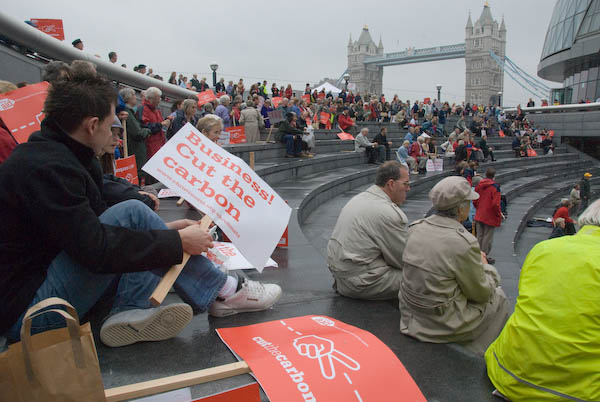
AA few of the international marchers had to go home before the end, but most, together with those from the UK, made it to the end, and spoke at the rally in the City Hall Scoop before the march set off.
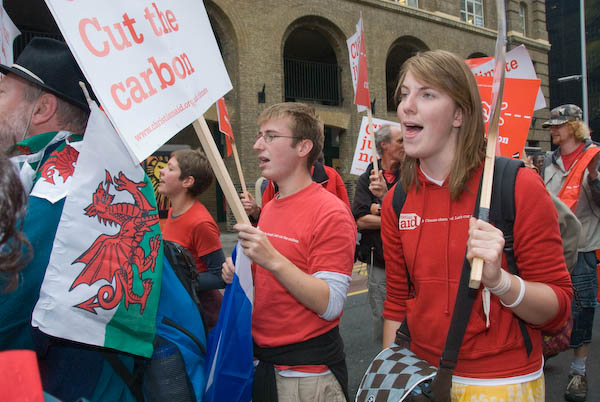
The route led over London Bridge and then up past the Stock Exchange to St Paul’s Churchyard, where there were more speeches, particularly from a Muslim marcher, before a service in the cathedral.

As photography isn’t allowed at events inside St Paul’s (its one of the few places I’ve actually been thrown out of for trying to take pictures) I came home as people streamed inside. The marchers were due to meet with Hilary Benn afterwards to press the case for climate justice. [Benn was Secretary of State for International Development from 2003 until earlier in 2007 and was in October 2007 Secretary of State for Environment, Food and Rural Affairs.]

Several speakers from this country and abroad had made the point that Britain lead the world in creating the problem when we began the industrial revolution and so should feel a great obligation to get things going to save the world from the disaster into which it is currently fast heading.
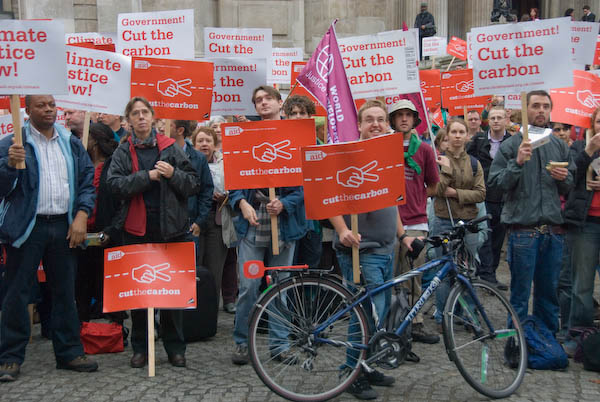
Protesters at St Paul’s Cathedral send a clear message to Hilary Benn and the government to Cut the Carbon

Other demonstrators at St Paul’s made the point that raising animals was an important factor in the high carbon footprint; growing and eating crops can be far less wasteful and polluting. [They pointed out that] Christian Aid’s development policies would be better directed to encouraging vegetarian and vegan production rather than the current reliance in some projects on raising animals for food.
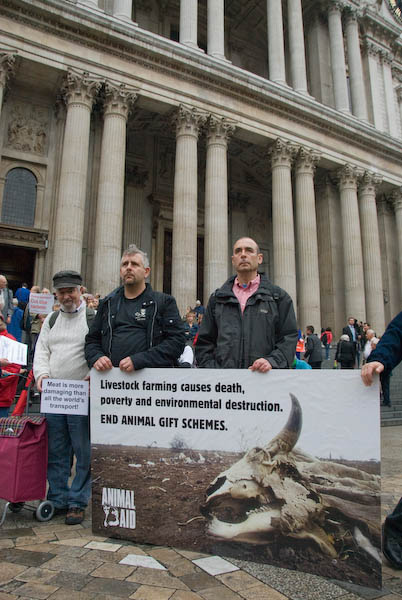

Many more pictures at Christian aid cut the carbon march – final mile.


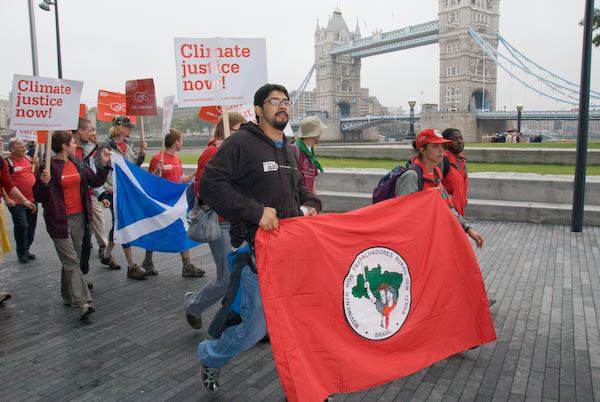
I was pleased that my exhibition of pictures of environmental protests at London as a part of Foto Arte in Brasilia in December 2007 was able to include the top picture in this post, showing the Brazilians from the Movimento Dos Trabalhadores Rurais Sem Terra (Landless Workers’ Movement) leading the march with Tower Bridge in the background, and I think some from this group may have come to the talk on car culture I gave at the festival.


Flickr – Facebook – My London Diary – Hull Photos – Lea Valley – Paris
London’s Industrial Heritage – London Photos

All photographs on this page are copyright © Peter Marshall.
Contact me to buy prints or licence to reproduce.
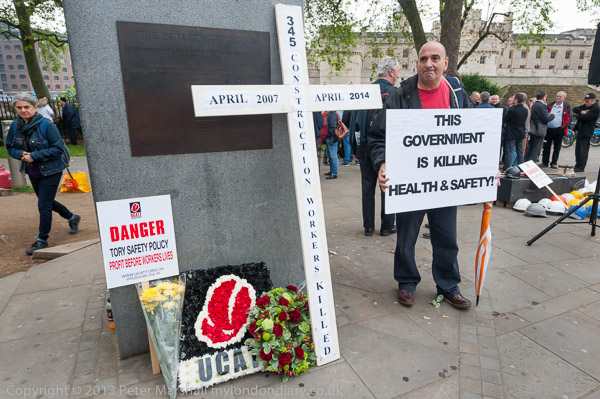
Workers Memorial Day, HS2 Protest – 2014

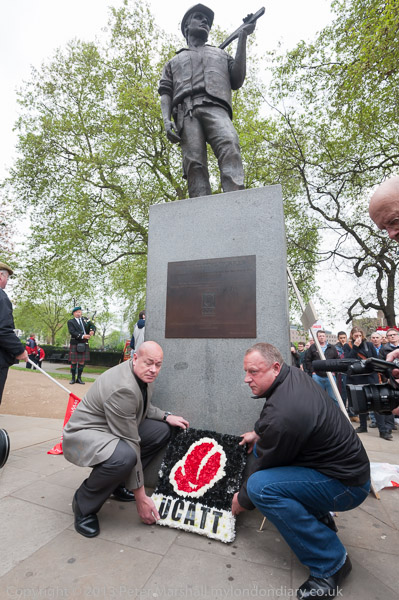
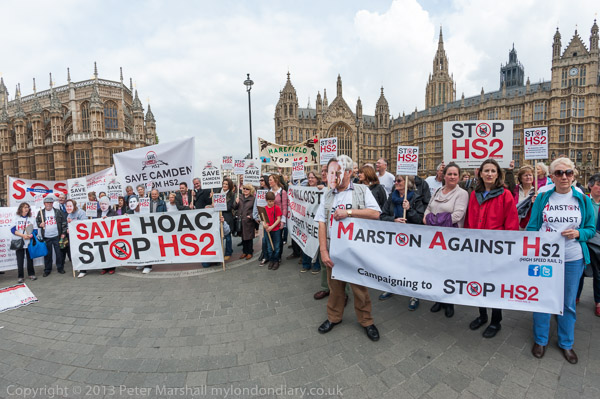
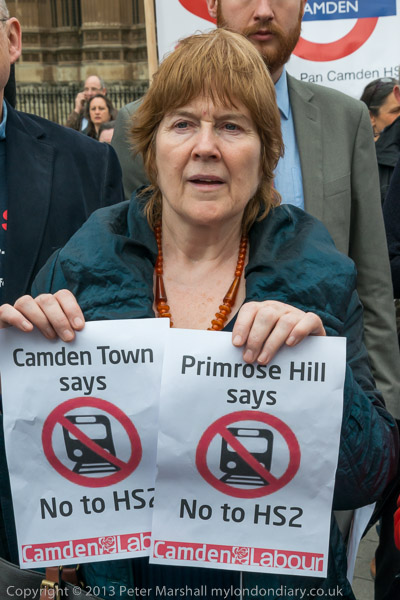
Workers Memorial Day, HS2 Protest: Every year since 1989, April 28th has been International Workers’ Memorial Day, and on Monday 28th April 2014 I once more attended the event commemorating this at the statue of the Building Worker on Tower Hill in London, later going to Parliament Square where protesters called on MPs to vote against the HS2 Bill being debated in the House of Commons.


Workers Memorial Day

Tower Hill

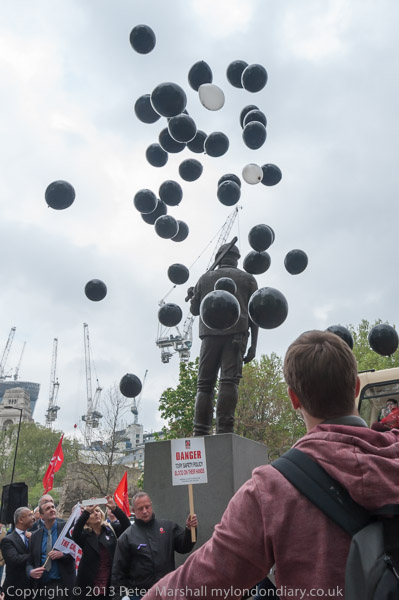
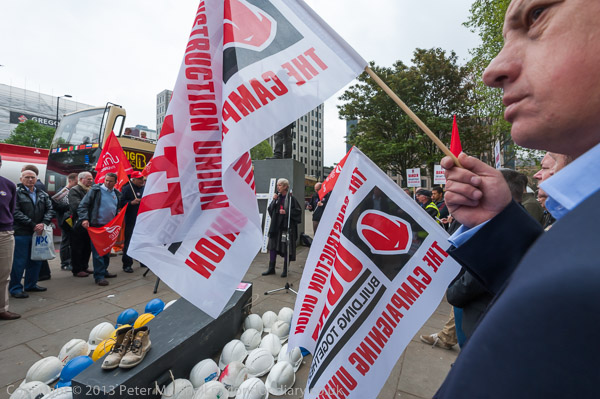
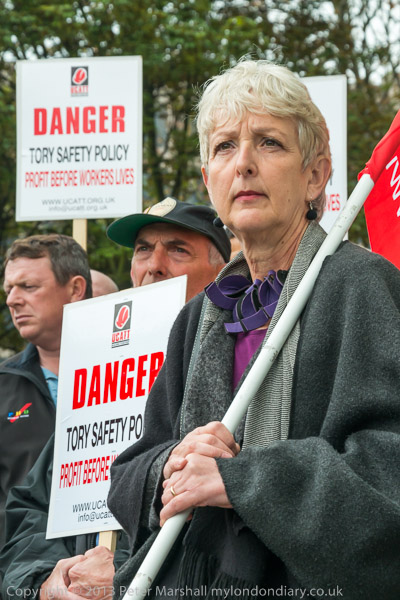
One of the more hazardous industries in the UK is construction, and the annual Workers Memorial Day points this out. There had been over 50 deaths on construction sites in the previous year and the rally place around a coffin with boots, work gloves and hard hats.

Workers Memorial Day, HS2 Protest - 2014

A TUC report published for the day, ‘Toxic, Corrosive and Hazardous: The government’s record on health and safety‘ pointed out that since the coalition government came to power in 2010 it had “drastically cut Health and Safety Executive (HSE) inspections, cut funding to the HSE by 40 per cent, blocked new regulations and removed vital existing protections, prevented improved European regulation on health and safety, cut support for employers and health and safety reps, seen local authorities reduce their workplace inspections by 93 per cent, and made it much harder for workers to claim compensation if they are injured or made ill at work following employer negligence.”

Workers Memorial Day, HS2 Protest - 2014
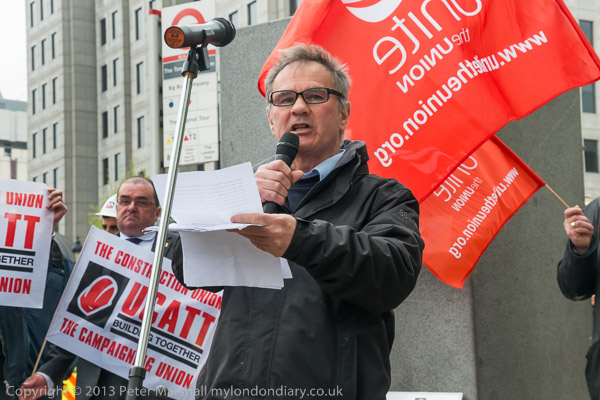
Gail Cartmail, Assistant General Secretary of Unite

The government was now planning to exempt many ‘self-employed workers’ from health and safety protection – despite them being twice as likely to be killed at work than other workers.

Workers Memorial Day, HS2 Protest - 2014

This attack on health and safety, carried out under the title of ‘reducing red tape’ also played an important role in providing the environment which allowed the disastrous fire at Grenfell Tower.

Workers Memorial Day, HS2 Protest - 2014
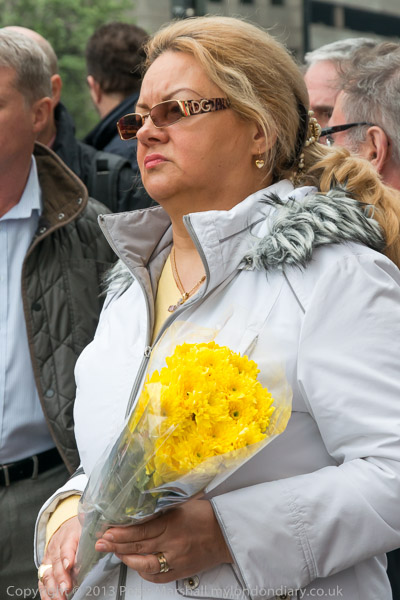
Liliana Alexa of the Battersea Crane Disaster Action Group

The theme for the 2014 events from the ITUC, the global union body coordinating the event worldwide, is ‘Protecting workers around the world through strong regulation, enforcement and union rights’ and it encouraged unions to use the slogan, ‘Unions make work safer’.

Workers Memorial Day, HS2 Protest - 2014
Tony O’Brien of the Construction Safety Campaign

There were speeches including by Gail Cartmail, Assistant General Secretary of Unite, Tony O’Brien of the Construction Safety Campaign and Jerry Swain Regional Secretary for UCATT’s London and South East Region, after which wreaths and flowers were laid at the base of the statue by UCATT, Tower Hamlets Mayor Lutfur Rahman and Liliana Alexa who founded the Battersea Crane Disaster Action Group after her son Michael was killed by a falling crane as he walked past a building site near his Battersea home.

The event ended with the release of black balloons, for the 50 workers killed in the last year and a period of silence around the coffin with its boots, hard hat and work gloves and a hard hat for each one of them.

More pictures from Workers Memorial Day


Stop HS2 Rally at Parliament

Old Palace Yard, Westminster

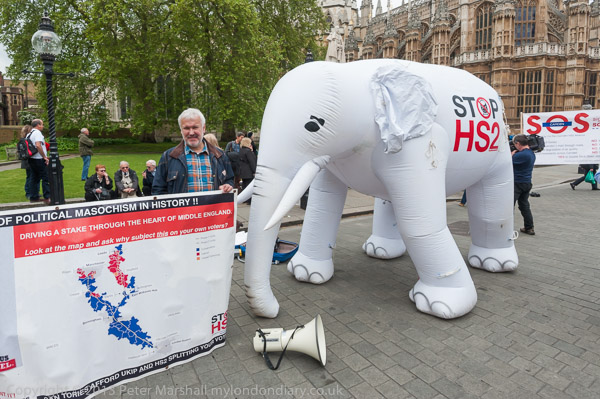
HS2 is generally seen now as an expensive disaster, failing to achieve its aims and becoming something of a white elephant. It doesn’t go to where it was intended and will have to run rather slower than planned.

Despite the plans to run to Manchester and Leeds having been dropped the scheme has had a massive increase in costs. It still remains doubtful if it will ever actually reach its intended destination in London, Euston or simply serve its temporary terminus at Old Oak Common, six miles out in the middle of nowhere very much, where it will largely rely on a connection to the Elizabeth Line.

The project was almost certainly doomed from the start in 2009 under Labour, but its position was worsened by decisions by each successive government. There are various detailed studies of where it went wrong on-line, including by Graham Winch of the Productivity Institute.

The London to Birmingham section we may one day get was only a minor aspect of the original scheme and a part that offers relatively little gain – nobody really needs to get to Birmingham 20 minutes faster. Its route was poorly chosen and bound to result in the kind of local opposition that has greatly put up costs, and the whole project was severely over-specified – and in a way that makes it incompatible with the existing network.

Others, such as High Speed UK have developed much more coherent plans for the future UK rail network which governments have refused to consider seriously – and were one of those supporting and speaking at this protest. Their plans in 2014 would have avoided “damage to the Chilterns by following the M1 and would be 25% cheaper than HS2, while offering time savings on average of 40% for most intercity services – not just those on the high speed route.“

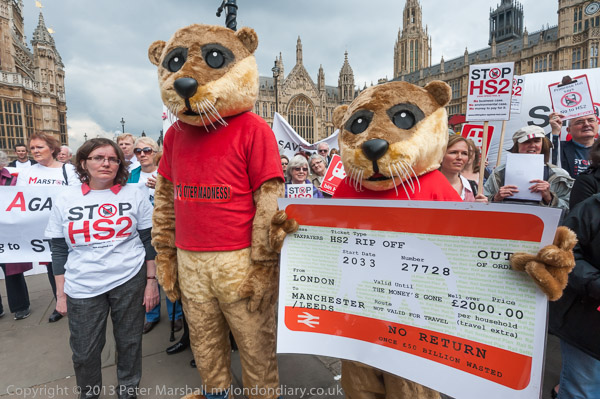
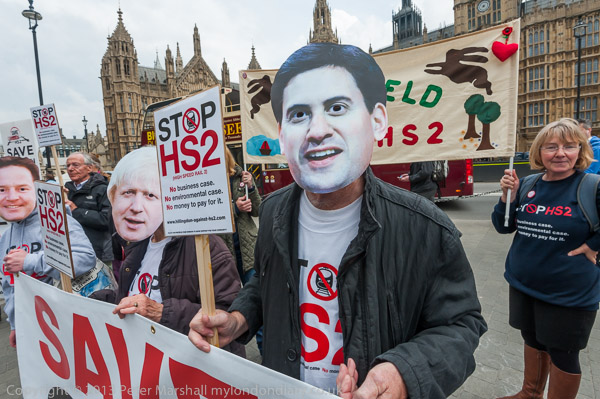
This was a relatively small demonstration with perhaps a couple of hundred people, but a colourful one, with a large inflatable white elephant and a couple of bears with a very large rail ticket about the £50 billion rip-off of HS2. There were speeches including from several MPs and campaigners.

More at Stop HS2 Rally at Parliament.


Flickr – Facebook – My London Diary – Hull Photos – Lea Valley – Paris
London’s Industrial Heritage – London Photos

All photographs on this page are copyright © Peter Marshall.
Contact me to buy prints or licence to reproduce.