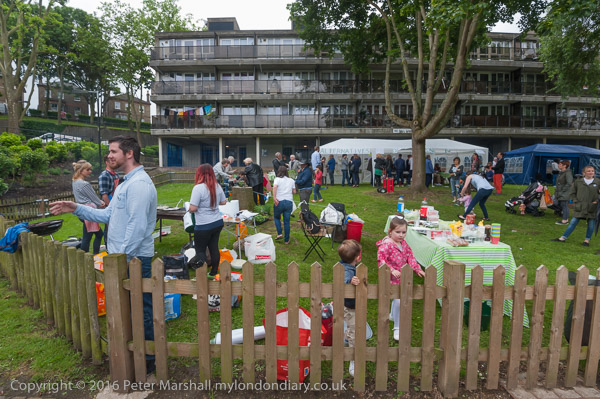
National Housing Demo, London 2026

National Housing Demo, London: Last Saturday, 18th April 2026, I photographed the National Housing Demonstration which began with a rally in Soho Square.
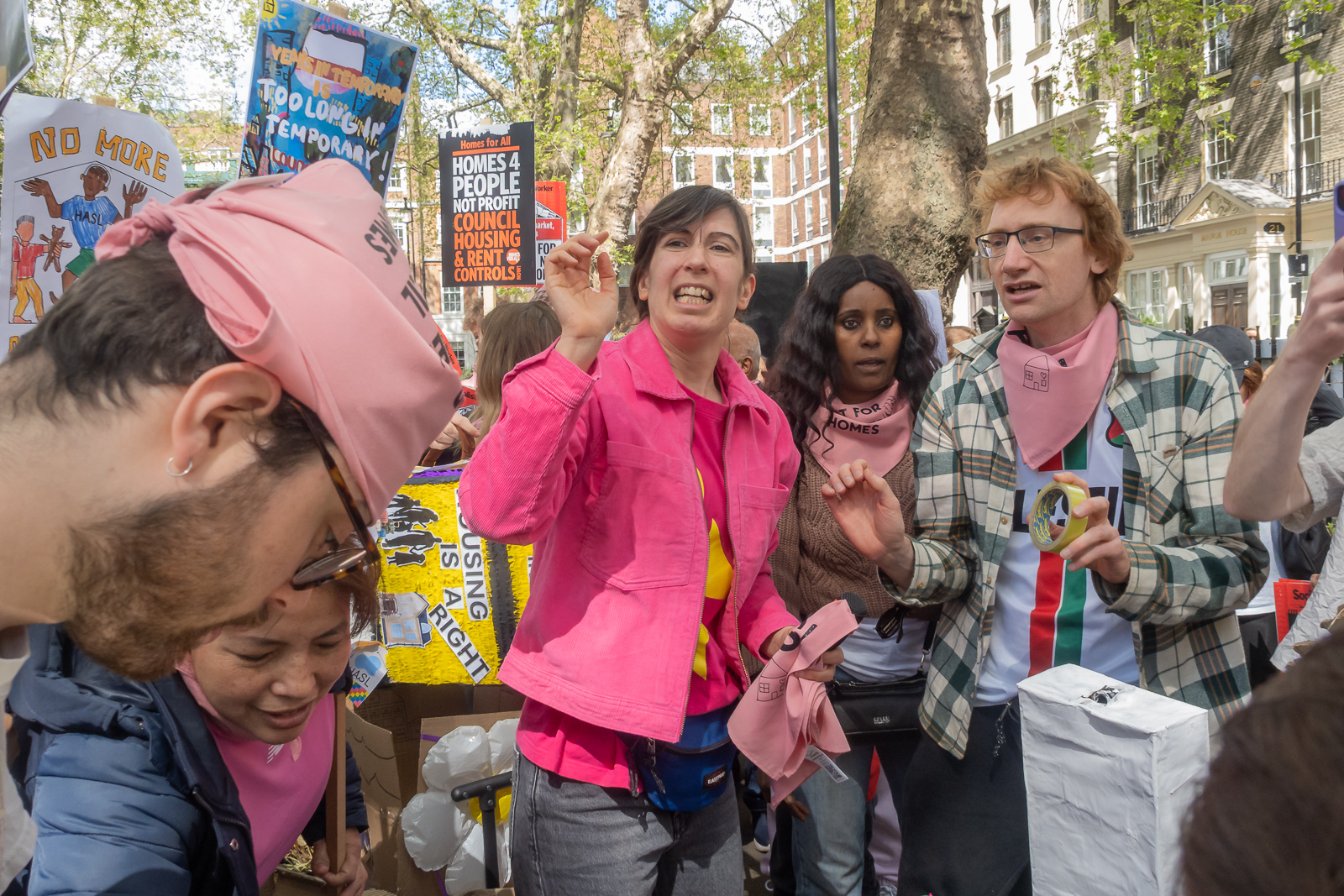
National Housing Demo, London 2026
London, UK. 18 Apr 2026. Several thousands of private renters, social housing tenants, workers, disabled, people of colour, migrants, campaigners and others suffering under our current housing system with excessive rents for poor quality homes came to demand rent controls and more council housing. The current system allows private developers and landlords to make large profits at the expense of tenants. They marched along Oxford Street from a rally in Soho Square. Peter Marshall

In the years after the end of the Second World War, Britain began a concerted effort to address the housing problems. Money was short but succesive governments did all they could to address the problems of old, poorly built slums thrown up in the nineteenth century as industrialisation caused a huge population surge in our cites and large towns.

National Housing Demo, London 2026
London, UK. 18 Apr 2026. ‘Corporate Green Is Making Us Homeless’.

During the war, Churchill’s government had laid plans to build 500,000 prefabs, “with a planned life of up to 10 years, within five years of the end of the Second World War”. And from 1945-51, 1.2 million new houses were built including around 150,000 prefabs.

National Housing Demo, London 2026

For many of the 1.2 million families moving into these new properties it was the first time they had their own bathrooms and toilets, no longer sharing often rather primitive facilities with neighbours in multi-occupied and overcrowded properties.
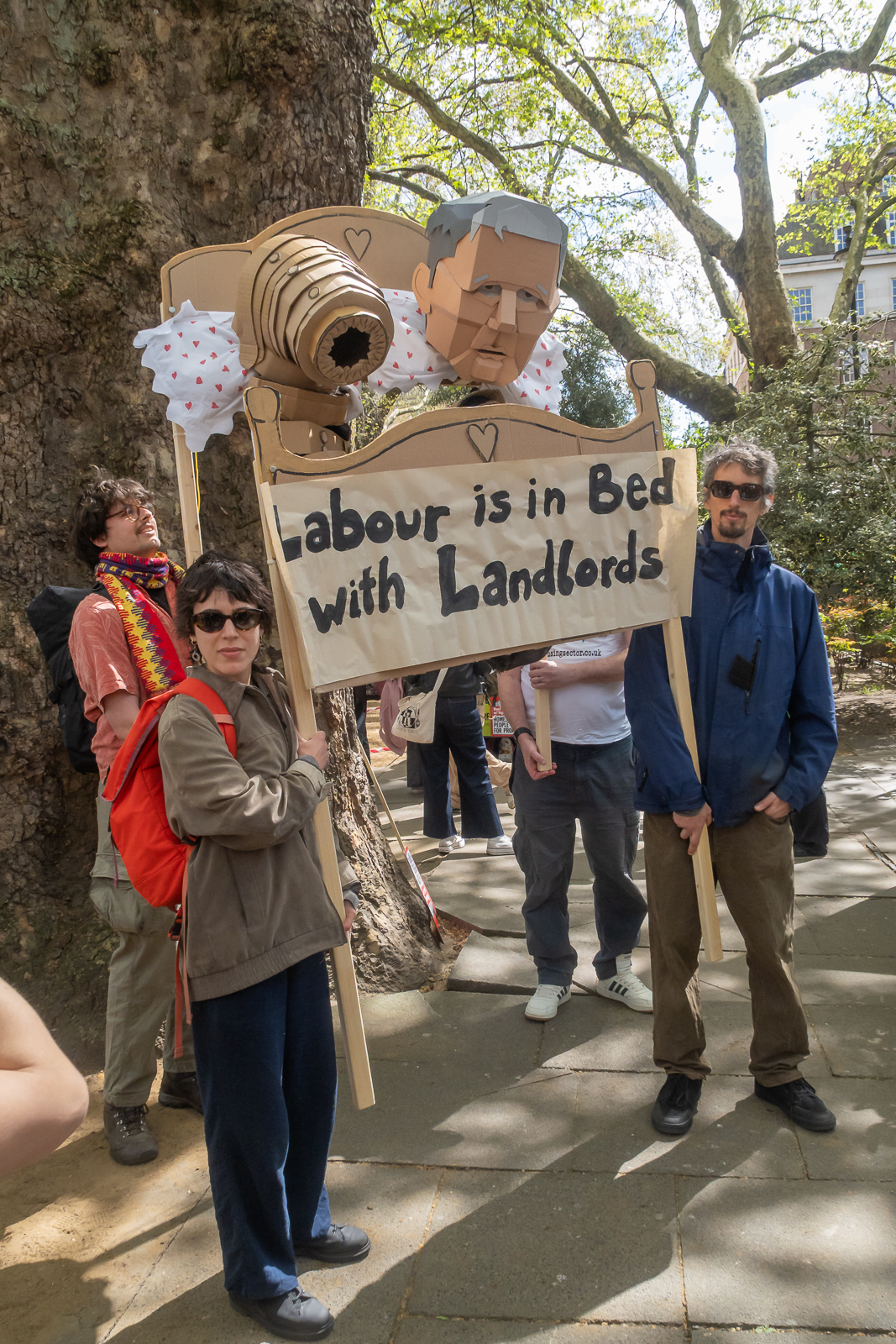
London, UK. 18 Apr 2026. ‘Labour is in Bed with Landlords’

There were new towns and local authorites were encouraged to build council housing, although under the Conservatives the emphasis altered in the 1950s to providing “welfare accommodation for low income earners” rather than meeting more general housing needs. But under MacMillan as Housing Minister they still aimed to build 300,000 homes a year.

National Housing Demo, London 2026

Mistakes were made. It was also largely when the Conservatives were in power that we saw a huge shift towards building high-rise, and in particular to system-built blocks. Some of the best of these are now largely privately owned and expensive flats, but others, often because of shoddy building practices have had to be demolished.

National Housing Demo, London 2026
London, UK. 18 Apr 2026. London Renters Union

Increasingly Conservative policies changed to encouraging home ownership rather than municipal provision of low-cost accomodation. And the final death blows came under Thatcher, who prevented authorities from using local tax money to build new housing and serverely reduced local housing stocks with the ‘right to buy’ – and added final cruel twist by refusing to allow them to use the money from sales to build. Right to buy also meant councils many of their larger and more desirable properties.

National Housing Demo, London 2026
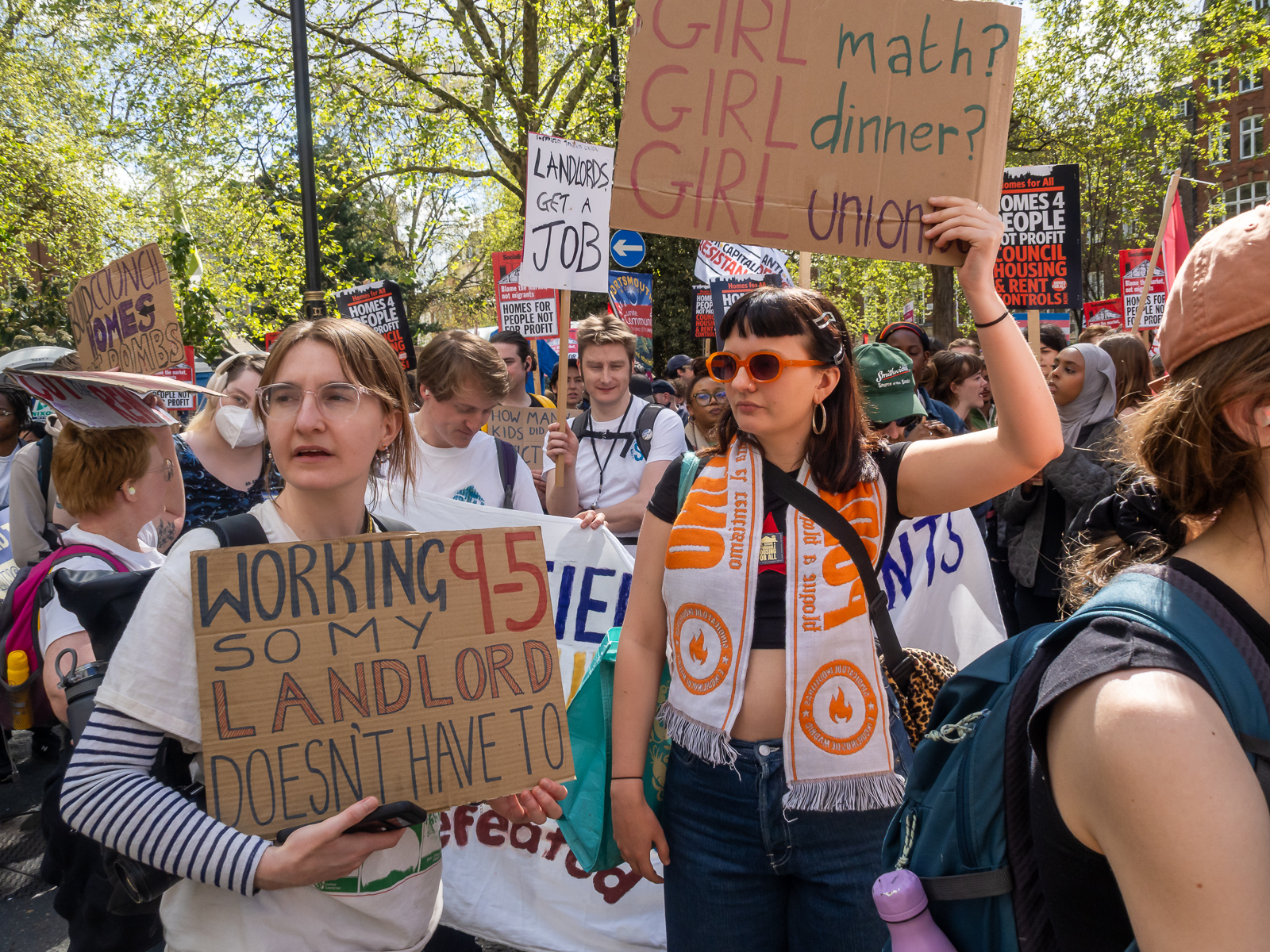
London, UK. 18 Apr 2026. ‘Working 9-5 so my landlord doesen’t have to.’
National Housing Demo, London 2026

Thatcher’s policies resulted in an increase in the waiting lists for council accommodation and meant that councils had to take desperate measures to try to rehouse those they had a statutory obligation to – resulting in a huge increase in the use of often sub-standard temporary accommodation often far away from their local areas, and in people being rehoused with little security in poor private flats.
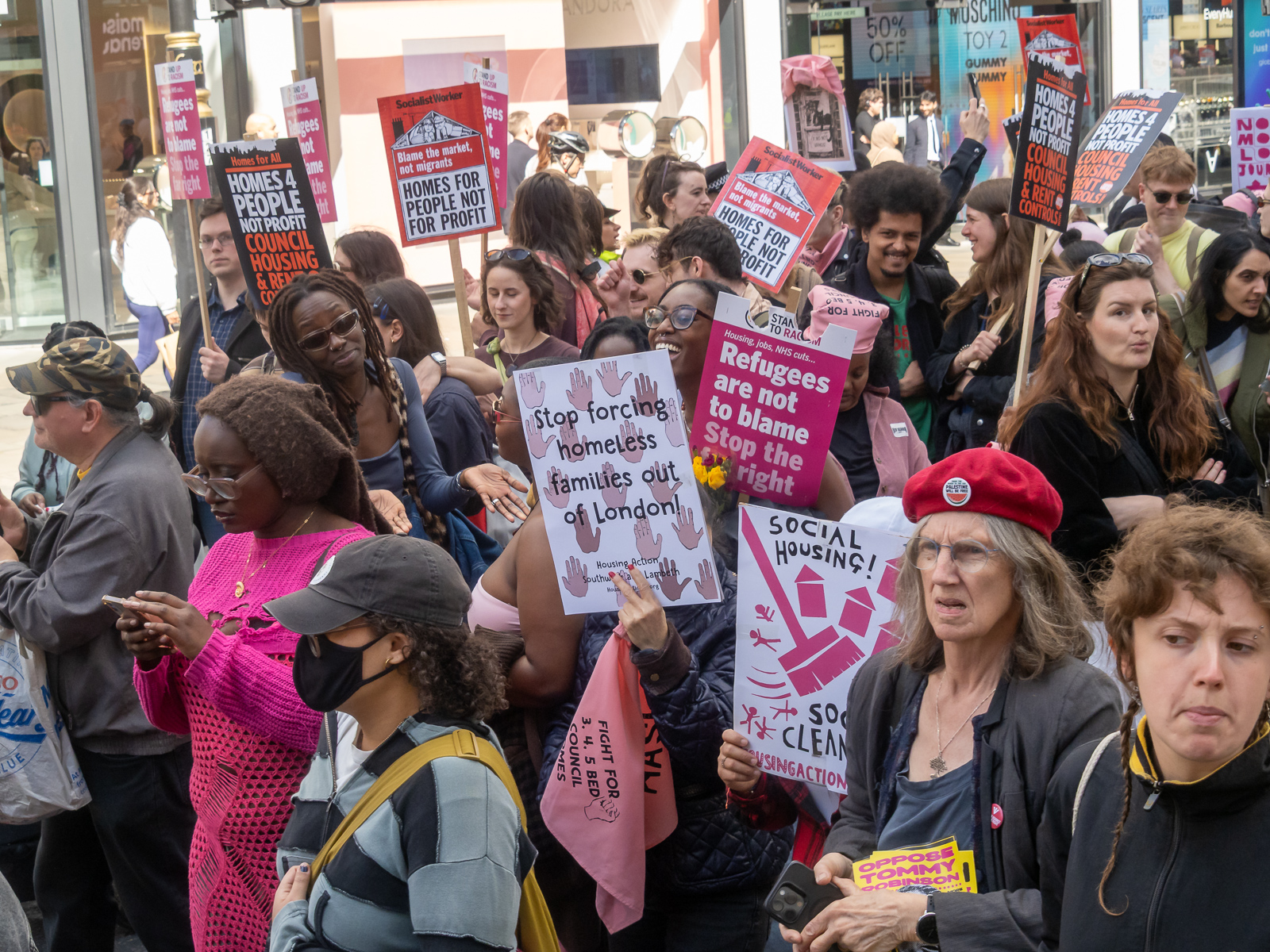
National Housing Demo, London 2026

New Labour did little if anything to improve things, except for property developers. In London and elsewhere we have seen a succession of well-built council estates with years of life being allowed to deteriorate and then, rather than being refurbished at relatively low cost, being demolished and replaced by developers working with councils largely as high-cost private developments with little social housing.
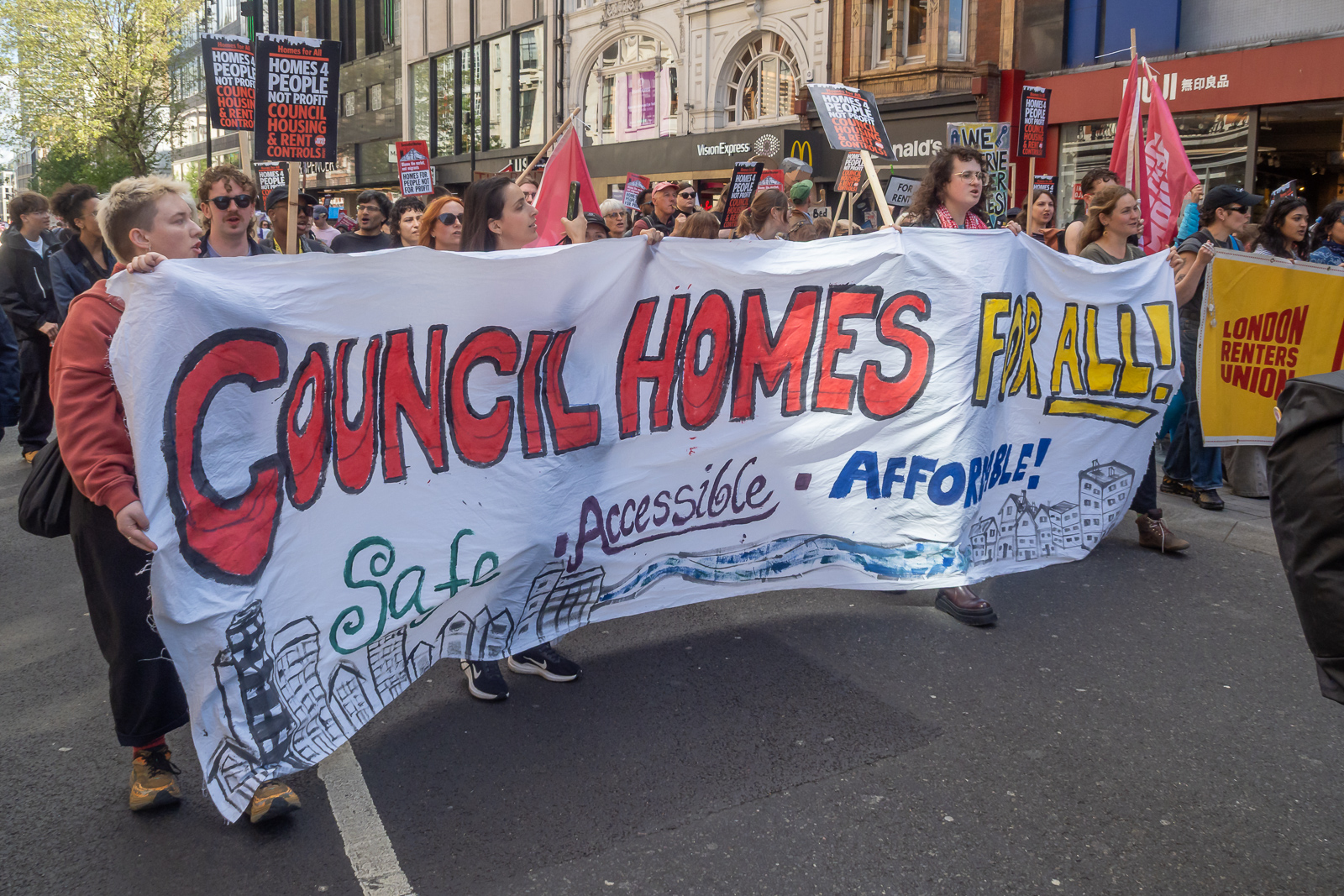
National Housing Demo, London 2026
London, UK. 18 Apr 2026. ‘COUNCIL HOMES FOR ALL!’.

Although there were a few examples of succesful regeneration, most have been disastrous for their former residents, priced out of their local areas, with those who had bought their properties sometimes being seriously defrauded.
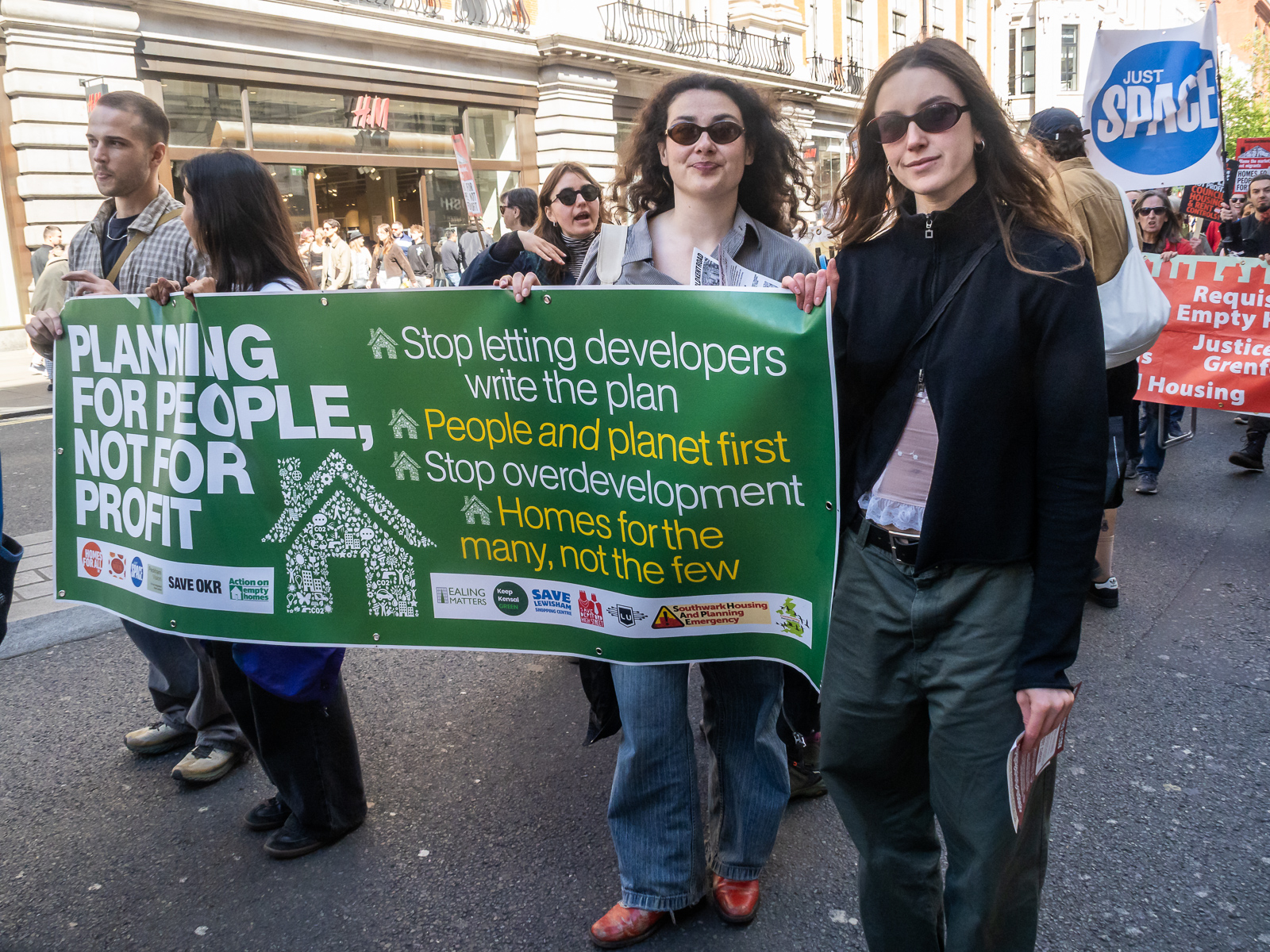
National Housing Demo, London 2026
London, UK. 18 Apr 2026. ‘PLANNING FOR PEOPLE NOT FOR PROFIT’.

Many of these regenerated estates are now full of empty homes owned as investments by overseas buyers, buying them simply to profit over a few years from the increasing house prices in the UK and in cities including London in particular.

National Housing Demo, London 2026
London, UK. 18 Apr 2026. ‘AFFORDABLE HOMES FOR ALL SHOULDN’T BE A RADICAL IDEA’.

Under the coalition government and succesive Tory governments the housing crisis has continued to grow, with rents in London skyrocketing. And bit by bit the security of tenure that council property used to provide has been whittled away. So far the Labour landslide has changed nothing.
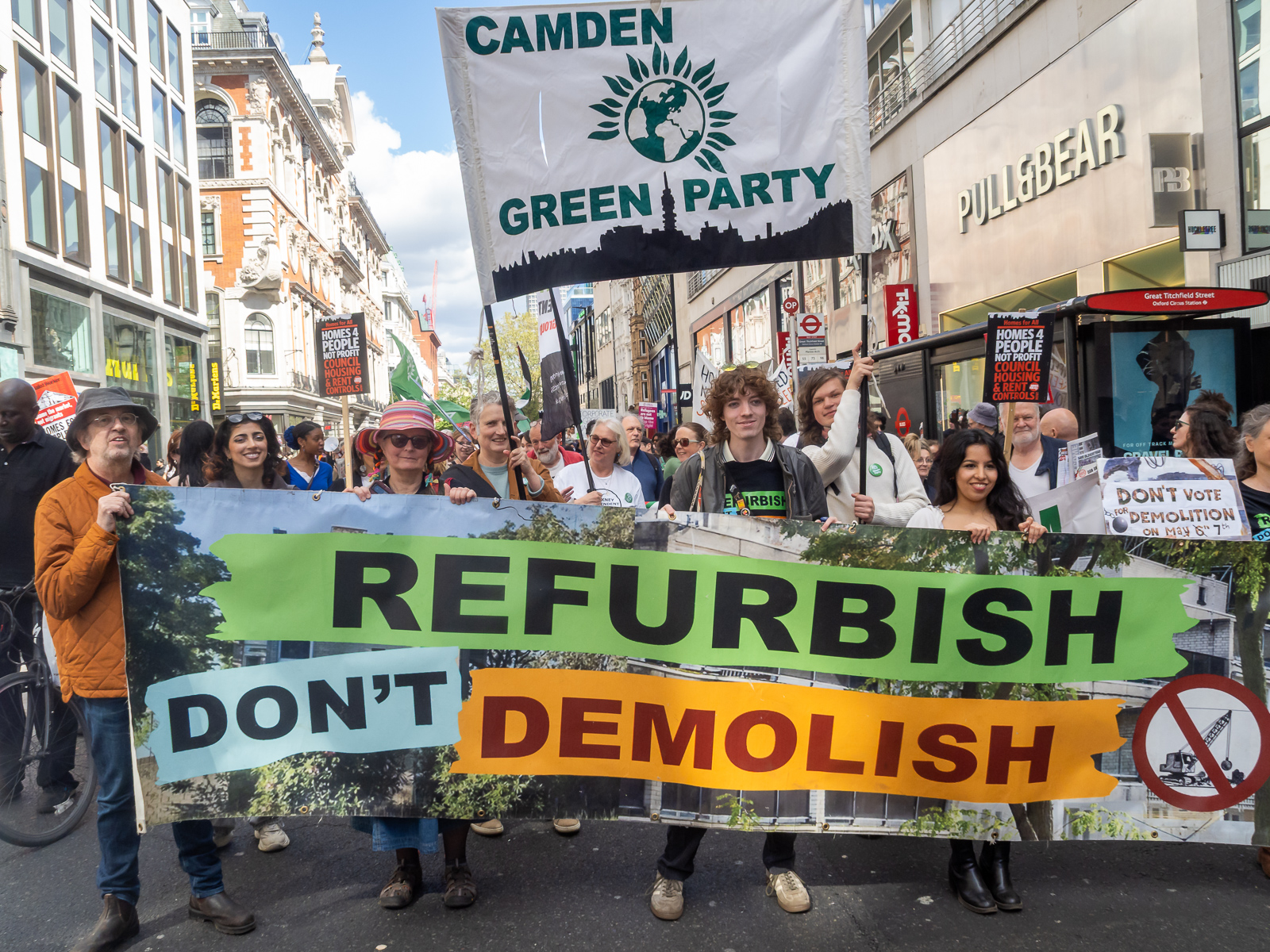
National Housing Demo, London 2026
London, UK. 18 Apr 2026. ‘REFURBISH DON’T DEMOLISH’.

There are some simple policies the protesters were calling for that could help. There are huge numbers of properties that are long-term empty and there could be greater powers of compulsory purchase. There could be changes to make it possible for local authorities to maintain and refurbish existing estates and build more social homes. We could stop getting estate agents and developers to dominate our housing policies for their own benefits.
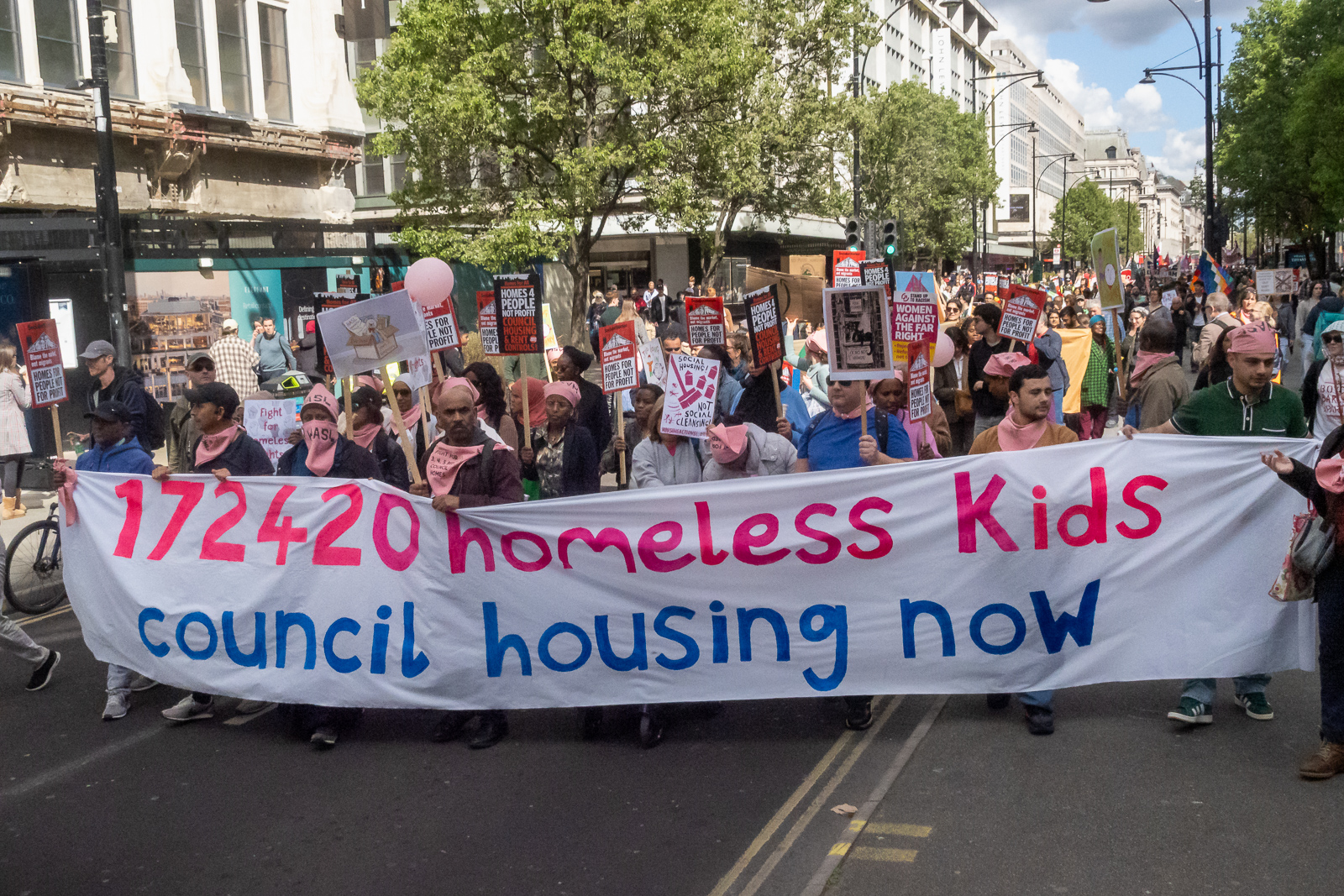
National Housing Demo, London 2026
London, UK. 18 Apr 2026. ‘172420 homeless Kids – council housing now’

Part of the housing problem is that too many of our MPs are themselves landlords and have opposed attempts to improve the conditions of tenants, watering down legislation. But perhaps the largest need is for a change in the way we think about housing, seeing it as an asset rather than a home. The whole idea of the ‘property ladder’.

Many more pictures from Saturday’s protest in my Facebook album National Housing Demo.


FlickrFacebookMy London DiaryHull PhotosLea ValleyParis
London’s Industrial HeritageLondon Photos

All photographs on this page are copyright © Peter Marshall.
Contact me to buy prints or licence to reproduce.


Property Developer’s Awards – 2017

Property Developer's Awards - 2017

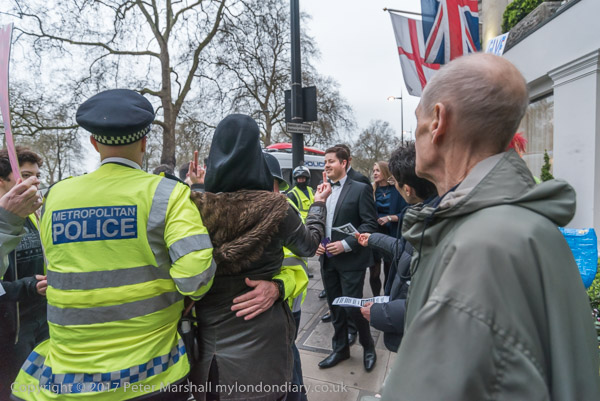
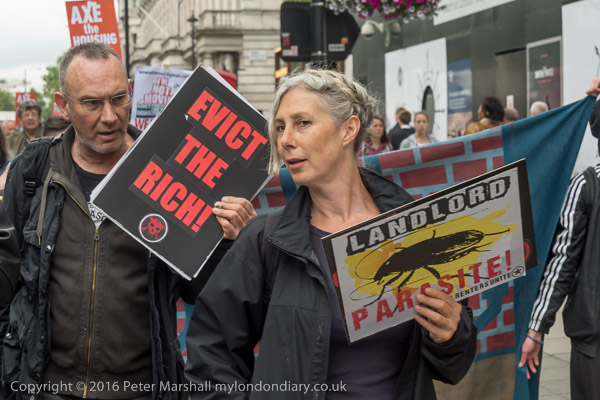
Property Developer’s Awards: On Tuesday 4th April 2017 I joined protesters on the pavement in front of the Grosvenor House Hotel in Mayfair where the annual Property Developers Awards were being held .

Property Developer's Awards - 2017

Property developers largely operate at one of the greedier ends of capitalism, many clearly putting their profits above everything else. Of course we need to build things, but we need to build the right things rather than those that maximise profits for the developers. Capitalism and the market doesn’t serve the interests of the vast majority.

Property Developer's Awards - 2017
Rev Paul Nicolson of Taxpayers Against Poverty speaks

In London we are clearly not building the right things. The desperate need is for social housing, while developers are working together with local councils to destroy this, demolishing council estates and replacing them with largely private developments with rents and prices beyond the reach of Londoners in desperate need of housing. And landlords are making obscene profits for lousy (sometimes literally) accommodation.

Property Developer's Awards - 2017
Landlord – Parasite!’ poster from Private Renters Unite – many rented properties suffer from damp and are infested by cockroaches etc

London councils have huge waiting lists for social housing and an estimated 210,000 Londoners are homeless and living in temporary accommodation, including 102,000 homeless children. The situation is now even worse than in 2017 and London councils now spend around £5.5 million per day on homelessness.

Property Developer's Awards - 2017

And yet there are huge developments taking place in London, but so many of these are for student housing and expensive private flats, many bought by overseas investors and remaining empty for all or most of the year. Because these are the kind of developments that make the largest profits for the property developers.

Property Developer's Awards - 2017
Activists rush up with a sack of horse manure and tip it on the hotel entrance

Of course gaining planning permission for many developments require them to include social housing and ‘affordable housing’. “Affordable housing is used by governments to mean 80% of market prices – something totally unaffordable for most people – the term true Orwellian doublespeak.” But if the developers feel they are not getting enough profit when building they can simply ask for a reduction in these and it gets granted.

Cockroaches crawl around a poster next to the manure
which a hotel employee tries to sweep up as Ian Bone walks in front with a siren

London Mayor Sadiq Khan has funding of up to £11.7 billion for a ‘London Social and Affordable Homes Programme 2026-36‘, but it remains to be seen what this will actually deliver – other of course than profits for the developers.

Jane Nicholl confronts a man going into the Property Developer’s Awards who seems amused by being accused of social cleansing

Of course both developers and councils who work with them do so in a political atmosphere which since Thatcher has made providing social housing much more difficult. But some councillors and officers have joined with developers in pursuing their personal fortunes rather than public good.

People from the Property Developer’s Awards came out to have a cigarette and watch the protest

“The protesters, who included queer coalition the Sexual Avengers and Class War say the developers demolishing social housing and community facilities across London in a process of social cleansing aided by largely Labour councils and led by Savills who sponsor the awards and were nominated for six of them. They are demolishing council estates and replacing most of their social housing with high cost private developments, often largely sold to foreign investors and making obscene profits – and tickets for this event were £396 per seat.”

Ian Bone directs some of those coming to the Property Developer’s Awards, calling them “rich scum”

The protesters made their views very clear, calling those entering the Award beanfeast ‘scum’ and ‘parasites.’ A small group rushed up to the hotel entrance and dumped a sack of horse manure and coackroaches in front of it. A hotel employees came out with a bin and broom to try to sweep it up.

Police hold back a woman giving those coming to the awards the finger

The protest continued with Class War in particular confronting the developers as they arrived and police ensuring they could walk past and enter, holding back the protesters. Some of those entering appeared to be amused by the idea they were ‘social cleansing’ and a small group came out to watch the protest.

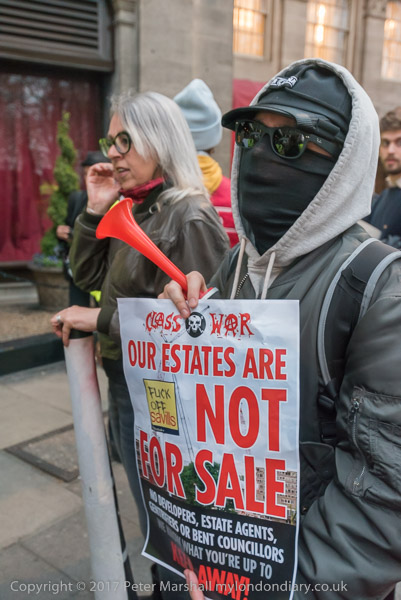
Class War – Our Estates Are Not for Sale – No Developers, Estate Agents, Gentrifiers or Bent Councillors – We Know What You’re Up to – Keep Away!

More pictures at Property Developer’s Awards.


FlickrFacebookMy London DiaryHull PhotosLea ValleyParis
London’s Industrial HeritageLondon Photos

All photographs on this page are copyright © Peter Marshall.
Contact me to buy prints or licence to reproduce.


People’s Assembly against Austerity 2.0

People’s Assembly against Austerity 2.0: Last Saturday, 7th June 2025 the People’s Assembly had organised what they hoped would be a huge anti-austerity demonstration against Labour’s Austerity 2.0 which seems a return to the policies of the Cameron and other Tory governments, cutting spending on public services while ensuring the rich continue to get richer.

People's Assembly against Austerity 2.0

They say:

Austerity is not an inevitability; it is a political choice. By sticking to her arbitrary ‘fiscal rules,’ Rachel Reeves is plunging the country into more crisis.
By choosing to spend money on arms rather than public services, social security and our NHS, this government is actively impoverishing us. We say no – and we mean it.

People's Assembly against Austerity 2.0

Recent government announcements of a huge increase in defence spending are based on a return to the worst excesses of the Cold War and a false narrative of Russian invasion of all of Europe – something that the criminal and disastrous invasion of Ukraine when what Putin thought would be over in three days has turned into years of attrition, ruining the Russian economy, actually makes less likely.

People's Assembly against Austerity 2.0

Arms manufacturers have always played on our fears to boost their profits – and they are the only people who come out of wars as winners – both the Ukrainian people and the Russian people will end up as losers whatever the final outcome in Ukraine. And it was them and the NATO military hawks who kept up the isolation of Russia and the manipulation of politics in Ukraine and elsewhere after the fall of the USSR rather than welcoming Russia into our fold.

People's Assembly against Austerity 2.0

Already our government has drastically cut the aid budget, probably the most important expenditure to promote peace across the world, and is also planning huge cuts in benefits in an attack on the most vulnerable in our society.

People's Assembly against Austerity 2.0

It has also continued its attacks on migrants with a new Immigration White Paper which will attack our migrant communities and affect millions of migrants, continuing the racist policies of previous governments. We need migrants, particularly as our population is ageing. Those already here are making a positive contribution to our country – and would do more if we introduced safe ways for them to come here, particularly to join relatives already living here, allowed asylum seekers who can to work, recognised their qualification and made it easier for them to become British citizens. We need a positive approach to migrants rather than the increasingly hostile one.

Many on the protest came to protest about the increasing privatisation of the NHS and the failures to adequately resource it, about the cuts in education and about misguided and inadequate housing policies which have led to huge increases in rents – while making landlords wealthy. About the increases in energy prices and in prices generally which are making many poor. About the failure to abolish to two child cap on benefits which has put so many children into poverty.

Kid Starver Out – and a cut up Labour Party card.

We live in a country with massive inequalities and with governments that are inatroducing policies to increase these. The protest called for ‘Welfare not Warfare’, to ‘Tax the Rich’ and ‘Stop the Cuts’.

NEU protesters

We would not need to bring in tax increases to greatly increase the amount of tax the country receives but could bring in billions by simply clamping down on tax evasion and tax avoidance. We should outlaw all those schemes that enable companies and individuals who earn money in the UK from not paying taxes. We need to change the law so HMRC would work to a simple rule – if you earn it here, you pay tax on it here – and enforce it. It would probably bring in at least another £20 billion a year.

Saturday’s protest was not the huge demonstration that the People’s Assembly had hoped for, though it was a respectable size, perhaps 3-5,000 people. The drastic and inaccurate weather forecast may have put some people off, but the many groups who backed the event only came in small numbers. Sometimes only just enough to carry their banner.

Revolutionary Communist Party

By far the largest and loudest bloc on the march was that of the Revolutionary Communist Party. Until 2024 called ‘Socialist Appeal’ it was relaunched under this new name. Back around the 1970s it was the Trotskyist Labour group ‘Militant tendency’, set up around the newspaper ‘Militant’ in 1964 and finally proscribed by the Labour Party in 1982.

Many more pictures in my Facebook album Welfare Not Warfare, Stop The Cuts March.


FlickrFacebookMy London DiaryHull PhotosLea ValleyParis
London’s Industrial HeritageLondon Photos

All photographs on this page are copyright © Peter Marshall.
Contact me to buy prints or licence to reproduce.


Housing and Planning Bill March – 2016

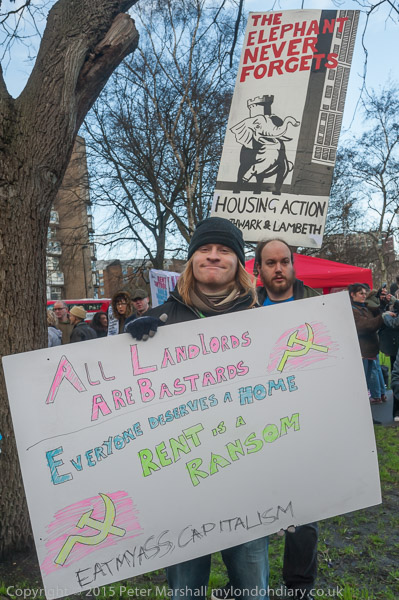
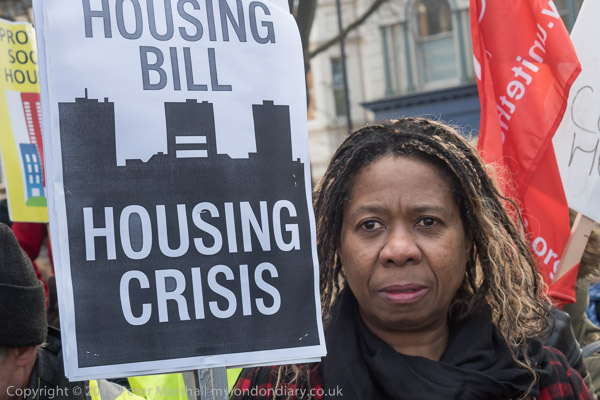
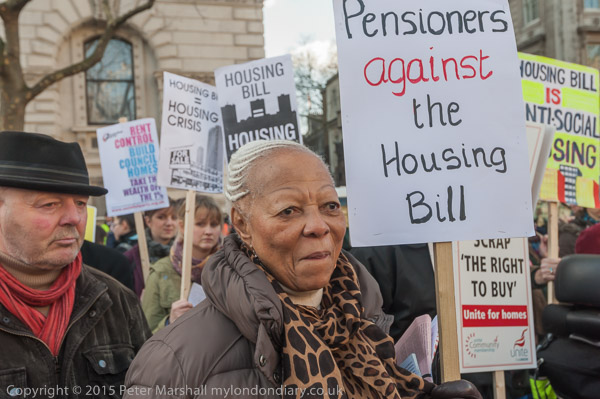
Housing and Planning Bill March: On Saturday 30th January 2016 housing activists including some local councillors and housing activist groups mainly from South London including Class War marched from the Imperial War Museum to Downing St in a protest organised by Lambeth Housing Activists against the Housing and Planning Bill.

Housing and Planning Bill March - 2016

They say the bill will have a particularly large impact in London and greatly worsen the already acute housing crisis here.

Housing and Planning Bill March - 2016

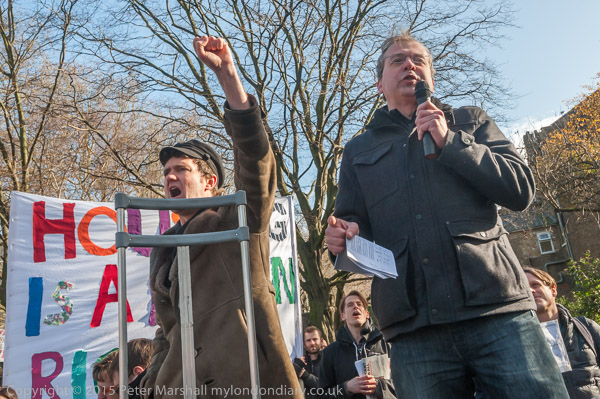
Speeches at the rally before the march in Geraldine Mary Harmsworth Park at the side of the Imperial War Museum by Green Party Leader Natalie Bennett and an number of housing activists including Simon Elmer of Architects for Social Housing were warmly applauded.

Housing and Planning Bill March - 2016

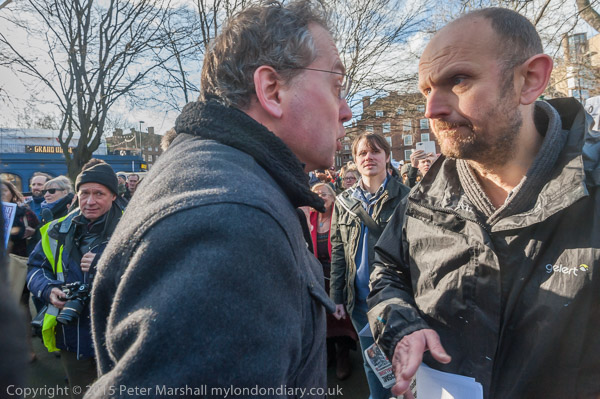
But there was one exception; when Southwark Council Cabinet Member for Housing Richard Livingstone the atmosphere changed, with boos and loud heckling from several people in the crowd including Elmer.

Housing and Planning Bill March - 2016
Simon Elmer shouts as Richard Livingstone speaks

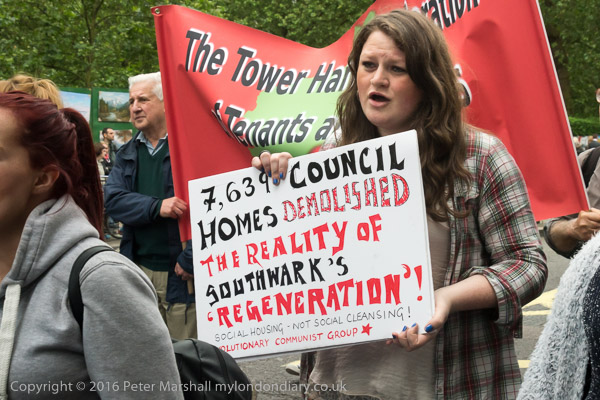
The arguments continued in the crowd after Livingstone had left the platform with Elmer pointing out the scandal over the demolition of the Heygate Estate and now the Aylesbury estate, where thousands of council homes have been demolished and few of the promises made by Southwark Council have been kept.

Housing and Planning Bill March - 2016

Financially and morally Heygate was a scandal, with the council making derisory offers of compensation to leaseholders, far less than the value of comparable properties in the area and a huge loss of social housing, while getting rid of a huge public asset at a fraction of its true value. And since it was something the council seemed determined to repeat, and it is not surprising that feelings ran high.

Rather to the surprise of many the march set off walking in the opposite direction to its final destination of Downing Street, and it soon became clear that we were on a tour of Lambeth rather than taking a direct route.

“Class War decided to liven things up a little, first by dancing along the street singing the ‘Lambeth Walk’ and then by rushing across the pavement towards a large estate agency.

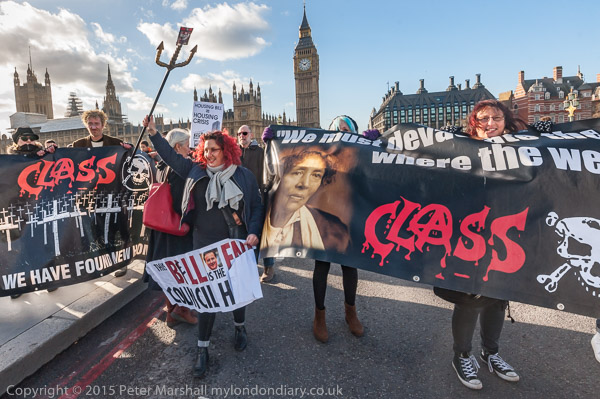
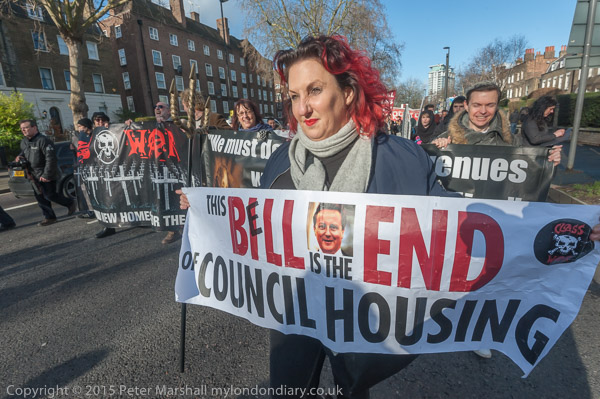
Police formed a line to stop them entering and they stood outside for some minutes with their banners – the field of crosses with the message ‘We have found new homes of for the rich’ and the Lucy Parsons banner with its quotation “We must devastate the avenues where the wealthy live” before rejoining the march.”

For much of the march Lisa Mackenzie who had stood at Class War’s candidate in the 2015 General Election against Iain Duncan Smith in Chingford stood in front of the banners waving a plastic trident with a small banner ‘This Bill is the end of Council Housing’ with its second message an image of David Cameron and the alternative text ‘Bell End’. At times she donned a face mask of Smith.

Eventually the march reached Downing Street where police tried to direct them to the opposite side of Whitehall, but the marchers walked past them and crossed back to protest outside the gates, blocking traffic on Whitehall.

Here there were several groups listening to speakers and a samba band playing. Eventually police persuaded most of them to leave the road and I left for home.

More pictures at Housing and Planning Bill March.


FlickrFacebookMy London DiaryHull PhotosLea ValleyParis
London’s Industrial HeritageLondon Photos

All photographs on this page are copyright © Peter Marshall.
Contact me to buy prints or licence to reproduce.


Housing Act, Student rents & Open Gardens – 2016

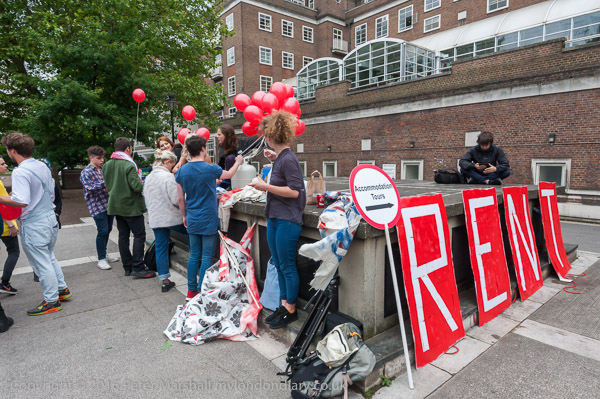
Housing Act, Student rents & Open Gardens: On Saturday 18th June 2016 I went to three events all with a connection with housing. First was a protest against the 2016 Housing and Planning Act passed the previous month, after which I briefly visited students celebrating a victory at UCL before going to South London for an Open Gardens event at an estate which Lambeth Council want to demolish.


Axe the Housing Act March – Hyde Park Corner

Housing Act, Student rents & Open Gardens

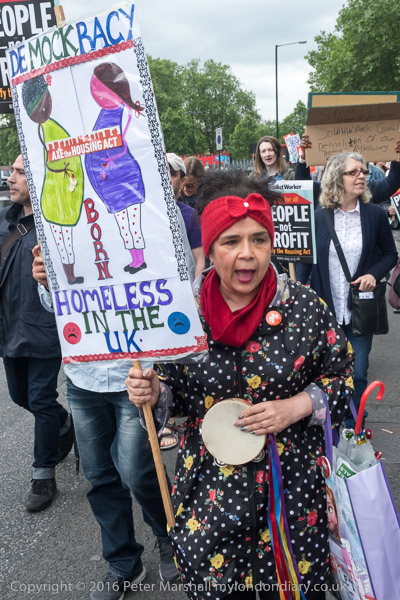
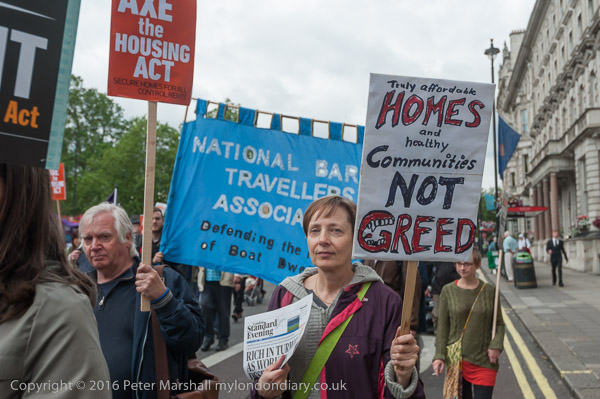
Protesters marched from Hyde Park Corner to Parliament against the Housing and Planning Act which tenant and housing groups, councils, academics, trade unions and communities say will deepen the current housing crisis, removing security from many tenants and will result in the demolition and selling off of almost all social housing.

Housing Act, Student rents & Open Gardens

The Act extends the ‘Right to Buy’ to housing association tenants and allows councils to sell vacant ‘higher value’ vacant council homes to fund this.

Housing Act, Student rents & Open Gardens

It brings in mandatory rent increases for households in social housing with a combined family income of ore than £40,000 in London and £31,000 elsewhere with their rents increasing over time to market rents. Amendments made this slightly fairer by limiting the income considered to the taxable income of two main household earners and excluding most of those receiving benefits from the calculations.

Housing Act, Student rents & Open Gardens

The Act removes security of tenure for most council tenants. New tenants will only get fixed term tenancies generally from 2-5 years, with some longer tenancies agreed for those with a disability or children living at home until they reach the age of 19 following pressure from the House of Lords.

The Act reflects and emphasises the Tory view that social housing should be a very limited resource only supporting the the very poorest in society, second-class citizens, with the landlords and house builders being able to make profits from the rest of us. But housing campaigners generally see it as by far the most cost-effective way to provide for one of our basic human needs and also argue that it can provide an income for local councils to support other vital services.

The protesters urged councils to refuse to implement the Act and call on people to stand together to boycott the pay-to-stay tax, resist evictions and block regeneration and estate demolitions.

Among the speakers before the march began was Richard Livingstone, a councillor from the London Borough of Southwark, Cabinet Member for Adult Care and Financial Inclusion and formerly responsible for housing in the borough.

Southwark is a borough with an appalling record on housing and estate demolition and many at the protest were appalled at his presence calling Southwark’s demolition of the Heygate and Aylesbury a shameful example of exactly the kind of social cleansing this protest was against.

Many feel that many Labour councillors and officers are now careerists, driven by political or financial advancement rather than caring for the people in their borough. A number have earned themselves highly paid jobs with developers and other companies in the housing sector.

I left as the march moved off towards Parliament and made my way to UCL.

More at Axe the Housing Act March.


UCL Rent Strike Victory

It was good for once to be able to celebrate a victory, after after the Complaints Panel at UCL decided that the residents of Campbell House West will be compensated in full for the final term last year – up to £1,368 per student.

They determined that UCL Management “Not only demonstrated a lack of empathy towards students’ circumstances and an understanding or appreciation of what would be an acceptable student experience, but was disingenuous to the students concerned.”

So the mass protest that had been planned, an Open Day Manifestation, turned into a celebration of their victory, and also to show their determination to continue their campaign to cut student rents.

I left after a brief visit, missing the lively victory march around the West End with flares and the helium-filled balloons I had watched them preparing.

UCL Rent Strike Victory


Central Hill Open Gardens Estates – Upper Norwood

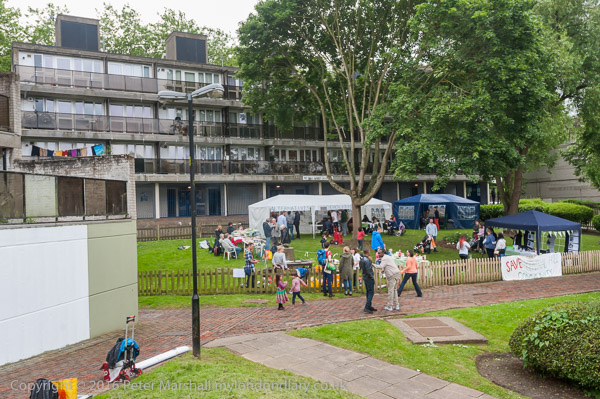
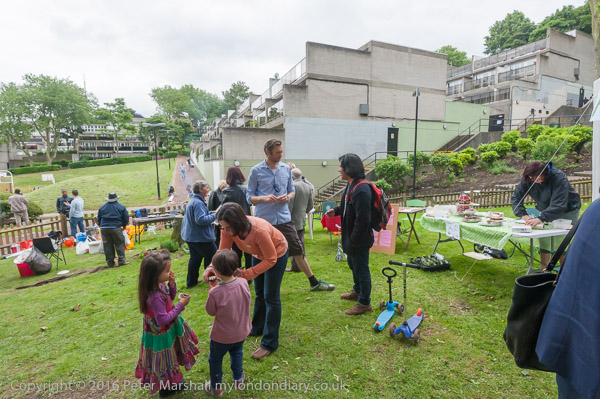
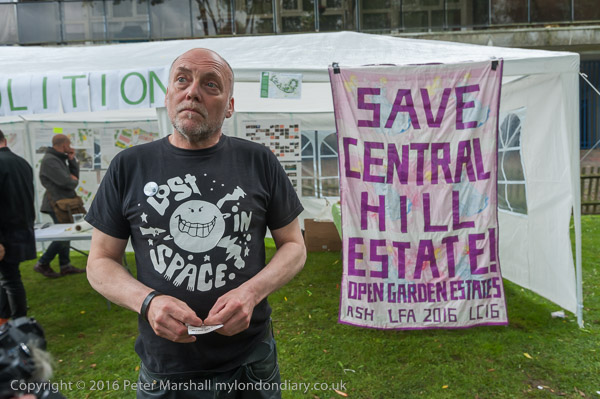
Lambeth’s Central Hill Estate is a popular and well-planned estate of considerable architectural interest in good condition under threat of demolition by Lambeth Council. Like some other estates it has been refused listing probably on political grounds. The properties, completed in 1974, were well built and are generally in good condition though suffering like most council estates from a lack of proper maintenance and in need of relatively minor refurbishment.

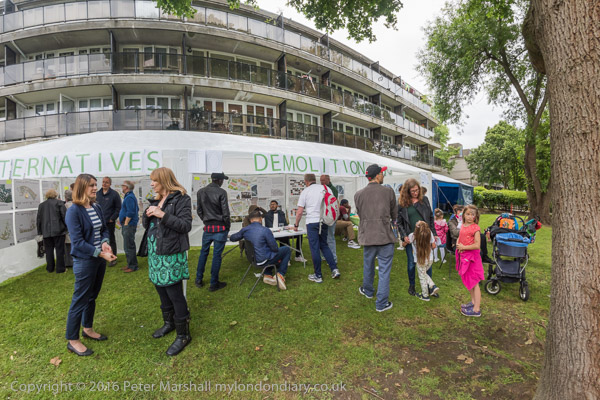
This was one of the estates under threat of demolition by Government Housing policies, council regeneration programmes and property developers which were welcoming visitors to open day events as a part of the Open Garden Estates initiative by Architects for Social Housing, ASH.

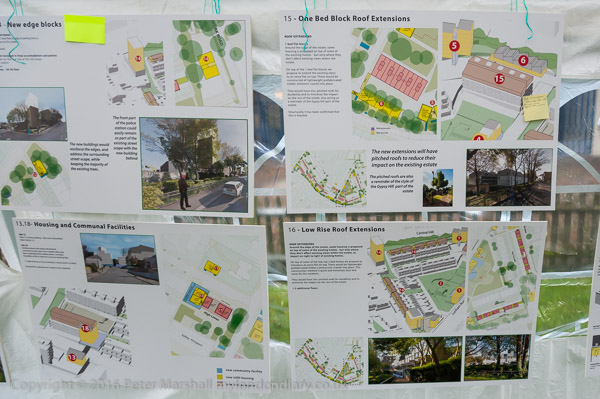
There was a display of the alternative plans for the estate by ASH showing how the council’s aims of increasing the capacity of the estate could be achieved without any demolition and at a much lower financial and environmental cost.

Lambeth Council had refused to make any serious consideration of these plans, almost certainly because although the cost would be much less, they would not provide the profits to the developers from the high market value sales of new properties and market rents, and the costs of the ASH scheme to the council would be greater.

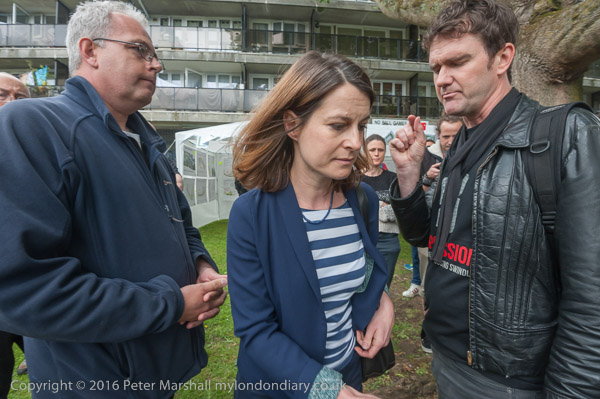
One of the visitors to the open day was Labour MP for Dulwich and West Norwood Helen Hayes, who stormed out after being questioned why she was attending when she had given her backing to Labour councillors behind the plans to demolish the estate.

Also at the open day were various food, book and other stalls, a music performance, film show (I watched a film about how Southwark Counci had mistreated the residents of Myatts Fields) and a Marxist puppet show as well as estate tours. I’d visited the estate several times in the past and had photographed parts of it in the 1990s as well as more recently in February 2016 when I wrote more about it and Lambeth’s plans to demolish.

Although New Labour’s ‘Regeneration’ policy possibly had good intentions, its results have often been disastrous, and Labour really needs to rethink its whole approach to council-owned housing.

As I wrote in 2016: “‘Regeneration’ has resulted in huge transfers of public assets into private hands, in a wholesale loss of social housing, and in social cleansing, with people being forced outwards from London, unable to afford either the laughably named ‘affordable’ properties or those at market rates. It has meant the dispersal of functioning communities, in widespread and arguably fraudulent under-compensation of leaseholders, and in a great deal of sub-standard buildings, often to lower specifications of space and worse design than those they replace.

More people were arriving at the event when I left to go home and I was sorry to have to miss some of the activities planned for later in the day.
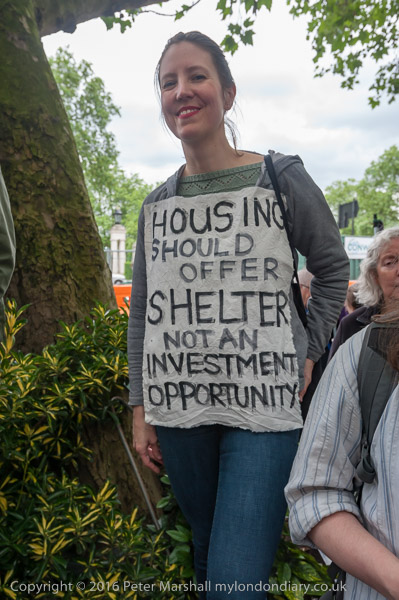
The estate is still standing and the fight to save it continues. In March 2024 Lambeth Council set up a contract with consultants to reappraise the plans for estate ‘regeneration’ at Cressingham Gardens, Central Hill and Fenwick. Perhaps it will come up with some more sensible proposals …

More at Central Hill Open Gardens Estates.


FlickrFacebookMy London DiaryHull PhotosLea ValleyParis
London’s Industrial HeritageLondon Photos

All photographs on this page are copyright © Peter Marshall.
Contact me to buy prints or licence to reproduce.