More Thames Path – 2011

Charlton to Belvedere
More Thames Path - 2011

Charlton to Belvedere
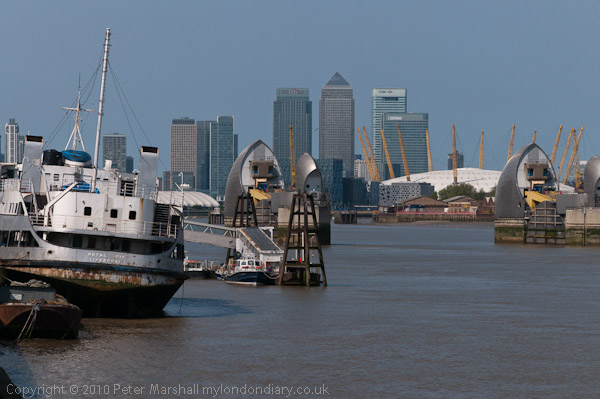
The view upriver from Charlton with the Thames barrier, Dome and Canary Wharf

Charlton to Belvedere: On Monday 25 April 2011 I went with my wife and elder son on a walk from Charlton Station to Belvedere. They walked but I rode on my folding Brompton bike as I was still suffering from plantar fasciitis and walking any distance became too painful.
More Thames Path - 2011

Charlton to Belvedere
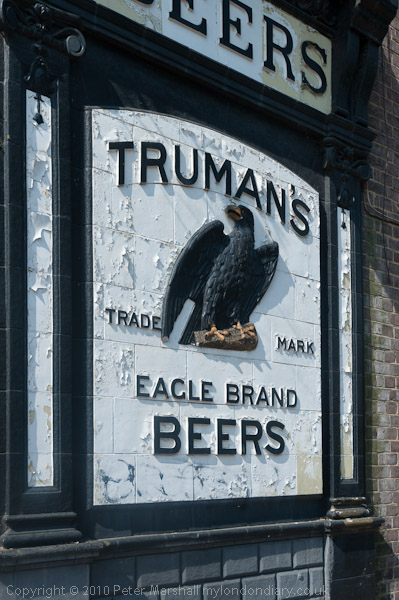
A derelict pub in Charlton

As a cyclist any pressure is on the ball of the foot, with no weight at all on the heel and arch where the pain can be intense. Gel insoles help a little for walking and I was still managing to photograph events, but longer – and faster – walks were still completely out of the question for me.
More Thames Path - 2011

Charlton to Belvedere
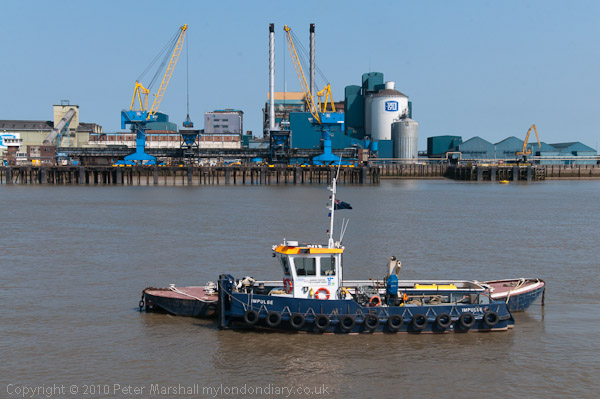
Tate & Lyle in Silvertown

I’d been to see my doctor who was sympathetic and told me that physiotherapy might help, but given the waiting list for appointments the pain would probably have gone away before I got one. But there were exercises that could help – and after I had spent a few months rolling a baked bean tin back and forth under my heal while having breakfast the pain did eventually go away.
More Thames Path - 2011

Charlton to Belvedere
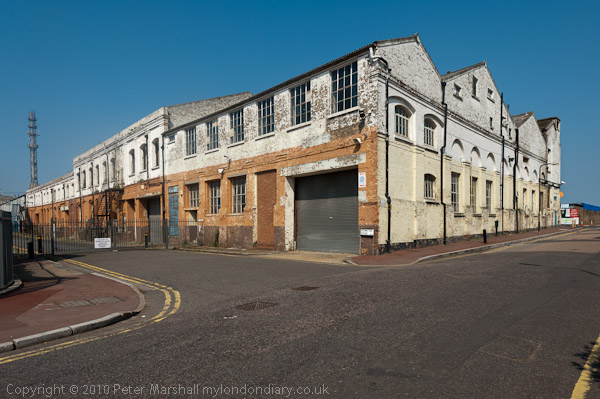
Warspite Rd/Bowater Rd SE18

The bike was a great idea. Linda and Sam were fast walkers and intent on getting to our destination, while as a photographer I kept stopping and sometimes wandering a little to one side to get into the right position to take pictures. Then I would see them a couple of hundred yards ahead and would need to run to catch up. So much easier on the bike.
More Thames Path - 2011

Charlton to Belvedere

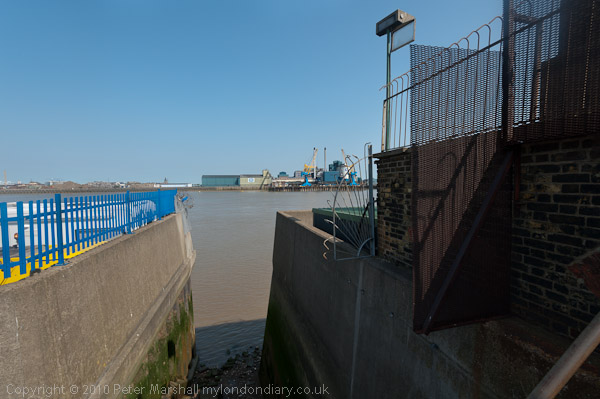
I took advantage of my bike to make some longer than normal diversions, at one stage cycling down a road to reach the river where there was no riverside path but riverside steps. I had a scary moment here, walking out on a ledge to get a better view I lost my balance and began to shake uncontrollably in front of a 10 foot drop onto the concrete steps and rubble of the foreshore. Fortunately I managed instead to grab hold of a rail behind me and after holding it for a few seconds steady myself enough to edge back to safety. I was only too aware of a history of photographers falling to their deaths while ‘getting a better view’.
More Thames Path - 2011

Charlton to Belvedere
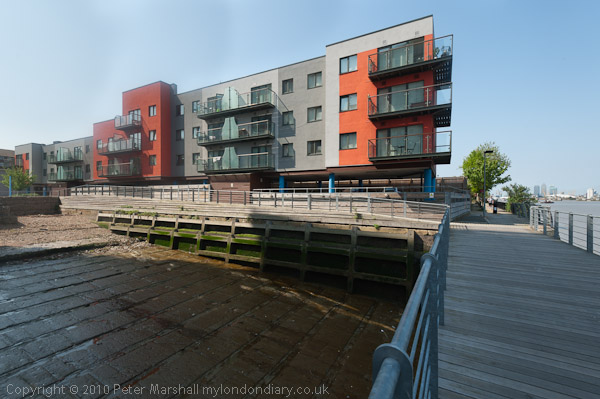
Recent flats on the former Royal Dockyard at Woolwich

Eventually I stopped shaking and was able to get back on my bike and hurry after the others. And no, I didn’t tell them what had happened and they still won’t know about it unless they read this.
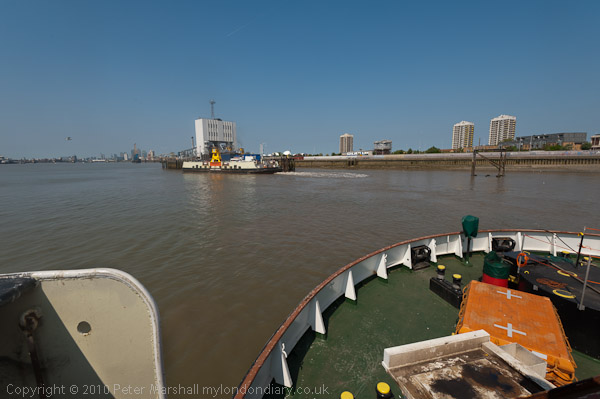
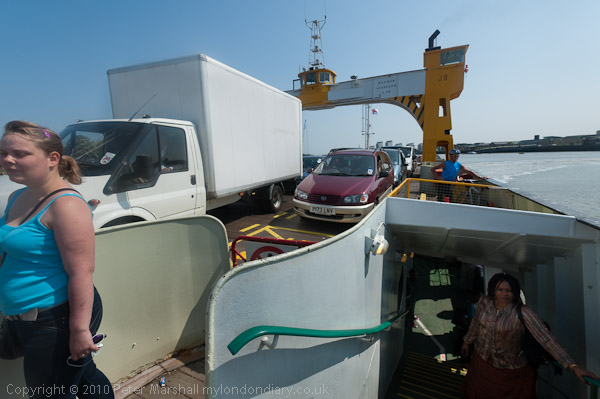
We were on the John Burns, named after the great trade unionist and Labour politician who called the Thames ‘liquid history’.

At Woolwich we took a ride across on the Free Ferry. Folding the Brompton I could walk past the ‘No Bicycles’ sign and go below deck with the others. I’d hoped we could return by the tunnel, but it was closed so we had a short walk in North Woolwich and a second ferry ride.
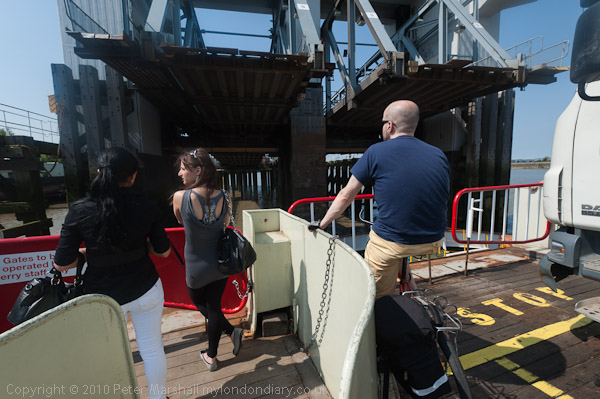
Coming back to Woolwich I kept on the vehicle deck. Bikes get to ride off before the cars.

When the Thames Path was declared a National Trail and then opened in 1996 it ended at the Thames Barrier. Our walk in 2011 began at Charlton station so only the first short section was on that and beyond we were walking the Thames Path Extension. I had previously walked all of this route, and further on as far as Cliffe. If you have the stamina you can now continue all the way to the Isle of Grain though a bike would really be a good idea. Perhaps one day I’ll do it.

The Royal Arsenal site, once an official secret is now a tourist destination, complete with various sculptures, including Peter Burke‘s Assembly
There are glimpses of the river and these waste transfer barges though trees and over bushe and Beckton on the opposite bank
One of the larger tributaries of the Thames is the treated outfall from Beckton sewage works at left. close to Barking Creek
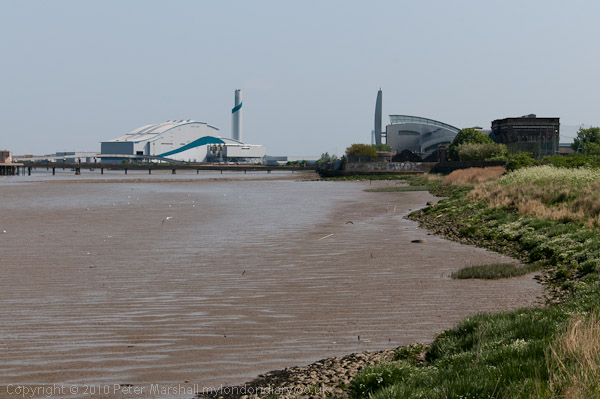
Waste incinerators and the Bazalgette pumping station
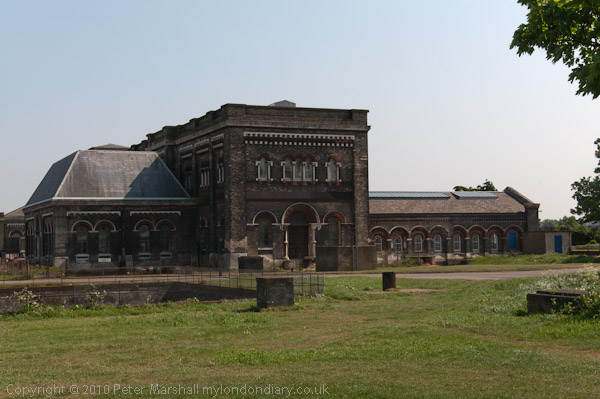
The Romanesque Crossness Southern Outfall Works opened in 1865, pumping sewage out when the tide would take it seawards
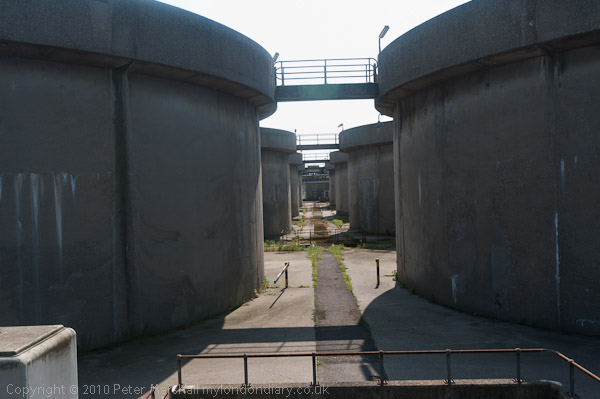
Part of the more utilitarian 1950s sewage treatment plant at Crossness
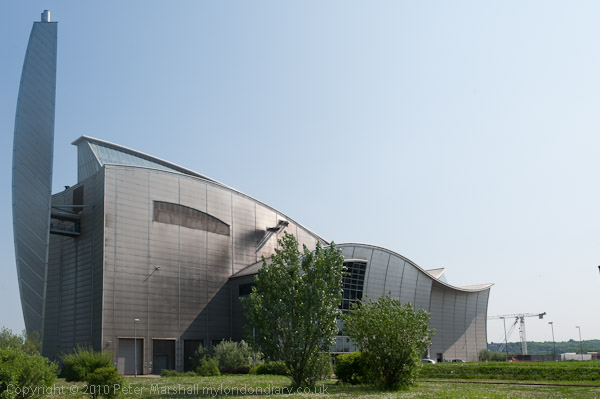
The 1998 sludge incinerator, an elegant swan-like metal structure
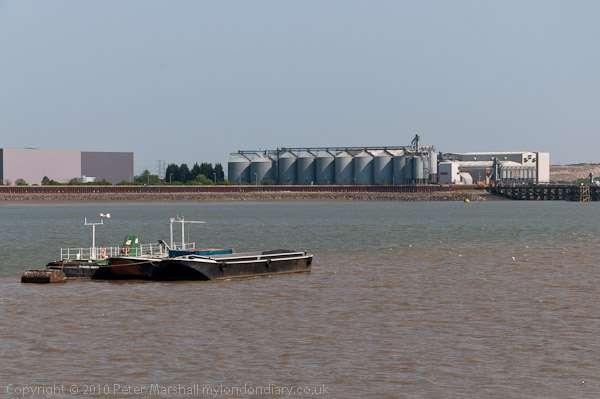
Looking downstream to silos at Rainham

On this ‘walk’ I gave up here and cycled to Belvedere station to get home for a meeting in the evening, while the two walkers continued to the Darent and then walked back to Slade Green station.

Many more pictures on My London Diary from the walk and the ferry at More Thames Path.


FlickrFacebookMy London DiaryHull PhotosLea ValleyParis
London’s Industrial HeritageLondon Photos

All photographs on this page are copyright © Peter Marshall.
Contact me to buy prints or licence to reproduce.


Great Union St, Hedon Rd & Popple Street

Great Union St, Hedon Rd & Popple Street: The River Hull divides the city in two, and although there are around a dozen bridges linking the two sides, they remain very separate. Perhaps the most obvious aspect of this are the two league sides, Hull FC and Hull KR, facing each other in bitter rivalry from West and East. The river may not quite be an iron curtain but at least when I first went to Hull it was a very tangible divide.

I stayed in North Hull, on the west side of the river, and was surprised to find my wife who had grown up there was almost completely ignorant of anything on the other side. Of course some people worked on the other side of the river, and back in the sixties and seventies were often delayed on on their way to work or coming home as the bridges opened for river traffic. Now those openings are infrequent as few vessels make passages upriver.

Mo's Cafe, Great Union St,, Hull, 1989 89-8n-15
Mo’s Cafe, Great Union St, Hull, 1989 89-8n-15

I photographed Mo’s Cafe on two different days in August 1989 and the notice in this picture tells me it had recently closed and “MOVED TO DRYPOOL GARGE 18 HEDON RD 2 MIN’S AWAY”. My second picture a day or two later is from across the road and shows some of the surrounding buildings which were still there on Great Union Street until 2015, but are now demolished.

On the north corner of St Peter Street, those buildings were part of the Rank Hovis Clarence Mill site, and Mo’s Cafe was at the rear of the Waterloo Tavern on Great Union Street at its junction with Clarence Street. The pub closed around 2010 and is now an an antiques salvage yard.

As You Like It, Hedon Rd, Hull, 1989 89-8n-16

This doorway presents a mystery I have been unable to solve in its plate fixed on the wall. At the top is a helmet of sorts, perhaps a link to diving though it could be just heraldic fantasy. Below is a shield with its three crowns, the emblem of the City of Kingston upon Hull since the 1400’s and the text ‘AS YOU LIKE IT’, presumably a trademark as underneath in smaller letters it states ‘REGISTERED’.

Finally at the bottom is one of those lettermarks of combined letters, always unreadable unless you know what they are. I can see a ‘J’, ‘F’ and ‘R’ with an ‘L’ that is possibly for Limited as there is a small ‘D’ to the right. Perhaps some local historian will know more and comment.

Gravestone, Great Union St, Hull, 1989 89-8o-62

I think the small graveyard area is part of the churchyard of the former St. Peter’s Church, which was destroyed in a wartime bombing raid in 1941. Since the Covid lockdown this area has been cleaned up by a group of local residents and is now a small park now known as ‘Thinkers Corner’ after a sculpture by Kevin Storch was placed in it on the 59th anniversary of the start of the Second World War in 1989.

Unfortunately I could not read the inscription on the stone but I thought he had probably been the captain of the vessel shown.

Herald, Storage tanks, Hedon Rd, Hull, 1989 89-8o-63

I don’t know what was in these tanks if anything, but the 1928 OS Map shows some molasses tanks in this area to the south of Hedon Road. The large building with HERALD on it has its frontage on Popple Street, just off Hedon Road, and the name N R Burnett Ltd large on the other side. The company is still listed as a timber merchant in Hull, now in West Carr Lane. HERALD seems to have been painted over their name at a later date. It was also on the side of the building followed by a second line already illegible, but could have read TIMBER [HULL] LTD.

This area is immediately to the north of Hull’s timber dock, Victoria Dock, which opened in 1850 and closed to shipping in 1970 and has been redeveloped for residential use. Hull remains the UK’s leading importer of softwood mainly from Russia and the Baltic states.

C M Railton & Son, Popple St, Hull, 1989 89-8o-66

C M Railton & Son were as their sign states Joinery Manufacturers and the property in the centre of the picture is still on Popple Street, backing on to Hedon Road next to Robbies pub (aka Victoria Hotel/Monkey House.) The site is currently a medical supplies company.

C M Railton moved out and are now registered in Beverley as a non-trading company, due to be struck of the register and deemed to be bona vacantia – without owner.

Behind at right is a sawmill, one of a number on the Hedon Road. You can read an extensive article by Paul Gibson, The timber industry in Hull, on his Hull and Eat Yorkshire History site.

National Dock Labour Board, Popple St, Hull, 1989 89-8o-51

The National Dock Labour Board was set up by the Labour government following the 1945 Dock Strike in 1947 to adminster the Dock Workers’ (Regulation of Employment) Scheme. It combined the trade unions and employers and controlled wages, hiring of labour and discipline of workers and was financed by a levy on employers.

It gave dock workers security, guaranteeing them with work on the docks, finding employment for them if they were laid off by an employer – or if no work was available a £25,000 payoff. The scheme was abolished by Thatcher in 1989 as being an anachronism that prevented the industry exploiting its workers. Dockers went out on strike in July 1989 but most voted to go back to work in August.

This building remains on Popple Street though rather difficult to recognise except by the distinctive brickwork. It was used for some time by St John Ambulance but is now a charity providing activities and education for vulnerable adults.

More from East Hull in later posts. As always you can click on the pictures to see a larger version on Flickr.


FlickrFacebookMy London DiaryHull PhotosLea ValleyParis
London’s Industrial HeritageLondon Photos

All photographs on this page are copyright © Peter Marshall.
Contact me to buy prints or licence to reproduce.