Belvedere Riverside & Plumstead – 1994

Belvedere Riverside & Plumstead: Some more pictures including some panoramas from my Thames riverside walk on Monday 1st August 1994, and a few from Plumstead a few days later.

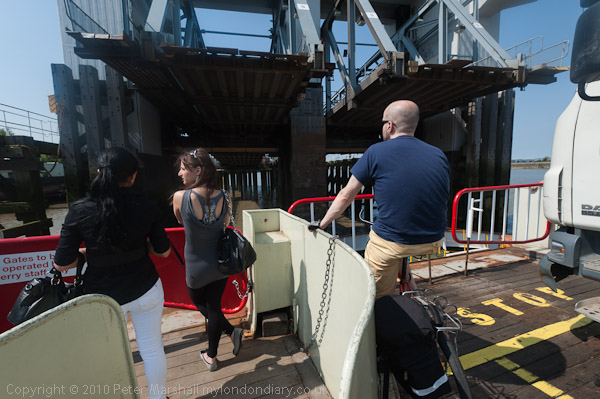
Ford Ferry, Pier, River Thames, Belvedere, Bexley, 1994, 94-805-22

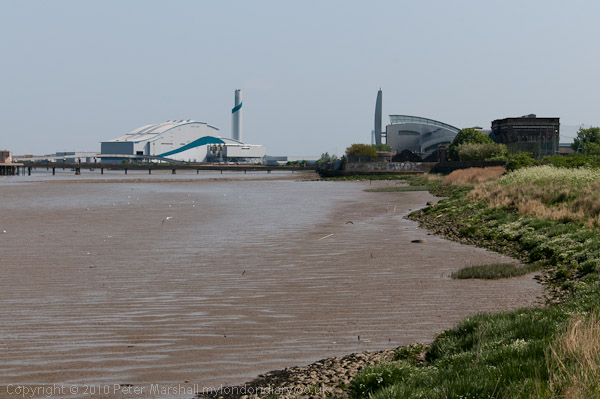
Ford at Dagenham was just on the opposite bank of the Thames, with a Ford ship moored in front of it and some ominous black smoke rising.

But although the Ford was only around 600 metres away, the fastest route for workers driving from here to the factory was around 15 miles. Taking the Woolwich ferry would take a couple of miles off this, but be slower.

Ford Ferry, Pier, River Thames, Belvedere, Bexley, 1994, 94-802-11

Many of Ford’s workers did live south of the river, either in Thamesmead or further away, and Ford provided a large suppposedly secure car park here from which they could walk down the pier to the Ford Ferry to take them across the river.

Ford had come to Dagenham in 1929 and opened the factory in 1931. They set up the private ferry for workers living in Kent in 1933. In its heyday it made 50 crossings a day taking as many as 1,500 workers to and from the plant, but after vehicle production ended with the plant turning to making engines it was only taking around 240 across and Ford discontinued it in 2003. Eventually they were forced to pay around half a million in compensation and to provide a bus service instead.

Much earlier there had been a Pilgrims ferry from Rainham to Erith, for pilgrims on their way to Canterbury, said to have begun in 1199 and to have continued in use until the mid 1950s.

Riverside Path, River Thames, Belvedere, Bexley, 1994, 94-802-12

Around here I turned back towards Erith, taking some more pictures on my way (some of which were included in my previous post.)

Riverside Path, River Thames, Belvedere, Bexley, 1994, 94-802-13

I can’t now remember exactly where on the path this was, but I think I walked all the way back to Erith and to the station there.

Penny's Cafe, Motor Auctions, Erith, Bexley, 1994, 94-803-32
Penny’s Cafe, Motor Auctions, Manor Road, Erith, Bexley, 1994, 94-803-32

Finally from that day in Erith, one I took earlier around the start of my walk but failed to post previously. Manor Road leads out east from Erith and was then an industrial area.

This Café (and Motor Auctions) had also clearly once been a factory and still catered for workers in nearby factories. Facebook posts say it had been an engineering factory called Ivor & Jettage, that the café was full of boxing photos and that its yard, used for motor auctions and later car boot sales on Sundays, was in 2024 a scaffolding yard. But I have been unable to confirm this.

Nathan Way, Plumstead, Greenwich, 1994, 94-806-52

A few days after my Erith walk I was back not far away in Plumstead, and made just a handful of colour images including these three.

This picture was made from The Ridgeway a foot and cycle path on top of the Southern Outfall Sewer from Plumstead to Crossness. Nathan Way runs for around 600 metres just to the north of this and most industrial sites along here were demolished by 2015 and are being replaced by a huge estate of blocks of flats, Lombard Square, with 1,913 new homes. The first were finished in 2025.

Nathan Way, Plumstead, Greenwich, 1994, 94-805-24

Another image from The Greenway not far from where I made the panorama above. From 1888-90 here or close by Royal Arsenal football team played here at what became the Manor Ground. They moved next to Woolwich, becoming Woolwich Arsenal but soon found the rent there too high and moved back. They played their last game here in 1913 before moving to Highbury in North London – and of course losing the Woolwich.

Some industry remains at the east end of this stretch of Nathan Way but I’m not sure this includes any in my picture.

Panoramic, Double Glazing, Nathan Way, Plumstead, Greenwich, 1994, 94-806-31

Nathan Way is a long road leading from Plumsteaad to Thamesmead and I think this may have been on the corner with Kellner Road.. But the name repeated on the lorry and the large modern shed behind as well as on what was perhas a small shed in the foreground was unmissable. I just had to make a Panorama.

Tony's Snack Bar, Nathan Way,  Plumstead, Greenwich, 1994, 94-805-26
Tony’s Snack Bar, Nathan Way, Plumstead, Greenwich, 1994, 94-805-26

I think the building at left it 115 Nathan Way, now occupied by Hydraquip Hose & Hydraulics, while behind are the roofs of Belmarsh Prison. But the picture is about the mobile snack bar here and the neat empty row of six white chairs for its then non-existent customers.

My walk continued on into Thamesmead but although I took quite a few black and white pictures I can’t at the moment find any more colour – and perhaps I took none.


FlickrFacebookMy London DiaryHull PhotosLea ValleyParis
London’s Industrial HeritageLondon Photos

All photographs on this page are copyright © Peter Marshall.
Contact me to buy prints or licence to reproduce.


More From the Riverside – 1994

More From the Riverside: More pictures from my walk by the River Thames at Erith and Belvedere on Monday 1st August 1994 to its end in Plumstead.

My previous post from this walk, Thames Riverside – Erith 1994 ended as I approached the Erith Oil Works jetty. The path here climbs up to go over the roadway from the jetty into the works which provided some good views of the jetty,

Jetty, River Thames, Erith Oil Works, Erith, Bexley, 1994, 94-802-52
Riverside Path, River Thames, Erith Oil Works, Erith, Bexley, 1994, 94-804-23
Riverside Path, River Thames, Erith Oil Works, Erith, Bexley, 1994, 94-802-42

Looking upstream from the bridge over the roadway from the jetty to Erith Oil Works – the tanks at left are part of the oil works site.

Jetty, River Thames, Erith Oil Works, Erith, Bexley, 1994, 94-804-21

I continued along the path, looking back to take another view of the jetty

Bulk Carrier Tecumseh, Jetty, River Thames, Erith Oil Works, Erith, Bexley, 1994, 94-804-32
Bulk Carrier Tecumseh, Jetty, River Thames, Erith Oil Works, Erith, Bexley, 1994, 94-804-53

This whole shoreline was once lined by industrial sites with their own jetties, by 1994 mainly like this now derelict and shortened.

Riverside Path, River Thames, Belvedere, Bexley, 1994, 94-805-45
Riverside Path, River Thames, Belvedere, Bexley, 1994, 94-805-32

Looking inshore there will still industrial sites, but much no longer relying on the river, though there were still some like the aggregate works that still had working jetties.

Jetty, Riverside Path, River Thames, Erith, Bexley, 1994, 94-802-43

Another disused jetty a short distance upstream from the Oil Works.

Wharf, Mulberry Way, Riverside Path, River Thames, Belvedere, Bexley, 1994, 94-805-31

Sheds and neat stacks of orange and green boxes at a wharf – now serviced by road – at Mulberry Way. This gets its name from the temporary portable floating harbours some of which were constructed here in 1944 by Nuttall Brothers and towed to the French coast after D-Day to land supplies for the Allied invasion. Two temporary harbours were constructed on the Normandy coast; one only lasted a few days before being destroyed by a storm but that at Arromanches remained in use for 10 months.

Wharf, Mulberry Way, Riverside Path, River Thames, Belvedere, Bexley, 1994, 94-802-33

A panoraamic view from the same viewpoint as the previous image. I had climbed up on the wide concrete flood defence wall here to make the picture. The sky was filled with clouds, perfect weather for panoramic landscapes.

Remains of wharf, Riverside Path, River Thames, Belvedere, Bexley, 1994, 94-802-21

I kept walking along the riverside path, coming to these timbers which would once have supported a long landing stage on a wharf with a short jetty into deep water. Across the river you can see Tilbury Docks at the left of the picture, with the blue hull of a ship there and some cranes, and further towards the centre the chimney and turbine hall of East Tilbury Power Station.

The horizon, dead centre in the picture is straight but as you move further down in the picture the curvature produced by the cylindrical perspective become more and more apparent. The path at left is straight and it remained straight to where I was standing to take the picture and beyond. Usually I tried to compose photographs so that this curvature was less apparent, but here I rather liked the effect.

I was working with two swing lens panoramic cameras (and two ‘normal’ SLR cameras.) Normal wide-angle lenses use rectilinear perspective become unusable with a horizontal angle of view of around 90 degrees as the distance from the centre of the lens to the film increases as light travels to the edges of the frame, increasing the size of image objects. The curved film plane in a swing lens camera keeps the lens centre to film distance constant so objects are recorded at the same scale across the image. Of course the wooden posts get smaller in the image the further away they are from the camera.

Riverside Path, River Thames, Belvedere, Bexley, 1994, 94-802-23

The curvature is much less apparent in this image taken a few minutes later and a few yards further upstream. But the shadow at bottom left as actually the shadow of the same straight flood wall as the larger shadow at the right.

Both of the panoramic cameras I had gave images with a horizontal angle of view of somewhere around 130 degrees.

I’ll post more pictures from this walk later. More pictures also in my Flickr album 1994 London colour – and you can see these images larger there by clicking on them in this post.


FlickrFacebookMy London DiaryHull PhotosLea ValleyParis
London’s Industrial HeritageLondon Photos

All photographs on this page are copyright © Peter Marshall.
Contact me to buy prints or licence to reproduce.


1995 Colour – Part 1

1995 Colour – Part 1: The first of a series of posts on my colour work, mainly in London, from 1995, 35 years ago and when I’d been working extensively with colour negative film for ten years, though still continuing to work with black and white.

1995 Colour - Part 1
Car Wash, St Paul’s Cray, Bromley, 1995, 95c01-122

Although I’d always taken both colour and black and white photographs since I began in photography, black and white had dominated my work. It was still the serious side of photography in the 1970s; almost all gallery shows then were black and white, and most publications were still only printed in monochrome, including photographic magazines, although some occasionally had a few colour pages.

1995 Colour - Part 1
Frost & Smith, Accident Repairs, Cray Rd, Bexley, 1995, 95c01-123

And back then, almost all professional colour was taken using colour slide film such as Ektachrome and Kodachrome. Films were mainly sold inclusive of processing and you sent away your exposed film and a few days later s box of slides came back through the post. Professionals might use Ektachrome and take it to a lab for processing, but that worked out more expensive, though you could get the results in an hour or so.

1995 Colour - Part 1
St Paul’s Cray, Bromley, 1995, 95c01-132

I was interested in colour but in the early years took far fewer colour images, largely because of the cost, though I did cut this down by buying colour film in bulk and home processing, though this needed much tighter control of time and temperature than black and white and the results were not always quite as they should have been.

1995 Colour - Part 1
Hi-Q, Tyres, Sevenoaks Way, St Paul’s Cray, Bromley, 1995, 95c01-133

Most photographers at the time felt that colour negative film was only for amateurs, but two things changed that for me. One was my frustration with transparency film which simply could not handle many of the high contrast scenes I was interested in, giving impenetrable shadows where I wanted detail and the second was seeing some prints produced by another photographer, printed on Fuji paper.

1995 Colour - Part 1
Opticians, Walthamstow, 1994, Waltham Forest, 95c01-141

There was a clarity about the colours that this paper gave when compared with Kodak, Agfa and the others, but the other great advantage was that there was little or no colour shift with exposure. This meant that I could dodge and burn prints with a similar creative control to working with black and white.

Chinese Takeaway, Hoe St, Walthamstow, 1994, 95c01-155

Some time early in 1985 I made the decision to switch entirely from transparency to negative for all of my personal colour work.

Belvedere, Bexley, 1994, 95c01-161

This post is the first of a number which will show some of my colour images from 1995.

Belvedere, Bexley, 1994, 95c01-163

These pictures were all made in December 1994 or January 1995 with some 1994 images only being processed in January 1995.

War Memorial, Callender’s Cables, Church Manorway, Belvedere, Bexley, 1994, 95c01-165

I’ll publish more in later posts, perhaps also including some of the colour panoramas I made. There is much more of my colour work on film in a number of Flickr albums.


FlickrFacebookMy London DiaryHull PhotosLea ValleyParis
London’s Industrial HeritageLondon Photos

All photographs on this page are copyright © Peter Marshall.
Contact me to buy prints or licence to reproduce.