End Slave Auctions in Libya – 2017

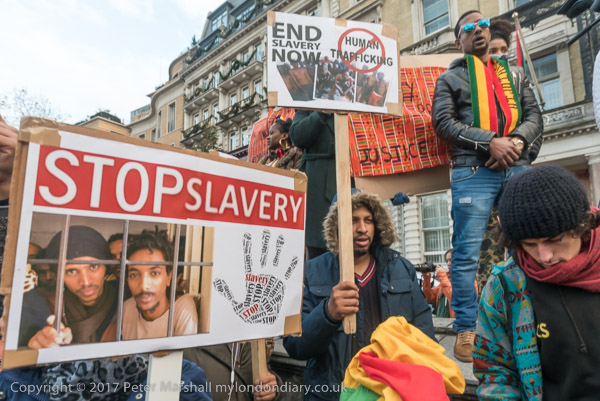
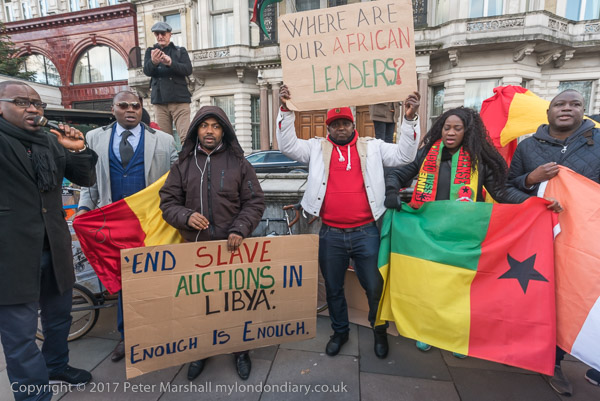
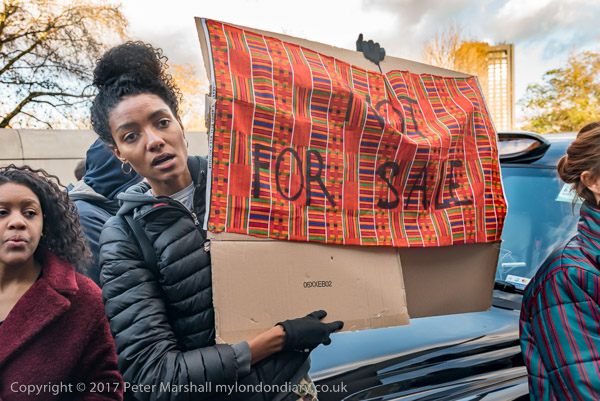
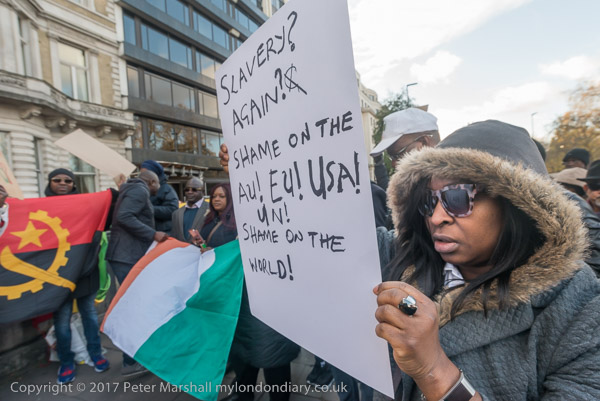
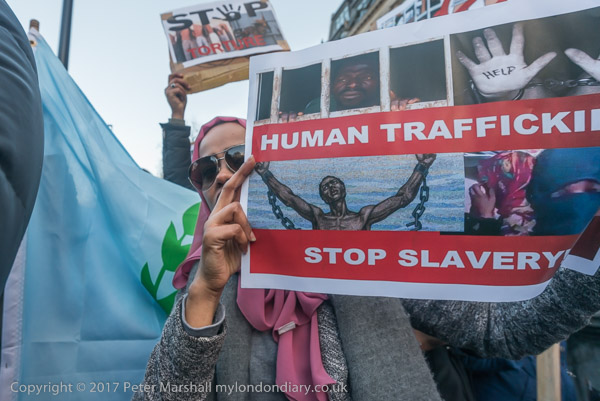
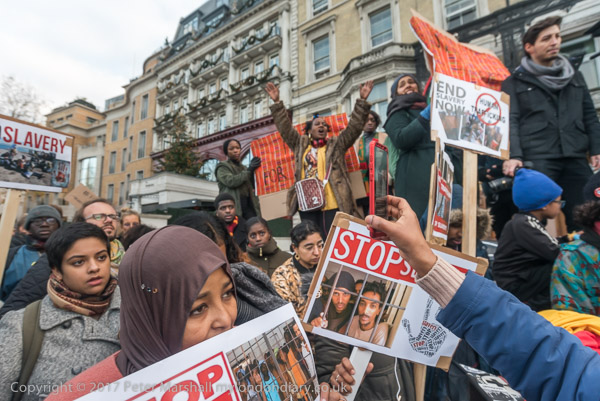
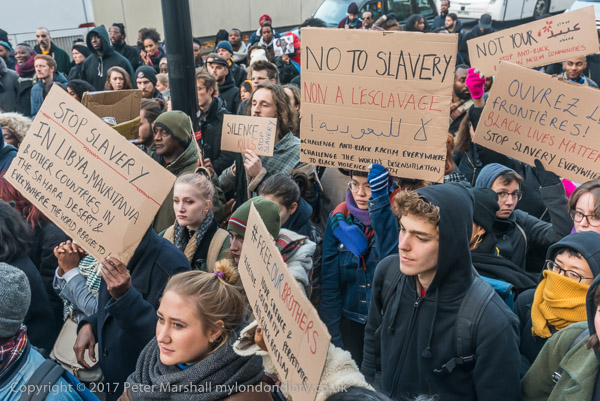
End Slave Auctions in Libya: On Sunday 26th November 2017 a large protest outside the Libyan Embassy in Knightsbridge called for an end to the slave auctions of Black African migrants in Libya.

End Slave Auctions in Libya - 2017

The protest came following a number of reports earlier in the year showing migrants being sold as slaves in Libya. The situation had worsened since the EU clampdown on migration across the Mediterranean, working with the Libyan authorities to intercept and tow migrant boats back to be detained in Libya.

End Slave Auctions in Libya - 2017

This clampdown had resulted in around 20,000 people, mainly from the Afgrican continent being detained in inhumane conditions in Libya, where many were being held with ransom demands being made from their families and others sold into slavery.

End Slave Auctions in Libya - 2017

As Wikipedia notes, Libya has a history of slavery dating back into antiquity with slaves from across the Sahara being sold there along with Berbers (the pre-Arab residents of the area), Jews and Europeans captured in Barbary slaving raids around the Mediterranean and as far north as Ireland, Scotland and even Iceland.

End Slave Auctions in Libya - 2017

The slave trade was made illegal by a decree in Tripoli in 1857, but this had little practical effect for many years and it was only under Italian rule in the 1930s that it was largely brought to an end.

End Slave Auctions in Libya - 2017

As I wrote in 2017, “Many at the protest saw the situation in Libya as part of a continuing neo-colonialist attempt to control Africa’s natural resources which results in the instability and mass migration from African countries, and that the current Libyan regime are western puppets installed though Western intervention to replace the genuinely nationalist Gaddafi regime and are engaged in a process of de-Africanisation and elimination of Black Libyans, of which slave auctions are a logical extension.”

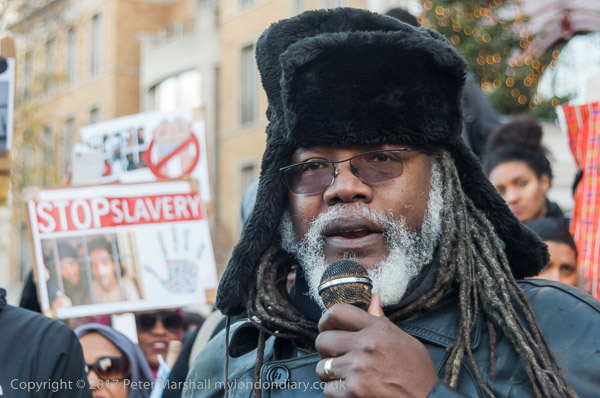
Glenroy Watson of the Global African Congress and RMT

As Wikipedia points out, since Gaddafi was brought down in 2011, Libya “has been plagued by disorder, leaving migrants with little cash and no papers vulnerable.

Slaves in the past were kidnapped by raiders, but now they pay people smugglers to be brought to Libya, lured by the promise of being taken to a new life in Europe, but once in Libya are detained by the smugglers and local militias and subjected to torture, forced labour and sexual violence.

If ransoms are not paid they may be left to starve to death in detention. State security forces are also responsible for similar crimes against humanity for those returned from boats setting out across the Mediterranean, and the EU contributes by giving support to these forces.

Although the fate of migrants has seldom featured in our news media since 2017, little if anything has changed, as the 2025 report, The Scandal of a Slave Market in Libya from the Human Rights Research Center makes clear.

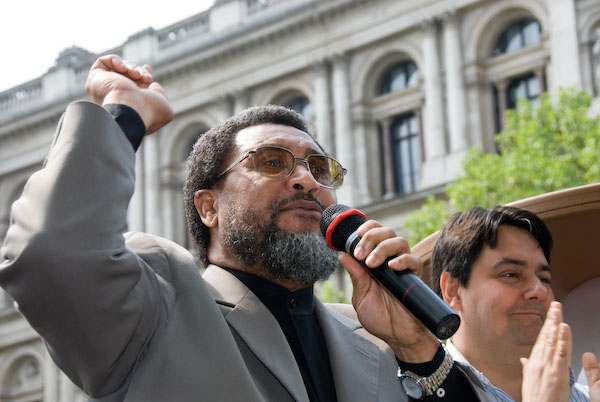
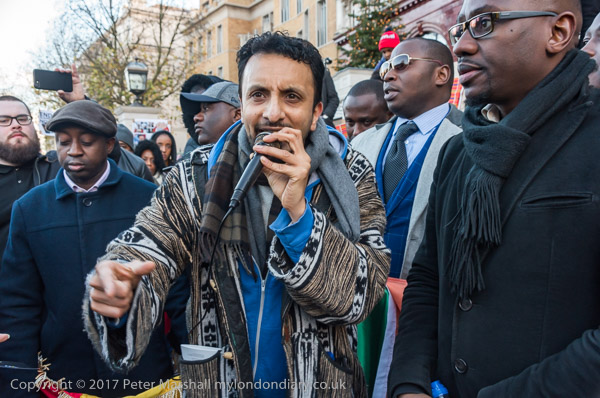
Sukant Chandan, a coordinator at the Malcolm X Movement, speaks from his experience in working with the opposition forces in Libya, and says how those currently in power in Libya have long carried out a policy of getting rid of Black Africans. He calls them a puppet government put into power to protest Western interests in Libya’s mineral wealth.

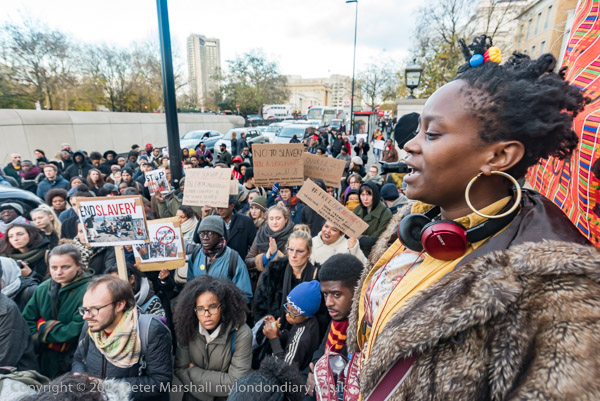
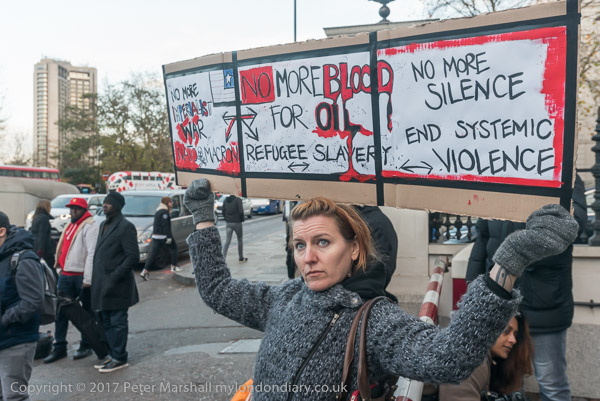
The area outside the Libyan Embassy soon became very crowded, with people lining the pavement for some distance in each direction and some spilling out onto the busy road. When I had to leave after approaching an hour and a half there were people still arriving and it took me several minutes to make my way through the crowd. I took a final picture of a woman holding a large poster on the edge of the protest on my way to Hyde Park Corner.

On My London Diary you can see more pictures, including some of the other speakers at the event.

End Slave Auctions in Libya


FlickrFacebookMy London DiaryHull PhotosLea ValleyParis
London’s Industrial HeritageLondon Photos

All photographs on this page are copyright © Peter Marshall.
Contact me to buy prints or licence to reproduce.
Carnival of Dirt – 2012

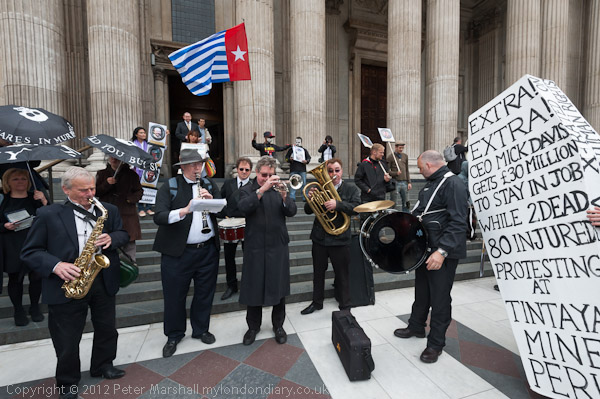
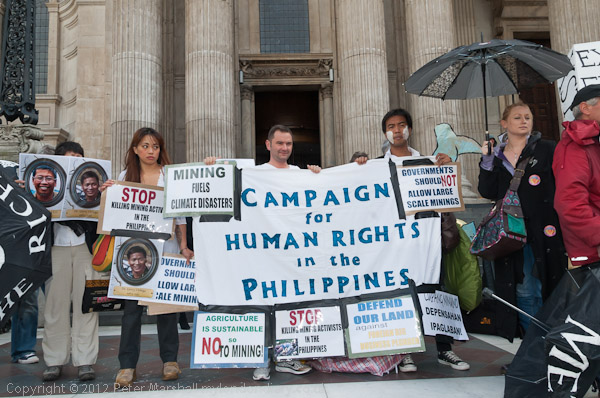
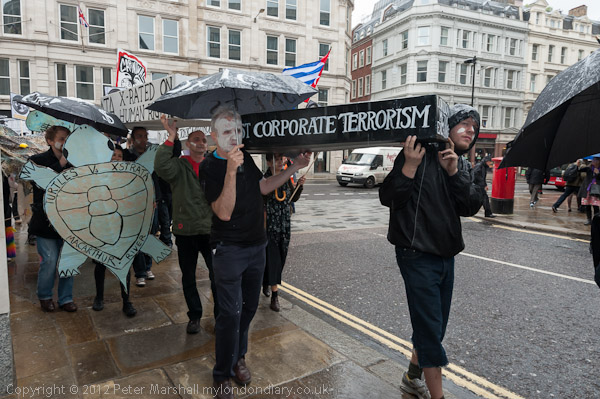
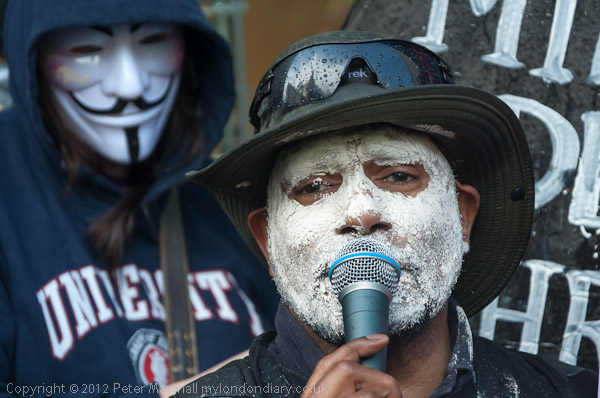
Carnival of Dirt: People from more than 30 activist groups from London and around the world met on the steps of St Paul’s Cathedral on Friday 15th June 2012 for the Carnival of Dirt, a funeral procession for the many killed by mining and extraction companies, powerful financial organisations whose crimes are legitimised by the City of London.

Carnival of Dirt
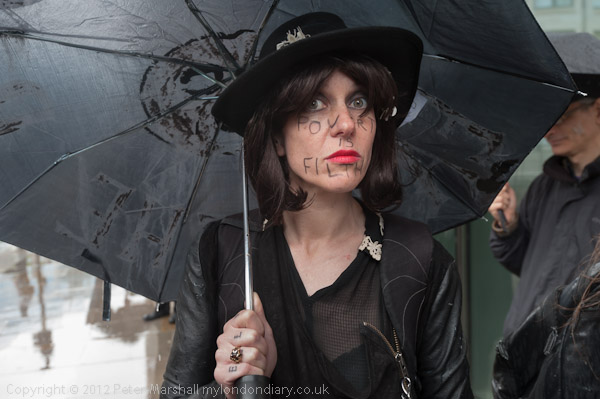
‘POVERTY IS FILTHY’

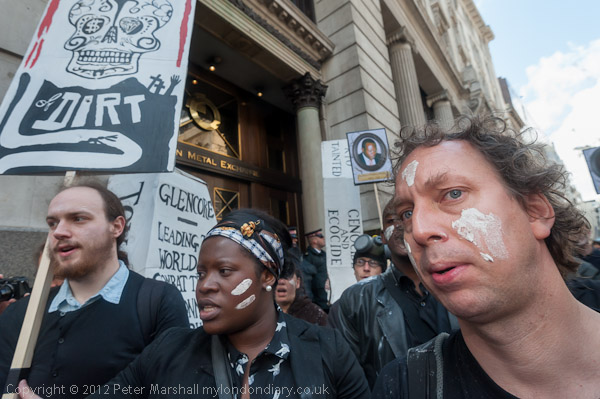
Although little mining now goes on in the UK, London remains the mining capital of the world with many of the largest and most powerful mining and extraction companies listed on the London Stock Exchange and trading on the London Metal Exchange. The Carnival of Dirt named some of them as major criminals, including Xstrata, Glencore International, Rio Tinto, Vedanta, Anglo American, BHP Billiton, BP and Shell.

Carnival of Dirt

Many activists around the world have been murdered for standing up against the interests of these companies, whose greed has led to crimes against humanity on a huge scale around the world. As I wrote in 2012, “They lie behind the millions who have died in wars in the Congo and elsewhere, behind the torture and rapes and other human rights abuses that are used to drive people off their land, behind the huge areas of land poisoned by toxic wastes, forests and whole mountains destroyed, ecocide on a truly massive scale.”

Carnival of Dirt

Many of these crimes have been well-documented but these companies are still supported by our pension schemes and protected by our government, as well as being allowed to get away with avoiding or evading millions or billions of pounds in UK taxes.

Carnival of Dirt

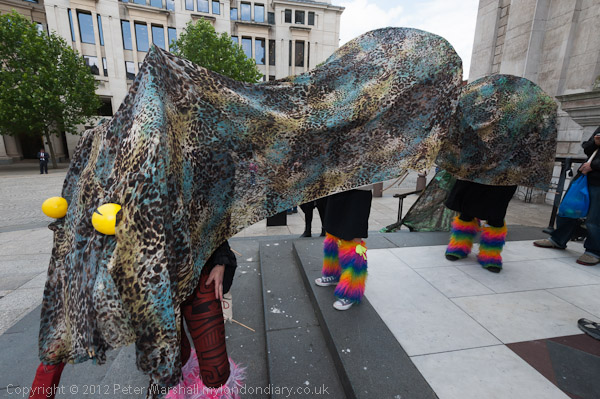
Many of those who came to the carnival were dressed in black, and the funeral procession had a New Orleans style theme. The cortège “included a large snake, a turtle and a tortoise, a reminder of XStrata’s criminal diversion of the McArthur River, destroying the ecosystem and despoiling the sacred sites of Australian aborigines.”

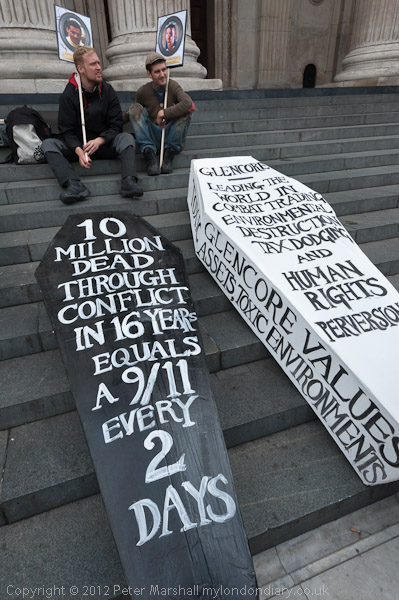
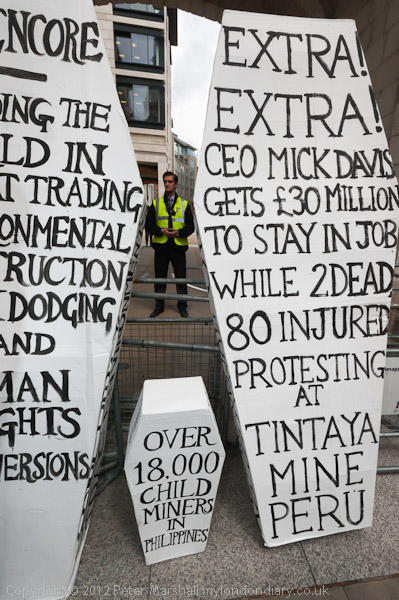
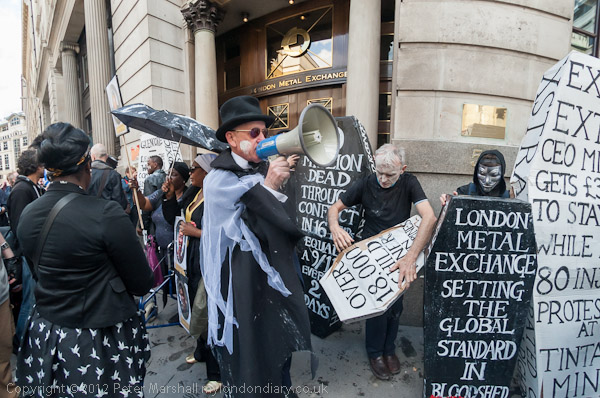
There were a number of coffins to represent the dead, naming some of the companies involved with messages such as ‘Glencore Values – Toxic Assets, Toxic Environments‘. Another read ‘XStrata – X-Rated on Human Rights‘ and pointed out the CEO Mick Davis “Gets £30 million to stay in job while 2 Dead 80 Injured protesting at Tintaya mine in Chile.’

The more than 18,000 child miners in the Phillipines were represented by a small coffin. One read ‘10 Million Dead Through Conflict in 16 years equals a 9/11 every 2 days‘. Red drops for blood ran down the side of a black coffin with the messages ‘Resist Corporate Terrorism’ and ‘London Metal Exchange – Setting the Global Standard in Bloodshed‘ . Another coffin testified to the genocide in West Papua where Indonesian troops have torched villages.

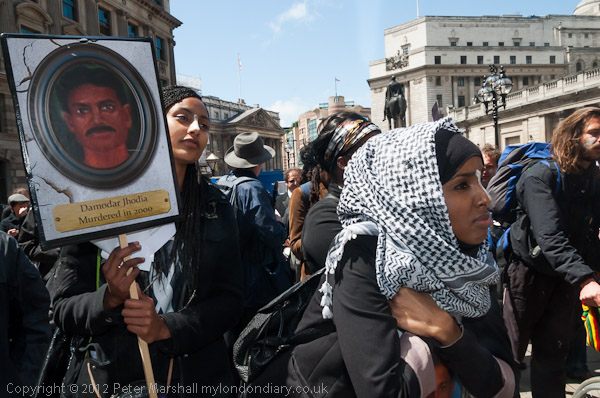
Some of the protesters walked with photographs of a few of the better-known activists murdered for standing up to corporate terrorism, and a leaflet named some – “Valmore Locarno, Fr Fausto Tentorio, Victor Orcasita, Alexandro Chacon, Fr Reinel Restropo, Dr Gerry Ortega, Armin Marin, Dr Leonard Co, Elizer Billanes, Jorge Eliecer, Floribert Chebeya, Raghunath Jhodia, Abhilash Jhodia, Damodar Jhodia, Petrus Ayamiseba.” Other placards showed unnamed and horribly mutilated victims.

After brief speeches the procession moved off from St Paul’s towards the Stock Exchange behind the marching band, but they were blocked by barriers and private security staff at Temple Bar, preventing them going into the now privatised Paternoster Square. After a short protest there it moved off, walking along public streets to the north entrance of the Stock Exchange on Newgate Street.

The entrance was blocked by a line of police but the protesters stopped from a short rally, listening to a speech by Benny Wenda who managed to escape to the UK after being arrested, imprisoned and tortured by Indonesian troops. There were heavy showers and we all got rather wet, though some protesters were fortunate to be carrying black umbrellas with slogans on them; the slogans ran in the rain but the umbrellas kept those underneath rather drier.

From there the cortège moved on to protest in front of the Bank of England, where there were several speeches from researchers and activists. From there we moved to a final rally at the London Metal Exchange, where we heard a longer exposition of the various trading activities which cause a great deal of death and unnatural disaster across the globe.

The came a reading of the names of some of the prominent murdered activists, each name being followed by the protesters shouting ‘Present’ or the Spanish ‘Presente’ to show they were still a part of the living, in the hearts and minds of those mourning them. At the end of the list there was a two-minute silence in the memory of them and the millions of others killed for the profits of the mining companies. After throwing ashes at the building the procession continued to its finish at Altab Ali park.

By this time I was very wet, and so were my cameras and lenses, with condensation steaming up on inner glass surfaces. Many of the later images were taken with a wideangle fisheye, a single focal length lens that was more resistant than the two zooms I use for most of my work. I was tired and needed to get somewhere to dry out, so while many were planning to go on to further protests in Green Park and on the Embankment it was time for me to go home.

More pictures on My London Diary at Carnival of Dirt.