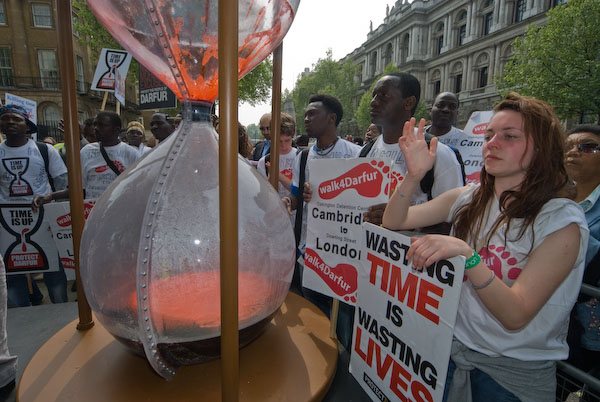
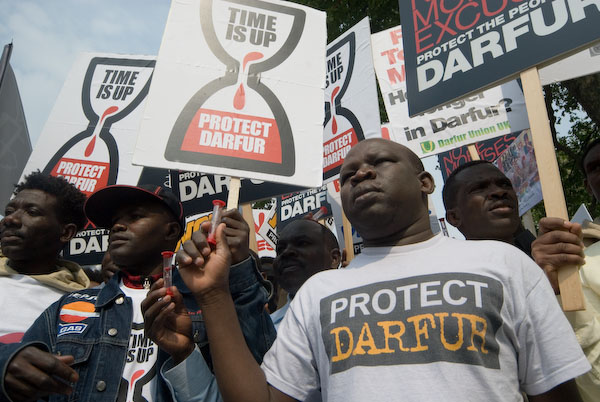
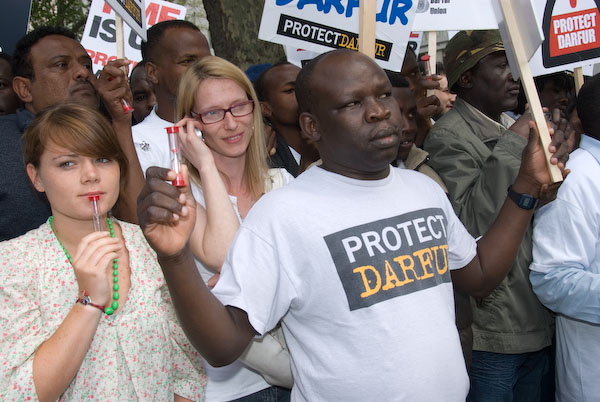
Darfur – International Day of Action: There have been protests in London against the continuing bloodshed in Sudan in recent months and the situation there is increasingly desperate. But as Wikipedia points out, there have been civil wars in Sudan “intermittently ongoing for more than 70 years“.
The War in Darfur began in 2003 with two groups, the Sudan Liberation Movement (SLM) and the Justice and Equality Movement (JEM) fighting against the Sudanese government of Omar-al-Bashir. They accused him of ethnic cleansing against non-Arabs in Darfur, and his response was to ramp up a campaign of genocide, war crimes, and crimes against humanity.
One of the major forces on the government’s side was a militia group, the Janjaweed and this has since developed into a coalition, the Rapid Support Forces, which is now fighting the Sudanese Army. The Holocaust Encylcopedia states “Between 2003 and 2008, armed conflict and targeted killings in Darfur caused about 300,000 civilian deaths and displaced about 2.7 million civilians.”
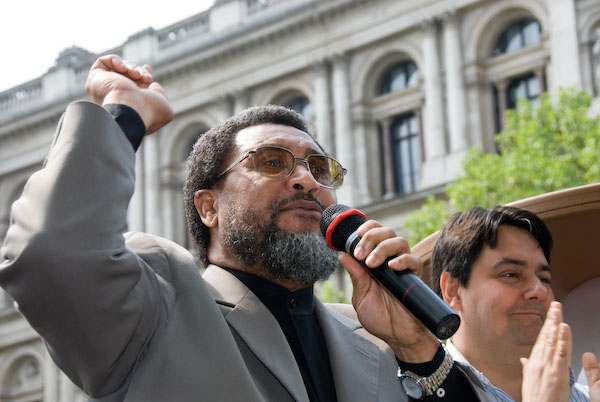
Daud Abdullah, Deputy Secretary General, Muslim Council of Britian
The Sudanese government and the JEM signed a ceasefire agreement in 2010, although this was soon violated by government forces and the fighting continued. After the Sudanese Revolution of 2018 which led to the removal of al-Bashir from power in April 2019 there was a peace process that lead to a peace agreement in 2020.
Unfortunately conflicts continued in Sudan and in 2023 resulted in a still continuing civil war between the RSF and the Sudanese Army. By February 2026 more than 40,000 people had been killed, with aid agencies suggesting a much higher figure. Again according to the Holocaust Encyclopedia “The violence has led to the displacement of more than 12 million people, or one in three Sudanese. Nearly half of the population lacks access to adequate food, and famine has been declared in the Darfur and Kordofan regions.”
In 2007 I wrote:
“Sunday was the International Day Of Action For Darfur, and although the demonstration in London was a relatively small one – perhaps a thousand people – the organisers had really managed to capture media attention. While anti-war or other marches of this size or even 50 times larger don’t usually even rate a mention, this was a lead item on the morning’s radio news – and listeners were even perhaps uniquely told when and where it was happening.
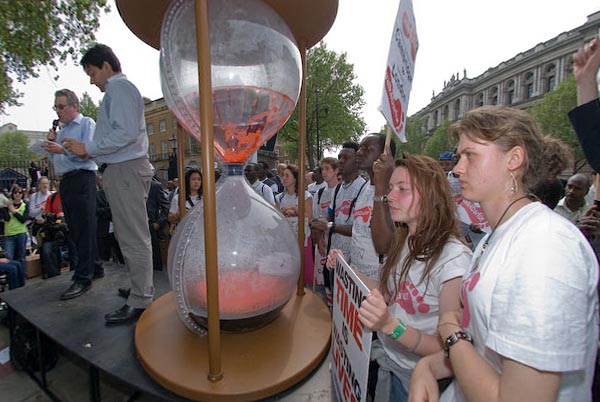
I don’t begrudge the publicity in any way. The situation is a world scandal and disaster and one that the nations are avoiding effective action on. As the posters, and the hour-glasses large and many small insist, time is running out, the blood is running out and time is up for Darfur.
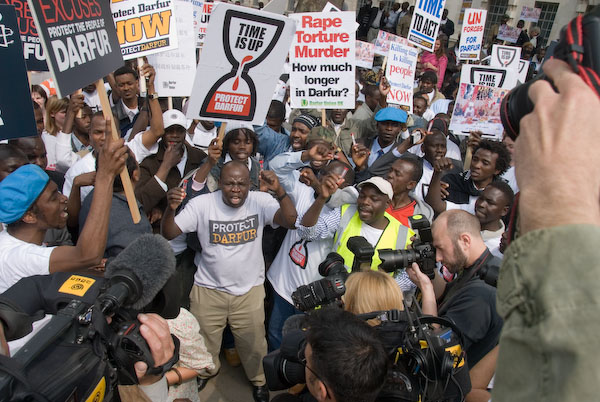
“It’s just a shame that the media in general choose to turn their backs on other events. But today you could hardly move for TV cameras and photographers from what used to be Fleet Street. those freelances who cover the other demonstrations, small and large, that the papers and TV don’t want to know about were also there of course.
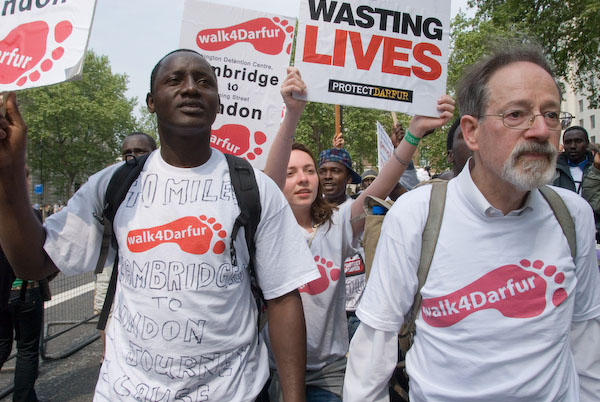
Holocaust survivor Martin Stern leads the Cambridge to London ‘Walk 4 Darfur’ into the London rall
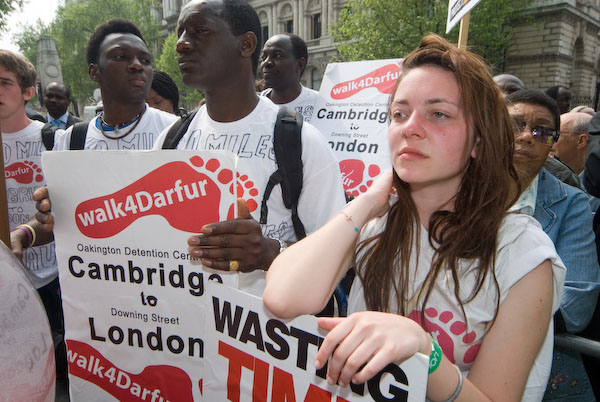
“For me the most interesting aspect of this actual event was the arrival of the group of students and others who had marched from Oakington detention centre near Cambridge to raise awareness about Darfur (and about refugees held there who are from Darfur.) By the time they arrived, most of the media had left. Perhaps they were too much like ordinary demonstrators (and too much like those cyclists who came from Faslane earlier in the month to publicise the treatment of Mordechai Vanunu.)”
Political Policing & Shocking Lies: Last Saturday, 19th January 2025 I was witness to a shameful display of aggressive and politically motivated policing in the centre of London.
Politics had come into the event days earlier when police had banned the National Protest for Palestine from gathering at the BBC to march to Whitehall on the less than flimsy pretext that there is a synagogue around three hundred yards away.
The synagogue in question is down a side street and in the opposite direction that the march would travel, and none of the previous over 20 national marches for Palestine has involved any violence or intimidation of Jews.
Anti-Zionist ulltra-orthodox Neturei Karta Jews
Police harass a group of holocaust survivors and families, telling them they must move further up Whitehall.
Many Jews have taken part in all of these marches and other protests against the killing in Gaza and the continuing repression in the occupied West Bank, calling for freedom for Palestinians. And all of the marches since the Hamas attack on Israel have called for the release of the hostages held in Gaza as well as for a solution to bring peace and justice to Palestine.
To meet the police objections the march organisers had offered to march in the opposite direction, meaning they would arrive at the BBC several hours after any of those attending the synagogue would have left. Police rejected this offer and instead proposed that the march would start in Russell Square. Since the march was in large part a protest against the biased coverage of events by the BBC.
In their thoroughly researched report published in March 2004, the Centre for Media Monitoring clearly showed the extent of pro-Israel bias in BBC reporting, for example in giving considerable publicity to unverified statements by Israeli official sources, many of which have later been found to be false, as well as deliberately calling into question statements from Palestinian sources.
The report is a long and careful study and should at least have meant considerable changes in the way that the BBC covers events if it values its claim to be impartial, but any changes have been minor. The organisation continues to heap doubt on the claims over the number of deaths of Palestinians despite these largely being confirmed as accurate by UN and other observers – and a recent peer-reviewed statistical analysis in The Lancet suggesting that the actual number of deaths are 40% higher than the official Gaza health ministry figures.
Peter Tatchell calls for the release of all Palestine political prisoners.
When their reasonable suggestion was turned down by the police, the march organisers announced they would instead hold a rally in Whitehall. Clearly the police were not happy at this but it would have been difficult for them to raise any legally sustainable reason to ban it.
So the rally went ahead, and I went to photograph it. Entering Whitehall I was stopped for a short time as policed parked a van to make access more difficult but managed to walk past. Others coming to the protest were actually stopped by police and had to walk around to enter Whitehall by side streets.
‘BBC Complicity’ is Orwellian.
Inside Whitehall there seemed to be a number of lines of police giving contradictory orders to people to move up or down the street. I watched with incredulity as a group of officers came to tell a small group of Jewish holocuast survivors and sons and duaghters of survivors they could not stand at the side of the road in front of the stage but had to move further away up Whitehall.
Then I hear shouting from a crowd by the side of the stage. A particularly aggesive squad of police was forcing them to move and had arrested one woman who had not obeyed there orders, thowing her to the ground. The protesters were shouting ‘Let Her Go, Let Her Go‘ but they didn’t, simply facing the crowd aggressively and promising further arrests. A second slightly less aggressive squad was similarly forcing people along past the other side of the compound around the stage.
There seemed no point to either of these squads other than to stage a little police aggession. A few minutes later they left the area and people were free to wander into the areas they had cleared – and a group set up a large display with children’s clothing hung on washing lines.
At the end of the rally the speakers including one of the holocaust survivors, MPs John McDonnell and Jeremy Corbyn and representatives of other groups involved in the protest came to stand on the stage holding bunches of flowers for two minutes of silence.
It was then announced that this small group of delegates would attempt to march to lay flowers at the BBC, but if stopped by police they would lay down the flowers where they were stopped in front of the police line and accuse them of being complicit in the lies told by the BBC and our government in support of the genocide taking place in Gaza.
The protesters in the huge crowd in Whitehall were asked to move to the side to make way for this group, and people did until they had almost reached Trafalgar Square. Here police stopped them and they waited patiently to see if they would be allowed through.
But thousands of protesters had moved up Whitehall with them, and those of us at the front were in danger of being crushed, slowly being pushed forwards by the crowd behind, but held back by police. The police withdrew and I managed to find some space inside the box of stewards where they had been in front of the marchers. Then in the only sensible action by police I saw that day, some officers returned to force a path and urge the marchers to go through into Trafalgar Square, and I went with them.
Marchers stop in front of the line of police and wait
I was rather shaken after being crushed and after taking a final picture of the march moving freely on towards Pall Mall I turned and walked slowly away towards Charing Cross station. Later I heard that the small delegation of marchers had decided to lay their flowers in Trafalgar Square when a snatch squad of ten police approached the head steward Chris Nineham and brutally threw him to the ground and arrested him. Their violence was totally unnecessary.
Police make way and tell the marchers to go through
Nineham was held for around 20 hours before being arrested on police bail which prevents him from taking part in any protest. His was one of 77 arrests made, many after the end of the protest when police kettled those still in Trafalgar Square. So far at least 13 have been charged, including Nineham and Ben Jamal, head of the Palestine Solidarity Campaign and both Jeremy Corbyn and John McDonnel have been interviewed under criminal caution.
and they march into Trafalgar Square unhindered.
Police were very quick to publish the lie that the marchers forced their way through the police line, and it was quickly picked up and amplified by the media despite video and eye-witnesses showing that they were urged and escorted though by officers.
Police told many other lies on the day, acted throughout aggressively and were clearly under pressure from members of the government and some Jewish leaders to do so. Many British Jews support Palestine and there were hundreds if not thousands of them taking part in the protest, far outnumbering a small group that came to oppose it.