Whitehall, Sunday 29 April, 2007
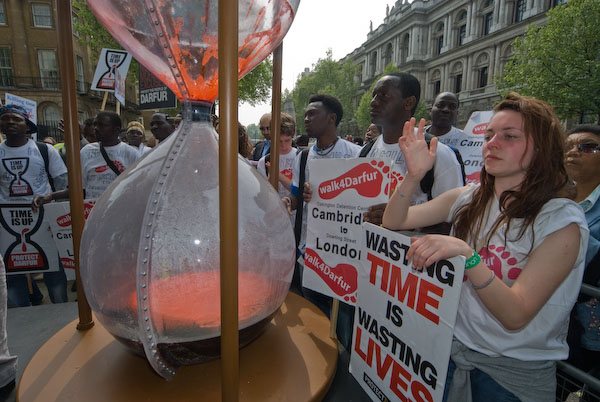
Darfur – International Day of Action: There have been protests in London against the continuing bloodshed in Sudan in recent months and the situation there is increasingly desperate. But as Wikipedia points out, there have been civil wars in Sudan “intermittently ongoing for more than 70 years“.
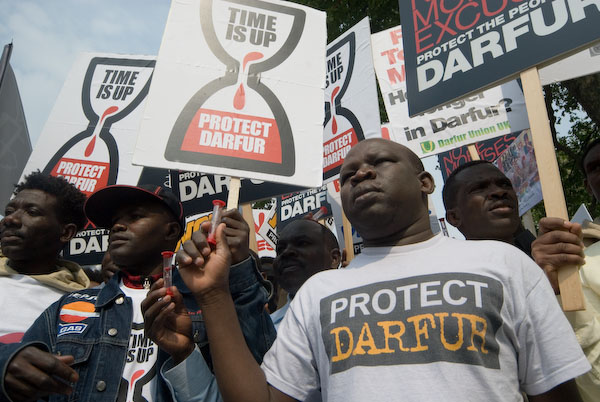
The War in Darfur began in 2003 with two groups, the Sudan Liberation Movement (SLM) and the Justice and Equality Movement (JEM) fighting against the Sudanese government of Omar-al-Bashir. They accused him of ethnic cleansing against non-Arabs in Darfur, and his response was to ramp up a campaign of genocide, war crimes, and crimes against humanity.

One of the major forces on the government’s side was a militia group, the Janjaweed and this has since developed into a coalition, the Rapid Support Forces, which is now fighting the Sudanese Army. The Holocaust Encylcopedia states “Between 2003 and 2008, armed conflict and targeted killings in Darfur caused about 300,000 civilian deaths and displaced about 2.7 million civilians.”
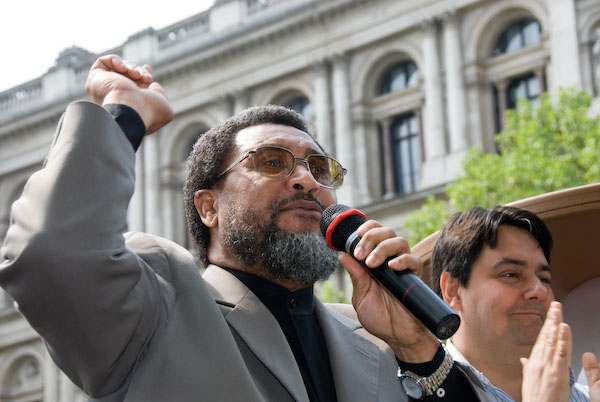
The Sudanese government and the JEM signed a ceasefire agreement in 2010, although this was soon violated by government forces and the fighting continued. After the Sudanese Revolution of 2018 which led to the removal of al-Bashir from power in April 2019 there was a peace process that lead to a peace agreement in 2020.
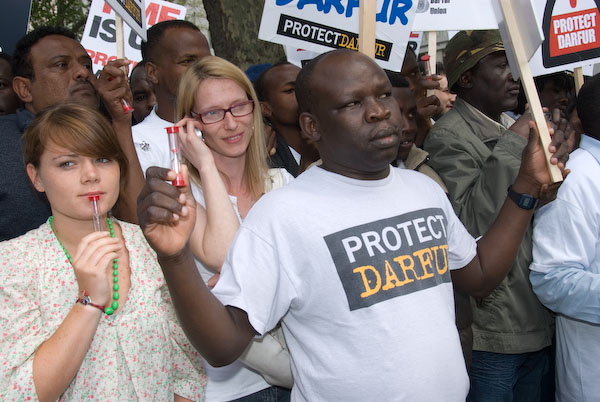
Unfortunately conflicts continued in Sudan and in 2023 resulted in a still continuing civil war between the RSF and the Sudanese Army. By February 2026 more than 40,000 people had been killed, with aid agencies suggesting a much higher figure. Again according to the Holocaust Encyclopedia “The violence has led to the displacement of more than 12 million people, or one in three Sudanese. Nearly half of the population lacks access to adequate food, and famine has been declared in the Darfur and Kordofan regions.”
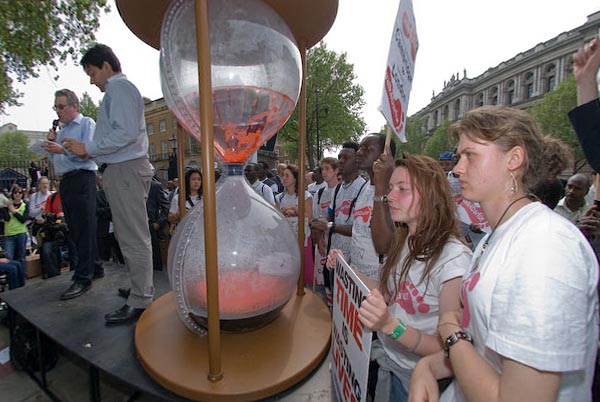
In 2007 I wrote:

“Sunday was the International Day Of Action For Darfur, and although the demonstration in London was a relatively small one – perhaps a thousand people – the organisers had really managed to capture media attention. While anti-war or other marches of this size or even 50 times larger don’t usually even rate a mention, this was a lead item on the morning’s radio news – and listeners were even perhaps uniquely told when and where it was happening.
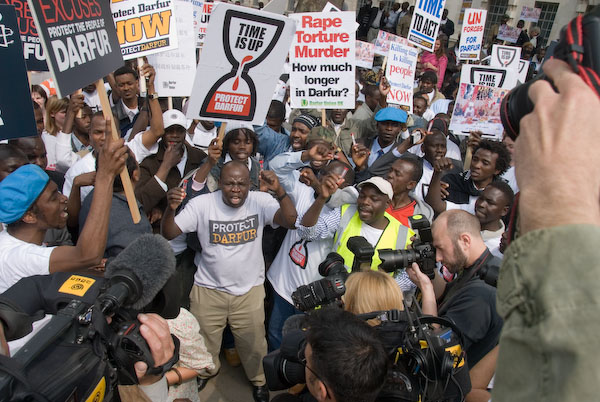
I don’t begrudge the publicity in any way. The situation is a world scandal and disaster and one that the nations are avoiding effective action on. As the posters, and the hour-glasses large and many small insist, time is running out, the blood is running out and time is up for Darfur.
“It’s just a shame that the media in general choose to turn their backs on other events. But today you could hardly move for TV cameras and photographers from what used to be Fleet Street. those freelances who cover the other demonstrations, small and large, that the papers and TV don’t want to know about were also there of course.
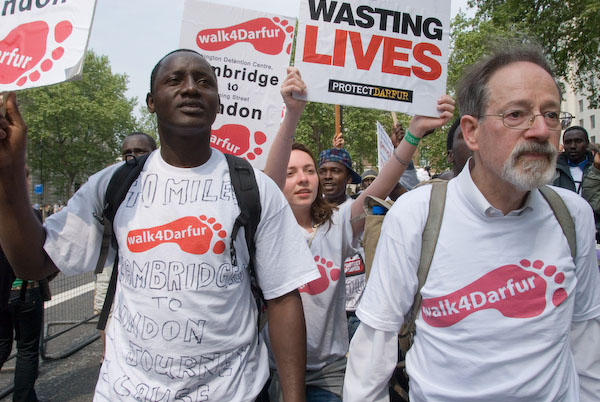
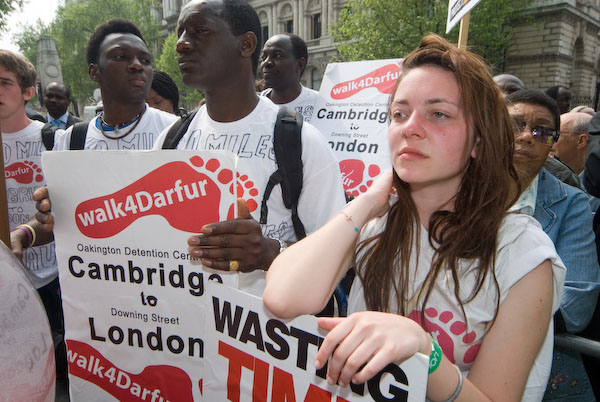
“For me the most interesting aspect of this actual event was the arrival of the group of students and others who had marched from Oakington detention centre near Cambridge to raise awareness about Darfur (and about refugees held there who are from Darfur.) By the time they arrived, most of the media had left. Perhaps they were too much like ordinary demonstrators (and too much like those cyclists who came from Faslane earlier in the month to publicise the treatment of Mordechai Vanunu.)”
More pictures on My London Diary.
Flickr – Facebook – My London Diary – Hull Photos – Lea Valley – Paris
London’s Industrial Heritage – London Photos
All photographs on this page are copyright © Peter Marshall.
Contact me to buy prints or licence to reproduce.