Darfur – International Day of Action – 2007

Whitehall, Sunday 29 April, 2007
Darfur - International Day of Action

Darfur – International Day of Action: There have been protests in London against the continuing bloodshed in Sudan in recent months and the situation there is increasingly desperate. But as Wikipedia points out, there have been civil wars in Sudan “intermittently ongoing for more than 70 years“.
International Day of Action for Darfur: London © 2007, Peter Marshall

The War in Darfur began in 2003 with two groups, the Sudan Liberation Movement (SLM) and the Justice and Equality Movement (JEM) fighting against the Sudanese government of Omar-al-Bashir. They accused him of ethnic cleansing against non-Arabs in Darfur, and his response was to ramp up a campaign of genocide, war crimes, and crimes against humanity.

International Day of Action for Darfur: London © 2007, Peter Marshall

One of the major forces on the government’s side was a militia group, the Janjaweed and this has since developed into a coalition, the Rapid Support Forces, which is now fighting the Sudanese Army. The Holocaust Encylcopedia states “Between 2003 and 2008, armed conflict and targeted killings in Darfur caused about 300,000 civilian deaths and displaced about 2.7 million civilians.”
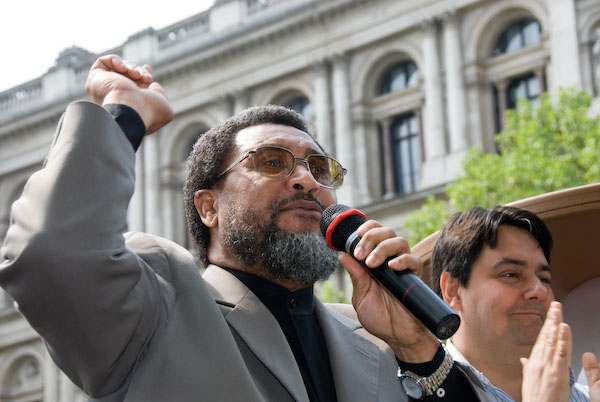
International Day of Action for Darfur: London © 2007, Peter Marshall
Daud Abdullah, Deputy Secretary General, Muslim Council of Britian

The Sudanese government and the JEM signed a ceasefire agreement in 2010, although this was soon violated by government forces and the fighting continued. After the Sudanese Revolution of 2018 which led to the removal of al-Bashir from power in April 2019 there was a peace process that lead to a peace agreement in 2020.
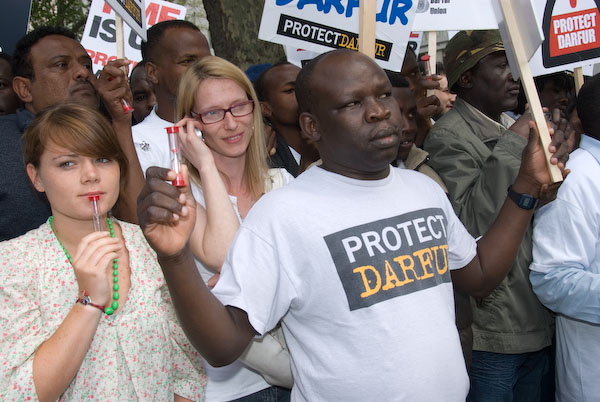
International Day of Action for Darfur: London © 2007, Peter Marshall

Unfortunately conflicts continued in Sudan and in 2023 resulted in a still continuing civil war between the RSF and the Sudanese Army. By February 2026 more than 40,000 people had been killed, with aid agencies suggesting a much higher figure. Again according to the Holocaust EncyclopediaThe violence has led to the displacement of more than 12 million people, or one in three Sudanese. Nearly half of the population lacks access to adequate food, and famine has been declared in the Darfur and Kordofan regions.”
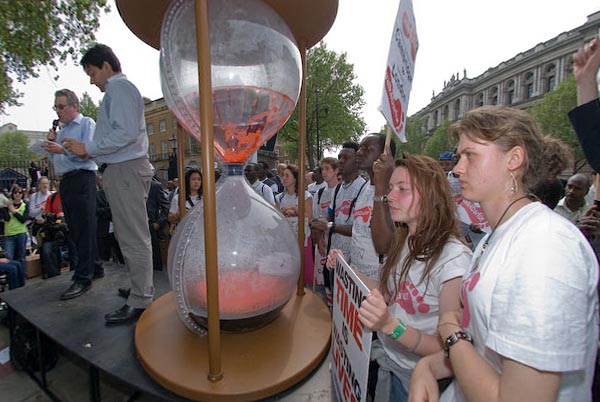
International Day of Action for Darfur: London © 2007, Peter Marshall

In 2007 I wrote:

Darfur - International Day of Action

“Sunday was the International Day Of Action For Darfur, and although the demonstration in London was a relatively small one – perhaps a thousand people – the organisers had really managed to capture media attention. While anti-war or other marches of this size or even 50 times larger don’t usually even rate a mention, this was a lead item on the morning’s radio news – and listeners were even perhaps uniquely told when and where it was happening.
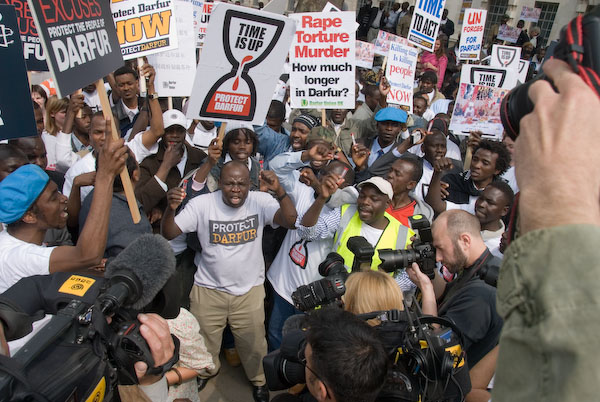
Darfur - International Day of Action

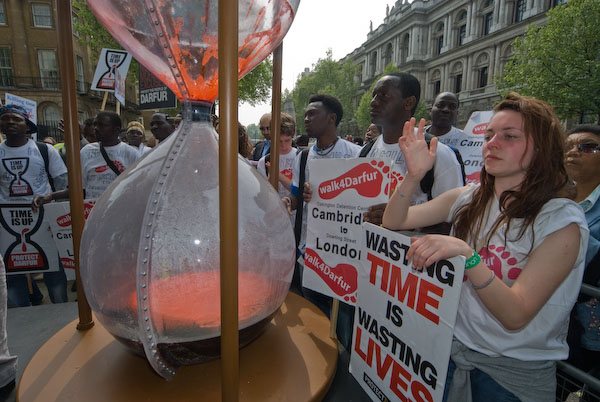
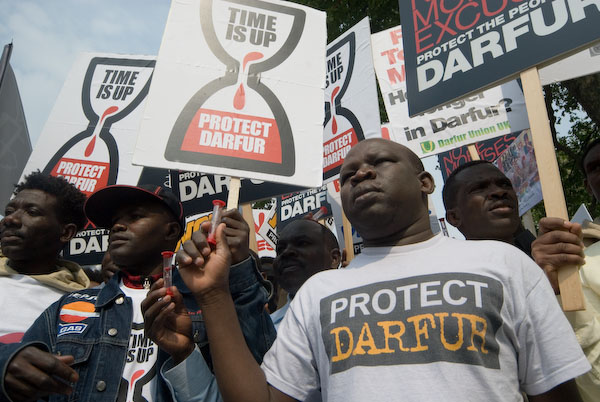
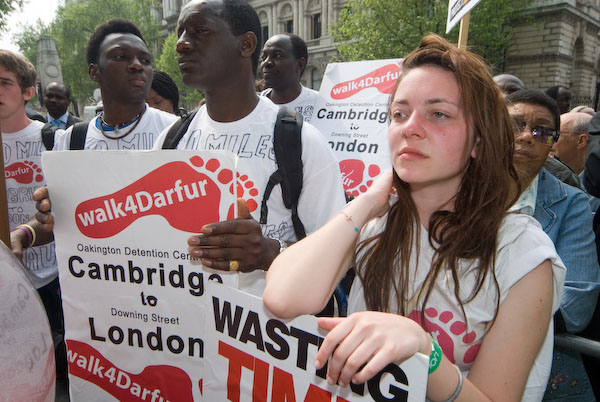
I don’t begrudge the publicity in any way. The situation is a world scandal and disaster and one that the nations are avoiding effective action on. As the posters, and the hour-glasses large and many small insist, time is running out, the blood is running out and time is up for Darfur.
International Day of Action for Darfur: London © 2007, Peter Marshall

“It’s just a shame that the media in general choose to turn their backs on other events. But today you could hardly move for TV cameras and photographers from what used to be Fleet Street. those freelances who cover the other demonstrations, small and large, that the papers and TV don’t want to know about were also there of course.
International Day of Action for Darfur: London © 2007, Peter Marshall
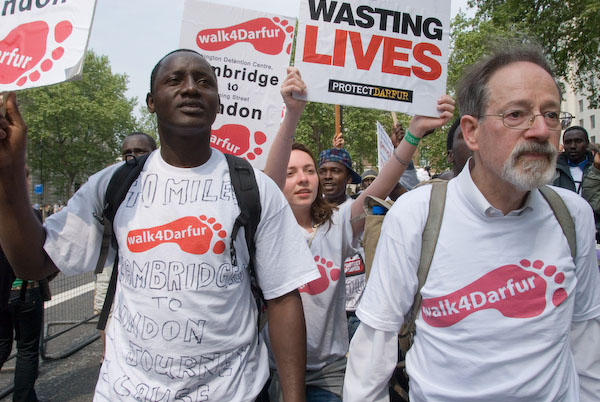
Holocaust survivor Martin Stern leads the Cambridge to London ‘Walk 4 Darfur’ into the London rall

“For me the most interesting aspect of this actual event was the arrival of the group of students and others who had marched from Oakington detention centre near Cambridge to raise awareness about Darfur (and about refugees held there who are from Darfur.) By the time they arrived, most of the media had left. Perhaps they were too much like ordinary demonstrators (and too much like those cyclists who came from Faslane earlier in the month to publicise the treatment of Mordechai Vanunu.)”

More pictures on My London Diary.


FlickrFacebookMy London DiaryHull PhotosLea ValleyParis
London’s Industrial HeritageLondon Photos

All photographs on this page are copyright © Peter Marshall.
Contact me to buy prints or licence to reproduce.
DPAC 4th July Tea Party 2014

DPAC 4th July Tea Party: One of the many strange questions that Americans ask on Quora (a web site I occasionally waste some time on and usually regret) is why we British don’t celebrate the 4th of July. It’s actually a rather better question than most – perhaps we should celebrate when we got rid of a nation that can produce Trump and Biden, one of whom still seems likely to be the next president when clearly neither is suitable.

4th July Tea Party

Of course, here in the UK we have our own contest today between Sunak and Starmer, neither of whom in my estimation fit to govern, and, as in the USA elected by an archaic system designed to frustrate rather than provide democracy. If you were unfortunate not to have heard the late David Graeber speaking in person about US Democracy (and haven’t read his book on the subject) you can hear him talking on video (and read a transcript) on The Lost Byway, the site on which more usually John Rogers publishes the videos of his remarkably upbeat walks around London.

4th July Tea Party

Of course I don’t believe that there are Americans dumb enough to write most of the stupid questions that are posted on Quora, which must surely employ a whole squad of AI-driven bots to generate and post them.

4th July Tea Party

Should we need an excuse for a party in the first half of July we would of course do better to wait 10 days and celebrate with the French (also this year embroiled in election madness.) That would almost certainly be far more fun and a good excuse to drink wine, though I might draw the line at accordions. Its 58 years since I found myself in the square in front of the Mairie in a small French municipality a few mile south of Paris and I haven’t forgotten it.

4th July Tea Party

But I have photographed at protests over the years which have deliberately been timed for various reasons for US Independence Day as well as rather more that totally ignored any significance the day might have.

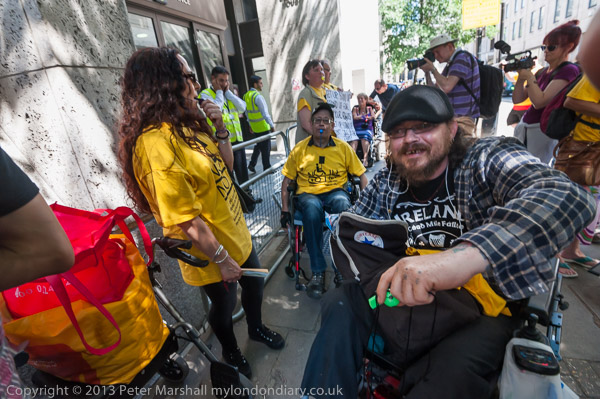
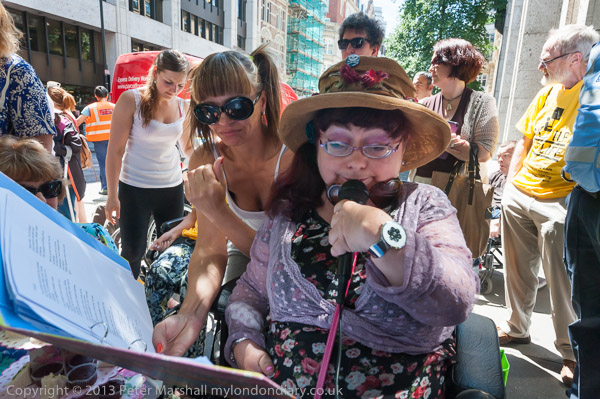
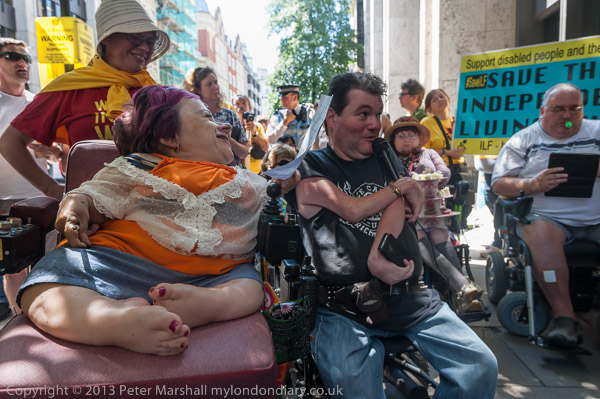
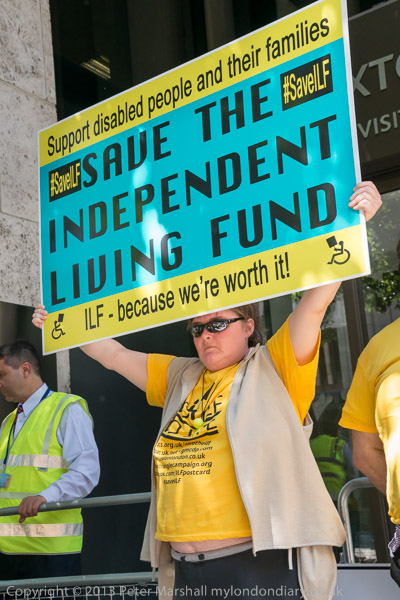
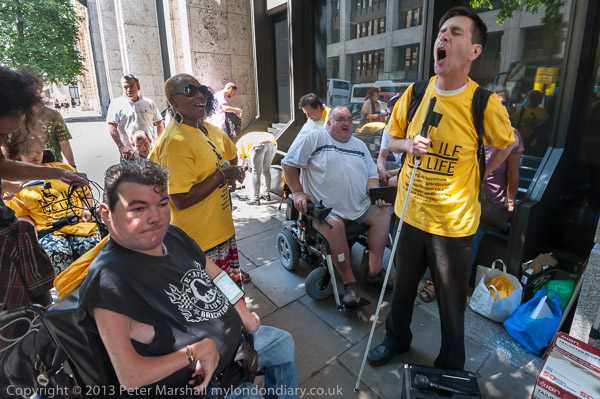
On Friday 4th of July 2014 Disabled People Against Cuts (DPAC) celebrated Independent Living Day with an Independent Living Tea Party at the Dept of Work & Pensions, calling for a stop to the removal of the Independent Living Fund which provides funding, education and transport that enables disabled people to live in the community.

The chose American Independence Day stating “The famous Boston teaparty led to a revolution against the British government let’s see where our teaparty leads….”

It wasn’t a huge protest but “Fifteen or so people in wheelchairs along with around as many walking but with other disabilities along with carers and supporters filled the pavement in front of the DWP in Caxton St, and at times made a considerable noise. As well as their voices and a megaphone, some had brought whistles and other musical instruments (and some less musical) to liven up the event. For those with hearing difficulties there was a BSL signer.

The future looked desperate for the almost 18,000 who then received support through the fund, and they were engaged in a long fight to try to prevent it being closed. In 2013 the government had lost a court case over its closure, but four months later the government had decided to go ahead and close it anyway in 2015. A fresh legal challenge failed.

Responsibility for supporting disabled people being passed to local authorities who were given funding roughly 12% less than the ILF – and this was not ring-fenced. DPAC said that given councils were having already to make massive cuts it seems unlikely that all of this will make its way to the disabled and that councils will largely be unable to find the staff to properly implement fair schemes. They point out that the ILF is a well organised and cost-effective scheme and any replacement is almost certain to be less efficient and to severely impacting the quality of life of severely disabled people.

DPAC fear that many currently usefully employed disabled people will have to give up work and will no longer be able to live independently but will have to go into residential care – at much greater cost.

Protests that are well-behaved and follow the rules seldom get coverage in the media – as last weekends massive Restore Nature Now showed – 60,000 people supported by a huge range of groups marching through London was not ‘news’ for BBC Radio 4, and there has been a huge news blackout on all the many peaceful marches calling for a ceasefire in Palestine.

So DPAC always like to end their events with a little disruptive action, usually in the form of a road block, although despite this their protests are still ignored by the mass media. Around half of those taking part decided to take part and blocked busy Victoria St by stopping their wheelchairs and holding banners on the pedestrian crossing.

Police arrived a few minutes later and tried to persuade them to move, getting a little firmer and eventually threatening protesters with the possibility of arrest for obstructing the highway.

Before long there were around four times as many police as protesters and when it began to look as if the police might carry out their threat of arrest, the protesters who had been receiving a great deal of support from tourists and others – even including some in the traffic being held up or diverted away down Great Smith St – decided it was time to end the protest and wheeled their chairs away.”

Despite this action I don’t think the event received any publicity outside some specialist print and online media. There were a couple of celebrity weddings, another getting sentenced for indecently assaulting girls, a hurricane in the US, an underpass collapse in Brazil – and some celebrations in the USA and many other stories.

More at Independent Living Tea party.


FlickrFacebookMy London DiaryHull PhotosLea ValleyParis
London’s Industrial HeritageLondon Photos

All photographs on this page are copyright © Peter Marshall.
Contact me to buy prints or licence to reproduce.