Cold Harbour & Myatt’s Fields

My walk on Sunday 9th April 1989 continues in this post, Cold Harbour & Myatt’s Fields. The previous post was Camberwell & Myatt’s Fields.

Church, Shop, Coldharbour Lane, Camberwell, Lambeth, 1989 89-4j-61

Back in 1989 I was still pretty pressed for cash, still buying film in bulk 100 ft lengths and loading it into cassettes myself in total darkness.

Over the years I’d perfected my method. Two nails on the back of my darkroom door, hang one of the sprocket holes at the end of the roll of film on the top one, unroll it down to the second, cut across, replace film in can. Pick up first spool from a waiting row on the bench, already with a short length of masking tape on it, attach to the bottom end of the hanging length of film, carefully roll it up to the top, remove from nail, pick up cassette body, insert spool with film end though velvet light trap, pick up end cap and pinch cassette to push it into place. Repeat another 18 times until the film roll is finished. Turn on light, trim film ends to fit cameras and put into plastic pots to go into camera bag.

Slow, tedious but then less than half the cost of buying film in 26 exposure cassettes, though I did ocasoinally treat myself – and if I bought Ilford film rather than Kodak I could reuse the cassettes with bulk film. Kodak had crimped on ends which had to be removed with a bottle cap remover destroying them.

I had learnt to be very careful with film in this project to photograph London, working with 35mm cameras much as I would have done with large format camera, carefully considering various viewpoints before deciding on an exposure. But when working with people I had to respond rather more quickly, and seeing these two men in front of the white church door my response was immediate.

Shops, Coldharbour Lane, Camberwell, Lambeth, 1989 89-4j-62

After that rather snatched image I continued with photographing the two shops which had attracted my interest here, making first a vertical image and then moving back across the road for a wider view. In this (below) you can see the notice for the Celestial Church of Christ and the alley leading to this.

Shops, Coldharbour Lane, Camberwell, Lambeth, 1989 89-4j-63

As well as these black and white images I also took a couple in colour which you can see in another album. I had two Olympus OM bodies with me and only brought the one with colour negative film out of my bag occasionally, while the black and white camera was usually on a strap around my neck. When I was intending to photograph people rather than buildings I usually went out with a Leica M2 instead.

Coldharbour Lane leads from Camberwell to Brixton and got a very bad reputation after the 1981 clashes between police and locals in Brixton. In 2003 it was called in an article in the London Evening Standard the most dangerous street in the most dangerous borough in London, but that was lagely rabid tabloid journalism. Wikipedia gives several theories about its name none of which seem entirely convincing, but the name seems often to have been associated with the ruins of Roman or Romano-British settlements, The area we know usually call Loughborough Junction around the station on early maps was called Cold Harbour. Coldharbour Lane was then known as Camberwell Lane.

Cafe,  Hinton Rd, Camberwell, Lambeth, 1989 89-4j-65
Café, Hinton Rd, Camberwell, Lambeth, 1989 89-4j-65

The S&J Corner Café was on the corner with Wellfit Street, close to Loughborough Junction station. The railway line here is just south of the station. A second bridge can be seen going above this and the cafe which is the line from Brixton to Denmark Hill, now used by London Overground services.

Cyclist, HInton Rd, Camberwell, Lambeth, 1989 89-4j-51
Cyclist, Hinton Rd, Camberwell, Lambeth, 1989 89-4j-51

Another picture I took on the spur of the moment as I saw a cyclist coming towards me under the bridges on Hinton Road. I was standing on the pavement beside the cafe in the previous image, and the cyclist is on the pavement, rather safer than roads like this in London. At the end of the row of shops on the left are the traffic lights and Coldharbour Lane whch I had just begun to walk towards.

Hinton Rd, Camberwell, Lambeth, 1989 89-4j-52

The pub at right of this picture is The Green Man on the corner with Coldharbour Lane. According to a post on the Brixton Buzz, this had been on the site since 1881, but that is the date of the current building which replaced an earlier pub on the site important enough to be marked on Stanford’s 1862 map. The Buzz says it was closed in 2003 because of drug dealing and crime, and it quotes from the Urban75 blog that it was “was frequented by dealers (crack, heroin you name it), prosi’s and general madhatters.

The buildings at the left date from around the same time as the area was developed around the railways, and number 6 at left has a barely legible road name ‘Hinton Terrace‘ and I think at the top the illegible name of a builder and decorator whose sign presumably once hung on the bracket beside the street name.

House, Lilford Rd, Camberwell, Lambeth, 1989 89-4j-53
Houses, Lilford Rd, Camberwell, Lambeth, 1989 89-4j-53

I walked up past Loughborough Junction and made my next picture on Lilford Road at the corner of Minet Road, returning to the area I had been earlier on this walk, the Minet Estate around Myatt’s Fields. This is on the corner of a terrace with basement flats with an entrance here under the steps which extends along both streets and this grand entrance is actually for two adjoining houses above the flats, one on each street. The Grade II listing calls these “Early-mid C19″ and describes this a “double prostyle composite porch with fluted composite columns.”

Longfield Hall, Knatchbull Rd, Myatts Fields, Camberwell, Lambeth, 1989 89-4j-54
Longfield Hall, Knatchbull Rd, Camberwell, Lambeth, 1989

William Minet founded this Grade II listed community hall, architect George Hubbard, which opened in 1889, as well as the Minet library opposite which was destroyed by bombing and rebuilt in 1956 in what Pevsner described as ‘a meek replacement’. The Library was a memorial for his late wife. The Hall is still in use for various community activities including three church congregations and from 1969 -1975 was the base of Britain’s first Black Theatre Company, ‘Dark And Light’, recently marked by a Blue Plaque. It was Grade II listed in 1979 and is now run by a charity, The Longfield Hall Trust.

My walk made on on Sunday 9th April 1989 will finish in a later post. The first part from it is at Peckham and East Dulwich 1989.
No Third Runway at Heathrow – 2016

No Third Runway at Heathrow

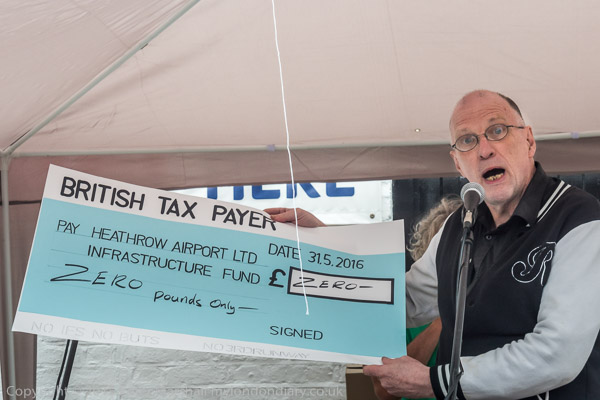
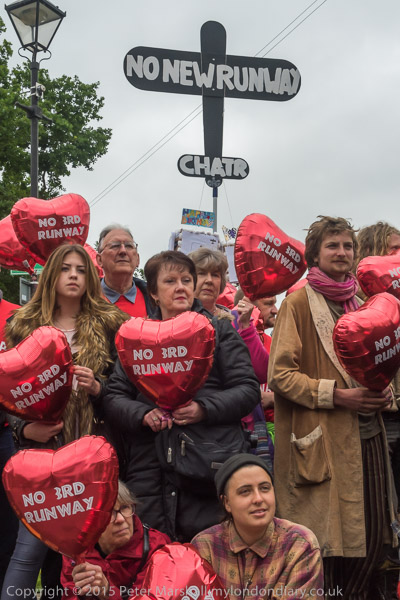
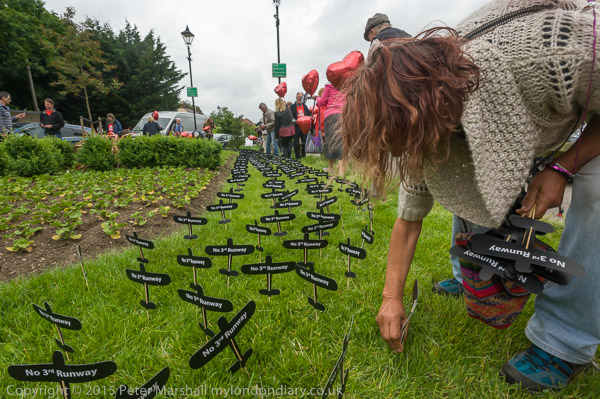
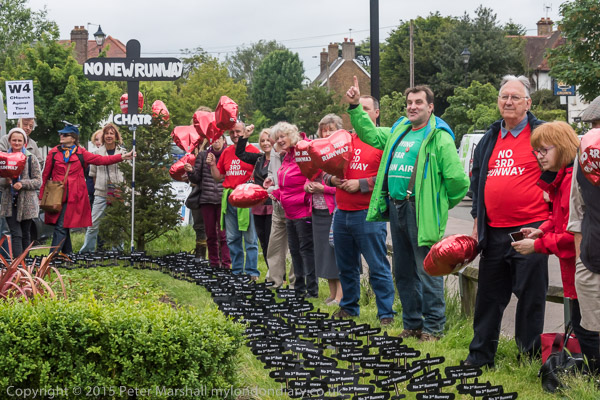
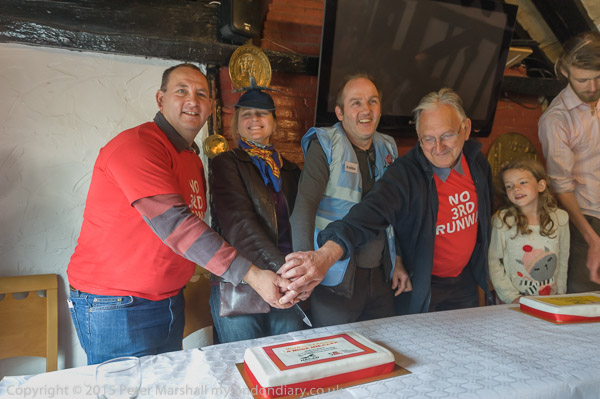
No Third Runway at Heathrow: Heathrow Airport celebrated its 70th anniversary on Monday 30th May 2016. and local residents marked the occasion with a protest on the village green at Harmondsworth against the plans to build a third runway which would destroy over 750 local homes.

No Third Runway at Heathrow

I grew up under the flightpath a couple of miles from touchdown on the main runway used for incoming flights, standing in my back garden and crossing off the registration letters of the planes passing rather close overhead in my spotters book. Those early planes – like the Douglas DC3 and the Vickers Viscount – were small and relatively quiet and gave young boys like me hours of interest with little disruption of normal life, but the generations that followed were very different, larger and ear-shattering. The complaints against their noise grew rapidly – and those easy to read letters on the underside of the wings disappeared so it was harder to identify flights in our complaints.

No Third Runway at Heathrow

Heathrow had been planted on the edge of London’s built up area by deception, beginning as a ‘military’ airport towards the end of the Second World War when it was known it would never be used as such, by people who were determined to make it London’s major civil airport. They did it to get around the objecteons there would have been later to a civil airport here.

No Third Runway at Heathrow
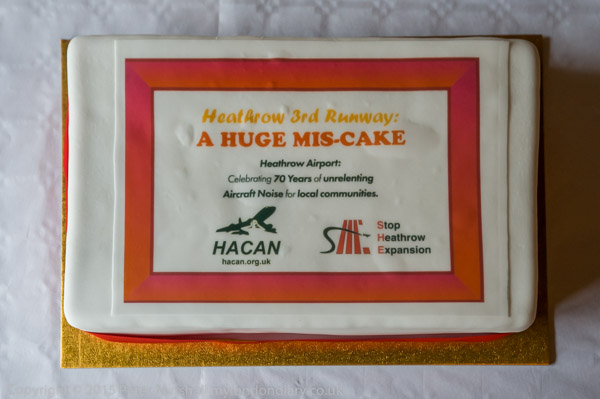
A huge mis-cake’ Heathrow Airport: Celebrating 70 years of unrelenting Aircraft Noise for local communities’

Over the years Heathrow continued to grow and grow. More flights and more terminals. More local traffic and more pollution. Every new development was made with promises that were later broken. T4 was promised to be the last new terminal – but then came the application to build T5. With this came the promise that Heathrow would never ask for another runway – but this was broken even before T5 had opened.

The enquiry into the third runway was said to be final – but while the local community were still celebrating their victory – and David Cameron was saying ” No Ifs, No Buts, No Third Runway”, Heathrow Airport was already plotting the setting up of a new inquiry that would somehow against all the evidence come up with the result they wanted – the Davies Commission.

John Stewart – HACAN – Heathrow want taxpayers to pay for the new roads, tunnels etc needed

In 2016 the threat of the new ‘third runway’ loomed dangerously over the area again, with the Conservative Government backing the proposals. Many of those who came to the event at Harmondsworth feared they would soon lose their homes – and property in the area was blighted as it had been for many years. Others outside the actual development would find their lives made impossible by aircraft noise, with people from almost the whole of West London suffering, particularly from flights in the early morning, with plane after plane passing overhead.

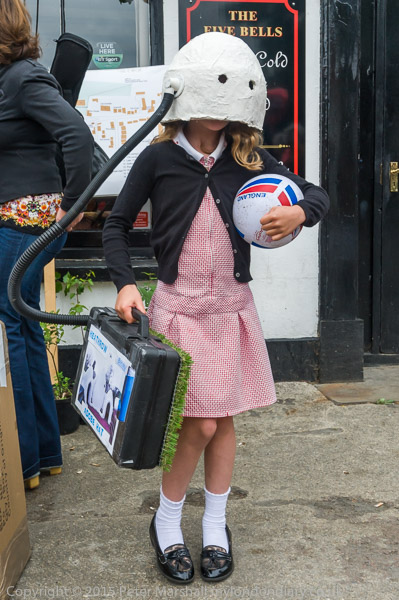
The Heathrow Adobe Hat, with portable air purifier and environmentally biodiverse suitcase

Heathrow’s noise and pollution affect a surprisingly large area of London. Twenty years ago I was in a hospital bed in Tooting in south London, around 12 miles away as the jet flies, awake early in the morning partly by their noise, watching and hearing a whole line of plane after plane in line for touchdown.

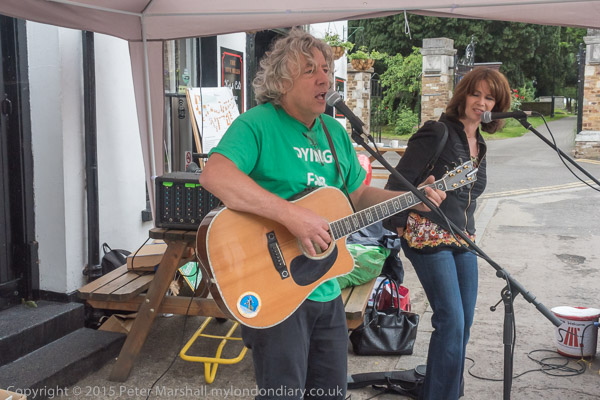
Neil Keveren, Chair of Stop Heathrow Expansion (SHE)

In our local area we get the pollution from the planes, both from running their engines on the ground and also from takeoff and landing. But more importantly the airport generates huge amounts of road traffic, both on local roads and the motorways serving the area – M3, M4 and M25.

Seven years on it seems increasingly unlikely that there will ever be a third runway built. Even the most jet-headed politicians are beginning to see that we cannot continue with airport expansion and meet the need to cut carbon emissions. Financial constraints increasingly make it less likely too.

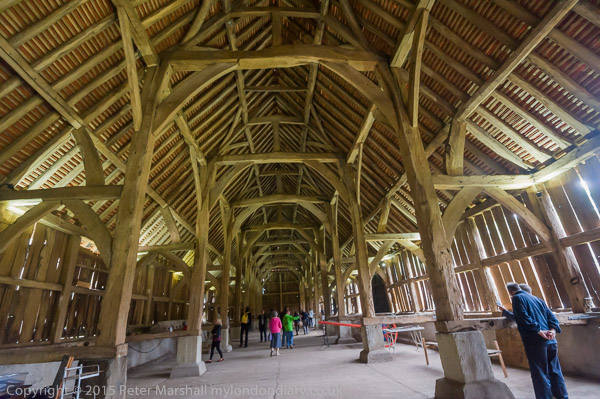
My post on My London Diary has the details about the event on Monday 30th May 2016 and of course more pictures, including some of the village itself, including its pubs, church and remarkable Grade I listed tithe barn, said to be the largest wooden structure in the country, dating from 1426. Local campaigners saved that a few years ago and it was bought by English Heritage in 2012 and has been much restored. It lies just outside the area the airport would take over for the new runway and would be at serous danger from vibration – and would almost certainly need to be re-sited.

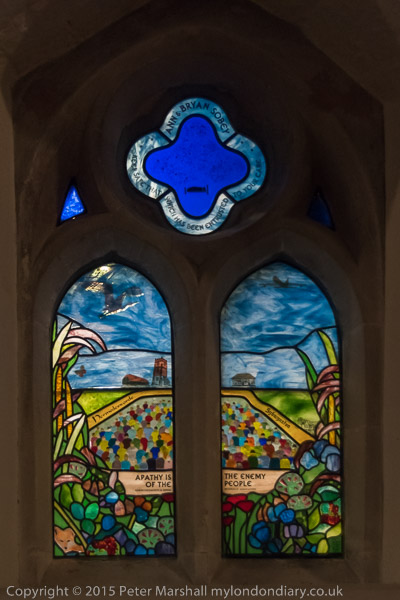
A church window remembers Ann & Bryan Sobey who led the ‘Right to Sleep’ campaign for restrictions on night flights into Heathrow

Though on the edge of London Harmondsworth still has a village atmosphere, and still seems much like the village I cycled through in my youth. I hope it remains that way.

More at No 3rd Runway Heathrow 70th Birthday.


London Loop – Uxbridge to Moor Park

London Loop - Uxbridge to Moor Park
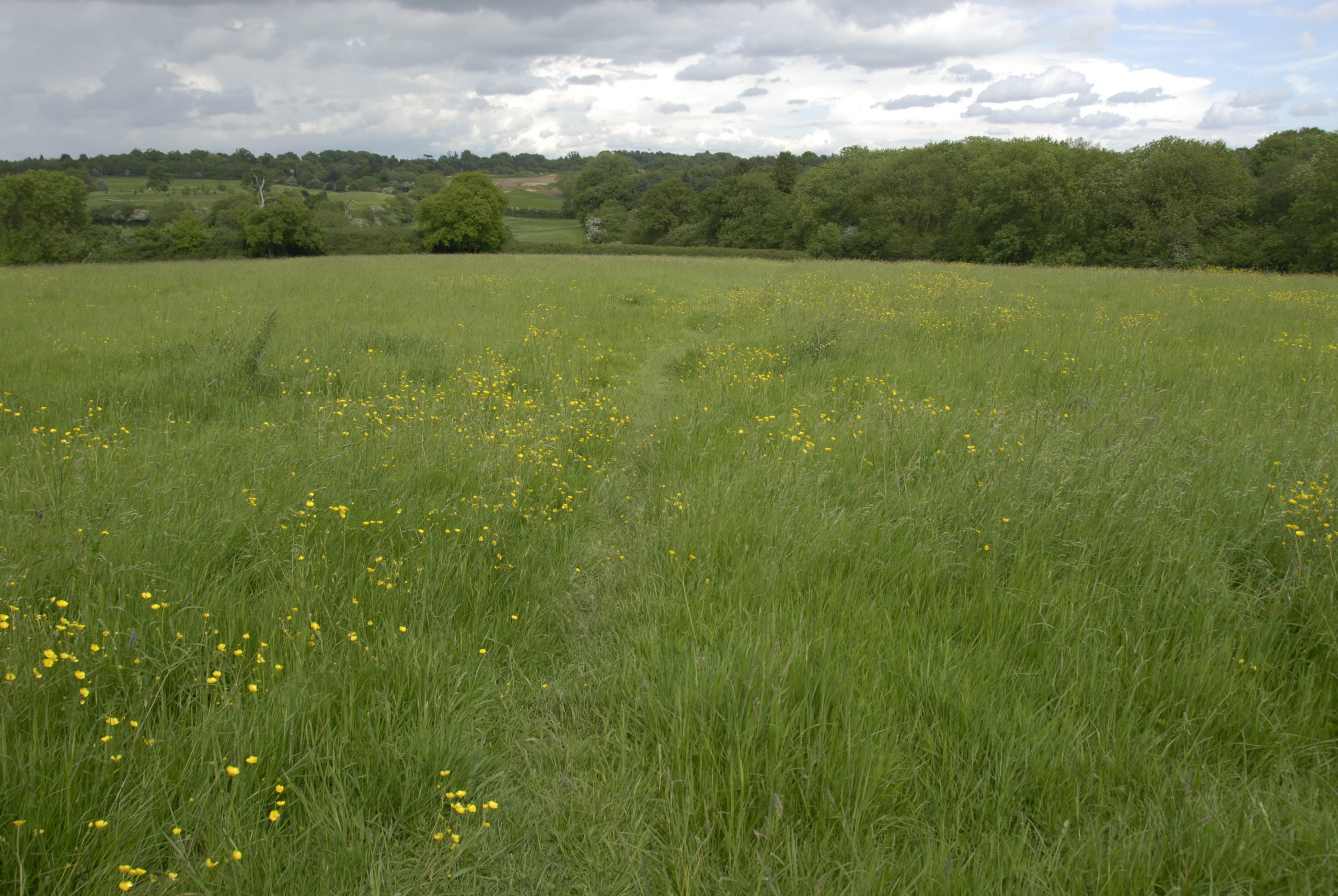
Spot the path

London Loop – Uxbridge to Moor Park: Monday May 29th 2006 was the Late May Bank Holiday for that year, the day which replaced the Whit Monday Bank holiday in 1968, though at first for a trial 5 year period, only becoming a final replacement in 1971. Unlike Whitsun it came in a regular place, saving us having to do esoteric calculations to find the date o0f Easter, and then add on 50 days for Pentecost. This year, 2023, the Late May Bank Holiday actually falls on Whit Monday, but that isn’t usual. Though some people still call it Whit when it isn’t.

London Loop - Uxbridge to Moor Park

We had decided to go on a walk on the bank holiday, and we had been following the various stages of the London Loop, a kind of walkers M25 around the outskirts of London. The section we had reached began at Uxbridge and ended at Moor Park.

London Loop - Uxbridge to Moor Park

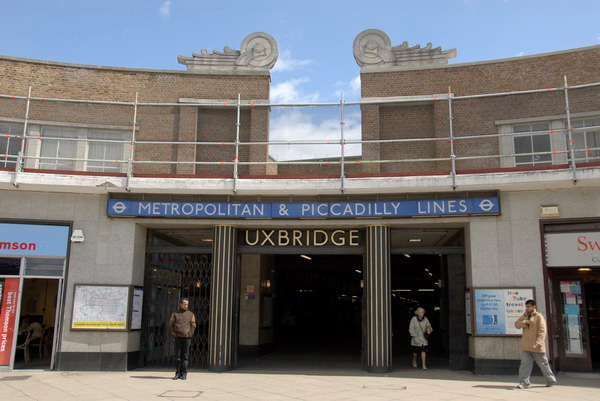
Although the M25 has made journeys around London much easier for those in cars, there is no equivalent for public transport. I live only 8 miles as the crow flies from Uxbridge station it took us a train, two buses and well over an hour to get there.

London Loop - Uxbridge to Moor Park

From then on it was fairly plain sailing, or rather walking, though much of the first half of our route was on the towpath of the Grand Union Canal. We covered section 12 which ends in Harefield and section 13 which goes on to Moor Park. The two add up to around nine and a half miles, with another mile or to the station at each end. The two links give maps and details and also short notes on points of interest in the walks, so I don’t need to add to them.

We didn’t have these pdfs, but a copy of the book about the whole loop published five years earlier. Perhaps some things had changed but I think the directions given were at times in any case rather too vague to be useful. However the small reproductions of the OS Maps it contains soon let us work out the correct path. Nowadays of course you can get the maps and route guides on your phone, which can also tell you exactly where you are. Unless like me a few years ago when you get lost in a dense forest where there is no GPS (and no phone signal.)

On My London Diary right at the bottom of the May 2006 page there is a short text about the day which includes “most of it was pretty boring, far too much green. The book giving the route is pretty hopeless in places too, which is perhaps why there were parts of it that very few people seem to have found, with badly overgrown paths” and also points out that back in 2006, the London Loop was still “an almost unsigned footpath route“. I think the waymarks are now much improved.

The piece concludes with what should have been a link to the pictures simply reading “coming shortly” though there is a previously unlinked page with a set of them. The next page and the rest of the pictures are still missing. But probably I had decided the 25 that are there are enough to give a good impression for the walk.. I’ve uploaded just one extra to go with this post.


Beltane, Chariot Festival, Barking & Whitechapel

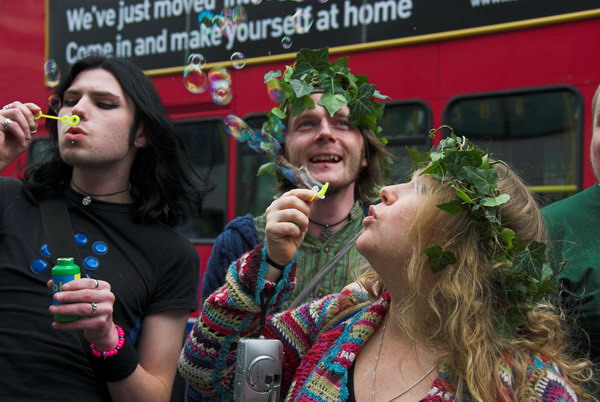
Beltane, Chariot Festival, Barking & Whitechapel: I had an interesting and varied day at events and places across London on Sunday 28th May 2006, taking rather a lot of photographs. Appropriately for a Sunday I covered two religious events.


Pagan Pride – Beltane Bash – Holborn

Beltane, Chariot Festival, Barking & Whitechapel

My working day began at Holborn, having caught a fairly early train into London. Now I like to relax a bit on Sundays, but for many years I often came up by the first train to take photographs. Though it wasn’t that early on Sundays, departing around 8am.

Beltane, Chariot Festival, Barking & Whitechapel

I took a bus from Waterloo to Holborn and walked the few yards to the Conway Hall at the north-east corner of Red Lion Square.

Beltane, Chariot Festival, Barking & Whitechapel

Here (with corrected capitalisation) is what I wrote about this event on My London Diary in 2006.

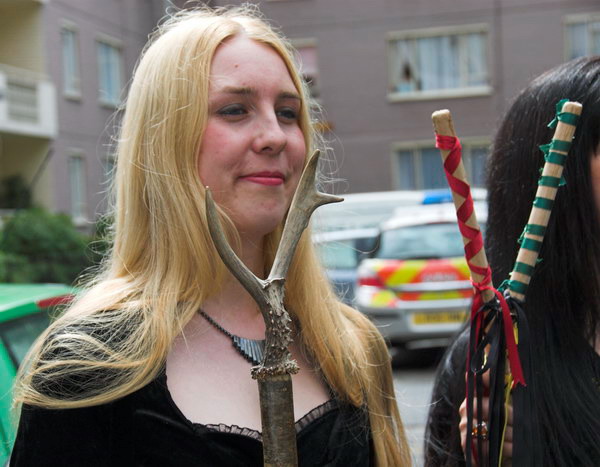
The Pagan Pride Parade in Holborn is now a regular annual event, a part of the Beltane Bash that takes place in the Conway Hall in Red Lion Square. Mostly it was the same people as last year, but I found it hard to get into the mood to take pictures.

Beltane, Chariot Festival, Barking & Whitechapel

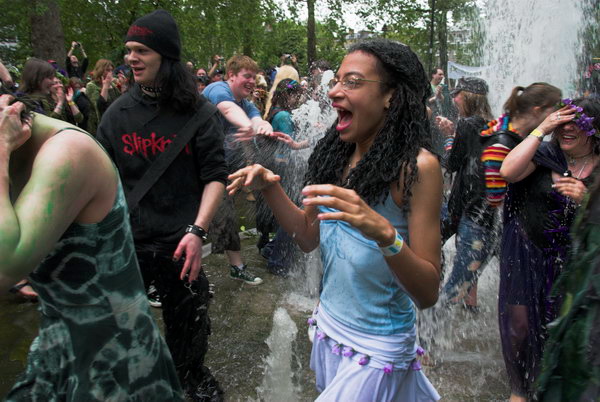
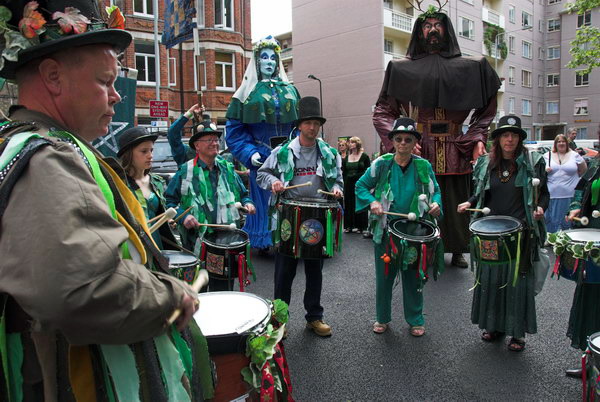
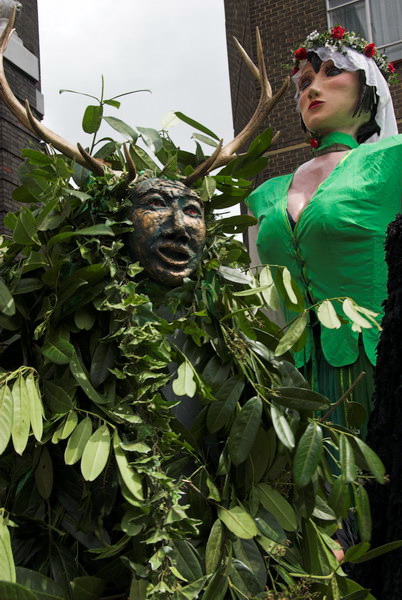
As usual the parade was led by Jack In The Green – a dancing bush – the Green Lady and the Bogies. The Giants included the Morrigan (in green and flowers to welcome summer) with Black Ravens, Old Man Thunder and Old Dame Holder, along with the rest of it.

Beltane, Chariot Festival, Barking & Whitechapel

Dancing round the fountains was energetic, but somehow for me the event didn’t really get going, and lacked any real climax, people just slowly began to fade away.

My London Diary – May 2006

Chariot Festival, Sri Mahalakshmi Temple – East Ham

Those taking part in the Pagan Pride parade began to make their way back to Conway Hall for the rest of their day of events, but I rushed to Holborn underground station to take the Central line eastwards, changing at Mile End to get to East Ham. But I had stayed too long with the pagans.

The Sri Mahalakshmi Temple had been built in 1989 and opened and was almost opposite the station. Before that Hindus and worshipped at a converted shop on the corner of Kensington Avenue and High Street North, around 300 yards north from the station.

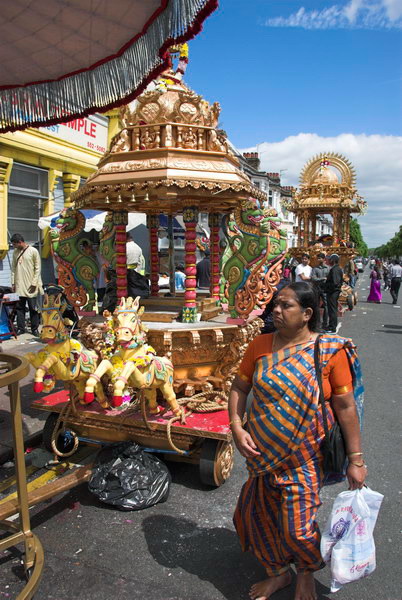
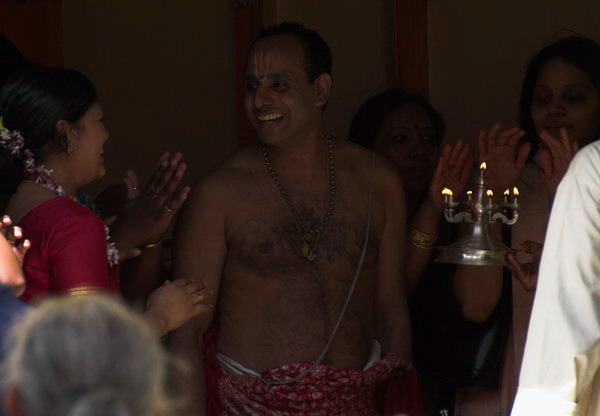
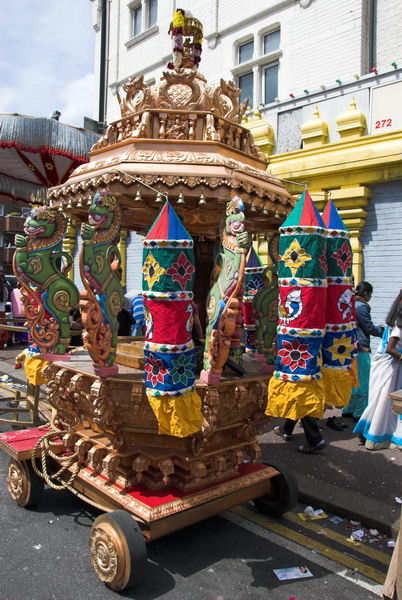
Unfortunately I had arrived too late and the procession on the streets had ended, though I was still able to photograph the chariots outside and a few of the people. I made a mental note to come back and cover this event another year, but although I photographed other chariot festivals including one in Manor Park, East Ham, I’ve never returned for this one.

My London Diary – May 2006


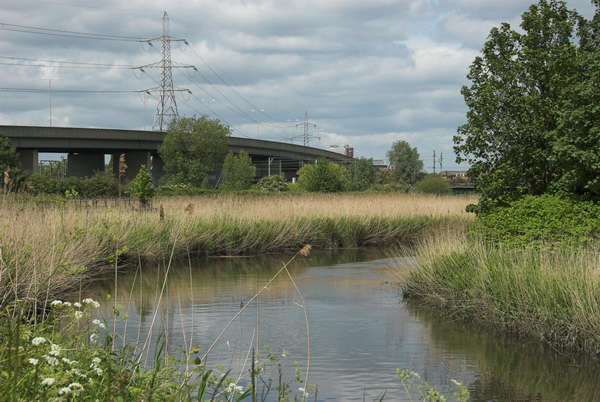
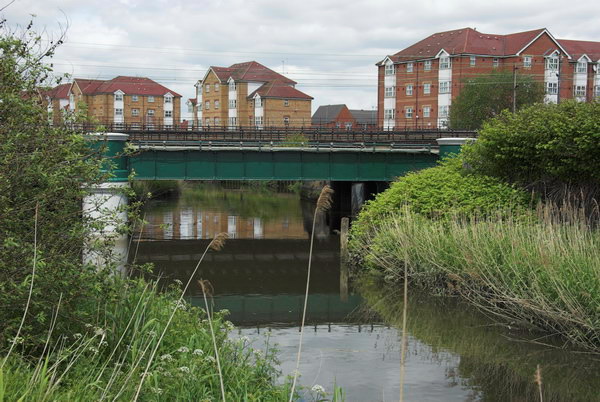
Barking and River Roding – Barking

I was in East Ham and the afternoon lay ahead; it was a fine day and I decided this was a great opportunity to take a walk a little further to the east by the River Roding. I took a few pictures of the chariots, then went to walk along by the River Roding and to photograph a new development by the railway in Barking.

The half-mile walk along unkonwln was rather uninteresting. It’s a long suburban street lined with terraces of working class housing from the early twentieth century on both sides, named for the family who once owned the estate on which it was built. As Stephen Benton points out in his London Postcode walk it has one small claim to fame, and almost every famous pop guitarist from the the 70s and 80s – including those from the Beatles, Rolling Stones, Yardbirds, The Who as well as musical failures like me will have started with Bert Weedon’s ‘Play in A Day – Guide to Modern Guitar’, first published in 1957. Weedon (1920-2012) was born here, though he had probably moved away long before he became famous.

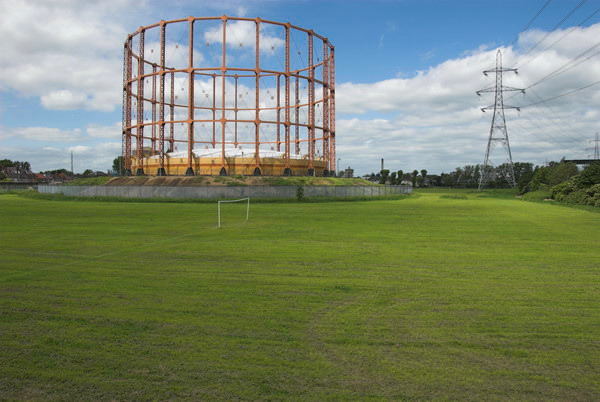
The path led on to Watson Ave, with a view of the Leigh Road gasholder in what is now the derelict Leigh Road Sports Ground. The Barking Gas Works opened here in 1836 but was purchased in 1912 by the Gas Light and Coke Company, who closed it as they had the much larger and more economical works they had opened at Beckton in 1870. But the holder remained and was I think still in use by the North Thames Gas Board possibly until the change from coal gas to natural gas. The area around it became their sports ground.

At the end of Watson Ave is a long footbridge which took me over the North Circular Road, from which I took a few pictures before going through an industrial estate.

I made quite a few pictures in the Tanner Street area, where a considerable amount of new development was taking place.

I told myself I would return here later, but I don’t think I’ve done so yet.

My London Diary – May 2006


Whitechapel

I think I had travelled back from Barking on a Hammersmith & City line train and needed to change soemwhere to the District Line. Having got off the train I decided I had time for a short walk around on before needing to continue my journey. I only taok a few pictures, perhaps making 20 exposures, and there are only four pictures on My London Diary.

My London Diary – May 2006


Camberwell & Myatt’s Fields

My walk on Sunday 9th April 1989 continued. The previous post was Hairdressers, Mansions, Baptists, Tiles and Greeks.

Escort Parts Centre, Camberwell Station Rd, Camberwell, Southwark, 1989 89-4i-43

Camberwell Station Road runs south from Camberwell New Road alongside the railway line, and along its west side are a number of small businesses in the railway arches, almost all garages of some kind.

The Escort Parts Centre was on the corner with Camberwell New Road and remained in business here until around 2010. The premises are now covered with graffiti and look derelict. The number 344 does not appear to be for either street and I think is some numbering for the arches in the viaduct.

Sacred Heart of Jesus, RC Church, Camberwell, Southwark, 1989 89-4i-32

The Roman Catholic Church of the Sacred Heart is in Knatchbull Road, just past the railway bridge and is on a dramatic scale, towering above the railway viaduct.

The Grade II listing text states it was built in 1952-8 from designs by D Plaskett Marshall in a moderne style, reminiscent of the inter-war churches of Cachemaille-Day. According to Wikipedia, “Nugent Francis Cachemaille-Day (1896–1976), often referred to as NF Cachemaille-Day, was an English architect who designed some of the most “revolutionary” 20th-century churches in the country.

Again according to Wikipedia he designed his first church in Northenden in 1936-7 and by 1963 had been responsible for at least 61, many Grade II listed. Because of its location it is difficult to get a picture of this one which provides a good overall impression.

Tyre Fitting Bay, Camberwell Station Rd, Camberwell, Lambeth, 1989 89-4i-36

This was little further down Camberwell Station Rd which hasn’t had a passenger station since 1916 , though if you go down far enough you can still see the former station building, now occupied by a motorbike repair shop.

Camberwell station opened in 1862 on the London, Chatham and Dover Railway’s line into Blackfriars from Herne Hill. After the closure for passengers it remained in use for goods until 1964. The goods yard is now a housing estate.

Various schemes this century have looked at the reopening of the station but all so far have been abandoned.

Houses, Myatts Fields area, Camberwell, Lambeth, 1989 89-4i-25
Houses, 22-24, Flodden Rd, Myatts Fields, Camberwell, Lambeth, 1989 89-4i-25

I walked back up to Camberwell New Road and took three pictures of terraces there ( not on-line) before going down County Grove. These houses are 22 and 24 Flodden Road. On my map the Southwark-Lambeth boundary runs down the middle of the road, making these in Lambeth.

The Survey of London states that this area was bought from Sir Edward Knatchbull in 1770 by Hughes Minet, the grandson of a French Hugenot refugee, but it was only after the railway was opened in 1863 that it was developed to meet the demand this generated for small suburban houses. Builders obtained leases from the Minet family who were public-spririted landlords and provided a church and the Minet library and also closely controlled the building ensuring a mix of house sizes. In 1889 William Minet gave the 14.5 acres to the London County Council for a permanent open space, Myatt’s fields.

Houses, Myatts Fields area, Camberwell, Lambeth, 1989 89-4i-11
Upstall St, Myatts Fields, Camberwell, Lambeth, 1989 89-4i-11

The Metropolitan Public Gardens Association spent around £10,000 to lay it out as a park to the designs of Fanny Wilkinson, a suffragette and one of the first women to be a professional landscape designer. The new park was named for Joseph Myatt, a well-known market gardener who produced a number of then famous strawberry varieties including Eliza, British Queen and Deptford Vine at his nursery in Deptford. His son James Myatt brought the business to the fields here.

Joseph also experimented with various varieties of rhubarb, hoping that he could get people to eat this together with strawberries, but this proved rather less successful, though rhubarb did become popular later.

Lambeth Council became the freeholder of the Minet estate in 1968.

Paulet Rd, Camberwell, Lambeth, 1989 89-4i-12

Lambeth Council redeveloped a large stretch along the west side of Paulet Road in the early 1970s. Although the long terrace blocks of the Paulet Road Estate are in a modern style they have a similar scale to the Victorian terraces opposite and were built using yellow stock bricks and slates like them. But they still look like monolithic slabs rather than the repeating units of the earlier houses.

Paulet Rd, Camberwell, Lambeth, 1989 89-4i-13

The side and rear of one of the blocks on the Paulet Road Estate. I think that these stairs lead up to the front doors of the upper level flats. These buildings are some of relatively few modern buildings in the Minet Conservation Area designated in 1980.

Provision Shop, Lilford Rd, Camberwell, Lambeth, 1989 89-4i-15

The south end of Paulet Road ends at Lilford Road and I turned east along it, going under the railway again. I think this shop just a little to the east of the railway bridge was at No 106 and has been converted into a private residence and is no longer recognisable. There are many fewer small corner shops now.

My walk will continue in a later post. The first part my walk on Sunday 9th April 1989 is at Peckham and East Dulwich 1989.

Hairdressers, Mansions, Baptists, Tiles & Greeks

The first part of this walk I made on Sunday 9th April 1989 is at Peckham and East Dulwich 1989.

Hairdresser, North Cross Rd, East Dulwich, Southwark, 1989 89-4i-61

I’d taken a picture of this poster in a hairdresser’s window when I’d walked along North Cross Road a couple of months earlier but hadn’t been entirely satisfied with it. In winter I had been working with Kodak’s TMAX400 and I think I felt that the fine graphic detail on the poster would be better on the more fine-grained TMAX100 I had switched to for the summer. The difference isn’t huge but it does show. The framing is also a little different, though in making this digital image I have made this version just a little more skewed than my usual slight lean. I blame it on living in a house where nothing is quite a right angle.

North Cross Rd, East Dulwich, Southwark, 1989 89-4i-62

I’m not sure what the shop at 65 North Cross Road was then selling but I rather liked the graphic on the window. It could have been, as it now is, another hairdresser. The doorway was for the flat above.

Fruit & Veg, Coldharbour Place, Camberwell, Lambeth, 1989 89-4i-63
Coldharbour Place, Camberwell, Lambeth, 1989 89-4i-63

I think I may have jumped on a bus on Lordship Lane to take me to Camberwell Green. Coming up to London for many of these walks I used a Travelcard which had first been introduced by the Greater Londo Council in 1981 and had greatly simplified travel around London. At the beginning of 1989 it had been extended to cover British Rail services, replacing an earlier One Day Capitalcard. The GLC had lost a legal battle to cut London fares in 1982, and was abolished by Thatcher in 1986, with fairly disastrous consequences, but their rationalisation of travel continued. Without it I don’t think I would have been able to do much of my extensive work across London. Now it seems that Tory cuts are going to force TfL to get rid of it for those of us travelling into London.

This is the next frame on my film, and was made around a mile and a half away, probably around a 15 minute bus ride from the previous image. The picture was made from Coldharbour Lane looking down Coldharbour Place, which continues with a narrow alley to Denmark Hill. The large building at left was a garage and has now been replaced by a larger block of flats, but the buildings at the right which front onto Denmark Hill remain and the wall at right is now covered by the ‘Great Wave’ mural based on Hokusai’s iconic image.

Denmark Place, Baptist Church, Coldharbour Lane, Camberwell, Lambeth, 1989 89-4i-64

This Grade II listed church was built in 1823 and though some alterations were made in 1869 still looks remarkably like it did in Victorian times. I wounder why it has four doors along its frontage, and is without a central door. Possibly the doors at the left and right of the set may lead to galleries around the main hall, and some more strict churches had separate doors for men and women, but although the listed text has a fairly full description of the exterior it gives no clues for the reasons behind the design.

Shops, Coldharbour Lane, Camberwell, Lambeth, 1989 89-4i-65

A rather fine row of shops with flats above, Denmark Mansions at 78-96 Coldharbour Lane. These mansions replaced earlier semi-detached villas with front gardens on the street at some time around 1900 though I can find no exact date.

Kenbury St, Camberwell, Lambeth, 1989 89-4i-51

A derelict frontage in Kenbury St, just off Coldharbour Lane. This is part of Kenbury Mansions and has long been restored. These buildings are rather decorative fronts on a rather large solid block behind, each front door leading to half a dozen flats.

Arcanum Works, Warner Rd, Camberwell, Lambeth, 1989 89-4i-54

Arcanum means the mysteries or secrets of a subject but other than the name I’m unsure what was mysterious about the Arcanum Terrazzo & Stone Company Limited who shared this works with the Decorative Tile Company Limited and the yard at rear with Wandle Paving Ltd.

This building is still there, but is now the Glory Divine Christian Centre & Community Hall. The factory behind is labelled as a Brewery on the 1877 OS large-scale map, but by the time of the 1916 OS map had turned sour as a Vinegar Works.

St Marys Greek Orthodox Cathedral, Camberwell New Rd, Camberwell, Lambeth, 1989 89-4i-55

The Greek Orthodox Cathedral of the Nativity of the Mother of God, Camberwell is a church in the Archdiocese of Thyateira & Great Britain. Greek Orthodox Christians had begun to celebrate in nearby St Giles in 1962.

In 1963 they moved into and later bought the former Catholic Apostolic Church, Camberwell New Road built for this splinter group of Anglo-Catholics in 1877, architect J & J Belcher. They had worshipped there until 1961. The church was damaged by bombing in 1941 and lost the impressive frontage rising behind the cloisters which can be seen in an illustration on Archiseek.com – with almost half the former nave now being a courtyard.

St Marys Greek Orthodox Cathedral, Camberwell New Rd, Camberwell, Lambeth, 1989 89-4i-42

I peered into the rather strange buildings to take this picture of the cloisters which the Anglo-Catholics had required of the architect. The more recent addition at left is probably very practical but rather spoils the impression.

My walk will continue in a later post. The previous post was the first on this walk, Peckham and East Dulwich 1989.

Bengali New Year and Levellers 2013

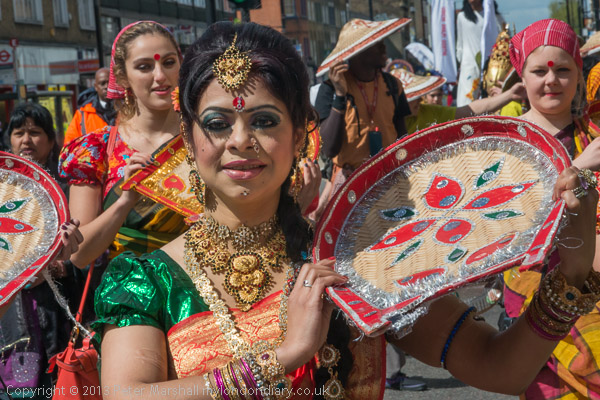
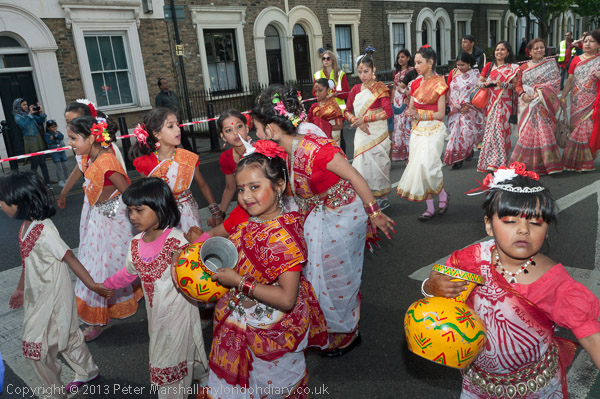
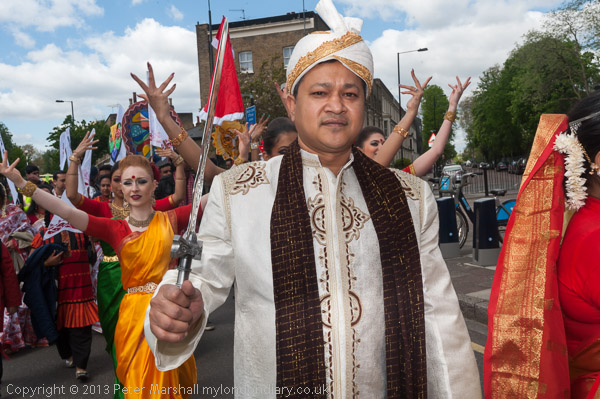
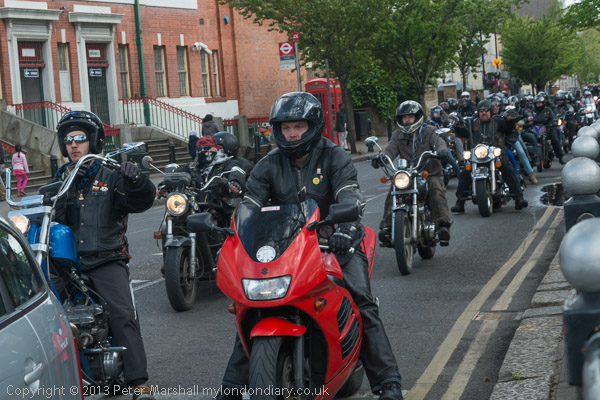
Bengali New Year and Levellers: I spent Sunday 12th May in East London, beginning at Weavers Fields in Bethnal Green for the Boishakhi Mela procession and then moving on to Wapping where a plaque was being unveiled at the burial place of Leveller Thomas Rainsborough. On my way there I was passed by a large group of motorcyclists out for a ride.


Boishakhi Mela Procession – Bethnal Green

Bengali New Year and Levellers 2013

The Bengali New Year is in the middle of April, but when the annual celebrations by the Bangladeshi community in Tower Hamlets began in 1997 they decided April in London was too cold and likely to rain and moved their celebration to a month later.

Bengali New Year and Levellers 2013

The celebration, which I’d photographed in 2006 and 2008, had been based around Brick Lane, but had by 2013 become a victim of its own popularity and had outgrown its original location, and had been moved to Victoria Park, well away from the centre of the Bangladeshi community. I think in later years it returned to its original location in the Brick Lane area, but I’ve not been back since.

Bengali New Year and Levellers 2013

The Mela is said to be the largest celebration of Boishaki outside of Bangladesh, and it was certainly very crowded when I was in Brick Lane in 2008. Tower Hamlets Council had that year banned it on safety grounds from using their parks, but later allowed them to use Weavers Fields for the main stage. It is said to be the second largest street festival in UK – though at around 80,000 taking part it is still an order of magnitude smaller than Notting Hill.

Bengali New Year and Levellers 2013

But as the pictures show it is a very colourful event. The council took over the management of the festival in 2009 when a record 95,000 people attended.

I walked with the procession to the gates of Victoria Park taking photographs, but left as they entered the park to go to Wapping.

Boishakhi Mela Procession


Bikers – Bethnal Green

The Boishakhi Mela Procession had been held up for a couple of minutes in Bethnal Green and had to wait as a large group of motorcyclists made its way down Old Ford Road where they were to go. I talked briefly with some of the bikers as they waited at the traffic lights, but conversation was rather difficult over the noise of perhaps a hundred poorly silenced engines. But I think they were simply a group from Dagenham and other parts of Essex out for a ride around London.

Bikers


Leveller Thomas Rainsborough – St John’s Churchyard, Wapping

Although I had walked through and photographed the small park, saved from being built on by local campaigners, which had been the churchyard of St John’s in Wapping, I don’t think I had previously known it was where Thomas Rainsborough had been buried.

Colonel Thomas Rainsborough was a military leader in Cromwell’s New Model Army, fighting for Parliament against the king in the English Civil War. He was killed by a Royalist raising party during the siege of Pontefract on 29 October 1648 and buried at Wapping on 14th November.

Rainsborough is best remembered now for his statement in the Putney Debates in London in 1647 about all men being equal:

"For really I think that the poorest he that is in England hath a life to live as the greatest he; and therefore truly, sir, I think it’s clear that every man that is to live under a government ought first by his own consent to put himself under that government; and I do think that the poorest man in England is not bound in a strict sense to that government that he hath not had a voice to put himself under…"

It was truly a revolutionary idea at the time, and he was labelled as an extremist. He was the most senior officer to support the Levellers.

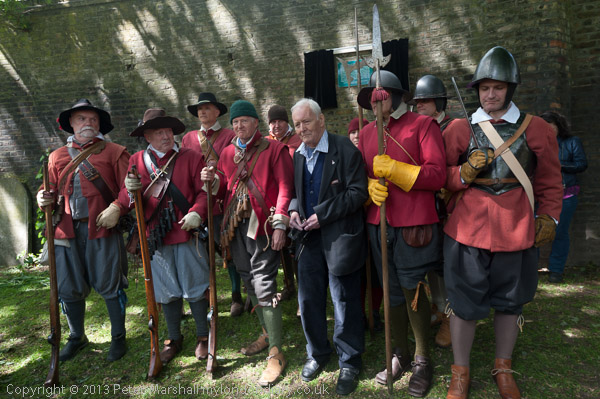
The four Royalists had entered his lodgings at night and attempted to arrest him. There was a huge funeral procession by Levellers from Tottenham to Wapping for his burial. His sea-green regimental standard (a replica of which was carried by the Sealed Knot’s ‘Colonel Rainsborough’s Regiment of Foote’ in today’s ceremonies) was torn into strips and the sea-green ribbons became a Leveller symbol.

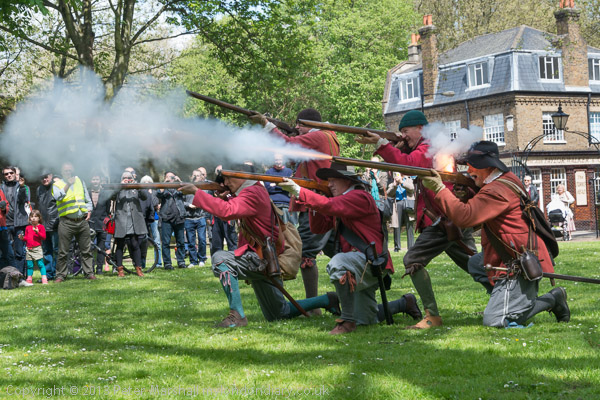
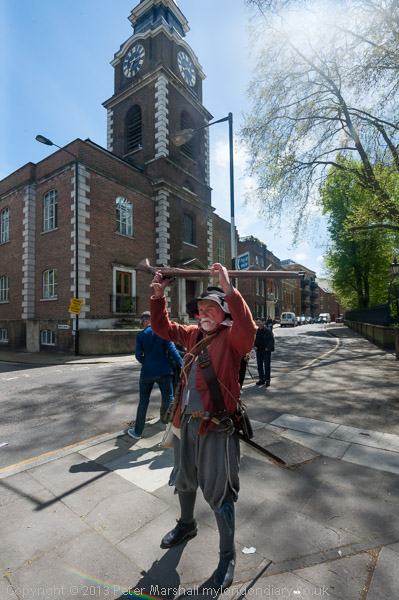
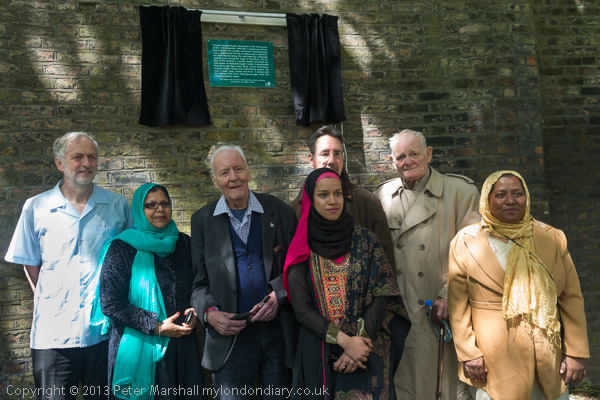
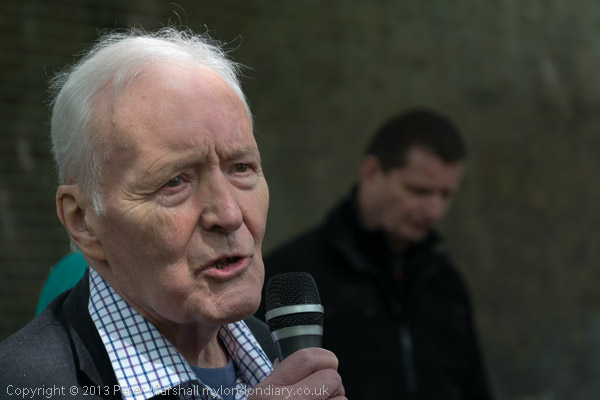
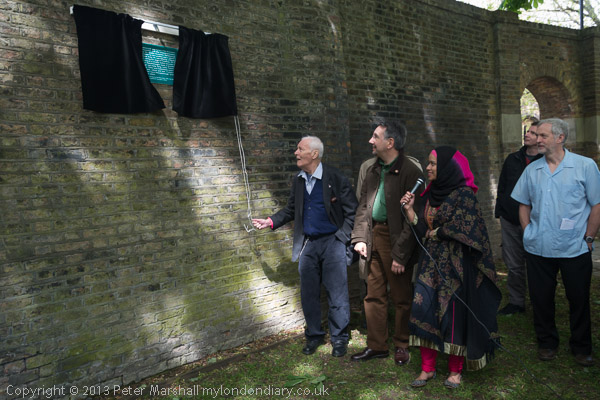
He had been an important military leader, in command of 1500 musketeers, but today there just five from the Sealed Knot, along with an officer and some pikemen, but they put on an impressive performance for the hundred or so of us who had turned up for the event, with speeches by John Reese, Tony Benn and others before Tony Benn pulled the string to unveil the plaque. This included words from the inscription on his long lost tomb which proclaimed he had made ‘Kings, Lords, Commons, Judges shake, Cities and Committees quake‘.

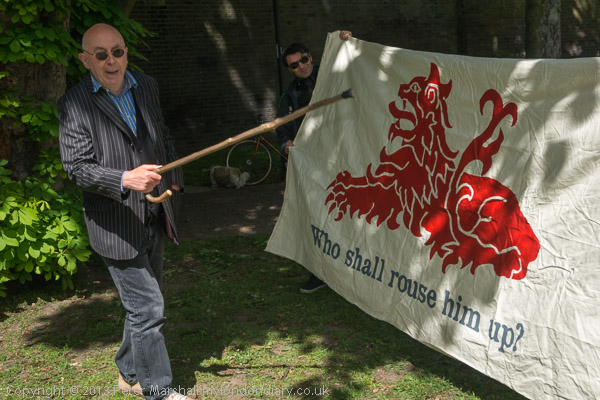
After the official proceedings and while photographs were being taken Ian Bone of Class War seized the opportunity to speak against the appropriation of Rainsborough by members of the political establishment who had taken part in the ceremony, but would still be opposed to the radical ideas put forward by the Levellers.

Standing in front of a fine banner showing a red sleeping lion with the text ‘Who shall rouse him up’ he spoke about the more radical Fifth Monarchists, fifty of whom staged a brief and doomed insurrection following the restoration in 1661, led by Thomas Venner. They stormed St Paul’s Cathedral on January 1 and held parts of London for three days before all were killed or taken prisoner. Venner was captured after suffering 19 wounds, tried and then hanged, drawn and quartered on 19 January 1661.

More at Leveller Thomas Rainsborough.


Peckham and East Dulwich 1989

Courtyard, Peckham Rye Station, Rye Lane, Peckham, Southwark, 1989 89-4h-35

The day after my walk around King’s Cross, in part on a walk led by GLIAS, on Sunday 9th April 1989 I was back in London on my own, south of the river for a walk beginning in Peckham.

People have often asked my why I photographed the areas of South London, and although I tell them I also photographed the North, East and West, my interest was certainly was certainly inspired by a remarkable book, London South Of the River, by Sam Price Myers, published in 1949, illutstrated by some fine wood engravings by Rachel Reckitt.

Back in 1989 there was relatively little graffiti in the area, but much of the walls in the 1930’s building at the centre of the picture where an arcade leads left towards Rye Lane was covered fairly colourfully last time I visited. You can just see a little of the station at right through the first arch. The second arch on Station Way leads to Blenheim Grove,

Courtyard, Peckham Rye Station, Rye Lane, Peckham, Southwark, 1989 89-4h-36

Myers does not have a great deal to say about Peckham, but has an engaging enthusiasm for the subject matter. His short section on the area does, like me start at Peckham Rye Station, though I had probably not arrived by train but on a bus to Peckham from Vauxhall. The book also contains some decent photographs, though greatly weakened by the rather pallid reproduction of the era, by a number of photographers including Ursula Hartleben and Bernard Alfieri.

My copy, bearing the stamp of the Illustrated London News Editorial Library, was certainly £4 well spent, and I find a copy in rather better condition now offered for sale on the web for £555; the advert shows several of Reckitt’s illustrations, and another was posted by a friend on Twitter. You can still find copies of the book in similar condition to mine for a rather more reasonable price.

This picture is looking north up Station Way from outside the station entrance towards Holly Grove. My interest on this occasion was obviously rather more in the 1930s building than the Victorian station,

Shop, Blenheim Grove, Peckham, Southwark, 1989 89-4h-21

This was another part of the 1930s development in front of the station between it and Rye Lane, here with shops and flats above. I walked the few yards east into Rye Lane and continued south down this, taking few pictures as I had photographed this area on previous walks.

Matrix Gym, Rye Lane, Peckham, Southwark, 1989 89-4h-23

Continuing south, Rye Lane merges into Peckham Rye, and I often confused the two. The numbers on the door frame here are 257-261 and this was a part of the former Co-Op building at the bottom of Rye Lane, now demolished and replaced.

Lock, Peckham Rye, Peckham, Southwark, 1989 89-4h-12

The giant lock with its legend YALE LOCKS was became labelled the entrance to Ezel Court (which I think was just the flats above the shops), but I assume that at one time either 56 – here dealing with pets – or the shop to the left had sold locks. In recent years these have become a Mini Super Market and a restaurant. I had photographed this earlier in the year and another picture appears in my post Peckham Rye to Goose Green – 1989.

Houses, Kelmore Grove, East Dulwich, Southwark, 1989 89-4h-13

I continued down Peckham Rye to the junction where I turned to the west along East Dulwich Road. In 1879 this there were really substantial villas along the south of East Dulwich Rd, but by the early 90s Oakhurst Grove, Kelmore Grove and The Gardens at the back of these had been laid and lined with substantial family homes.

These beautifully decorated late Victorian houses are on the south side of Kelmore Grove, with slightly plainer examples on the other side of the road. Although only two storey, these are substantial semi-detached houses with a wide frontage with a large room on each side of the central hallway.

Houses, Oakhurst Grove, East Dulwich, Southwark, 1989 89-4h-14

The houses in Oakhurst Grove have alternate bays and rather curious towers in what are semi-detached three storey houses. The two doors in each pair are adjacent with only a room on one side and although taller they are less grand than those in the picture above. But they also have some fine brickwork and decorative elements.

This walk will continue in later posts.


Buildings, Dancers, Gym and a Bison

This is the final part of my walk around King’s Cross after the walk led by the Greater London Industrial Archeology Society finished on Saturday 8th April 1989. The previous post was Goods Way, Gasholders & St Pancras.

Stanley Buildings, Stanley Passage, Cheney Rd, King's Cross, Camden, 1989 89-4h-61
Stanley Buildings, Stanley Passage, Cheney Rd, King’s Cross, Camden, 1989 89-4h-61

I was clearly in no hurry to get home and spent some time wandering around the area taking pictures. In this post they are in the order that I made them, along with some others, mainly near duplicates, but I haven’t kept to this in posting them to the album.

This block of flats was built 1864-5 by the Improved Industrial Dwellings Company, architect Matthew Allen. They were grade II listed five years after I made this picture and have been retained in the fairly comprehensive development around them, being incorporated after considerable rebuilding around 2014 into a modern office development.

The listing text decribes them as part of a group with the “King’s Cross Gasholders, Goods Way and Barlow’s great shed to St Pancras Station, Euston Road” and “in addition an important part of a dramatic Victorian industrial landscape.” Unfortunately this is no longer the case, and it is now simply an addendum to a modern development.

Gasholder, Cheney Rd, Battlebridge Rd, King's Cross, Camden, 1989 89-4h-62
Gasholder, Cheney Rd, Battlebridge Rd, King’s Cross, Camden, 1989 89-4h-62

Here and in the next picture we see a landscape and portrait view of a nearby part of that “dramatic Victorian industrial landscape”, now gone and replaced by modern blocks

89-4h-64-Edit_2400
Gasholder, Cheney Rd, Battlebridge Rd, King’s Cross, Camden, 1989 89-4h-64-Edit_2400

I made the landscape format view first, but then decided that it was probably better to include the top of the gasholder.

German Gymnasium, Cheney Rd, King's Cross, Camden, 1989 89-4h-65
German Gymnasium, Cheney Rd, King’s Cross, Camden, 1989 89-4h-65

The German Gymnasium on the south side of Clarence Passage was also built in 1964-5, paid for by the German Gymnastics Society and London’s German community and it had its front entrance on Pancras Road. It was one of the first venues used by the National Olympian Association for its first games in 1866.

Dancers, Mural, Stanley Buildings, Pancras Rd, King's Cross, Camden, 1989 89-4h-56
Dancers, Mural, Stanley Buildings, Pancras Rd, King’s Cross, Camden, 1989 89-4h-56

My favourite mural in London, on the side of this block of flats. I don’t know when this disappeared. The ‘preserved’ building has a huge featureless brick wall facing Pancras Road which could do with something like this to liven it up.

German Gymnasium, Cheney Rd, King's Cross, Camden, 1989 89-4h-42
German Gymnasium, Cheney Rd, King’s Cross, Camden, 1989 89-4h-42

Although this building was Grade II listed in 1976, part of its western end was demolished for the construction of St Pancras International, with a new end wall being built in matching fashion. The building is now in use as a restaurant and bar.

Culross Buildings, Kings Cross Station, King's Cross, Camden, 1989 89-4h-43
Culross Buildings, Kings Cross Station, King’s Cross, Camden, 1989 89-4h-43

I had wandered here to the side of the Motorail terminal at King Cross, where you used to be able to drive your car onto a train and sleep in a bunk bed all the way to Edinburgh or Aberdeen. This was the first such service, I think dating from the 1950s by British Rail, who set it up as Car Sleeper Limited, but it was soon joined by a network of similar services serving other stations and distant destinations, with London terminals at Olympia, Paddington and Euston.

As the motorway network grew, demand for motorail decreased, and I think the service from Kings Cross ended around the time I made this picture.

Culross Buildings, Kings Cross Station, King's Cross, Camden, 1989 89-4h-44
Culross Buildings, Kings Cross Station, King’s Cross, Camden, 1989 89-4h-44

Another image from somewhere around the north of King’s Cross Station where I had wandered.

Great Northern Hotel, Pancras Rd, King's Cross, Camden, 1989 89-4h-45
Great Northern Hotel, Pancras Rd, King’s Cross, Camden, 1989 89-4h-45

Back on Pancras Rd I walked to the eastern side of the Great Northern Hotel facing King’s Cross Station to take this picture of the main facade. The area in front of the hotel is now covered by the extended station building from 2008. The building was a part of Lewis Cubitt’s plans for the station, built in 1854 and Grade II listed in 1984. The slightly less impressive convex rear of the building is still fully visible on Pancras Rd.

Ox, Pancras Rd, King's Cross, Camden, 1989 89-4h-46
Ox, Pancras Rd, King’s Cross, Camden, 1989 89-4h-46

This rather threadbare beast was for some years a feature of Pancras Road, and although I’ve called it an Ox I think it was really a Bison. I think it was there simply to draw attention to the shop behind, or perhaps just to make it easier to find. Perhaps someone will be able to post more about it in a comment?

A short distance down the road was the Underground entrance at which my walk ended and my journey home began.

The first post on this walk was Kings Cross, St George’s Gardens & More

Excalibur – The Estate – 2014

Excalibur“, Wikipedia tells me, “is the mythical sword of King Arthur that may be attributed with magical powers or associated with the rightful sovereignty of Britain.” As a French poem of around 1200AD where it first appears relates, “Arthur obtained the British throne by pulling a sword from an anvil sitting atop a stone that appeared in a churchyard on Christmas Eve“.

Excalibur - The Estate

In this account, as foretold by Merlin, the act could not be performed except by ‘the true king’, meaning the divinely appointed king or true heir of Uther Pendragon“. This won’t happen at today’s event in Westminster Abbey, although there does appear to be rather a lot of medieval mumbo-jumbo – described by the Concise Oxford Dictionary as “an object of senseless veneration or a meaningless ritual.

Excalibur - The Estate

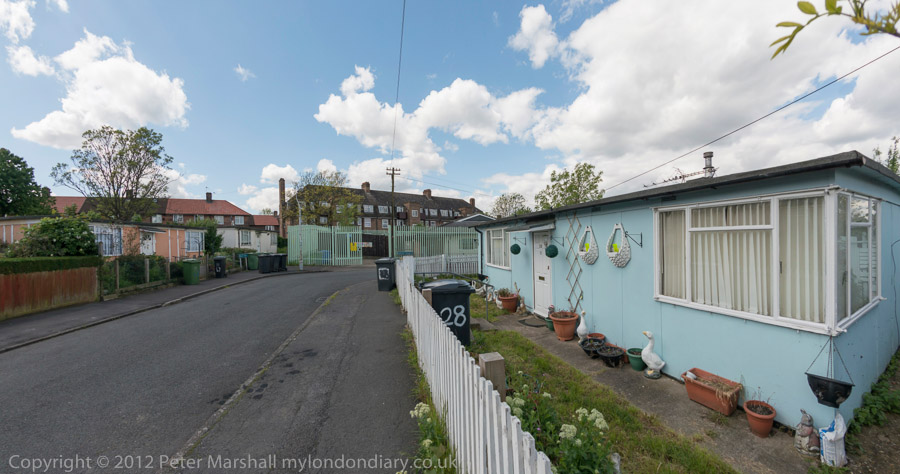
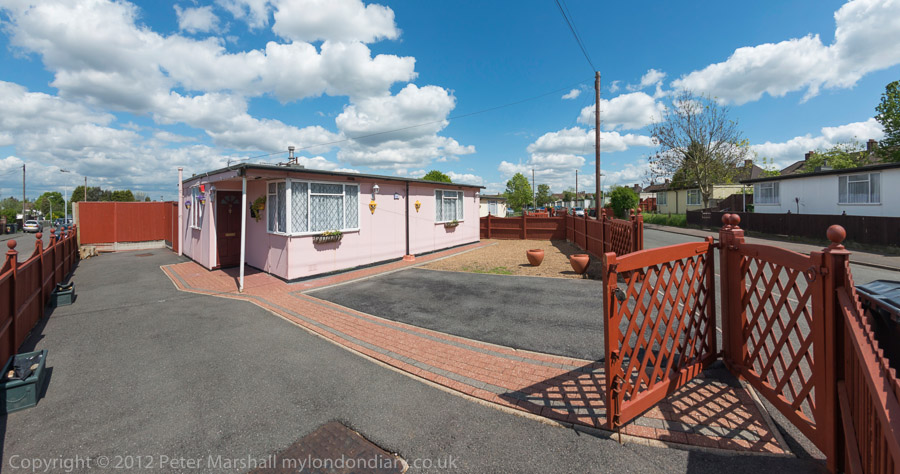
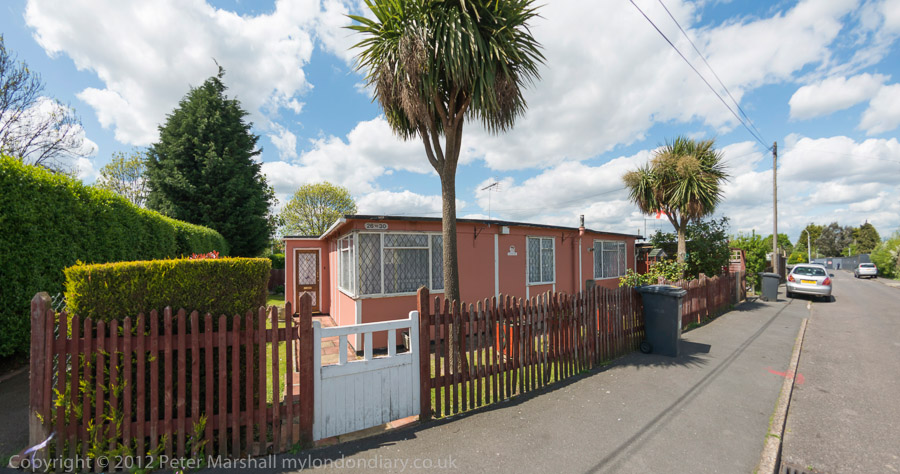
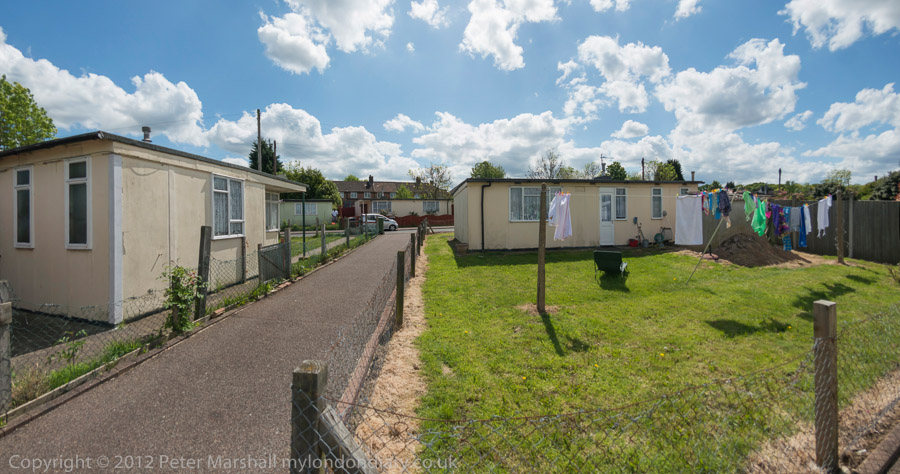
But Excalibur is also the name of of what was one of the more interesting estates in London, a pre-fab estate built during 1945-6 by German and Italian prisoners of war using two prefabricated designs of housing, and was initially intended to last 10 years.

Excalibur - The Estate

The owner of the land, a Lord Forster gave it to the London County Council on a promise it would be returned to parkland when these single-storey two bedroom temporary houses were cleared.

Excalibur - The Estate

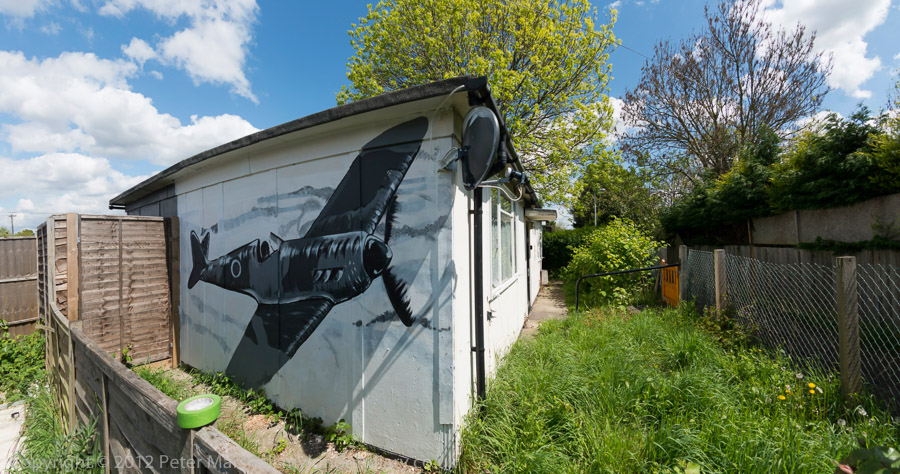
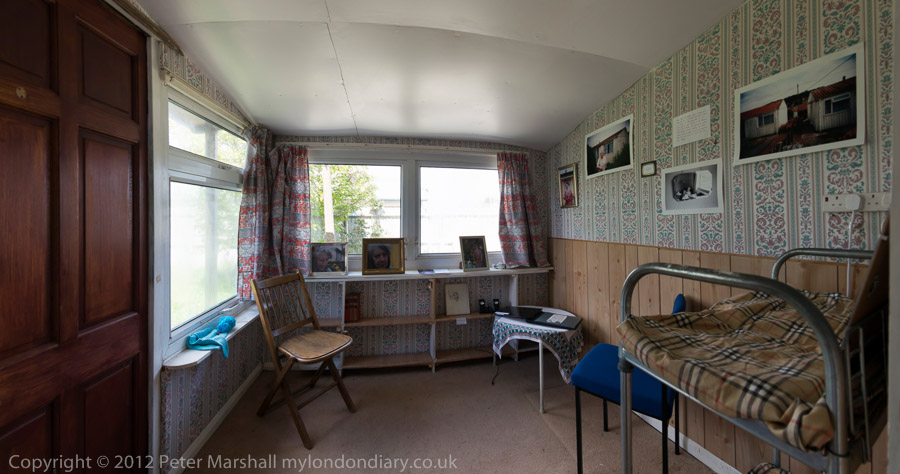
The estate lasted rather longer than expected and most of the 187 homes were still being lived in when I paid another visit on 6th May 2014 to make some panoramic images and also to visit the Prefab Museum, an art project by Elisabeth Blanchet.

My first visit had been back in the 1990s, when I walked the Greenwich Meridian in London as a part of a proposed Millennium project, Meridian, which failed to attract the funding needed to complete it, though I had taken all the photographs I needed. Only some of those north of Greenwich are on line. The Greenwich meridian actually ran through the centre of the pre-fab which housed the museum.

I’d returned back in 2010 to take more pictures after reading that the estate was to be demolished, despite valiant attempts to save it. And of course that promise made to John Forster, 1st Baron Forster of Harraby was forgotten – and he had in any case died in 1972.

Half a dozen of the pre-fabs were eventually listed after a long battle and so should survive the demolition of the estate. But it was really the estate that was important rather than the individual buildings. Although parts of the estate have now gone, much still remains, but has been allowed to decay considerably since I made these panoramas on May 6th 2014. All of these pictures show a roughly 140 degree horizontal angle of view – and roughly 90 degrees horizontal, with some fine clouds in a blue sky. These are a small sample of the roughly 70 images I made on the day.

The images online – much smaller than the orginals – are actually twice the width they appear on this post and you can view them larger – as well as many more – on My London Diary at Excalibur Estate.