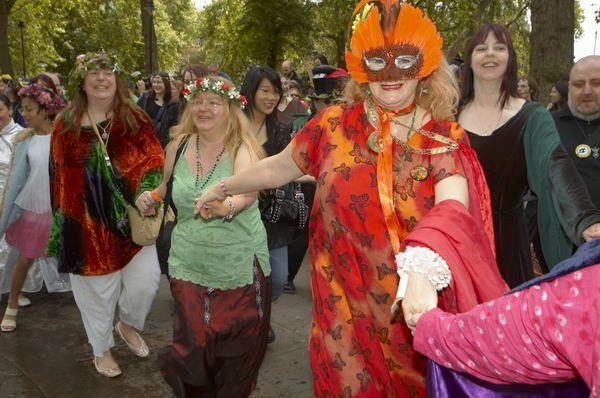
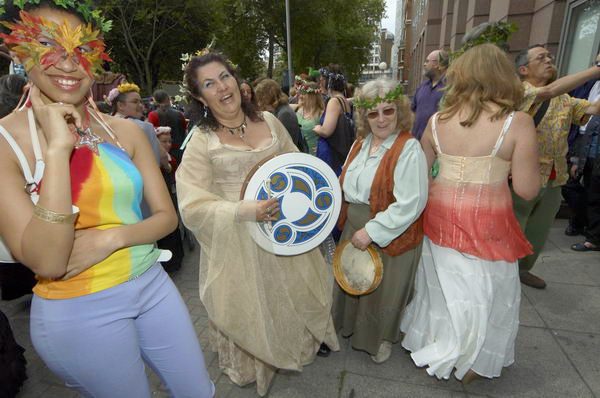
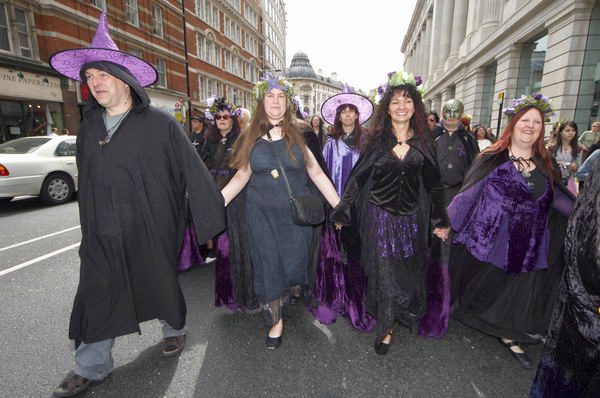
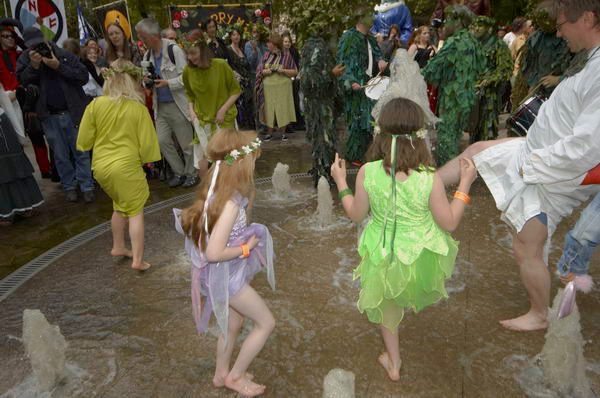
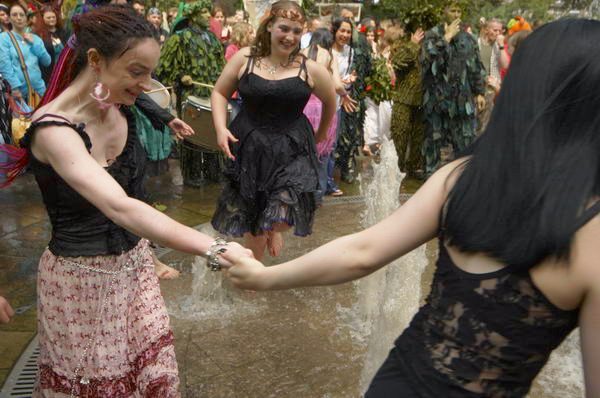
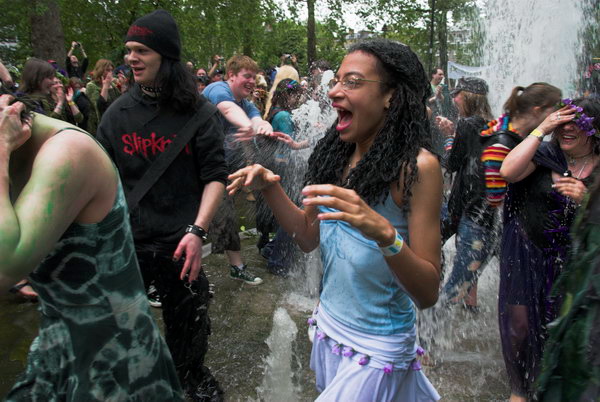
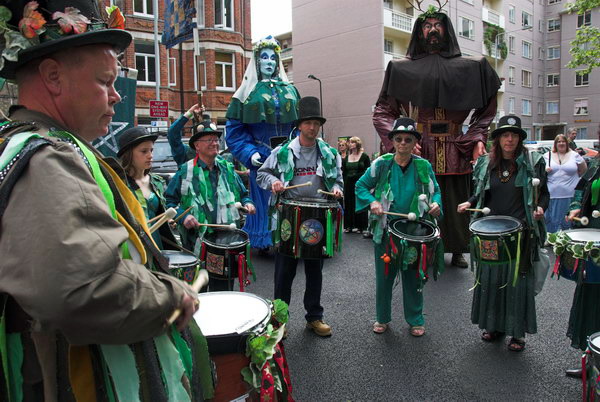
Beltane Bash – Pagan Pride 2005: Spiral dance around the fountain in Russell Square
Beltane was an ancient Gaelic Festival to mark the beginning of Summer and was celebrated in Ireland and Scotland on May 1st, but the whole month of May was the month of Beltane, and this London celebration on Sunday 29 May 2005 took place on the last Sunday of Beltane.
It was when cattle were taken to higher Summer pastures and various fires and rituals were performed “to protect cattle, people and crops, and to encourage growth.” There was also a great deal of feasting and merry-making.
Beltane was still celebrated in many places in the Victorian era and attracted the attention of folklorists recording its dying practices. But the mid twentieth century saw its revival in cultural festivals in some towns including in the Gaelic diaspora.
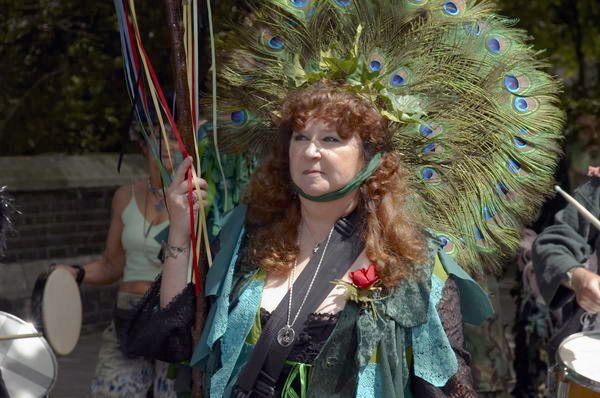
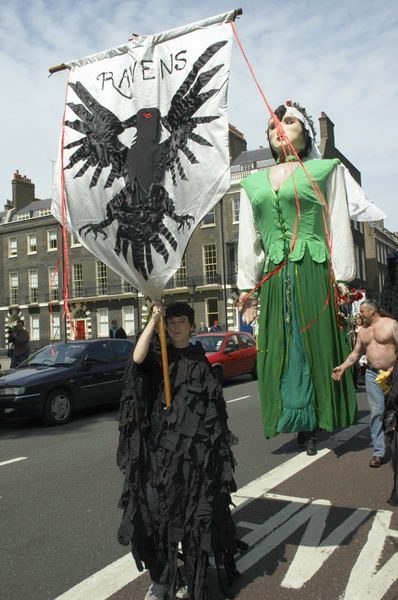
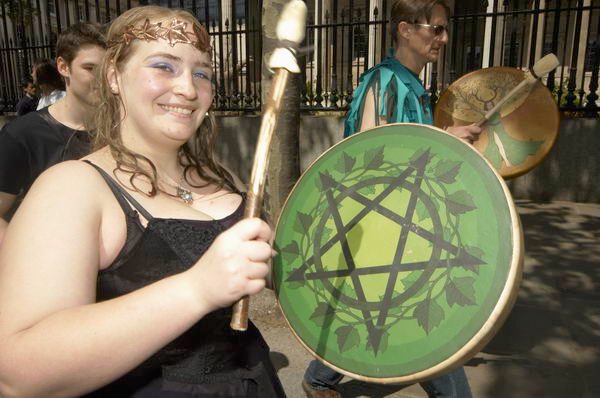
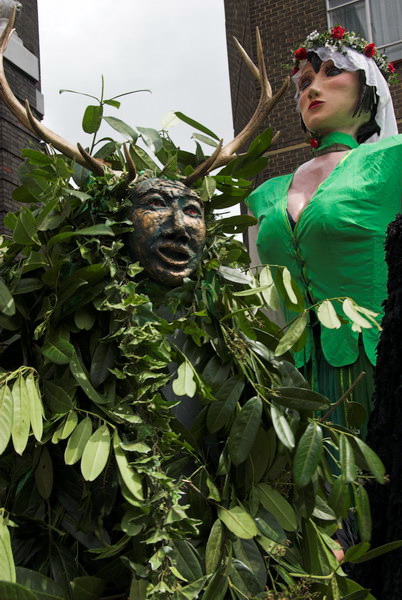
The Green Lady
Celebrations have also been revived in Neopaganist events such as this annual event in London which I photographed most years from 2004 to 2010, but there are other celebrations in various venues across the country and wider, mainly around the start of May.
I’m unsure if the Pagan Pride Parade still takes place in London. The first was in 1998 and there was a parade in London in 2019, but I don’t know if there have been more since Covid.
Here’s the text I wrote in 2005 – and a link to more pictures from the day:
Beltane Bash – Pagan Pride
Bloomsbury
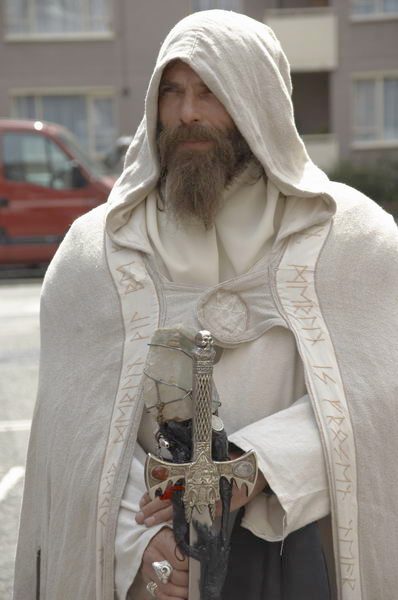
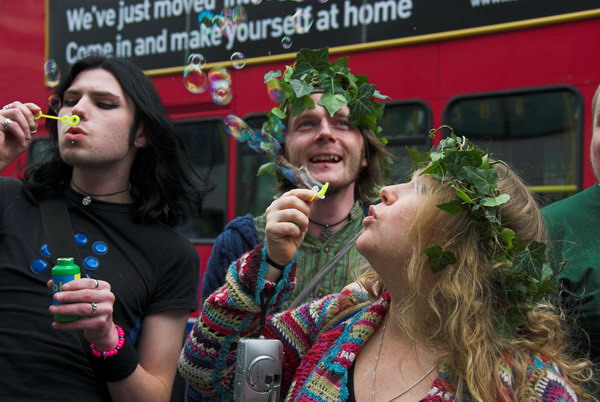
The Beltane Bash takes place annually in London during late May, and is a gathering of “pagans of all traditions, whether they be witches, wiccans, druids, odinists, asatru, shamans and Egyptian traditions” to celebrate the changing seasons of the year.
The event starts with a Pagan Pride Parade around Bloomsbury, with a dance and a certain amount of splashing around the fountain in the middle of Russell Square. The fountains have a number of jets which rise and fall, and some play is made of this in the proceedings.
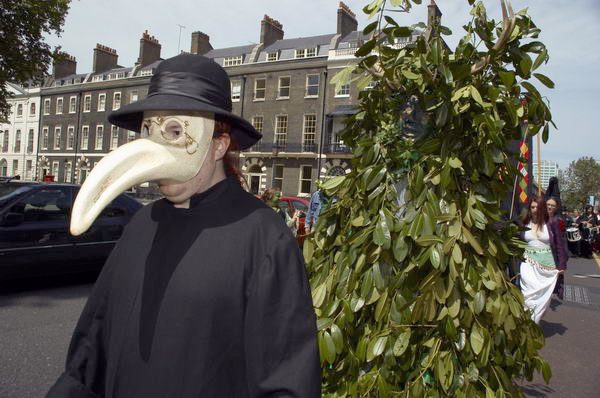
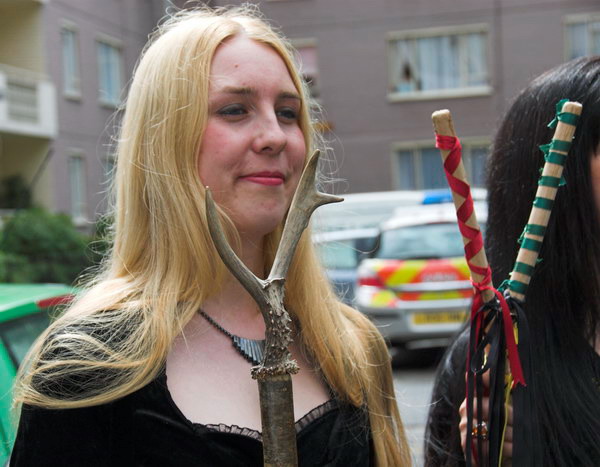
The procession, led by the Green Lady, includes the Jack In The Green – a dancing bush – along with a whole band of Green Men, the Bogie drummers, Giants including Herne, Lord of the Forests, the Ravens and much more.
Beltane Bash is also a fund-raising event, helping to ensure the future of an area of 25 acres of ancient woodland, Raven’s Wood, near Tring in Buckinghamshire.
There are more pictures on My London Diary on most May pages from 2004 to 2010. Those from 2005 start here.
Brian, Bears, Morris and May Queens: On Saturday 13th May 2006 I went to Parliament Square where I photographed resident peace protester Brian Haw and Morris Dancers, going on to more dancers performing in Trafalgar Square as a part of a Westminster Day of Dance. From there the Underground took me out to Hanger Lane from where I walked to Brentham to photograph the 100th anniversary of the first Brentham May Queen crowning.
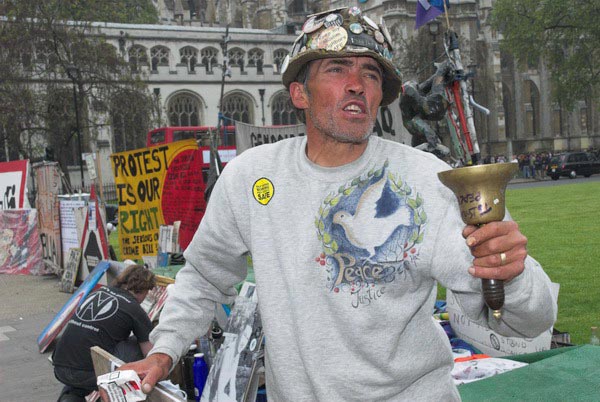
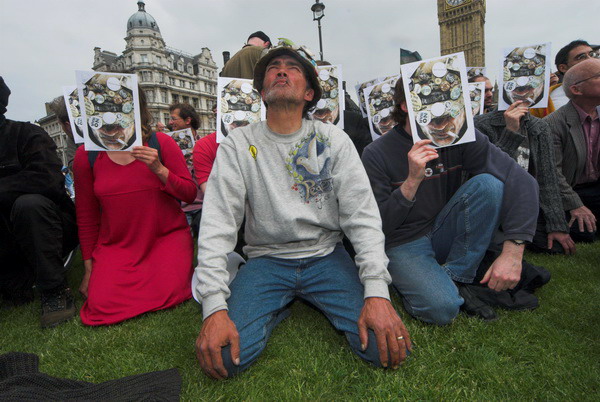
Brian Haw at Parliament Square
Brian and the Bears
Brian Haw lost the appeal by the government over his protest in Parliament Square, the court deciding that the Serious Organised Crimes And Police Act did apply to his protest after all, despite it having started around 4 years before the act came into force. It seems to be a decision that reflects more on the ability of the government to apply pressure rather than one that suggests an independent judiciary.
At the moment, Brian is still there, his protest now regulated by the police, but it seems rather likely that at some moment the feel convenient they will decide to terminate it. On Saturday morning I went to have a short word with him and take some more pictures, particularly of some of the bears who are with him.
His protest from the start has been about the killing of children, at first by the effects of sanctions, then by the war, and the teddy bear symbolises this (I think of one of the most poignant images from the Second World War, by Cecil Beaton, of a child in a hospital bed with a teddy bear.) I hope to be back to see Brian tomorrow, with a few friends, if he is still there. [He was, and depite constant harassment remained there until ill-health forced him to leave in 2011, dying in a German hospital six mohnths later.]
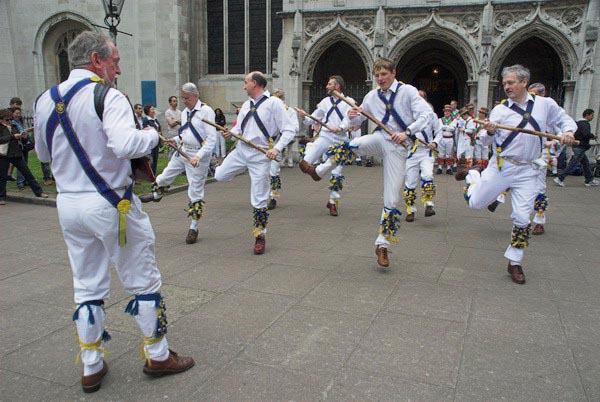
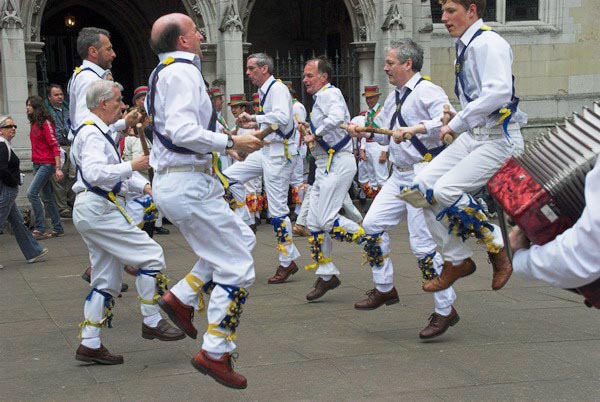
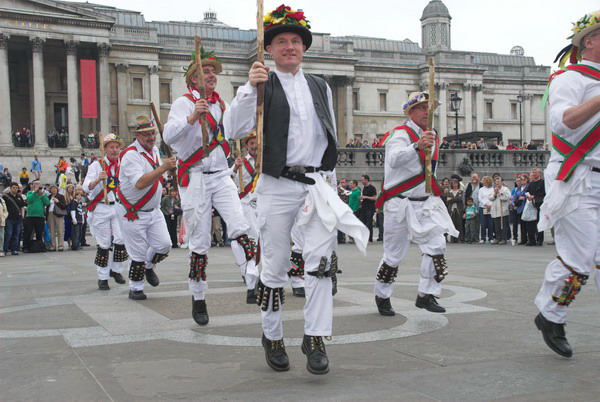
For several years there has been a dance festival in Westminster in May, with teams of Morris Dancers from around the country. I caught up with them briefly dancing in front of St Margaret’s Church next to Westminster Abbey, then a little later in Trafalgar Square.
Although i’ve never had a great desire to take up Morris myself, it certainly is one of our English traditions, going back at least 500 years – the first written record of it is in 1448.
It was still alive in many villages in the nineteenth century and a revival started in the early twentieth century particularly through the work of Cecil Sharp, who collected over 170 different dances around the country and started the English Folk Dance Society in 1911. Sharp and Mary Neal published books of dances, and in the 1920s and 30s, country dancing became a part of most young school children’s week. How I hated it in the 1950s!
It is perhaps that enforced participation that led to Morris Dancing being thought of as something false and lacking in credibility. In a curious anomaly, our Arts Councils refuse to support English ethnic dances while (quite rightly) giving aid to foster dance and related activities among minority ethnic groups. Despite this, Morris Dancing has continued to grow both in the UK and now increasingly abroad, particularly in Canada and the USA.
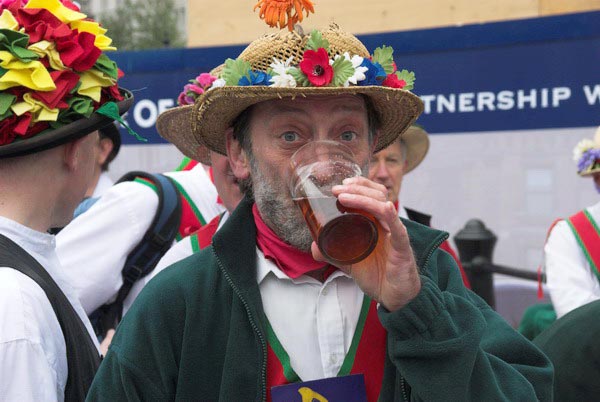
All the teams in Trafalgar Square were men, although there are also many women dancers. One of the things that comes out in my pictures is that the dance is at times a very athletic event. Many of the traditional dances use swords or staves and have a link to martial arts. Morris also has a strong link to another English tradition, the ale house.
May continued for me with another May Queen. Last year (2005) I had photographed the oldest continuing May Queen event at least in the London area, the Merrie England and London May Queen Fayre at Hayes, Kent, held continuously since 1913. This year I went instead to Brentham, where a May Fayre with maypole dancing was held in 1906, and its centenary was held this year.
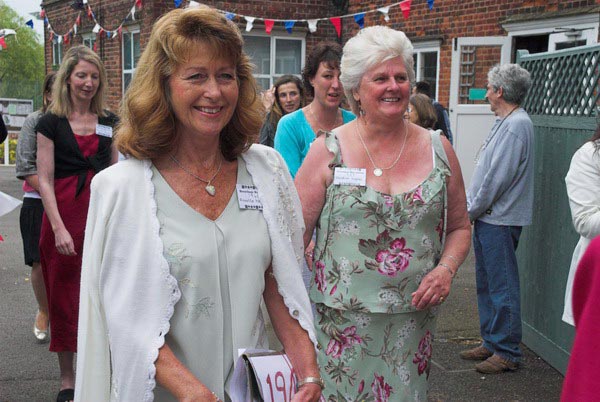
For this event, the organisers had managed to find and invite along many former May Queens, including some from the 1950s. Some had come long distances to be there, including one now living in America.
Brentham was one of the earliest “garden village” estates, built by ‘Ealing Tenants’ a co-partnership housing scheme started in 1901 and largely completed by 1915. The road layout was designed by Raymond Unwin and Barry Parker, and it was in many ways a model for other and better known garden villages.
The Brentham May Queen is less formalised that the south London events, with little or no long speeches and ceremonies (unlike Hayes it was not set up by a Dulwich schoolmaster.)
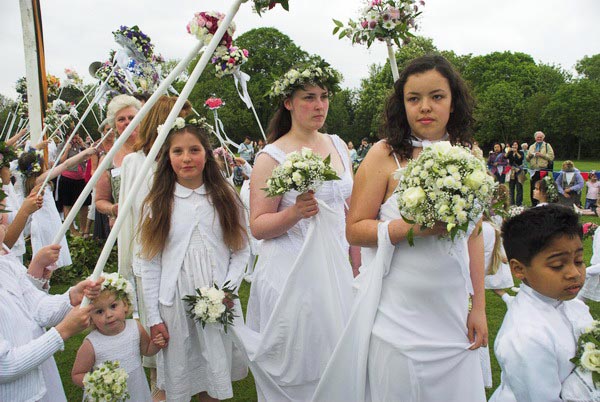
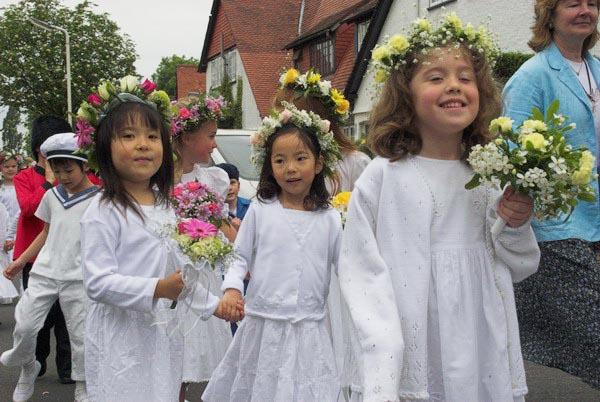
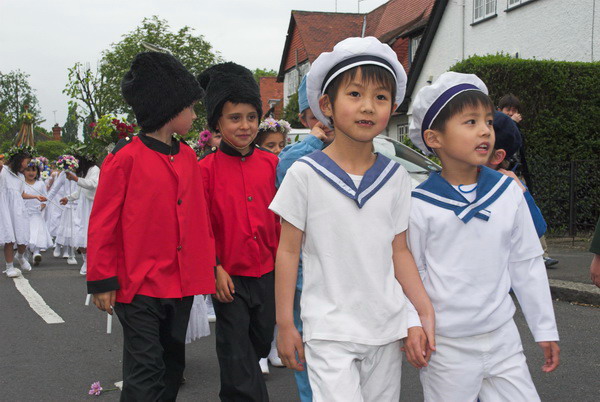
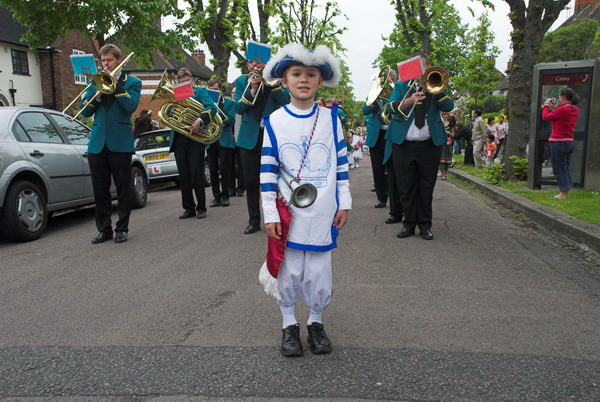
As well as the May Queen Elect and previous May Queens, each with a small group of attendants, there is also a herald who leads the parade (aided today by a brass band) Brittania, Sailor and Soldier, and, leading the large group of around 150 young girls dressed in white with flowers, a Jack In The Green, covered with leaves, with just bare legs and sandals visible.
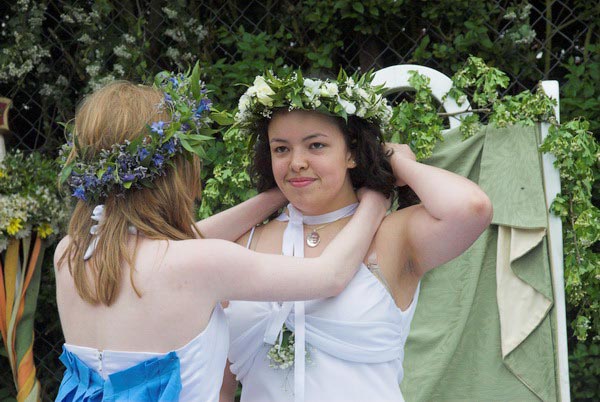
The crowning of the 2006 Brentham May Queen
After the parade around the area, there was a short ceremony in one of the fields by the River Brent in which last year’s May Queen crowned the new queen, and a very short speech. Following this were country dances and dancing round the maypole, but I left before this began.
Beltane, Chariot Festival, Barking & Whitechapel: I had an interesting and varied day at events and places across London on Sunday 28th May 2006, taking rather a lot of photographs. Appropriately for a Sunday I covered two religious events.
Pagan Pride – Beltane Bash – Holborn
My working day began at Holborn, having caught a fairly early train into London. Now I like to relax a bit on Sundays, but for many years I often came up by the first train to take photographs. Though it wasn’t that early on Sundays, departing around 8am.
I took a bus from Waterloo to Holborn and walked the few yards to the Conway Hall at the north-east corner of Red Lion Square.
Here (with corrected capitalisation) is what I wrote about this event on My London Diary in 2006.
The Pagan Pride Parade in Holborn is now a regular annual event, a part of the Beltane Bash that takes place in the Conway Hall in Red Lion Square. Mostly it was the same people as last year, but I found it hard to get into the mood to take pictures.
As usual the parade was led by Jack In The Green – a dancing bush – the Green Lady and the Bogies. The Giants included the Morrigan (in green and flowers to welcome summer) with Black Ravens, Old Man Thunder and Old Dame Holder, along with the rest of it.
Dancing round the fountains was energetic, but somehow for me the event didn’t really get going, and lacked any real climax, people just slowly began to fade away.
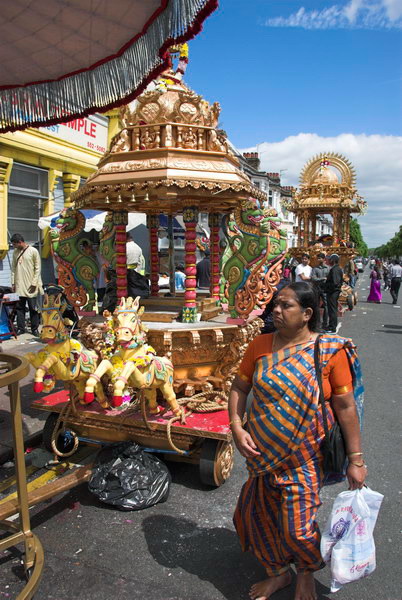
Chariot Festival, Sri Mahalakshmi Temple – East Ham
Those taking part in the Pagan Pride parade began to make their way back to Conway Hall for the rest of their day of events, but I rushed to Holborn underground station to take the Central line eastwards, changing at Mile End to get to East Ham. But I had stayed too long with the pagans.
The Sri Mahalakshmi Temple had been built in 1989 and opened and was almost opposite the station. Before that Hindus and worshipped at a converted shop on the corner of Kensington Avenue and High Street North, around 300 yards north from the station.
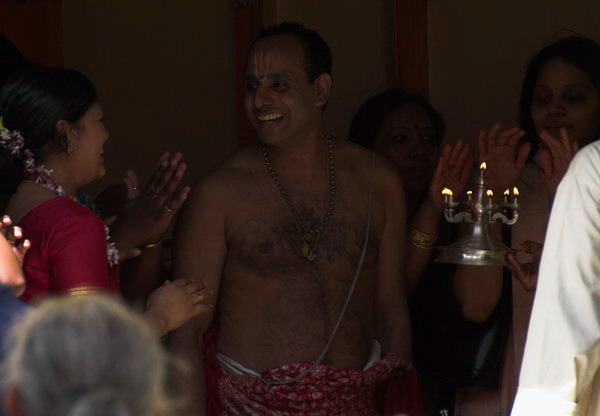
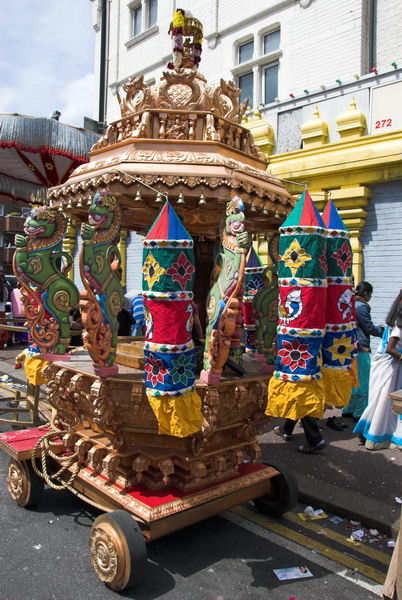
Unfortunately I had arrived too late and the procession on the streets had ended, though I was still able to photograph the chariots outside and a few of the people. I made a mental note to come back and cover this event another year, but although I photographed other chariot festivals including one in Manor Park, East Ham, I’ve never returned for this one.
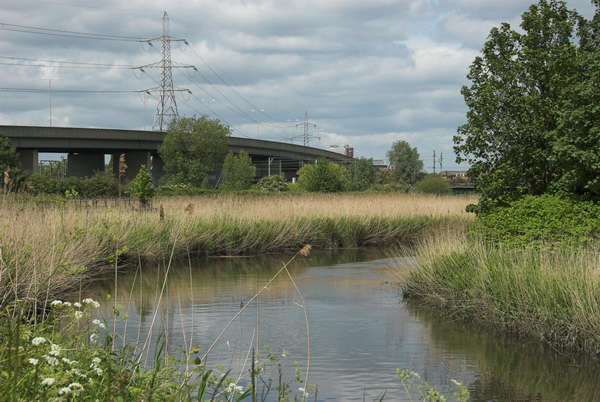
I was in East Ham and the afternoon lay ahead; it was a fine day and I decided this was a great opportunity to take a walk a little further to the east by the River Roding. I took a few pictures of the chariots, then went to walk along by the River Roding and to photograph a new development by the railway in Barking.
The half-mile walk along unkonwln was rather uninteresting. It’s a long suburban street lined with terraces of working class housing from the early twentieth century on both sides, named for the family who once owned the estate on which it was built. As Stephen Benton points out in his London Postcode walk it has one small claim to fame, and almost every famous pop guitarist from the the 70s and 80s – including those from the Beatles, Rolling Stones, Yardbirds, The Who as well as musical failures like me will have started with Bert Weedon’s ‘Play in A Day – Guide to Modern Guitar’, first published in 1957. Weedon (1920-2012) was born here, though he had probably moved away long before he became famous.
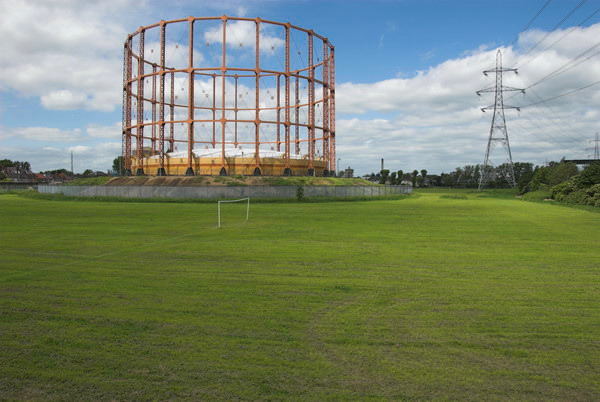
The path led on to Watson Ave, with a view of the Leigh Road gasholder in what is now the derelict Leigh Road Sports Ground. The Barking Gas Works opened here in 1836 but was purchased in 1912 by the Gas Light and Coke Company, who closed it as they had the much larger and more economical works they had opened at Beckton in 1870. But the holder remained and was I think still in use by the North Thames Gas Board possibly until the change from coal gas to natural gas. The area around it became their sports ground.
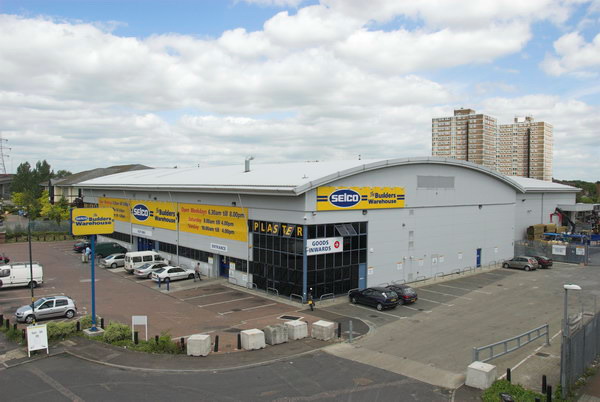
At the end of Watson Ave is a long footbridge which took me over the North Circular Road, from which I took a few pictures before going through an industrial estate.
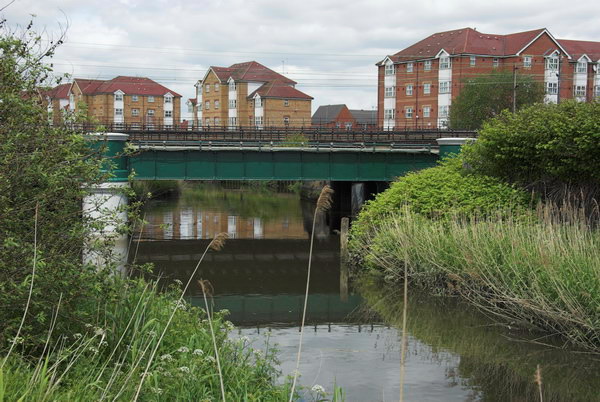
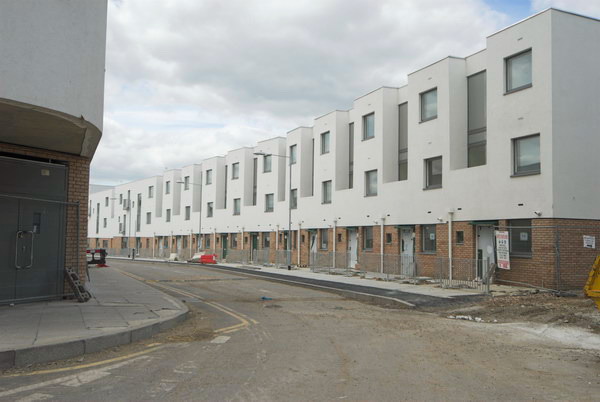
I made quite a few pictures in the Tanner Street area, where a considerable amount of new development was taking place.
I told myself I would return here later, but I don’t think I’ve done so yet.
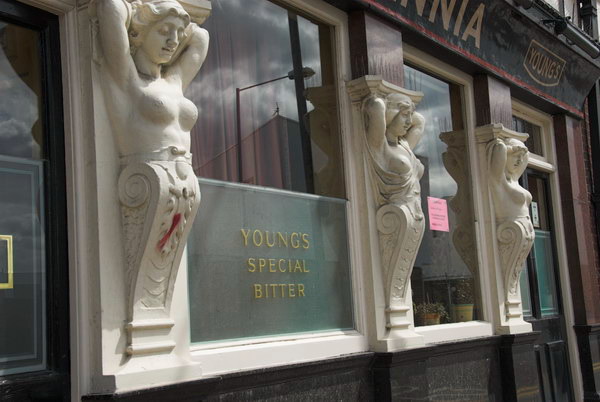
I think I had travelled back from Barking on a Hammersmith & City line train and needed to change soemwhere to the District Line. Having got off the train I decided I had time for a short walk around on before needing to continue my journey. I only taok a few pictures, perhaps making 20 exposures, and there are only four pictures on My London Diary.