Nunhead and Brockley: Pictures from my walk on 18th March 1990 in Nunhead and Brockley.

The Beer and Wine Trade Society decided in 1851 to provide an asylum for its elderly poor members and purchased land on the north side of Nunhead Green, launching an appeal to its members to build these almshouses. They were built at at a cost of around £3,000 as a terrace of seven dwellings to house 13 people. The Metropolitan Beer and Wine Trade Society almshouses, architect William Webbe, opened in 1853.
The accommodation was on a generous scale, with each having four rooms and a kitchen and a part of the garden behind to grow vegetables. As well as the accommodation the residents also received a weekly allowance.
The almshouses are Grade II listed and are now private homes.

Nunhead Library was designed by Robert Whellock of Camberwell in an Arts and Crafts style and built in 1896. Since 1965 in the London Borough of Southwark where it is one of four libraries which were founded by philanthropist John Passmore Edwards and is still in use as a library. Edwards founded another 11 libraries in London, most no longer in use.
Nunhead had been a part of the ancient parish of Camberwell but became a separate parish in 1878 and became part of the Metropolitan Borough of Camberwell in 1900, which became part of the London Borough of Southwark in 1965.

Nunhead Railway station is in Gibbon Road and this Gents Hairdresser at 52 and Launderette at 54 (and the Fish & Chip shop at 50 whose frying times are in the corner of their window) are just past the bridge north of the station entrance. Rather to my surprise there is still Gents Hairdresser and a Fish and Chip shop here, though the Launderette closed around 2010 and is now two homes at 54 and 54a.
The two people sitting reading outside – before the age of mobile phones – are doubtless waiting for their washing to finish inside the launderette.

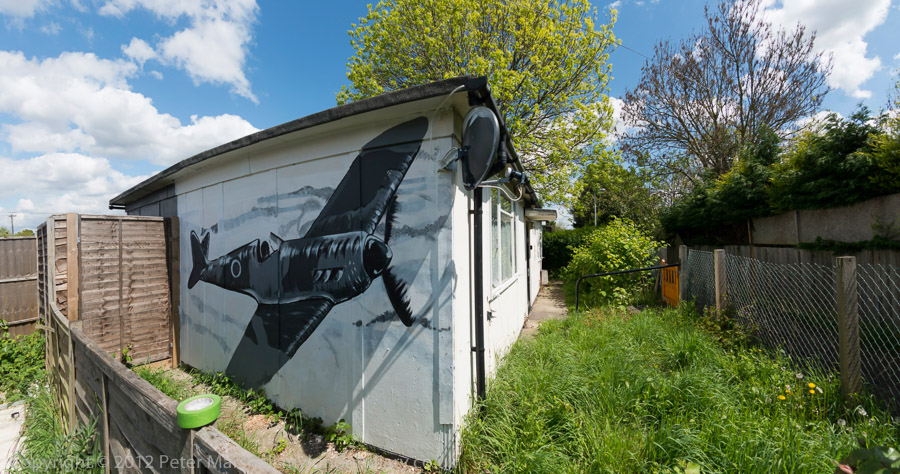
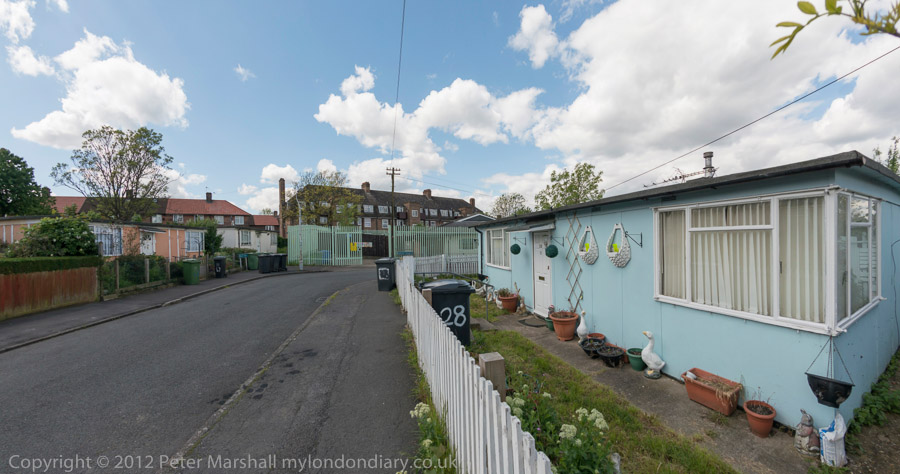
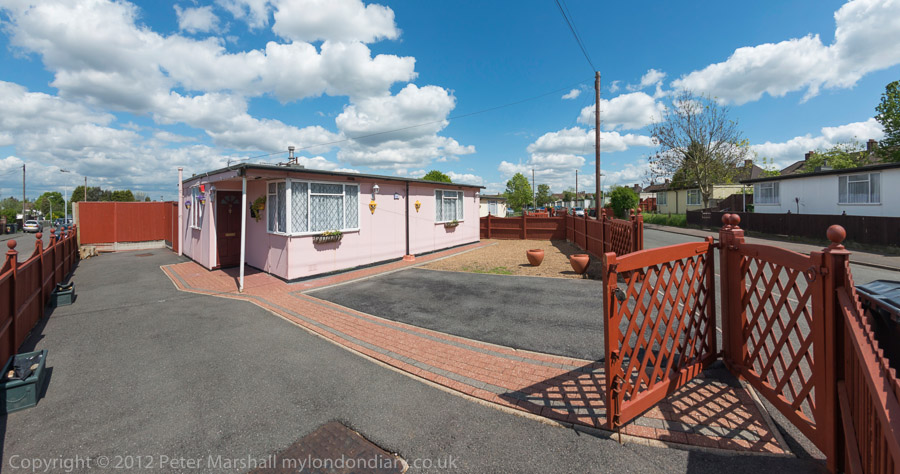
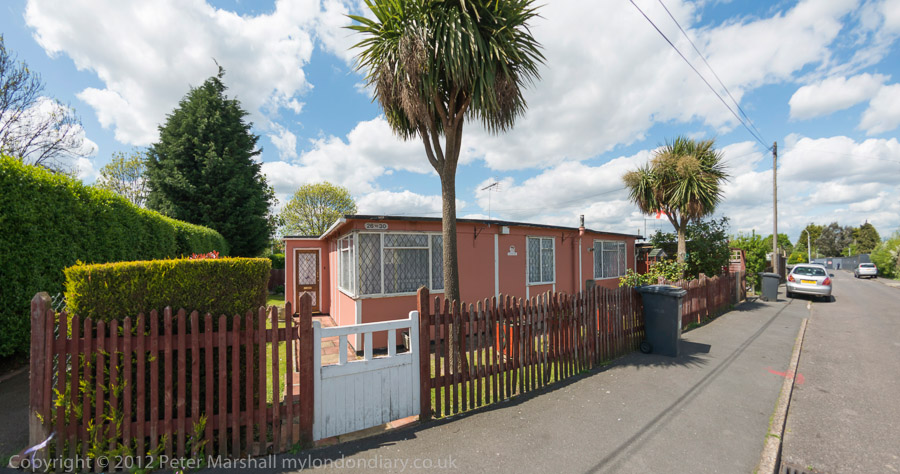
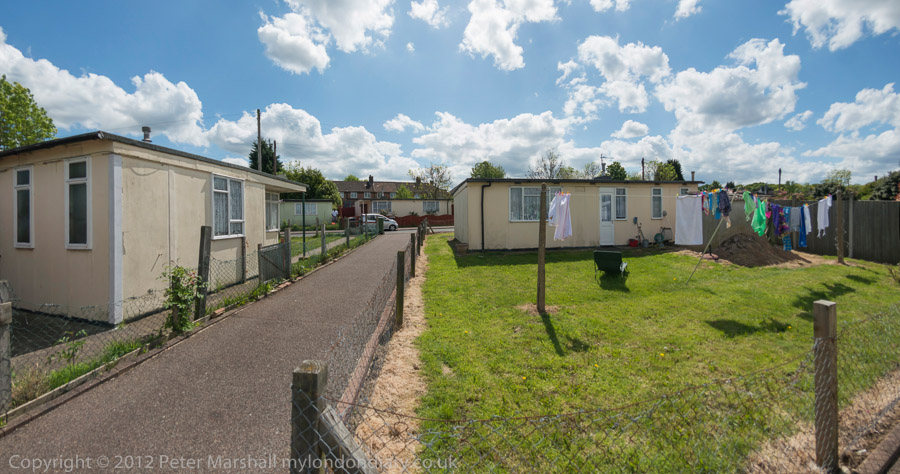
I went down Gibbon Road and turned left into Hathway Terrace, which turns into Kitto Road and leads on to Drakefell Rd. Somewhere here was this path with a broken-down fence leading to an area of prefabs.
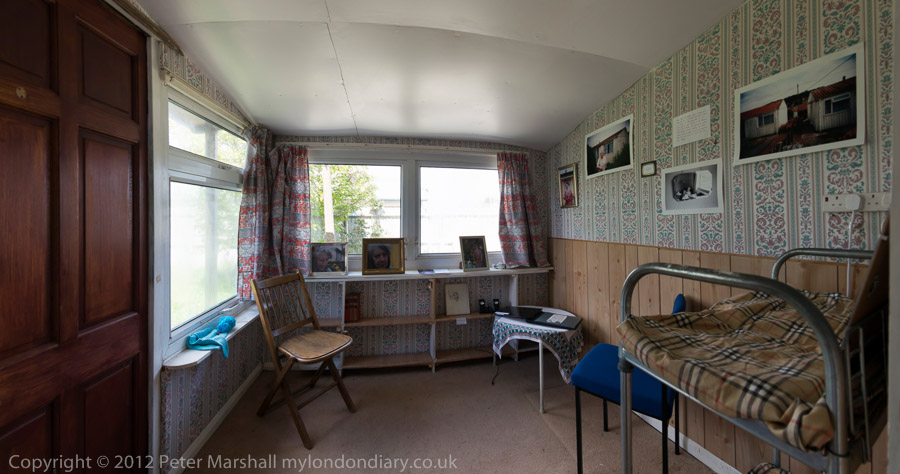
In 201 Elisabeth Blanchet and Jame Hearn from the Prefab Museum photographed the interior of a prefab in Drakefell Road and posted a video of the resident, John De’Ath, who had moved in when these prefabs were new in 1948 and stayed there until his death in 2017, a very satisfied resident. You can read more about London’s prefabs and see a photograph of one of them in a GLIAS Journal, when in 2024 the two last prefabs there were awaiting demolition.

The 10 acres site the hill top on Kitto Road was created in 1894 thanks to George Livesey, chairman of the South Metropolitan Gas Company and a local philanthropist. It has good views to central London and south and east towards Croydon and Shooters Hill, which made it a great side for a semaphore station which was built around 1795 – as one of a series which formed an optical communication system from London to Dover and Southampton with large arms which could be moved to different positions to convey letters or codes.
The French had invented the system for their military and we copied it – and it was able to speedily deliver the new of Wellington’s victory at Waterloo (among many other messages over the years) back to London. The signal station was out of use by 1823, but the name it gave to what had previously been ‘Plowed Garlic Hill’ stuck.
Rather than take the views, I decided to make a picture that showed a hill. I don’t think it shows the part of the park which once had the telegraph station.

Mantle Road and Endwell Road meet at Brockley Cross, just to the north of Brockley Station, which is just down the hill which goes under the railway bridge at the left of Endwell Court. This rather isolated block appears to have been built as a mansion block with perhaps four flats and looks very similar now.

A small group of three semi-detached houses on the north side of Drakefell Road close to Brockley Cross have some rather unusually detailed ornamentation. This end of Drakefell Road was Penmartin Road until 1902, and I think these houses probably date from a few years before then. The houses are now flats.
As always, comments and corrections are welcome. More from Brockley in a later post.
Flickr – Facebook – My London Diary – Hull Photos – Lea Valley – Paris
London’s Industrial Heritage – London Photos
All photographs on this page are copyright © Peter Marshall.
Contact me to buy prints or licence to reproduce.