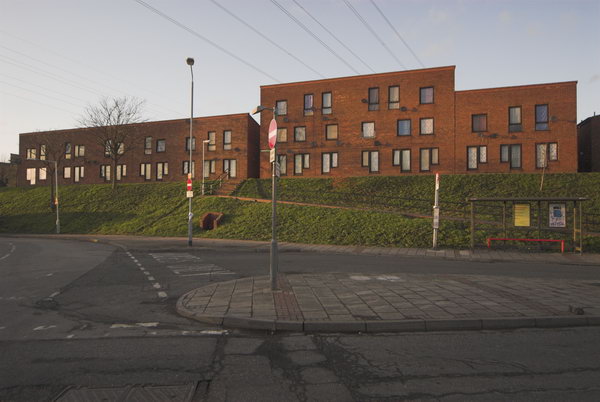
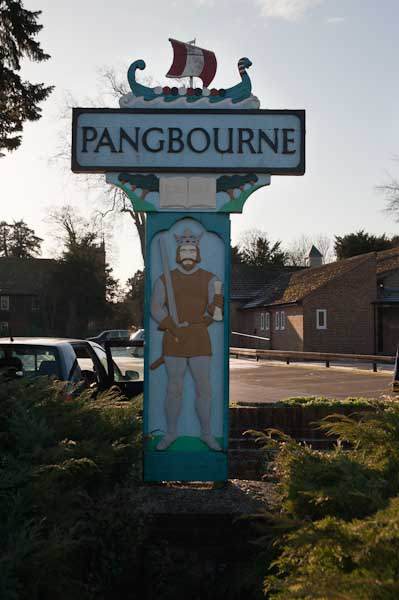
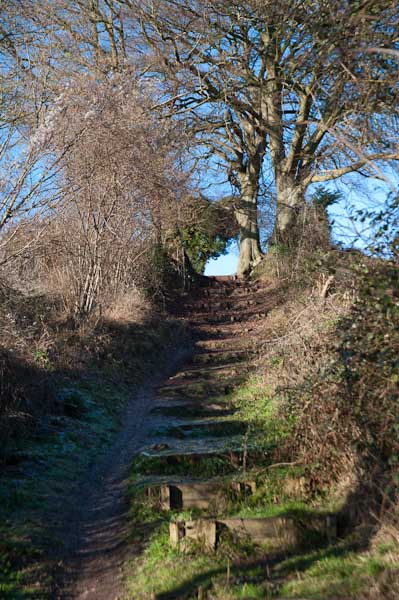
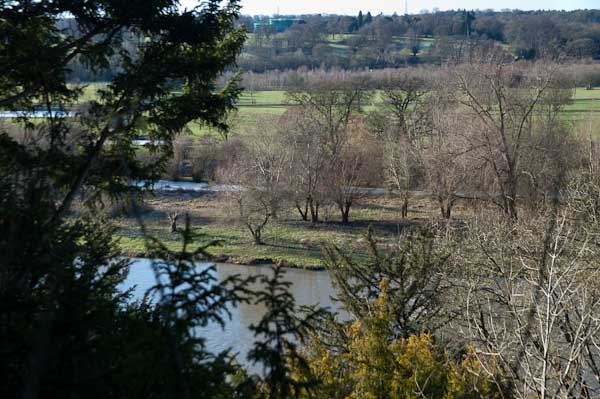
A Walk Along Bow Creek, 2017

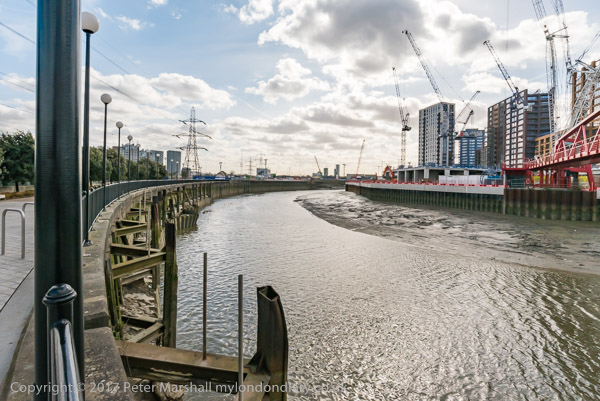
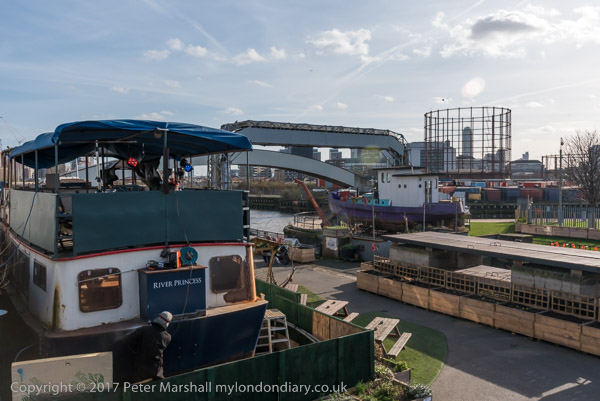
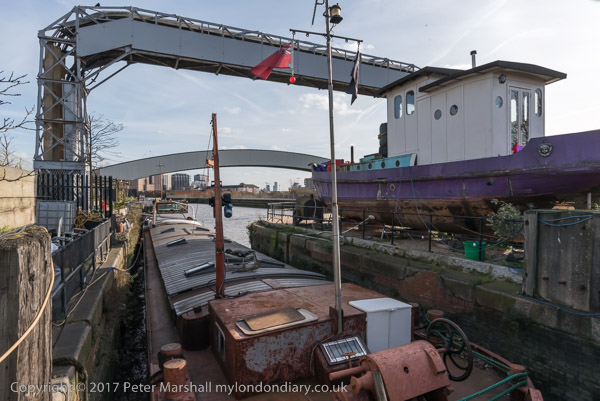
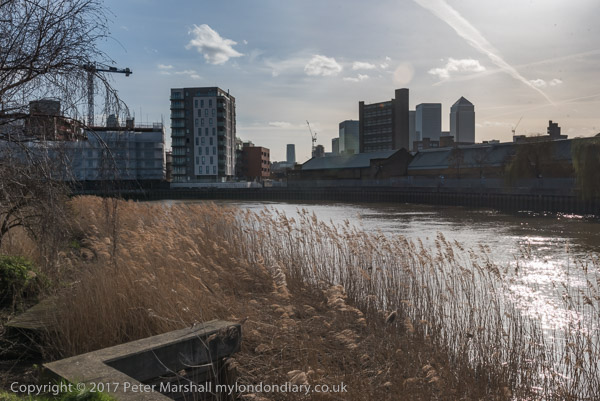
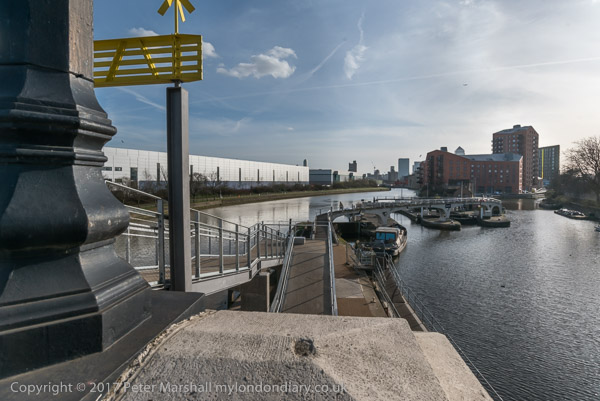
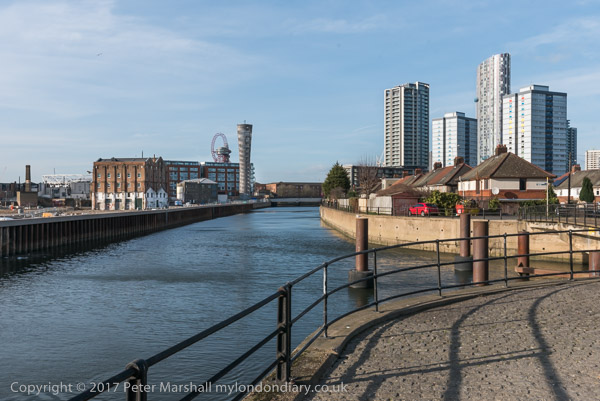
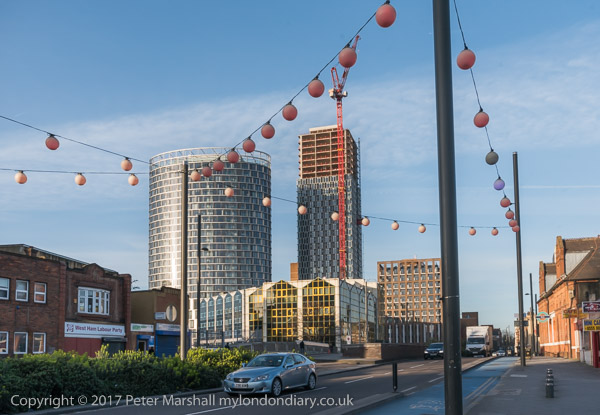
On Thursday 2nd March 2017 I had a meeting at Cody Dock about my photographic exhibition there later in the year. The weather forecast was good and promised me a day with blue sky and some clouds, perfect for my photography, particularly for some panoramas, where a clear blue sky or sullen grey overcast are both killers, so I rushed to get on an earlier train than I needed for the meeting to give time to take a walk along a part of Bow Creek before the meeting.

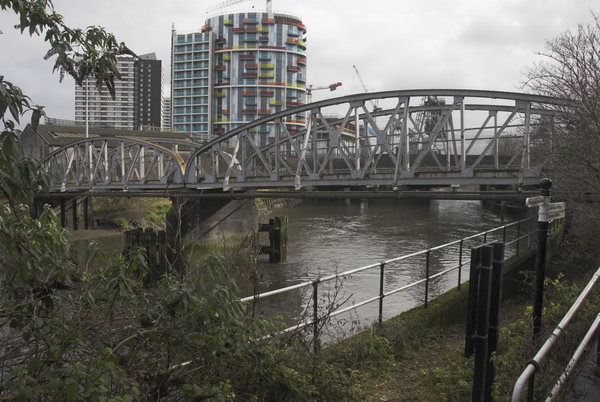
Years earlier there had been plans for a walk beside Bow Creek all the way from where it meets the Thames at Trinity Buoy Wharf up to the Stratford to join the tow path beside the Lea Navigation, but so far only some separate sections have materialised. The original plans envisaged two bridges taking the path across Bow Creek, and although a competition was organised (and won) for designs for one of these, neither had been built, largely because the money wasn’t there.

This section of the Leawalk has yet to open

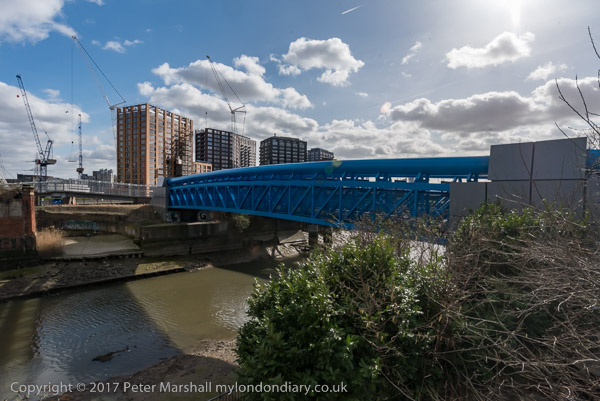
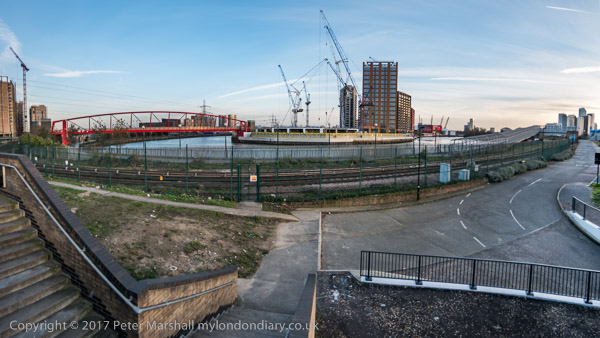
Instead the plans were changed to make use of existing bridges, but vital riverside sections remain closed, either because of existing users of the land refusing access or because of new developments taking place in the area. One such development, that of London City Island has recently provided a new bridge which allows an alternative route to the mouth of the creek.

The red bridge built for London City Island

Part of the problem has probably been that the walk is along the boundary of two local authorities, Tower Hamlets and Newham, with sections in both.

Cody Dock

I walked one section before the meeting, but came to a locked bridge which led to a fairly lengthy detour, and ended up with me having to run along the West India Dock Road to catch the DLR to get to the meeting in time.

Cody Dock

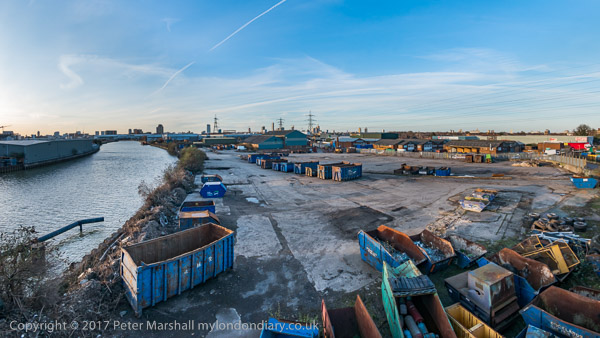
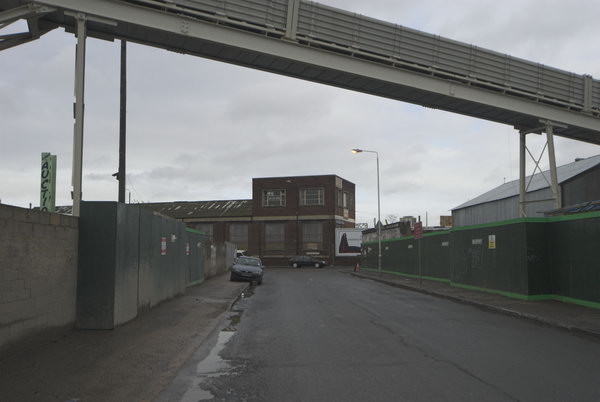
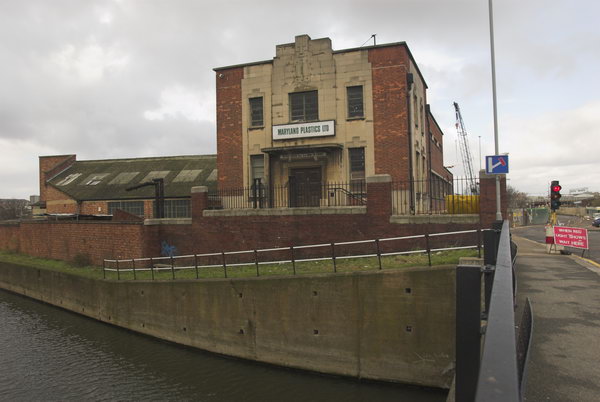
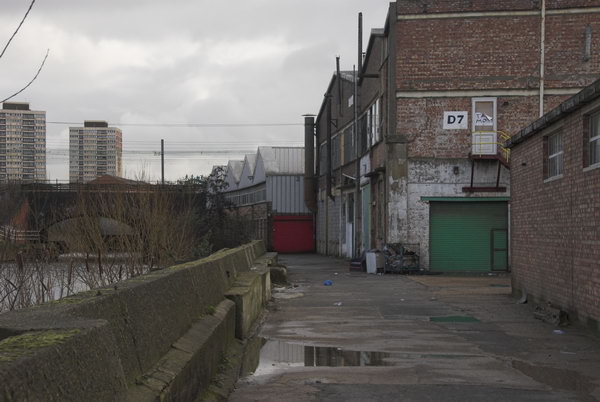
There is currently no path between that road and Cody Dock which would have been a faster route for me. Instead I took the DLR from Canning Town one stop to Star Lane, from where a walk through an industrial estate took me to Cody Dock.

After the meeting I was able to rejoin the riverside path, now renamed the Leaway after I and many others made fun of its previous title as the Fatwalk, and made my way to Stratford.

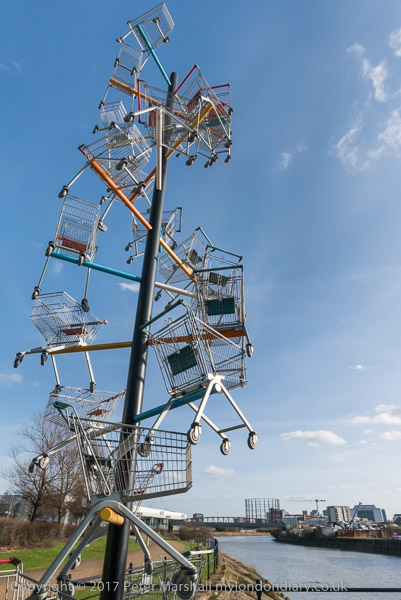
One of the works on ‘The Line’

On my way I was pleased to find a newly opened link from Twelvetrees Crescent (named after a Mr Twelvetrees who built a bridge there to his factory) to the footpath between the river and the Lea Navigation, enabling me to avoid the rather nasty detour between here and the path via the horrendously busy Blackwall Tunnel Approach road.

This part of the Leaway is now walked much more, not least because if forms part of of ‘The Line’ sculpture trail, which rather roughly follows the Meridian from Greenwich to Stratford. But those following this still have, like me, to take the DLR or walk along busy and dusty roads from Canning Town to Cody Dock.

There was still plenty of daylight left by the time my wanderings took me to the DLR Stratford High Street station, where I entrained back to Canning Town for a few more pictures which both lack of time and the position of the sun had made impossible before my meeting. Then it was back to the station for the Jubilee Line back to central London.

Many more pictures from these walks on My London Diary at:
Three Mills & Stratford
Leawalk to Bow Locks
Cody Dock
Bow Creek Canning Town


Before the Olympics – 2007

Five years and a few months before the London 2012 Olympic Games took place much of the site was still open although businesses had been moved out and some of the buildings were becoming derelict. I’d had an invitation to a party at a site there the previous evening but hadn’t been able to attend, but on Sunday 11th February 2007 I took my Brompton on the trains to Stratford Station for a tour of the area. It began as a rather gloomy day but the weather at least brightened up later.

Carpenters Rd from Wharton Road

I did return to parts of the area in later months as the close down was taking effect – and even led a two-day workshop at the View Tube in April 2010. And in June I was there to photograph workmen putting up the blue fence to keep us out of the whole Olympic area until well after the games were gone.

Before the Olympics - 2007
Footbridge to railway works over Waterworks River, Stratford Marsh.

Here’s what I wrote on back in 2007 about my ride around the area, much of which I spent pushing and carrying my Brompton bike along footpaths. But it did make it possible for me to cover rather more ground than would have been possible on foot. I’ve corrected the capitalisation etc. There are several pages of pictures with the original on My London Diary, just a few of which are shown here.

Before the Olympics - 2007
Marshgate Lane and Bow Back Rivers

2012 Olympic Site – Stratford, Sunday 11 Feb, 2007

Before the Olympics - 2007
Tate Moss, home to four artists and a venue for gigs of various kinds, now lost for the Olympics

Sunday I went to the Olympic site again, keen to photograph before the area becomes ‘fortress Olympics’ and is destroyed. Many of the businesses have now moved out and some of the small industrial estates are looking pretty empty. Tate Moss, who occupied a site by the City Mill River had staged their final event the night before, but the partying didn’t keep going long enough for me to look in and the place was deserted.

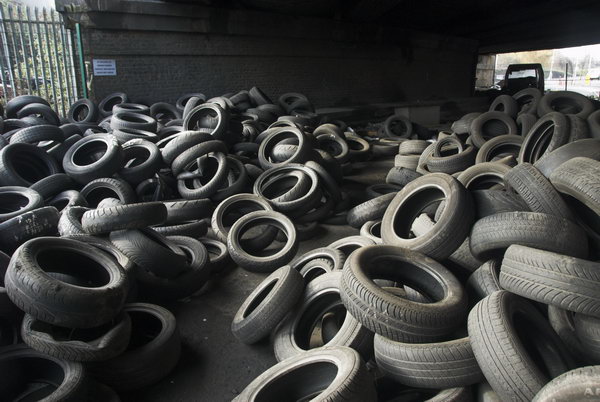
Marshgate Lane under the Northern Outfall Sewer is blocked with old tyres

Some of the riverside paths were open again after the test borings that have been going on, although several were fenced off over a year ago. The gate to the path by the waterworks river from the Greenway wasn’t locked, so I took a walk up this, but I knew that it was no longer possible to get out onto Marshgate Lane so had to retrace my steps.

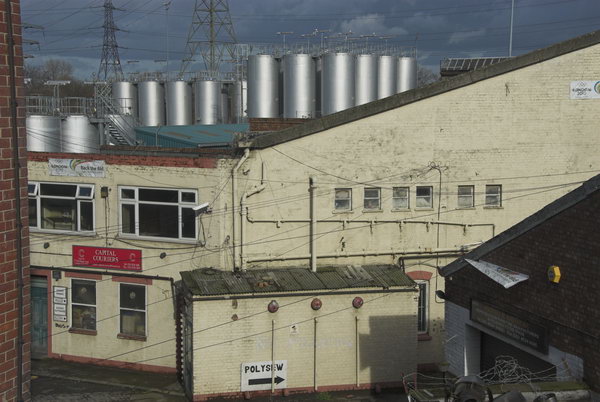
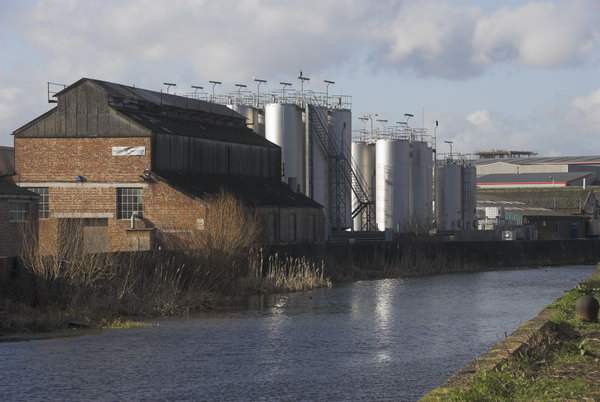
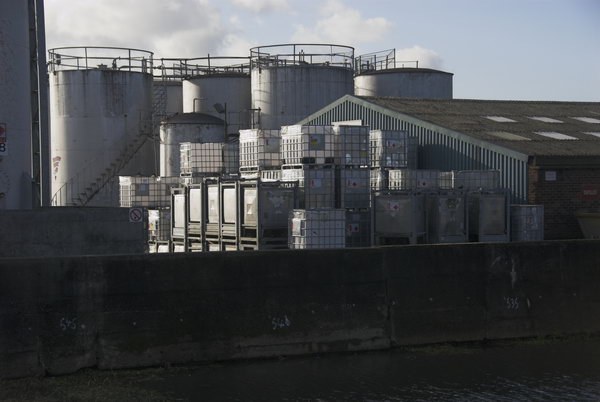
The Marshgate Centre and Banner Chemicals from the Greenway

The route back up to the Greenway from Marshgate Lane was almost completely obstructed by heaps of old car tires, and I had to carry my Brompton for a few yards and climb up onto a grass bank where the steps were completely blocked. Parts of the road were no longer open to cars too.

City Mill River

From there I moved on to Hackney Wick and Waterden road, and I finished the day as the light was getting low on Hackney Marshes, one of the areas in which locally important sporting facilities will be lost at least for a few years, perhaps for good.

Original text on the February 2007 page (you will need to scroll down.)


Banner Chemicals

My article back then ended with the paragraph above, but my ride didn’t – I had to get back home. It had previously taken me to a number of places just outside the condemned area, including some that were to be demolished for Crossrail, and it didn’t actually end on the Hackney Marshes, as the pictures on My London Diary demonstrate.

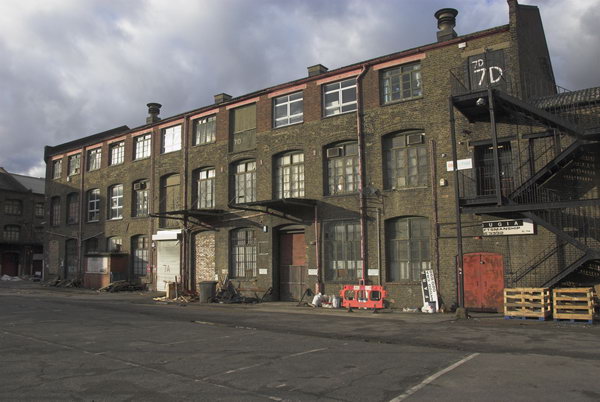
Kings Yard

I decided to ride back to Stratford to get the train home, and that ride took me back past Clays Lane, where the estate was to be demolished for the athletes’ village and I stopped several more times on my way to take more pictures in the gloom. Even when I arrived at Stratford around sunset there was still enough light for a few final images.

Clays Lane

You can see many more pictures from the entire ride on My London Diary


Thames Path – Pangbourne to Cholsey

I grew up not far from the Thames, though rather more of my young days were spent playing in and around one of its tributaries, the River Crane both in the wilder areas of Hounslow Heath and to the north and in the rather tamer Crane Park, where I caught tiddlers, sticklebacks which were destined to die in jam jars, and learnt that small boys on bicycles were faster than irate whistle-blowing park keepers.

Thames Path - Pangbourne to Cholsey

But the river was there, a formidable barrier protecting us in Middlesex from the wilds of Surrey, though we occasionally crossed it on bridges and ferries, perhaps to go to Kew Gardens in search of plant specimens. This was before the days of garden centres, and my father, a keen gardener carried scissors in his waistcoat pocket and would occasionally take a small cutting from gardens as we walked past or visited, or find seeds. Gardeners where we lived didn’t buy seeds – they saved them and swapped them with others.

Thames Path - Pangbourne to Cholsey

And the Thames was the river where I learnt to swim, if only badly, with a paddling pool and a swimming area with a springboard in the riverside park, The Lammas. Later I learnt to row at Isleworth, in a heavyweight Sea Scout boat – and we swam there too, despite the filthy oily state of the mud and water.

Thames Path - Pangbourne to Cholsey

Older and wiser I kept to the riverside paths, walking them both in Middlesex and Surrey and also out to the east of London, sometimes taking my family with me, but also on walks with other photographers and on my own. And when plans were being made in the 1980s for a Thames Walk I made a few suggestions on the proposed path of what in 1989 became the Thames Path.

Far more of the river in London is now accessible to the public than back in the 1970s and 80s when much of the riverside was still a working area, though many of the wharves were derelict. But as I found when I joined a small group led by a Tower Hamlets official with responsibility for footpaths, parts of the path on the north bank were still not always easy to access, with developers and residents erecting gates and barriers and making some parts appear private. Some years later The Guardian in 2015 published Privatised London: the Thames Path walk that resembles a prison corridor which showed that little had changed.

But like many others, my family has now walked the Thames Path, from the Thames Barrier at Charlton to the source in Gloucestershire, as well as some way to the east along both shores. Most of the path proper is readily accessible by public transport and can be done as a series of one-day walks, travelling and returning from from our home in Staines or from London. But for the final three days of walking we had to spend a couple of nights in hotels on the route.

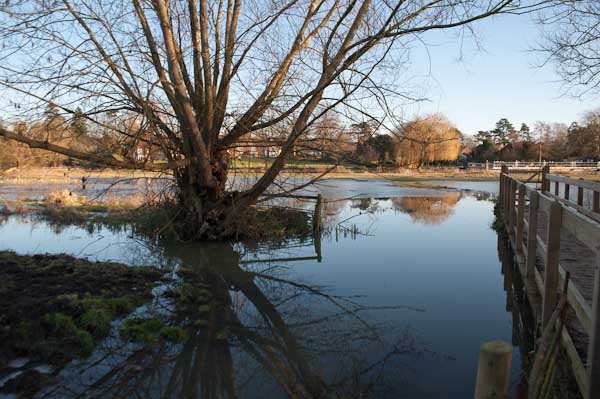
At Streatley the path goes through a small lake

At the start of 2010, we spent both New Years Day and January 2nd walking two short sections of the walk, from Reading to Pangbourne on Friday 1st and returning to Pangbourne on the Saturday to walk to Cholsey. Both Cholsey and Pangbourne have stations with trains to Reading, so access was easy, although Cholsey station is over a mile from the Thames Path.

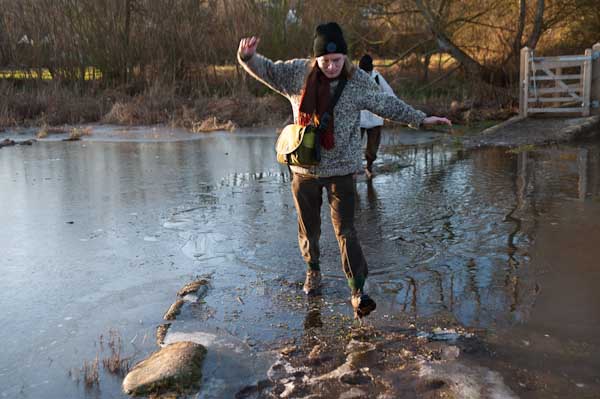
The pictures here are all from Saturday 2nd January, on what is perhaps the most scenic stretch of the Thames Path. It was a bitterly cold day, which was perhaps as well, as the parts of this section would have been very muddy and a little flooded. But the mud was frozen and most of the ice on the flooded parts was thick enough to take our weight. It was more pleasant walking across the ice than it would have been wading through the few inches of mud and freezing water, almost certainly just deep enough to overtop my walking boots.

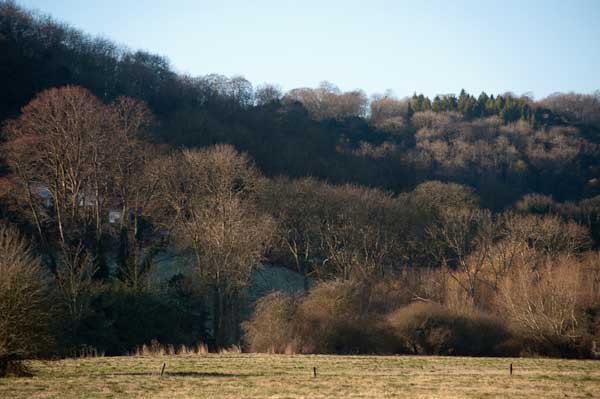
At the start of the walk from Pangbourne, after crossing the river the path climbs a little up a ridge, with occasional views through the trees across the valley. It then goes down to the riverside again, passing under one of Brunel’s fine brick bridges for the GWR to the Goring Gap, where the Thames runs between wooded hills. Goring itself is the kind of place I like to avoid, though I’m sure it has its charms, but I’ve always seen it as a kind of playground for the self-satisfied rich. We crossed the river to Streatley on the south side, a village owned by Oxford Brewery owners the Morrell family until they sold it in in 1938. They had protected it from development.

It was here that we found the worst flooding on the path, and almost took one look at a gate leading on to a lake and turned round – we could have ended our walk here and returned to Reading from Goring station. But eventually we decided the water couldn’t be too deep and perhaps the ice might hold our weight and we went on. I think we all got wet feet.

There were more icy bits on the rest of the walk, but nothing quite so bad, and we continued our walk along the Thames Path. Unfortunately at Moulsford the path leaves the river – the towpath switches to the opposite bank, and although this is a Ferry Lane, the ferries are long gone. Moulsford would be a pleasant enough village were it not on the A329, and the one kilometre trek along this relatively busy road was tedious, though we did make a short diversion to see the parish church.

Our walk along the Thames Path ended when this left the road to return to the river, but we had further to go before turning off onto a footpath on our way to Cholsey station, adding another mile to our walk.

More on My London Diary at Thames Path including our walk on the previous day from Reading to Pangbourne.


Aldgate, Class War Rich Door, Poor Door

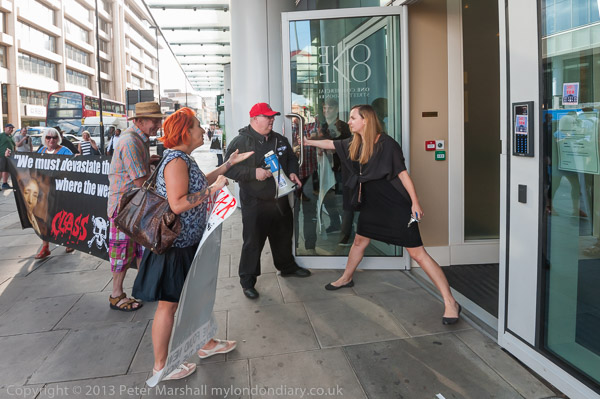
Aldgate, Class War Rich Door, Poor Door – On 30th July 2014 I went to London to cover another in the long series of protests by Class War over the ‘social apartheid’ of separate entrances to large blocks of flats for the wealthy and poor people who live in them. I went up early and walked around the area beforehand.

Class War – Rich Door, Poor Door – 1 Commercial St, Aldgate

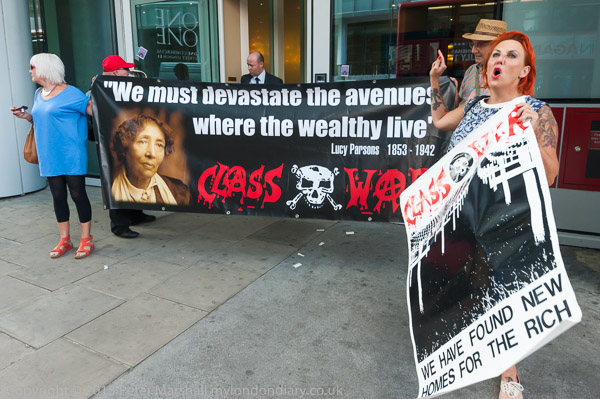
Class War, including three of their candidates for the 2015 General Election the following year, protested at 1 Commercial St in Aldgate which has a separate ‘poor doors’ for the social housing flats they had to include to gain planning permission for the development.

The front entrance on Whitechapel High St (One Commercial St is the name of the block) has a hotel-like reception desk, and is staffed 24 hours. It leads to the lifts for the expensive flats, many owned by overseas investors. Like most such buildings, some of them are empty and seldom used, while others are short term holiday lets.

Flats like these are advertised to overseas investors particularly in the far East as providing a high return on capital. Buy a flat now and you will be able to sell it for much more in a few years as London housing prices continue to soar – some publicity suggested that people could get the equivalent of a 13% interest rate. It’s easier to sell if you keep the flats empty, though you can use them for the occasional visit to London, or even let them over the web for a few days or weeks as holiday lets to generate a little actual income.

As I commented:

The web site for One Commercial St (studios, apartments and penthouses specified to exceptional levels, with exclusive services for residents – or rather those residents allowed to use the rich door) suggests that the average rent in the area is £1,935 pcm and investors can expect a 32% increase in property value by the time Crossrail opens. It’s all a part of the madness that means London is being developed not for the people of London but for investors in China, the oil states and elsewhere.

The building owners claimed there was no internal connection between the part of the building with expensive privately owned flats and that occupied by social housing tenants, although that was simply a lie – and on a later occasion I was taken through by one of the private owners from her flat to the ‘poor door’ which she used when walking her dog.

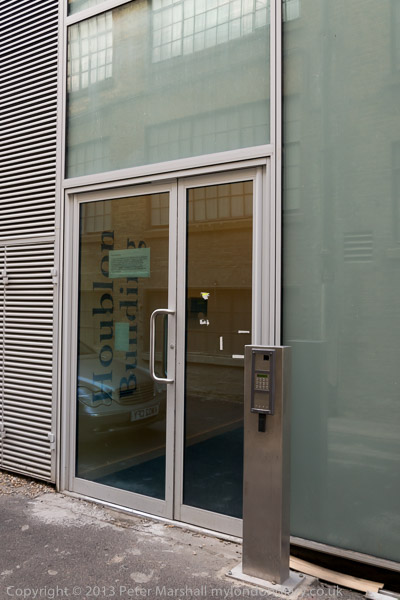
The owners give the social housing in the block a different name and only allow the tenants to access their flats through a side door in what was when Class War began their protests a dark alley often full of dumped rubbish, smelling of urine. A card entry system let them into a long bare corridor with some mail boxes on one side, quite a contrast to the large foyer with a reception desk, concierge, comfortable seating and art works enjoyed by the rich.

The protests had by then resulted in some small improvements, the alley now having been cleaned and new lighting installed, though the card entry system was apparently often out of order. And the alley still had that nasty smell.

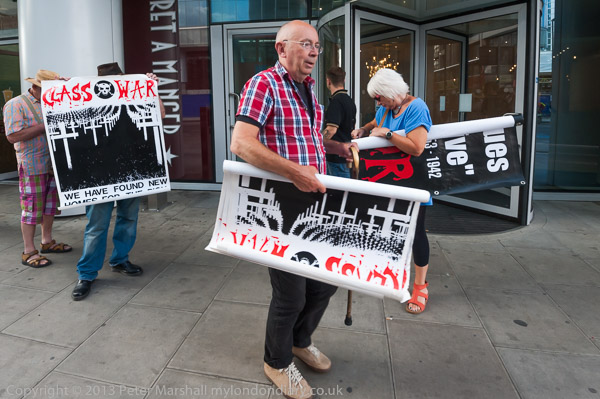
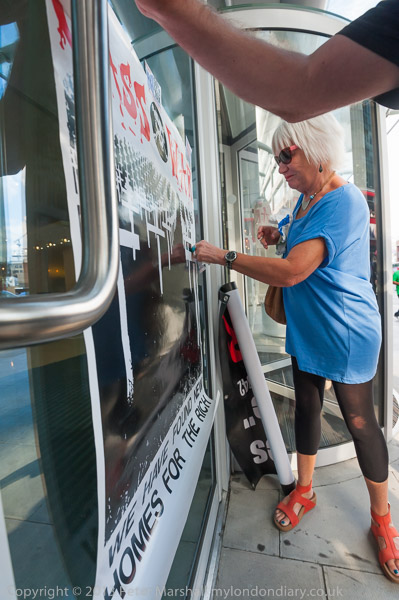
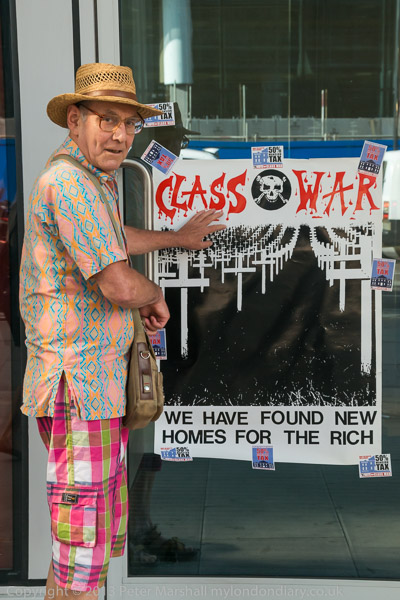
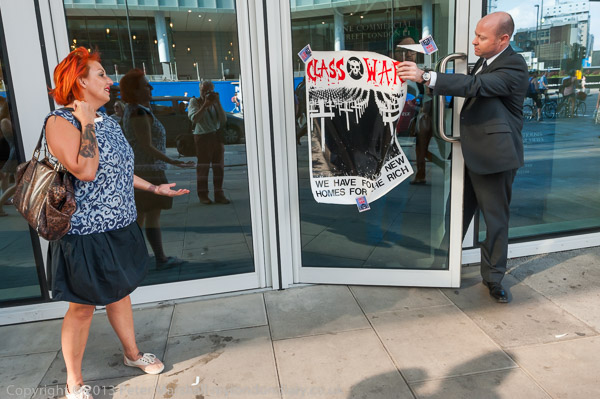
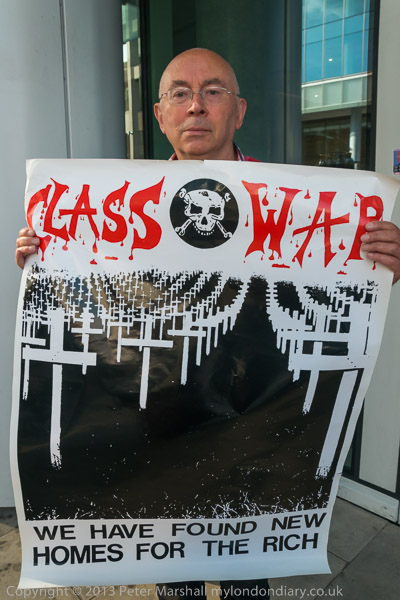
The protesters came with a banner featuring the radical US labour activist Lucy Parsons (1853-1942) with her quotation “We must devastate the avenues where the wealthy live” and posters – with their skull and crossbones – and the message “We have found new homes for the rich” with long rows of grave crosses stretching into the distance – which at one time police tried to arrest them for. They stuck posters on the windows on and around the ‘Rich Door’ using Class War election stickers with their promise of a 50% mansion tax. The building manager came out and pulled the posters off and screwed them up, but they held up others beside the door.

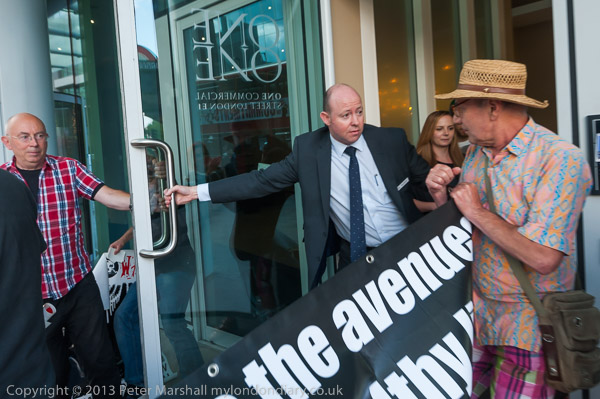
Most of the protest took place in front of the ‘Rich Door’, where they chanted calling for an end to the social apartheid and attempted to talk with the few people who left and entered the building. They held the door open to make their protest more easily heard inside, and there was a brief brief tug of war as security and a resident tried to close it. Eventually they let the door be closed, probably when they saw police arriving.

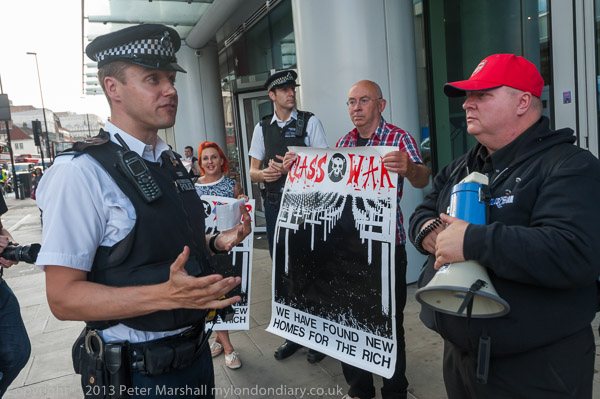
Police only arrived around 15 minutes after the protesters and they went directly inside the building to talk to the building manager and concierge. Then the police came out and argued with the protesters, trying to get them to move further from the doorway, but they insisted on their right to protest where they wanted on the pavement. Class War kept up the protest for around an hour before they decided it was time to leave – and come back for another protest there the following week. This was just one of a series of around 30 ‘Poor Doors’ protests, most of which I photographed – and published a ‘zine’ of the pictures, still available from Blurb.

Class War – Rich Door, Poor Door


Aldgate & Spitalfields

I was early for the protest at One Commercial St, and took a short walk around the area while I was waiting, going up Commercial St and then back down Toynbee St. I was astonished at the amount of new buildings since I was last here a few years back, and with a great deal of work currently going on. At night all the red lights on the tops of the cranes make London look like a Christmas tree.

It is of course a prime site just on the edge of the City of London, an easy walk to the city, and with plenty of buses, underground stations and both Liverpool St and London Bridge stations not far away. London City Airport is a short taxi ride too, or under half an hour by public transport, and Brick Lane’s curry houses just around the corner. Crossrail will cut journey times to Canary Wharf to 4 minutes when Whitechapel station opens in 2018.

In fact Crossrail only opened in 2022, four years behind schedule, but investors still did pretty well, and much more of the area has been demolished and replaced by investment flats. Our government still counts these as a part of our meagre housing programme although they make no contribution towards easing the housing crisis. We need strong laws to limit overseas ownership of property and financial encouragement to build homes for people, particularly homes at social rents.

Aldgate & Spitalfields


March for a People’s Olympics

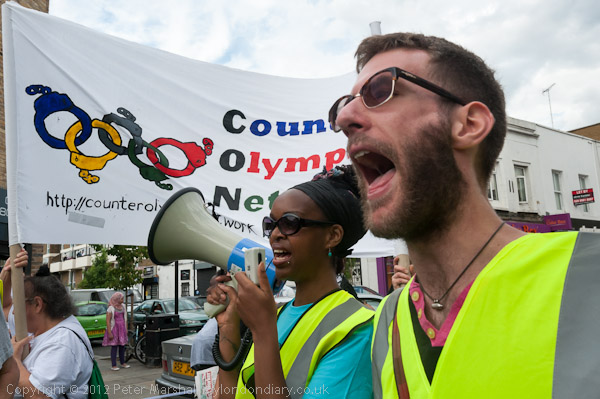
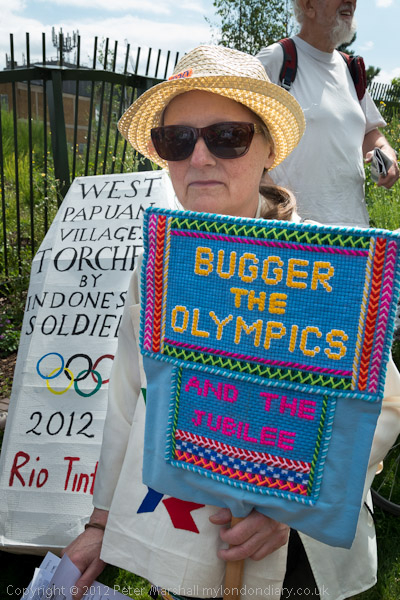
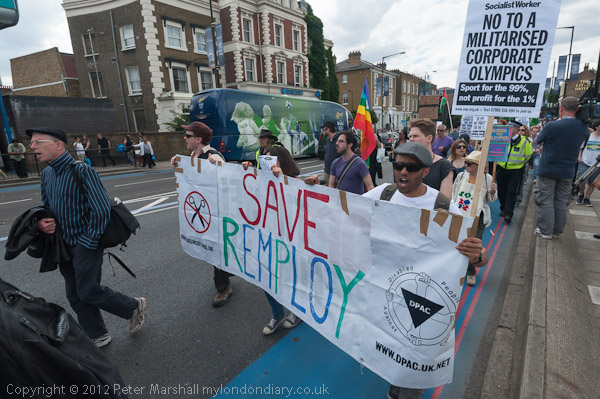
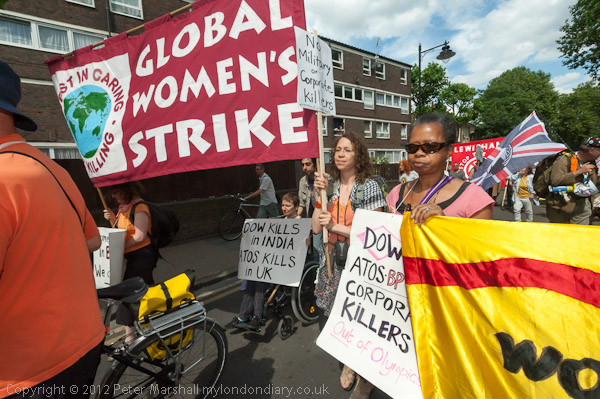
Ten years ago on July 27th 2012, as the London 2012 Olympics were getting underway in Stratford, people, mainly from the local area, marched to call for an end to the corporate takeover of the Olympics and the draconian policing and military presence largely aimed at the protection of brands and for the games to meet its legacy promises.

The authorities had done their damnedest to stop the protest taking place – first they had tried to ban it altogether, then Transport for London had refused permission for them to march along any roads which were emergency backup Games routes. But protesters agreed with police that they would leave the road if there was any emergency. Tower Hamlets council tried to ban any speeches or other events on Wennington Green where the march ended, and protesters were threatened they would be arrested if they carried banners, placards or t-shirts with political messages – though it was hard to see any legal basis for doing so.

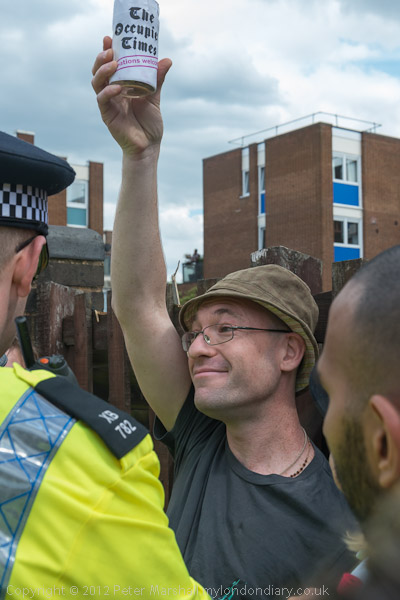
The ‘Whose Games? Whose City?’ protest went ahead despite the threats, with only one small incident when police seized and searched a man who had cut a piece of police tape. A crowd of marchers supported them and shouted for his release and after a few minutes he was set free without charge and the march continued.

The threats and public controversy had doubtless persuaded many not to come to the event, where around 500 marchers mingled with press and TV from around the world at the starting point in Mile End Park at midday. The organisers, the Counter Olympics Network (CON) had made clear that they were not against the Olympics as a sporting event but against the way it had been taken over by corporate interests. In my long account of the event on My London Diary I quoted from several of their statements, including:

"the close ties between the Olympic brand and its corporate sponsors who, despite IOC claims of vetting on ethical grounds, include serial polluters, companies which seriously damage the environment and which wreck or take lives, Coca Cola, Rio Tinto, BP, Dow Chemical. G4S, Cisco, and Atos deny people their human rights in a variety of situations while Macdonalds helps to fuel the obesity epidemic. London2012 provides benefits at taxpayers’ expense while receiving little in return."

CON also pointed out the many broken promises made about the games and the very doubtful legacy the games will leave, particularly in East London.

"the lack of benefits for local people and businesses, the fantastic expansion of security into our daily lives, the deployment of missiles and large numbers of troops, the unwarranted seizure of public land at Wanstead Flats, Leyton Marsh and Greenwich Park."
A man celebrates after the crowd made police release him

Later in his speech on Wennington Green, Chris Nineham of the Stop The Olympic Missiles Campaign declared that the London Olympics had already set a number of records, including the largest ever number of arrests on the first day, the highest ticket prices, the most intensive application of branding rules and the highest level of militarisation of any Olympic games, with far more being spent on security that even in China. There were now more troops in London than at any time since World War 2, and more than at any time in Afghanistan, where our military activities were now making us a terrorist target in London. Among the other speakers was Melanie Strickland, one of the 182 ‘Critical Mass’ cyclists arrested the previous night for riding near the Olympic stadium.

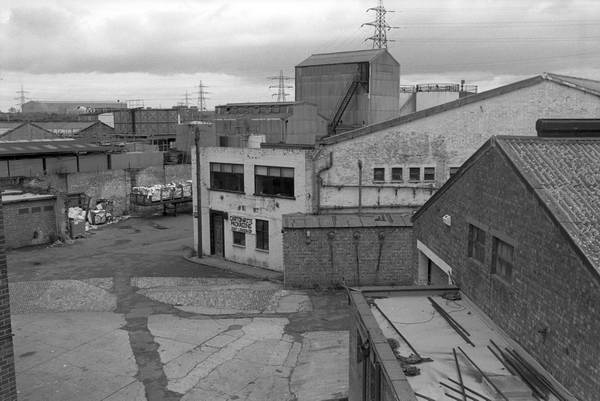
Industry on the Olympic site, Marshagate Lane, 1990

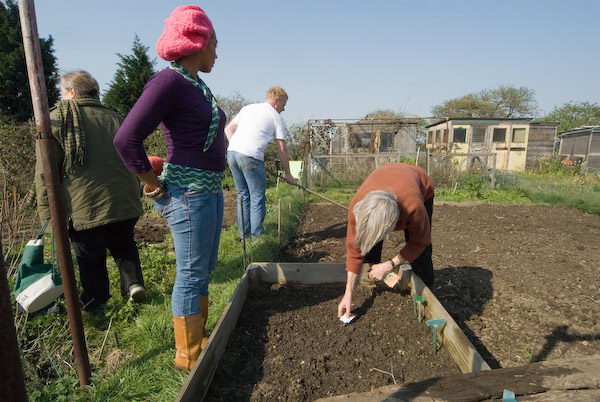
I had known and photographed the Olympic area since the early 1980s until the public were all excluded from the vast site in 2007 and after when we were only able to peer over the blue fence. In 2010 I brought out a book ‘Before The Olympics’ which included many pictures of the area in the thirty years or so before they took place, as well as looking more widely along the length of the River Lea and the Navigation. Most people miss that parts of the area were formerly thriving industrial and commercial sites, others a verdant wilderness – and of course some thriving allotments. Of course there have been some benefits following 2012 – more housing is something London desperately needs, but much was already being planned before the bid succeeded. But the park remains to me deeply disappointing.

Allotments on the Olympic site, April 2007

The book is still available and you should be able to view a preview at ‘Before the Olympics‘ though Blurb appears to be having some problems at the moment; it is a ridiculously highly priced softback, but there is a more reasonable PDF version. The book includes many of my pictures of the area which are also on my The Lea Valley web site including mainly black and white images from the 1980s and 90s and colour from the 2000s. Later images from before and after 2012 are on various pages of My London Diary. There is a large collection of the black and white images in my Flickr album River Lea – Lea Navigation 1981-1992 including many from what became the Olympic site.


Clean Air and Fair Pay – 2019

Clean Air and Fair Pay – 2019. Two protests on Friday 12th July 2019 over different issues in different parts of London meant I had to leave the first before the rally at the end of the march.

XR East London marches for clean air – Bethnal Green

Clean Air and Fair Pay - 2019

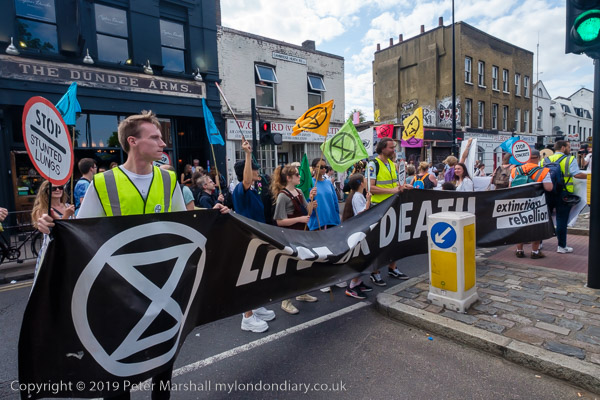
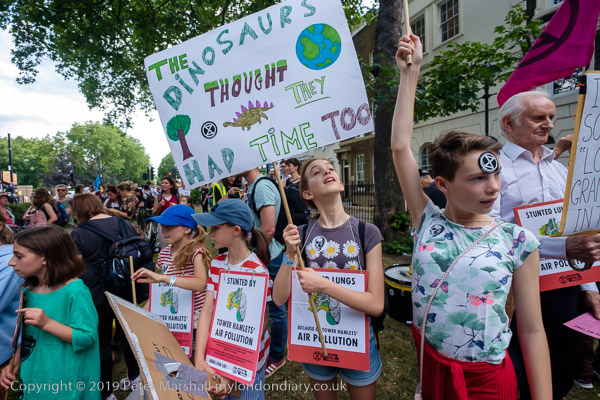
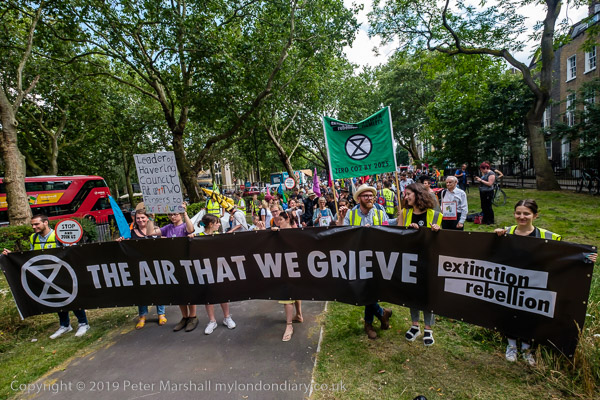
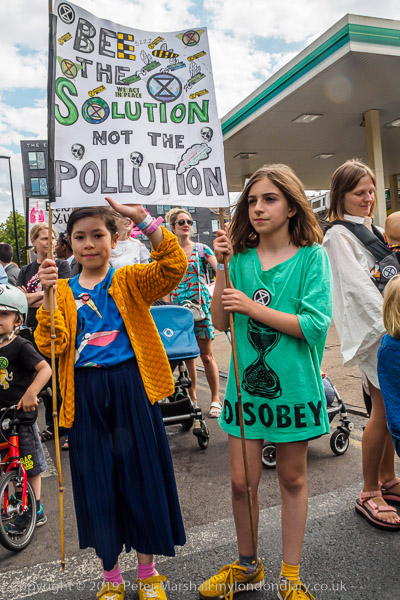
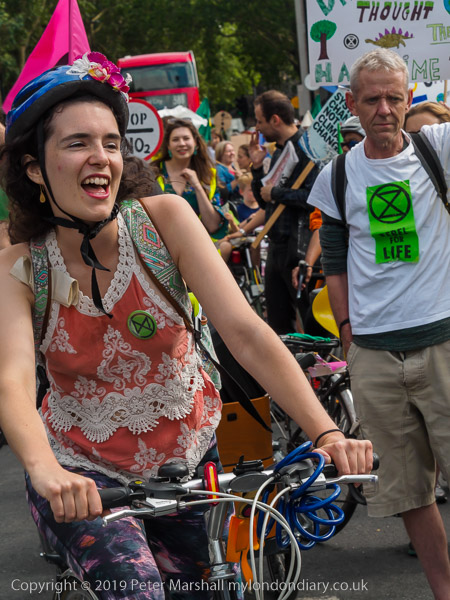
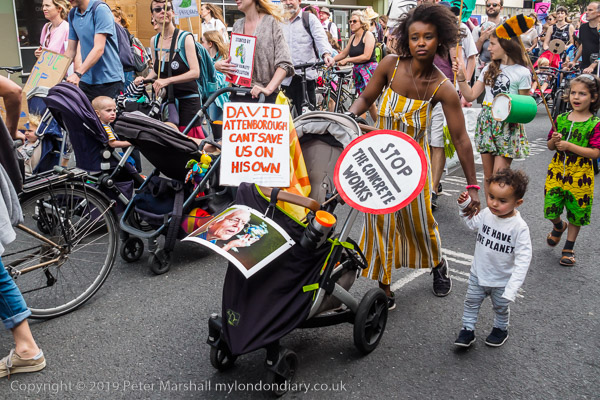
The march from Paradise Gardens at the centre of Bethnal Green to Hackney Town Hall was the initial event in a weekend of play, protest and education which Extinction Rebellion East London had organised under the title ‘East London Uprising’.

Clean Air and Fair Pay - 2019

Paradise Gardens was an obvious and appropriate if ironic meeting point for this march calling for the urgent action on the environment we need if the planet is to remain habitable. Although this has been protected commonland since 1678, this public green space is a thin and rather neglected strip between the busy Cambridge Heath Road and Paradise Row, a narrower street lined mainly by Grade II listed houses. It used to be simply a part of Bethnal Green Gardens which are on the east side of the main road but got its current name from Paradise Row – and the northern part of the gardens across the traffic-clogged road became Museum Gardens.

Clean Air and Fair Pay - 2019

Until shortly before this protest this small area of park had been closed as it was being used by contractors for nearby construction work, with the proviso that they restore it after their work was finished. This appeared to largely have been done, and had not affected the main attraction of the area, the dozen or so large trees along both edges.

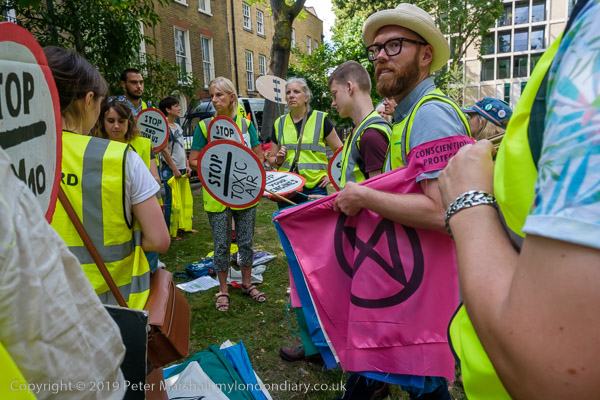
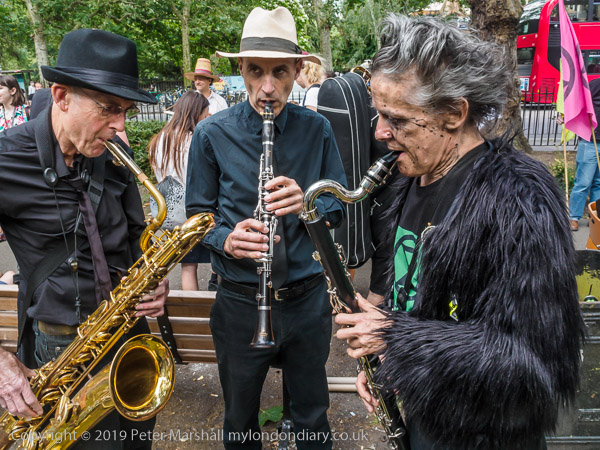
When I arrived, people were still getting ready for the march, though most were simply standing around and waiting, some were getting their faces painted while the marching band were practising playing together, and the march stewards were getting their instructions. But finally people lined up behind the main banner with its message ‘THE AIR THAT WE GRIEVE’ and moved onto the fume-laden Cambridge Heath Road.

Air pollution is a huge problem in London, with many areas well above the EU’s legal limits for various pollutants much or all of the time. Traffic is a major source both of gases such as nitrogen oxides and also particulates, and moving towards electric vehicles, though an improvement will not solve the problem as much of the most dangerous particulates come from tyres and brakes. We need to cut traffic, by reducing the need for movement, shifting hugely to public transport and moving to using bicycles, electric bicycles and scooters particularly for shorter journeys.

Air pollution is said to be responsible for almost 10,000 premature deaths in London each year, and a much larger number suffer from serious lung and other conditions from it, greatly reducing their quality of life and creating a heavy burden and costs for our healthcare system. But encouraging people to adopt healthier means of transport needs much more spending on making these safer and more convenient.

The march up one of the area’s busier roads was largely uneventful, though it will have delayed many on their journeys through the area, but it will also have made many people in the area more aware of the problems. Those who drive in London are used to delays, with an overcrowded system in which any minor problem can cause lengthy delays – and as a bus passenger it isn’t unusual I often find myself getting off and walking when I’m in a hurry.

I left the march shortly after it moved across the border from Tower Hamlets into Hackney and was going up Mare Street towards the Town Hall. I was sorry to have to miss the childrens’ assembly which was to take place there at the end of the march, but wanted to be sure to be in time for the protest at Senate House in the centre of London.

More pictures: XR East London marches for clean air


IWGB welcome new Vice Chancellor – Senate House, University of London

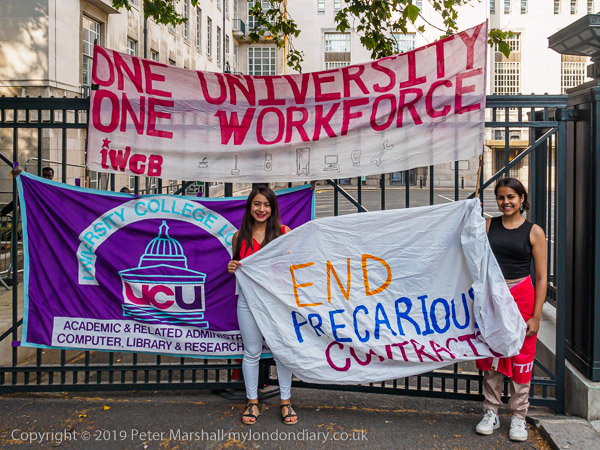
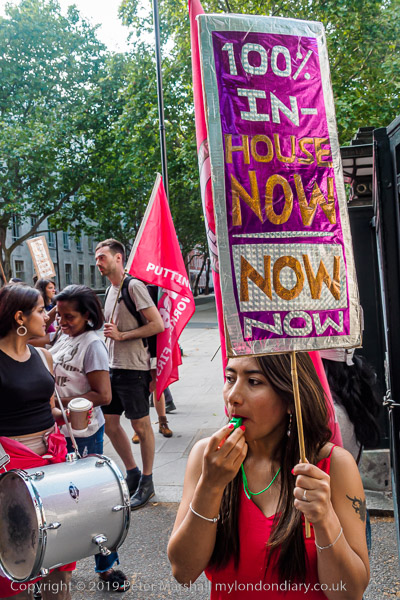
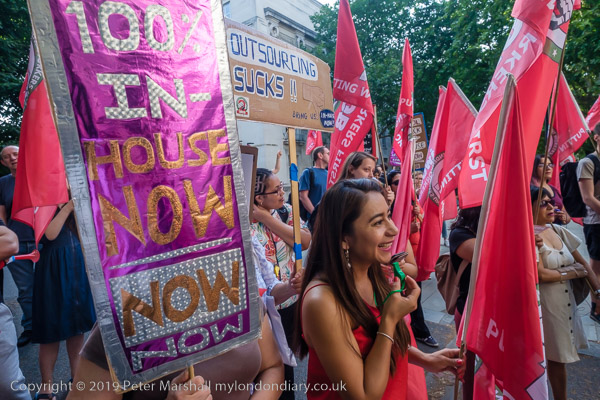
Most of the workers carrying out essential but low paid jobs at the University of London are not employed by the university but by contractors who provide their services to the university. This outsourcing results in the workers being poorly paid, often bullied and employed with only the minimum legal conditions of employment.

For years they have been protesting to be employed directly by the university and so get the same pay and working conditions as other staff in similar jobs that are on the payroll. In particular they want the same sick pay, holiday pay and pensions, and of course the London Living Wage.

Their campaigns have met with some progress – and three years on many have been brought in house, but the university dragged its feet for many years, spending large amounts on extra outsourced security staff and refusing to talk with the unions representing the low paid workers. Although trade union legislation means that as employers have to recognise unions, neither the contractors who employed these workers nor the university in whose premises they worked were willing to recognise or negotiate with their unions.

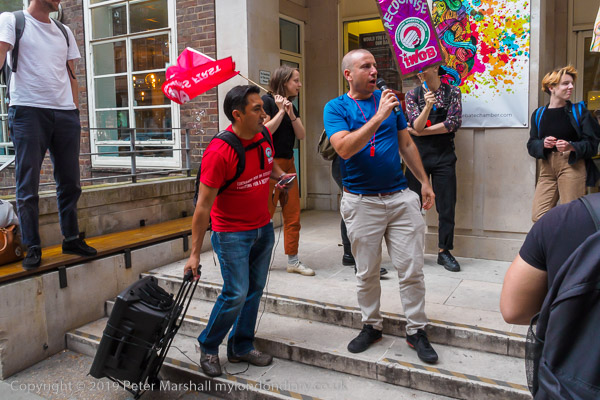
Progress has only been made by direct actions such as this by the grass-roots trade union IWGB, and by strikes by the workers. They had tried to meet with the new Vice-Chancellor Wendy Thomson but their request had simply been ignored.

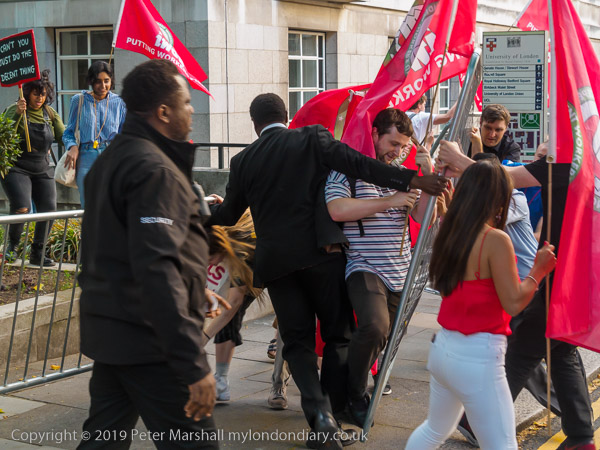
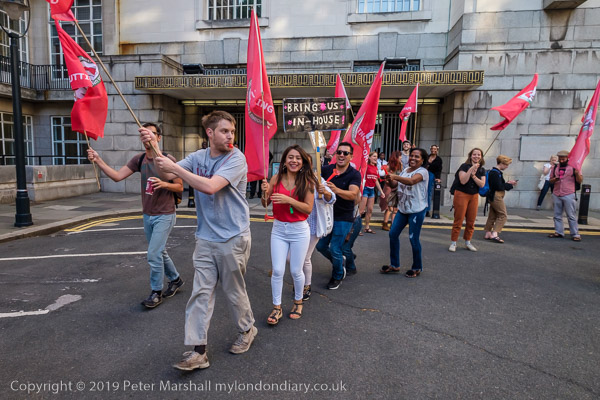
After a rally at the main gates and a protest outside Student Central (the former University of London Union, closed down by the University because it supported the workers) the protesters returned to Senate House. A small group pushed down some flimsy barriers with the extra security unable to stop them and the rest surged in after them to dance noisily in protest in the yard in front of the locked entrance to Senate House.

More at IWGB welcome new Vice Chancellor


Independent Living Ends, Robin Hood Gardens

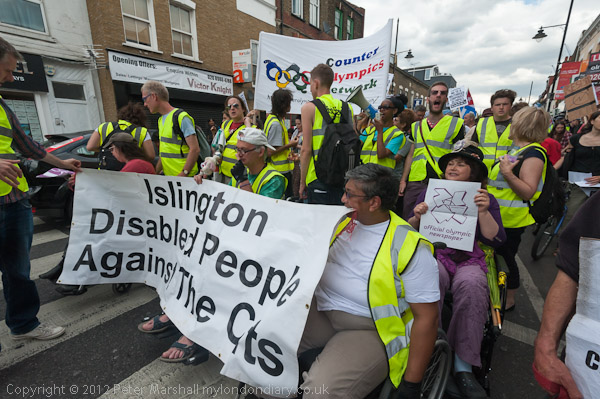
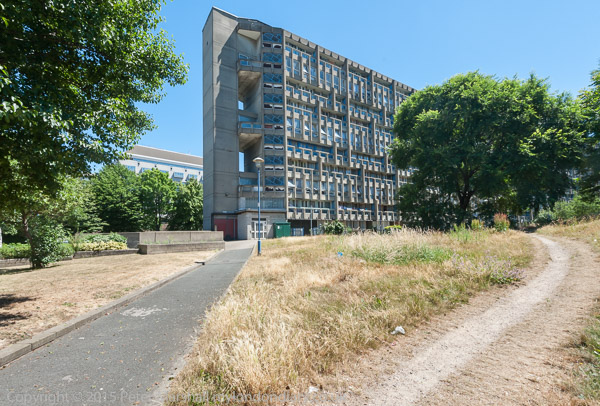
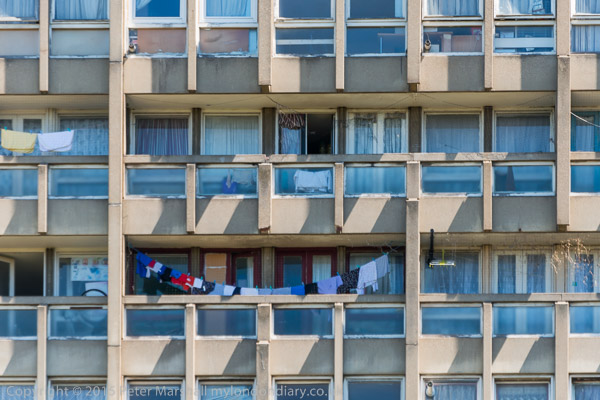
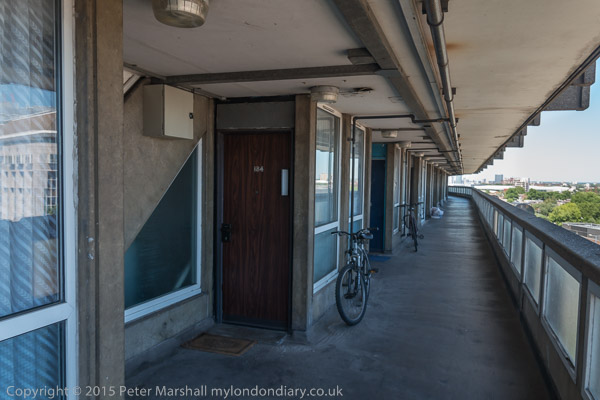
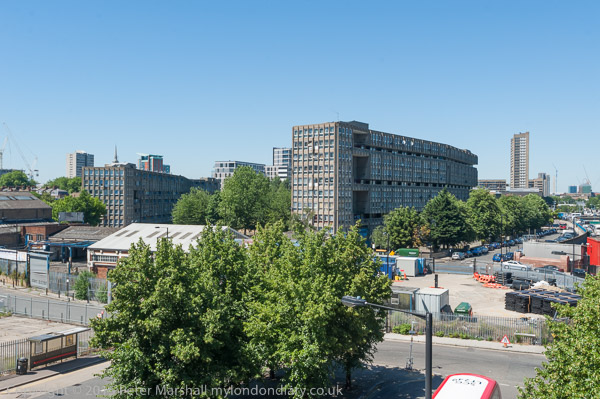
Independent Living Ends, Robin Hood Gardens. On Tuesday 30th June 2015 I joined disabled people at Downing St marking the ending of the Independent Living Fund before going to Robin Hood Gardens, a brutalist estate in Poplar doomed for demolition.


DPAC’s ILF Closing Ceremony – Downing St to Old Palace Yard

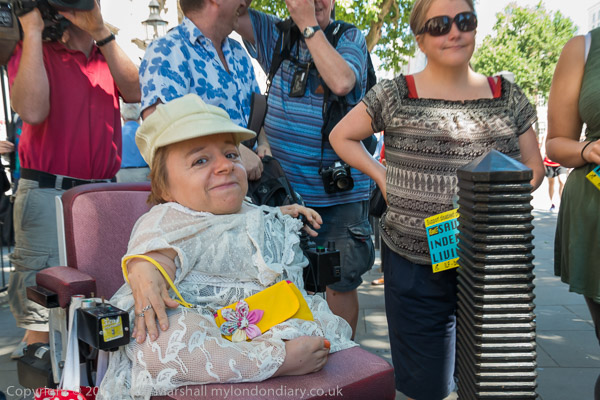
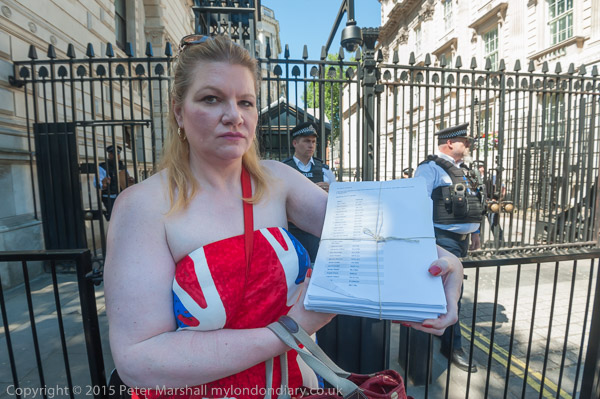
Disabled people and supporters of DPAC, Disabled People Against Cuts, met outside Downing St to bring a petition with over 25,000 signatures calling for a continuation of this essential support for the disabled.

Sophie Partridge, disabled Actor, Writer & Workshop artist

The Independent Living Fund which was coming to an end on that day had given them to money to employ support to enable them to live with dignity and for many to continue in work and make a contribution to society. Without it they fear they will simply be shut away and left to rot, many fearing they will now be left for many hours at a time in incontinence pads.

Paula Peters

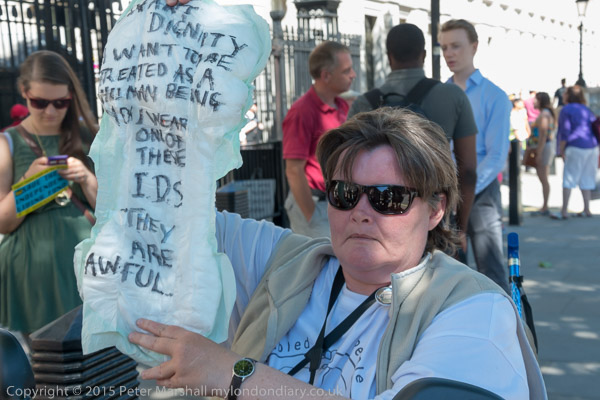
Outside the gates of Downing Street they wrote slogans on incontinence pads; Paula Peters of DPAC had a message for Iain Duncan Smith, then Secretary of State for Work and Pensions responsible for the ending of support, ‘I want dignity – I want to be treated as a human – You wear one of these I. D. S. They are awful’.

A campaigner dressed as Brittania was among those who had come to hand in the petition which had gained support from a video by the stars of Coronation Street and the Graeae Theatre Company’s 2014 UK Tour of The Threepenny Opera. One of those stars spoke in front of the gates of Downing Street.

John Kelly as Schimmel leads the march

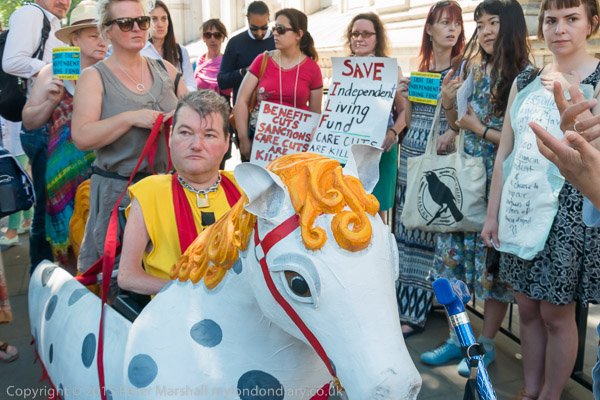
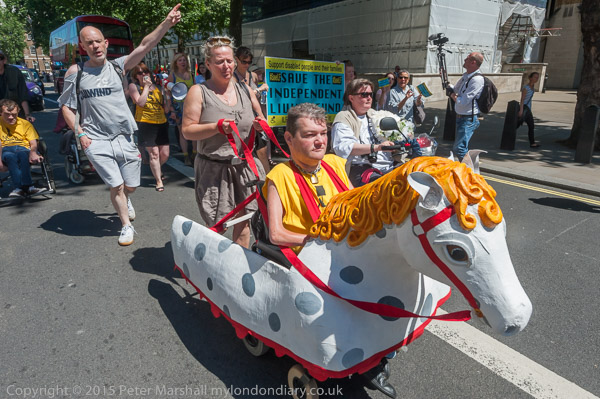
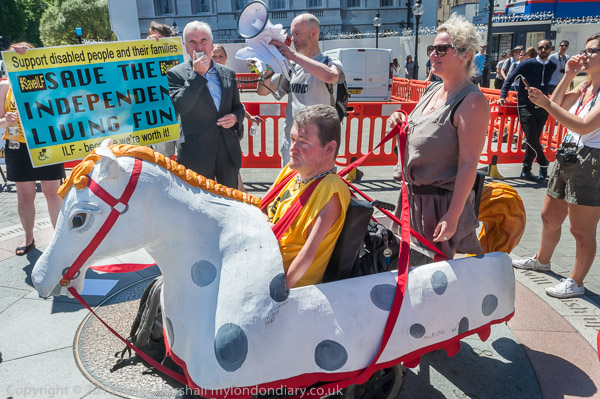
From Downing Street the campaigners marched the quarter mile or so to Old Palace Yard opposite the Houses of Parliament, led by John Kelly as Schimmel, the equine star and proud battle horse of the Threepenny Opera.

Here they were joined by others including Labour MP John McDonnell who spoke at the rally marking the end of the Independent Living Fund, at the end of which a wreath with the message’s ‘RIP ILF’ was laid.

DPAC’s ILF Closing Ceremony


Robin Hood Gardens – Poplar

Two walls of flats protect an inner garden area

The ILF protest had ended a little before 1pm and it was a fine day and I decided to take another visit to Robin Hood Gardens in Poplar, where demolition had begun after the refusal to list the site. Listing had been recommended for listing by the advisory committee of English Heritage in 2009, but the then Minister of Culture Andy Burnham had issued a certificate of immunity against listing which expired in 2014.

These are large and desirable properties, but often have been used to house difficult residents

A further attempt was then made to have the site listed, supported by almost every well-known British architect, but Historic England, now responsible for listing buildings rejected this.

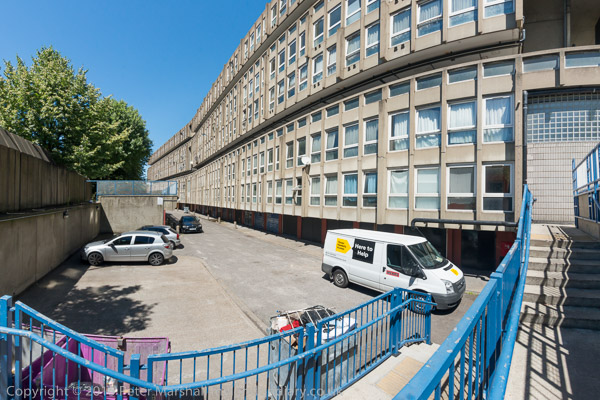
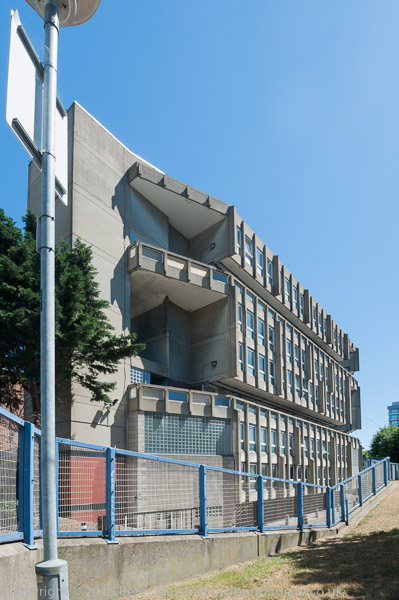
A wall at left screens the estate and there is a lower service and parking area

An open letter signed by many leading architects including Richard Rogers made clear the value of the site, and I quoted from this in My London Diary.

The buildings, which offer generously sized flats that could be refurbished, are of outstanding architectural quality and significant historic interest, and public appreciation and understanding of the value of Modernist architecture has grown over the past five years, making the case for listing stronger than ever.”

The end of the ‘street in the sky’

The refusal to list on both occasions was clearly a political one, almost certainly driven by the huge profits demolition and rebuilding on the site would make for the developers.

As with the award-winning Heygate Estate in Southwark, and the fine Central Hill Estate at Gypsy Hill, Lambeth, the local council, Tower Hamlets, was keen to get rid of the estate and had carried out what I described as “a well funded campaign of vilification“, seeing it “only as a large area with potential for redevelopment at a higher density“, working with “developers who see any area of social housing in London as rich pickings for redevelopment and sale to the rich.”

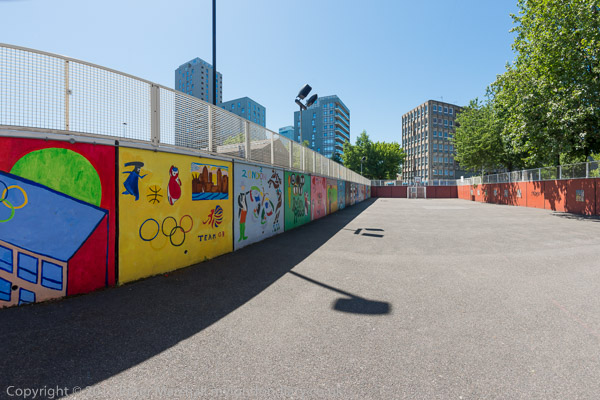
A large enclosed playground at the south end of the site

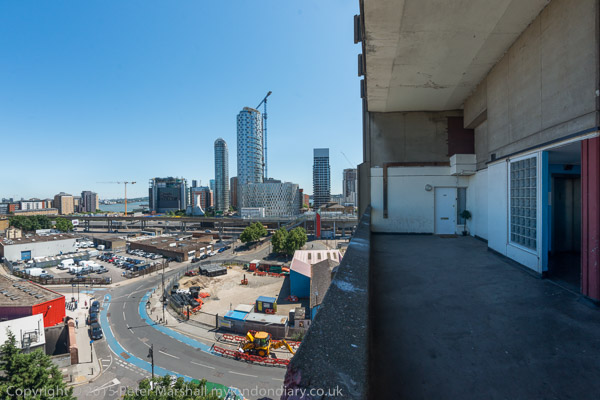
By the end of June 2015 most of the west block seemed empty and boarded up and I was unable to gain entry. But I could roam the large garden in the centre of the estate, now let to grow wild, and went inside the still occupied east block, going up to the highest public level, a ‘street in the sky’ built rather less wide than the architects had originally intended, overlooking the Blackwall Tunnel approach. From there I took a number of pictures of the views from the block looking towards the east.

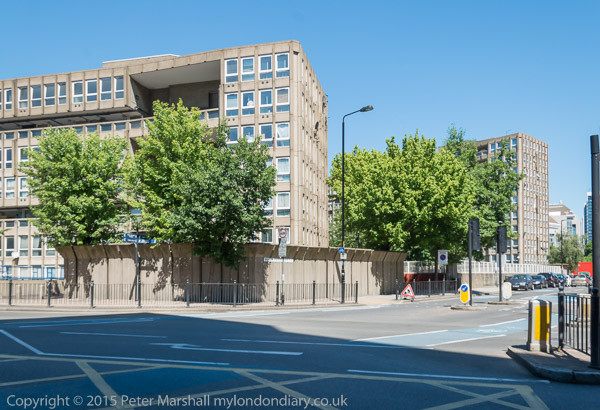
The south end of Robin Hood Gardens was on Poplar High St

As on a couple of previous visits I talked briefly with some of the residents who all told me they were pleased to be living in the block and sad they would have to leave – though some did complain about the lifts (I think only one of the two at the entrance I went in was working.)

Knocking down buildings like these which are structurally in good condition is inexcusable in terms of the huge carbon footprint involved in their construction, demolition and rebuilding. The estate could and should have been refurbished at relatively low cost and would have continued to provide good quality homes for many years. Its replacements – the west section already built – are of lower quality and will almost certainly not last as long as this could have done. The advantage of their roughly three times higher density is at the expense of possible amenity.

As well as walking in and around the estate I also took some pictures of it from the surrounding area, and some other pictures you can see on My London Diary, including a few when I stopped at Canning Town station and took a few pictures of people on the new footbridge across Bow Creek.

Robin Hood Gardens


Rip Down the Ripper Facade!

Rip Down the Ripper Facade! When Mark Palmer-Edgecumbe, a former former head of diversity for Google got his architects to apply for planning permission to turn a building on Cable Street in East London into a ‘Museum of Women’s History’ the application stated it would “recognise and celebrate the women of the East End who have shaped history, telling the story of how they have been instrumental in changing society. It will analyse the social, political and domestic experience from the Victorian period to the present day.” The application his architects submitted was illustrated with pictures of suffragettes and other notable women from the past.

Rip Down the Ripper Facade!

But when the boards around the site came down in 2015, everyone was shocked to see it was instead it had been turned into a ‘Jack the Ripper Museum’, exploiting the unfortunate women who had been the victims of a series of unsolved murders in the East End in 1888. The architect who made the application and others who had been consulted made clear they had been duped into supporting the project and there were protests outside by members of the local community including the Bishop of Stepney, the Rt Rev Adrian Newman, and Tower Hamlets mayor John Biggs.

Rip Down the Ripper Facade!
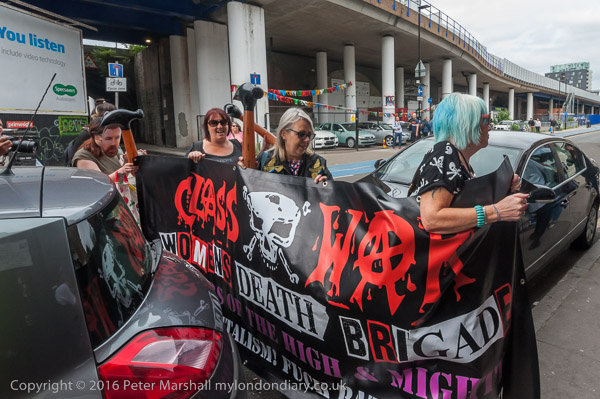
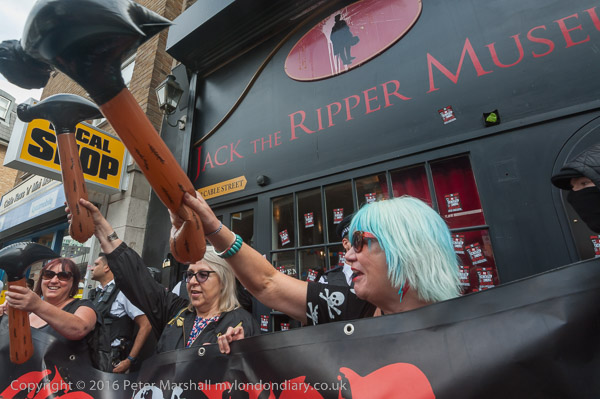
Class War Womens Death Brigade arrive for the protest

But most of the protests outside the tacky tourist attraction have been by Class War and its supporters along with feminists including London Fourth Wave Feminists who, together with Class War’s Womens Death Brigade organised the protest I photographed on June 19th 2016. These groups continued to protest after others – including Tower Hamlets Council – appear to have given up.

Rip Down the Ripper Facade!
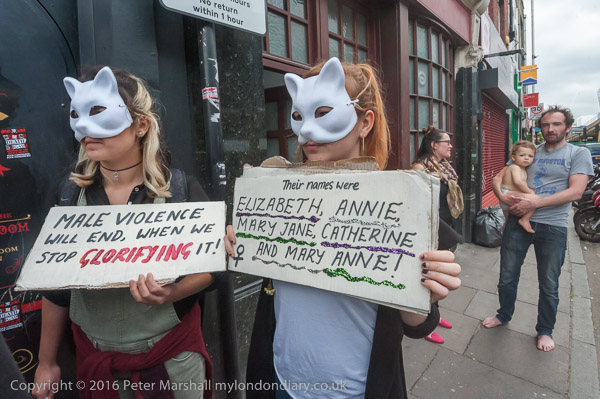
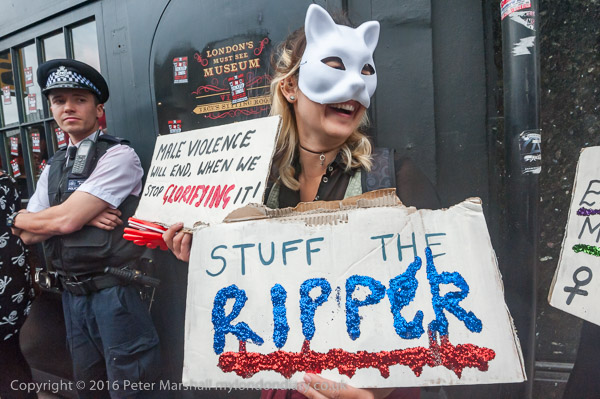
London Fourth Wave Feminists were there waiting

The council in 2016 refused retrospective planning permission for the shop front and ordered changes to the signage and the removal of a metal roller shutter, which the shop had installed after a window was broken by persons unknown in the middle of the night – not during one of the protests outside as Wikipedia (and possibly the shop owner) suggest. I think I was present at all of the various protests except for the first rather tame event which the local council had arranged to calm things down after Class War and others had widely advertised one for the following evening.

Class War women had brought inflatable plastic hammers

The planning decision was appealed by the shop, and even after their appeal failed the council failed to take enforcement action and it was not until 2018 that the shop front was redesigned. Bad publicity from the protests possibly contributed to the commercial failure of the shop, though there were also poor reviews from visitors who felt it not to be value for money.

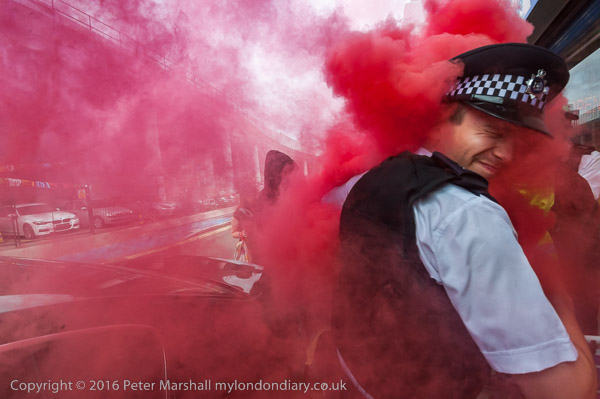
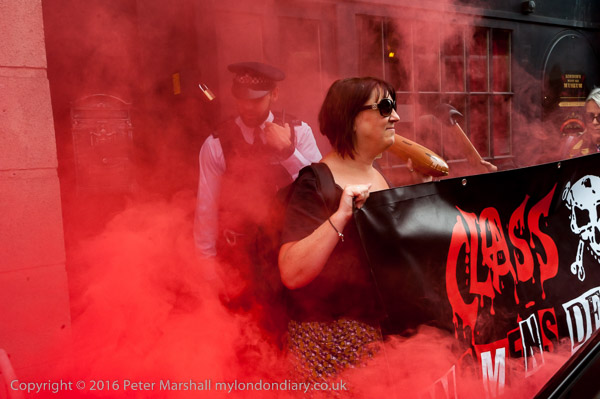
Black-clad protesters arrived set off some red smoke

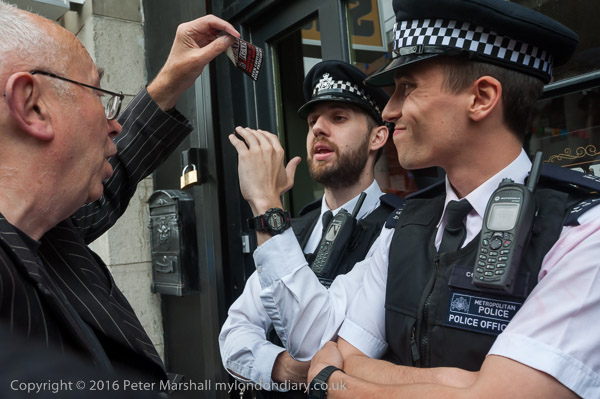
Class War did not of course ‘Rip Down the Ripper Facade’ but the action was typical of their street theatre with inflatable plastic hammers and a little coloured smoke, while the Fourth Wave Feminists came with cat masks and posters to make clear why they were opposed to the shop’s glorification and profiting from violence against women. Eggs were thrown at one of the signs the shop had been ordered to remove and the windows were liberally covered with stickers, but there was no permanent damage.

Rip Down the Ripper Facade!
Ian Bone reaches past police to post a sticker on the window

During the roughly hour long protest there were no customers who came to try and enter the shop, and none inside left. Although London was spilling over with tourists on a Sunday afternoon in June, apparently none wanted to visit this particular tourist attraction. It had been hoped it would close after it was put up for sale in April 2021, but appears still to be open.

More on My London Diary: Rip Down the Ripper Facade!


Old Ford, Hertford Union & Hackney

Old Ford, Hertford Union & Hackney

Gunmakers Lane, Hertford Union, canal, Old Ford, Tower Hamlets, 1988 88-8am-33-Edit_2400
Gunmakers Lane, Hertford Union, canal, Old Ford, Tower Hamlets, 1988 88-8am-33

The short street which goes across the canal on Three Colts Bridge probably got its name from the pub, the Gunmakers Arms, which stood opposite it 438 Old Ford Road on the west side of St Stephens Road – and perhaps there were once some guns made nearby. In April 1915 the pub was taken over by the East London Federation of Suffragettes, led by Sylvia Pankhurst, a more militant and working class breakaway from Women’s Social and Political Union who turned it into a day nursery and clinic.

The Connaught Works here on Old Ford Road was a furniture factory and is said to date from the 1920’s though it looks earlier and was extended to the east around 20 years later.

Gunmakers Lane, Hertford Union, canal, Old Ford, Tower Hamlets, 1988  88-8am-34-Edit_2400
Three Colt Bridge, Gunmakers Lane, Hertford Union, canal, Old Ford, Tower Hamlets, 1988 88-8am-34

This early 19th century cast iron bridge presumably dates from the building of the Hertford Union Canal which opened in 1830. It is Grade II* listed Scheduled Ancient Monument. A pub, the Old Three Colts, was close by at 450 Old Ford Rd from 1792 or earlier but was I think demolished a few years after WW2. St Stephens Road used to be called Three Colts Street, possibly because this pub was more or less at its end.

Victoria park Rd, Homerton, Hackney, 1988 88-8am-35-Edit_2400
Victoria park Rd, Homerton, Hackney, 1988 88-8am-35

The Three Colts Bridge leads to the Gunmakers Gate of Victoria Park, and I walked across the park to Victoria Park Road. This gothic fantasy of a building is now the Mossbourne Victoria Park Academy but was built in 1864-5 by Robert Lewis Roumieu as a French Protestant Hospital by a Huguenot charity, La Providence, who had decided to move out of earlier almshouses and hospital in Finsbury to a larger and more rural site here.

After WWII, La Providence moved to Rochester, selling the building to Roman Catholic nuns, the Faithful Companions of Jesus, and it reopened as the St Victoire Convent Girls’ Grammar School. When I made this picture it had become Cardinal Pole RC School and in 2014 was sold to be an academy school. The building is Grade II* listed.

Terrace Rd, Church Crescent, South Hackney, Hackney, 1988 88-8am-21-Edit_2400
Terrace Rd, Church Crescent, South Hackney, Hackney, 1988 88-8am-21

These Tudor-style group of cottages are thought to have been built in 1847-8 to designs by George Wales who was the architect of Monger’s almshouses further down Church Crescent. The other houses between the two sites are more classical in design but also thought to be by Wales.

They are Grade II listed and still there and look now rather neater, with the middle property of the Tudor three having had its brickwork cleaned and looking considerably brighter. It also appears to lack the variation in colour of the darker brickwork which I find more attractive, though perhaps it looks more like when it was newly built.

Terrace, Cassland Rd, Hackney, 1988 88-8am-25-Edit_2400
Hackney Terrace, Cassland Rd, Hackney, 1988 88-8am-25

This remarkable terrace at 20-54 Cassland Road overlooking Cassland Crescent is Grade II listed and was built from 1794 using funding from subscribers who made monthly payments over a period of four years, with the houses being allotted by ballot to a subscriber as each was built. All 18 were completed and occupied by 1801. This kind of co-operative funding of a development predates the earliest more conventional building societies.

James Taylor, gallery, Collent St, Hackney, 1988 88-8am-26-Edit_2400
James Taylor, gallery, Collent St, Hackney, 1988 88-8am-26

The James Taylor warehouse was built in 1893 in Collent Road, which was described by the James Taylor gallery as “Formerly a Victorian factory, china warehouse, squat and film location.” Around ten years ago it was transformed with the facade and front building on the site being retained, along with a long wall along the north almost to Cresset Road as a part of a complex redevelopment with up to 10 storeys containing 69 flats, office space and an underground car park.

I made a few more exposures around Well St and I think my walk probably ended on neaby Mare Street, where I photographed the Crown pub (not online) and then probably caught a train from Hackney Central.


Clicking on any of the pictures will take you to a larger version in my album 1988 London Photos, from where you can browse other images in the album.


Old Ford, Middlesex Filter Beds & Hertford Union

After my stay in Paris in August 1988 I was back in London and managed to fit in one more walk before the end of the month, starting from where I had finished one of my previous walks in Bethnal Green.

Old Ford Rd, Old Ford, Tower Hamlets, 1988 88-8am-66-Edit_2400
Old Ford Rd, Old Ford, Tower Hamlets, 1988 88-8am-66

Old Ford Road runs parallel to Roman Road but a couple of hundred yards to the north, and almost certainly follows the real Roman route to the east out of London, fording the River Lea somewhere close to where the Northern Outfall Sewer (The Greenway) now crosses. The river here is a part of the Lea Navigation and now very much more constrained between banks than it once was, though then it will still have been tidal here.

There was a route here even before the Romans, leading along the way of modern Oxford St and Old Street to Bethnal Green and Old Ford and then continuing through what were then marshes to Wanstead Slip north of Stratford and on the Colchester.

There are long stretches of Victorian houses as well as modern flats along Old Ford Road, but the house at the left of this picture is No 218, and is a terrace beginning with 196 and ending at 224 a little to the west of the bridge over the Regent’s Canal and immediately north of the Cranbrook estate.

Roman Rd, Bethnal Green, Tower Hamlets, 1988 88-8am-52-Edit_2400
Roman Rd, Bethnal Green, Tower Hamlets, 1988 88-8am-52

I wasn’t sure what to make of this establishment on Roman Road, which seemed to be both a Patisserie and Bar, offering Light Lunches & Coffee, as well as catering for all functions, with rather curious window decoration and an odd bit of statuary in its entrance.

Middlesex FIlter Beds, Lea Bridge, Waltham Forest, 1988 88-8am-42-Edit_2400
Middlesex Filter Beds, Lea Bridge, Waltham Forest, 1988 88-8am-42

I did a lot more walking without taking many photographs, going south down Usher Road and then going east to cross the East Cross Route on Wick Lane before joining the towpath on the opposite bank of the Lea Navigation to get to the Middlesex Filter Beds at the north corner of the Hackney Marshes – something over 2 miles before I took the next black and white pictures in what had been turned into a nature reserve.

The filter beds were built in the early nineteenth century to combat cholera in London by providing clean drinking water which was still killing thousands but were unable to cope with the increasing population and were finally closed in 1969, left to become a nature reserve. I think they may have recently been made open to the public when I made this short visit. Going back more recently they seem to have been made a little less overgrown than they had become over the 19 years since they were abandoned. This image seems to me the more interesting of the five frames that I took – film was still expensive.

Lea Navigation, Eastway,  Hackney Wick, Hackney, 1988 88-8am-45-Edit_2400
Lea Navigation, Eastway, Hackney Wick, Hackney, 1988 88-8am-45

Walking back south along the towpath I made three exposures of this derelict building with its broken windows and the reflection in the canal by the Eastway Bridge. I probably took few pictures on this part of the walk as I had photographed fairly extensively along the Lea a few years earlier – some pictures you can see in the book ‘Before the Olympics‘ which has images from the source to the Thames.

Hertford Union, canal, Old Ford, Tower Hamlets, 1988 88-8am-46-Edit_2400
Hertford Union, canal, Old Ford, Tower Hamlets, 1988 88-8am-26

At Hackney Wick I crossed the bridge and took the towpath beside the Herrtford Union Canal, a short section joining the Lea Navigation to the Regent’s Canal. Then there were still a number of canal wharves, mainly for timber, though it was a few years since commercial traffic here had ended.

Hertford Union, canal, Old Ford, Tower Hamlets, 1988  88-8am-32-Edit_2400
Hertford Union, canal, Old Ford, Tower Hamlets, 1988 88-8am-32

Another view of the same wharf, and one of the lorries which now served them rather than canal boats. The Challenge, owned by the Docklands Canal Boat Trust, a registered charity formed in 1985 that provides boating holidays and day trips for people with disabilities, is a specially built boat for the purpose – and it was a challenge to get the money to build it. Still in operation it is now based on the Lea at Clapton.

Hertford Union, canal, Hackney Wick, Tower Hamlets, 1988  88-8am-31-Edit_2400

Hertford Union, canal, Hackney Wick, Tower Hamlets, 1988 88-8am-31

There was still plenty of timber along this stretch of the canal.

More from the end of this walk in a later post. You can see a larger version of any of these pictures by clicking on them which will take you to my album 1988 London Photos.