Cleaners, Bow Creek and Stirling Prize

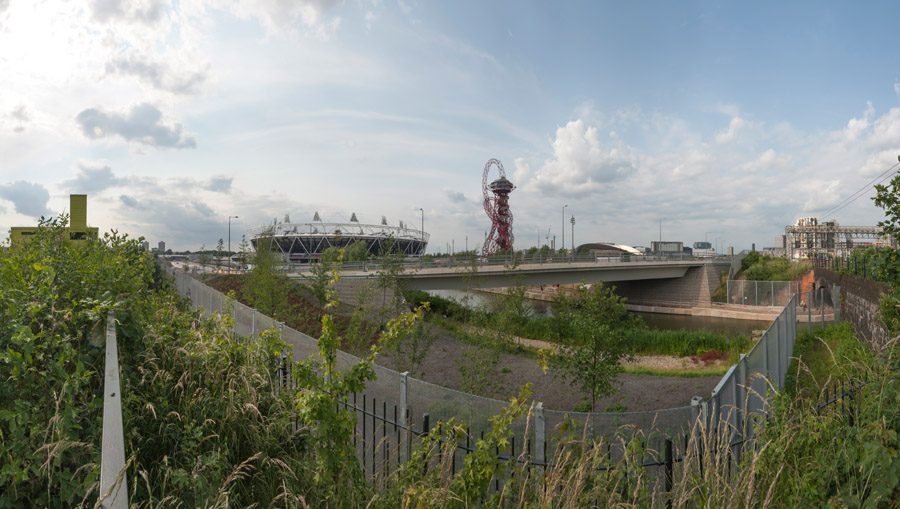
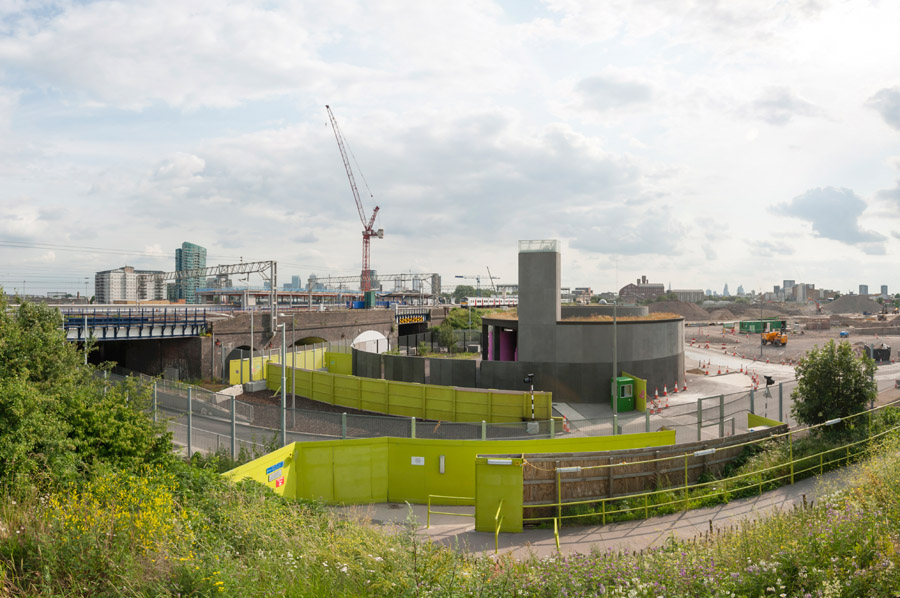
Thursday 6th October 2016 was another of those varied days I love. I began with a lunchtime protest against victimisation and nepotism by cleaners, then went for a walk by Bow Creek before finally photographing a protest outside RIBA where the annual Stirling Prize presentation was taking place.


Cleaners demand ‘End Nepotism’ – 155 Moorgate
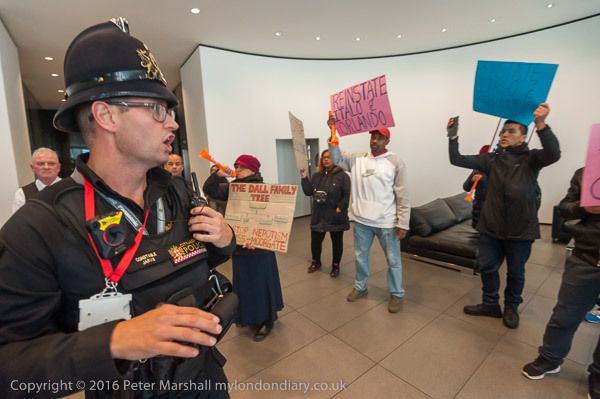
The Independent Workers Union CAIWU occupied the lobby of Mace’s headquarters building in Moorgate at lunchtime protesting noisily against cleaning contractor Dall Cleaning Services. I met the cleaners and supporters outside Moorgate station where they got out posters and a banner before marching quietly to pay an unannounced visit to Mace’s headquarters building where they walked into the lobby and started making a lot of noise.
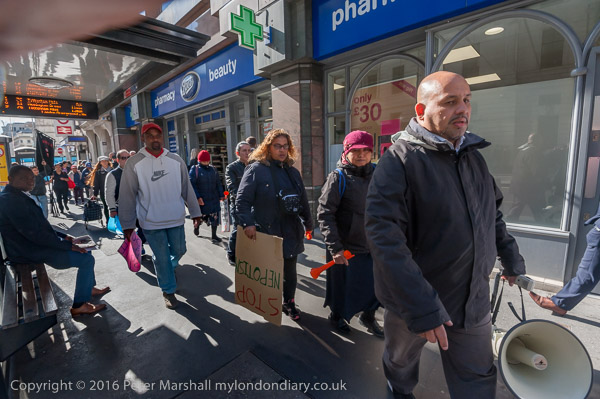
They called for the reinstatement of two cleaners who they say were dismissed illegally without proper notice or other procedures being followed. They say that the cleaners have been dismissed simply to give jobs to members of the family of a Dall Cleaning Services supervisor.
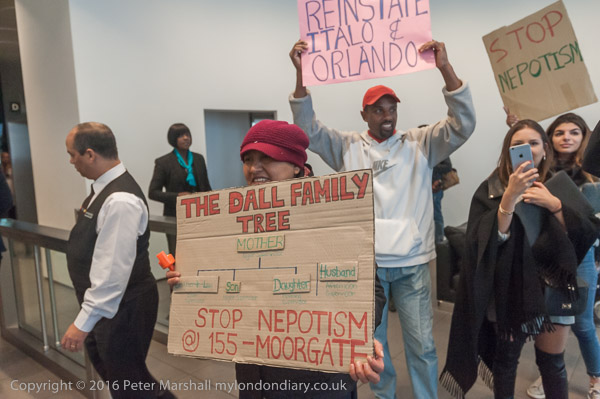
After around 15 minutes a police officer arrived, but it was too noisy to hear what he was saying and the protest continued. He stood a little to the side and called for reinforcements, and as these arrived the protesters walked out to join those who had stayed outside and the protest continued on the pavement for another 20 minutes.
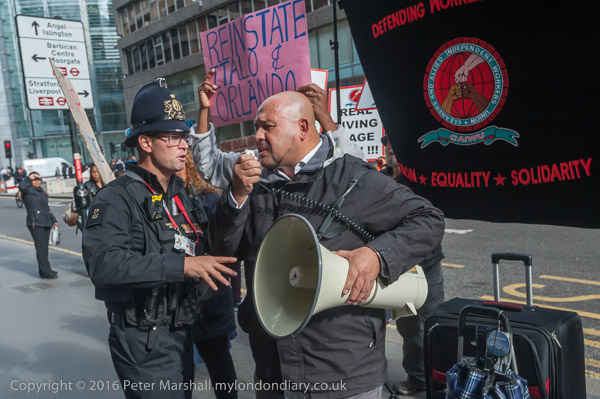
Police came to tell the protesters they were making a lot of noise, and were told that was the idea – they came here to do so and shame Mace and Dall Cleaning Services.
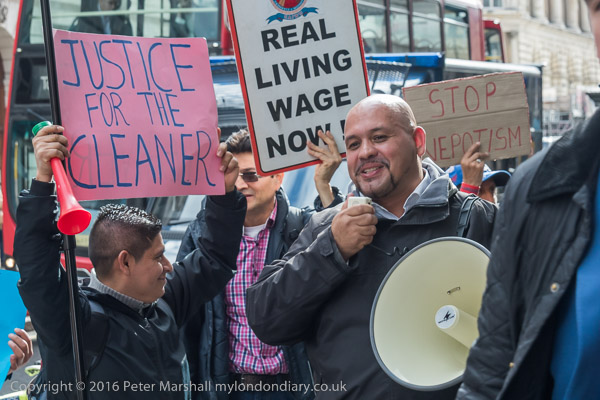
Eventually another officer who had been present at several previous CAIWU protests arrived and was told they would soon be stopping.
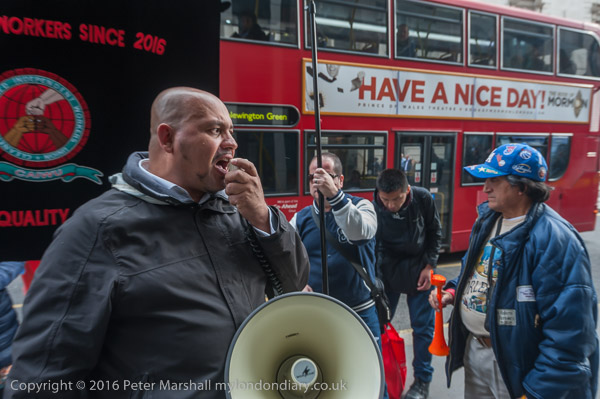
And after a couple more minutes, Alberto ended the protest with the usual warning “We’ll be back – and that’s a fact”.

More at Cleaners demand ‘End Nepotism’.


Limehouse, Bow Creek & Silvertown, London
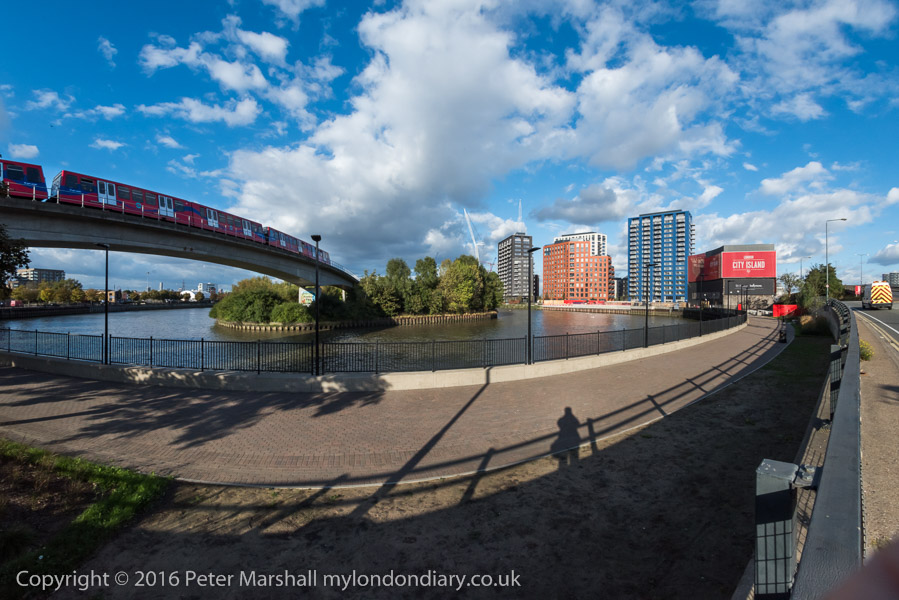
I had the afternoon to fill before the next protest and it was a fine day so I decided it was time to take another trip to Bow Creek. I took the DLR from Bank to West India Dock to start my walk, and took the opportunity and a fairly clean train window to take a few pictures on my way there.
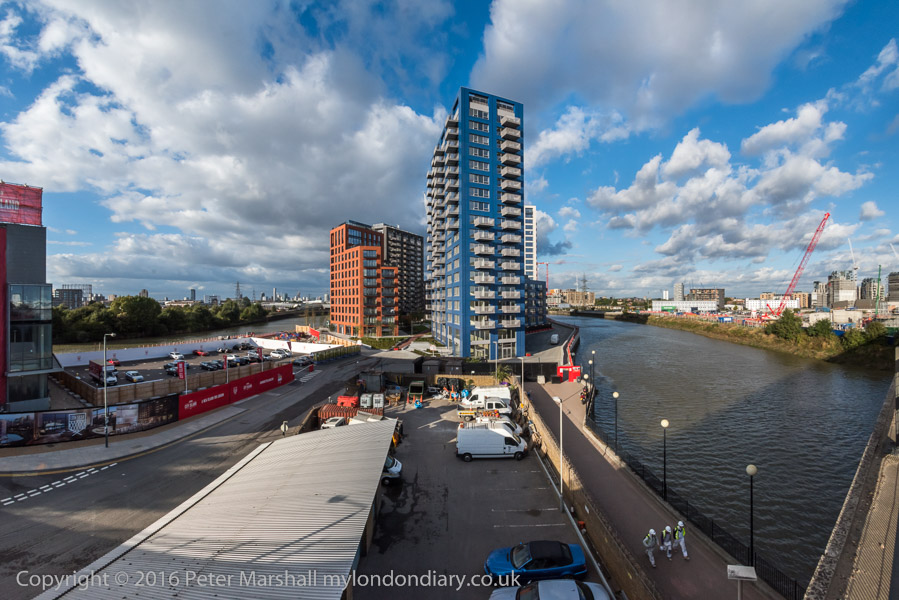
City Island is not quite an island

I walked over the Lower Lea Crossing, which provided a view of work which was now rapidly going ahead on ‘City Island’, where a loop in Bow Creek goes around what was previously the site of Pura Foods. This development had stalled with the financial crash in 2008 but was now in full swing.
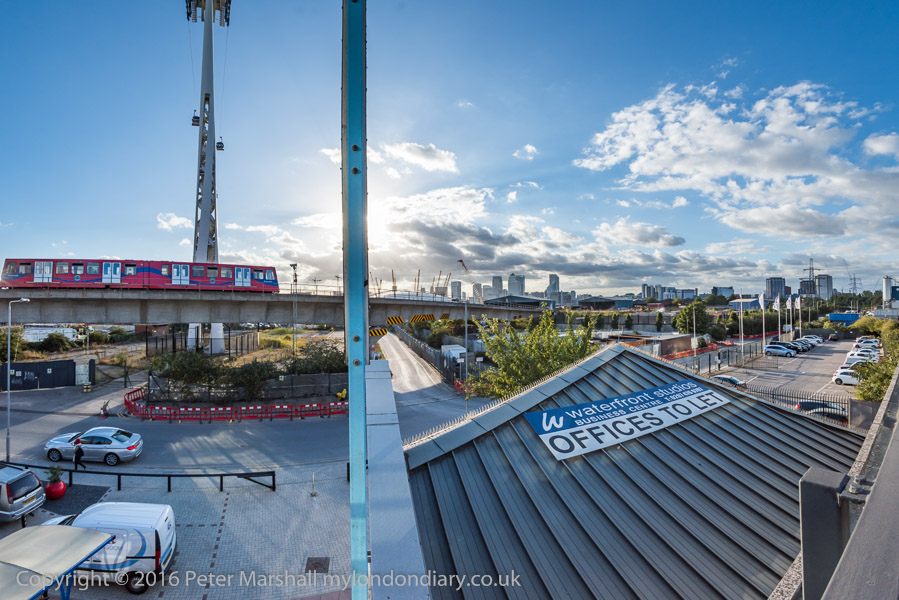
From there I walked on along the elevated Silvertown Way, giving views of the surrounding area, before taking the DLR back to Canning Town, again taking advantage of a fairly clean train window on the ride.
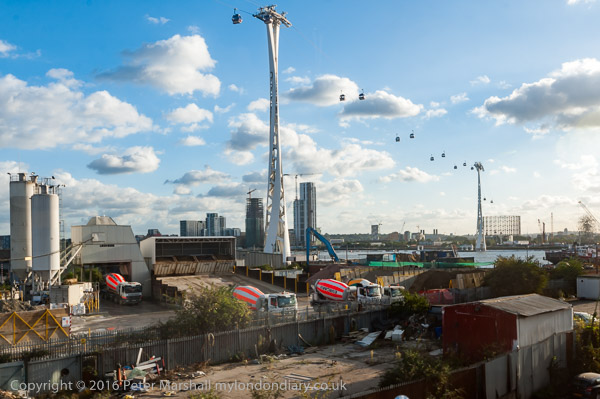
Rather to my surprise, at Canning Town I found that the exist to the riverside walk was finally open. I think the walk here beside Bow Creek was constructed in the 1990s and I’d been waiting for around 20 years for this exit from the station to open and give access to it. I didn’t have as much time left as I would have liked but did make a few pictures.
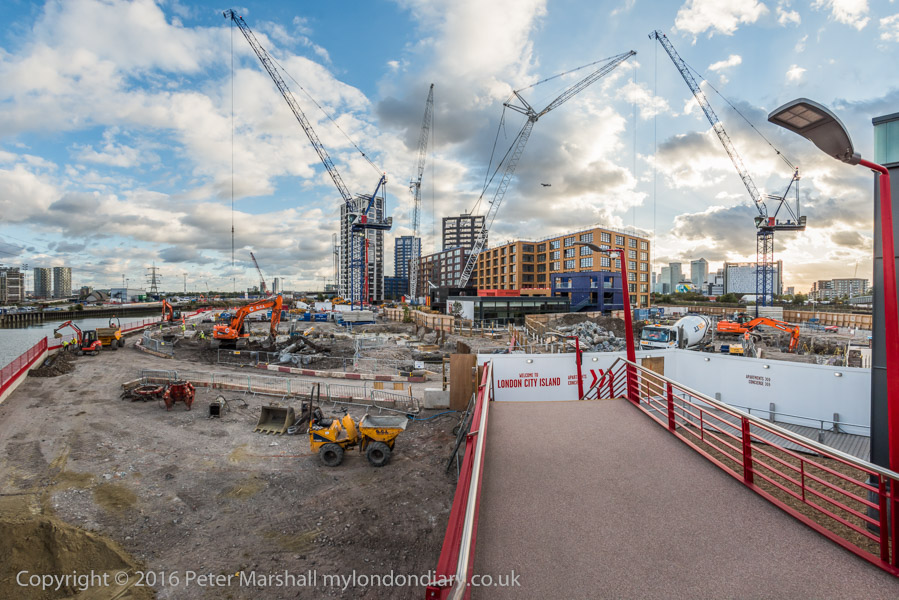
For years there have been plans to create a walk from the path beside the Lea Navigation at Bromley-by-Bow to the Thames at Trinity Buoy Wharf, and the section as far as Cody Dock had opened a few years earlier – with the ridiculous name of ‘The Fatwalk’. It hasn’t really got any further yet, though at least it has been renamed as the ‘Leaway’.

More pictures – both panoramic and otherwise at Limehouse, Bow Creek & Silvertown.


ASH protest Stirling Prize – RIBA, Portland Place
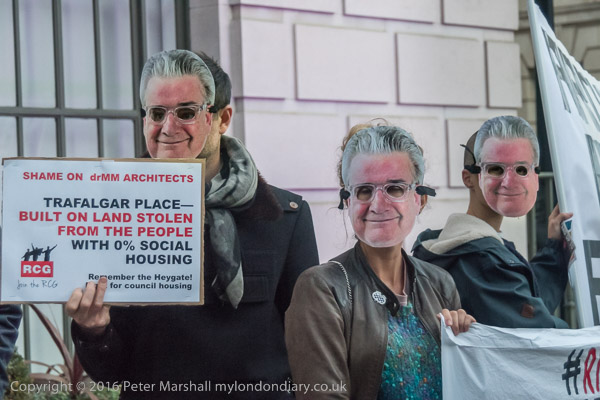
Many of the protesters wore masks showing RIBA President Elect Ben Derbyshire

Architects for Social Housing (ASH) led a protest outside the Stirling Prize awards ceremony pointing out that one of the short-listed projects, Trafalgar Place, was built on the demolished Heygate Estate, which was ‘stolen from the people’ with hundreds of social housing tenants and leaseholders being evicted and the site sold at one tenth of its value to the developers.
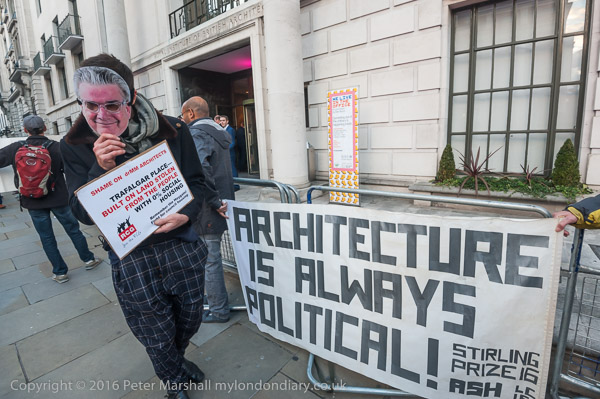
 ‘Architecture is Always Political!’, a quote from Richard Rogers

Together with other housing protesters than held their own awards ceremony on the pavement in front of the RIBA building, awarding the ‘O J Simpson Award for getting away with murder’ to drMM Architects for this project, the first phase of Lendlease’s £1.5 billion Elephant & Castle redevelopment. This will replace 1214 social housing homes with few or no affordable homes.
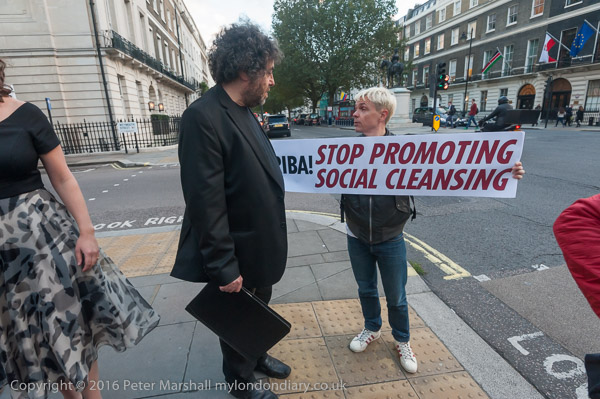
There were no other contestants for the Ben Derbyshire Foot In Mouth Award than RIBA President Elect Ben Derbyshire but there was a vote to select which of five of his totally ridiculous statements by him about social housing should be the winner.
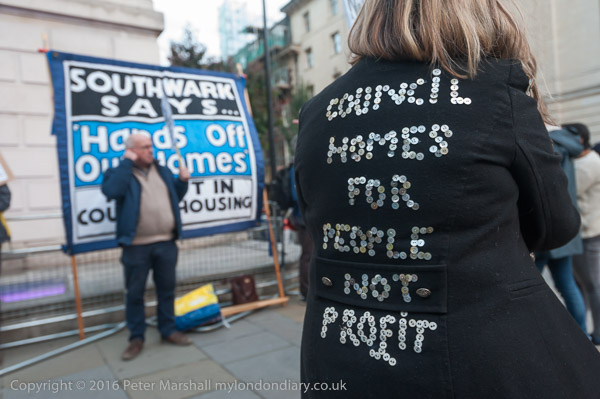
Among those at the protest were residents opposing the demolition of the Aylesbury estate, close to the Heygate, where Southwark Council are also demolishing social housing properties rather than carry out relatively low cost Aylesbury estate,that was voted for by the residents and could continue the useful life of these properties for many years.
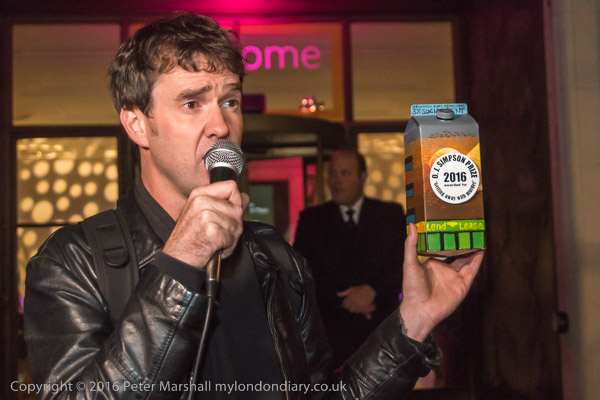
Simon Elmer of ASH holds up the award for the ‘O J Simpson Award for getting away with murder’ awarded to drMM Architects and developers Lend Lease for Trafalgar Place

Estate demolition has a huge social and environmental cost and schemes like these in the borough of Southwark result in huge losses of social housing. But they provide expensive properties often sold largely to investors who will never live in them and large profits to the developers. Councils hope to share in these profits, but on the Heygate made huge losses, though some individuals involved have gained highly lucrative jobs.

More at ASH protest Stirling Prize.
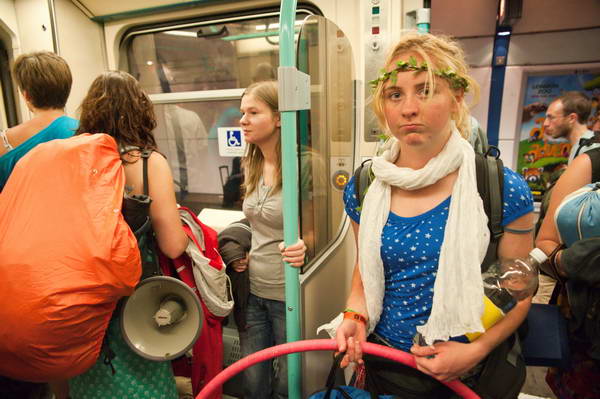

Climate Camp Blackheath 2009

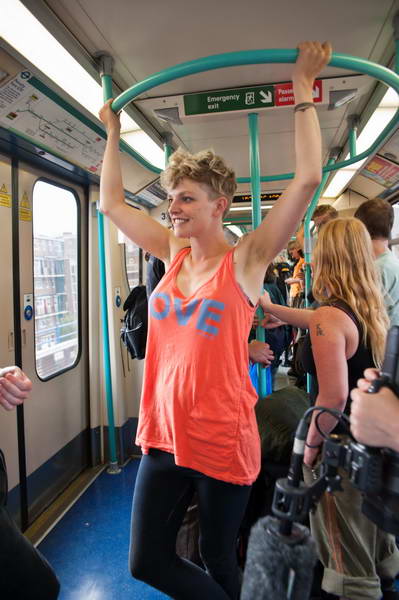
Climate Camp Blackheath 2009  - activists on the tube

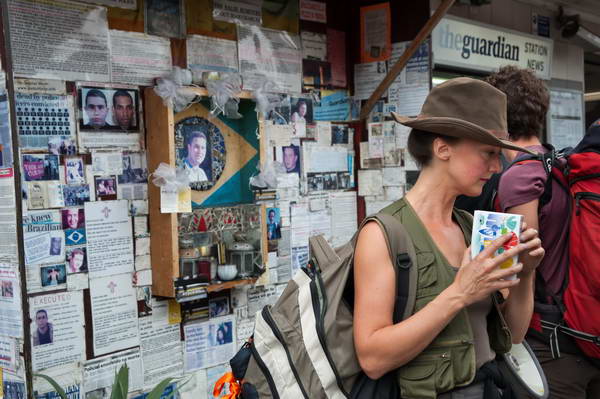
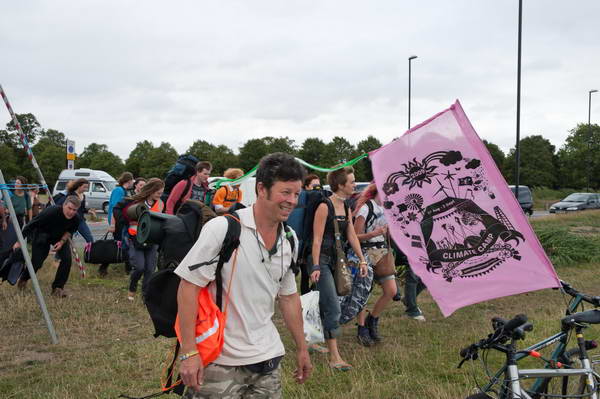
Climate Camp Blackheath 2009 – On Wednesday 26 August 2009 I joined a group of climate activists who were gathering in front of Stockwell Underground Station in south London, waiting for directions to move to wherever that year’s climate camp was to be held. They were ‘Blue Group’, at one of six locations around London, waiting to get the secret instructions and move to the site.

We met by the memorial to Jean Charles de Menezez

It had been chosen as one of the meeting points because of what happened there on 22 July 2005. As I wrote, coming “up the escalator at Stockwell station it’s hard not to shiver at the memory of those videos showing Jean Charles de Menezes strolling down to catch his last train, and police coming though the gates in pursuit. There is a memorial to him outside the station, including a great deal of information about the event and the misinformation and covering up by police.”

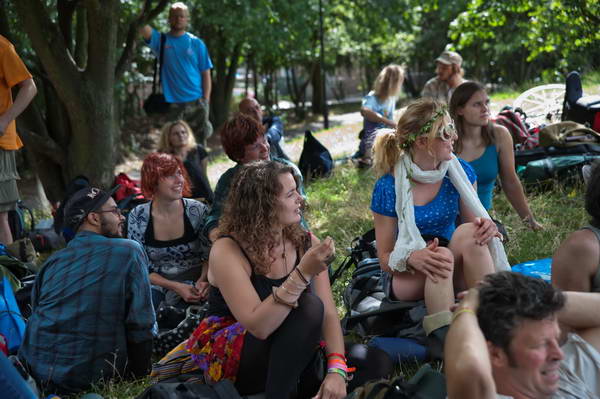
People wait for instructions in Larkhall Park

It was a terrible mistake made by the Metropolitan Police and the officer in charge was rewarded for it by being put in charge of London’s police. She only recently lost that job after the London Mayor made clear that he had lost confidence in her, but a huge number of Londoners had lost confidence in her and the police in 2002.

On the DLR to Greenwich

After hanging around for while, we were told to go and sit in a nearby park and wait there, and we sat down and ate our sandwiches while some played games. Eventually at 2pm instructions came and we followed the leaders onto the tube, alighting at Bank and changing to the DLR, most still not knowing where the journey would end.

And eventually we reached Blackheat Common

By the time the DLR arrived in Greenwich the destination had become clear, and we left the station for the long walk up the hill to Blackheath Common, an area of common land with a long pedigree as a meeting place for rebels. Police seemed happy both at Stockwell and on the journey to watch the activists from a distance and as we walked past a police station they seemed to be in hiding.

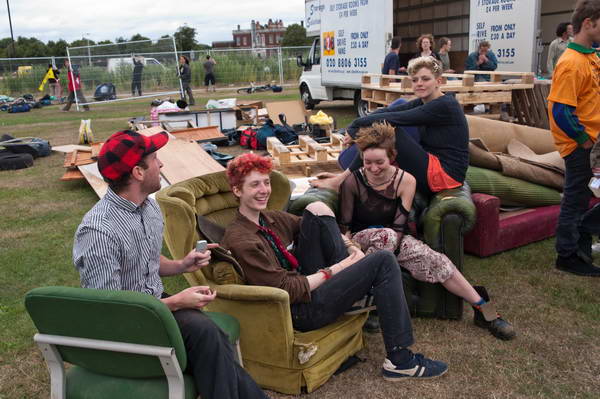
Some rested after the walk up the hill

The common was the site where John Ball made his famous speech with his famous “When Adam delved and Eve span, who was then the gentleman?” and urged his peasant audience to “cast off the yoke of bondage, and recover liberty.” But the Peasant’s Revolt ended badly in 1381, with teenage King Richard II looking on as the priest was briefly hung and then carefully kept alive to watch his genitals and bowels being removed and burnt before he was beheaded and his body hacked into four pieces.

Jack Cade was a little more fortunate after his rebels camped here in 1450, as he was killed in a battle before he could be executed, but like Ball his severed head was displayed on London Bridge as a warning to others.

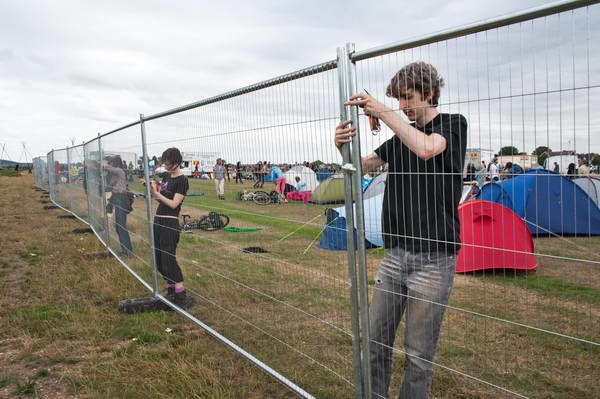
Others were busy working, setting up the fence, toilets etc

In 2009, the authorities rather stood back and watched, including from a helicopter hovering above as the camp was set up. As I commented, “With stabilised cameras the image quality should have been high enough for them to match the faces against their database (which of course they claim does not exist.)” Later they brought in a cherry picker to take pictures from, a considerably cheaper option.

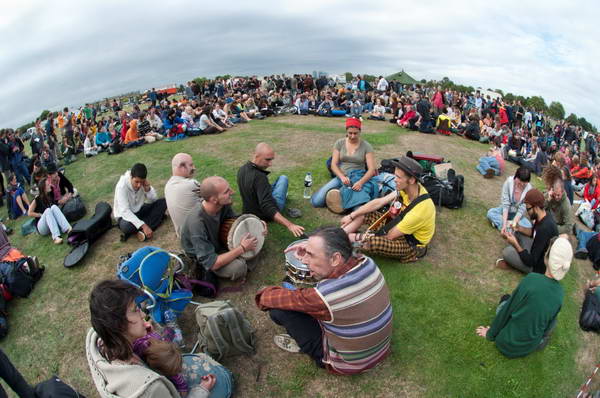
Time for a meeting

I’d largely avoided photographing previous climate camps because of their ‘media policy’, which as I wrote “appears to be driven by a few individuals with paranoid ideas about privacy and a totally irrational fear of being photographed. It really does not steal your soul!” This stated that press photographers had to sign the policy and be accompanied while on the site by a minder.

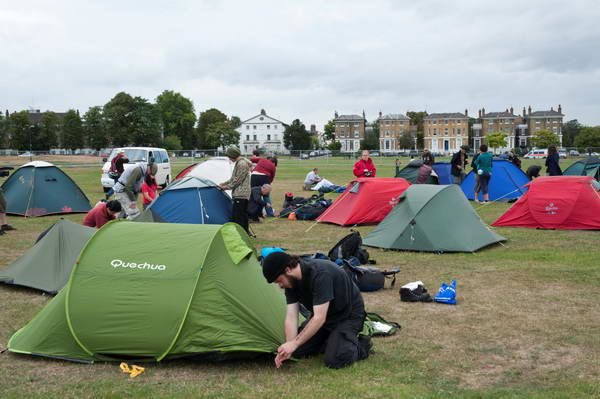
Setting up tents

I didn’t have any problems wandering freely and taking pictures while the site was being set up, and met many people who welcomed me, having met me at previous environmental protests. And I was invited to return later to the camp as a member of the documentation team with a sash that allowed me to wander freely. So I came back two days later to take more pictures, and though there were a few people who made clear they didn’t want to be photographed I was generally able to work as normal.

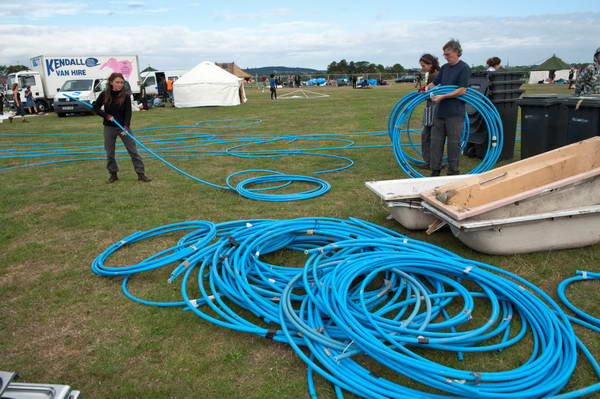
Water pipes for washing and kitchens

There were no uniformed police on the site on my later visit – and as I noted, it “was almost certainly the most caring and most law-abiding part of South London, with no crime, no drugs and very little alcohol around.” The organisation of the site was truly impressive.

But shortly before I left I noticed that one of the police cameras on their cherry picker was following me as I walked around, and after I left the site I was “followed rather ineptly (perhaps deliberately so) by a young black man in plain clothes as I wandered around for the next 15 minutes, occasionally writing in his notebook. It seemed a waste of public money.”

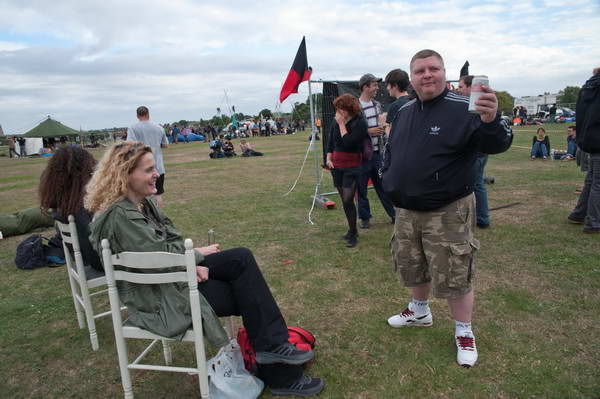
Some anarchists left after 2 police came on site

I’d stopped for some minutes at several of the workshops that were taking place on my second visit, and had been impressed by the expertise of many, both those leading the sessions and some of those contributing to the debates. If people like these rather than the politicians had been in positions of power we would now be in a very much better place to avoid climate catastrophe, but unfortunately what we have seen is 13 more years almost completely wasted.

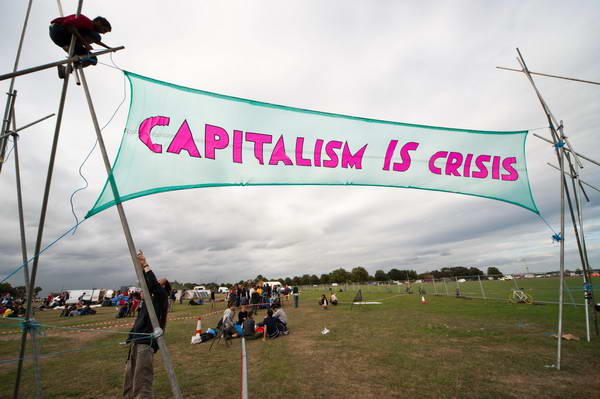
Capitalism IS Crisis

More pictures from Wednesday August 26th
Climate Camp: Blue Group Swoop
Climate Camp: Setup

And for an account and pictures from my day there on Saturday August 29th
Climate Camp: Saturday


Dangleway, Silvertown and Stratford Marsh

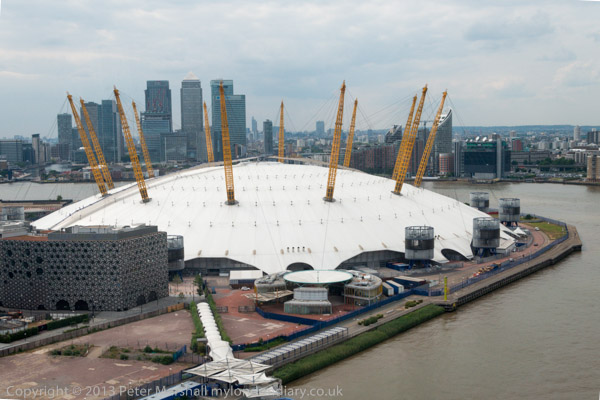
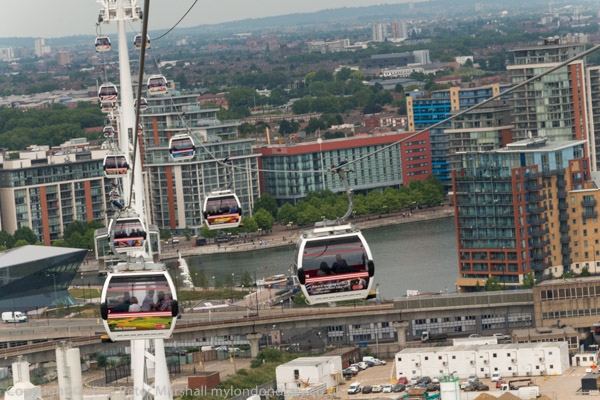
Dangleway, Silvertown and Stratford Marsh: My day out on Wednesday 26 June 2013 began by taking the tube to North Greenwich and then walking to the cablecar for the ride across the Thames.

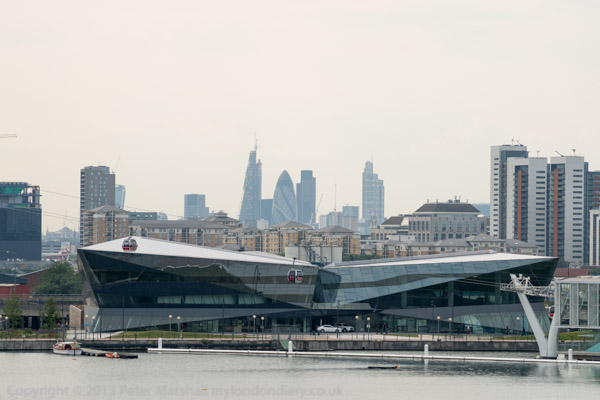
Back then I commented “Given the huge losses it is sustaining I can’t see it remaining open too much longer, so if you’ve not taken a ride don’t leave it too long“, and I’m surprised to find it still running 8 years later. But perhaps not for much longer, as the sponsorship deal with the Emirates Airline comes to an end this month, and no other company has come forward to pick up the tab, even though TfL have offered a huge reduction for the privilege.

Never a sensible contribution to London’s travel network it remains one of London’s cheaper and more interesting tourist attractions. I’m not sure whether the fact that it now lands on the north bank spitting distance from London’s now misplaced County Hall adds to its chances of retention, but it could make it more likely to be brought within the normal London fare structures.

There are already fare reductions for people with Travelcards, and frequent users can buy a ticket which reduces the cost to make it a viable part of a commute to work, particularly as you can take a bike with you for free. However I suspect the number of ‘frequent fliers’ is probably only in two figures. Its also a service which is more affected by weather than surface transport, closing down in high winds.

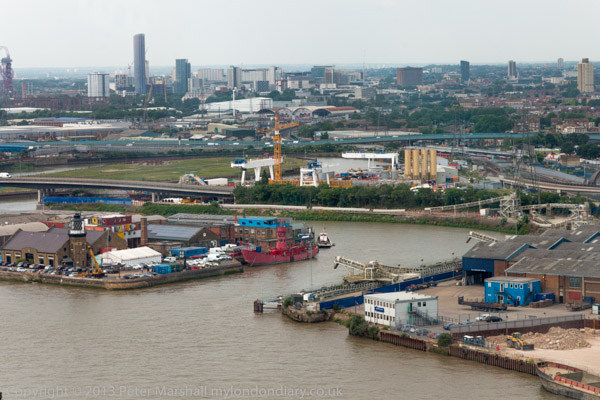
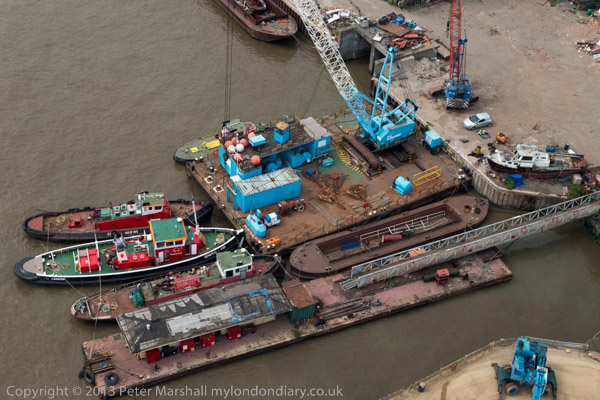
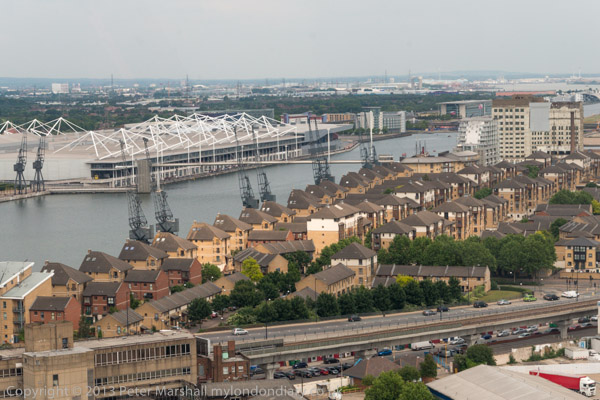
But it does have the height to give some splended views, even if the surrounding area is perhaps less rich than that of London’s other aerial attraction, the London Eye. Actually for me is considerably more attractive, and it’s an area which is now rapidly developing on both sides of the river, with new residential developments replacing old industrial and commercial uses.

The dangleway is also a part of the East London sculpture trail, The Line, which vaguely follows the Greenwich Meridian, from North Greenwich to Stratford and makes an interesting walk, although this will become a more interesting walk once the riverside path from Cody Dock to the East India Dock Road is opened, something we have been waiting for around 20 years. One day it might even extend past Canning Town station to Trinity Buoy Wharf, but we may not live that long.

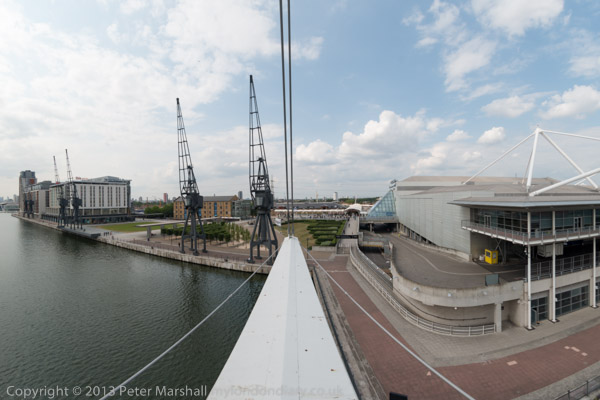
Although you can see the riverside from above, little of it is now publicly accessible, though I walked along Bow Creek and a little of the Thames here back in the 1980s taking photographs now on Flickr. But back then the Royal Victoria Dock was largely fenced off and you can now walk around it and over a high-level bridge which also has interesting views.

Or at least you can most of the time. But the area becomes a high security zone with the bridge closed when the Excel Centre is full of arms dealers selling often illegal arms to repressive regimes around the world – every other September. Fortunately it was June, though I was back there for the DSEI protests in September – and in other years.

The DLR also runs through the area on a viaduct, and from the train and the stations you also get some interesting views, though the train windows are often rather to dirty for taking photographs. That you are looking south from the line can also mean the sun is shining directly into the lens.

This is the Woolwich branch of the DLR and at Canary Wharf I changed onto a train towards Stratford, alighting at Pudding Mill Lane to walk up onto the Greenway. I arrived just too late to go into the View Tube there so I had to be content with making pictures from the Greenway which runs high through the area.

I’d begun making photogrfaphs here back in the 1980s, and had published some of these on my my River Lea/Lee Valley web site – and in the Blurb book ‘Before The Olympics‘, returning to the area occasionally and photographing it as it changed and particularly as the Olympic site developed. Progress on restoring the area to some useful purpose appeared to be very slow

More on My London Diary where the pictures are also larger – though you can see these ones larger by opening the images in their own window.
Stratford Greenway Olympic Revisit
Victoria Dock and Silvertown
Emirates ‘Airline’ – Arab Dangleway


Bow, Kingsly Hall, a Nursery, Grime, Quakers & more

This post continues from my previous post on this walk by me on 1st August 1988, Coventry Cross, Gandhi, Graffiti, Drag Balls …

Stroudley Walk, Bow, Tower Hamlets, 1988 88-8a-21-Edit_2400
Stroudley Walk, Bow, Tower Hamlets, 1988 88-8a-21

The buildings of the Diary and the Rose & Crown are still standing at the north end of Stroudley Walk where it meets the end of Bromley High St, but the closed diary became Hussains Convenience Store and then Jalalabad Grocers and half is now a mobile phone repair shop.

The Rose & Crown had opened here around 1720, as the Bowling Green Inn, though the building here is from the 1880s. It closed in 2007, was boarded up for some years before reopening around 2014 as a coffee bar and fast food restaurant.

This was formerly the north end of Devons Road, and a sign for this painted on the brickwork at the left of the pub had virtually disappeared when I made this picture in 1988. Later repainted it has now almost disappeared again.

Kingsley Hall, Powis Rd, Bromley-By-Bow, Tower Hamlets, 1988 88-8a-25-Edit_2400
Kingsley Hall, Powis Rd, Bromley-By-Bow, Tower Hamlets, 1988 88-8a-25

I wrote more about Kingsley Hall and the sisters Muriel and Doris Lester in the previous post on this walk. They used a legacy from their younger brother Kingsley to set up a house where they lived in relative poverty and served the neighbourhood as well as campaigning for peace and justice across the world. A plaque on the building records that Mahatma Gandhi lived in a small cabin here during his three month stay attending a government conference as a representative of the Indian National Congress. You can read and see more about his visit and the sisters on the Muriel Lester web site.

This image gives a better view of the whole building, which dates from 1928. It faces the Devons Estate, built for the London County Council in 1949 and described by Pevsner as being in their ‘pre-war manner, but with all the drabness of post-war austerity‘. Those moved from slums into its maisonettes and flats would have taken a far more positive view and the estate was solidly built and well-designed to the standards of the day.

Clyde House, Bruce Rd, Bromley-by-Bow,  Tower Hamlets, 1988 88-8a-26-Edit_2400
Clyde House, Bruce Rd, Bromley-by-Bow, Tower Hamlets, 1988 88-8a-26

Clyde House is still there at 46 Bruce Road, looking in rather better condition now. Built in 1884 it appears to have been built as a pair with its double-fronted neighbour at 48.

Children's House, Nursery School, , Bruce Rd, Bromley-by-Bow,  Tower Hamlets, 1988 88-8a-11-Edit_2400
Children’s House, Nursery School, Bruce Rd, Bromley-by-Bow, Tower Hamlets, 1988 88-8a-11

Sisters Muriel and Doris Lester helped to set up the Children’s House on Bruce Road 1923. Doris had trained as a teacher and they commissioned Charles Cowles-Voysey to design a building based on Maria Montessori’s ideal learning environment for young children. The school was opened in 1923 by H G Wells and is still a school, run by Tower Hamlets Council.

Inside there is a 12 metre mural painted in 1935 by Eve Garnett, the illustrator, artist and writer of the first children’s book about working class characters, The Family from One End Street, in 1937. There is now a campaign to save and restore the mural which is dirty and damaged and the web site is asking for donations to pay for this.

Regent Square, Bow, Tower Hamlets, 1988  88-8a-15-Edit_2400
Regent Square, Bow, Tower Hamlets, 1988 88-8a-15

The Crossways Estate, built in 1970 was apparently at the time known as the ‘Pride of Bow’, for its three 25 storey towers and a low rise block, Holyhead Close, built over the railway line. Later it was more prosaically referred to as the ‘three flats.’

It was here that Grime developed in 2003, after Rinse FM squatted in a flat and broadcast illegally from here, and it was also where Dizzee Rascal and others grew up.

Like many council developments the area around the estate was hard to navigate, with walkways and roads often not shown on maps. My contact sheet says ‘Regent Square and gives grid reference 375827 for the first of the five images I made. The three towers were Hackworth Point, Mallard Point and Priestman Point and are on Rainhill Way.

And also like many council estates, it was subjected to a policy of ‘managed decline’ and by 1999 was in a very poor state, so bad its demolition was under consideration. Tower Hamlets decided to retain and refurbish the estate which passed to Swan Homes after a residents ballot in 2005. Its towers now refurbished and clad more brightly this is now the Bow Cross Estate.

Bow Church, station, DLR,  Crossways estate, Bow, Tower Hamlets, 1988 88-8b-56-Edit_2400
Bow Church, station, DLR, Crossways estate, Bow, Tower Hamlets, 1988 88-8b-56

The ‘three flats’ seen from Bow Road and Bow Church DLR station which opened on 31 August 1987.

Mornington Grove, Bow, Tower Hamlets, 1988 88-8b-61-Edit_2400
Mornington Grove, Bow, Tower Hamlets, 1988 88-8b-61

Mornington Grove not only gets a mention in the London 5: East volume of Pevsner (p619) which describes these houses as “unusually grand for the area” but also has an extensive web site covering its history by Ken Ward, a resident in the street, from which this information is extracted – and which has far more detail. And it really is an interesting history – if you have the time do click the link and read more.

The land of a nursery here was bought by the Quaker meeting in Ratcliff in 1812, and houses on Mornington Road were developed by them from 1854-1889 – those on the east side in this picture being among the later development. Arthur Wellesley, the 1st Duke of Wellington was the son of the first Earl of Mornington, and the fourth Earl lived nearby on the north side of Bow Road.

Many of the houses in Mornington Road were compulsory purchased and demolished for the Whitehapel and Bow Railway (later the District Line) and others by World War II bombing of what had in 1939 been renamed Mornington Grove. Under the Quakers, at least 5/7th of the rents of the houses went to the support of the poor.

Most of the houses in the street, by then under multiple occupation, were sold by the Quakers to a housing association in 1980, becoming social housing, though many have now been sold off.


More from Bow in the next post from my walk in 1988. You can see larger versions of any of these pictures by clicking on the image which will take you to my album 1988 London Pictures from where you can browse.


Spratt’s, Far Famed Cakes and Bromley by Bow

Spratt’s, Far Famed Cakes and Bromley by Bow. My walk on 31st February 1988 was coming to an end as I made my way towards Bromley-by-Bow District Line station to begin my journey home. You can see the previous part at Lansbury, Brownfield, Teviot and St Leonards Road.

Footbridge, Railway, Spratt's Patent, Clutton St, Poplar, Tower Hamlets, 1988 88-7t-15-positive_2400
Footbridge, Railway, Spratt’s Patent, Clutton St, Poplar, Tower Hamlets, 1988 88-7t-15

St Leonard’s Road beyond Langdon Park becomes Uamvar St, an odd name whose origin I can’t find. It used to be a little west of its current route and I think with St Leonard’s Road used earlier to be Bow Lane. I soon turned left onto Clutton St and climbed onto the footbridge over the railway. The bridge has now been replaced by a metal structure on which it would be rather harder to write ‘Happy Birthday’ and ‘I Love You’.

The railway line here carries the Docklands Light Railway line from Poplar to Stratford, but had been a part of the North London Railway (founded in 1846 as the East and West India Docks and Birmingham Junction Railway.) The Spratt’s Patent Limited Offices Fenchurch St are still there, with an entrance from Fawe St.

Farfamed Cake Company, Fawe St, Footbridge, Poplar, Tower Hamlets, 1988 88-7t-16-positive_2400
Far Famed Cake Company, Fawe St, Footbridge, Poplar, Tower Hamlets, 1988 88-7t-16

The Far Famed Cake Company began in 1881, and was bought by Fitch Lovell in 1950. They merged it with another company to form Hales Trent Cakes in 1962. In 1974 this was bought by Lyons. The factory had employed around 320 people. I think this site is now occupied by a large new block of flats with some shops on Morris Road.

Spratt's Patent Limited, Fawe St, Poplar, 1988 88-8a-62-Edit_2400
Spratt’s Patent Limited, Fawe St, Poplar, 1988 88-8a-62

Separated by a long yard from the block of Spratt’s Patent beside the DLR is another block of Spratt’s Patent Limited, still there and now the A B Fine Art Foundry.

Foresters Arms, pub, St Leonards Road , Poplar, Tower Hamlets, 1988 88-8a-63-Edit_2400
Foresters Arms, pub, St Leonards Road , Poplar, Tower Hamlets, 1988 88-8a-63

The Foresters Arms at 253 St Leonards Road, on the corner with Clutton St, a former Charrington & Co pub closed in 2004 and was sold. It was extended and converted to 6 flats in 2005. There had been a pub on this site since before 1856. It still has an address on St Leonards Road lthough my map calls the road huere Uamvar St.

Limehouse Cut, Blackwall Tunnel Northern Approach, Bromley-by-Bow, Tower Hamlets, 1988 88-8a-64-Edit_2400
Limehouse Cut, Blackwall Tunnel Northern Approach, Bromley-by-Bow, Tower Hamlets, 1988 88-8a-64

I continued my walk up Uamver St and on to the Blackwall Tunnel Northern Approach, and this picture was taken beside Tweed House, part of which can be seen at the extreme left. The buildings in the centre have now been replaced by a lower-rise redevelopment but that visible above the wall at the right of the picture is still there.

This section of the Limehouse Cut towpath was then rather overgrown and little used. It is now much busier, with a new floating section taking the path from Bow Locks under the busy tunnel approach road.

Nursery, Flats, Blackwall Tunnel Northern Approach, Bromley-by-Bow, Tower Hamlets, 1988 88-8a-52-Edit_2400
Nursery, Flats, Blackwall Tunnel Northern Approach, Bromley-by-Bow, Tower Hamlets, 1988 88-8a-52

I photographed this mural on a nursery and clinic in the flats beside the Blackwall Tunnel North Approach close to Devas St. This was part of the Coventry Cross West Estate, built by the LCC in the early 1950s as an addition to their 1935 Coventry Cross Estate. The name Coventry Cross came from a long-closed pub in the area since 1690 – at 68 St Leonards Street in 1861. The estate passed to the GLC and then TOwer Hamlets before after consultation and vote they joined Poplar HARCA.

From here is was a short distance to the end of my walk at Bromley-By-Bow District line station – from where I began my next walk in early August 1988

This had been an good walk for me and I hope readers will have found the pictures and text about them interesting. There are some more pictures from it in my album 1988 London Photos including some from earlier in the day at Petticoat Lane, in Whitechapel and Tower Hamlets cemetery before I started the walk proper.


West India – North Dock 1988

The Ledger Building,  Hertsmere Rd, West India Docks, Poplar, Tower Hamlets, 1988 88-6c-52-positive_2400
The Ledger Building, Hertsmere Rd, West India Docks, Poplar, Tower Hamlets, 1988 88-6c-52

The Offices of the West India Docks an Hertsmere Rd at the west corner of what was the Import Dock of the West India Docks and were Grade I listed in 1950 together with the adjoining warehouses. They were built in 1803 , architect George Gwilt and converted to hold the dock ledgers by John Rennie, who added the portico in 1827.

In 2000 it was converted into a Wetherspoon pub, the Ledger Office and can be visited during normal opening hours and displays some information about the history of the docks which can be read while drinking a cheap pint.

Warehouses, Hertsmere Rd, West India Docks, Poplar, Tower Hamlets, 1988 88-6c-53-positive_2400
Warehouses, Hertsmere Rd, West India Docks, Poplar, Tower Hamlets, 1988 88-6c-53

These listed warehouses are now converted for various uses including the Museum of London Docklands which has both permanent and temporary displays on the history of the River Thames, the growth of Port of London and the docks historical link to the Atlantic slave trade, in which this building, a sugar warehouse, played an important role. Temporary exhibitions there have included some of my pictures including in the show ‘Estuary‘ celebrating the museum’s 10th anniversary in 2013

Warehouses, Hertsmere Rd, West India Docks, Poplar, Tower Hamlets, 1988 88-6c-55-positive_2400
Warehouses, Hertsmere Rd, West India Docks, Poplar, Tower Hamlets, 1988 88-6c-55

The area has been opened up by the removal of the dockside sheds and is now a popular tourist venue, though it has lost most of its previous allure. But it’s still an interesting area, both for the old and the new buildings.

Crane, West India Quay, Poplar, Tower Hamlets, 1988 88-6c-44-positive_2400
Crane, West India Quay, Poplar, Tower Hamlets, 1988 88-6c-44

Two dockside cranes remain on the side of the dock, close to West India Quay DLR station, perhaps left there to divert attention from a rather hideous hotel building to their north.

Bridge, West India Quay, Poplar, Tower Hamlets, 1988 88-6c-45-positive_2400

This picture taken I think from more or less underneath the DLR which goes across the North (Import) Dock gives some impression of the scale of the West India Docks , which I think when constructed in 1800-1806 were I think the largest enclosed high-security docks in the world – and a model for later docks elsewhere.

This dock now looks considerably smaller, with around half of its width taken up by a strange building on top of a new Crossrail station, looking to me rather like a woodlouse. Nothing in this picture remains except the listed dock wall at bottom left (and possibly the bollard on it.)

Bridge, West India Quay, Poplar, Tower Hamlets, 1988 88-6c-46-positive_2400

I think this bridge, built from what looks suspiciously like Meccano, was the Great Wharf Road Bridge, later replaced by what was intended as a more permanent structure as the Upper Bank Street Bridge. I can find no information about it on-line, but it appears to have a central lifting section with heavy counterweights in those four towers. That more permanent bridge was removed for the construction of the Crossrail station in 2012 and a new, much shorter bridge was built in five sections in Belgium by Hollandia and welded together in situ in, opening in 2020.

Docklands Light Railway, Poplar, Tower Hamlets, 1988 88-6c-32-positive_2400
Docklands Light Railway, Poplar, Tower Hamlets, 1988 88-6c-32

It was time to leave Docklands for home, and together with my two young assistants we got on the DLR, sitting right at the front of the train. This view from the front window as the train had just left Poplar Station and about to cross Aspen Way shows dockland cranes at left and St Anne’s Limehouse at right. Then DLR trains were single two-carriage units like the Stratford service in this picture.

This is the final part of posts here about my pictures from my walk around the docks on the Isle of Dogs in June 1988.

Click on any of the pictures to see a larger version in my album 1988 London Photos, from where you can browse the album. The pictures there are largely ordered by my negative reference numbers, which do not in detail reflect the order in which the pictures were taken used in the posts here.


North Pole & Heron Quay

The North Pole, Manilla Street, Millwall, Tower Hamlets, 1988 88-6b-22-positive_2400
The North Pole, Manilla Street, Millwall, Tower Hamlets, 1988 88-6b-22

Continuing my walk around the West India Docks I walked down from Marsh Wall to Manilla St, where I think you can still find The North Pole, a beer house built in the 1860s, on the corner at No 74. It closed as a pub in 2014, and I suspect the building’s days are numbered.

Cuba St, Millwall, Tower Hamlets, 1988 88-6b-23-positive_2400
Cuba St, Millwall, Tower Hamlets, 1988 88-6b-23

Nothing, or almost nothing in this picture of Cuba St has survived the redevelopment of this street on the fringe of the West India Docks. In the far distance you can just make out the distinctive frontage of the building on the corner of Cuba St and Westferry Road, the first few feet of which have been incorporated into a modern red-brick block and is now an Indian Restaurant. It seems to be much more than the usual facade, with the older building integrated into the development, Regatta Point, which is on a rather smaller scale than much of the new building, only 5 storeys of shops with flats above.

Docklands Enterprise, Wendy Ann Taylor, Sculpture, Heron Quays, Marsh Wall, Tower Hamlets, 1988 88-6b-24-positive_2400
Docklands Enterprise, Wendy Ann Taylor, Sculpture, South Dock, Marsh Wall, Tower Hamlets, 1988 88-6b-24

Wendy Ann Taylor, born 1945 claims to have been as one of the first artists of her generation to “take art out of the galleries and onto the streets”’ and has made a number of sculptures around London and in several of the new towns. This sculpture was commissioned by the LDDC and the Docklands Business Club and dates from 1987. It is still in place, although everything in the background of this picture has been replaced by newer and much taller developments. I took the shape emaphasised in my picture and repeated at right angles in her work as representing the river around the Isle of Dogs and the vertical as enterprise reaching for the sky.

Heron Quay, DLR, Middle Dock, West India Docks, Tower Hamlets, 1988 88-6b-14-positive_2400
Heron Quay, DLR, South Dock, West India Docks, Tower Hamlets, 1988 88-6b-14

You can still just about see the DLR as it goes across South Dock here but Heron Quay station is now completely engulfed in tall office blocks, the water now looking enclosed rather than open as it was. The distant gasholder at right at Greenwich has also now gone, though long invisible from here.

Heron Quay, West India Docks, Tower Hamlets, 1988 88-6c-63-positive_2400
Heron Quay, South Dock, West India Docks, Tower Hamlets, 1988 88-6c-63

I think it is a long time since any boats were moored here.

Heron Quay, West India Docks, Tower Hamlets, 1988 88-6c-65-positive_2400
Heron Quay, West India Docks, Tower Hamlets, 1988 88-6c-65

This picture is looking along Middle Dock, with the north side of the buildings, long demolished, of Heron Quay at right.

I continued my walk to the North Dock – and a few pictures in a later post.

Click on any of the pictures to see a larger version in my album 1988 London Photos, from where you can browse the album. The pictures there are largely ordered by my negative reference numbers, which do not in detail reflect the order in which the pictures were taken used in the posts here.


West India Docks 1988 (2)

SS Robin, South Dock, Tower Hamlets, 1988 88-6b-44-positive_2400
SS Robin, South Dock, Tower Hamlets, 1988 88-6b-44

SS Robin is a 350 gross ton steam coaster built by Mackenzie, MacAlpine & Co at their Orchard House Yard in Bow Creek in 1890 and the only complete Victorian steam ship in existence. She still has the original steam engine fitted in Dundee by Gourlay Brothers & Co.

In 1900 she was renamed Maria and spent the next 74 years working around Spain for several Spanish owners, and in 1966 some extensive alterations were made. When about to be scrapped in 1974 she was bought by the Maritime Trust, her original name restored and treated to an extensive restoration in Rochester before coming to St Katharine’s Docks in London and opened to the public as a part of their Historic Ships Collection. After this closed in 1986, along with several other vessels from the collection Robin was laid up here in the West India Docks. You can see the stern of the Yarmouth Steam Drifter Lydia Eva at the right.

In 2000 Robin was sold for £1 and later the SS Robin Trust was set up to restore the vessel, an expensive and lengthy process and eventually it was decided necessary to put the vessel on a pontoon. The SS Robin museum, theatre and educational centre is now in the Royal Victoria Dock.

DLR, BT, Quay House, Admirals Way, South Quay, Tower Hamlets, 198888-6b-45-positive_2400
DLR, BT, Quay House, Admirals Way, South Quay, Tower Hamlets, 1988 88-6b-45

Quay House, a three storey office block built in 1986-7 was occupied by BT. Empty for some years, planning permission was obtained in 2020 for the 40-storey Quay House waterfront development including a 400-bedroom hotel and 279 serviced apartments alongside dockside leisure facilities.

South Dock, Heron Quays, Marsh Wall, Tower Hamlets, 1988  88-6b-46-positive_2400
South Dock, Heron Quays, Marsh Wall, Tower Hamlets, 1988 88-6b-46

The Survey of London describes these low rise buildings as “high-tech ‘cabins’ or ‘Swiss chalets’, with light steel structures, covered with red, purple and blue-grey vitreous enamel panels, while the monopitch roofs are clad in aluminium” and says they were part of a large scheme for the area begun in 1981 and built in 1984-9.

I think this is now the site of 1 Bank Street, a 28 floor office block completed in 2019.

BT, South Dock, Admirals Way, South Quay, Tower Hamlets, 1988  88-6b-31-positive_2400
BT, South Dock, Admirals Way, South Quay, Tower Hamlets, 1988 88-6b-31

The front of the BT Business Centre on South Dock.

DLR, South Dock, Admirals Way, South Quay, Tower Hamlets, 1988  88-6b-32-positive_2400
DLR, South Dock, Admirals Way, South Quay, Tower Hamlets, 1988 88-6b-32

Taken from more or less the same place as the previous picture and that below, this is where the DLR crosses the South Dock of the West India Docks, looking towards Heron Quays station. It shows how little development there was here in 1988.

DLR, BT, South Dock, Admirals Way, South Quay, Tower Hamlets, 1988 88-6b-33-positive_2400
DLR, BT, South Dock, Admirals Way, South Quay, Tower Hamlets, 1988 88-6b-33

Looking back at the curve of the DLR around Quay house towards Marsh Wall.

London River Man, John W Mills, sculpture, Ensign House, Marsh Wall, Tower Hamlets, 1988 88-6b-35-positive_2400
London River Man, John W Mills, sculpture, Ensign House, Marsh Wall, Tower Hamlets, 1988 88-6b-35

“London River Man‘ John W Mills ARCA FRBS 1987. This sculpture salutes all London river workers – toshers – bargees – dockers – ale tasters – coalheavers – ferrymen” and is rather hidden now on Marsh Wall. It is rather less than lifesize. John Mills (b1933) is better known for his Whitehall memorial to the women of World War II.

Admirals Way,  South Dock,  South Quay, Tower Hamlets 88-6b-36-positive_2400
Admirals Way, South Dock, South Quay, Tower Hamlets 88-6b-36

This is Waterside, where these buildings, described as small-business apartments were built in 1985-6. They are still there, looking much the same, though probably for not much longer.

BT,  Admirals Way, South Quay, Tower Hamlets, 1988  88-6b-21-positive_2400
BT, Admirals Way, South Quay, Tower Hamlets, 1988 88-6b-21

A final picture of the British Telecom Business Centre – and what was presumably its main entrance.

More from around the West India Docks in a later post. Click on any of the pictures to see larger versions of any of them in the album 1988 London Photos from where you can browse other images.


West India Docks 1988 (1)

Millwall Inner Dock, Tower Hamlets, 1988 88-6b-65-positive_2400
Millwall Inner Dock, Tower Hamlets, 1988 88-6b-65

When the Docklands Light Railway opened in 1997 there were just two lines, one from the City at Tower Gateway east to Canary Wharf and then south to Island Gardens, and the second coming down south from Stratford to Canary Wharf and then using the same track south. For cost reasons it had been decided not to make a connection with the existing Underground network, except at Stratford where the DLR shared a station with both the Central Line and National Rail. The tunnel link to Bank Station was only opened four years later.

So I and my two young assistants had walked as in my earlier post from London Bridge across Tower Bridge to Tower Gateway station, and then took the DLR to Crossharbour. It was something of a fairground-like attraction, particularly around where the line turned south to go into West India station, and in the first years the line was little used and it was usually possible at the terminus to get a seat right at the front of the driverless train and imagine you were in the driving seat.

Glengall Bridge, Millwall Inner Dock, Tower Hamelts, 1988 88-6b-66-positive_2400
Glengall Bridge, Millwall Inner Dock, Tower Hamlets, 1988 88-6b-66

There was considerable building work taking place around Millwall Inner Dock, as well as cranes and the lifting bridge and it made a good day out for small boys as well as older photographers.

My assistants, Millwall Inner Dock, Tower Hamlets, 1988 88-6b-52-positive_2400
My assistants, Millwall Inner Dock, Tower Hamlets, 1988 88-6b-52

And here they are on an empty plinth surveying the scene, sandwiches and drinks in their back packs.

Millwall Inner Dock, Tower Hamlets, 1988 88-6b-55-positive_2400
Millwall Inner Dock, Tower Hamlets, 1988 88-6b-55

Millwall Dock was only opened in 1868 and was then quite separate from the West India Docks to the north. It had an entrance from the Thames on the west side of the Isle of Dogs to a large dock running halfway across the ‘island’, with another large dock, later called the Millwall Inner Dock branching off to the north. Most of the cargo was timber and grain, and McDougall’s built a large flour mill on its south bank the year after it opened. In 1928 it was connected to the West India Docks by the Millwall Passage, and became a part of the same impounding system for water levels.

Guardian building, Marsh Wall, Tower Hamlets, 1988 88-6b-41-positive_2400
Guardian building, Marsh Wall, Tower Hamlets, 1988 88-6b-41

The Guardian print works in Wimpey’s Enterprise Business Park was built in 1985-7 and apparently its silver-blue reflective panels and tinted glass were meant to make its ugly box look smaller, merging the building with the sky. It doesn’t work in black and white and it didn’t work in reality. The Guardian now has its print works in Stratford.

Millwall Inner Dock, Marsh Wall, Tower Hamlets, 1988 88-6b-42-positive_2400
Millwall Inner Dock, Marsh Wall, Tower Hamlets, 1988 88-6b-42

Looking roughly south down Millwall Inner Dock from Marsh Wall. The chimney in the distance is that of Deptford Power Station, demolished in a spectacular explosion in 1992.

Docklands Light Railway, DLR, Daily Telegraph, Marsh Wall, South Quay, Tower Hamlets, 88-6b-43-positive_2400
Docklands Light Railway, DLR, Daily Telegraph, Marsh Wall, South Quay, Tower Hamlets, 88-6b-43

The Daily Telegraph moved in to this building to the east of South Quay DLR station when it was completed in 1987, naming it Peterborough Court. In 1992 they moved to Canary Wharf tower.

Our walk around the area continues in West India Docks 1988 (2) shortly.


Bow Creek Panoramas – 1992

DLR Viaduct, Bow Creek, Leamouth Rd, Leamouth, Tower Hamlets, Newham, 1992 92-1j61pr_2400

At the end of 1991 I finally bought my first panoramic camera, a Japanese Widelux F8 which I couldn’t really afford. It was a camera that took around 21 pictures on a 36 exposure film, with the film curved around a part of a cylindrical path with the lens pivoting around the centre of the cylinder.

Bow Creek, Bridges, Leamouth Rd, Tower Hamlets, 1992 92-3a42a_2400

The lens is a 26mm f2.8, though it needs to be stopped down to around f8 for most pictures as the camera is fixed focus at around 6 ft and only gets sharp at infinity when stopped down. Winding on the film winds up a clockwork motor and returns the lens to its starting position. On pressing the shutter the lens swings around through about 140 degrees, exposing the film through a slit at its back which swings across close to the film. It has 3 shutter speeds, 1/15, 1/125, and 1/250th, but even at the fastest speed it still takes rather longer to actually complete the exposure.

92-3b38_2400

The design keeps lens to film distant constant – at around 26mm – right to the edge of the film across a negative 24mm x 56mm. If this was flat, the distance to the corner would be more like 40mm and so objects at the edges get stretched to around 1.5 times actual size. This camera eliminates this distortion, but at the expense of introducing its own which you can see in these pictures. This becomes particularly noticeable in the curvature of most straight non-vertical lines.

Pura Foods, Bow Creek, M & J Reuben, London Sawmills, Wharfside Rd, Newham, 1992 92-3b52_2400

In particular, horizons become curved unless the camera is kept absolutely level. The pictures of Bow Creek were made with the camera on a sturdy tripod and with the help of a spirit level. There is one on the top plate of the camera, but I found a larger separate one more useful.

Bow Creek, Orchard Place, River Thames, Lower Lea Crossing, Tower Hamlets, Newham, 1992 92-1n12_leamouth_2400

Although the angle of view is often stated as 140 degrees this is perhaps misleading and I think probably is the angle across the diagonal. Rather more useful is the horizontal angle of view, which I think is just slightly over 120 degrees. Theoretically it would be possible to create a full 360 degree view in three exposures, but practically it needed four, though I don’t think I ever succeeded on the few occasions I tried to make one.

Later I made many more panoramas here and around London, particularly with a similar Russian camera, the Horizon or Horizont which was rather more convenient to use, as well as a few with a much larger medium format version. I also used a Hassleblad X-Pan, a nice camera which was panoramic only in format, with a similar negative size, 58x24mm, but using rectilinear lenses which can’t acheive a really wide angle of view.