Canning Town Walk (2007): 7

7 Royal Victoria Docks from the footbridge

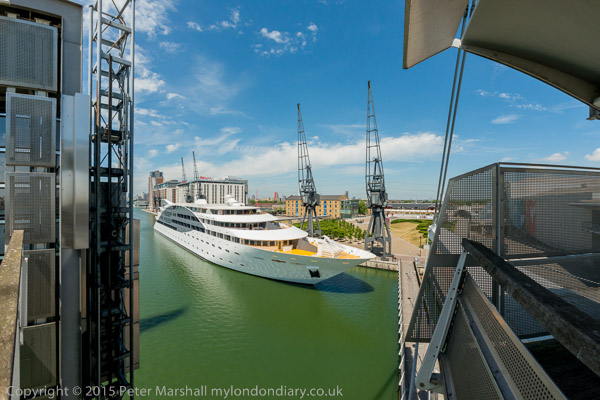
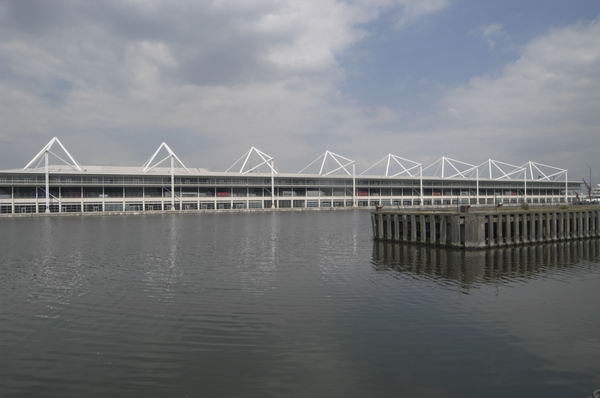
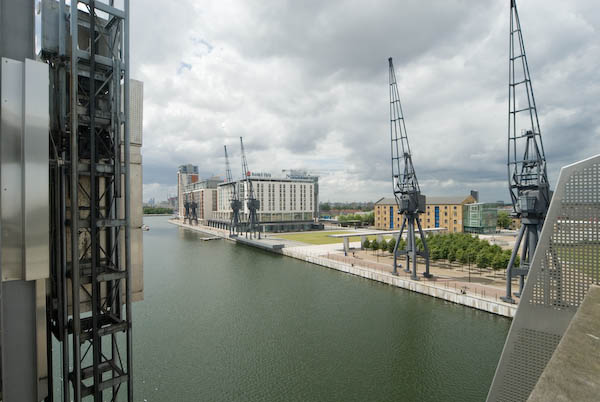
From the top of the bridge there is a splendid view in all directions. Starting at the ExCeL centre and moving clockwise we see:

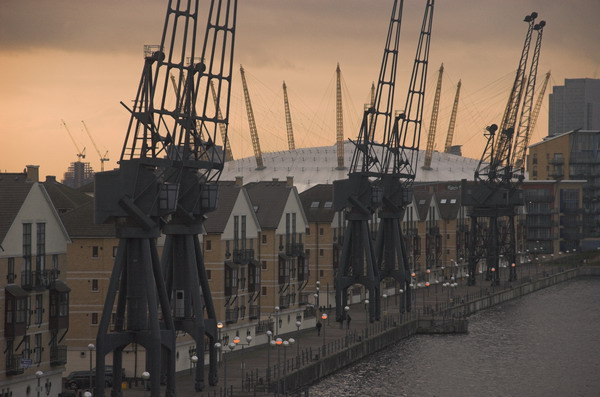
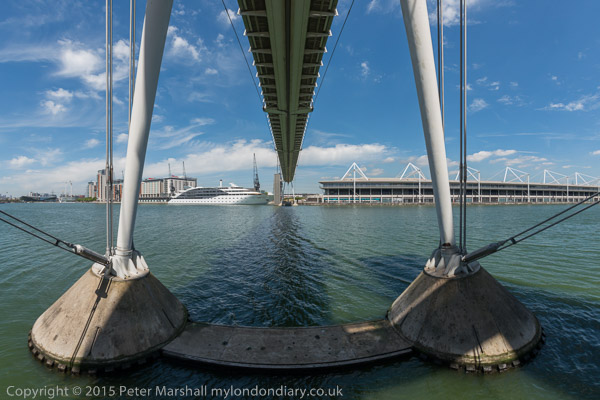
  • ExCel, standing for Exhibition Centre London. This was an LDDC idea, but not completed and opened until 2000. It has attracted many hotels to the area – including the floating Sunborn Yacht hotel.
Canning Town Walk (2007): 7 Royal Victoria Docks from the footbridge
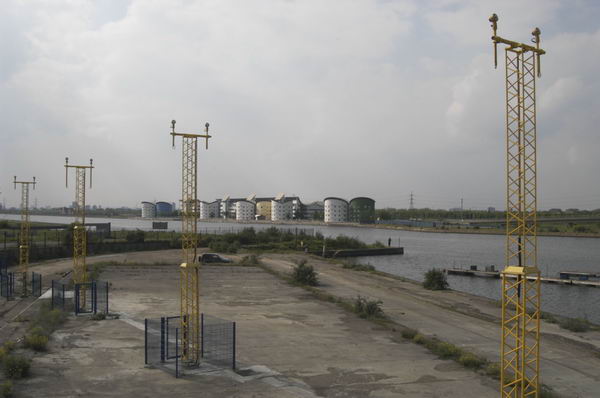
  • In the distance, you can see East London University, one of the developments on the Royal Albert Dock, which is worth a visit of its own, particularly for the group of cylindrical student residences, looking rather like oil storage tanks.
Canning Town Walk (2007): 7 Royal Victoria Docks from the footbridge
  • East London University and flight path beacons for City Airport, King George V Dock, North Woolwich
Canning Town Walk (2007): 7 Royal Victoria Docks from the footbridge
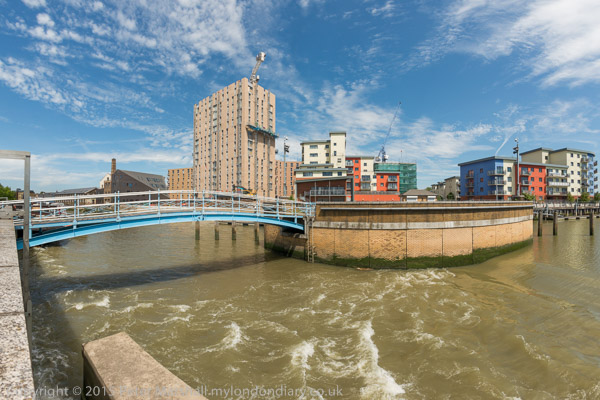
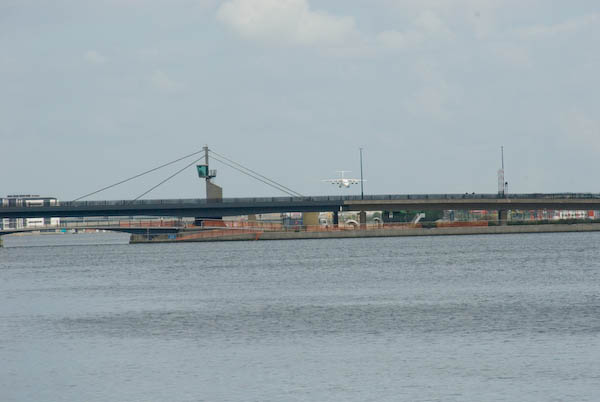
  • Closer than that, spanning the area and separating the Royal Victoria Docks from the two later Royal Albert and King George V docks is the Connaught Crossing, completed in 1990.
Canning Town Walk (2007): 7 Royal Victoria Docks from the footbridge
Millennium Mills and Eastern Quay
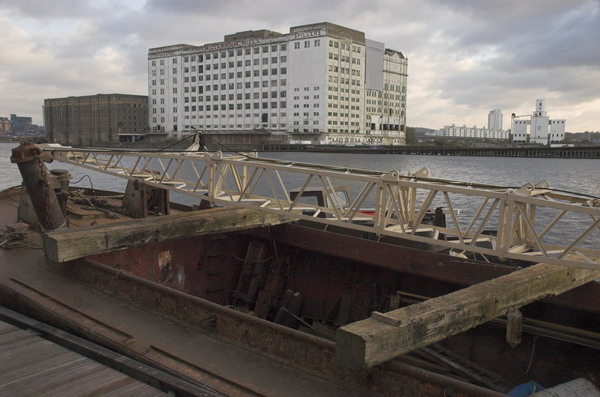
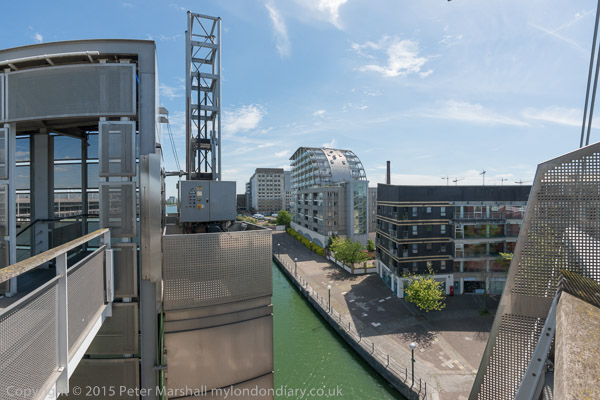
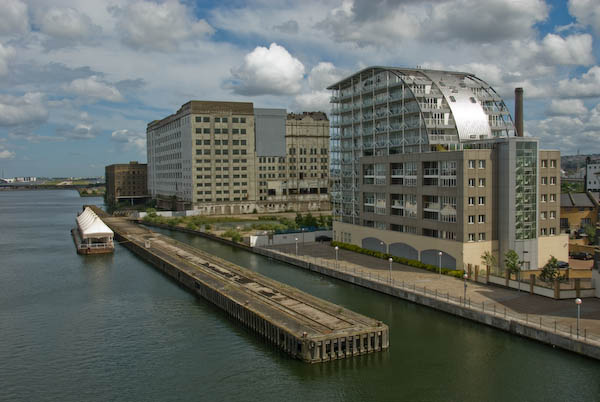
  • The large area on the right of the dock, including the area of water off from the main dock and the large bulk of Millennium Mills (built for Spillers flour in 1933) is the Silvertown Quays site, a £1.5 billion development that got planning permission in May 2007. This includes conversion of the mills into flats, 5,000 new homes, various community facilities, a lively town centre for Silvertown and the Biota! Project, a large aquarium designed by Terry Farrell & Partners for London Zoo. (though we don’t expect it to be anything like as good as The Deep in Hull!)
  • Close to the bridge is Eastern Quay (2003 Gardner Stewart Architects), constructed with a steel frame and is one of the first residential apartment blocks in the United Kingdom to have fully-glazed exterior walls. It uses advanced glazing technology to stop residents getting fried.

The large development, mainly of fairly small houses is Brittania Village, which began in 1994 with a Peabody development of 85 homes. The LDDC then made a deal with Wimpey for 777 more, along with some limited community facilities, including a primary school, in 1995. The area was completed with a few more Peabody trust and East Thames Housing Group properties.

Canning Town Walk (2007): 7 Royal Victoria Docks from the footbridge

Walk or take the lift down to dock level at the south end of the bridge, and walk through the arch at the centre of the semi-circular ring of shops.

Here there is a plaque marking the opening of the West Silvertown Urban Village by the government minister Selwyn Gummer in 1996.

Turn left and then right at the roundabout with a tall chimney and walk down Mill Road to the main road (North Woolwich Road.)

The large chimney in the middle of the roundabout dates from the 1930s. At the southern end of Mill Road are some workers cottages which appear to date from around 1900.

Cross the main road to the south side, taking great care. A suitably placed pedestrian crossing is only in planning application stage! [There is now a light-controlled crossing for pedestrians and cyclists.]

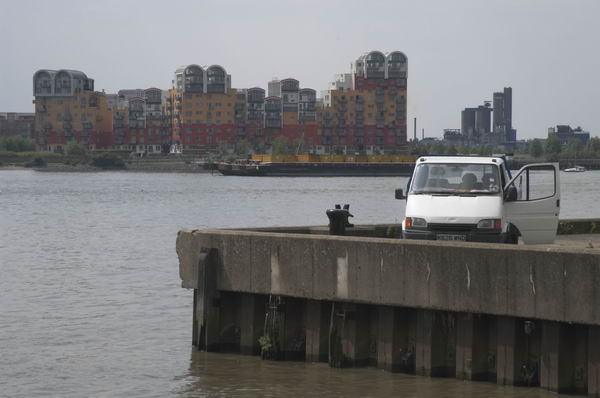
If you have plenty of time, you might like to make a detour to Lyle Park at this point, off Bradfield Road, a couple of hundred yards to the east. The park was presented to West Ham by Abraham Lyle & Son in 1924 and contains the fine metal gates from Harland & Wolff Ltd, ship builders, ship repairers and engineers in Woolwich Manor Way, Beckton from 1924-1972 (their actual shipyards were in Belfast and Govan.) The park also provides good views across the Thames to Greenwich Millenium Village and elsewhere.
Canning Town Walk (2007): 7 Royal Victoria Docks from the footbridge

This walk will continue in a later post with Part 8: North Woolwich Road.


You can read the whole document as I published it in 2007 beginning here and see more pictures I took in 2007 on My London Diary at canning town, victoria dock, silvertown west.


FlickrFacebookMy London DiaryHull PhotosLea ValleyParis
London’s Industrial HeritageLondon Photos

All photographs on this page are copyright © Peter Marshall.
Contact me to buy prints or licence to reproduce.
Canning Town Walk (2007): 6

6 Excel and Royal Victoria Square

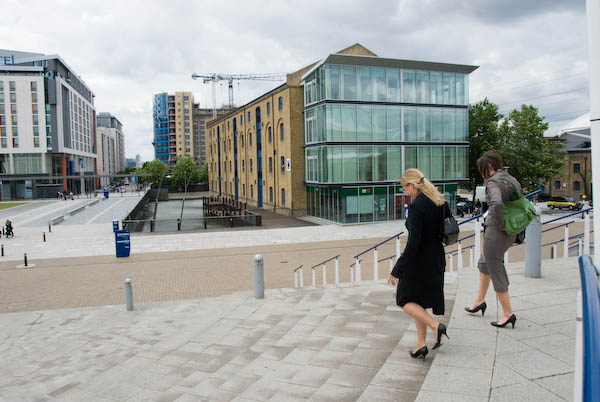
Walk along the covered walkway leading to the ExCeLcentre, passing some Victorian dock buildings on your right. At ExCeL, go to your right and down into the open square.

Canning Town Walk (2007): 6

6 Excel and Royal Victoria Square

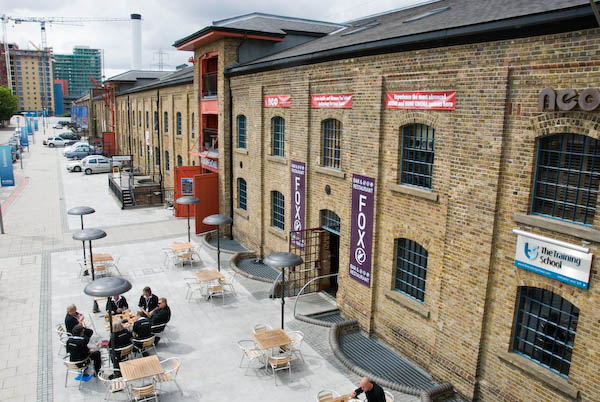
On our right is a range of dock buildings, K Warehouse, built 1859, used for some years as a store for the Museum of London and now housing a restaurant. On our left is the ExCeL centre (Exhibition Centre London) used for various conferences and business events. [Including controversially every two years DSEi, the worlds largest arms fair, which attracts many protests.]

Canning Town Walk (2007): 6

6 Excel and Royal Victoria Square

W warehouse from 1883 was originally more or less on the dockside, which had a number of wide jetties coming out from it towards the centre of the main dock, more or less as far as the current waterline. Ships were moored on each side of these for loading and unloading. Probably most of the buildings on these were fairly simple and temporary, and the number of these bays changed over the years. The docks were given an extensive makeover in the 1930s and 40s, and also needed considerable work to repair war damage.

In later years, these jetties were removed and the dock narrowed, with larger warehouses by its edge.

The Royal Docks were at their busiest around 1960, but the decline after this was rapid. Cargo handling methods were rapidly changing, with containerisation and bulk handling techniques, and ships were getting larger.

Considerable investment was needed and the PLA rightly decided to make this at Tilbury. Traffic congestion was a major problem at the Royals (the 1930’s road improvements linked into London’s congested road system) while Tilbury had the prospect of excellent connections to the M25 and the rest of the expanding motorway system. It was also closer to the sea, and avoided a longer journey through relatively narrow channels upriver, with greater tidal limitations.

Weighbridge office, King George V Dock, Royal Albert Dock, Newham, 1984 84-7l-25

The Royal Docks closed in 1981, and a year or two later I photographed them as a ghost town. There were abandoned offices with half-drunk cups of tea, cobwebbed jackets hanging on hooks, paperwork and rubber stamps left on desks. [There are many pictures from that project on Flickr, in the albums 1984 London Photographs and 1984 Docklands Colour. I also published pictures from the project as The Deserted Royals and you can view an extensive preview online.]

Royal Victoria Square was developed by the GLA’s London Development Agency and opened by Ken Livingstone in 2001. It cost £3.5million. The fountains are apparently quite nice should they ever be working. Computer controlled and coloured by fibre optics to give a wave effect. Apparently.

Canning Town Walk (2007): 6

6 Excel and Royal Victoria Square

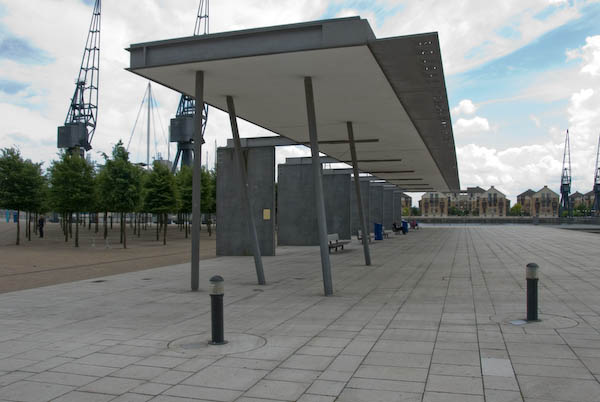
The square is at its best in bright sun, when the shadows of the closely planted trees create interesting effects, and the dark stone contrasts with the light paving. It is a pleasant place to sit and relax, although the modern hotel buildings hardly add to that pleasure.

Canning Town Walk (2007): 6

6 Excel and Royal Victoria Square

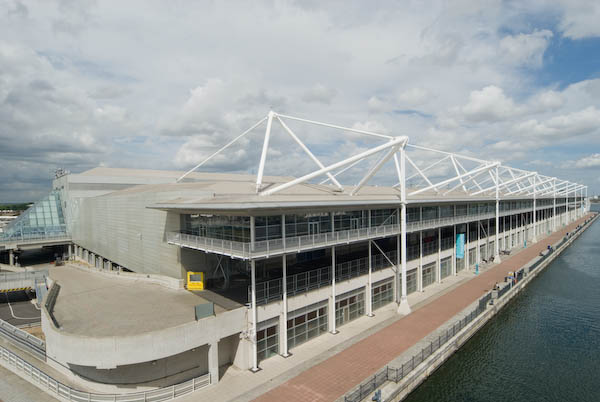
The ExCeL centre also looks better in sun, which adds shadows from its external spars, as well as a glow from its white surfaces, and brings out its geometries. The idea came from the LDDC, but it was not completed and opened until 2000. Its presence has attracted many hotels to the area – including the floating Sunborn Yacht hotel.

Walk down to the dockside, where deck hangs out over the water for a view of the bridge.

Canning Town Walk (2007): 6

6 Excel and Royal Victoria Square

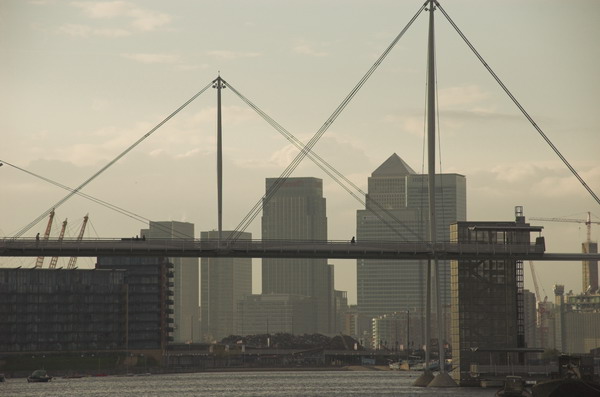
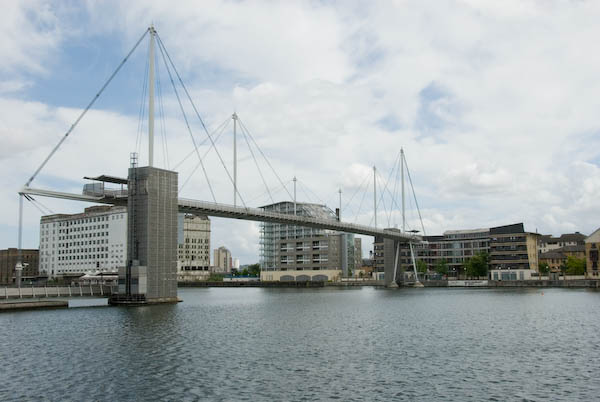
The bridge was designed by Lifschultz Davidson as a very slender structure, representing the sailing heritage of the dock, and cost £3.9 million. Six masts support the bridge varying from almost 30m at one end to 10.6m at the middle. Originally there had been talk of a transporter bridge, but this is I think both more elegant and more practical. While the docks were in use, there was a ferry service across the dock at this location.

Walk to the bridge and go to the high level either by the steps or lift.*

This walk continues in a later post with Part 7: Royal Victoria Dock from the footbridge.


[* You may find the footbridge is closed or the lifts are not working. If you cannot access the bridge you can continue the walk by walking on the dockside path around the west end of the dock.]


You can read the whole document as I published it in 2007 beginning here and see more pictures I took in 2007 on My London Diary at canning town, victoria dock, silvertown west.


FlickrFacebookMy London DiaryHull PhotosLea ValleyParis
London’s Industrial HeritageLondon Photos

All photographs on this page are copyright © Peter Marshall.
Contact me to buy prints or licence to reproduce.

1994 London Colour – City, Limehouse & Canning Town

1994 London Colour – City, Limehouse & Canning Town: More of my colour pictures made in July or the start of August 1994, in the City of London, Limehouse and at the Royal Victoria Dock in Canning Town.

Red Chairs, London, 1994, 94-722-51

I can no longer remember where I saw this circle of chairs, left after a celebration of some kind. Reflected in the background I can see myself looking in, probably from one of the highwalks in the City, with a whole range of buildings behind me, none of which I can immediately recognise. I am standing in sunlight, which shines on the foreground chairs, but the back of the room is in fluorescent lighting, giving it an unnatural blued-green tint. A single empty glass on the decorated table and a stubbed out cigarette on the floor remain from the earlier gathering.

Fleet Place, City, 1994, 94-722-26

Fleet Place is immediately east of City Thameslink Station and this is one of London’s private pedestrian areas – like Broadgate and Canary Wharf – where various activities, including photography are not permitted.

Fleet Place, City, 1994, 94-723-61

I took a few pictures in Fleet Place on several occasions but was usually then approached by the private security men and told that photography was not allowed. But I generally work fairly quickly, though using the panoramic camera is rather slower than a normal camera as it needs careful levelling. But usually by the time I was told I could not take photographs I had already done so and was happy to leave the premises. But I think I took this in rather a hurry and underexposed it – perhaps seeing the man approaching.

Demolition, Tower Block, Limehouse, Tower Hamlets, 1994, 94-803-43

A skeleton around the spine of a tower block in Limehouse, with the wall paper and paint of the flats that were once attached.

Car Sales, Royal Navy, pub, Salmon Lane, Limehouse, Tower Hamlets, 1994, 94-803-44
Car Sales, Royal Navy, pub, 53 Salmon Lane, Limehouse, Tower Hamlets, 1994, 94-803-44

Car sales and the typical bunting around them on the corner of Condor Street aand Salmon Lane. The Royal Navy pub at 53 Salmon Lane was open by 1856 but closed permanently in 1999 and was converted into flats four years later.

Tidal Basin Pumping Station, Tidal Basin Rd, Canning Town, Newham, 1994, 94-803-51

The Tidal Basin Pumping Station designed by Richard Rogers and built in 1998 is one of the three pumping stations that prevent the former marshy areas to the north of the Royal Docks from flooding, pumping out surface water into the Thames, allowing their redevelopment by the LDDC. It was built in a colourful post-modern fashion in a deliberate attempt to provide a colourful accent in the area.

Warehouses, Royal Victoria Dock, Canning Town, Newham, 1994, 94-723-25

The part of the dock in the left foreground has now been built over, but six cranes remain on the dockside.

Royal Victoria Dock, Canning Town, Newham , 1994, 94-803-61
Royal Victoria Dock, Canning Town, Newham, 1994, 94-803-61

Spillers Millenium Mills were “designed and built by millers William Vernon & Sons of West Float, Birkenhead in 1905” and were the last of the large mills built on the dock, following those of the Cooperative Wholesale Society and Joseph Rank. All the mills were damaged by the 1917 Silvertown explosion. Spillers took over the mill in 1920 and rebuilt it “as a 10-storey concrete art deco building in 1933.” Badly damaged by bombing it was again rebuilt after the war, reopening in 1953. The dock closed in 1981, and the other buildings in the picture have since been demolished.


FlickrFacebookMy London DiaryHull PhotosLea ValleyParis
London’s Industrial HeritageLondon Photos

All photographs on this page are copyright © Peter Marshall.
Contact me to buy prints or licence to reproduce.

Panoramas Around Albert & Victoria Docks – 1994

Panoramas Around Albert & Victoria Docks: More panoramas I made in July 1994 on and around the Beckton Extension of the DLR, getting off the train at each stop, taking a walk around and making a few pictures before boarding the train again

DLR, Roundabout, Royal Albert Way, West Beckton, Newham, 1994, 94-718-33

One of the few pictures I made with a deliberate tilt of the camera in order to get the whole circle of the roundabout in the image. As you can see this results in a curved horizon.

DLR, Albert Dock, West Beckton, Newham, 1994, 94-719-11

The DLR stations on the elevated line often provided a useful viewpoint. Along the horizon here at left you can see the church at Silvertown, then the Silvertown Flyover. Around the centre are the mills on Royal Victoria Dock, then the more distant Canary Wharf and past that the Grade II listed 1881 Connaught Tavern. At right is the Compressor House, built in 1914 as a cold store for the dock.

DLR, Albert Dock, West Beckton, Newham, 1994, 94-721-22

A view through the front window of a DLR train which shows the Compressor House next to the Royal Albert Dock Station and the long stretch of the Royal Albert Dock. At the left are the houses of West Beckton. At right is London City Airport with a couple of planes.

DLR, Connaught Crossing,  Custom House, Newham, 1994, 94-721-42
DLR, Connaught Crossing, Custom House, Newham, 1994, 94-721-42

A view from the side of the train as it goes across Connaught Road looking over the recently built cable stayed swing bridge with reinforced concrete approach viaducts, opened around 1990. It replaced an earlier swing bridge built in 1904 to carry both the road and the North Woolwich Railway across the Connaught Passage between the Royal Victoria and Royal Albert Docks. The small octagonal building to the left of the bridge pumps water from the Connaught Tunnel, originally by hydraulic pumps but now by electric pumps. This was replaced by a larger circular structure when the tunnel was rebuilt for the Crossrail.

DLR, Victoria Dock Rd, Canning Town, Newham, 1994, 94-718-53

The DLR line runs beside Victoria Dock Road and this picture was made from Custom House Station and shows the junction with Freemasons Rd. Further along Victoria Dock Road you can see The Missions to Seaman Institute, Flying Angel House, built in red-brick Art Deco style in 1936. It closed in 1973 and after being used for some time as a college was converted into flats.

Royal Victoria Dock, Canning Town, Newham, 1994, 94-718-41

The western end of Royal Victoria Dock which closed in 1981. This picture was taken roughlky from where the cable car ride now has its northern terminal. The dockside sheds have been replaced by tall waterside blocks – around 17 storeys. There are still some of the old cranes on the quayside.

More panoramas from 1994 to follow.


FlickrFacebookMy London DiaryHull PhotosLea ValleyParis
London’s Industrial HeritageLondon Photos

All photographs on this page are copyright © Peter Marshall.
Contact me to buy prints or licence to reproduce.

DSEI March and a Tank – 2007

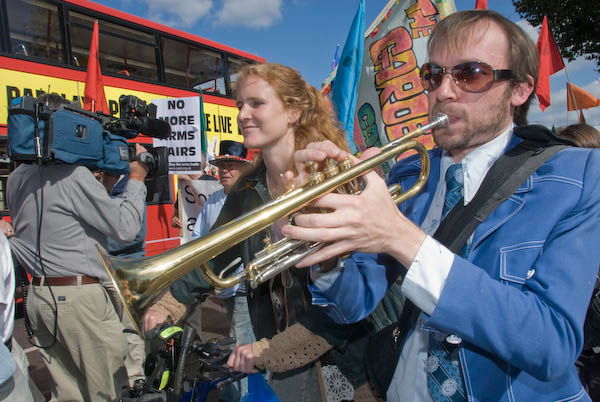
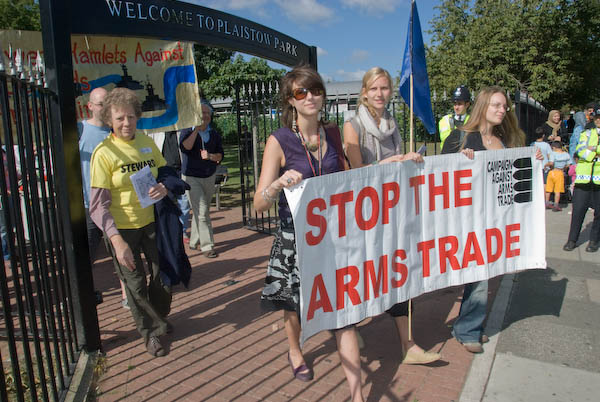
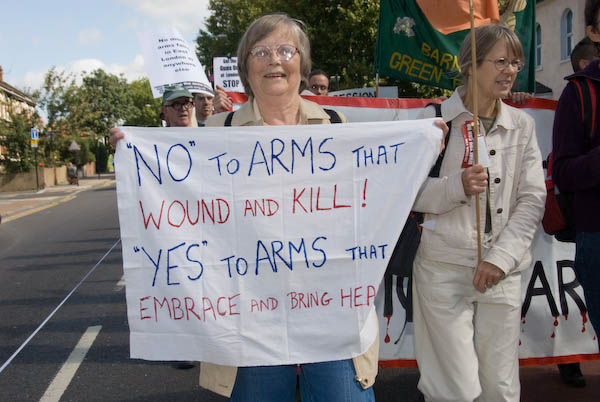
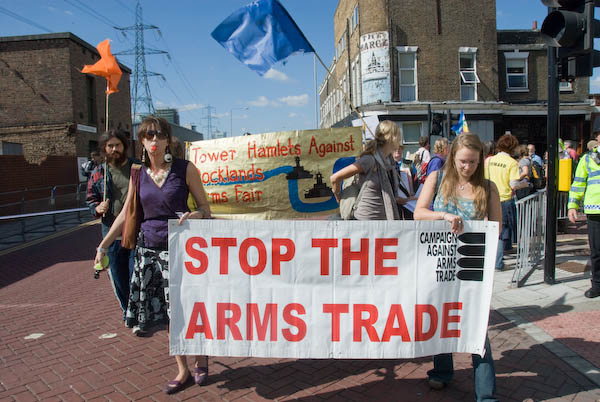
DSEI March and a Tank: On Tuesday 11th September 2007 I marched with protesters from Plaistow Park to Custom House were the largest arms fair in the world was being held, – it is still held every two years and is again taking place now. Then I went to the main entrance by the side of the Royal Victoria Dock to welcome the Space Hijackers, “an international band of anarchitects” who had promised to come with a tank to sell it at the fair as a protest.

DSEI March and a Tank - 2007
Over 150 people marched from Plaistow Park to Custom House

Here, with some minor corrections, is what I wrote about the day’s events back in 2007, along with some of the pictures I took and links to where you can see more of my pictures on My London Diary.


CAAT March Against DSEi East London Arms Fair

DSEI March and a Tank - 2007 CAAT March Against DSEi East London Arms Fair

One of the more scandalous events to take place in London is the DSEI (Defence Systems & Equipment International Exhibition) arms fair, held every two years since 2001 at the Excel Centre on the side of the Royal Victoria Dock in Newham.

DSEI March and a Tank - 2007

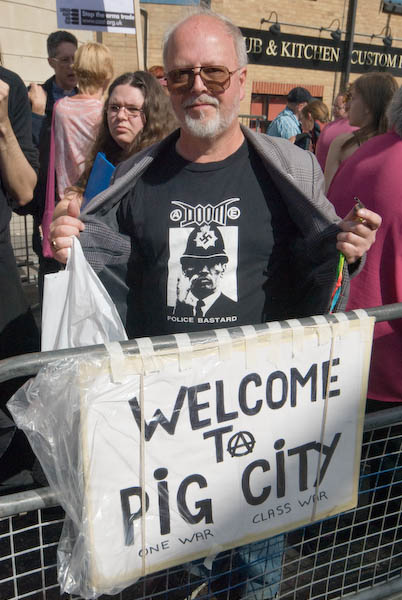
Even if you are not a pacifist (and I’m not) it is a trade that has its sickening side, with arms sales to corrupt regimes who use them to kill, torture and deny human rights to their own people, as well as endless shady deals by arms dealers that end up with weapons traded there in the hands of criminals around the world – including some used on the streets of this country.

DSEI March and a Tank - 2007

Britain also has a thriving business in implements of torture, which have been exposed as on sale in earlier shows here. The show also features all the other kinds of nasty devices used by police forces around the world to keep corrupt governments in power.

Of course our government claims to have an ethical policy so far as arms sales are concerned, but in reality it is more about making deals look clean on paper than really worrying about where the arms will end up and what they will be used for. DSEI isn’t just a UK show, it is the world’s largest arms fair – the 2005 show had over 1200 exhibitors from 35 countries present.

DSEI March and a Tank - 2007

The Campaign Against Arms Trade (CAAT) organised a peaceful protest against the fair with a march through Newham from Plaistow Park to a rally outside Custom House Station, as close as they were allowed to get to the Excel Centre. Around 150 people walked the 2 miles to the rally where they met around 50 others who had travelled there directly, and later they were joined by a group of ‘Critical Mass’ cyclists.

Unfortunately the police set up a long thin pen along the side of the road opposite the station, and would not allow speakers to use the small cycle-towed sound system. So the demonstrators were too spread out for many to hear the speeches, by local residents Len Aldis and Bill Perry, local councillor Alan Craig, Green Party Mayoral Candidate Sian Berry, CAAT’s Ian Prichard and comedian Mark Thomas.

DSEI March and a Tank - 2007

The DSEI causes major disruption to the area, with millions spent on extra policing and a number of roads and paths being closed – including the very useful high-level bridge across the dock itself. But the very minor inconvenience of a slightly louder amplification for a few minutes was apparently out of the question. It was a decision that clearly indicated police priorities.

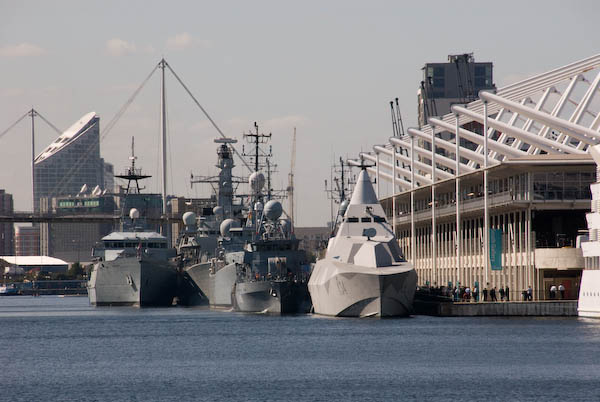
Normally the Royal Victoria dockside is open to the public, but this week the whole northern side was off limits as I found. I took a walk past the eastern end of the dock and then around to the dockside at Brittania Village to get a view of the Excel Centre and the military vessels moored alongside, including a Swedish Stealth Corvette, with odd profiles and jagged camouflage designed to reduce its visibility and radar and other profiles.

More pictures at CAAT March Against the Arms Fair

Space Hijackers Auction Tank at Arms Fair

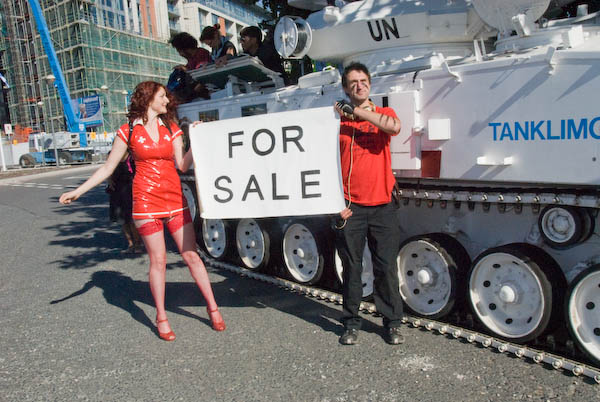
The ‘tank’ makes its way down Tidal Basin Road to the ExCeL entrance

I was slowly making my way around the the Tidal Dock Basin Road which leads to the main vehicle entrance to Excel. The Space Hijackers had announced they would be bringing a tank to the fair, and this seemed to be the likely route they would take.

Police had earlier stopped their actual tank almost as soon as it hit the road for some so-called ‘road safety checks’, but the Space Hijackers had tank number 2 in reserve. I think it was strictly a converted Armoured Personnel Carrier, but still a very impressive vehicle. I was pleased to find my guess was right when it made its way down the road, led by someone on a bicycle.

No surprise, the police wouldn’t let it into the arms fair, but it was allowed to park by the side of the entrance and a party and auction took place.

When people began to leave the arms fair, the protesters were able to make a very visible and audible protest as they drove slowly by. At one stage the police helped by blocking the traffic for a while so they could get a better view of the protest.

Generally the police were unnecessarily restrictive, penning the protesters to one side of the road, and harassing press. That isn’t a genuine press pass one said when I showed my NUJ issued press card [from the UK Press Card Authority Ltd and recognised by the National Police Chiefs’ Council as showing me “a bona fide newsgatherer” who were trying to stop me doing my job], threatening me with arrest unless I got back behind the line of police.

The police FIT team did its usual best to stoke up the atmosphere with their intimidatory tactics – certainly something that gives photographers a bad name. It is hard to believe that those hundreds (probably by now thousands) of pictures they have of me – mainly with a camera obscuring my face – are of any great use in protection national security. [Later when I made a ‘Freedom of Information’ request they denied having a single image of me.]

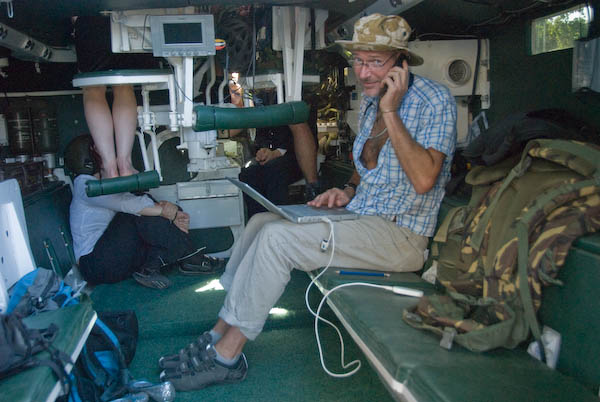
Communications centre inside the ‘tank’

I’m not worried about being photographed – my appearance is pretty much public property since until recently a picture of me was viewed around a million times a month on the commercial site I used to write for.

I stayed until the tank had been auctioned, with some interesting bids but then had to leave to attend a meeting where my presence was vital. I was rather annoyed at having to walk an extra half mile or so to the station when police refused to let anyone use the direct route. There was really no reason or logic for this kind of minor harassment.


You can see much more about the event and also read more comments on the police harassment of journalists on My London Diary at space hijackers auction tank at dsei.


FlickrFacebookMy London DiaryHull PhotosLea ValleyParis
London’s Industrial HeritageLondon Photos

All photographs on this page are copyright © Peter Marshall.
Contact me to buy prints or licence to reproduce.

1995 Colour – Poplar, Bow, Leyton, North Woolwich & Silvertown

Poplar, Bow, Leyton, North Woolwich & Silvertown: These pictures come from a number of visits to areas of London working on several different projects and are my final selection of colour panoramas made in 1995. There are a few more colour images, including some panoramas I made in 1995 in the images in the Flickr album as well as many I have not digitised; some very similar to those online, others that I now find of less interest. Some of these were taken as a part of my project on the Greenwich Meridian in London – you can see a set of 16 images from this on the urban landscape web site.

Bow Locks, River Lea, Bow Creek, Bow, Tower Hamlets, 1995, 95p4-752

Bow Locks separate the tidal River Lea from the Lea Navigation and the Limehouse Cut which offers an alternative route to the Thames to avoid the winding and dangerous Bow Creek. First built in 1850 they were remodelled in 1930. At the highest Spring tides water from Bow Creek would overtop the locks and raise the level of the canals here – the locks were modified in 2000 to stop this and avoid the silting it caused.

London Galvanizers, Leven Rd, Poplar, Tower Hamlets, 5p4-743
London Galvanizers, Leven Rd, Poplar, Tower Hamlets, 95p4-743

The Poplar Gas Coompany built a local gas works here in the 1820s at the request of the Poplar Vestry after ratepayers lobbied them to provide gas street lighting. The site was cleared in 2011 and I was commissioned to photograph the removal of toxic earth from the site using barges on Bow Creek. Something around an eigth of the material was removed in this way, tides making the removal of more difficult. The original gasholders had to be built to special safety standards because of their proximity to the West India Dock wall. The last of the gasholders was removed in 2017.

London Galvanizers had modernised their galvanizing plant here in 1983-5 and were one of the most important jobbing galvanizers in London and the Home Counties.

Langthorne Rd, Leyton, Waltham Forest, 1995, 95p4-862

This street corner is close to the Meridian and I had stood here for some time outside the Chinese restaurant which was having some joinery work done. I liked the contrast between its orange paint and the blue on the opposite corner and the warm brown of the Birkbeck Tavern at right. I think I had made at least one exposure when a young girl in a red coat on roller skates came to see what I was doing – and I made this exposure as a red car come around, filling an otherwise rather empty grey space.

St Patrick's Catholic Cemetery, Langthorne Rd, Leyton, Waltham Forest, 1995, 95p4-841
St Patrick’s Catholic Cemetery, Langthorne Rd, Leyton, Waltham Forest, 1995, 95p4-841

The Meridian also passes through this cemetery and I chose a viewpoint which included the cemetery chapel with a fine group of monuments in the foreground, I think all for people of Italian origin.

Stratford Station, Great Eastern Rd, Stratford, 1995, 95p4-963
Stratford Station, Great Eastern Rd, Stratford, Newham,1995, 95p4-963

I’m unsure what this railway building to the east of the station was, perhaps a 1930s signal box. Parts of this area have now been redeveloped, and this has been behind fences for more than ten years and could stil be there, as least in part.

King George V Dock, Woolwich Manor Way, North Woolwich, Newham, 1995, 95p9-171

Finally four pictures from a walk along Woolwich Manor Way, this taken looking westwards along the south side of the King George V Dock. You can see the bridge over the dock entrance at right and the City Airport terminal and Canary Wharf at the end of the dock.

Royal Albert Dock Basin, Woolwich Manor Way, North Woolwich, Newham, 1995, 95p9-161

At left is the old swing bridge that took the road over the dock entrance from the basin. To its right is the elevated DLR and the pumping station at the centre of the Gallions roundabout. Further on only two buildings were standing along the side of the Basin, the Gallions Hotel and the Royal Docks Pumping Station.

Containers, Woolwich Manor Way, North Woolwich, Newham, 1995, 95p9-162

Land to the south of the Royal Albert Dock Basin just east of Woolwich Manor Way.

King George V Lock, Woolwich Manor Way, North Woolwich, Newham, 1995, 95p9-153

This swing bridge across the dock entrance is still there.

Royal Victoria Dock, Silvertown, Newham, 1995, 95p11-262

This was taken from Silvertown Way, looking across the Royal Victoria Dock. There are still cranes along the dockside here but the foreground now has flats. The Millenium Mills are still there, but there is nothing in the picture where the Excel Centre now stands and none of the other new developments on the north side of the dock. The council flats at the right have been demolished.

You can see these and some other colour pictures I took in 1995 at 1995 London Colour.


FlickrFacebookMy London DiaryHull PhotosLea ValleyParis
London’s Industrial HeritageLondon Photos

All photographs on this page are copyright © Peter Marshall.
Contact me to buy prints or licence to reproduce.


King’s Cross, Excel and a Musical Protest – 2005

King’s Cross, Excel and a Musical Protest: Like other posts in the early years of My London Diary the text and pictures from Saturday 26th November 2005 are rather hidden away and it isn’t always easy to connect pictures with text. And it had seemed at the time a good idea to write the texts all in lower case, which makes them rather difficult to read, so I now like to resurrect some of them occasionally in a more accessible manner, linking back to the original pages for more pictures than in these posts on >Re:PHOTO.

Kings Cross – never again!

King's Cross, Excel and a Musical Protest - 2005
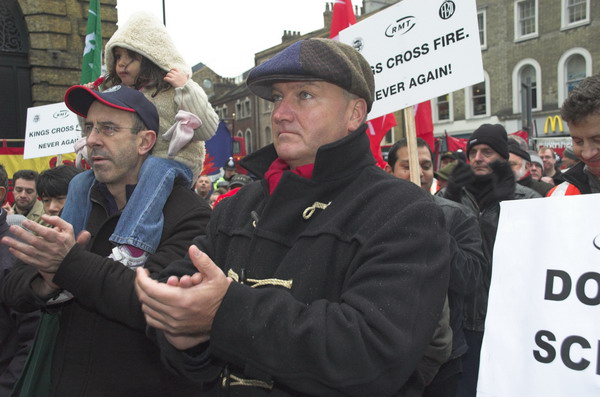
Bob Crow (RMT), right, applauds a speaker

As I walked up the escalator (yes, I was late again) at King’s Cross I remembered the interviews with those who had been caught there in the terrible fire, thinking how hard it would be to find the way out in smoke-filled darkness. Parts of the station still look a terrible mess, though that’s not unusual in our underground system.

King's Cross, Excel and a Musical Protest - 2005

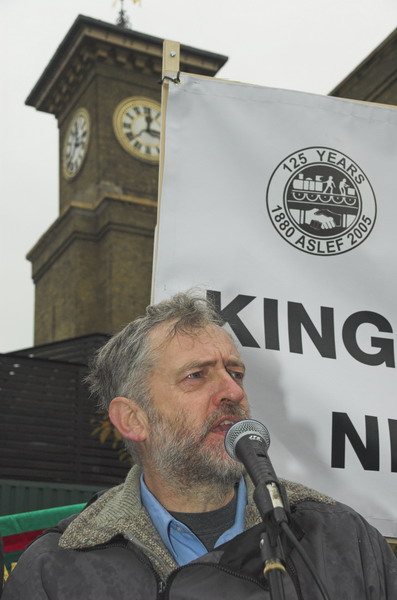
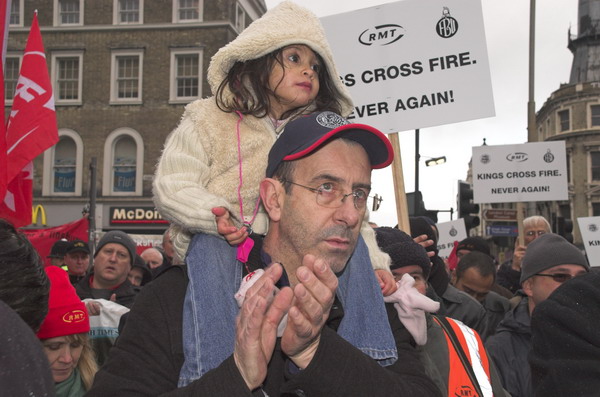
Up at ground level was a joint trades union demonstration in memory of the fire, and to defend the safety rules which are currently under attack by management wanting to save costs. Kings Cross – Never Again! was address by a number of speakers including Mick Connolly, John Mcdonnell MP Jeremy Corbyn MP, Keith Norman (ASLEF), Matt Wrack (FBU), and Bob Crow (RMT), all worried by the threat to the public and those who work on the Underground or in rescue services.

King's Cross, Excel and a Musical Protest - 2005
Islington MP Jeremy Corbyn

Proper safety procedures are particularly vital when as well as accidental disasters such as the King’s Cross fire, the safety of the system is also threatened by deliberate terrorist attacks.

King's Cross, Excel and a Musical Protest - 2005

I’d hoped the event would end in time for me to get to a lecture at the ICA, but it was too late. I went that way just the same, getting off the tube at Charing Cross and walking down Whitehall to Westminster station for the Jubilee Line, past the Cenotaph, surrounded now by a low fence. It was still covered by the wreaths of poppies from earlier in the month, now partly covered by the falling leaves from the many London plane trees, another and in some ways more touching symbol of loss.

More pictures from Kings Cross – never again!


Excel and Victoria Dock

Victoria Dock, Spillers Millennium Mills and Pontoon Dock, with new Riverside Flats in distance, Silvertown, London.

It was an afternoon of low winter sun, and stormy showers, with impressive clouds in the wide open skies over the expanse of the Royal Docks, and some peculiar colours. The demonstration I’d gone to see was nowhere to be found when I arrived, and I wandered the dock estate marvelling in the views.

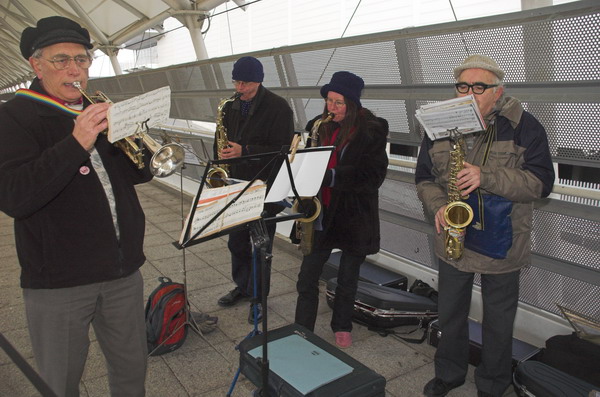
In particular the high-level bridge over the dock is one of new London’s more spectacular sights, and a fine viewing platform. Unlike the last time I visited, the lifts were working too. A small group of people with musical instruments began to gather on the top, but they turned out only to be a band coming for a photo session.

More pictures from Excel and Victoria Dock.


East London Against the Arms Trade

Musicians from ‘East London Against the Arms Fair’ treat visitors to the Excel centre to a musical welcome

I’d more or less given up and decided to go home at that point when in the distance I heard the brassy notes of the Red Flag, and made my way towards them. By the time I’d arrived at the entrance to the Excel Centre, they were into the Internationale, complete with new words for the occasion (except that no-one was singing them, and I didn’t fancy a solo role):

We are told that profit from the arms fair will
trickle down all over town,
But it’s killing our sisters and our brothers,
it’s their blood that is trickling down.

All people now rally!
No arms fair any place!
The Intenationale unites the human race!

Next came the Cutty Wren, a song from the Peasant’s Revolt, which took my mind back to Fobbing where I’d been ten days earlier.

The Excel centre has hosted several arms fairs which have attracted a number of protests from local groups. One of the local papers, the Newham Recorder, found in a poll that 79% of local residents oppose them, and London Mayor Ken Livingstone has also voiced his opposition. Further arms fairs are already booked for 2007, 2009 and 2011 and the musical protest was one of a number of actions attempting to get the Excel centre to cancel these future events.

More pictures at East London Against the Arms Trade.

And I returned in those later years to photograph many protests agains the arms fairs – and you can find pictures of them on various September pages on My London Dairy.


FlickrFacebookMy London DiaryHull PhotosLea ValleyParis
London’s Industrial HeritageLondon Photos

All photographs on this page are copyright © Peter Marshall.
Contact me to buy prints or licence to reproduce.


Stop The London Arms Fair – 2017

Stop The London Arms Fair: On Wednesday 6th September 2017 I was with protesters who were blocking the two roads leading to the Excel Centre on the side of the Royal Victoria Dock in Custom House, Newham.

Stop The London Arms Fair

Every two years the DSEI, the Defence & Security Equipment International exhibition takes place at the Excel Centre. This is the world’s largest arms fair, backed by the UK government , where arms companies and arms dealers sell weapons to countries around the world including many repressive regimes. The previous show in 2015 was found to be featuring numerous weapons prohibited under international laws.

Stop The London Arms Fair

The show has been condemned by the Mayor of London, Newham Council and the people who live in this area of East London, but still goes on. It came to the Excel Centre in 2001 and there have been protests against it since then, organised by Campaign Against Arms Trade (CAAT) and many other groups.

Stop The London Arms Fair

Wikipedia quotes London Mayor Sadiq Khan in 2019: “London is a global city, which is home to individuals who have fled conflict and suffered as a consequence of arms and weapons like those exhibited at DSEI. In order to represent Londoners’ interests, I will take any opportunity available to prevent this event from taking place at the Royal Docks in future years.” Unfortunately he has had no success, and the 2025 show is already being advertised.

Stop The London Arms Fair

CAAT point out that among those official military and security delegations coming to the show are many from human rights abusing regimes including Egypt, the UAE, Democratic Republic of Congo. Arms sales to Saudi Arabia taking a major role in the war in Yemen by UK firms have been £1.9billion since the start of 2021, and overall sales to the coalition since the start of the war in 2015 have been around £18 billion.

Again Wikipeda states that “Amnesty International has criticised the event for selling weapons of torture and for providing weapons that have been traced to attacks on civilians.” You can still see their page on the 2015 arms fair, including a video . And in 2021 they found a company at the fair offering “waist chains and cuffs with leg cuffs“.

Protests at the Excel Centre in 2017 had begun on Monday 4th September when a protest camp was set up close to the Excel Centre. I’d gone there the following day to photograph ‘No Faith In War‘, a series of events organised by various faith groups.

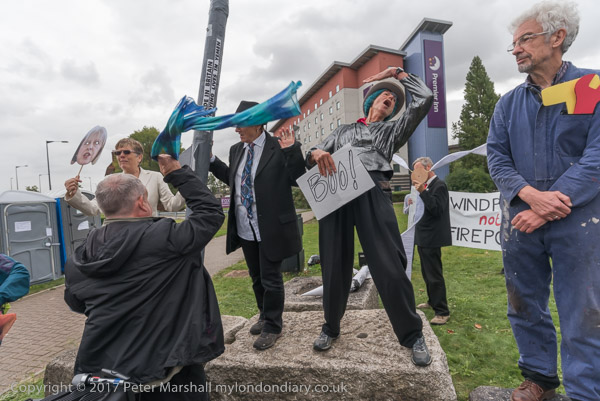
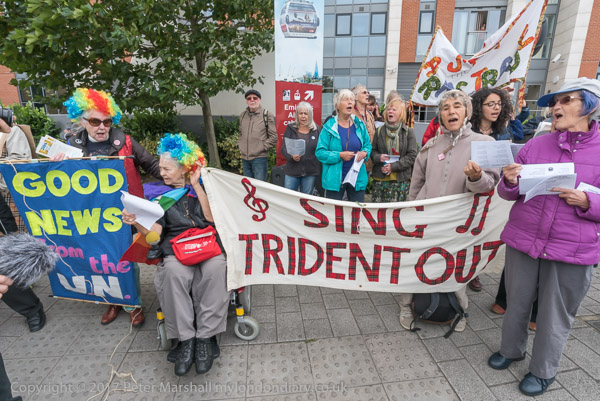
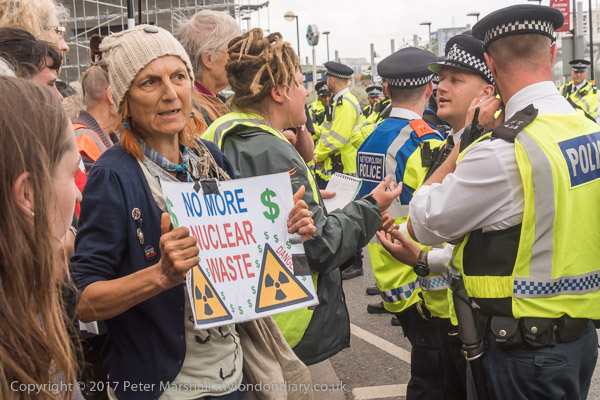
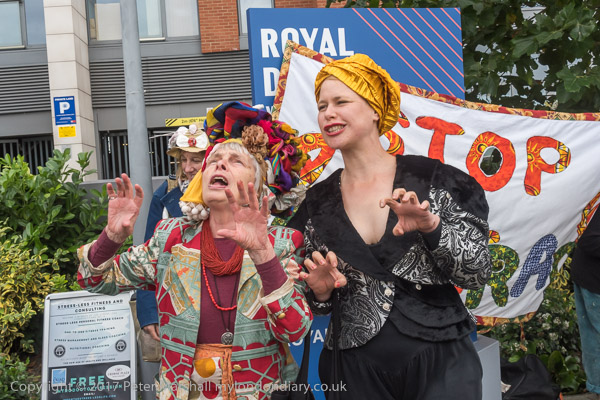
I had returned on Wednesday 6th September when the protest theme was ‘Arms to Renewables – No to Nuclear‘ and there was music, singing, dancing, a free ‘bring and share’ picnic and a short theatrical performance urging that instead of arms industry and huge spending on Trident and on wars we should rather provide jobs in renewable energy technologies and spend the military budget on homes, schools, health and other social benefits.

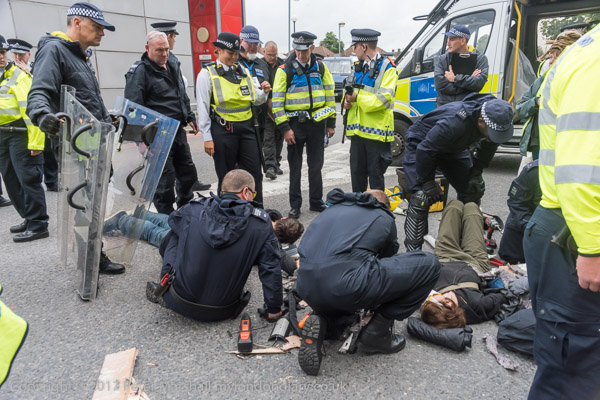
During the day their were a series of lengthy lock-ons on the roads at both East and West gates blocking access to London’s ExCeL where lorries were arriving to set up the exhibition stands for arms companies. Over the six days of protests there were more than a hundred arrests – and in 2021 the Supreme Court ruled that four of those charged had a “lawful excuse” for their actions which were were “exercising their rights to free speech and assembly (under Article 10 and 11 of the European Convention on Human Rights)”.

The Supreme Court ruled that “protestors can still have a defence to a charge of wilful obstruction of the highway, even where there is a deliberate obstruction that has a real impact on other road users.” But each case had to be judged on its merits and on whether the conviction was “a proportionate response to the defendants’ actions” which in this case it was not. It seems clear to me – if not to the judge concerned – that the draconian sentences passed recently on the M25 protesters were not proportionate, and that his refusal to allow them to explain the reasons for their taking action was unlawful.

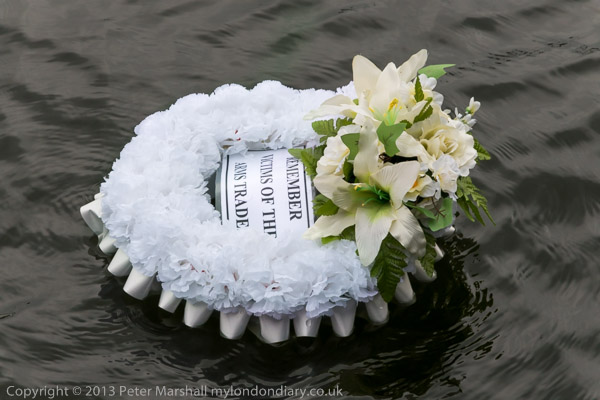
There are details and photographs of some of the events at the 2017 protests on My London Diary, including those from my later visits on the Thursday and Saturday. All the pictures here are from Wednesday 6th September. The final event on the following Tuesday when the arms show opened was a procession organised by East London Against Arms Fairs (ELAAF) carrying a white wreath with the message ‘Remember Victims of the Arms Trade’ around the Royal Victoria Dock.


No Faith in War DSEI Arms Fair protest
Protesters block DSEI arms fair entrances
Protest picnic & checkpoint at DSEI
DSEI Festival Morning at the East Gate
Festival of Resistance – DSEI West Gate
DSEI East Gate blocked
Wreath for victims of the arms trade


FlickrFacebookMy London DiaryHull PhotosLea ValleyParis
London’s Industrial HeritageLondon Photos

All photographs on this page are copyright © Peter Marshall.
Contact me to buy prints or licence to reproduce.


G4S Abuses, The Line & Barking Creek 2015

G4S Abuses, The Line & Barking Creek: My day on Thursday 4th June 2015 began with a protest outside the AGM of G4S on the UN International Day of Innocent Children Victims of Aggression, after which I took a walk around the Royal Victoria Dock looking at the three sculptures then on London’s meridian sculpture trail before going for a longer walk around Barking Creek on this fine early summer day.


G4S AGM Torture Protest, Excel Centre, Custom House

G4S Abuses, The Line & Barking Creek

I travelled out to the Royal Victoria Dock in Newham for a protest outside the Excel Centre where G4S was holding its AGM. It was the UN International Day of Innocent Children Victims of Aggression and protesters were there as G4S runs the Israeli prisons where Palestinian children are held in small underground cells in solitary confinement, often for many days.

G4S Abuses, The Line & Barking Creek

An Avaaz petition with 1,792,311 signatures had called on G4S to stop running Israeli prisons and Inminds had held regular protests outside the Victoria St head offices of the company.

G4S Abuses, The Line & Barking Creek

Some had bought shares in 2014 so they could attend the AGM and ask questions, and there were angry scenes inside the AGM as they were forcibly ejected. In 2015 there were also shareholder protesters, but security for the meeting was tight and mobile phones were prohibited and press were very definitely not allowed access.

G4S Abuses, The Line & Barking Creek

As the protest outside continued, some of those who were ejected this year came and spoke about what had happened when they tried to ask questions, and the general feeling inside the AGM, which appeared to be one of some despondency.

G4S Abuses, The Line & Barking Creek

Security at Excel made attempts to move the protesters further away from the building. Eventually a request was made to reduce the noise as there were students inside taking an exam and after some discussion the protesters moved back

G4S also runs immigration detention centres in the UK where various human rights abuses have been disclosed by reporters.

More at G4S AGM Torture Protest.


The Line – Sculpture Trail, Royal Victoria Dock

I left the protest and took the opportunity to walk across the high level bridge over the dock, taking a few pictures, and then along the path around the dock to the DLR station at Royal Victoria.

As on other occasions I found the views from the bridge stunning, and those at ground level were also interesting.

By the time I came to the first of the three sculptures on London’s sculpture trail on the Greenwich meridian the first two of these seemed extremely underwhelming. All have now been replaced by other works in a trail that regularly changes.

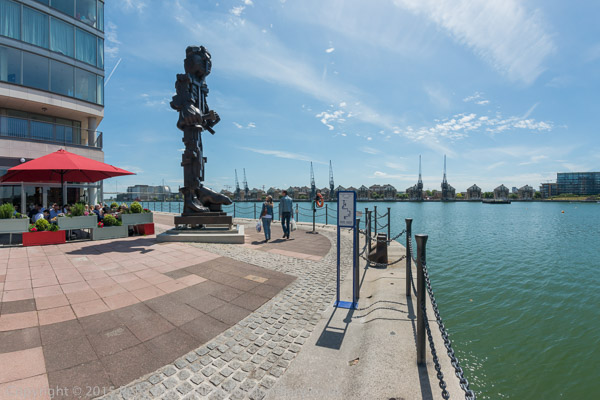
The only one I found of any interest was ‘Vulcan’ (1999), a 30ft-high bronze figure by late Scottish artist Eduardo Paolozzi, now in Edinburgh, close to his home town of Leith. You can see pictures of the other two on My London Diary.
The Line – Sculpture Trail


Barking Creek

It was a fine afternoon and I decided to return to Barking, hoping to go along the path on the west bank of Barking Creek to the hames, marked on my OS map as a traffic-free cycle route. But as in the previous year I found it fenced off and with a locked gate.

Instead I made my way north along Barking Creek, past Cuckold’s Haven to the Barking Barrage, a half tide barrier opened in 1998, going across this and returning alongside the east bank of the Creek to the A13, where I took a bus to Beckton and the DLR.

Barking in the nineteenth century claimed the world’s largest fishing fleet, with 220 commercial boats, going out into the North Sea fishing grounds, and fishing was the major industry of the town. But in the 1860s the fleet moved out to Gorleston in Suffolk and Grimsby in Lincolnshire, both much closer to the fishing grounds.

Until then the fish had been kept fresh by ice, gathered on Barking marshes in the winter and stored in large ice houses until taken out in the boat, or stored live, swimming in sea water tanks inside the boats. A fast schooner was used in the heyday to bring the catch from the fleet back to Barking so they could continue fishing for up to a couple of months. Once in Barking the fish was then well-placed for the London markets.

The coming of the railways meant that fish from Gorleston or Grimsby could be taken rapidly to London for sale, and the industry in Barking collapsed almost overnight. There are still a few boats moored on the river at Roding, but the only fishing is a few mainly elderly men sitting by the river with rod and line, who I’ve never seen getting a bite. And it would certainly be a brave man who would eat anything out of the Roding or Thames.

But fish is now coming back to Barking, or at least nearby Dagenham Dock, under a City of London Scheme, but although this has received planning permission it apparently still needs an Act of Parliament. Progress on this was halted by the dissolution of Parliament on 30 May 2024.

More pictures on My London Diary: Barking Creek.


FlickrFacebookMy London DiaryHull PhotosLea ValleyParis
London’s Industrial HeritageLondon Photos

All photographs on this page are copyright © Peter Marshall.
Contact me to buy prints or licence to reproduce.


Arms Fair, Chile & Syria – 2013

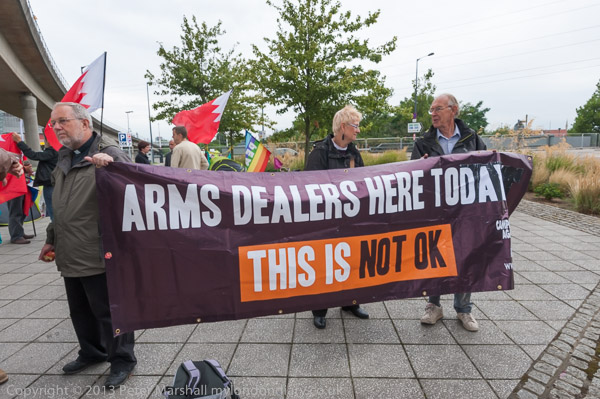
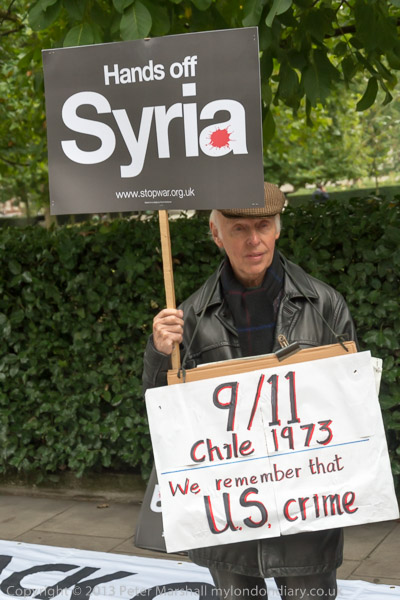
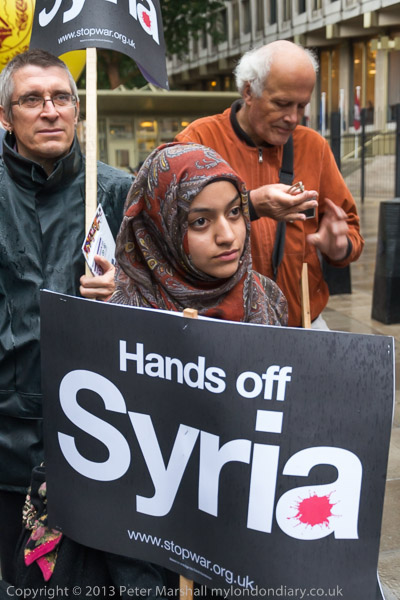
Arms Fair, Chile & Syria – On Wednesday 11th September 2013 protests were continuing against the DSEi Arms Fair, with East London Against Arms Fair floating a wreath on the dock in Front of the ExCel Centre and protesters still occupying a camp at the East Gate. But it was also the 40th anniversary of the US backed coup in Chile, rather now overshadowed by later the 9/11 events, and Stop The War protested at the US Embassy against any military intervention in Syria.


Wreath for Victims of London Arms Fair – Royal Victoria Dock

Arms Fair, Chile & Syria

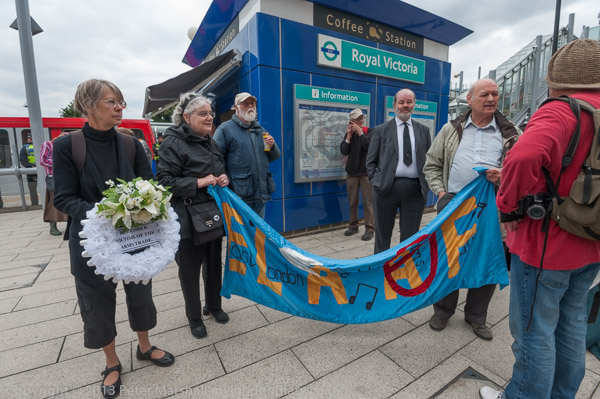
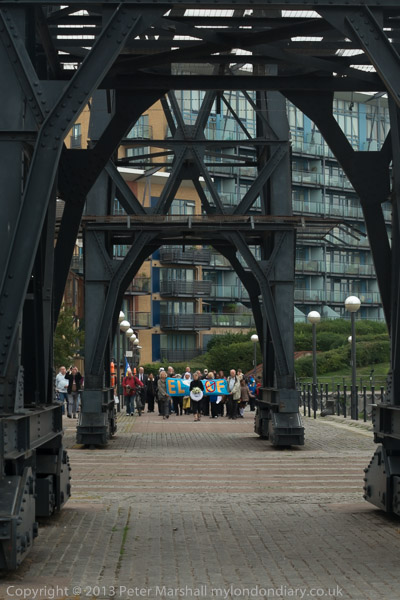
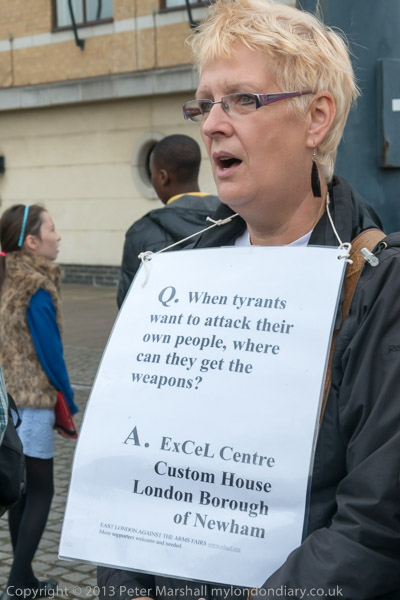
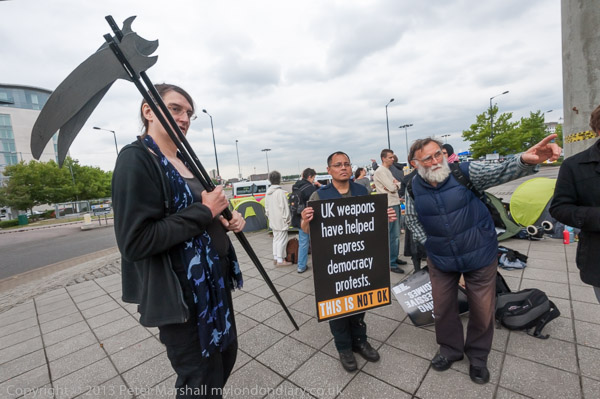
Protesters met at Royal Victoria Station for a procession around the Royal Victoria Dock organised by East London Against Arms Fair (ELAAF) to commemorate all those who will be killed by the weapons being sold at the DSEi arms fair taking place in the ExCel Centre on the dock, as well as those sold there at previous DSEi arms fairs.

Arms Fair, Chile & Syria

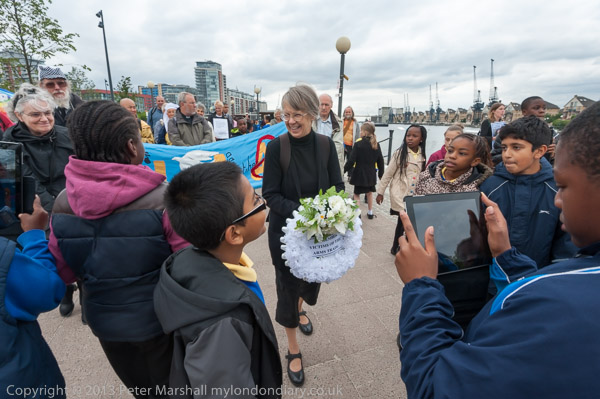
The procession walked around the dockside led by a woman dressed in black carrying a white floral wreath with the message ‘REMEMBER VICTIMS OF THE ARMS TRADE.’

Arms Fair, Chile & Syria

Following here people marched behind the ELAAF banner with its dove of peace. Also there to record the procession were a class from the local primary school, many of whom took photographs on their tablets and interviewed some of those taking part.
Arms Fair, Chile & Syria

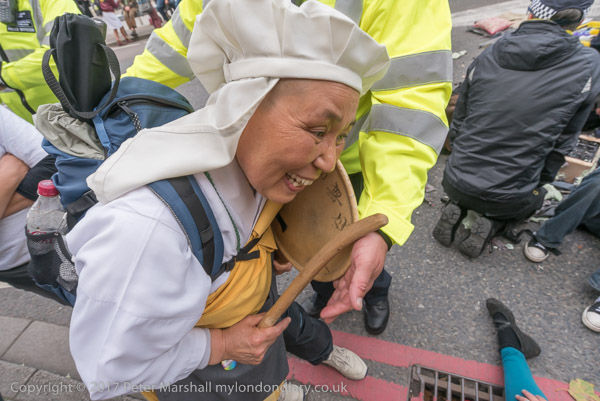
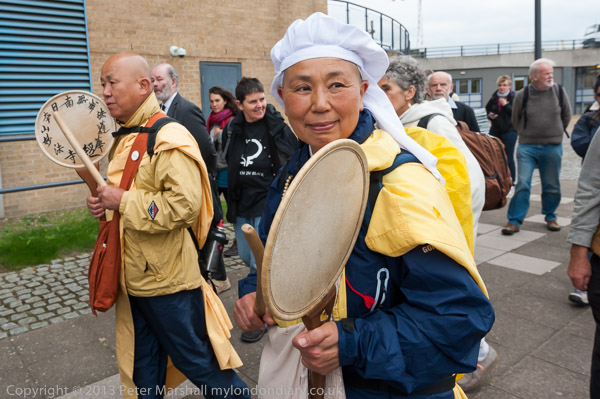
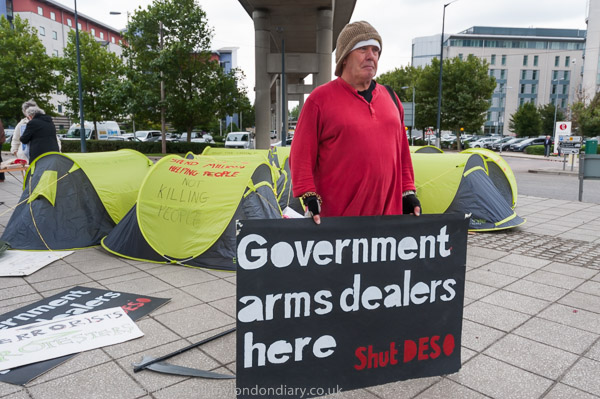
As well as ELAAF members there were also two Buddhist monks and some of the activists who have been occupying the roundabout at the East gate of the Arms Fair at ExCel since Sunday.

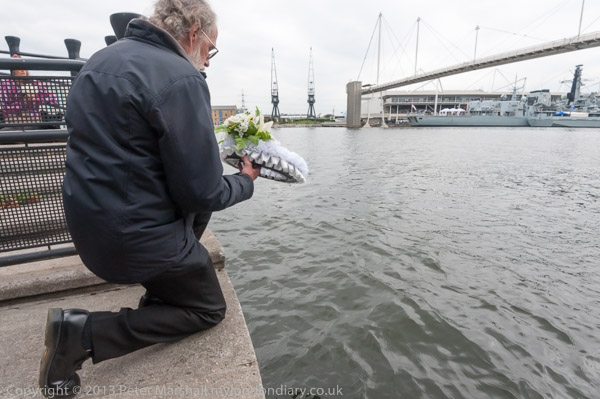
When the procession neared the end of the dockside path opposite the ExCel Centre it stopped and after a song against the arms fair the wreath was placed on the water in the dock.

As it floated away they held a two minute silence in memory of those killed by the arms from deals made at the previous fairs and those who will die from the weapons being sold at this DSEi fair. The event ended with another anti-war song, after which everyone dispersed.

More pictures on My London Diary at Wreath for Victims of London Arms Fair.


Occupation at DSEi Arms Fair Continues – Eastern Gateway Roundabout

Protesters were still occupying the roundabout at the eastern gate of the DSEi arms fair in East London, with around a dozen sleeping there most nights, and more visiting during the day.

Some protesters had been arrested earlier in the day after blocking the entrance to the arms fair for a short time.
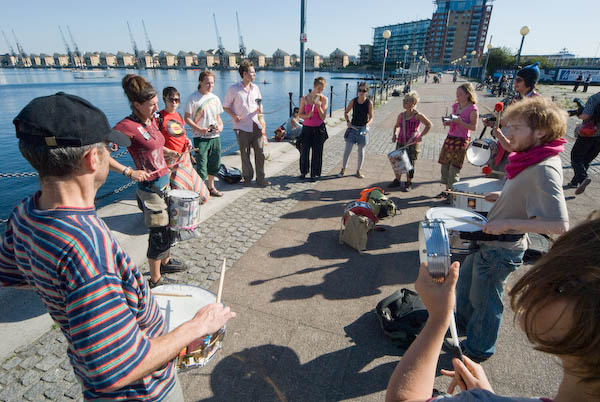
While I was there the protesters were handing out leaflets to the few pedestrians who left by the eastern gate, and showing posters and banners to vehicles, including several coaches that were taking visitors from the ExCel centre.

More pictures at Occupation at DSEi Arms Fair Continues.
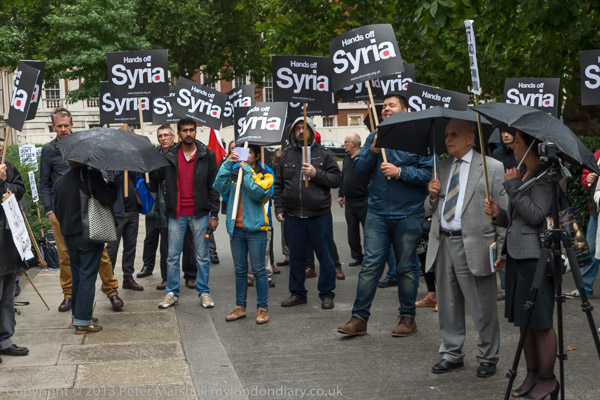

9/11 Protest at US Embassy – US Embassy, Grosvenor Square

The date 9/11, though confusing for those of us who put day and month in a more logical order was etched into our memories in 2001. For those who launched the attacks it was probably the anniversary of the defeat of the armies of Islam at Vienna in 1643.

But in terms of rather more recent American history, September 11th 2013 was the 40th anniversary of the CIA-backed military coup in which the Chilean military, led by General Augusto Pinochet, seized power from the democratically elected government and murdered Chile’s President Salvador Allende to set up a US-backed military dictatorship.

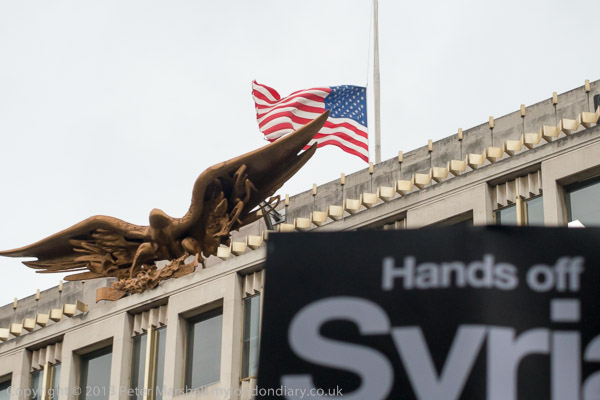
It was the Chilean anniversary that brought protesters to the US Embassy to demand that the US should not attack Syria, though the embassy flag was at half-mast for the 2001 twin towers attack.

More pictures at 9/11 Protest at US Embassy.