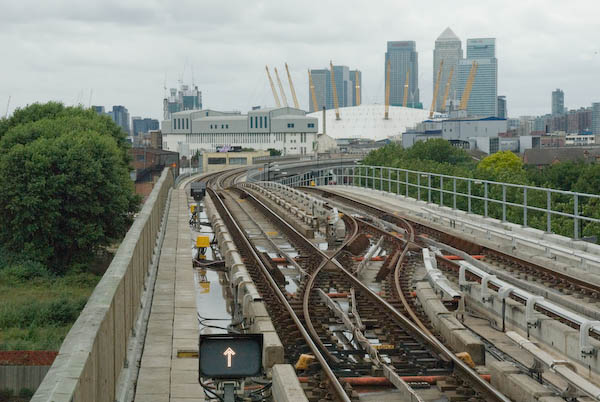
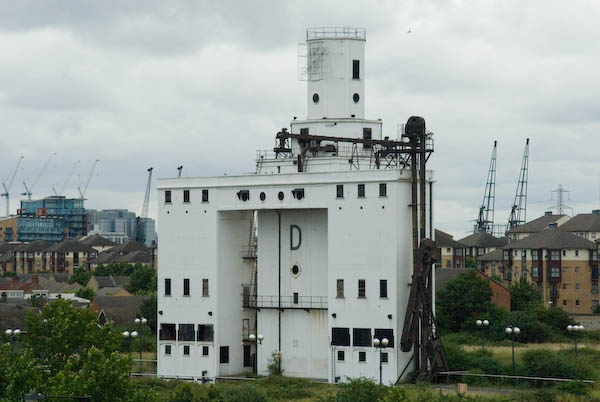
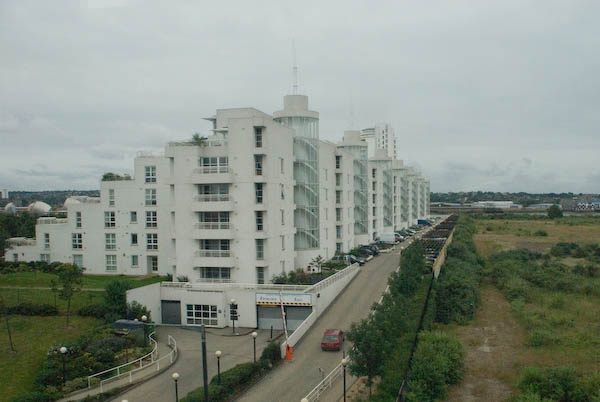
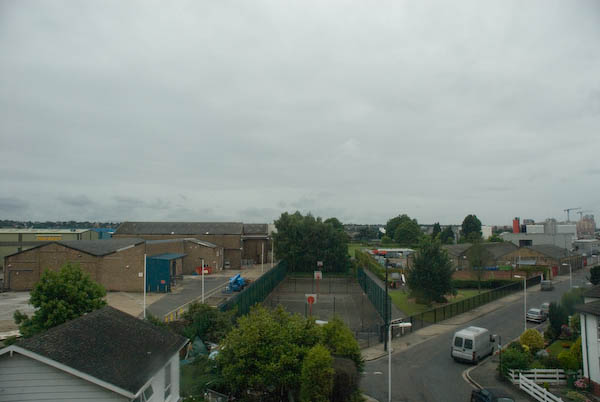
Take the DLR from Pontoon Dock to East India Station. [There is now a train every 10 minutes during normal hours.]
From the platform level you get good views, both through the windows and at each end of the long platform, of the Park, Barrier Point, Royal Victoria Dock and elsewhere.
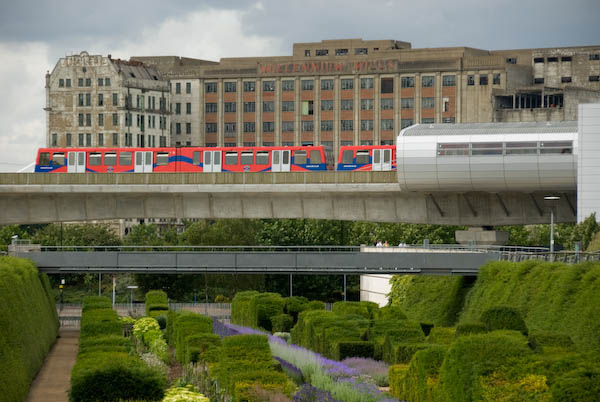
Listed Grain silo at Pontoon Dock
The train journey provides some of the best views of the riverside properties in this area, which otherwise are often impossible to access. It also gives a rapid overview of an area that is time-consuming to access on foot.
Barrier Point from the DLR
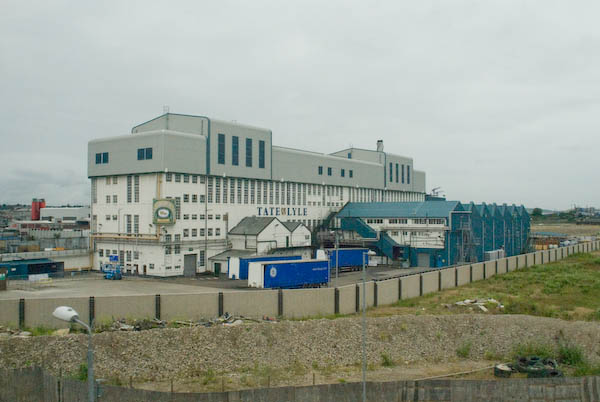
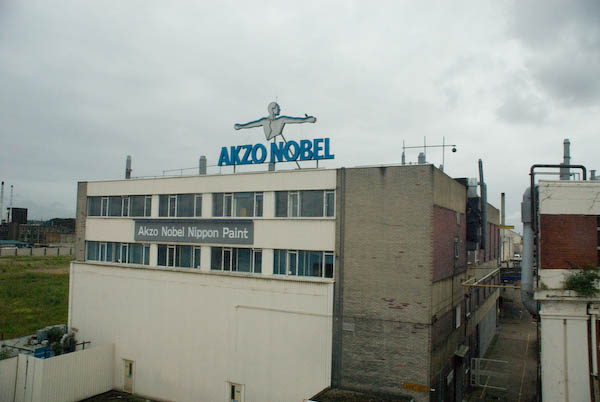
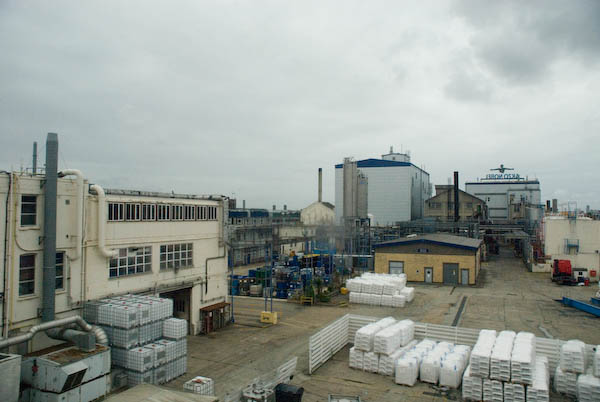
You should have no problem in identifying one of the Tate & Lyle buildings on the route, as well as Akzo Nobel, although you may recognise some of their brand-names – such as Crown, Bergger and International Paints, Sandtex and Sadolin – more easily. [I think only the Tate & Lyle Plaistow Wharf factory remains. Much was demolished to build Royal Wharf, as well as to the west of Plaistow Wharf where the land now remains empty.]
Lyle Park from the DLR
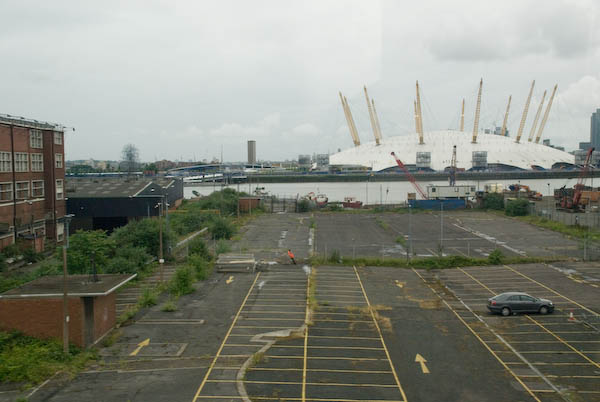
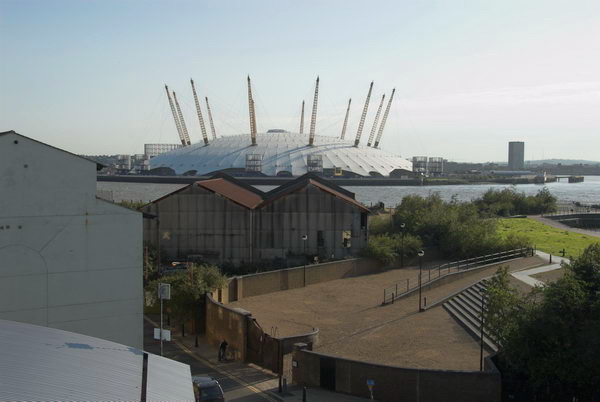
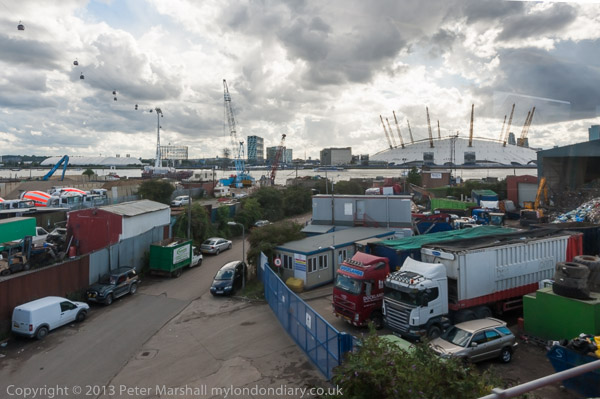
From the train you can also see the mouth of the River Lea and Trinity Buoy Wharf with its lighthouse and stack of containers in use as artists studios, as well of course as the Millennium Dome.
After Canning Town station, the line curves around the River Lea and climbs through the ecological reserve at Bow Creek and over the viaduct across Bow Creek. This section of the DLR was built in 1994 for the Becton extension.
From East India you have the choice continuing on the DLR towards the centre of London (change at Poplar for the DLR to Canary Wharf and the Jubilee Line), or taking a journey back to Canning Town.
If you have time and energy for a further walk, go north out of the station onto East India Dock Road and after crossing Bow Creek follow the path beside the creek to go over the Lower Lea Crossing. Again this elevated bridge gives good views across the Thames and Bow Creek to the south. [Now you can if you wish take a short cut by going out of the Bow Creek exit of the station, across the red bridge and through London City Island to the Lower Lea Crossing.]
Leamouth, Thames & Millennium Dome, 2009
When the bridge descends to a roundabout under the Silvertown Viaduct, you can either continue under it to Royal Victoria Station, or cross the road just before the roundabout and take the steps up to the top of the viaduct and walk to Canning Town station.
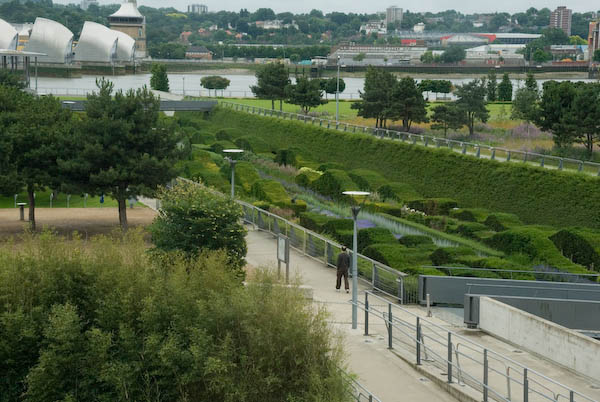
The children’s fun area is a nice idea, [32 computer controlled fountains] but this works better at Parc Citroen in Paris, and hasn’t stood up to British weather or use. We just don’t have the same level of upkeep in Newham as does the City of Paris. Competitions such as was carried out for this are a good idea, but only if the judges think rather more about what the result will look like in ten years time rather than on the sketches. It is also unfortunately not possible to enter the Green Dock at the ground level at the north end and walk through it (there is still an entry at the south end.)
[The park is managed by the Greater London Authority and was built on one of the most polluted sites in the country, the former PR Chemicals factory, which took years to decontaminate.]
The sides of the dock were lined by a metal fence with lower wires, which have currently been removed. In their place the fence is lined by normal street safety barriers, tied together with plastic bags. Although it may be effective, it is visually unacceptable and hopefully the fences are to be repaired and these removed.
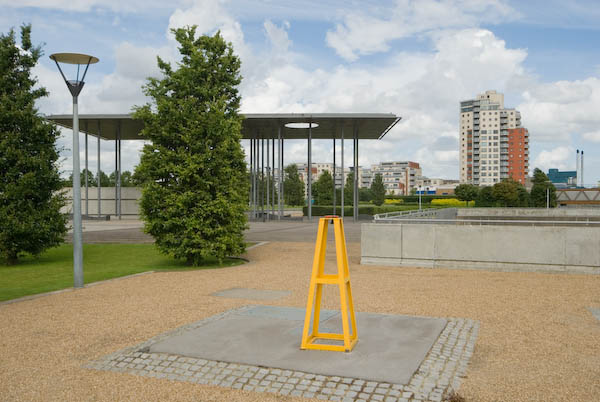
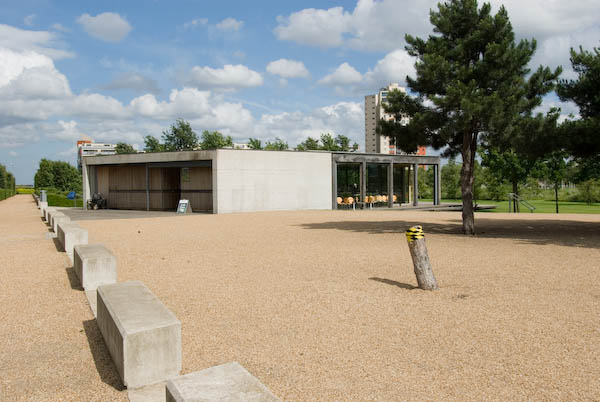
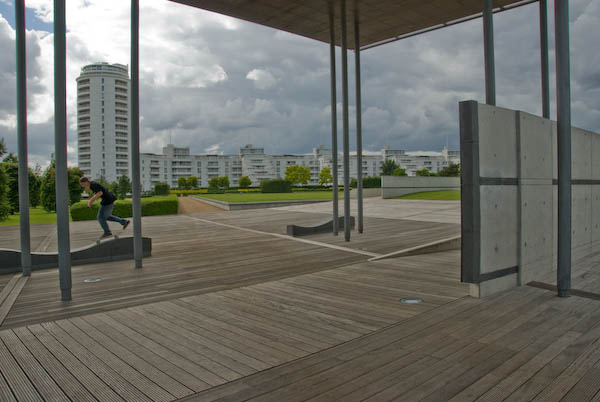
The two buildings in the park have a Japanese feel. One usefully houses toilets and a café, while the other was erected by Newham in memory of the victims of war. Its undulating seating was intended to carry on the wave theme of the Green Dock, but is perhaps of more interest to skateboarders than for comfort.
Walk along the edge of the ‘Green Dock’ to the riverside.
The park gives an excellent view of the Thames Barrier. Silvertown was one of the areas to be flooded in 1953, though rather less disastrously than Canvey, although some 1130 homes here were flooded. It took until 1982 for the Thames Barrier to be completed. Estimates of how much longer it will remain effective with the sea level rise due to global warming vary widely, but certainly at the moment it is getting used rather more often than was envisaged.
Walk back along the other edge of the Green Dock to the cafe and/or the station.
It’s some years since I’ve been back to the park, and it would be interesting to see how it has changed over the years. Perhaps I’ll find time this summer.
This walk will continue in a later post with Part 10: Riverside which mainly looks at views from the DLR.
An elevated section of the Docklands Light Railway runs along the south side of North Woolwich Road. Opened in 2006, it currently runs to King George V station in North Woolwich, but tunnelling is in progress to take it under the Thames to Woolwich. [It opened in 2009]
DLR under construction from Silvertown Way – 2004.
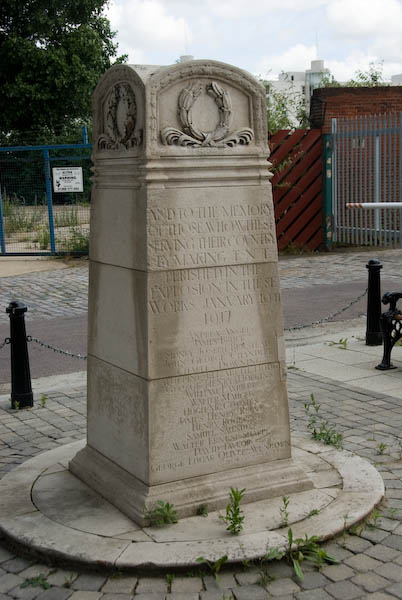
Turn left and walk east along North Woolwich Road; roughly 100 meters on is a site entrance which includes a monument to the Silvertown Explosion.
The Brunner Mond chemical works opened here at Crescent Wharf in West Silvertown in 1893, producing first soda and then caustic soda. But by 1914 the works was idle, and the government needed a factory to purify TNT. This was known to be extremely dangerous and a process that should be carried out in a remote area, and not in this highly populated area such as this. Dr FA Freeth, Brunner Mond’s head chemist later made his views about the process clear:
“It worked but was manifestly dangerous. At the end of every month we used to write to Silvertown to say that their plant would go up sooner or later.” But the Government, at a safe distance in Whitehall, decided that the risk was worth taking. It was the people of Silvertown who were, largely unwittingly, taking it.
“Sooner or later” turned out to be Friday 19 January 1917 when a fire caused 50 tons of TNT to explode. They heard the bang in Cambridge and Guildford. Around 70,000 properties were damaged, costing £2.5 million. Over 70 people were killed (12 of the bodies were never found) and 400 injured. Because of war-time restrictions, it was 3 days before the news was in the papers.
This site is now under application for development as Minoco Wharf. In January 2005 the Mayor removed its safeguarded wharf status, which will allow more freedom in its development. [Renamed ‘Royal Wharf’ and recently completed it includes 3,385 new homes, a primary school, leisure facilities and retail and commercial office space.]
Tate & Lyle’s Plaistow wharf
A little to the west is Peruvian Wharf, which includes the site of the old guano works and Tate & Lyle’s Plaistow wharf. (Tate & Lyle have consolidated their activities at Thames Refinery to the east in Silvertown.)
The application to develop this site, which still has safeguarded wharf status, went to public enquiry and was refused in 2006. There are further applications, mainly for industrial use. The best views of these sites are from the DLR. [The site was bought by the Port of London Authority in 2016 and part leased to for an aggregate wharf and concrete batching plant.]
Continue along North Woolwich Road and walk up the steps immediately behind Barrier Point into Barrier Park.
Barrier Point residential development, architects Goddard Manton Partnership (they took some ideas from their earlier Pierhead Lock at West India Docks) is in two parts, the ‘Seven Steps’ garden apartments occupied in 2000, and the landmark tower completed in 2001. It provides 252 “concierged apartments” and attracted various awards, making it “the most decorated contemporary housing development” in Britain. It forms an impressive wall at right-angles to the Thames, with suitably maritime railings and decks, although these perhaps give it too much of a 1930s international modern feel. The tower, a shining white lighthouse, is a grand effect.
This walk will continue in a later post with Part 9: Barrier Park
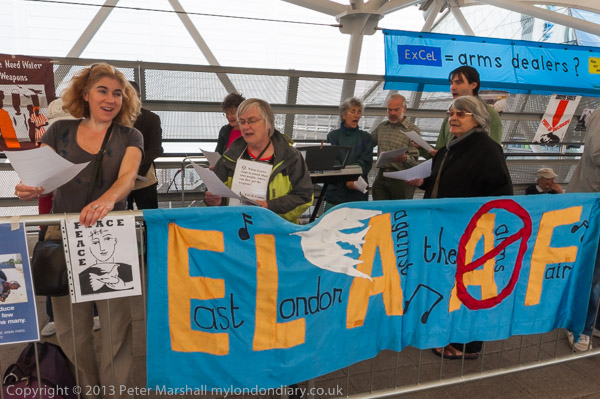
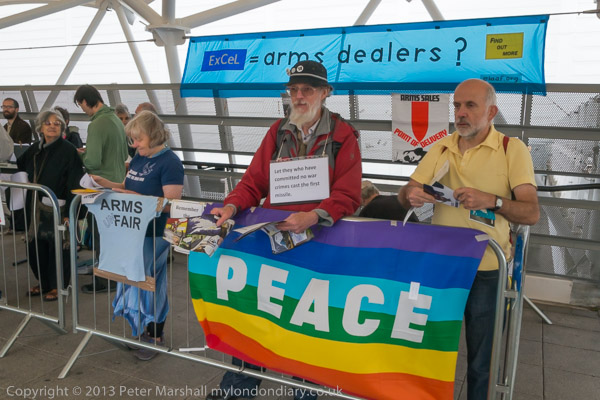
EDL Stopped, Musicians at Arms Fair, Silvertown: On Saturday 7th September 2013 after photographing the EDL attempting to march into Tower Hamlets and the people coming out to stop them I went on to the Excel Centre in Newham where East London Against Arms Fairs were holding a Musical Protest against next weeks DSEi arms fair. And on my way home I took more pictures.
EDL Try To March Into Tower Hamlets
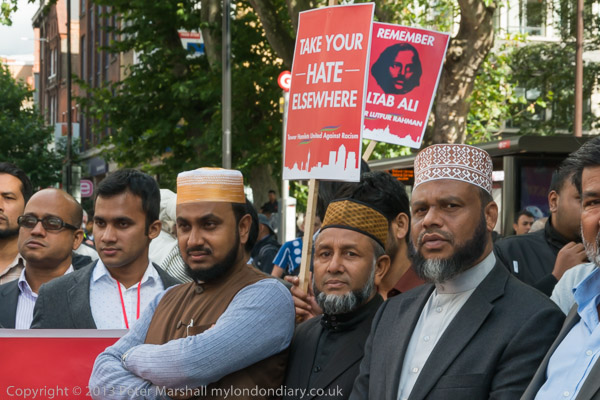
Whitechapel says ‘Take Your HATE Elsewhere’
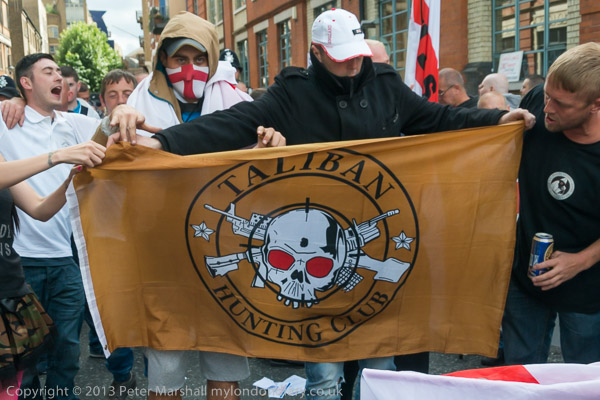
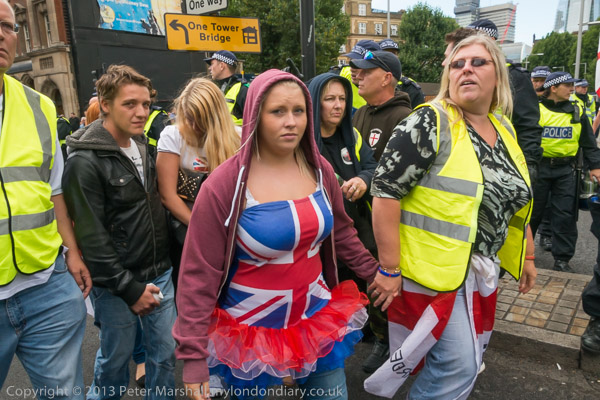
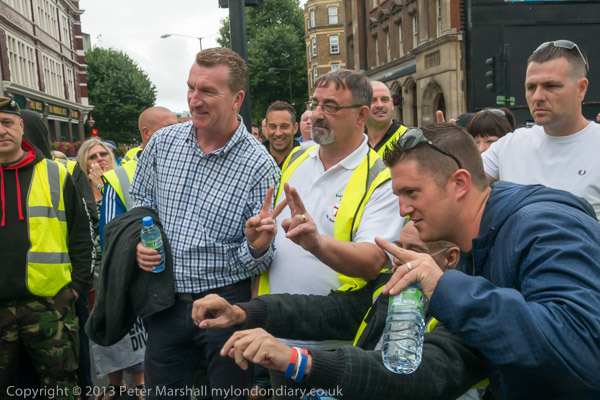
I started the day in Bermondsey were around a thousand EDL supporters were gathering for a march across Tower Bridge to Aldgate High St.
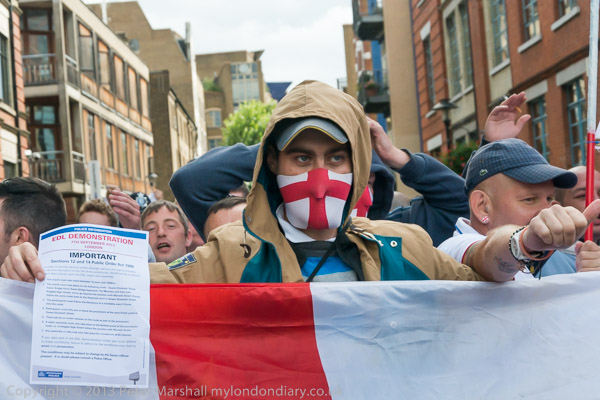
Police had laid down very strict conditions for the march, specifying the exact route and timings and more, which where specified on A4 sheets they handed out to protesters and were also broadcast every few minutes from a loudspeaker van where the marchers were gathering.
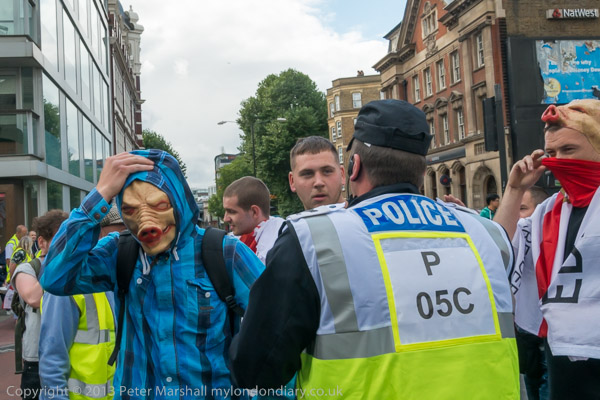
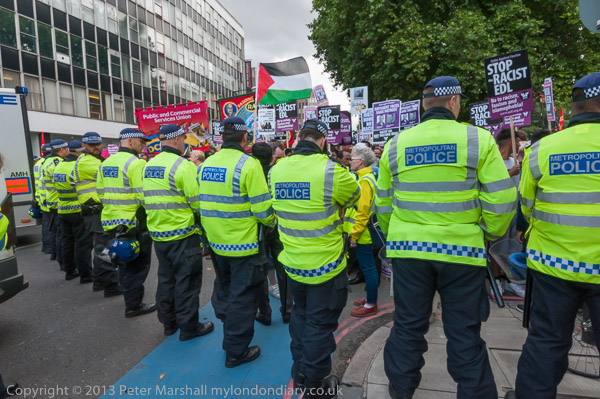
There was a very strong police presence on the streets with police on all sides around the marchers and some mingling with them. The EDL were also on their best behaviour, with many posing for photographs. A couple who arrived in pig’s head masks were forced by police to remove them and hand them over.
There was still a great deal of racism and hate in the comments that were being made and when the march got under way the majority took up the usual Islamophobic chants including “Allah, Allah, who the f**k is Allah“.
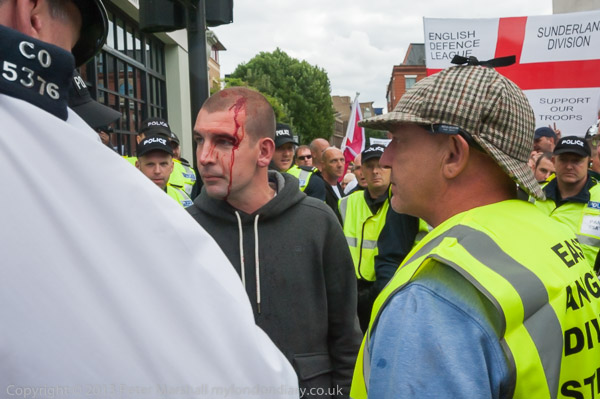
There were a small number of anti-fascist protesters in the area, and police tried to keep them well away from the march, although EDL stewards who led away one man with a bleeding face from the crowd alleged he had been hit by a bottle thrown from across the road.
As the march set off, police moved photographers well away, and police handlers with dogs walked in advance of the marchers. Later I was able to get a little closer.
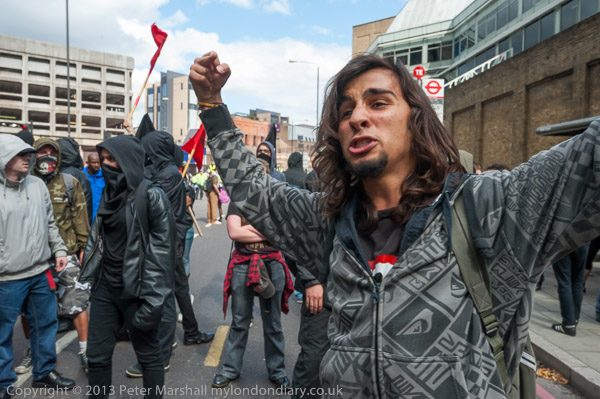
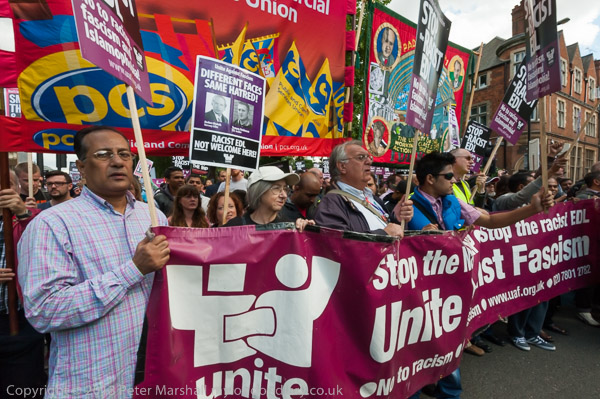
After crossing Tower Bridge I saw red smoke in the distance coming from the ground in front of a row of police vans in Mansell St and rushed there to find a group of around 50 anti-fascist protesters, mainly dressed in black, with red and black flags and a few with Unite Against Fascism placards.
The EDL march stopped for a couple of minutes opposite them and the two sides shouted insults at each other with the police keeping them well apart before the march moved on to Aldgate High Street without further incident. I later heard that the anti-fascists here had been kettled for some hours before many of them were arrested.
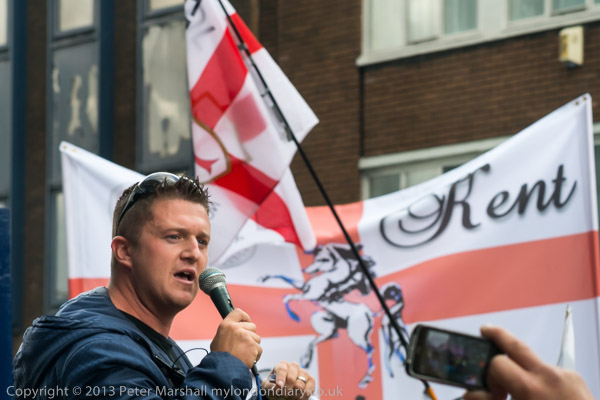
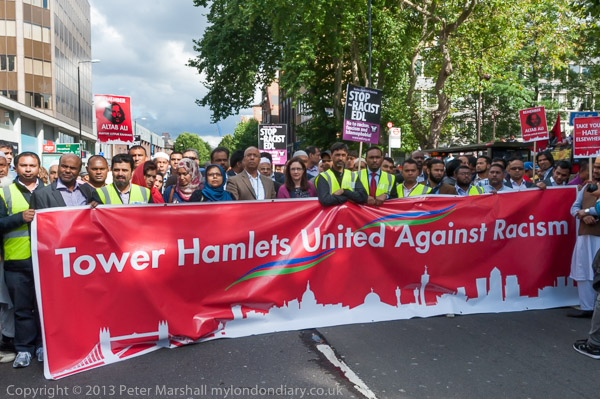
I photographed Tommy Robinson addressing the rally, then made my way to where a counter-protest was being held by the community of Tower Hamlets, united in opposing the EDL. I had to go through several lines of police, showing my Press Card. A few officers refused to let me through, but I was able to walk along the line and make my way through.
As I commented, “It was a remarkable change in atmosphere from the feeling of hate and Islamophobia that filled the air with gestures and chanting from the EDL to the incredible unity and warmth of the several thousands largely from the local community who had come out to oppose them and make a statement based around love and shared experience of living in Tower Hamlets with people of different backgrounds and religion.”
There was clearly a determination in Whitechapel, as there was in the 1930s at the Battle of Cable Street which had taken place not far away of a community that had decided that ‘They shall not pass’. And although most had come to protest peacefully, had the police not kept the two sides well apart, the EDL would have been heavily outnumbered by local youths angry at their presence.
I’d left the EDL rally before Tommy Robinson was arrested for incitement, apparently for suggesting that people break some of the restrictions that police had imposed on the EDL march and rally. The police presence had prevented any large outbreaks of public disorder and although the EDL were up in arms over the arrest of their leader had protected them from a severe beating.
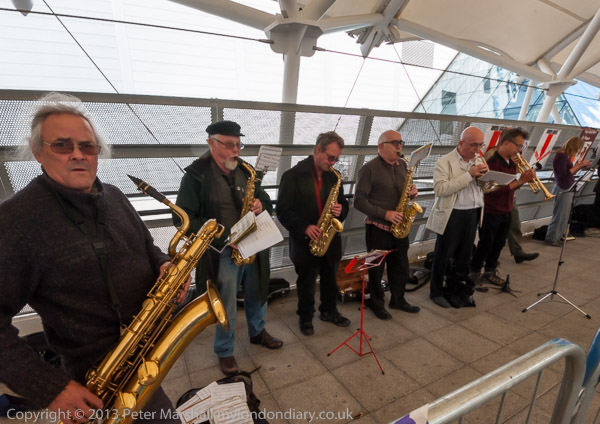
Musical Protest against Arms Fair – Excel Centre, Custom House
I didn’t stay long in Whitechapel but took the tube and bus to Custom House where on the walkway leading the the ExCel Centre East London Against Arms Fairs (ELAAF) were holding a Musical Protest against next weeks DSEi arms fair with a big band and singers and others handing out leaflets opposing the event.
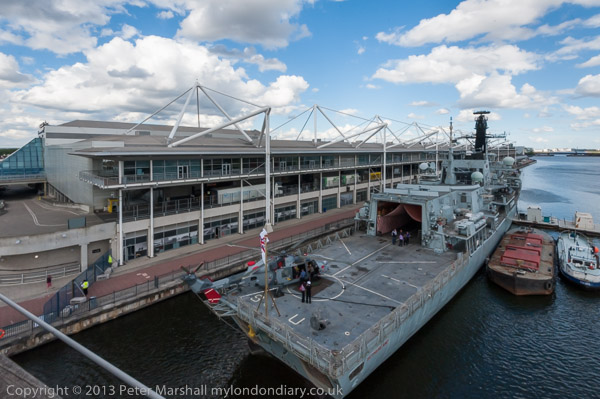
THe DSEi arms fair, held every other year at the ExCel Centre in London Docklands attracts buyers from all over the world, including those from many countries with oppressive regimes. It’s a showcase for the weapons they need to continue to oppress their populations and to wage war on their neighbouring states and others.
There were more and larger protests in the following week against the arms fair.
Although the DLR wasn’t running on the branch leading to Custom House, there were trains running on the branch through Silvertown and I walked to there across Victoria Dock on the high-level bridge, taking a few photographs.
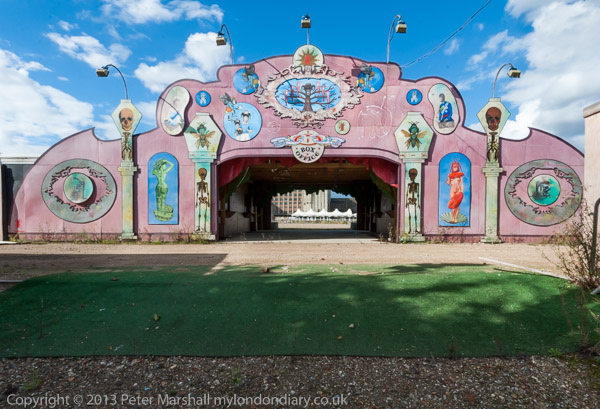
The gates to the London Pleasure Gardens which had closed recently only a few weeks after its opening were locked but I was able to take pictures through the gates. I walked on to the elevated Pontoon Dock DLR station and made some panoramas from there before catching a train.
For once the DLR train had a very clean window and I took advantage of this to take some more pictures on the way to Canning Town where I changed to the Jubilee line.