Hayling Island Carnival – 2005

Hayling Island Carnival: On Wednesday 3rd August 2005 I went to photograph the carnival on Hayling Island with a couple of friends. I’d been there for the carnival a couple of times in earlier years, though it wasn’t really my kind of thing.

Neptune’s court – he had plenty to keep him busy

Two of my friends had in earlier years got money from the Arts Council to record English Carnivals and had persuaded me to go with them in earlier years and I was with one of them again in 2005.

There is an odd fascination about English carnivals, bringing out the eccentricities of the English, something that had been exploited by earlier photographers, perhaps the first being Sir Benjamin Stone (1838 – 1914), who as Wikipedia states made “an invaluable record of the folk customs and traditions of the British Isles, which influenced later photographers of note“. Notable among these, and one who inspired many before his tragic early death was Tony Ray-Jones (1941-72) and the posthumous book ‘A Day Off: An English Journal‘ published in 1974 was certainly the most influential British photographic publication of that era.

I never met Ray-Jones, who died before I was deeply involved in photography, but I did later become friends and worked with his friend, the Brooklyn-born photographer John Benton-Harris who printed much of his work, including the prints for ‘A Day Off’ and had occasionally photographed with him. And those two photographers who first took me to Canvey were ex-students and close friends of John too.

I worked with John on producing the images for what would have been his masterwork, ‘Mad Hatters – a diary of a secret people… as seen through the looking glass of – John Benton Harris‘ still unpublished, though a few of us treasure copies printed by Blurb but never made public. In mine he thanks me for my ‘Valued Technical Help‘, though we also had many discussions and arguments on the sequencing and very occasionally the selection of images, many of which I made significant improvements by some judicious dodging and burning – though always subject to his approval.

The ladies from the Health centre were going on a booze cruise

Actually with John virtually every discussion was a bitter argument – we were once asked to leave an event in Borough Market after a shouting match over a review I had written of a book by Homer Sykes (another of those influenced by Stone.) Sadly ‘Mad Hatters’ remains unpublished. It’s a fine body of work but a book greatly in need of an editor – something John would never tolerate.

The Navy gets in on the act with HMS Hayling

Back to 2005, here is the text I wrote for My London Diary about the day:

I went to Hayling Island for the carnival with Paul and Michael, and it was a nice day. Paul drove us down - it isn't too long a drive from London, really a Londoner's day out. Hayling seems full of people from London on holiday, some with second homes there, others hiring them, often from family and friends.
A beach tableau, complete with seagull
Back to the beaches
Despite a longer than usual hold-up at Haslemere, we arrived just in time for the official opening. Everything was happening on the day, and it started with the crowning of the Carnival Queen and her retinue, then on to the Fancy Dress.
Then came the Baby Show, after which we went down to the other end of the town, where the carnival formed up in previous years. It seemed dead there, with more housing and less shops than before, and nothing was happening. People up that end are apparently pretty fed up to lose the carnival, and we were sorry to miss another meeting with 'the King' whose playing had been a major feature of previous years.
We grabbed a meal at a restaurant and then made our way back for the Dog Show, After which it was time for the parade to form up near the sea front. There were more mermaids than you could ever imagine and everyone seemed to be having fun and I took a lot of pictures.

More pictures from Hayling Island Carnival 2005 on My London Diary.


FlickrFacebookMy London DiaryHull PhotosLea ValleyParis
London’s Industrial HeritageLondon Photos

All photographs on this page are copyright © Peter Marshall.
Contact me to buy prints or licence to reproduce.
Al Quds & Roma Holocaust Memorial Day – 2013

Al Quds & Roma Holocaust Memorial Day: On Friday 2nd August 2013 I photographed the annual al-Quds Day march in London, leaving before it reached a rally at the US Embassy to attend a ceremony at the Holocaust Memorial in Hyde Park for Roma Holocaust Memorial Day.


Al Quds Day March – Portland Place to US Embassy

Al Quds & Roma Holocaust Memorial Day - 2013

Thousands marched peacefully for outside Broadcasting House to the US Embassy calling for the liberation of Palestine, with a few carrying banners and chanting in support of Hezbollah.

Al Quds & Roma Holocaust Memorial Day - 2013

The starting point was chosen because of the continuing pro-Israel bias of the BBC and their failure to adequately cover the Israeli apartheid, the continuing occupation of Palestine and the oppression of the Palestinian people, as well as the siege of Gaza, which already 12 years ago was denying sufficient essential medical supplies and restricting food and other materials.

Al Quds & Roma Holocaust Memorial Day - 2013

The celebration of Al Quds day on the last Friday of Ramadan was introduced by Ayatollah Khomeini in Iran in 1979 and its observance has spread, mainly in Arab and Muslim countries, and for many years there has been an annual march in London in support of Palestine as a show of solidarity with the people of Palestine and oppressed people everywhere.

Al Quds & Roma Holocaust Memorial Day - 2013

Often the march has been met with opposition from various Zionist and Iranian freedom, communist and royalist movements as well as fringe UK right wing groups including the EDL and March for England, but there was no sign of protests against it this year, though I imagine there will have been a counter-protest to the rally at the US Embassy, but I had to leave for another event before the march reached this.

Al Quds & Roma Holocaust Memorial Day - 2013

There were also Jews taking part in the march calling for freedom for Palestine, both from the obvious and small group of ultra-orthodox Neturei Karta Jews and others from the British left.

Al Quds & Roma Holocaust Memorial Day - 2013

The march, attended by many Muslim families from mosques across England, was heavily policed but was as always an entirely peaceful and closely stewarded event that requires no policing other than traffic control unless others come to try and disrupt it.

Many more pictures at Al Quds Day March.


Roma Genocide Commemorated – Hyde Park

Grattan Puxon speaking in front of the Holocaust Memorial which was draped with a Roma flag

A ceremony at the Holocaust Memorial in Hyde Park on Roma Holocaust Memorial Day remembered the mass killing of 3,000 Romas at Auschwitz on 2nd August 1944 and protested against the rise of neo-Nazi attacks against the Romas in the Czech Republic and Slovakia.

A few of the 3000 who died on the night of the ‘Porajmos’ on 2nd August 1944

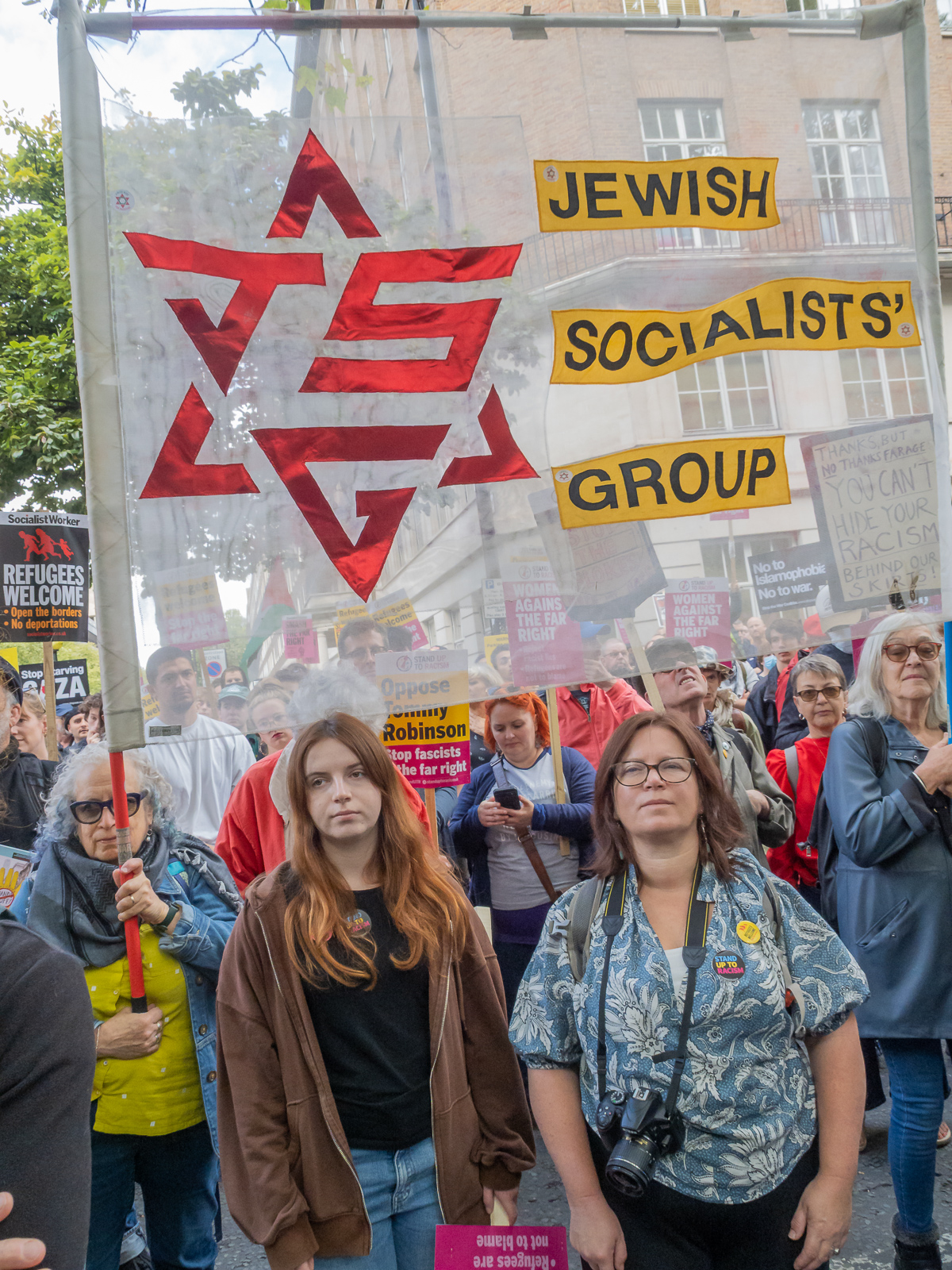
Around a quarter of a million Sinti and Roma were killed by the Nazis in Germany, and many others in Romania and Croatia. A Jewish socialist, who spoke at the event regretted the fact that the memorial only refers to the Jewish victims of the holocaust, which also included many others.

Professor Rainer Schulze

After a short introduction there was a two minute silence followed by speeches in Czech and in English including by Professor Rainer Schulze who spoke in some detail about the way Sinti and Roma were treated by the Nazis and of the fight they put up even as they were being forced into the gas chambers.

As well as speakers from various Roma and Sinti communities others included a Japanese peace activist who brought a statement of support from Hiroshima. Some of those present had earlier protested against the rise of Neo-Nazi attacks against the Roma in the Czech Republic and Slovakia, and were going on to protest at the French Embassy against deportation of Roma from France.

Recent years have seen increasing discrimination against Roma across Europe and here in the UK, including harassment of those sleeping rough on the streets of London.

More pictures at Roma Genocide Commemorated.


FlickrFacebookMy London DiaryHull PhotosLea ValleyParis
London’s Industrial HeritageLondon Photos

All photographs on this page are copyright © Peter Marshall.
Contact me to buy prints or licence to reproduce.

Soho Pride – 2004

Soho Pride – 1st August 2004: Soho Pride was a festival celebrated in the streets around Old Compton Street from 2003-2008, a separate event from the annual London Pride parade which now takes over the whole area for after-parties on the day of the parade. You can read a little more about it # on the Historic England web site which has a “Self-Guided Virtual Heritage Walking Tour” 130 Years of Queer Soho (or thereabouts) which includes Soho Pride.

Soho Pride - 2004

I paid the first Soho Pride a brief visit in 2003 on my way home from a busy 5th July after covering a protest calling for legal recognition of British Sign Language and the Somerstown Festival Of Cultures. There are just a few pictures of Soho and Soho Pride 2003 on My London Diary.

Soho Pride - 2004

I spent rather longer at Soho Pride 2004, and here is what I wrote it on My London Diary – and all the pictures in this post come from the 2004 festival.

Soho Pride - 2004
The first Soho Pride held last year was a great success, and this year's event followed the same pattern. Street closures, restaurant tables in the roadway, DJs and loud sounds, people out to eat, drink, dance and generally have a good time.
Soho Pride - 2004
Even in mid-afternoon, the streets were beginning to get really packed, especially outside the more popular gay bars and around the club DJs.
Soho Pride - 2004
Really it was one big party, and a party that catered for almost all tastes except in music, which was uniformly relentless club beats. Perhaps a pity that the Jazz On The Streets events had beat a retreat to Carnaby Street (surely forty years behind us with flower power.)
Soho Pride - 2004
After a while I began to feel my age, and escaped to the Underground and home for a quiet and leisurely alfresco dinner with a few glasses of white wine.

More pictures on My London Diary from Soho Pride 2004.


FlickrFacebookMy London DiaryHull PhotosLea ValleyParis
London’s Industrial HeritageLondon Photos

All photographs on this page are copyright © Peter Marshall.
Contact me to buy prints or licence to reproduce.
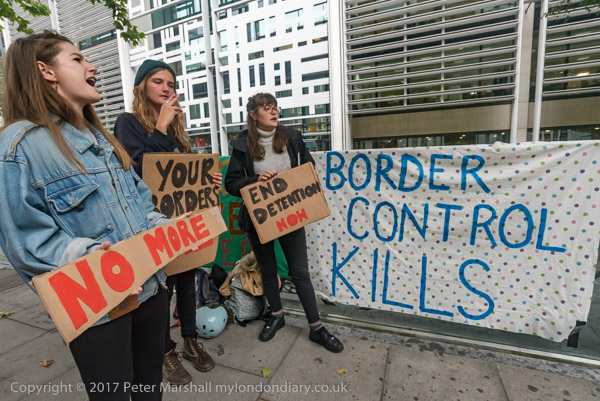

Hunger Strikers & Sotheby’s – 2015

Hunger Strikers & Sotheby’s: Ten years ago today this protest over Palestine was about Palestinians on hunger strike in Israeli jails against the use of indefinite illegal administration. Later I went to Mayfair where cleaners and their supporters were protesting for the reinstatement of two cleaners sacked and victimised because of their trade union activities.

BBC protest over Palestinian Hunger Strikes – Broadcasting House

Hunger Strikers & Sotheby's - 2015

The hunger strike by Palestinian prisoners Muhammad Allan and Uday Isteiti held in Israeli jails under administrative detention was in its sixth week, but the BBC had failed to report this and other hunger strikes.

Hunger Strikers & Sotheby's - 2015

So Innovative Minds in cooperation with The Prisoner’s Centre for Studies in Jerusalem had come to the BBC to protest against the continuing pro-Israel bias among management and some reporters. It’s a bias that has often been confirmed by academic studies and is continuing, though the recent use of starvation in Gaza and its appalling consequences we have all seen has resulting in some toughening of the BBC reporting on Israel’s war crimes.

Hunger Strikers & Sotheby's - 2015

Administrative detention allows people to be held without any real evidence and without trial and although in Palestine it is supposedly time-limited, in practice many are immediately re-arrested when their sentence ends to begin another term and so is in practice indefinite.

As I concluded in 2015: “Many who used to regard the BBC as a great institution and praised its high standards are now disillusioned and feel that they need to listen and watch other broadcasters to get an impartial and more complete view of both overseas and UK news.”

Hunger Strikers & Sotheby's - 2015

The BBC has some fine reporters but they often come under pressure from their managers – who themselves are under pressure from powerful lobbying groups and politicians with strong sympathies for the Zionist cause, including leading figures in our government. But they also misinterpret their ideas of impartiality, often ignoring the facts of the situation in a misguided attempt to show both sides. As it has been said “there are no two sides to genocide.”

More at BBC protest over Palestinian Hunger Strikers.


Reinstate the Sotheby’s 2 – New Bond St

Early in 2015 the United Voices of the World union had come to an agreement with the company who then employed the outsourced cleaners at auction house Sotheby’s which had guaranteed the workers non-toxic products, reinstatements, fairer schedules and the London Living Wage (backdated.)

Sotheby’s, who make huge profits by selling art works and other items, decided to sabotage that deal by ending the contract with that company and starting a new contract with Servest, who decided not to honour the agreement that had been reached earlier.

This led the UVW to organise a series of protests, including a large and noisy one outside a “blockbuster £130m art sale” on July 1st. Sotheby’s responded by sacking four of the most active trade union members who had taken part in the protest, though later were forced by threats of legal action to reinstate two of them.

The protest on 31 July outside another auction demanded the reinstatement of the ‘Sotheby’s 2‘, as well as repeating the cleaners demands for proper sick pay, paid holidays and pensions and the London Living Wage.

The UVW continued with protests in Autumn 2015 and were able to announce in early 2016 that “ALL outsourced workers at Sotheby’s, including cleaners, caterers, porters and security guards would receive both the London Living Wage and contractual (much improved) sick pay.”

More at Reinstate the Sotheby’s 2.


FlickrFacebookMy London DiaryHull PhotosLea ValleyParis
London’s Industrial HeritageLondon Photos

All photographs on this page are copyright © Peter Marshall.
Contact me to buy prints or licence to reproduce.

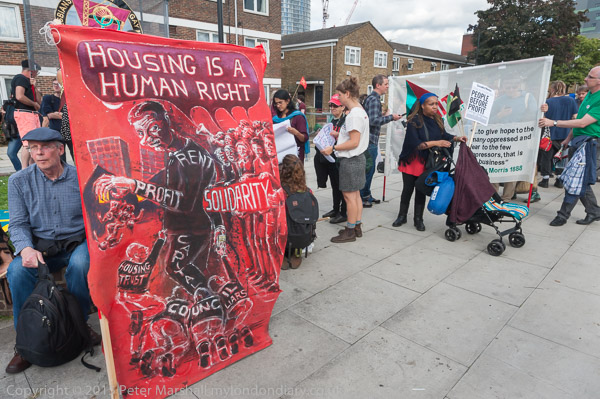
Rich Door, Poor Door – 30th July 2014

Rich Door, Poor Door - 30th July 2014

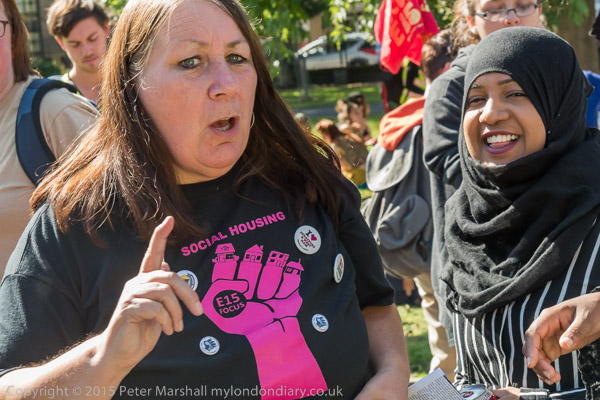
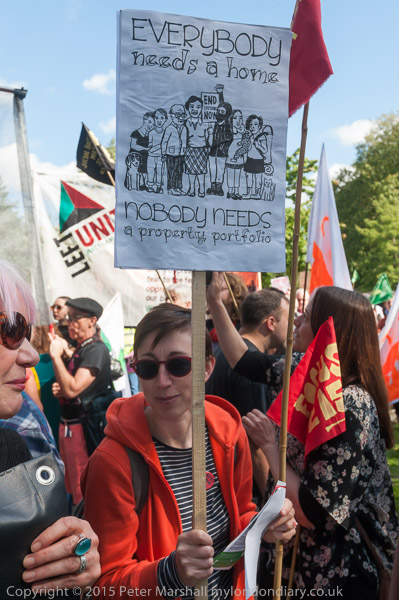
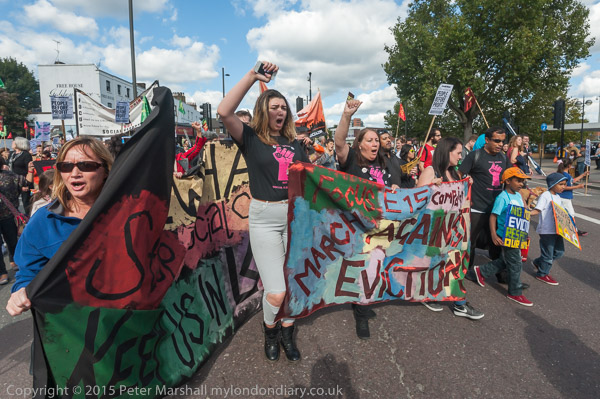
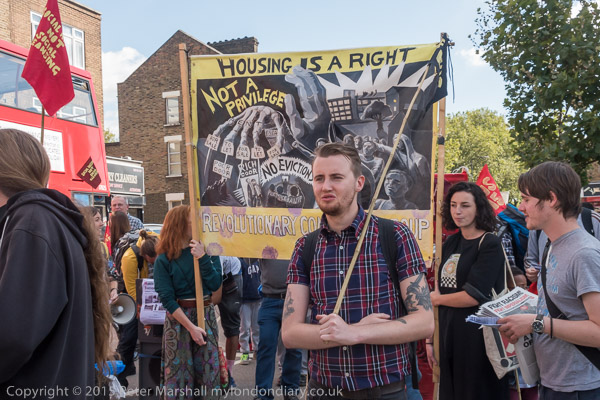
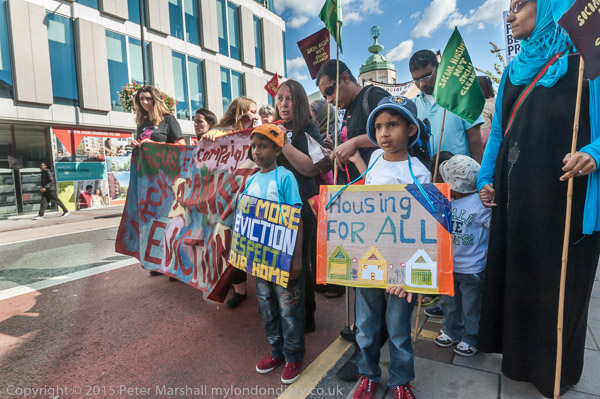
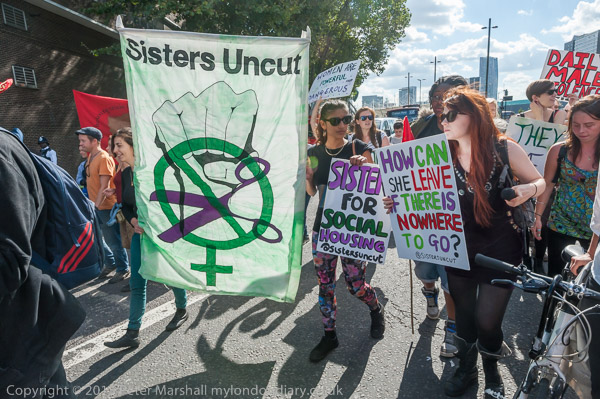
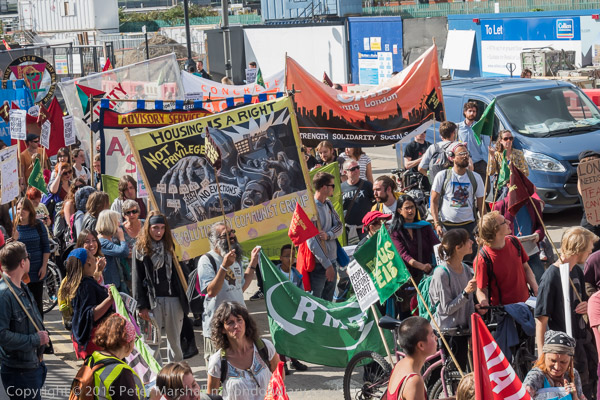
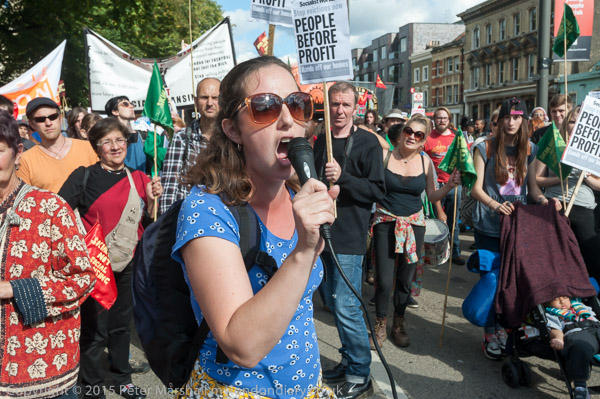
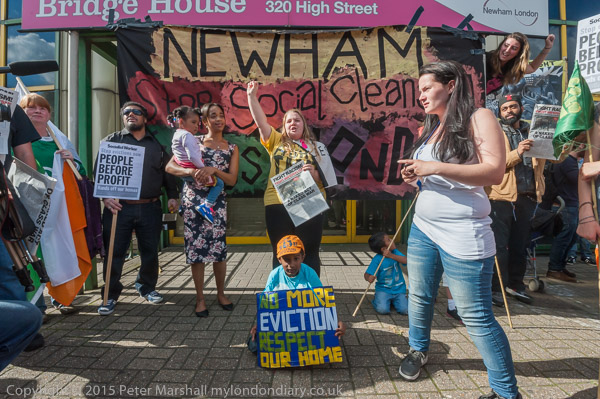
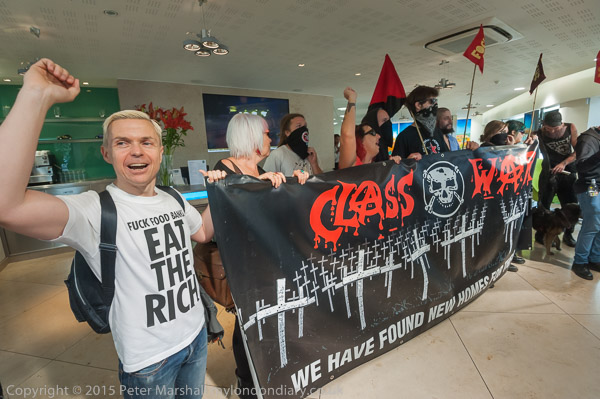
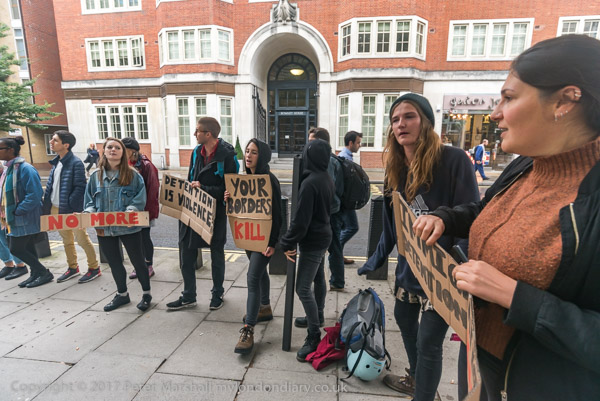
Rich Door, Poor Door: Class War’s Long series of protests against the separate and very different entrances to the tower block at One Commercial Street in Aldgate began on 30th July 2014 and weekly protests continued with some short pauses and a few extra visits until May 2015, when Class War devoted themselves to the General Election campaign.

Rich Door, Poor Door - 30th July 2014

Here is the introduction to my long post I made in 2014 about the event:

Class War, including three of their candidates for the 2015 General Election, protested at 1 Commercial St in Aldgate against London's new apartment blocks providing separate 'poor doors' for the affordable flats they have to include to gain planning permission for the development. Class War characterise this as 'social apartheid.'

Rich Door, Poor Door - 30th July 2014

You can still read the rest at Class War – Rich Door, Poor Door. At the time the building owners told us that there was “no internal connection between this part of the building and that containing the social housing” but on a later occasion I was taken by an owner of a flat in the “rich” section out of the building from her flat by the poor door – a route she took routinely when walking her dog.

Rich Door, Poor Door - 30th July 2014

I photographed almost all of the 30 events that took place in front of the building during that time, missing just a couple when I was out of London. And shortly after the protests ended I put together a ‘zine’ full of pictures from them (still available from Blurb) ‘Class War: Rich Door, Poor Door ISBN 978-1-909363-14-4′.

Rich Door, Poor Door - 30th July 2014

At the front of the zine is the text I posted on My London Diary on 30th July 2014, along with a list of the actions, and at its end a short note about how I came to photograph protests. But the bulk of the publication is simply pages of pictures with just a few short notes.

In a short conclusion I stated:

One Commercial Street still has its separate doors for rich and poor, but the campaign which had been suspended for the general election has made 'social apartheid' in housing an issue, and along with other housing campaigns has brought housing, and housing in London in particular onto the public agenda.

I should also had made it clear that Class War had taken an part in these other housing campaigns and their presence had helped to raise the profile of protests over these. In particular they had played an important part in making clear the involvement of Labour councils in London in collaborating with developers in the transfer of huge public assets into private ownership while failing to provide much-needed social housing.

Our current Labour government has still not got serious about the need to provide social housing rather than simply encourage developers to build more largely private housing (with a largely token amount of unaffordable “affordable” housing.) Perhaps if we do get a new party of the left things will change.

The preview on Blurb includes I think most or all of the publication and shows it better than the print publication. Viewing at full screen you can also read all the text, including my post from 2014 still on My London Diary. The pictures and text from all the other Poor Door protests are also still on My London Diary.

On My London Dairy for 30th July 2014: Class War – Rich Door, Poor Door

Stop Starving Palestine Pan Protest

Whitehall, London. 25th July 2025

Stop Starving Palestine Pan Protest

Stop Starving Palestine Pan Protest: Last Friday evening thousands of us came to Whitehall shocked by the news and photographs coming out of Gaza, where much of the population is now suffering from malnutrition and over a thousand have already died of starvation.

The famine there is entirely due to the actions of the Israeli government and their army, the IDF. Over the past months they have denied access to the normal humanitarian supplies of foods and essential items to Gaza.

Stop Starving Palestine Pan Protest

Israel has also disrupted the well-established channels through which food was distributed in Gaza through the UN and humanitarian agencies. Together with the USA they have set up an alternative way to supply food which has operated at only four centres; the amount of food supplied has been vastly inadequate and over a thousand of those queueing for it have been killed by the IDF.

Stop Starving Palestine Pan Protest
A holocaust survivor speaks outside the Foreign & Commonwealth Office.

The world has been shocked by the pictures coming out from Gaza, and by well-documented stories from medical staff that snipers and not only target those queueing for food but ‘gaming’ by targeting different parts of the anatomy on different days. One day hospitals treated many who had been shot in their testicles.

For months we have been appalled by the accounts of the shelling and bombing of hospitals, medical facilities and the arrests and interrogation of medical staff, some of whom have clearly been tortured.

Stop Starving Palestine Pan Protest
L

Large areas of Gaza are now covered with the rubble of people’s homes and people forced to flee and living in makeshift tents, often in so-called ‘safe areas’ have been killed by the military.

The attack began after an attack by Hamas across the border into Israel in which over a thousand died – including some by Israeli military fire and hundreds were kidnapped as hostages. But it has continued for over 600 days, with the killing of many, many thousands of innocent Palestinians, men, women and children in what has clearly become a series of war crimes.

Stop Starving Palestine Pan Protest

Some Israeli ministers have clearly stated their intention to entirely rid Gaza of Palestinians, and Donald Trump has supported them, with plans to turn the area into a holiday resort. Israel clearly wants to settle the area with Israelis.

From the rest of the world we have seen words of condemnation, but little or no real action, with the USA using its veto in the UN. The UK has banned some of its arms exports and is nowmaking plans for air drops of food – but these will only be a small – and dangerous – drop in the ocean of desperate need.

On Friday evening I travelled up to London with my wife – carrying a large pan and a wooden spoon to bang it with in a protest calling on our government to take effective action.

I began by photographing a rally outside the Foreign & Commonwealth office by the International Jewish Anti-Zionist Network UK who began weekly protests in October 2023 against the Israeli Ambassador to the UK who had called for the illegal annexation of the West Bank and for “every school, every mosque, every second house” in Gaza to be destroyed. Their protests have been hounded by police, banned first from being outside her residence and then from Swiss Cottage.

Among the speakers I photographed there was a woman holocaust survivor who received tremendous support with people banging their pans and was unable to continue for several minutes. This was also one of the few parts of the evening of protest where many people had also come with placards.

A few yards up Whitehall there were crowds of protesters banging pans on both sides of Whitehall. Police tried to keep them on the pavement but when they appeared to be trying to arrest one of those who refused to move, crowds surged around them and occupied the whole of the highway.

There were a couple of speeches from in front of the gates to Downing Street, but many of those present were too far away to hear them and people kept up the banging of pans.

Eventually the organisers asked people to come and leave their pans in front of Downing Street and start moving towards Trafalgar Square. Some did, but many others still needed them to cook with. A thin police line held up the movement towards the square for around ten minutes – though the protesters could easily have broken through they waited patiently and then marched on to the square where I left them.

More pictures on Facebook at Stop Starving Gaza Protest at Downing St and as usual available for publication on Alamy.


FlickrFacebookMy London DiaryHull PhotosLea ValleyParis
London’s Industrial HeritageLondon Photos

All photographs on this page are copyright © Peter Marshall.
Contact me to buy prints or licence to reproduce.

Vedanta AGM Protest – 2010

Vedanta AGM Protest: Westminster, Wednesday 28 July 2010

Vedanta AGM Protest

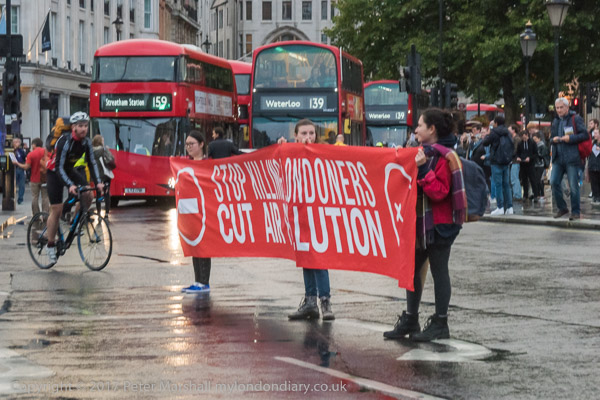
The protest outside Vedanta’s AGM held in Westminster on Wednesday 28th July 2010 was the first time I really became aware of the company and its mining activities. This protest concentrated on its plans to displace and wipe out an ancient civilisation in the Niyamgiri Hills of Orissa, India by bauxite mining.

Vedanta AGM Protest

The hills which would have been destroyed by their mining are sacred to the region’s Adivasis, primarily the Dongria Kondh tribes. By 2010 Foil Vedanta who organised the protest were saying that Vedanta had caused more than 100 deaths in the area though accidents, police shooting, forced displacement, injury and illness.

Vedanta AGM Protest

More than a thousand people have already been displaced, with 8000 under threat, moved away from their traditional sources of income and dumped into shanty towns where there is no work. Thousands of acres of fertile agricultural land have been destroyed, rivers and streams disrupted and drinking water contaminated by fly ash and toxic red mud.

Vedanta AGM Protest
Anil Agarwal is CEO of Vedanta

Vedanta Resouces is an Indian company founded and still run by the Agarwal family, but in 2003 was listed on the London Stock Exchange following a two year ban by the Securities Exchange Board of India from accessing capital markets after they were found guilty of cornering shares and rigging share prices.

Vedanta AGM Protest
Police push back security who assaulted activists who tried to enter the building

A damning report, Vedanta’s Billions: Regulatory failure, environment and human rights‘, issued by Foil Vedanta in 2018 accuses “the City of London and the Financial Conduct Authority” of minimising the risks associated with Vedanta’s legal violations and human rights and environmental abuses’ and failing to investigate or penalise any London listed mining company on these grounds.”

Among other crimes, the report names Vedanta as “the latest in a string of London listed mining companies linked to the murder or ‘massacre’ of protesters, including Lonmin, Glencore, Kazakhmys, ENRC, Essar, GCM Resources, Anglo Gold Ashanti, African Barrick Gold and Monterrico Metals.”

As well as Foil Vedanta the campaign against them was supported by Amnesty International, Survival International and Action Aid, and a number of campaigners had become shareholders so they could attend the meeting and attempt to question the company’s activities – and these included Bianca Jagger. Her presence and that of two bright blue aliens from the tribe destroyed in the James Cameron film ‘Avatar’ ensured that the protest for once got some press coverage. Also supporting the protest were the South Asia Solidarity Group, South Asian Alliance, Brent Refugee and Migrant Forum and London Development Education Centre.

The campaign against Vedanta had already been successful in getting various shareholders to end their investment, including the Church of England, the Joseph Rowntree Trust and the Dutch pensions company in ending their investments due to concerns about its approach to human rights and the environment. And continued protests by Foil Vedanta undoubtedly played a part in the company’s decision to de-list from the London Stock Exchange in 2018.

The company was helped to list in London by the British Government’s Department of Trade and Industry and the Department for International Development (DfID), and was getting continued support from the DfID Building Partnerships for Development programme and the Orissa ‘Drivers for Change’ research project, and former British Ambassador to Saudi Arabia and High Commissioner of India David Gore-Booth had been a directory.

Its billionaire CEO Anil Agarwal was said to have close links with the extremist umbrella group for Indian Hindu right-wing organistions, Sangh Parivar, said to be responsible for many attacks on Muslim and Christian communities in Orissa, Gujurat and other parts of India.

The Foil Vedanta report has a “special focus on illegal mining in Goa, pollution and tax evasion in Zambia, as well as illegal expansion and pollution in Thoothukudi, Tamil Nadu, industrial disaster at Korba in Chhattisgarh, land settlement and pollution issues in Punjab, displacement and harassment of activists in Lanjigarh, Odisha, and a mineral allocation scam in Rajasthan.

You can see and read more about the 2010 protest on My London Diary at Vedanta AGM Protest.


FlickrFacebookMy London DiaryHull PhotosLea ValleyParis
London’s Industrial HeritageLondon Photos

All photographs on this page are copyright © Peter Marshall.
Contact me to buy prints or licence to reproduce.

A Long Day Around Hull – 2018

A Long Day Around Hull: We were staying in Hull for a few days to celebrate our wedding anniversary and on Friday 27 July 2018 we visited some old friends in Cottingham before walking to Oppy Wood in the morning. A bus took us back to the city centre where we bought sandwiches for lunch to a bus to Stoneferry where we sat on the bank of the River Hull to eat them before walking back towards the Wilmington Bridge and crossing here to view the extensive Bankside Gallery before going to the Whalebone pub to refresh ourselves before making our way back to the city centre for dinner and spending some time with family members at the Royal Hotel.

It had been a long and rather tiring day and I had taken a great many photographs, a few of which are included in this post, but rather more are on My London Diary – links in the separate sections below. In particular I had decided to make many panoramic images on our walk.


Hull, Cottingham & Oppy Wood – 2018

Hull, Cottingham & Oppy Wood - 2018

We set off early from our hotel in the city centre and took a roundabout route to Hull Interchange photographing a few of the interesting buildings on our way. I made a few pictures from the upper deck of the bus on the way to Cottingham and on the short walk to have morning coffee with old friends in their bungalow.

Hull, Cottingham & Oppy Wood - 2018

From there it was another walk to Oppy Wood, created by the Woodland Trust around 2004, after they had planted 18,000 trees as a living memorial for the 200 local men from the Hull Pals battalions who died in the Battle of Oppy Wood, near Arras, France on May 3rd, 1917. There is a permanent Kingston Upon Hull Memorial at Oppy unveiled there in 1927.

Hull, Cottingham & Oppy Wood - 2018

Unfortunately extensive work was going on in the area in a flood prevention scheme for the city and access to the site – usually open to the public – was much more limited than normal.

More at Hull, Cottingham.


Stoneferry, Wincolmlee & City Centre

Hull, Cottingham & Oppy Wood - 2018
Cargill’s Oil Mill, built as Isis Mill for Wray, Sanderson & Co in 1912 and still crushing oil seeds

Again I took a number of pictures from the bus as we travelled from the city centre to Anne Watson Street where we walked to a quiet spot by the River Hull to sit in the sun and eat our sandwich lunch, before making our way back towards the city centre.

Hull, Cottingham & Oppy Wood - 2018

Unfortunately there is only a short part of the walk beside the river and much of the time we were walking along a busy hot dusty road until we got to the footpath leading to Wilmington Bridge which used to take the railway lines to Hornsea and Withernsea across the river – but now only has cycle and footpaths.

We crossed the river mainly to photograph the ‘Bankside Gallery’ – pictures in a separate section – but there is also now a little more access to the river than before here. Hull Railway bridge was still taking goods to and from the docks.

We walked north to the end of the gallery, then made our way back down Air Street to Wincolmlee, still with many small businesses some in the old buildings in poor condition but now few making any use of the river.

High Flags, WIncolmlee

We had got very hot and stopped for a drink at the Whalebone before making our way back to the city centre. There was still time to take a few more pictures there before going to meet family for a meal at the Royal Hotel at Paragon Station.

Much more at Stoneferry, Wincolmlee & City Centre.


Bankside Gallery

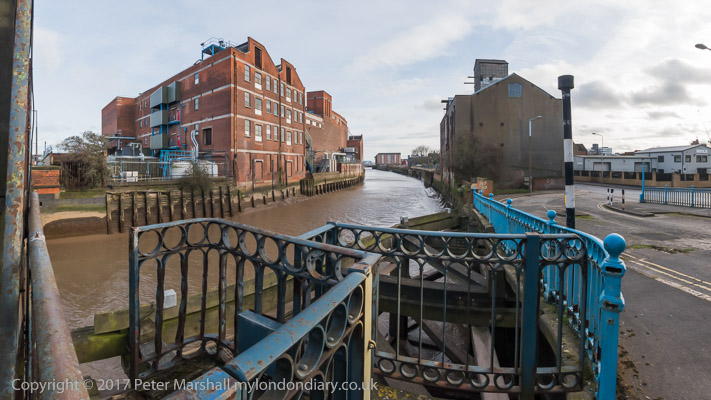
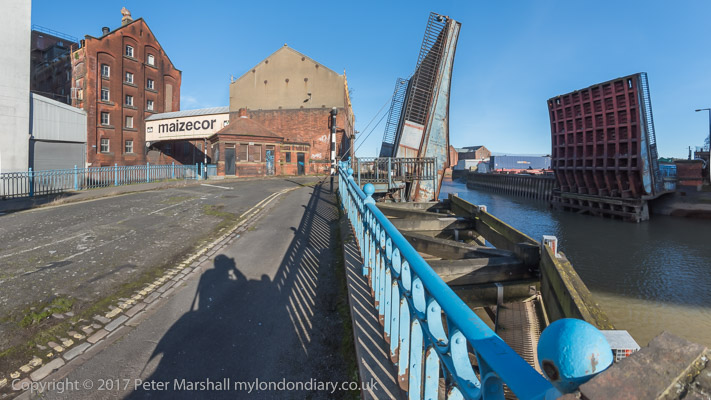
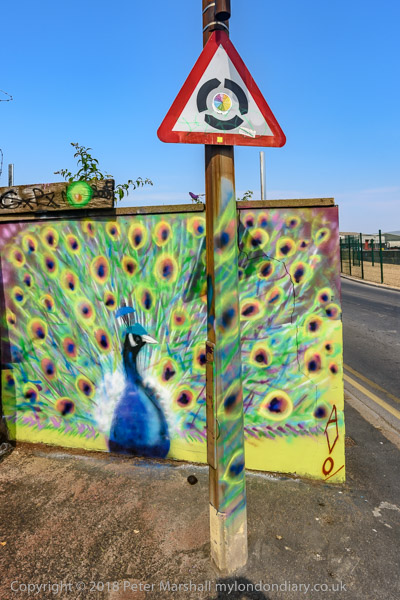
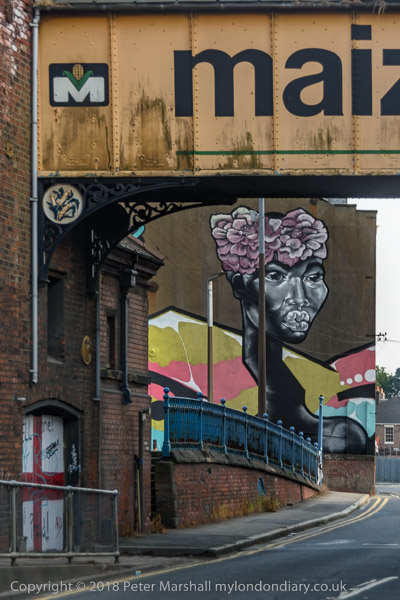
Hull has Banksy to thank for the Bankside Gallery. His ‘Draw The Raised Bridge‘ which appeared on Scott Street bridge on 26 January 2018 brought crowds to the area and inspired many to create murals on the many walls in the area, creating the extensive gallery.

The Grade II listed lifting bridge which has was closed to road traffic, its bascules permanently raised since 1995 was demolished in 2019-20. It had long been neglected by the city council both before and after closure.

Here I’ll post just three of the many images I took – there are many more at Bankside Gallery.


Hull Panoramas

On my visit to Hull in 2017 when it was UK City of Culture I had begun making a series of panoramic images in Hull, including many of the areas that I first photographed in black and white in the 1970s and 1980s for the work which became a show, ‘Still Occupied’ at the Ferens Art Gallery in Hull in 1983, and later a self-published book of the same name and more recently in a couple of Café Royal zines.

Scott Street Bridge

Here are two of them – and there are another 16 on My London Diary that I made during this walk – at Hull Panoramas.


FlickrFacebookMy London DiaryHull PhotosLea ValleyParis
London’s Industrial HeritageLondon Photos

All photographs on this page are copyright © Peter Marshall.
Contact me to buy prints or licence to reproduce.

The Great West Road and a Missing Lion – Brentford 1990

The Great West Road and a Missing Lion – Brentford: Continuing my walk on Sunday 7th January 1990 – the previous post was Chiswick Cottage and Lionel Road Brentford – 1990.

Vantage London, Great West Rd, M4, Brentford, Hounslow, 1990, 90-1f-45

Built around 1970 as the 12 storey headquarters of Beecham Pharmaceuticals it was no longer needed after they became part of Glaxo Smith Kline and was refurbished as as Vantage London with offices let to a number of companies. The building was again refurbished in 2016 and in 2019 was sold to a Luxembourg based company for £30 million.

In 2024 a planning application was made by Resolution Property for its conversion into 178 flats. It was approved following some modifications in April 2025.

The elevated section of the M4 runs on top of the Great West Road in front of the building. The strucvture in the foreground is I think a gritting bin.

Great West Rd, M4, Brentford, Hounslow, 1990, 90-1f-35

Taken under the elevated M4 where slip roads link the A4 Great West Road with the motorway. One project I was working on at the time was inspired by J G Ballard’s 1973 novel ‘Crash’, key scenes of which were set in this area – although the 1996 film of the book by Cronenberg was made in Canada. Ballard who lived not far away in Shepperton obviously knew the area well.

Crash centres around a car crash victim who finds himself aroused by car accidents but my project was more simply about the domination of our culture by the car and I felt threatened by the powerfully enclosed architecture here which is perhaps a modern equivalent of the Roman coliseums, and was rather choked by the fumes.

Beechams, Clayponds Lane, Brentford, Hounslow, 1990, 90-1f-21

On previous occasions I had photographed the iconic moderne 1930s buildings along the Great West Road, and this at right shows Beechams, which had this side entrance a few yards down Clayponds Lane. The factory building continues in a more utilitarian fashion but with a tall window, probably lighting a staircase which reflects the style.

Flats, Carville Hall, Carville Hall Park, Brentford, Hounslow, 1990,90-1f-22

The Carville Hall Estate was bought by Middlesex County Council in 1919 for the construction of the Great West Rd, and they sold the parts on both sides of the new road to Brentford UDC as a park, which opened in 1923. The house, orginally known as Clayponds, is now called Simmonds House. Originally built in the late 18th century, the front was re-modelled in the 19th century. It is locally listed.

The park is off Clayponds Lane and parts of it were once dug for clay, leaving ponds, marked as ‘Fishponds’ on the 1871 OS Map.

Lion, flats, Carville Hall Park, Brentford, Hounslow, 1990, 90-1f-23

Beyond the lion and the park are the tall blocks of the Brentford Towers Estate built for Hounslow Council in 1968-72.

The house here had extensive grounds and there is now a park on both sides of the A4/M4. The park to the north of the roads is larger than this but of little interest.

The house is thought to have been built for the “wealthy distiller and brewer David Roberts (c1733-97)” and was later home to “coal and horse racing magnate William Lancalot Redhead (c1853-1909) and his daughter“. It was later converted into flats.

Lion,  Carville Hall, Carville Hall Park, Brentford, Hounslow, 1990, 90-1f-24
Lion, Carville Hall, Carville Hall Park, Brentford, Hounslow, 1990, 90-1f-24

The fate of the lion appears to be a mystery. I was surprised on a later visit to find it no longer there and I’ve not been able to find what happened to it. The most I’ve come across is a suggestion that it was stolen.

I thought that it was probably a Victorian garden ornament made from artificial stone – Coade or Portland Stone etc – and would have been fairly heavy, so the thief would have needed a lorry with appropriate lifting gear.

More from my walk to follow.


FlickrFacebookMy London DiaryHull PhotosLea ValleyParis
London’s Industrial HeritageLondon Photos

All photographs on this page are copyright © Peter Marshall.
Contact me to buy prints or licence to reproduce.

Al Quds Day March in London – 2014

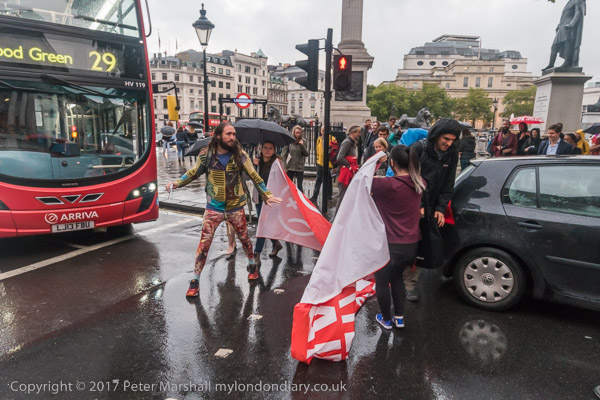
Al Quds Day March in London: International Quds Day is an annual event at the end of the Islamic holy month of Ramadan which expresses support for Palestinians and oppose Israel and Zionism. In particular it is a protest against the Israeli occupation of East Jerusalem – al-Quds in Arabic.

Al Quds Day March in London - 2014
Neturei Karta ultra-orthodox Jews oppose Zionism

A peaceful Al Quds march has taken place every year in London for over 40 years and the organisers describe it as having a “family atmosphere with demonstrators coming from all walks of life. Christians, Jews, Muslims, people of other faiths and none all march in common cause side by side.”
Al Quds Day March in London - 2014

This is largely true, but the march in London attracts counter-protests from Zionists and others (including Iranian freedom, communist and royalist movements and UK right wing fringe groups), which have sometimes led to confrontations and delays and increased security with some marchers becoming mistrustful of photographers.
Al Quds Day March in London - 2014

It has at times been a difficult event for me to cover in the close way I like work. Many of my pictures are made with wide angle or extreme wide angle lenses, 28mm or less focal length down to fisheye, working inside or on the edge of crowds. I want to be close to people, if not within touching distance, seldom more than a couple of metres away to give greater interaction and immediacy.

Al Quds Day March in London - 2014

The Quds Day march and rally in 2025 was on Sunday 23rd March, but chaotic rail services that day prevented me from covering it, though I had photographed a pro-Palestine rally close to the Israeli Embassy the previous day. The organisers pointed out that it was taking place “amid an ongoing genocide in Gaza where Israeli forces have slaughtered 50,000 civilians in Gaza, most of them women and children. At the same time armed colonial settlers and troops are running rampage in the occupied West Bank, invading, looting and attacking Palestinian towns and villages with the international community turning a blind eye or actively complicit in the slaughter.”

Al Quds Day March in London - 2014

Back in 2014, the situation in Gaza was dire. As UNRWA states, “During the 50 days of hostilities lasting from 8 July until 26 August 2014, 2,251 Palestinians were killed; 1,462 of them are believed to be civilians, including 551 children and 299 women. 66 Israeli soldiers and five civilians, including one child, were also killed. Overall, 11,231 Palestinians were injured during the conflict, including 3,540 women and 3,436 children.”

83 schools and 10 health centres were damaged, over 12,600 homes were totally destroyed and there was “a massive displacement crisis in Gaza, with almost 500,000 persons internally displaced at its peak.” The “scale of human loss, destruction, devastation and displacement caused by the 2014 conflict in Gaza – the third within seven years – was catastrophic, unprecedented and unparalleled in Gaza.”

But of course Gaza is now experiencing something far worse – and humanitarian agencies including UNWRA are being prevented by Israel from supporting the people and supplies of food and other necessities are largely being blocked. Inadequate amounts are brought in by the so-called “Gaza Humanitarian Foundation” and people desperate to get it are being shot by the Israeli Defence Forces.

Of course we all know this npw – even though the Israeli government has tried to hide it by preventing international journalists from entering Gaza – and also systematically targeting the Palestinians who are able to report. An article in Modern Times Review on July 15, 2025 quoted the Cost of War project as stating “more journalists have been killed in Gaza in the past 18 months than were killed in the U.S. Civil War, World War I, World War II, the Korean War, Vietnam, and Afghanistan combined.” Early in July the number killed in Gaza had risen to 226.

On 24th July 2014, the march began close to the BBC and went to a rally outside the US Embassy, then still in Grosvenor Square. It was covered by several foreign media organisations but – as with most UK demonstrations – willfully ignored by the BBC.

Protesters called for a boycott of Israel and an end to the occupation of Palestine as well as an end to the attacks on Gaza.

On My London Diary I give a list of the organisations supporting the march – and there is a rather longer list of those supporting the 2025 march. One of the major organisations in both is the Innovative Minds Human Rights Group (InMinds). Founded in 1997 and alleged to have links to the Iranian Islamic Republic it has held regular protests in London against companies supporting the Israeli military, against the arbitrary detention of Palestinians, the torture and imprisonment of Palestinian children and calling for an end to apartheid in Israel.

In the pictures you will see many flags and posters from Inminds – and also a few images of Ayatollah Khomeini who started the celebration of Al Quds Day in Iran in 1979 as well as the current Supreme Leader of Iran, Ali Khamenei.

Also standing out in my pictures are the ultra-orthodox anti-Zionist Neturei Karta Jews who state clearly their belief that Judaism is a religion and not a state, and “Judaism rejects the Zionist state And condemns its ATROCITIES”

One contentious issue in 2014 was over the carrying of flags of the Lebanese Shia Islamist political party and paramilitary group Hezbollah. In 2014 the political party, which was part of the government of Lebanon had not been proscribed and it was only illegal to carry it if there was other evidence to show support of the proscribed terrorist group. I was looking for these flags but only found a very few to photograph.

As the march made its way down Regent Street there were shouts against it from an upper floor window and vegetables were thrown down at the marchers who shouted back angrily. The march organisers asked police to investigate and urged to people to march on.

I left the march well before it reached the US Embassy and saw no other protests against the march. You can see more pictures from the march on My London Diary at Al Quds Day march for Jerusalem.


FlickrFacebookMy London DiaryHull PhotosLea ValleyParis
London’s Industrial HeritageLondon Photos

All photographs on this page are copyright © Peter Marshall.
Contact me to buy prints or licence to reproduce.