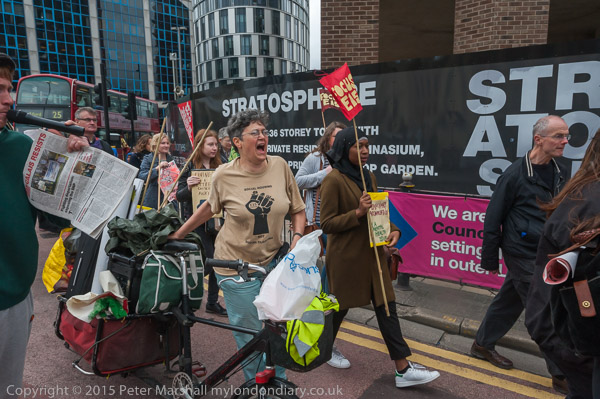
Milad 2007 – Eid Milad-Un-Nabi: On Saturday 14th April 2007 I was invited to the Eid Milad-Un-Nabi Procession and Community Day in Tooting in the south of London.
Eid-e-Milad-un-Nabi, also known as Mawlid, is observed on the 12th day of the third month of the Islamic calendar, Rabi’ al-Awwal. It commemorates the birth of the Prophet Muhammad. The name means “the first Spring” and it is a bank holiday in parts of India and there are processions in Lahore and elsewhere in Pakistan where it is a national holiday as in almost all Islamic countries. The day is celebrated by both Sunni and Shia Muslims. Some local Muslim Saints also have Mawlid celebrations on their birth dates in some Muslim countries.
In 2025, Mawlid is the Islamic Day from sunset to sunset on Thu, 4 Sept 2025 – Fri, 5 Sept 2025. Here is the post I made in 2007 on My London Diary with normal capitalisation and minor corrections.
April seems to be a very religious month for me. On Saturday 15th I went to the celebration of the Prophet’s birthday organised by the Sunni Muslim Association in Tooting which included a Juloos or procession from Tooting Bec Common through Tooting to the Leisure Centre in Garratt Lane.
Eid Milad-un-Nabi, or simply Milad, is an all-day community event and one that doesn’t tolerate “political banners or activists“. It was one of the friendliest events I’ve photographed, and as well as several hundred Muslims, their were also honoured guests including the Mayor of Wandsworth, various representatives of the police, of the fire service, a chaplain, someone from the local council of churches, the local conservative candidate and others.
It was a hot day, and walking in the sun made it feel hotter. I was glad to arrive at the leisure centre and take off my shoes, and relax on the mat in the hall. It was just a little dark for taking pictures (and I was still having to use an old flash unit while I wait for the new one to be returned from servicing) and both the whirling dervishes and the Islamic Martial Arts display presented a challenge, although the speakers were not too difficult.
The speeches, in English, stressed the peaceful aspects of Islam (and declared suicide bombing and violent demonstrations over the cartoons of the prophet as un-Islamic.) Perhaps the longest speech was by Lord Sheikh, a Conservative life peer since 2006, chairman of the Conservative Muslim Forum and also chairman of the Conservative Ethnic Diversity Council, who has had an extremely successful career in insurance since coming here from Uganda.
I left shortly after, and decided not to wait to pay homage to the Holy Relic Of The Prophet (peace be upon him) as I wasn’t sure if I was in a suitable state of purity and cleanliness. Probably not. But it had been a very positive and enjoyable day.
Who Wants to Evict a Millionaire? On Saturday 13th April UK Uncut led a protest against the benefit cuts and new taxes being brought in that will most severely impact many of the poorest and particularly the disabled in our society with a lively peaceful protest against Tory Peer Lord Freud, one of the millionaire architects of the bedroom tax.
Tories Against the (Bedroom) Tax protester on the Northern Line as UK Uncut travel to Archway
David Freud, a grandson of Sigmund, had made a fortune as a merchant banker before retiring in 2006 when he was asked by New Labour’s Prime Minister Tony Blair to review the UK’s welfare-to-work system. His 2008 report ‘Reducing dependency, increasing opportunity: options for the future of welfare‘ included making use of private companies to help lone parents and people on Incapacity Benefit back into work and for a single working-age benefit payment to replace the whole range of those currently being paid.
Green Party leader Natalie Bennett had come to take part in the protest
Many in the Labour Party found his ideas unpalatable, and Gordon Brown refused as prime minister to cut welfare spending. Freud then switched to supporting the Conservatives and in 2009 was made a life peer and became a Tory shadow minister. After the 2010 election Freud became Parliamentary Under Secretary of State for Welfare Reform at the Department for Work and Pensions.
Iain Duncan Smith had become Secretary of State for Work and Pensions and took up Freud’s ideas, working on the introduction of Universal Credit, introducing a new Work Programme under which claimants could be sanctioned, losing benefits for up to three years if they were judged to be failing to cooperate and making real terms cuts in benefits.
The ‘UK Uncut Removals’ van – ‘Millionaire eviction specialists’ – arrived just as we turned off Hillway into Langbourne Ave
Damaging to many as these policies were in principle, they were made much harsher by the sheer incompetence Duncan Smith imposed on the Department of Work and Pensions and his failure to realise or empathise with the very different lives of poorer people. For him or Freud a delay of five weeks in receiving payments would be no problem – their resources would seem them over and they could easily borrow from family or friends – or even banks.
But those on benefits had no resources to fall back on. If payments were delayed or they were sanctioned they would have no money to buy food, heat their homes, pay rent.
Some facts about benefits and the problems caused by cuts
Famously in April 2103 after a claimant had told the BBC he had £53 per week after paying housing costs, Duncan Smith replied that he could live on £53 per week. And in 2015 he “was criticised after the DWP admitted publishing fake testimonies of claimants enjoying their benefits cuts. Later the same month, publication of statistics showed 2,380 people died in a 3-year period shortly after a work capability assessment declared them fit for work.”
The Removal men had come with boxes
It was the policies of Freud and Duncan Smith that led to the huge increase in the need for food banks. In 2010-11 the Trussell Trust distributed 61,000 food parcels. By 2022-3 that annual figure was “close to 3 million, almost a fiftyfold increase.“
But the police were not letting them get on with the job
The protest was particularly directed against the ‘Bedroom Tax’, which penalised tenants in public housing by reducing their Housing Benefit if they were judged to have more rooms than they needed. It was meant to reduce the costs to and encourage council tenants to move to smaller accommodation – but as this was seldom available its result was simply to impoverish them. And it hit some groups particularly the disabled hardest, as they might have to move away from properties that had been suitable and adapted to their needs.
But there were also other measures, including a benefits cap which was being brought in across the country in stages to put a strict limit on the amounts that people may receive. It seemed inevitable that this would lead to many thousands being evicted, particularly in high rent areas such as London, as well as a cut in legal aid and council tax benefits and an end to disability living allowances.
Those benefits which remain will rise by less than inflation – a cut in real terms. And these cuts were taking place at the same time as the 50p tax rate was being abolished, saving the UK’s 13,000 millionaires around £100,000 each.
I went with the largest group of the protesters, who met at King’s Cross to travel to an undisclosed location, which turned out to be the Highgate home of Tory Peer Lord Freud.
Owen Jones
Outside his home there were a number of performances and speeches which you can read more about at the link below to My London Diary. And the protesters gave a huge cheer when it was announced that disabled activists from DPAC (Disabled Persons Against Cuts) had visited the home of Ian Duncan Smith and also delivered an eviction notice there.
Heathrow Villages fight for survival: On Sunday 12th April 2015 in the run up to the 2015 General Election, campaigners launched a renewed fight against the expansion of Heathrow which threatens to swallow up much of the area, showing again the local determination to protect its historic community against a third runway.
As a fairly local resident although on the other side of Heathrow I’d been involved in the successful campaign a dozen years earlier against the expansion, which had eventually convinced all political parties that expansion at Heathrow was politically impossible. And when the 2010 election put a Tory Lib-Dem coalition into power plans were cancelled as the Lib-Dems had always strongly opposed them.
Datchet Border Morris in the Great Barn
But Heathrow had not taken NO for an answer and had continued to spend a considerable amount lobbying for it, including setting up a heavily funded PR organisation called ‘Back Heathrow’ to come up with spurious survey results suggesting local backing for expansion.
In 2012 the coalition government set up an Airports Commission led by Sir Howard Davies who had held many leading roles as an economist for both governments and private companies and who when appointed resigned from his roles as an adviser to GIC Private Limited, formerly known as Government of Singapore Investment Corporation, a part owner of Heathrow.
Officially the commission’s role was to consider how the UK could “maintain its status as an international hub for aviation and immediate actions to improve the use of existing runway capacity in the next 5 years” but unofficially it was designed to produce a political consensus in its final report in Summer 2015 that would put Heathrow expansion back on track.
The Polar Bears brought their banner ‘Any new runway is Plane Stupid’
In October 2016 the Tories under Theresa May made a third runway and a new terminal a central Government policy, and in June 2018 the House of Commons voted by a large majority in favour, despite the opposition or abstention of most London MPs.
Clifford Dixon (UKIP), Pearl Lewis (Conservative), John McDonnell (Labour) and Alick Munro (Green)
The Supreme Court in 2020 ruled the government’s decision had been unlawful as they had not taken their committments to climate change under the Paris agreement into account. The government then accepted the judgement, but Heathrow appealed and won, with the ban being lifted.
John Stewart of HACAN(Heathrow Association for the Control of Aircraft Noise)
However the plans have so far not gone ahead, in part because governments have not agreed to pick up the huge infrastructure costs around the airport that would be required and that Heathrow were unwilling to finance.
A war veteran plants a tree on the recreation ground against Heathrow expansion
When the right-wing led Labour government came to power in 2024, they immediately set about making changes to the planning process that would enable developments like Heathrow to go ahead with little or no proper examination and inquiries. And in January 2025 they “confirmed it was the new Labour government’s plan to proceed with a third runway within the current parliamentary term.”
However the arguments against expansion continue to grow in strength, particularly on environmental grounds and the Trump-initiated slump in world trade seems likely to damage the economic arguments for expansion as well as increase the already huge costs of the project. So it still seems unlikely that it will happen, and certainly not by the “projected completion date around 2040.”
You can read more about the activities in Harmondsworth around the village centre back in April 2015 on My London Diary and see the strength of the local opposition back then. There were Morris Dancers performing outside the village pubs and inside the incredible Grade I listed Great Barn and a rally with the Plane Stupid polar bear, speeches from the general election candidates and protesters on what would be the new Heathrow boundary in the village centre.
Heathrow has of course promised the Great Barn would be protected along with the fine part 12th Century Parish Church, but they would not be the same without their context.
Heathrow represents a huge failure by successive governments over many years to set up a new major airport for London at some more suitable location. Even when opened as a civil airport in 1946 it was not a particularly suitable location, though when relatively small and quiet aircraft such as the DC3 were in use it was not a great problem. But once these began to be replaced by larger noisier and more polluting jets and passenger numbers and traffic in the surrounding area shot up the need to close it and move to a new location was clear. Heathrow’s answer was always to expand and make the problems worse, building new terminals (and actually closing runways that had become too short for the newer aircraft.) Heathrow should have been closed down years ago – and would have been a great site for a new town.
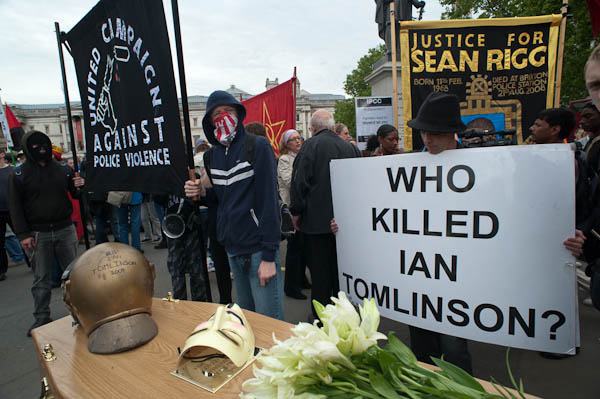
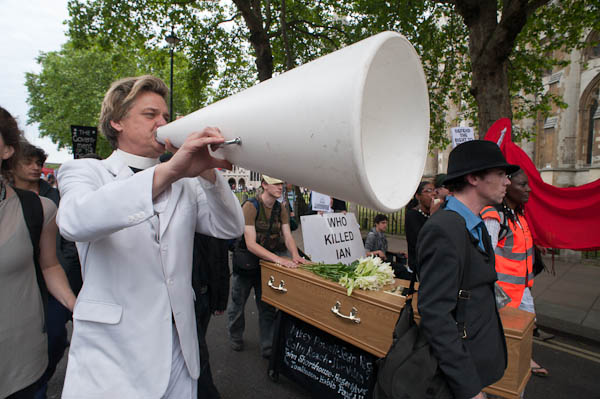
Ian Tomlinson Killing & Sri Lanka Genocide: On Saturday 11th April 2009 people marched from Bethnal Green Police Station to the spot were news vendor died after an unprovoked attack by police officer Simon Harwood. I also photographed a much larger march by Tamils against the genocide taking place in Sri Lanka.
March in Memory of Ian Tomlinson – Bethnal Green Police Station & Bank
G20 Meltdown, the organisers of the protest at Bank on April 1st 2009 where police officer Simon Harwood attacked Ian Tomlinson leading to his death, had organised a memorial march from Bethnal Green Police Station to the place where he died a few yards away from the attack.
Police discuss the march with Chris Knight
Tomlinson was not involved in the protest, but simply trying to make his way home after having been working, selling newspapers in the City. The protest would probably have been over by the time he was killed, but police had turned what had been intended as a carnival party into something far more sinister, kettling and then attacking many demonstrators and killing Tomlinson. There were numerous injuries and one photographer had his teeth knocked out, but I had seen the kettle coming and had left the area to cover another event.
At the Tomlinson family’s request, the march was peaceful, silent and respectful. Before it started his stepson Paul King spoke briefly, describing the family’s trauma from the tragic death of his step-father, a “much-loved and warm-hearted man,” and pain at seeing the video of the assault, and he hoped that the investigation would be full and that “action will be taken against any police officer who contributed to Ian’s death through his conduct.”
Paul King
As usual the investigation was carried out by the IPCC and the Crown Prosecution Service decided not to charge Harwood. After an inquest verdict of unlawful killing the CPS had to change their mind and charged him with manslaughter.
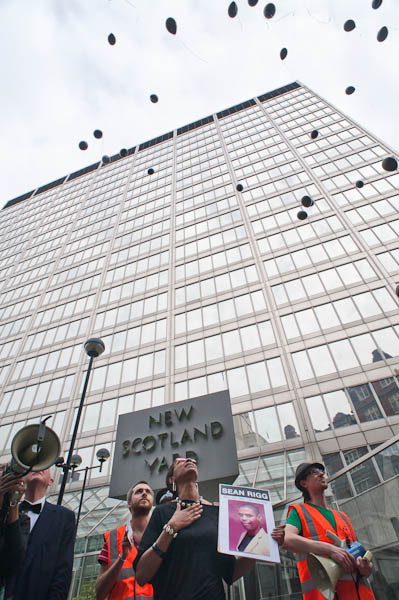
The sisters of Sean Rigg, murdered by police at Brixton the previous August were on the march
The jury was unable to hear evidence about his behaviour in previous incidents and was seriously misled both by some of Harwood’s own evidence and the evidence given by the first pathologist who had examined the body, Dr Freddy Patel. He had destroyed some vital evidence, puring away body fluids and had a long record of botched postmortems, having previously been suspended twice and finally was struck off the medical register in 2012.
After Harwood’s acquittal he was dismissed from the police. Tomlinson’s family took civil proceedings and in 2013, “the Metropolitan Police Service paid Tomlinson’s family an undisclosed sum and acknowledged that Harwood’s actions had caused Tomlinson’s death.
I left the march before it arrived at Bank, but returned the following day to photograph the flowers that had been left in Royal Exchange Buildings where the assault had taken place and a vigil was being held by Chris Knight, one of the G20 Meltdown organisers and a few others.
Tamils March – Stop Sri-Lanka Genocide – Temple to Hyde Park
A huge crowd had assembled on the Embankment at Temple, perhaps as many as 200,000, a very high proportion of Tamils in the UK who are thought to number around 300,000, around two thirds of them of Sri Lankan origin. It was a crowd with very few white faces.
Despite the size of the protest there appeared to be very little UK media interest and I saw no photographers or TV crews from major UK media covering the march to Hyde Park. Where there are usually a crowd of photographers in front at the start of large marches in London, for this one there was just me and three other freelances, none of whom get regular work for the mass media.
By April 2009 the civil war in Sri Lanka was clearly coming to an end, with the Tamil Tigers having been pushed back into a very small area. They had been defeated at a major battle at Aanandapuram on 5th April and the final assault by the government forces came at the end of the month with Sri Lanka declaring victory on May 16th.
Many of those taking part in the march were clearly supporting the “the LTTE, the Liberation Tigers of Tamil Eelam. A few carried actual tigers, fortunately only large toys, but many more wore the colours or carried flags or portraits of the founder and leader of the Tamil Tigers, Velupillai Pirapaharan.“
The LTTE was proscribed in 2000 and they were clearly committing an offence under the Terrorism Act 2000 by supporting the group or wearing clothing which arouses the “reasonable suspicion that he is a member or supporter of a proscribed organisation.” But clearly the Tamils were not intending to cause any serious trouble and police sensibly made no attempt to arrest them all. Only three arrests were reported.
The Tamils had lost in Sri Lanka and many both civilians and combatants were killed during the civil war – possibly almost 150,000 in the last 8 months of the civil war. Around 300,000 were transferred into special closed camps, described by many as concentration camps – they were slowly released and the camps were closed by the end of September 2012.
Welfare State & Tar Sands Party: On Saturday 10th of April 2010 pensioners led a march to defend the welfare state and oppose cuts in public services and later I went to a party at a BP garage in Shepherds Bush against the company’s plans to exploit Canadian tar sands.
Defend the Welfare State – Temple
The National Pensioners’ Convention, which represents over a thousand local regional and national pensioner groups with a total of 1.5 million members had organised a march and rally in London to defend the public services they are particularly dependent on ahead of the 2010 general election. The march was supported by the TUC and all major unions.
Age Concern has predicted that over 40% of votes in the next month’s election would be made by those over 60, and had identified five key issues which particularly impact pensioners. In particular they said that the basic state pension was seriously inadequate and the pension rise of only £2.40 was far too low. A quarter of all pensioners were living in poverty.
But all three major parties were making plans for cuts in public expenditure and moving away from the consensus Britain had come to during and after the Second World War, the welfare state with pensions, a free NHS, free education and other public services. Over the years some of these provisions had been eroded (and in a few areas such as dental care, never fully implemented) but now they were increasingly under threat, whichever party wins the general election.
Huge deficits had come from handouts to the bankers and the cost of wars in Iraq and Afghanistan, and the NHS had been hit particularly hard by the costs of privatisation under the huge debts from the Private Finance Initiative.
Cuts to local authorities who many pensioners rely on for social care and support services such as meals on wheels, as well as housing benefit, threaten the daily life of many and are leading to the closure of day centres and other provision.
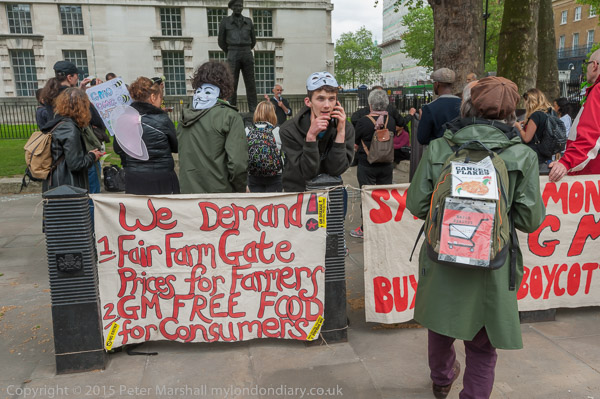
It was pressure from protests such as this, as well as the presence of the Lib-Dems in the coalition with the Tories that was elected that led to the introduction of the “triple lock” on pensions in 2010. In 2020 the state pension was around 16% of average earnings and by 2025 it had risen to around 25%. But pensioners have been badly hit by cuts in care.
Tar Sands Party at the Pumps – BP, Shepherd’s Bush Green
BP Sponsors Climate Chaos
The UK Tar Sands Network, Rising Tide and the Camp for Climate Action had organised a ‘Party at the Pumps’ as a part of a ‘BP Fortnight of Shame’ trying to get BP shareholders to reverse the company’s decision to take part in the exploitation of the Canadian Tar Sands which environmental activists say is “the dirtiest and most desperate attempt yet to profit from – and prolong – humanity’s crippling addiction to oil.“
Whistles signal its time to follow the flags and get on the Central Line
Extracting usable crude oil from tar sands always results in between three to five times the amount of carbon dioxide production as normal oil wells. Deposits close to the surface are strip mined, destroying ancient forests and peat bogs to dig up around 75 metres depth of sand and oil with huge trucks and mechanical shovels.
At the previous stop we were told to alight at Shepherds Bush
In Alberta four-fifths of tar sands are too deep to be mined in this way and are brought to the surface by the injection of high pressure steam – which uses around twice as much energy and pollutes twice as much highly toxic waste water which is already leaking into drinking water.
Indigenous people living in the area have very high cancer rates and their staple moose meat has been found with 300 times the acceptable level of heavy metals from the tar sand extraction.
People on the canopy roof with a banner
BP only got involved in the Canadian tar sands in 2007, probably because they had cheaper sources of oil elsewhere. They signed up with Canadian company Husky Energy for a large-scale tar sands project they called the ‘Sunrise Project’ and for other tar sands projects. This was put on hold when oil prices crashed in 2008, but BP shareholders were expected to approve it going ahead at their meeting in April 15th.
Protesters were told to meet at Oxford Circus with a Travel Card and after an hour or so we all – including a few police – went down into the station following those with green and yellow (BP’s colours) flags, at least some of whom knew our destination and boarded a west-bound Central Line train.
At Shepherds Bush the message came to alight. We rushed behind those carrying the flags along the busy shopping street, across the green to the BP garage on the south side, which had already been occupied by a smaller advance group of demonstrators.
Some of them had got onto the roof from scaffolding on a neighbouring block of flats and were fixing a banner there, while others blocked the forecourt entrance with a large ‘CLOSED’ banner. The protesters occupied the area and put tapes and stickers around the petrol pumps and elsewhere with the messages ‘DANGER GLOBAL WARNING‘ and ‘BP TAR SANDS – BACK TO BLACK?’
The Rhythms of Resistance band had also arrived and was drumming loudly and there was also a bicycle trailer sound system and the protesters were dancing. A live band and a caller played for more dancing and the protesters sat on the pavement and talk, eat sandwiches and snacks and drink, while some handed out leaflets to the passers-by and explained why the protest was taking place.
When I left after a couple of hours the protest was continuing. Police and a man from BP had earlier asked them when they would be leaving and were told ‘sometime later in the day‘ and assured that they would cause no permanent damage and although the police were still watching the protest, filming and taking notes but not otherwise taking any action. I presume BP had asked them to avoid more publicity for the event by trying to force it to an end or make arrests.
2004 Aldermaston March. On Friday 9th April the 2004 Aldermaston March began with a rally in Trafalgar Square before following the route taken by the first march back in April 1958, which had also begun with a rally in the square. The 2004 march was called as a protest against the development then of a new generation of nuclear weapons.
A young marcher on the way from Reading to Aldermaston
I covered the rally and went with the marchers as far as Hyde Park, and cycled to join them again in Maidenhead on Sunday 11th, walking with them for a few miles before returning to pick up my bike and cycle home. On the final day I caught the train to Reading and walked with them to Aldermaston.
I put many of my pictures from the march on My London Diary where you can still view them, and wrote a post about the events which I’ll reproduce here with proper capitalisation and some minor corrections, along with a few of the pictures I made in London on Friday 9th April 2004.
Aldermaston 2004: No New Nukes Rally & Start of March
Aldermaston isn’t in London, but the ‘stop the next generation of nuclear weapons‘ march from London to Aldermaston started on Good Friday, 9 April 2004, from Trafalgar Square, where there was a ‘No New Nukes‘ rally.
Aldermaston and nearby Burghfield are at the centre of the UK’s atomic weapon programme, and the march was a protest against the development of a new generation of nuclear weapons.
Pat Arrowsmith addresses the rally
In 1958 the dangers of nuclear war were clear to most of us, and almost fifty years of the proliferation of weapons of mass destruction among members of the nuclear club make them even more of a danger now. We have seen another almost 50 years of lies and deception dressed up as security and national interest. For example we still haven’t been told of the nuclear warheads kept by our American allies at Lakenheath.
It was good to see many familiar faces, both on the platform and off, with addresses from Tony Benn, Jenny Jones, Pat Arrowsmith, Jeremu Corbyn and more, including a fine performance from Susannah York. There were a considerable number who had been on the first Aldermaston march, back in 1958, forty six years ago. I was too young to be involved then, but my two older brothers had been there.
Street theatre about Trident from Theatre of War
‘Theatre Of War’ gave a spirited performance, and there was a jazz band to add a little spirit at the front of the march, perhaps a reminder of the trad boom of the fifties. Pat Arrowsmith, Bruce Kent and some other CND veterans were up there too, leading off the 2,300 who led off through St James. The police estimated the march at 1000. I actually stood and counted as they went by, and although it isn’t an exact science with a march this size, I won’t be more than fifty or so out either way.
A single Trident submarine has warheads equivalent to 3000 Hiroshima bombs.
It was a cheerful sendoff to those marchers on the long plod to Aldermaston, one of several marches there starting from different parts of the country.
At Hyde Park, the march proper formed up, with around 430 making their way west through Kensington and towards the first night stay at Southall. I couldn’t walk all the way, although I’d probably covered as much distance running around taking pictures and left the march in Kensington.
On Saturday, the march continued from Southall to Slough via Uxbridge. I had other things to do in the East End and central London, but I managed to catch up with the march on Sunday morning at Maidenhead Bridge with some furious bike riding from Staines.
Pat Arrowsmith
By then, some problems with Thames Valley Police had emerged, with the police trying to force the march on to the pavement, while some marchers insisted on keeping to the road. In the end a compromise emerged, with the police tolerating those who wanted to stay on the road walking close to the edge of the pavement.
From Maidenhead it seemed a long walk along the A4 to Knowl Hill for a rather late lunch stop. There we were greeted from a distance by the sounds of the Sheffield Samba Band who piped the march in to lunch. I regretted not bothering to pick up my meal tickets, but was really too busy to stop to eat. I photographed the column of marchers setting off for Reading and then started a more lonely walk back to Maidenhead and my bike.
Bristol Radical Cheerleaders
By this time I was feeling the strain. Even on my ‘day off’ on Saturday I’d walked over 10 miles with a heavy camera bag, and the weight of a Nikon with a solid lens round my neck was getting to be too much. So for Monday I travelled light, working with a tiny Canon Digital Ixus. It had the nasty habit of often not taking a picture until a second or so after you pressed the button, by which time I’ve usually put the camera down, so I came home with quite a few pictures of random patches of road and grass from Berkshire. However, as you can see on My London Diary, some came out.
On Monday I walked all the way and a few miles more, with pictures from Reading to Burghfield, were we stopped close to AWE Burghfield [where atomic bombs are made] to the end of the march rally at AWE Aldermaston, after which we took a walk halfway round the large site.
Aldermaston2004 was jointly organised by CND, the Aldermaston women’s peace Camp and Slough4Peace.
CND is still active, still campaigning for peace and a nuclear free world and opposing the UK’s possession of nuclear weapons. As they say, “Nuclear weapons threaten us all. And they are an obscene drain on public finances.” You can find out more about their actions and sign their petition calling on the government to embrace diplomacy and peace negotiations, instead of nuclear weapons and war and take steps towards nuclear disarmament and a safer world.
Ratcliff Highway and Limehouse Basin: My first photographic walk in 1990 came at the end of the Christmas and New Year season on 6th January 1990 when I returned to Limehouse for another walk. I’d taken quite a few pictures there back in 1984 and I thought it was time for another extensive visit. Getting there was easier now that the DLR ran to Limehouse. I left the station and walked down Branch Road.
Obviously not built as a Scout HQ, but something rather more official, and this was built in 1898 as the Stepney Borough Coroner’s Court.
Branch Road was apparently earlier called Horseferry Branch Road and led to a ferry across the Thames here – and Branch Road still leads to a road called Horseferry Rd. An ancient ferry ran from Ratcliff Cross Stairs and would have taken horses and carts as well as people across to Rotherhithe. You can still go down to the foreshore here from Narrow Street down the Grade II listed stairs but of course there is no ferry. The listing is probably more for the historic interest of the site – the stairs themselves are are relatively modern concrete replacement and the ancient causeway here apparently disappeared around 2000.
Tubular Barriers, The Queens Head, The Highway, Limehouse, Tower Hamlets, 1990, 89-12d-34
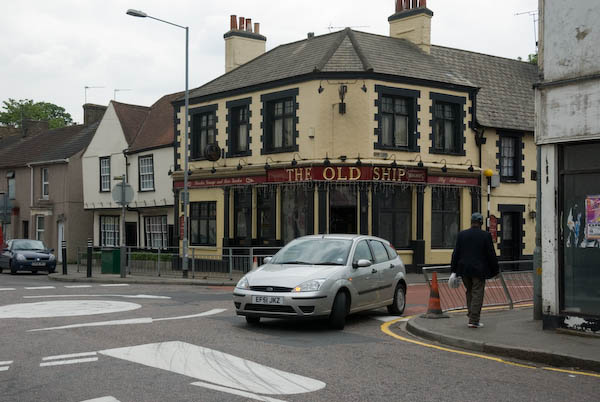
At 491 The Highway – formerly known as Ratcliffe Highway – close to the corner with Butcher Row – the Queens Head pub to the right of this view – was demolished soon after I made this picture in 1990, along with the rest of these buildings. At the left is a sign for the Limehouse Link tunnel, built between 1989 and 1993 and I think this was a storage yard for the work. The western end of the tunnel is a short distance to the east.
Another part of the Tubular Barriers site on The Highway which I think I photographed mainly for the graffiti ‘ELECTROCUTE MURDOCH’ on its wall. I think this was at the corner with Butcher Row. Though the company name also made me think of the Mike Oldfield album Tubular Bells.
There had been a particularly bitter and hard fought (sometimes literally) fight over the opening of Murdoch’s News International print works at Wapping in 1986, following the dismissal of all 6000 of the print workers at the previous Fleet Street hot metal print plant.
Works, 503-9, The Highway, Limehouse, Tower Hamlets, 1990, 89-12d-25
Control of the development of the Docklands areas was in 1981 taken away from the local authorities and given to the London Docklands Development Corporation (LDDC) a quango agency set up by Margaret Thatcher’s Secretary of State for the Environment, Michael Heseltine. Although this resulted in a faster regeneration of the area this was largely driven by the interests of global capital and often went against the interests and needs of the local communities. This whole area was demolished around 1990. I did wonder if the three-storey building might be a former pub.
Works, 503-9, The Highway, Limehouse, Tower Hamlets, 1990, 89-12d-12
Notices on the shop-front at right read
‘DOCKLANDS LOCAL PLUMBERS & ELECTRICIANS
CAN THE LDDC LEGALLY STEAL OUR LAND? 57 MEN TO LOSE THEIR JOBS’
The LDDC had wide ranging powers and legalised thefts such as this. It was an area in need of redevelopment and the LDDC got this moving at pace, but it would have been far better to have found ways to retain former businesses and provide more social housing and other community assets.
Considerable building work was taking place around the lock linking Limehouse Basin to the River Thames.
This is the ship lock and there had once been two narrower barge locks a short distance west. The ship lock was built slantwise to make for and easier entry by larger ships (up to 2000 tons) from the river and was a part of its enlargement in 1869. The lock had two compartments with three gates. In 1990 the outer gates to the Thames were still in place (in pictures not yet digitised) but no longer in use and the other two replaced by this much narrower single lock, suitable for the smaller vessels now using the Basin as a Marina.
A building for Limehouse Waterside and Marina on the corner of the 1869 Ship Lock and Limehouse Basin. Running across on the opposite side of the water is London’s third oldest railway viaduct, built in 1840 for the London and Blackwall Railway and now in use for the DLR.
New Charlton in Colour – 1995. New Charlton has now been given the new and more descriptive name of Charlton Riverside and is the area between the River Thames and the main road from Greenwich to Woolwich, Woolwich Road. The major feature of the area other than the river is the Thames Barrier, but although I photographed this in black and white it does not appear in my selection of colour pictures. I had photographed it in black and white and colour on several occasions since 1984 from both sides of the river and so felt no need to visit it again in 1995.
Eastmoor St, New Charlton, Greenwich, 1995, 95c5-743
I did find a very different barrier on Eastmoor Street, with this monumental slab apparently cut out to leave a gateway through this reflective red wall. Whatever its original purpose – I think perhaps an art work – it seemed to have served for target practice probably for bricks thrown by local youths.
Classic Car Restorations, New Charlton, Greenwich, 1995, 95c5-733
And I did photograph Thames Barrier Classic Car Restoration with its texts and pictures of cars on its wall.
Carpet Kingdom, New Charlton, Greenwich, 1995, 95c5-732
The redevelopment of the area had begun when the Thames Barrier was opened, but much was still industrial or derelict but large parts are now occupied by large retail units. Carpet Kingdom was one of the first to open, though I don’t remember exactly where. There is now a rather larger Carpet Giant in the area,
You can still see this giant mural, details from which are in my two pictures. It was painted on the wall of this house in 1976 by the Greenwich Mural Workshop in 1976 and has now faded considerably.
Mural, Charlton, Greenwich, 1995, 95c5-725
Just south of the railway line close to Charlton’s ground at The Valley and so in Charlton rather than New Chalton, I had glimpsed it in my journeys past on the train and so went to photograph it.
Annette, Hair Stylist, Valley Grove,Charlton, Greenwich, 1995, 95c5-724
Annette Hair Styling was just around the corner from the mural in Valley Grove, so also in Charlton rather than New Charlton.
Junior Doctors and Student Nurse Bursaries: On Wednesday 6th of April 2016 I photographed a picket and rally against the imposition of new contracts on junior doctors – hospital doctors now renamed to resident doctors to better reflect their status and then a march rally and die-in against the axing of NHS Student Bursaries.
The NHS was under attack from the Conservatives in various ways throughout their time in government from 2010 to 2024 and its hard to find any rational explanation of most of their policies other than a desire to bring in increasing privatisation. A desire perhaps largely driven by MPs financial interests in health companies as well as by the donations they receive.
Although the Labour Government quickly solved some of the outstanding pay issues in the NHS, research reveals that “Starmer’s cabinet received more than £500,000 in donations alone from lobbyists, hedge funds and private equity firms connected to the private healthcare sector since 2023.”
The Good Law Project gives more details on some of these donations to Wes Streeting. They say that “60% of the registered donations accepted by the health secretary come from people and companies linked to private health“, amounting to a total of £311,400 since 2015. Streeting has been one of the most vigorous advocates of private health company involvements in the NHS.
Support for Junior Doctor’s Picket – St Thomas’ Hospital
New contracts being imposed by Secretary of State for Health and Social Care Jeremy Hunt were described as sexist, racist and classist, and as aimed at easing the takeover of the NHS by private healthcare companies which is currently taking place. The doctors say the contract will reduce safety in hospitals, removing safeguards on overwork and unsocial hours. They claim the contract will particularly affect the disabled and women in general, both as workers in the NHS and as users of its services.
There were speeches at a rally next to the picket line at St Thomas’ Hospital and supporters, including Sisters Uncut, trade unionists, students, student nurses, medical professionals and DPAC members had come to support the doctors.
As well as some junior doctors, other speakers included Sara Tomlinson of Lambeth Teachers Association who announced that the NUT would be coordinating its strikes with further actions by the doctors, Danielle Tiplady, an organiser of the ‘Bursary or Bust’ campaign against the government’s intention to axe NHS student bursaries, Paula Peters of DPAC and a speaker for Sisters Uncut.
Danielle Tiplady of Bursary Or Bust leads the march in front of Florence Nightingale over Westminster Bridge
As the picket outside St Thomas’ Hospital was about to come to an end most of those who had taken part in the rally marched the short distance across Westminster Bridge to a rally in Whitehall outside Richmond House, then the headquarters of the Department for Health and Social Security.
The march was led by DPAC and student nurses from the ‘Bursaries or Bust’ campaign included Sisters Uncut, trade unionists, students, medical professionals and DPAC members. They were followed a few minutes later by junior doctors at the end of their picket.
Bursary or Bust Die-In & Rally – Dept of Health, Whitehall
It was hard to see the axing of bursaries for student nurses which eventually happened in 2017 as anything more than a direct attack on the NHS, then and now desperately short of nurses. The most recent statistics show 27,000 unfilled nursing positions.
Nurses are required as an integral part of their training to spend long hours working as nurses in hospitals where they are a vital part of the workforce. Along with long hours of study this makes them unable to take the part-time jobs that many students now work.
Axing the bursaries also makes it much for difficult for more mature entrants and those from less affluent backgrounds to train to become nurses and midwives.
Against the Invasion of Iraq: The US and its allies had begun the invasion of Iraq on 20th March 2003, with Britain taking part despite the huge opposition of the British people. President Bush had decided months earlier that the invasion would take place and the US had manufactured fake information that Iraq had failed to abandon its weapons of mass destruction.
UK’s Prime Minister Tony Blair had added his own lies to this to persuade the British parliament, presenting the “dodgy dossier” together with highly misleading statements. Although 84 Labour MPs voted against (along with almost all of the Liberal Democrats and most of the smaller parties) and there were 94 mainly Labour abstentions the Labour Government won the vote easily with the support of the Conservative Party. For many of us it seemed a vote which demonstrated a complete failure of our parliamentary democracy, MPs following the party line and voting for war in clear disregard of the evidence.
And the BBC and mass media had failed to properly investigate and challenge the official position, with the BBC moving into an establishment role in supporting the war.
On Saturday 5th April Stop the War, CND and others organised another protest against the war and I walked with the protesters from outside Broadcasting House in Portland Place to a rally close to the US embassy in Grosvenor Square and later posted the following piece (corrected as usual) on My London Diary with some of my pictures.
April started with the country at war, invading Iraq together with the USA.
On Saturday 5th I went to a march to protest against this and to call for proper reporting of the events in the media, especially the BBC.
I walked to the march past the houses of parliament and a small group of protesters in whitehall who were pointing out the number of Iraqi civilians already killed by the allied forces.
The main thrust of the demonstration now was that the civilian population of Iraq should be respected. The use of weapons such as depleted uranium shells and cluster bombs will mean the deaths continue for generations after the end of the fighting.
The march started opposite the BBC building in Portland Place and went to Grosvenor Square, close to the US Embassy. There were perhaps five thousand marchers, and several hundred police surrounding them most of the time. As the speakers pointed out, it was difficult not to see the war as a US takeover of the country when plans were already in place for Americans to run the country after the war.
The killing of Iraqis must stop, and rapid progress should be made to hand control of the country back to its people.
Peter Tatchell
Iraq has still not recovered from the disastrous effects of the invasion and in particular from the failure of the USA to think beyond getting rid of Saddam Hussein and his regime. In doing so they also demolished the civil state and the internal security of the country turning it into a lawless state.
It is now clear that there were no “Weapons of Mass Destruction” and that the whole invasion was justified on what were known at the time to be lies.
The USA established a provisional authority led by US diplomat Paul Bremner which made the ridiculous decision to disband the Iraqi Army and exclude all members of Saddam’s Ba’ath party from government in Iraq rather than taking these over and using them to build a new Iraq.
Adrian Mitchell
As well as leaving the country at the mercy of a wide range of militia units this also disqualified the entire civil service at all levels from taking part in the rebuilding of the the country – including all government officials for whom party membership was simply a condition of service, even the 40,000 teachers.
Lindsay German
As Wikipedia states, in 2023, “Corruption remains endemic throughout all levels of governance while US-endorsed sectarian political system has driven increased levels of violent terrorism and sectarian conflicts within Iraq.” And although accurate estimates are difficult, probably by now over a million Iraqis have died because of the invasion and the insurgencies that followed. Around 2.4 million Iraqis have left the country as refugees and well over a million remain internally displaced inside the Iraq.
As we are now seeing under Trump, a total irresponsibility and ignorance seems to be at the heart of US foreign policy. Trump has just made this more open and obvious.
There are just a few more pictures with the original article, particularly of the speakers at the event.