Druids enter the circle through a gateway between two standing druids
Druids Celebrate the Spring Equinox: On Friday 20th March 2009 I went to Tower Hill to photograph the annual ceremony there by the Druid Order.
It’s an interesting event to see and their web site this year states “Our Ceremony will be held at our traditional venue of Tower Hill. 12 noon, Friday, 20th March.”
I probably won’t be there today. It’s an event I’ve photographed on various occasions and stopped going when I felt I was simply repeating myself.
‘The Lady’ with a basket of flowers represents the Earth Mother, Ceridwen and her maids carry seeds and a vessel with a libation
I’ve also described the ceremony – and that at Primrose Hill on the Autumn Equinox – as well as some of the history of druidism and in particular of the Druid Order in various posts on My London Diary. So here I’ll just post some images of key points with brief captions.
A horn is blown to the four points of the compassThen with a raised sword, the question is asked, “Is it peace?”
The Wikipedia post The Druid Order gives some brief details and links to a couple of my posts.
The Lady and her companions request permission to enter the circle and bring their gifts
The Wikipedia link to ‘Autumn Equinox ceremony pictures‘ no longer works but you can view these from various years on My London Diary, most recently from 2014 in Druids on Primrose Hill. Search on My London Diary for ‘Druid Order‘ to find more.
The vessel containing the libation is passed to the Chief Druid who tastes it,then goes around the circle pouring it at intervals on the ground as a libation.
In my 2009 post I linked to the Spring Equinox ceremnonies in 2007 and 2008 and quoted a brief description from 2008 – so here it is again:
"The horn was sounded to the four corners, and then the sword was raised, and it was peace from the North, South, West and East. The Earth Mother, Ceridwen and her attendants brought a horn for a libation, seeds to scatter and flowers into the circle, and those departed were remembered."
You can also find a selection of my images of the Druid Order on Alamy available for personal or editorial use.
The Chief Druid gives a short address and then Druids join hands around the circle,and after a inal blessing process back to their starting place to unrobe.
All of the pictures in this post are from Friday 20th march 2009 where with more images they show the event in detail., You can see more of them at Druids Celebrate the Spring Equinox.
UN Anti-Racism Day & IDS Gone: Saturday 19th March 2016 was UN Anti-Racism Day and was celebrated with a Refugees Welcome march and rally, and by Australians and others protesting at the Australian High Commission in London to condemn the Australian government’s treatment of refugees. Later in Parliament Square I joined disabled people and friends celebrating the resignation of Iain Duncan Smith whose policies had caused them so much suffering and harm.
Stand Up to Racism – Refugees Welcome March
BBC to Piccadilly Circus
Thousands met outside the BBC for a national demonstration called by Stand Up to Racism against racism, Islamophobia, anti-Semitism and fascism and to make the point that refugees are welcome here.
They had started at the BBC pointing out that it should have a much more positive attitude to refugees. It gives much air time to the views of racists and extreme right groups and personalities and fails to adequately represent the view of the majority of the British population shown in protests such as this.
The BBC often minimises the positive contributions of migrants and refugees to the British economy and keeping vital services such as the NHS running and fails to criticise the increasingly racist government policies.
As well as a large ‘Black Lives Matter’ bloc led by Lee Jasper and Zita Holbourne, there were also groups working with refugees trapped in the camps in Calais and Dunkirk by the failure of our government to set up legal routes for refugees, demanding our government take a much more positive and humanitarian approach to refugees. Apart from a small concession for children, forced on them by Lord Dubs with massive public support, which was very grudgingly administered and prematurely ended, successive governments have responded with increasingly draconian measures.
What I wrote in 2016 is now even more apposite: “Of course there are racists and bigots who oppose Britain taking in any refugees, and those who would want to abandon the Universal Declaration of Human Rights, which Britain played a major role in drawing up in 1947-8. Winston Churchill – who many on the far right look on as a symbol of all things British – proposed a European Charter of Human Rights in 1947 and we were the first country to ratify it in 1951.”
A very small group of members of the far-right group ‘Britain First’ in their para-military uniforms stood guarded by several times as many police on the steps around Eros as the march past, shouting their hate and insults and making derisory and threatening gestures. Most of the marchers simply ignored them, but a few rushed towards them but were held back by police.
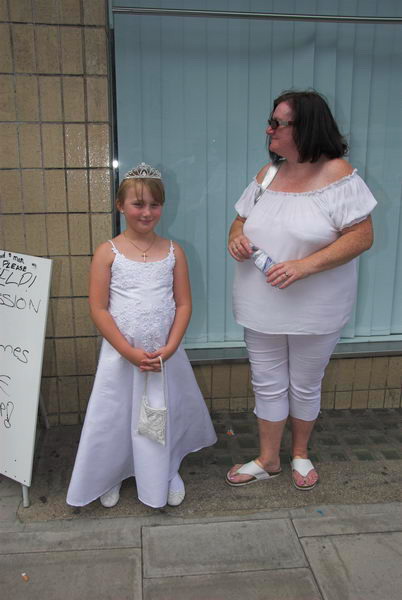
Australians were protesting at home & at embassies around the world against their country’s racist immigration policy.
Many who try to claim asylum in Australia are locked up and detained indefinitely in contradiction to international law on remote Pacific Islands including Manus and Nauru in detention camps run by Serco and will never be allowed to resettle in Australia.
Detainees in these camps have been sexually abused, denied proper health treatment, and in at least one case, that of a young man called Reza Berati, beaten to death by the prison guards.
Serco also run detention centres such as Yarl’s Wood in the UK, where detainees have also been mistreated, sexually abused and denied proper health treatment. The Australian protesters were joined by members of Movement for Justice, which has held many protests at UK detention centres including Yarl’s Wood and Harmondsworth.
No UK newspapers, TV or Radio media had even sent reporters to this protest. The only other photographer taking pictures at the event had been commissioned by a Sydney newspaper.
IDS, Iain Duncan Smith, was Secretary of State for Work and Pensions from 2010 to 2016 and responsible for brutal cuts in welfare polices in those years.
In particular he decided to save money by making it harder for sick and disabled people to claim benefits, introducing new eligibility tests and benefit sanctions, incentivising DWP staff to strip claimants of their benefits often for trivial reasons or for matters beyond their control such as the late arrival of official letters or cancellation of buses and trains making them arrive late for appointments.
In 2015 the statistics showed that 2,380 people died in a 3-year period shortly after a work capability assessment declared them fit for work.
The poorly thought out nature of the introduction of Universal Credit also brought suffering to many, left for weeks without financial support. He introduced disastrous schemes to force the disabled into work and cut the support which had enabled some disabled people to work.
His period as a minister had combined a total lack of empathy with a peculiar incompetence and the National Audit Office accused the DWP of ‘”weak management, ineffective control and poor governance” and of wasting £34 million on inadequate computer systems.’
So naturally DPAC were pleased to see him go, and celebrated at this party – though with Prosecco rather than the Champagne some media reports stated. And perhaps their celebrations were a little muted by the knowledge that his successor Stephen Crabb had shown himself to be equally bigoted and lacking compassion and understanding of the needs of the poor and disabled.
Strangely, despite his long record of cutting disablity benefits, IDS’s stated reason for his resignation was that he was unable to accept the government’s planned cuts to disability benefits, later describing the policies he had spent six years putting into effect of “balancing the books on the backs of the poor and vulnerable” as divisive and “deeply unfair“.
Belvedere Riverside & Plumstead: Some more pictures including some panoramas from my Thames riverside walk on Monday 1st August 1994, and a few from Plumstead a few days later.
Ford Ferry, Pier, River Thames, Belvedere, Bexley, 1994, 94-805-22
Ford at Dagenham was just on the opposite bank of the Thames, with a Ford ship moored in front of it and some ominous black smoke rising.
But although the Ford was only around 600 metres away, the fastest route for workers driving from here to the factory was around 15 miles. Taking the Woolwich ferry would take a couple of miles off this, but be slower.
Ford Ferry, Pier, River Thames, Belvedere, Bexley, 1994, 94-802-11
Many of Ford’s workers did live south of the river, either in Thamesmead or further away, and Ford provided a large suppposedly secure car park here from which they could walk down the pier to the Ford Ferry to take them across the river.
Ford had come to Dagenham in 1929 and opened the factory in 1931. They set up the private ferry for workers living in Kent in 1933. In its heyday it made 50 crossings a day taking as many as 1,500 workers to and from the plant, but after vehicle production ended with the plant turning to making engines it was only taking around 240 across and Ford discontinued it in 2003. Eventually they were forced to pay around half a million in compensation and to provide a bus service instead.
Much earlier there had been a Pilgrims ferry from Rainham to Erith, for pilgrims on their way to Canterbury, said to have begun in 1199 and to have continued in use until the mid 1950s.
Riverside Path, River Thames, Belvedere, Bexley, 1994, 94-802-12
Around here I turned back towards Erith, taking some more pictures on my way (some of which were included in my previous post.)
Riverside Path, River Thames, Belvedere, Bexley, 1994, 94-802-13
I can’t now remember exactly where on the path this was, but I think I walked all the way back to Erith and to the station there.
Penny’s Cafe, Motor Auctions, Manor Road, Erith, Bexley, 1994, 94-803-32
Finally from that day in Erith, one I took earlier around the start of my walk but failed to post previously. Manor Road leads out east from Erith and was then an industrial area.
This Café (and Motor Auctions) had also clearly once been a factory and still catered for workers in nearby factories. Facebook posts say it had been an engineering factory called Ivor & Jettage, that the café was full of boxing photos and that its yard, used for motor auctions and later car boot sales on Sundays, was in 2024 a scaffolding yard. But I have been unable to confirm this.
Nathan Way, Plumstead, Greenwich, 1994, 94-806-52
A few days after my Erith walk I was back not far away in Plumstead, and made just a handful of colour images including these three.
This picture was made from The Ridgeway a foot and cycle path on top of the Southern Outfall Sewer from Plumstead to Crossness. Nathan Way runs for around 600 metres just to the north of this and most industrial sites along here were demolished by 2015 and are being replaced by a huge estate of blocks of flats, Lombard Square, with 1,913 new homes. The first were finished in 2025.
Nathan Way, Plumstead, Greenwich, 1994, 94-805-24
Another image from The Greenway not far from where I made the panorama above. From 1888-90 here or close by Royal Arsenal football team played here at what became the Manor Ground. They moved next to Woolwich, becoming Woolwich Arsenal but soon found the rent there too high and moved back. They played their last game here in 1913 before moving to Highbury in North London – and of course losing the Woolwich.
Some industry remains at the east end of this stretch of Nathan Way but I’m not sure this includes any in my picture.
Nathan Way is a long road leading from Plumsteaad to Thamesmead and I think this may have been on the corner with Kellner Road.. But the name repeated on the lorry and the large modern shed behind as well as on what was perhas a small shed in the foreground was unmissable. I just had to make a Panorama.
Tony’s Snack Bar, Nathan Way, Plumstead, Greenwich, 1994, 94-805-26
I think the building at left it 115 Nathan Way, now occupied by Hydraquip Hose & Hydraulics, while behind are the roofs of Belmarsh Prison. But the picture is about the mobile snack bar here and the neat empty row of six white chairs for its then non-existent customers.
My walk continued on into Thamesmead but although I took quite a few black and white pictures I can’t at the moment find any more colour – and perhaps I took none.
Syria & St Patrick: Saturday 17th March 2012 was of course St Patrick’s Day, but before rushing to Willesden Green to photograph the St Patrick’s Day Parade there I photographed Syrians calling for freedom marching to the Syrian Embassy, where a rather smaller number had arrived earlier to support President Assad. When the march got to Edgware Road I took the Underground to Willesden Green and after photographing the procession rushed back to Belgrave Square and the Syrians.
Free Syrians March To Embassy
Paddington to Belgrave Square
Over a thousand Syrians had come to Paddington Green for the start of a march calling for freedom in Syria and an end to the massacres of the Syrian people.
They held a noisy rally there with a great deal of shouting, showing support for the ‘Free Syrian Army’, which included many who deserted from the Syrian Army after having been ordered to fire on innocent Syrian people.
A woman held a poster stating that 11,035 people had been killed by Asad’s forces, while others had placards giving monthly figures, for example that in December 2011 they had killed 1119 including 58 women and 68 children.
After an hour the march set off. I left them at Edgware Road but returned later to cover the events in Belgrave Square where there was a large pen filling most of the north side of the square with a platform for speakers opposite the Syrian Embassy.
Beside the tower in Belgrave Square
Next to the platform was a tall tower, a reminder of the tower in the main square of Homs, where huge peaceful demonstrations were put down by force, and where over 700 people, including many women and children were killed in government attacks the previous December.
During the speeches an effigy of Asad hanging from a gallows was carried through the crowd.
There was a large police presence in the whole area around the square and double barriers with an area empty except for police around 50 yards wide separating their protest from a smaller counter-protest by Assad supporters.
I walked away from the Free Syria protest to visit the very much smaller counter-protest. As I commented, “It seemed more a disco about a personality cult than a political rally of any kind, with almost everyone waving a placard with Asad’s photograph on it, and many wearing t-shirts featuring his face.”
They were playing music at a distressingly high volume, distorted through their speakers, clearly in an attempt to drown out the speakers at the other protest. Thankfully there were a few times when the music stopped for people to lead chants praising Asad.
There was only one speech while I was there, with a man calling on people to go to Syria and see for themselves that the situation in the country was being falsely reported by the media.
The placards and banners were all expensively produced
There had been doubts over whether there would be a Brent St Patrick’s Day procession in 2012 after Brent Council had been forced to make drastic cuts in council spending on community events.
But the event went ahead and as usual was led through the streets by the Mayor of Brent and St Patrick on its way from Willesden Green station to Willesden Library, though the streets did seem a little less crowded than in previous years.
On a smaller scale and with a more friendly atmosphere than the main London event, the procession was on St Patrick’s Day itself, which in 2012 was a Saturday. Most years I’d been there it had been on a schoolday; many children came from the schools to take part and watch along with their parents, but perhaps on a Saturday more had other things to do.
As usual, as well as the crowds that had gathered for the start of the parade, people came out of the bars on the street to watch as it passed.
There are many more pictures on My London Diary, though I had to rush away before the end to get back to photograph the Syrian protest in Belgrave Square.
Houses, St Ann’s Crescent, Wandsworth, 1990, 90-3a-11
This area was towards the end of the 18th century still farmland, part of the Manor or All-Farthing, a small hamlet to the south of Wandsworth. An 1804 map shows there were still no houses here, only fields around what was then All Farthing Lane. The first houses were built here at the same time as the church, in the 1820s, but these are rather later in the century, probably around 1850.
At left is Surrey House, 6 St Anne’s Crescent. The two large semi-detached houses at 4-10 are shown on the 1873 OS map (on what was then St Anne’s Hill) and locally listed.
St Anne’s Church, St Ann’s Hill, Wandsworth, 1990, 90-3a-12
St Anne’s was one of five ‘Waterloo Churches’ in the Southwark diocese built “as monuments to the victories at Trafalgar and Waterloo. Building of Saint Anne’s Church began in 1820 and was completed in 1824. The architect was Sir Robert Smirke. The church was consecrated on 1 May 1824 as a chapel of ease to the Parish Church of All Saints, Wandsworth.“
Smirke was a remarkably prolific architect and “is known to have designed or remodelled over twenty churches, more than fifty public buildings and more than sixty private houses.” These included seven of the the Waterloo Churches, and he was an official government architect and an adviser to the scheme – the only example of government funded church-building which provided a total of £1.5 million to provide 612 new Anglican churches. It was a huge scheme costing equivalent to more than £125 billion allowing for inflation.
Plowden & Smith, St Ann’s Hill, Wandsworth, 1990, 90-3a-13
I walked past the church to St Ann’s Hill (the church is St Anne’s but the street appears to have lost an ‘e’) and north along this. Plowden & Smith at 190-4, was established in 1966 and is a leading provider of art restoration services but they are now based in purpose-built premises on Morden Road, Mitcham. They left St Anne’s Hill around 2018. The building at 190 had previously been a sorting office and is now called Sorting House.
Plowden & Smith, 190, St Ann’s Hill, Wandsworth, 1990, 90-3a-14
As well as giving a good view of the frontage of the building I also liked the car parked partly obstructing the large painted sign ‘NO PARKING IN FRONT OF THIS BUILDING’. The development has retained most of the brickwork of the Victorian frontage but with more window area, and behind it and largely unnoticed from street level is a much taller modern structure which includes 9 new flats.
Temporary Housing, St Ann’s Hill, Wandsworth, 1990, 90-3a-15
As I wrote in an earlier post, “The LCC designed temporary housing together with the Timber Development Association as a temporary solution to the then acute housing problem. I think these may have been replaced by new housing on Malva Close built in 1993.
Designed to last 15 years these homes came as two boxes which were craned onto piles of paving slabs and did not need dug foundations. The two boxes were than bolted together. The walls were asbestos covered with plastic and both roof and floor were made from plywood sheets sandwiching polystyrene insulation. They had a hall, living room, two bedrooms, kitchen and bathroom.”
Many seemed to have found them comfortable and were reluctant to leave, often being rehoused in less convenient locations and in pokier flats.
Stop the War – Troops Out: The protest organised by Stop the War, CND and British Muslim Initiative on Saturday 15th March, 2008 was an impressive one, with around 50,000 marchers calling for the withdrawal of our troops from Iraq and Afghanistan, no attack on Iran and a free Palestine, as well as many other groups drawing attention to other issues around the world including the genocide in Somalia.
Tony Benn
It began with a rally in Trafalgar Square where speakers included Tony Benn and Bruce Kent and then took a roundabout route across Westminster Bridge and then back over the Thames on Lambeth Bridge and up Millbank to Parliament Square. Those at the rear of the march were still passing the corner of the square when those at the front arrived back there.
It was an event that included many issues still relevant now, particularly over Iran and Palestine, but also on direct action, with a reminder of the then upcoming trial of the Raytheon 9, anti-war activists who had entered the Raytheon factory in Derry in August 2006 after learning that Raytheon missiles were being used by Israel in their 2006 invasion of Lebanon.
Occupying the offices for eight hours before they were arrested they destroyed computers and documents, and six were tried for criminal damage and affray in May 2008. One man was found guilty of stealing two computer disks but they were all acquitted on all other charges.
The police took a great deal of interest in the protest, with FIT teams who photograph protesters (and journalists, particularly photographers) took an unusual interest in anarchist protesters from Class War, the Anarchist Federation and FITwatch who use their banner to try to prevent the police taking photographs and video.
I missed seeing four of the FITwatch protesters arrested, apparently for intimidating the police. As I commented, “Since a couple of weeks ago one of their photographers and his minder had been seen taking flight and seeking refuge up the steps of the National Gallery when pursued by a polite and always well behaved woman with a shopping trolley and free cakes – much to the amusement of other police present – intimidating the FIT doesn’t seem too difficult.“
But this – like the many large pro-Palestine protests since ‘September 7th’ – was an entirely peaceful protest, calling for peace in many areas around the world and for an end to UK involvement in wars and oppression.
It was a lively protest, with samba band, sound systes, street theatre and dancing. People laid flowers at Nelson Mandela’s statue and Brian Haw – still permanently camped in Parliament Square despite the attempts to remove him by passing SOCPA – joined the protest.
And like all of these marches it also included many Jewish marchers including the Neturei Karta ultra-orthodox anti-Zionists.
A Day with Class War: On Saturday 14th March I spent much of the day with Class War who had registered as a political party to stand a handful of candidates in the May 2015 General Election. Of course they didn’t expect to gain any MPs but it had seemed a good way to attract some publicity to their views – and to have a little fun. They began at Chingford with an election campaign launch for Lisa McKenzie who was standing against Tory minister Iain Duncan Smith.
After a public meeting on the street there the group retired to a nearby pub to celebrate the election launch before I travelled with Chingford and Purley candidates and a few supporters to visit and show solidarity with people on the Aylesbury Estate in Southwark who had occupied a flat there to highlight the shameful treatment by Southwark Council of residents whose homes are being demolished and are being forced out of the area.
Class War Chingford Election Launch
Chingford, London
Police seized Class War’s ‘Political Leaders’ banner two days earlier but they still had posters from the 2010 election with the same message
Lisa McKenzie came to Chingford with a small group of Class War supporters to announce she was giving electors there a chance to kick out Tory minister Iain Duncan Smith and the evil policies he represented, which inflict misery on the poor and disabled.
From the station they marched behind the ‘Lucy Parsons’ banner “We must devastate the avenues where the wealthy live” past the Conservative Association offices and the Assembly Hall to the end of Station Rd. Unfortunately police had seized their even more appropriate banner calling the main political leaders (as I put it) ‘f***ing wankers‘ at the Poor Doors protest two days earlier, but they still had plenty of posters with the same message.
They were followed down the street by a van full of police officers who were obviously taking this first official visit by the Class War candidate for the Chingford constituency very seriously.
At the end of the street Class War turned around and walked back to a convenient place to hold a meeting where candidate Lisa McKensie, then a research fellow at the LSE whose study of the St Ann’s Estate in Nottingham where she lived for many years was recently published as Getting By: Estates, Class and Culture in Austerity Britain and several others made speeches.
Police stood and watched from the opposite side of the road and after 10 minutes an officer walked across the road and ordered Stan who was one of those holding the ‘wanker’ posters to put it away or be arrested. There was some argument but eventually Stan rolled it up and the sergeant walked back across the road, standing with arms folded staring at the group – with several others still holding similar posters.
Ian Bone mimicked the officer who was watching from across the road
Most of those who walked past ignored the group, but some took the Class War election leaflets and were clearly amused, though one elderly man on a passing bus made his opinion clear in an appropriately Churchillian fashion.
After around half an hour the launch ended and the group walked back towards the station, with Lisa stopping off briefly to put one of her election leaflets through the door of the Conservative Association. When they went inside the pub opposite the station the police van drove off, but several police remained watching the pub.
The media summary with my pictures from inside the Station House pub stated:
“After a march and street rally in Station Rd, Chingford, Class War cadres adjourned with their candidate Lisa Mckenzie, who is opposing controversial Tory minister Iain Duncan Smith, to discus their forthcoming election campaign in the constituency.“
There was some talk about the campaign and Jane Nicholl got out a few ‘Iain Duncan Smith‘ masks for people to buy and wear – and I commented “the pub seems likely to become an unofficial campaign headquarters for Class War.”
I was pleased to buy a pint and have a drink with them, something I seldom do after protests as I’m usually rushing away to get home and file my pictures. Most photographers now carry a laptop and file on the spot, but I’ve resisted doing so – few of the events I cover are breaking news.
But while we were there a phone call came from the occupiers on the Aylesbury Estate in Southwark calling for support and I decided to go with them.
I was waiting in the pub to travel with two Class War election candidates, Lisa McKenzie standing for Chingford and Jon Bigger for South Croydon, along with several supporters, across London to the Aylesbury Estate in Southwark where people had occupied a flat in solidarity with occupiers who are being forced out from the large council estate which is being re-developed.
Police watched us until the train left
Some families were still living on this block of the estate which was now surrounded with high fences and anti-climb barriers with police and bailiffs severely restricting access to the estate by residents and visitors.
As I wrote then: “Southwark Council, having neglected the estate for many years, has decided to hand it over to developers who will knock it down and redevelop the area mainly for sale or rent at inflated London prices. The residents are being forced to move out against their wishes – clearly expressed in a council organised ballot in 2001 – to stay, and most will have to move out of the area and into more expensive privately rented accomodation with little or no security of tenure.”
The fence makes this part of the Aylesbury look like a prison camp
Police followed us to the station and watched us until the train left. It was a long journey by Overground, Underground and bus, with much banter and playing with the IDS masks but fortunately I knew the right bus stop to get off.
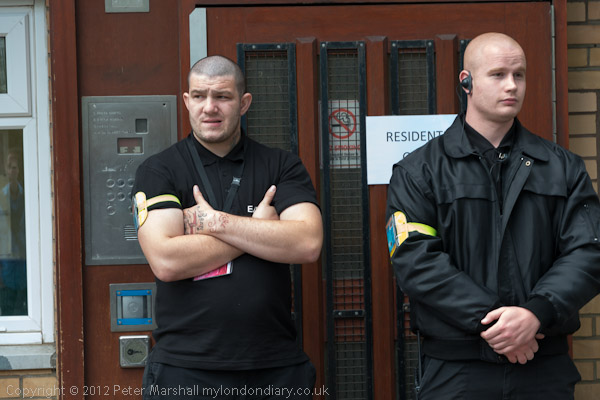
Security men guard the entrance to the flats where 12 families are still officially in residenceSwinging up from one set of stairs to another
As we walked towards the estate we met a group of activists who led us to the only way still not blocked into the sector of the estate with occupied flat. It involved a lengthy detour on the estates elevated walkways into Chiltern House. The lift was still working – there were still a dozen families living there, but after we got off at the eight floor we still had to walk up some stairs and then swing though a narrow gap onto another set of stairs that led to the occupied flat. It was something of a challenge to me carrying my heavy camera bag.
Aysen Dennis, a campaigner from the Aylesbury EstateJon Bigger, Stan and others
We were rewarded by extensive views over most of South London both through the windows and from the balcony – which as I commented made estates like these rich pickings for developers. Southwark had made a huge loss on selling off the neighbouring Heygate Estate, selling of off for a small fraction of its market valuation and seemed to be doing the same with the Aylesbury Estate. As I commented it is “Hard to see why local councils of any hue should commit treason against their local population in this way.”
Lisa McKenzie
Some people inside the occupied flat were very hostile to photographers and I took few pictures there, mainly of the people I had come with. I think a couple of those present and most vocal against having their pictures taken were almost certainly undercover police who had infiltrated the campaign to save the estate.
Jenny and Stan hold the Class War banner next to the lifts in Chiltern House
I left with some of Class War, again making the slightly tricky and tortuous route out we had got in by to avoid the security men at the official gate in the tall fence around the block.
More From the Riverside: More pictures from my walk by the River Thames at Erith and Belvedere on Monday 1st August 1994 to its end in Plumstead.
My previous post from this walk, Thames Riverside – Erith 1994 ended as I approached the Erith Oil Works jetty. The path here climbs up to go over the roadway from the jetty into the works which provided some good views of the jetty,
Jetty, River Thames, Erith Oil Works, Erith, Bexley, 1994, 94-802-52
This whole shoreline was once lined by industrial sites with their own jetties, by 1994 mainly like this now derelict and shortened.
Riverside Path, River Thames, Belvedere, Bexley, 1994, 94-805-45
Riverside Path, River Thames, Belvedere, Bexley, 1994, 94-805-32
Looking inshore there will still industrial sites, but much no longer relying on the river, though there were still some like the aggregate works that still had working jetties.
Jetty, Riverside Path, River Thames, Erith, Bexley, 1994, 94-802-43
Another disused jetty a short distance upstream from the Oil Works.
Sheds and neat stacks of orange and green boxes at a wharf – now serviced by road – at Mulberry Way. This gets its name from the temporary portable floating harbours some of which were constructed here in 1944 by Nuttall Brothers and towed to the French coast after D-Day to land supplies for the Allied invasion. Two temporary harbours were constructed on the Normandy coast; one only lasted a few days before being destroyed by a storm but that at Arromanches remained in use for 10 months.
A panoraamic view from the same viewpoint as the previous image. I had climbed up on the wide concrete flood defence wall here to make the picture. The sky was filled with clouds, perfect weather for panoramic landscapes.
Remains of wharf, Riverside Path, River Thames, Belvedere, Bexley, 1994, 94-802-21
I kept walking along the riverside path, coming to these timbers which would once have supported a long landing stage on a wharf with a short jetty into deep water. Across the river you can see Tilbury Docks at the left of the picture, with the blue hull of a ship there and some cranes, and further towards the centre the chimney and turbine hall of East Tilbury Power Station.
The horizon, dead centre in the picture is straight but as you move further down in the picture the curvature produced by the cylindrical perspective become more and more apparent. The path at left is straight and it remained straight to where I was standing to take the picture and beyond. Usually I tried to compose photographs so that this curvature was less apparent, but here I rather liked the effect.
I was working with two swing lens panoramic cameras (and two ‘normal’ SLR cameras.) Normal wide-angle lenses use rectilinear perspective become unusable with a horizontal angle of view of around 90 degrees as the distance from the centre of the lens to the film increases as light travels to the edges of the frame, increasing the size of image objects. The curved film plane in a swing lens camera keeps the lens centre to film distance constant so objects are recorded at the same scale across the image. Of course the wooden posts get smaller in the image the further away they are from the camera.
Riverside Path, River Thames, Belvedere, Bexley, 1994, 94-802-23
The curvature is much less apparent in this image taken a few minutes later and a few yards further upstream. But the shadow at bottom left as actually the shadow of the same straight flood wall as the larger shadow at the right.
Both of the panoramic cameras I had gave images with a horizontal angle of view of somewhere around 130 degrees.
I’ll post more pictures from this walk later. More pictures also in my Flickr album 1994 London colour – and you can see these images larger there by clicking on them in this post.
London St Patrick’s Day Parade: I used to enjoy St Patrick’s Day in London, particularly the parade in Willesden Green on the actual day itself. The main London celebrations take place the Sunday before this, and I made these pictures on Sunday 12th March 2006.
This annual London parade had begun in 2002 when Ken Livingstone, London’s first elected mayor. Though a Londoner, he had long been a supporter of a united Ireland and from 1987 to 2001 was MP for Brent East, a constituency with a large Irish population.
In his years as the leader of the Greater London Council from 1981 until its abolition by Thatcher in 1986 Livingstone had done much to change attitudes in London towards women and minority communities, and on being elected as London Mayor he began his victory speech saying “As I was saying before I was so rudely interrupted 14 years ago…” and continued these and other policies from his years at the GLC.
One small part of his legacy to London was the opening up of Trafalgar Square to various Community celebrations – though there is much more, including changes to London’s transport begun under the GLC which made much of my photography of London much easier. His successor took the credit for Livingstone’s ‘Boris Bikes’ though Ken was not responsible for the multiple bikes for hire that now litter our pavements in a rather mad private developments of this.
I photographed the first London St Patrick’s Day Parade in 2002. All the pictures here are from the 2006 Parade and below is the short text I wrote for this.
London now has one of the larger celebrations of St Patricks Day, held on the Sunday before the actual day, with a parade from Hyde Park to Trafalagar Square and events there as well as in Leicester Square and Covent Garden.
The parade celebrates the enormous contribution the Irish have made to the capital – approximately 400,000 people of Irish descent form the largest minority group in London. Paraders come from various community associations and other Irish groups and cultural organisations in the London Boroughs, including Irish dancing, music and sports. There are also some groups from Ireland.
Leading the parade is an Irish Wolfhound, the mascot of the London Irish team, along with various Irish leaders and of course the Mayor of London, Ken Livingstone, more green than red on this occasion.
Unfortunately government cuts under the coalition’s austerity programme meant the Brent council could no longer support the St Patrick’s Day parade in Willesden Green and I last photographed a rather smaller event there in 2013. The London St Patrick’s Parade and St Patrick’s Festival at Trafalgar Square are on Sunday 15 March 2026, but like so many events is much more organised and for me less interesting, and its years since I last went.
Fukushima & Million Women Rise: Saturday 11th March 2017 was the sixth anniversary of Fukushima nuclear power plant disaster in Japan and a march called for an end to nuclear power programmes around the world including in the UK. It was also the nearest Saturday to International Women’s Day and I photographed the Million Women Rise march.
Fukushima Anniversary Challenges Nuclear Future
London
Six years on, radiation was still leaking from the plant which was damaged by a tsunami from the Tohoku earthquake. This destroyed most of the plant’s cooling system and created the world’s worst nuclear disaster since Chernobyl.
Estimates of the human cost in the long-term from the radiation leaks vary considerably, but the financial cost of cleanup up has been estimated at around $180 US.
Buddhist Reverend Gyoro Nagase from Battersea and Reverend Sister Yoshie Maruta from Milton Keynes
Nuclear power has never achieved the early promises of cheap energy and remains the most expensive way of generating electricity. It is now promoted as an essential backup for renewable energy when the sun doesn’t shine and the wind doesn’t blow but its importance will fade as we exploit other continuous renewable sources and cheaper storage solutions become available. And as we move away from a grid-based power system to more local generation. Should nuclear fusion ever become feasible it promises to be a much safer, cheaper and cleaner way to generate electricity.
Probably the UK’s nuclear programme was never really about energy, but about our nuclear weapons programme.
The marchers met at the Japanese embassy on Piccadilly and marched on the pavement handing out leaflets to Downing Street. I left them on the march to photograph the start of Million Women Rise and then took to tube to Westminster for the Downing Street rally.
Around two or three thousand women gathered in Orchard Street to march to a rally in Trafalgar Square.
‘Women of the World Unite Against Violence’
Many carried feminist placards and there were groups from various women’s organisations around the country, including from various ethnic communities.
This was a march for women only, but most of them were very happy for me to photograph them, but I was not able to mingle freely with them as I would on most marches, and my pictures were from the sidelines or in front of the march.
Violence Against Women is a Global Pandemic’
I was able to take many pictures, but not always as I would have liked. But I think they are an interesting set – and here are just a few of them.
I left as the march reached Bond Street station to go back for the Fukushima rally.