A Day with Class War – 2015

A Day with Class War: On Saturday 14th March I spent much of the day with Class War who had registered as a political party to stand a handful of candidates in the May 2015 General Election. Of course they didn’t expect to gain any MPs but it had seemed a good way to attract some publicity to their views – and to have a little fun. They began at Chingford with an election campaign launch for Lisa McKenzie who was standing against Tory minister Iain Duncan Smith.

After a public meeting on the street there the group retired to a nearby pub to celebrate the election launch before I travelled with Chingford and Purley candidates and a few supporters to visit and show solidarity with people on the Aylesbury Estate in Southwark who had occupied a flat there to highlight the shameful treatment by Southwark Council of residents whose homes are being demolished and are being forced out of the area.


Class War Chingford Election Launch

Chingford, London

A Day with Class War - 2015
Police seized Class War’s ‘Political Leaders’ banner two days earlier but they still had posters from the 2010 election with the same message

Lisa McKenzie came to Chingford with a small group of Class War supporters to announce she was giving electors there a chance to kick out Tory minister Iain Duncan Smith and the evil policies he represented, which inflict misery on the poor and disabled.

A Day with Class War - 2015

From the station they marched behind the ‘Lucy Parsons’ banner “We must devastate the avenues where the wealthy live” past the Conservative Association offices and the Assembly Hall to the end of Station Rd. Unfortunately police had seized their even more appropriate banner calling the main political leaders (as I put it) ‘f***ing wankers‘ at the Poor Doors protest two days earlier, but they still had plenty of posters with the same message.
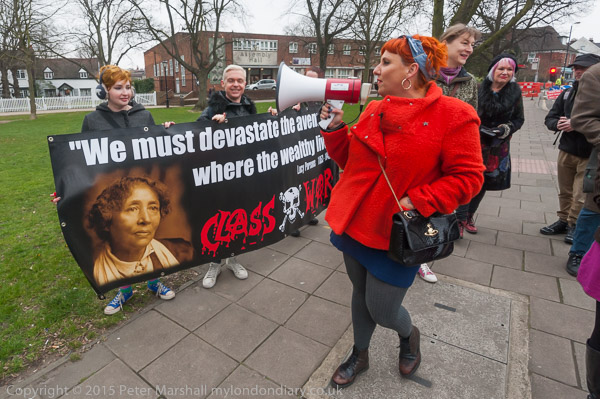
They were followed down the street by a van full of police officers who were obviously taking this first official visit by the Class War candidate for the Chingford constituency very seriously.

At the end of the street Class War turned around and walked back to a convenient place to hold a meeting where candidate Lisa McKensie, then a research fellow at the LSE whose study of the St Ann’s Estate in Nottingham where she lived for many years was recently published as Getting By: Estates, Class and Culture in Austerity Britain and several others made speeches.
A Day with Class War - 2015

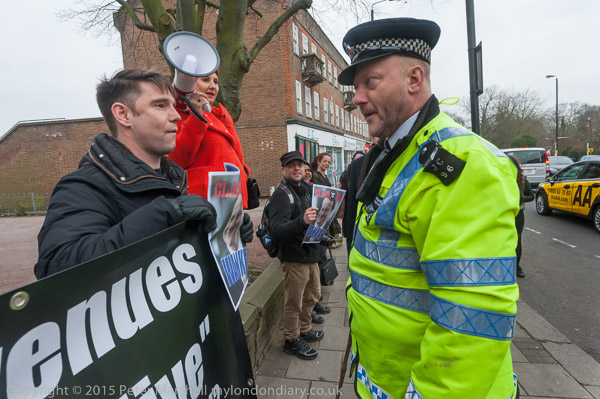
Police stood and watched from the opposite side of the road and after 10 minutes an officer walked across the road and ordered Stan who was one of those holding the ‘wanker’ posters to put it away or be arrested. There was some argument but eventually Stan rolled it up and the sergeant walked back across the road, standing with arms folded staring at the group – with several others still holding similar posters.

A Day with Class War - 2015
Ian Bone mimicked the officer who was watching from across the road

Most of those who walked past ignored the group, but some took the Class War election leaflets and were clearly amused, though one elderly man on a passing bus made his opinion clear in an appropriately Churchillian fashion.

A Day with Class War - 2015

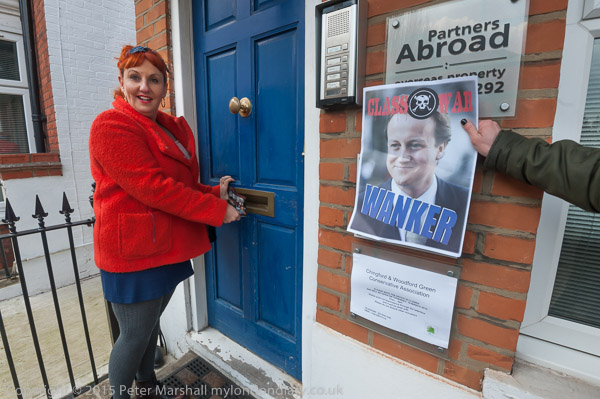
After around half an hour the launch ended and the group walked back towards the station, with Lisa stopping off briefly to put one of her election leaflets through the door of the Conservative Association. When they went inside the pub opposite the station the police van drove off, but several police remained watching the pub.

Class War Chingford Election Launch


Class War Celebrate Election Launch

Station House, Chingford

The media summary with my pictures from inside the Station House pub stated:

After a march and street rally in Station Rd, Chingford, Class War cadres adjourned with their candidate Lisa Mckenzie, who is opposing controversial Tory minister Iain Duncan Smith, to discus their forthcoming election campaign in the constituency.

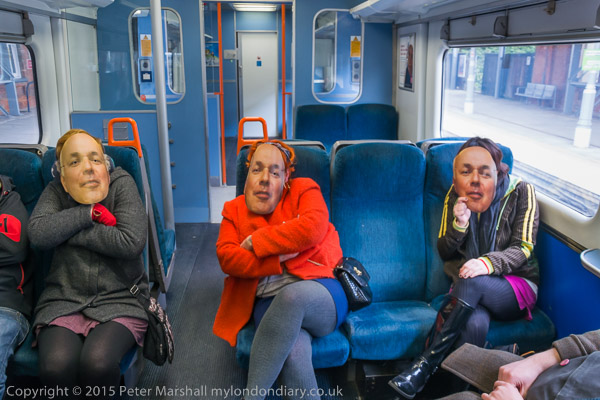
There was some talk about the campaign and Jane Nicholl got out a few ‘Iain Duncan Smith‘ masks for people to buy and wear – and I commented “the pub seems likely to become an unofficial campaign headquarters for Class War.”

I was pleased to buy a pint and have a drink with them, something I seldom do after protests as I’m usually rushing away to get home and file my pictures. Most photographers now carry a laptop and file on the spot, but I’ve resisted doing so – few of the events I cover are breaking news.

But while we were there a phone call came from the occupiers on the Aylesbury Estate in Southwark calling for support and I decided to go with them.

Class War celebrate Election Launch


Class War go to Aylesbury Estate

Walworth, Southwark
On the Overground

I was waiting in the pub to travel with two Class War election candidates, Lisa McKenzie standing for Chingford and Jon Bigger for South Croydon, along with several supporters, across London to the Aylesbury Estate in Southwark where people had occupied a flat in solidarity with occupiers who are being forced out from the large council estate which is being re-developed.
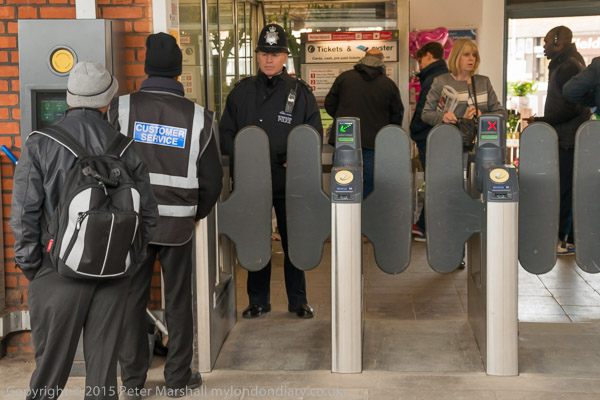
Police watched us until the train left

Some families were still living on this block of the estate which was now surrounded with high fences and anti-climb barriers with police and bailiffs severely restricting access to the estate by residents and visitors.
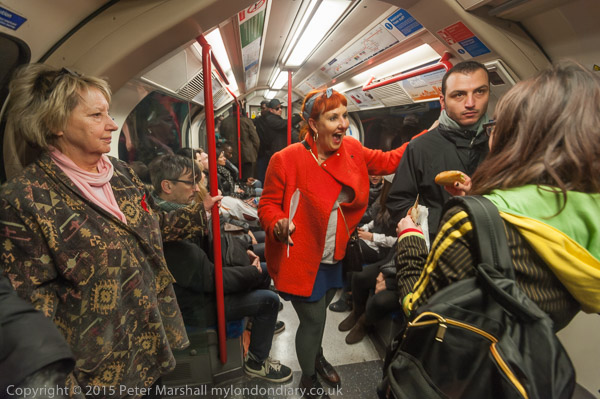
As I wrote then: “Southwark Council, having neglected the estate for many years, has decided to hand it over to developers who will knock it down and redevelop the area mainly for sale or rent at inflated London prices. The residents are being forced to move out against their wishes – clearly expressed in a council organised ballot in 2001 – to stay, and most will have to move out of the area and into more expensive privately rented accomodation with little or no security of tenure.”
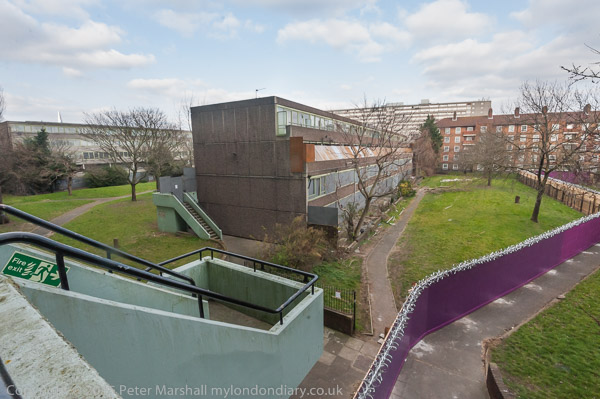
The fence makes this part of the Aylesbury look like a prison camp

Police followed us to the station and watched us until the train left. It was a long journey by Overground, Underground and bus, with much banter and playing with the IDS masks but fortunately I knew the right bus stop to get off.
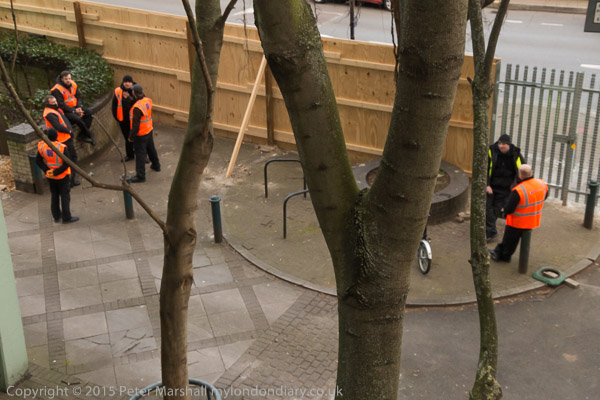
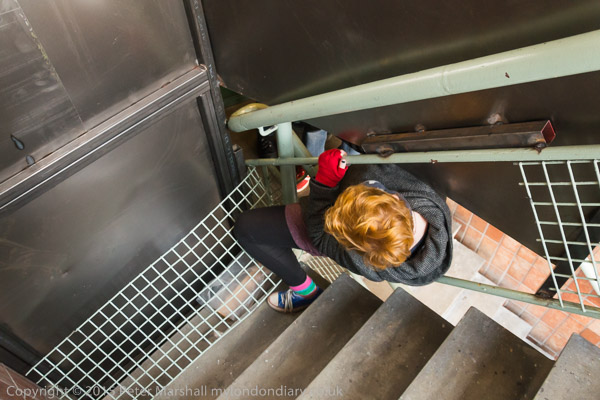
Security men guard the entrance to the flats where 12 families are still officially in residence
Swinging up from one set of stairs to another

As we walked towards the estate we met a group of activists who led us to the only way still not blocked into the sector of the estate with occupied flat. It involved a lengthy detour on the estates elevated walkways into Chiltern House. The lift was still working – there were still a dozen families living there, but after we got off at the eight floor we still had to walk up some stairs and then swing though a narrow gap onto another set of stairs that led to the occupied flat. It was something of a challenge to me carrying my heavy camera bag.
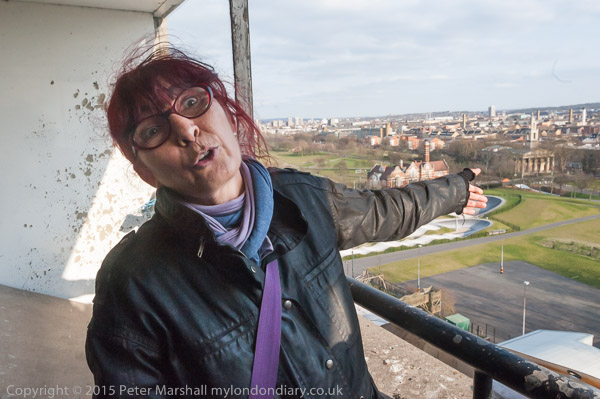
Aysen Dennis, a campaigner from the Aylesbury Estate
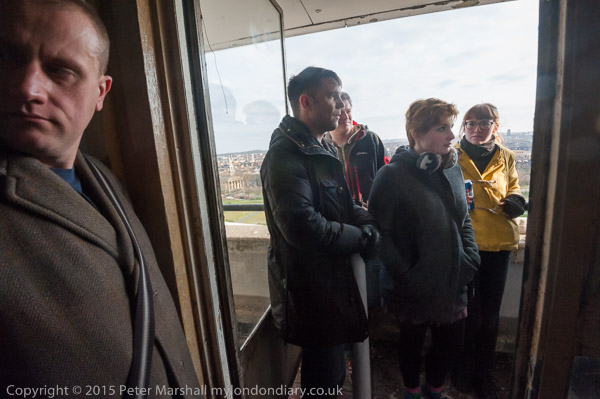
Jon Bigger, Stan and others

We were rewarded by extensive views over most of South London both through the windows and from the balcony – which as I commented made estates like these rich pickings for developers. Southwark had made a huge loss on selling off the neighbouring Heygate Estate, selling of off for a small fraction of its market valuation and seemed to be doing the same with the Aylesbury Estate. As I commented it is “Hard to see why local councils of any hue should commit treason against their local population in this way.”
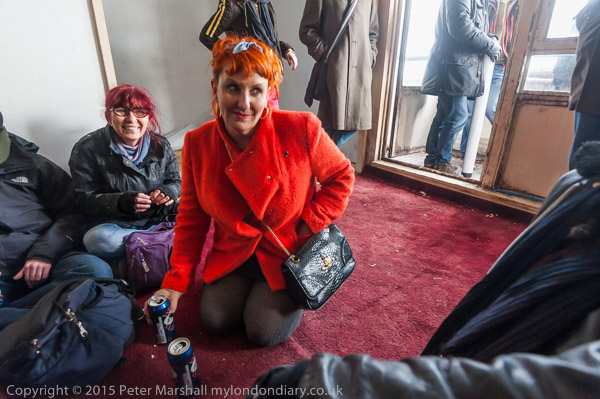

Lisa McKenzie

Some people inside the occupied flat were very hostile to photographers and I took few pictures there, mainly of the people I had come with. I think a couple of those present and most vocal against having their pictures taken were almost certainly undercover police who had infiltrated the campaign to save the estate.
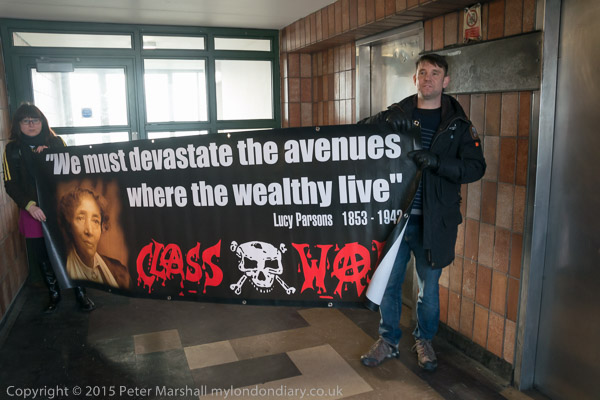
Jenny and Stan hold the Class War banner next to the lifts in Chiltern House

I left with some of Class War, again making the slightly tricky and tortuous route out we had got in by to avoid the security men at the official gate in the tall fence around the block.

Class War go to Aylesbury Estate


FlickrFacebookMy London DiaryHull PhotosLea ValleyParis
London’s Industrial HeritageLondon Photos

All photographs on this page are copyright © Peter Marshall.
Contact me to buy prints or licence to reproduce.
MfJ At Yarls Wood Again

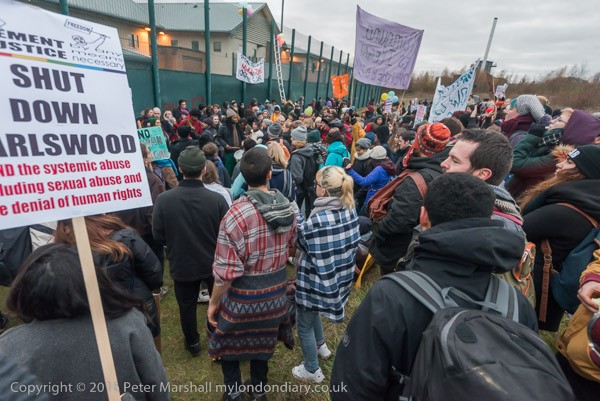
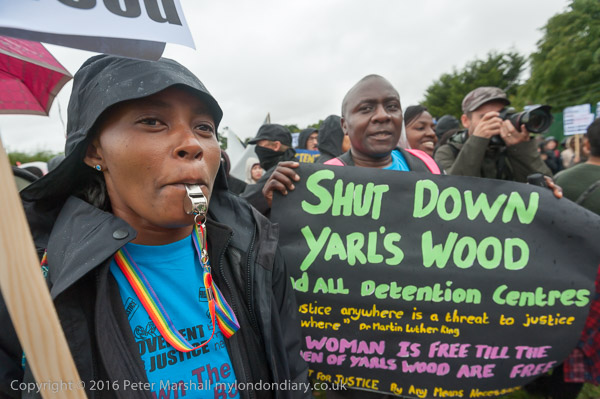
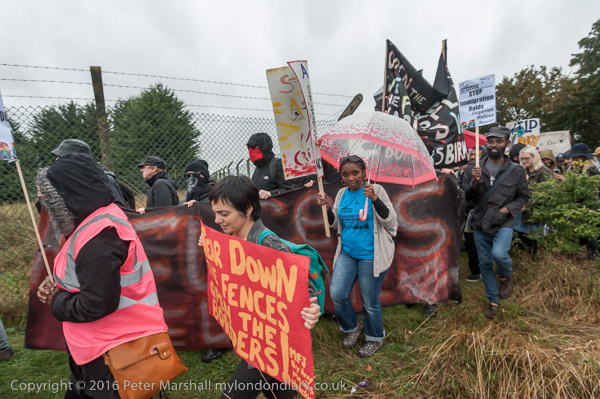
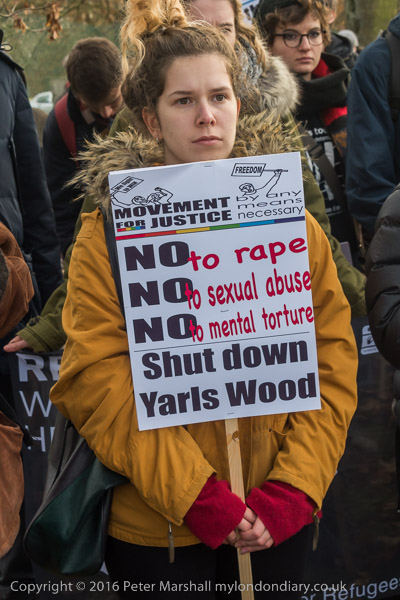
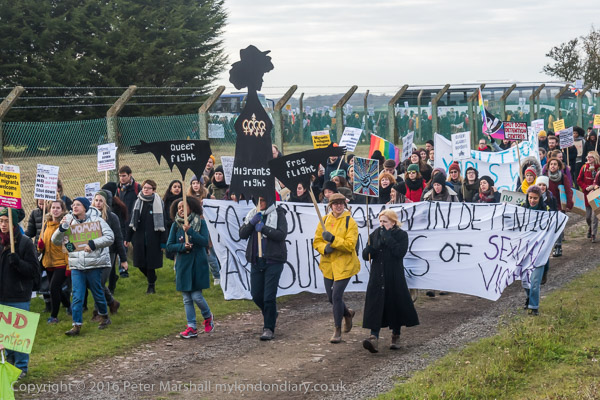
Saturday 3rd December 2016 saw the 10th protest organised by Movement for Justice at Yarl’s Wood, the immigration prison on an isolated wartime RAF base around five miles north of Bedford. Around 2000 protesters made there way there to call for the closure of Yarl’s Wood and all immigration detention centres.

MfJ At Yarls Wood Again

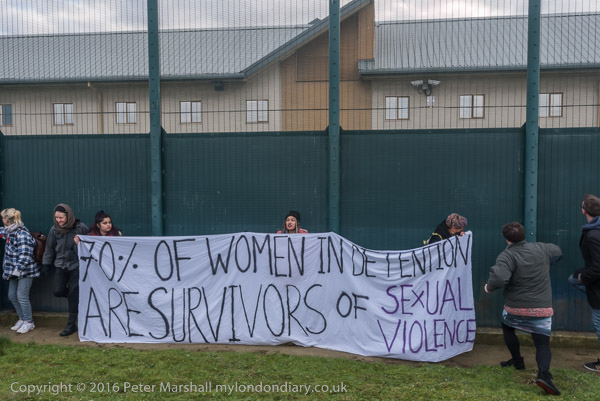
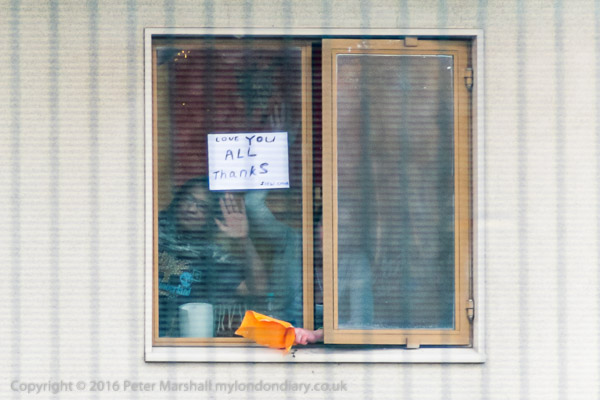
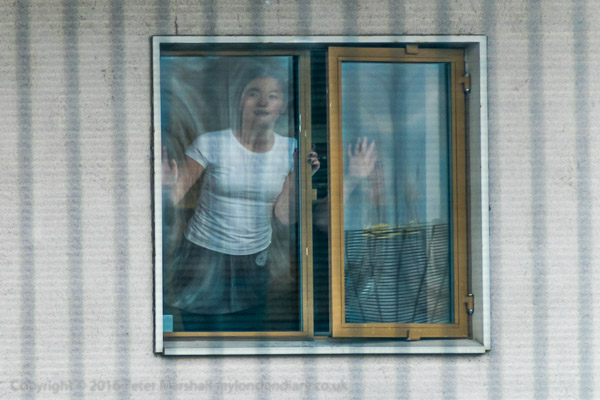
Because of heavy security inside the prison there were fewer women to greet them at the windows than on previous protests, but those who were able to make it greeted them enthusiastically, shouting and waving from the prison block behind the high fence, hindered by windows that open only a small crack.

MfJ At Yarls Wood Again

Several of those held inside were also able to speak to the protesters using their mobile phones, which detainees are allowed to have as they are essential in communicating with their lawyers. Conditions in immigration detention are different from those in our normal jails, but those held are still prisoners. And unlike most in normal jails, they are held in indefinite detention, never knowing when they will be released, with no limit on how long they can be held. One woman who spoke to us from inside had been held without any charge or trial for over two years.

MfJ At Yarls Wood Again

Those imprisoned at Yarls Wood are almost entirely women, with just a few family groups also being held there. The women who spoke, along with other former inmates who were taking part in the protest outside told grim and shameful stories of their detention. They told of assaults and abuse by Serco security guards who today had locked many in other wings to stop them seeing the protest and threatened those who greeted the protesters.

70% of Women in Detention are Survivors of Sexual Violence

One of the many complaints by those who are locked up in this and other immigration detention centres has been over the lack of proper access to medical treatment and it was worrying to hear from inside that there were now cases of TB in Yarl’s Wood. There have been some cases of death in detention when the staff have refused to take detainees health complaints seriously and have only called for medical assistance too late.

The complaints about abuse by security guards have been confirmed in reports in the mass media, including testimony and recordings made by an investigative reporter who worked as a security guard for several months there, revealing a horrific story of abuse.

Yarl’s Wood was temporarily closed down at the start of Covid with women being released or moved elsewhere. Most of the women who are held there are eventually released, most granted asylum or leave to remain. Some are simply released and disappear into the community and a few are actually deported.

It is a wasteful system in every way, particularly wasteful for the women who are confined there, often in great need of proper medical treatment and care for the trauma they escaped from with threats, beatings and rapes in their own country. But also wasteful for the taxpayer, both in paying the private companies that run these prisons and also in losing the positive contribution these women could be making if they were allowed freedom and able to work – and pay taxes rather than be a burden on them.

Yarl’s Wood is now being used to house some of those who have made the dangerous journey across the English Channel in small boats. A new asylum detention centre for women has been opened up in an even more isolated location, a former youth prison in County Durham, removing them even further from their legal advice and from protesters.

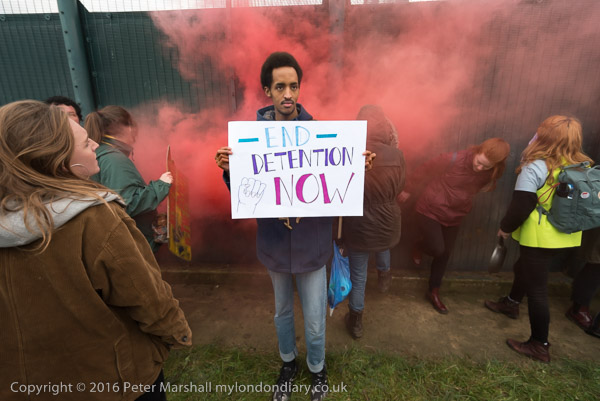
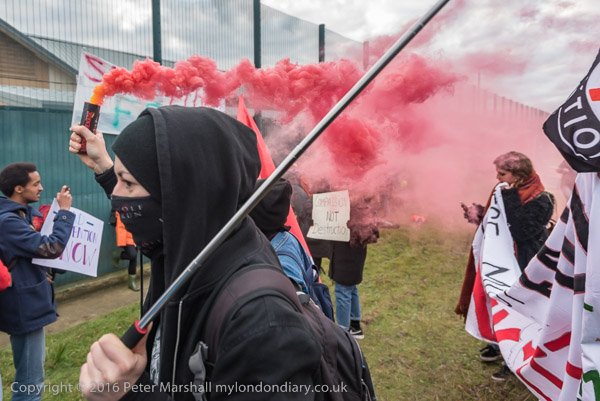
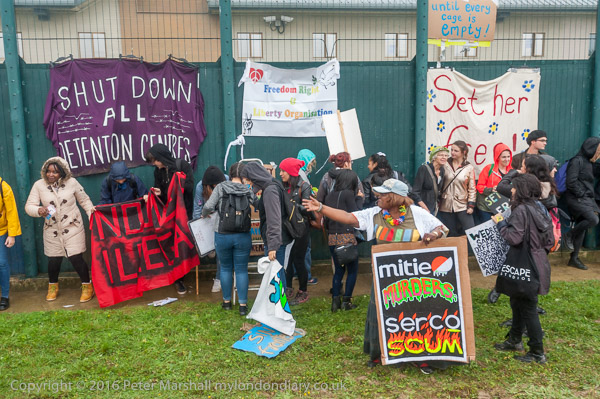
The protesters stood on a small rise in the field outside where they could see the upper two floors of the prison over the tall metal fence through the 10 feet of open metal grid above the 10 feet of solid metal panels. Photographing through the metal grid was possible but not easy. Some protesters went up to the fence and banged noisily on the panels, while others held posters on tall poles or climbed ladders against the fence so that those on the ground floor could see their banners, and there were also a number of flares let off to give large clouds of coloured smoke.

My MfJ organised coach back to Bedford Station was leaving shortly before the protest ended, and as I boarded it, half a mile away as the crow flies though nearer a mile along the public footpath and road, I could still clearly hear the noise of the protest. Those women locked away from the block facing the protesters will certainly have been able to hear it too. It had been a powerful protest but at the end I felt an intense sense of shame for the way this country treats asylum seekers and our clearly racist immigration system.

Much more at Shut Down Yarl’s Wood 10 on My London Diary.


A Wet Day at Yarls Wood

Five years ago Movement for Justice organised a protest outside Yarls Wood on Saturday 10th September 2016, and I took the train to Bedford where there was a coach to make the five mile or so journey to the remote site on a former WW2 airfield, now a business park. Unfortunately it is so remote that the coach driver didn’t know the way, and we ended up making a lengthy detour and arriving over half an hour later than we should have done.

The coach set us off as usual on the road outside the Twinwoods Business Park entrance, around 3/4 mile from the Immigration Removal Centre. A rally was taking place on the grass there while waiting for everyone to arrive.

Eventually we set off marching down the road to the public footpath that leads along mainly muddy tracks beside several fields to that beside the immigration prison. The prison has a 20ft high fence around it, the first 10ft with solid metal sheeting and the upper half with a thick gauze through which we could see the women at the windows welcoming and signalling to us.

The field rises up quite steeply from the fence, enabling us to see the two top floors of the nearest wing of the centre, a private prison run by Serco. Going further back the lower floor where famiilies were housed became partly visible. Those held inside are in indefinite detention, never knowing when they will be released or deported – and one woman was kept locked in there for just one day less than three years.


Many of the supporters of Movement for Justice have previously been held in this or similar detention prisons, and a number of them spoke at the protest about their experiences inside. We also heard from some of the women inside, who unlike those in our normal jails, are allowed mobile phones. Some told us how Serco security guards had prevented them from coming to the windows and were threatening those who greeted the protesters with solitary confinement.


Other groups from around the country had come to support the protest, and among them were Latin American women and Sisters Uncut, who at one point provided a display of coloured flares from the top of the hill. Unfortunately be the time I had clambered up to muddy slope to take pictures it was past its peak.


The rain continued, though fortunately it was not too heavy, but the slope towards the fence meant that some areas were waterlogged and others were slippery mud. It was a noisy protest as people shouted and kicked the fence and battered it with branches. On my way back to the coach I went to take a look at the real wood called Yarl’s Wood to the south. I’d hoped I might find another view of the prison, but was disappointed. it seemed a shame that such a peaceful wood should be mired by taking its name for this shameful immigration prison.

Many more pictures at Shut Down Yarl’s Wood on My London Diary.