UN Anti-Racism Day & IDS Gone: Saturday 19th March 2016 was UN Anti-Racism Day and was celebrated with a Refugees Welcome march and rally, and by Australians and others protesting at the Australian High Commission in London to condemn the Australian government’s treatment of refugees. Later in Parliament Square I joined disabled people and friends celebrating the resignation of Iain Duncan Smith whose policies had caused them so much suffering and harm.
Stand Up to Racism – Refugees Welcome March
BBC to Piccadilly Circus
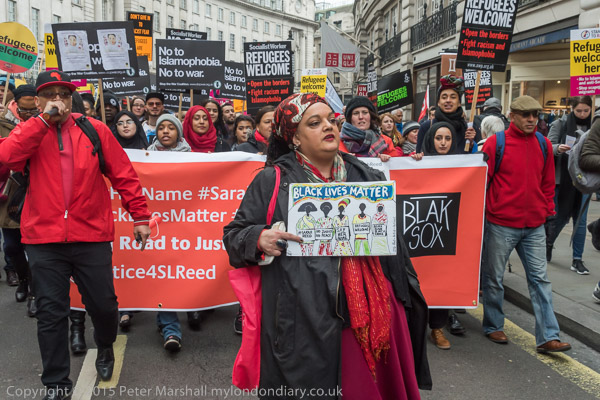
Thousands met outside the BBC for a national demonstration called by Stand Up to Racism against racism, Islamophobia, anti-Semitism and fascism and to make the point that refugees are welcome here.
They had started at the BBC pointing out that it should have a much more positive attitude to refugees. It gives much air time to the views of racists and extreme right groups and personalities and fails to adequately represent the view of the majority of the British population shown in protests such as this.
The BBC often minimises the positive contributions of migrants and refugees to the British economy and keeping vital services such as the NHS running and fails to criticise the increasingly racist government policies.

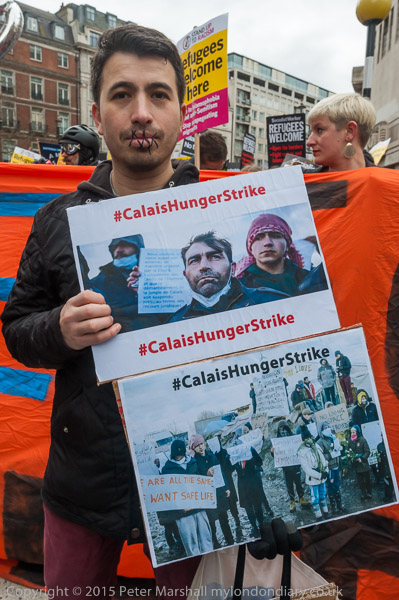
As well as a large ‘Black Lives Matter’ bloc led by Lee Jasper and Zita Holbourne, there were also groups working with refugees trapped in the camps in Calais and Dunkirk by the failure of our government to set up legal routes for refugees, demanding our government take a much more positive and humanitarian approach to refugees. Apart from a small concession for children, forced on them by Lord Dubs with massive public support, which was very grudgingly administered and prematurely ended, successive governments have responded with increasingly draconian measures.
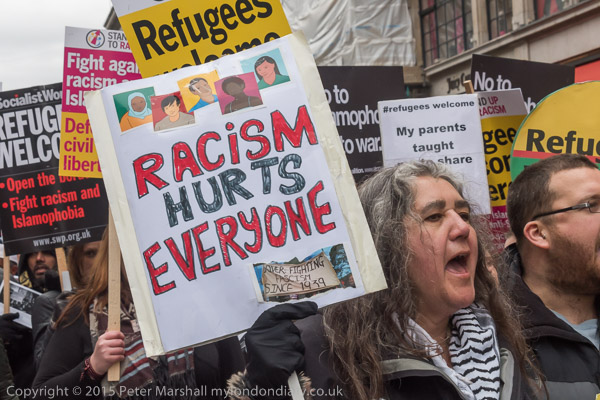
What I wrote in 2016 is now even more apposite: “Of course there are racists and bigots who oppose Britain taking in any refugees, and those who would want to abandon the Universal Declaration of Human Rights, which Britain played a major role in drawing up in 1947-8. Winston Churchill – who many on the far right look on as a symbol of all things British – proposed a European Charter of Human Rights in 1947 and we were the first country to ratify it in 1951.”

A very small group of members of the far-right group ‘Britain First’ in their para-military uniforms stood guarded by several times as many police on the steps around Eros as the march past, shouting their hate and insults and making derisory and threatening gestures. Most of the marchers simply ignored them, but a few rushed towards them but were held back by police.
Stand Up to Racism – Refugees Welcome march
Refugees Welcome Rally
Trafalgar Square
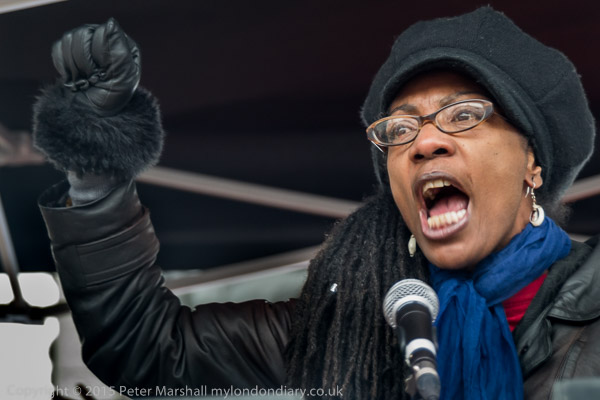
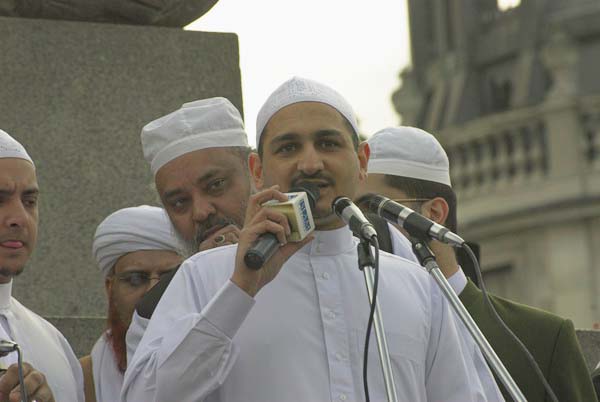
A long list of speakers came to the microphone in Trafalgar Square and I photographed most although I left before the end of the rally.

There are pictures of the following as well as Marcia Rigg on My London Diary:
- Vanessa Redgrave;
- Sabby Dhalu of Stand up to Racism;
- Maz Saleem, daughter of Mohammed Saleem killed in a racist attack;
- Stephanie Lightfoot, Bennett Co-Chair, United Friends and Families;
- Dave Ward CWU General Secretary;
- Sally Hunt UCU General Secretary;
- Christine Blower NUT General Secretary;
- Gary Younge Journalist;
- Gloria Mills, Chair of the TUC Race Relations Committee;
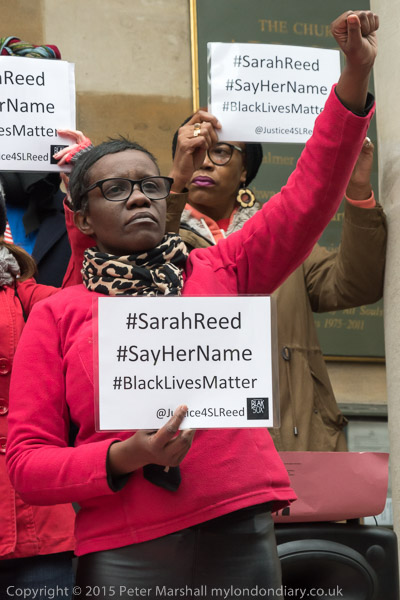
- Marilyn Reed, the mother of Sarah Reed who died in Holloway Prison;
- Lee Jasper, Movement Against Xenophobia and BARAC;
- Jeremy Hardy, Comedian;
- Diane Abbott MP;
- Michael Rosen Children’s novelist and poet;
- Claude Moraes MEP;
- Jean Lambert MEP;
- Amna, a refugee from Mosul, Iraq;
- Talha Ahmad National Council member,Muslim Council of Britain

Australians Protest on UN Anti-Racism Day
Australia House
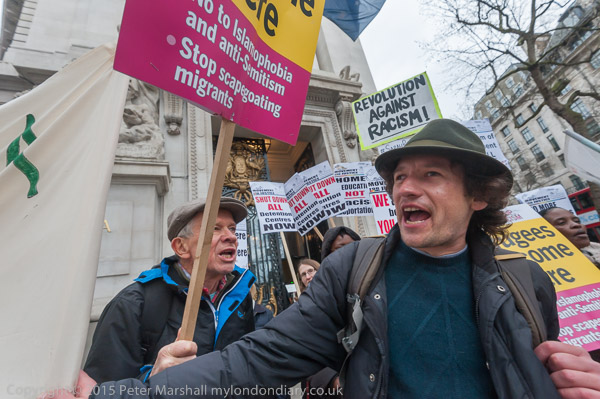
Australians were protesting at home & at embassies around the world against their country’s racist immigration policy.
Many who try to claim asylum in Australia are locked up and detained indefinitely in contradiction to international law on remote Pacific Islands including Manus and Nauru in detention camps run by Serco and will never be allowed to resettle in Australia.

Detainees in these camps have been sexually abused, denied proper health treatment, and in at least one case, that of a young man called Reza Berati, beaten to death by the prison guards.

Serco also run detention centres such as Yarl’s Wood in the UK, where detainees have also been mistreated, sexually abused and denied proper health treatment. The Australian protesters were joined by members of Movement for Justice, which has held many protests at UK detention centres including Yarl’s Wood and Harmondsworth.

No UK newspapers, TV or Radio media had even sent reporters to this protest. The only other photographer taking pictures at the event had been commissioned by a Sydney newspaper.
Australians protest on UN Anti-Racism day
DPAC’s ‘IDS Resignation Party’
Parliament Square
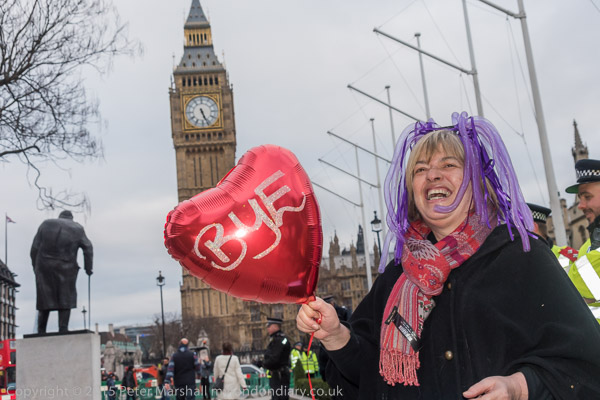
IDS, Iain Duncan Smith, was Secretary of State for Work and Pensions from 2010 to 2016 and responsible for brutal cuts in welfare polices in those years.
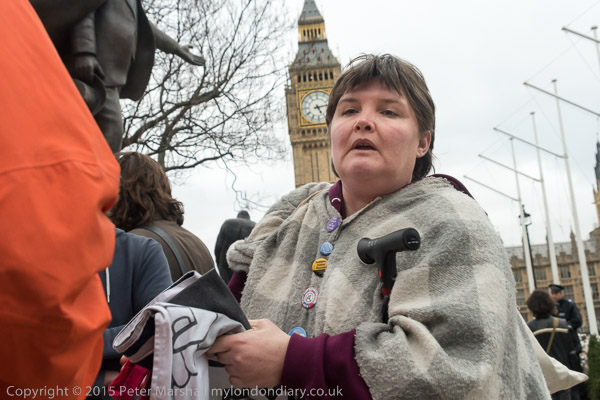
In particular he decided to save money by making it harder for sick and disabled people to claim benefits, introducing new eligibility tests and benefit sanctions, incentivising DWP staff to strip claimants of their benefits often for trivial reasons or for matters beyond their control such as the late arrival of official letters or cancellation of buses and trains making them arrive late for appointments.
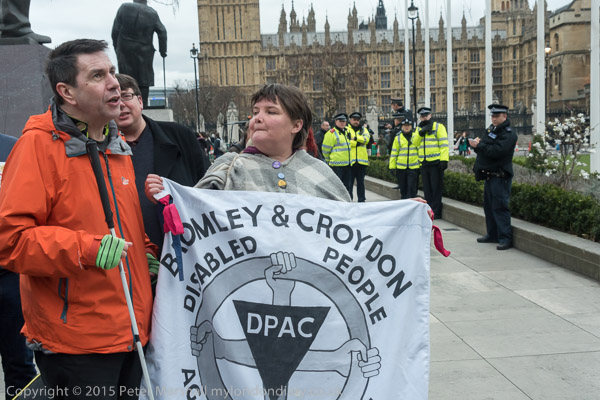
In 2015 the statistics showed that 2,380 people died in a 3-year period shortly after a work capability assessment declared them fit for work.
The poorly thought out nature of the introduction of Universal Credit also brought suffering to many, left for weeks without financial support. He introduced disastrous schemes to force the disabled into work and cut the support which had enabled some disabled people to work.
His period as a minister had combined a total lack of empathy with a peculiar incompetence and the National Audit Office accused the DWP of ‘”weak management, ineffective control and poor governance” and of wasting £34 million on inadequate computer systems.’
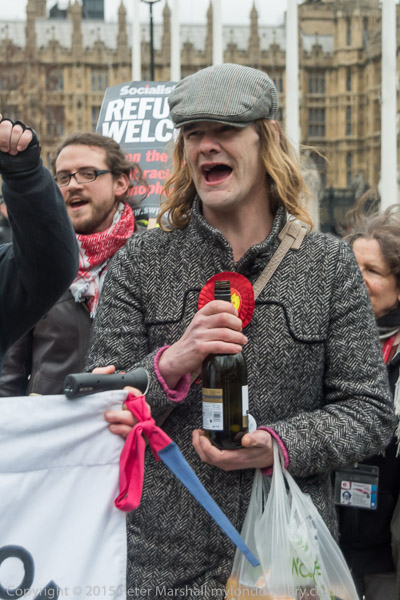
So naturally DPAC were pleased to see him go, and celebrated at this party – though with Prosecco rather than the Champagne some media reports stated. And perhaps their celebrations were a little muted by the knowledge that his successor Stephen Crabb had shown himself to be equally bigoted and lacking compassion and understanding of the needs of the poor and disabled.
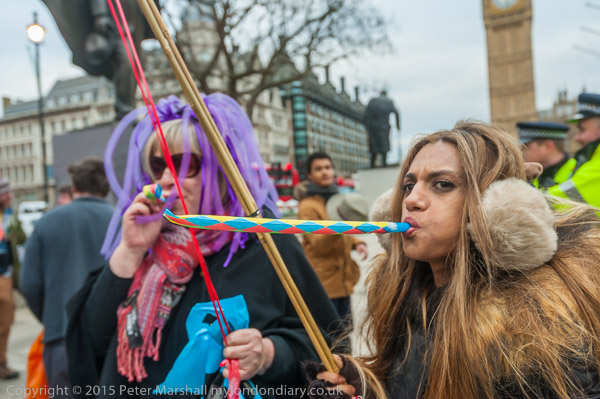
Strangely, despite his long record of cutting disablity benefits, IDS’s stated reason for his resignation was that he was unable to accept the government’s planned cuts to disability benefits, later describing the policies he had spent six years putting into effect of “balancing the books on the backs of the poor and vulnerable” as divisive and “deeply unfair“.
DPAC’s ‘IDS Resignation Party’
Flickr – Facebook – My London Diary – Hull Photos – Lea Valley – Paris
London’s Industrial Heritage – London Photos
All photographs on this page are copyright © Peter Marshall.
Contact me to buy prints or licence to reproduce.