St Anne’s and St Ann’s, Wandsworth – 1990

St Anne’s and St Ann’s, Wandsworth: My walk on Sunday 4th March 1990 had begun at Clapham Junction in Battersea with St John’s Road & East Hill, Battersea – 1990 and the previous post, More From Wandsworth 1990, had ended with a distant view of St Anne’s Church.

Houses, St Anne's Crescent, Wandsworth, 1990, 90-3a-11
Houses, St Ann’s Crescent, Wandsworth, 1990, 90-3a-11

This area was towards the end of the 18th century still farmland, part of the Manor or All-Farthing, a small hamlet to the south of Wandsworth. An 1804 map shows there were still no houses here, only fields around what was then All Farthing Lane. The first houses were built here at the same time as the church, in the 1820s, but these are rather later in the century, probably around 1850.

At left is Surrey House, 6 St Anne’s Crescent. The two large semi-detached houses at 4-10 are shown on the 1873 OS map (on what was then St Anne’s Hill) and locally listed.

St Anne's Church, St Anne's Hill, Wandsworth, 1990, 90-3a-12
St Anne’s Church, St Ann’s Hill, Wandsworth, 1990, 90-3a-12

St Anne’s was one of five ‘Waterloo Churches’ in the Southwark diocese built “as monuments to the victories at Trafalgar and Waterloo. Building of Saint Anne’s Church began in 1820 and was completed in 1824. The architect was Sir Robert Smirke. The church was consecrated on 1 May 1824 as a chapel of ease to the Parish Church of All Saints, Wandsworth.

Smirke was a remarkably prolific architect and “is known to have designed or remodelled over twenty churches, more than fifty public buildings and more than sixty private houses.” These included seven of the the Waterloo Churches, and he was an official government architect and an adviser to the scheme – the only example of government funded church-building which provided a total of £1.5 million to provide 612 new Anglican churches. It was a huge scheme costing equivalent to more than £125 billion allowing for inflation.

Plowden & Smith, St Anne's Hill, Wandsworth, 1990, 90-3a-13
Plowden & Smith, St Ann’s Hill, Wandsworth, 1990, 90-3a-13

I walked past the church to St Ann’s Hill (the church is St Anne’s but the street appears to have lost an ‘e’) and north along this. Plowden & Smith at 190-4, was established in 1966 and is a leading provider of art restoration services but they are now based in purpose-built premises on Morden Road, Mitcham. They left St Anne’s Hill around 2018. The building at 190 had previously been a sorting office and is now called Sorting House.

Plowden & Smith, St Anne's Hill, Wandsworth, 1990, 90-3a-14
Plowden & Smith, 190, St Ann’s Hill, Wandsworth, 1990, 90-3a-14

As well as giving a good view of the frontage of the building I also liked the car parked partly obstructing the large painted sign ‘NO PARKING IN FRONT OF THIS BUILDING’. The development has retained most of the brickwork of the Victorian frontage but with more window area, and behind it and largely unnoticed from street level is a much taller modern structure which includes 9 new flats.

Temporary Housing, St Anne's Hill, Wandsworth, 1990, 90-3a-15
Temporary Housing, St Ann’s Hill, Wandsworth, 1990, 90-3a-15

As I wrote in an earlier post, “The LCC designed temporary housing together with the Timber Development Association as a temporary solution to the then acute housing problem. I think these may have been replaced by new housing on Malva Close built in 1993.

Designed to last 15 years these homes came as two boxes which were craned onto piles of paving slabs and did not need dug foundations. The two boxes were than bolted together. The walls were asbestos covered with plastic and both roof and floor were made from plywood sheets sandwiching polystyrene insulation. They had a hall, living room, two bedrooms, kitchen and bathroom.”

Many seemed to have found them comfortable and were reluctant to leave, often being rehoused in less convenient locations and in pokier flats.

More to follow on this walk around Wandsworth.


FlickrFacebookMy London DiaryHull PhotosLea ValleyParis
London’s Industrial HeritageLondon Photos

All photographs on this page are copyright © Peter Marshall.
Contact me to buy prints or licence to reproduce.
Gun & Knife Crime, Equiano & St John’s – 2007

Gun & Knife Crime, Equiano & St John’s: I went to two events in North London on Sunday 14th October 2007, a local march against gun and knife crime and then a Black History Month event in Abney Park Cemetery. And on my way home I stopped to take a few pictures of the church opposite Waterloo Station.


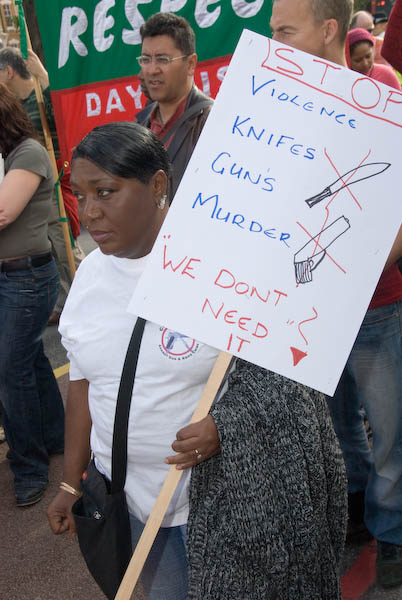
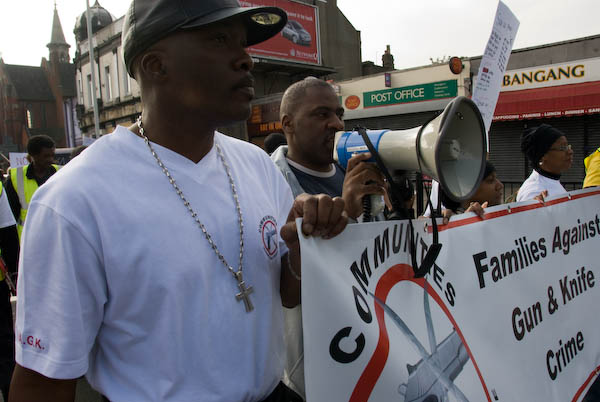
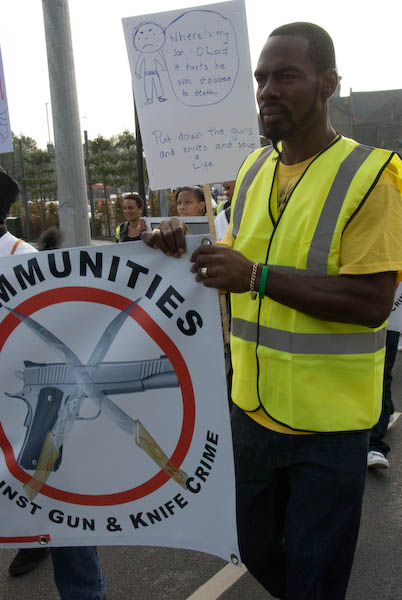
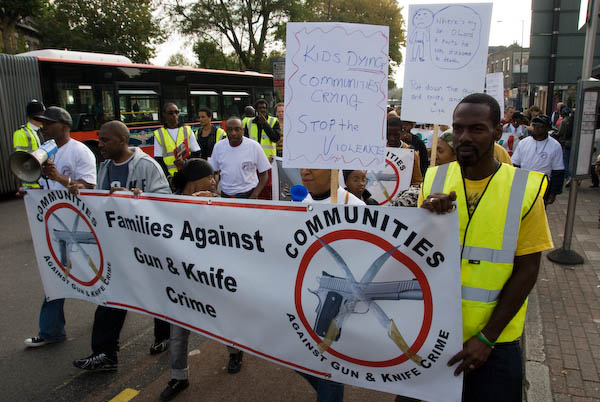
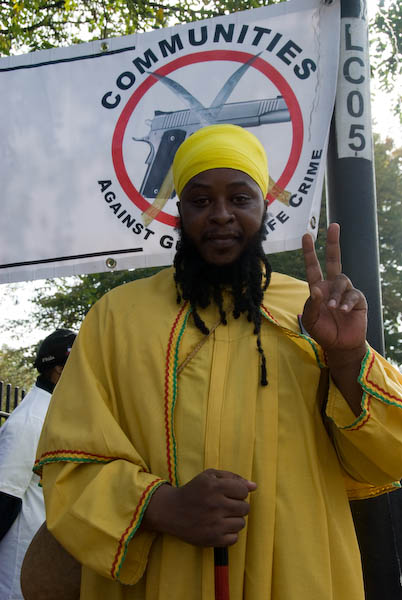
Communities Against Gun and Knife Crime, Hackney

In the 2000’s a stretch of road between Upper Clapton and Lower Clapton attracted the title ‘Murder Mile’ in the press after eight people were shot dead on the street or in the streets just off the main road over a period of two years. Of course there are some other cities around the world – including in the USA – where that number of deaths in a week or even a day would not be unusual. But London is generally a very safe city and Clapton is one of a number of areas which has more than its share of gun and knife crime.

Gun & Knife Crime, Equiano & St John's:

This is an area with a number of night clubs and where drug dealing is common and a large proportion of the shootings and deaths are related to these, often involving people from outside the area.

Gun & Knife Crime, Equiano & St John's:

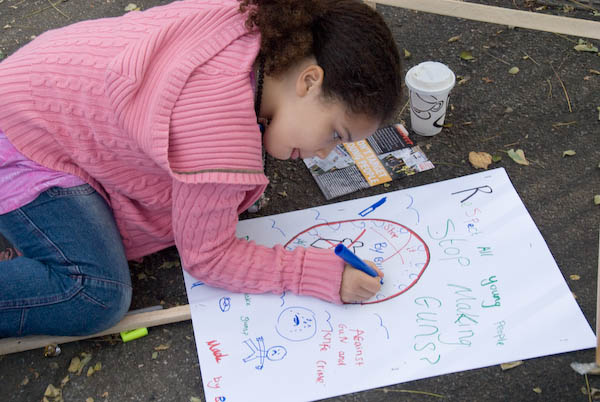
But young people who live in and around the area are also caught up in gun and knife crime and one death is one too many, particularly when it involves your friends or family. Like many areas of London it houses a wide social mix, and these crimes particularly involve the poorer members of the community, many of whom are black.

Gun & Knife Crime, Equiano & St John's:

The march organised by Communities Against Gun And Knife Crime appeared to have no support from either of the two London Boroughs concerned – Hackney and Haringey – or from the Met police, who did escort it. The only other organisation which I could see was supporting it was Hackney Respect, a local group of the left-wing Respect party.

Gun & Knife Crime, Equiano & St John's:

The march began at Clapton Pond with a prayer by a Black Church Sister, and then moved slowly north up the Lower Clapton Road and across the Lea Bridge Roundabout and up the Upper Clapton Road. I had to leave before the end for my second event.

The march was smaller than I had expected with fewer than a hundred people taking part, and although it atrracted waves and shouts of support from people as it passed, few if any of them came to join it. As I commented, “marches like this are surely useful in raising community awareness, and it is hard to see why there was so little support from either the public, local authorities or other local groups – including the other political parties, churches and other community groups.” Apart from myself there was a photographer from a local paper reporting on the event, but no other media interest. I don’t think any of the pictures or my report which I filed to an agency were ever used.

Here is my final comment from my 2007 article:

The real challenge in cutting youth crime – and gun and knife crime is mainly youth crime – is getting people, and especially young people – real jobs that offer training and possibilities for advancement. At the moment there are too few jobs for young people, and many pay below a living wage, especially a living wage for London. While crime offers the only way to money, prestige and apparent success, many will take that route.

Communities Against Gun and Knife Crime

Equiano Society – His Daughter’s Grave – Abney Park Cemetery, Stoke Newington

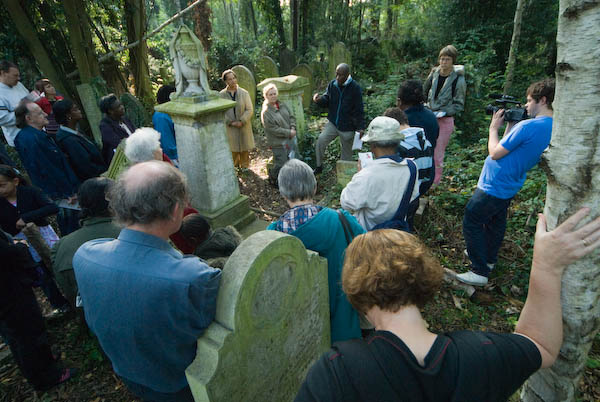
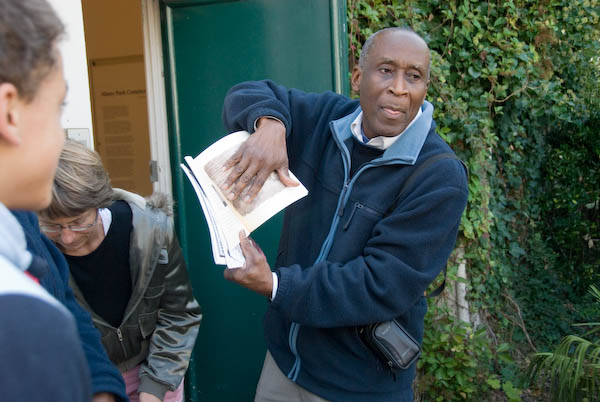
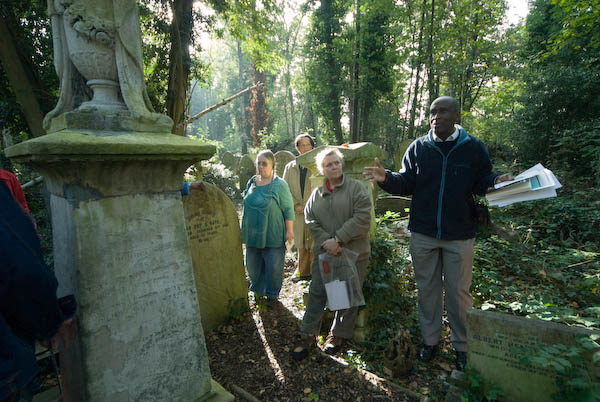
I joined a Black History Month walk led by Arthur Torrington OBE, the secretary of the Equiano Society which ended around the grave of Joanna Vassa, the daughter of Olaudah Equiano.

As the web site Olaudah Equiano, or, Gustavus Vassa, the African shows he was a truly remarkable man. Probably born around 1745 in what is now Nigeria he was kidnapped and sold into slavery as a child and taken to Barbados. In 1745 he became slave to a captain in the Royal Navy who renamed him Gustavus Vassa, and taught him to be a seaman and also sent him to school in London to learn to read and write. Later was bought by a Quaker merchant in Philadelphia who set him to work on one of his trading ships. Equiano was also able to engage in some trading for himself, and in four years made the £40 that his master had paid for him and was able to buy his freedom.

After various adventures in 1743 he came to London and became involved in the fight against slavery, although at first he was engaged in projects to set up black colonies in Central America and Sierra Leone, becoming for the latter the first black civil servant – but after he pointed out corruption among some officials he was quickly sacked.

He then wrote the book which made him famous, ‘The Interesting Narrative of the Life of Olaudah Equiano, or, Gustavus Vassa, the African‘ which was an autobiography, a description of the horrors of slavery and a polemic calling for its abolition. It was a success when published in 1789 and he earned a considerable income from it. In 1792 he married an English woman, Susanna Cullen, at Soham in Cambridgeshire and they had two daughters, one of whom after his death in 1797 inherited his estate of £950 (equivalent to around £100,000 now.)

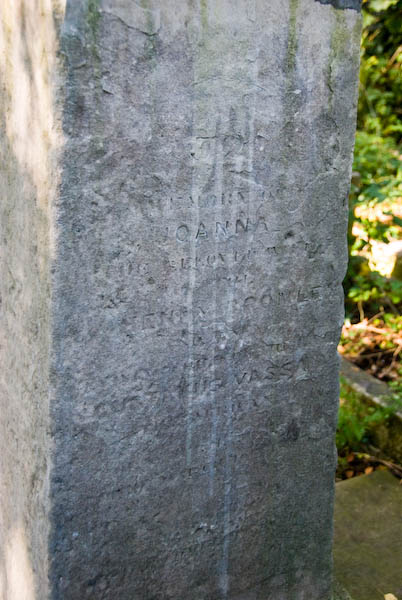
Joanna Vassa later married the Congregational minister, Henry Bromley, and in 2005 their joint grave (also of Henry’s second wife) was discovered in Abney Park Cemetery, fallen down and covered by moss and undergrowth. Much of the inscription was worn away, but the names remained and the stone was restored and re-erected.

Equiano’s daughter


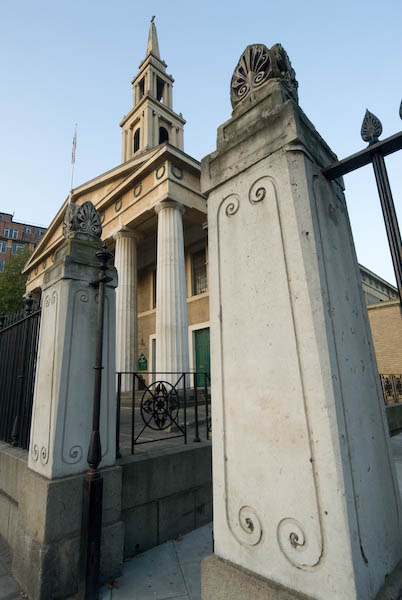
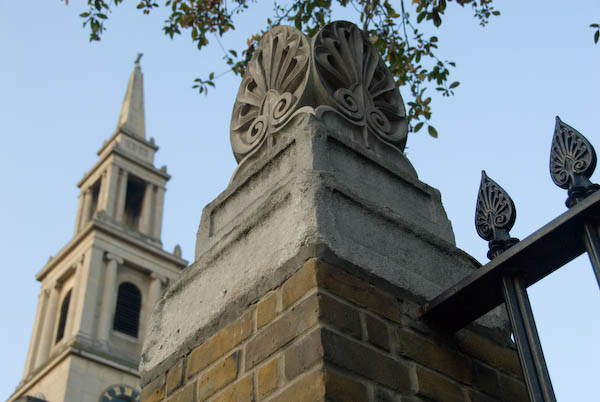
St John’s, Waterloo – A Waterloo Church

St John’s Church, now opposite Waterloo Station was one of a number of churches built in the years of national triumph following the defeat of Napoleon in 1815 with money granted by acts of Parliament to the Church Building Commission in 1818 and 1824 totalling £1.5 million. A total of 612 new churches were built by the Church Commissioners, mainly in the new and expanding industrial towns and cities, but initially “particularly in the Metropolis and its Vicinity“.

London south of the river was expanding rapidly, with new industries and a great deal of housing. The church was designed by Francis Octavius Bedford and built in 1822-1824 in a Greek Revival style – as were his other churches for the commissioners in Camberwell, West Norwood and Trinity Church Square, Southwark.

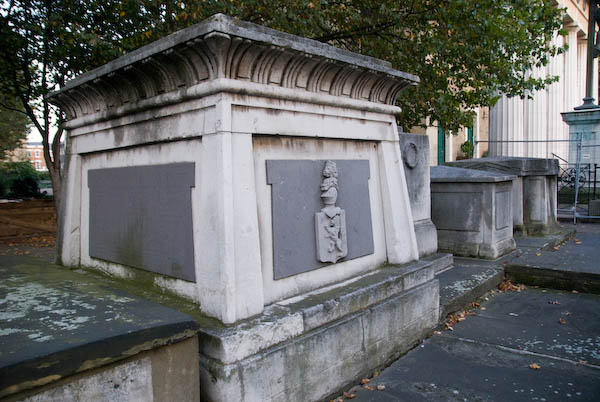
The site chosen, close to the foot of Waterloo Bridge was a difficult one, being a pond and a swamp, and John Rennie the Younger was consulted for advice about the foundations. This has proved sound as the building, despite being badly bombed in 1940 and standing in ruins until 1950 and the construction of the Jubilee Line underneath is still sound. It was restored and rededicated in 1951 as a part of the Festival of Britain, and again controversially in recent years which removed some of the later features.

I think I probably had just missed a train home from Waterloo Station opposite, a later development which opened as Waterloo Bridge Station in 1848, and had some time to wait for the next. Soon I was on a train home.

St John’s Waterloo