Houses, Trees & Walks – Highgate 1989

My wandering around Highgate on Sunday 19th November, continued. You can read the first part of it at Highgate – Mirrors, Mansions & Luxury Cars which had ended at the Kingdom Hall on North Hill.

Tree, Southwood Lane, Highgate, Haringey, 1989 89-11e-25

One thing that I seldom resist on a walk is a passage and a little further down North Hill I found Park House Passage. And after photographing the rather fine house beside it (4 North Hill, not digitised) I went down it to The Park, confusingly not a park but a street, with houses only on the north side. I took several more pictures not on line including two of a large block of flats two the south on Hillcrest, perhaps built later on the parkland which had given the street its name. But trees along the road meant they could not be seen as clearly as I would have liked.

But I saw the ash tree in this picture after I turned on to Southwood Lane in front of some modern housing largely hidden behind an old wall. Both house and tree are still there, though of course the tree has grown considerably. Most of the ash leaves had fallen but some were still holding on and contrasted greatly with the evergreen shrub at the bottom of the frame.

Highstone House, Jackson's Lane, Highgate, Haringey, 1989, 89-11e-11
Highstone House, Jackson’s Lane, Highgate, Haringey, 1989, 89-11e-11

A little further down Southwood Lane I turned into Jackson’s Lane, named after Joseph B Jackson, who lived in a house named Hillside, demolished to build the late Victorian Hillside Mansions and the street Hillside Gardens.

Highstone House is the first house down the street on a very narrow section of the road and it is now rather hidden as the wrought iron gate has been replaced by a solid wooden one.

House, 62, Jackson's Lane, Highgate, Haringey, 1989 89-11e-14
House, 62, Jacksons Lane, Highgate, Haringey, 1989 89-11e-14

I photographed another house on the opposite side of Jackson’s Lane and then turned around to return to Southwood Lane photographing this house close to the junction at 62 Jackson’s Lane.

Park Walk, Southwood Lane, Highgate, Haringey, 1989 89-11f-52

Almost opposite was Park Walk, leading from Southwood Lane to North Road, so I had to go down it. I think the white house on Southwood lane is possibly a detached part of the property on Jackson’s Lane in the previous picture.

Park Walk, Southwood Lane, Highgate, Haringey, 1989 89-11f-53

The flats which can be seen through the trees are I think on Hillcrest, and are perhaps Cunningham House or Tedder House. Park Walk took me back to North Hill, opposite the High Point flats.

Highpoint, North Road, Highgate, Haringey, 1989 89-11f-44

Berthold Lubetkin designed the Grade I listed High Point 1 flats built in 1931 in the International Modern style as housing for the employees of Sigmund Gestetner but they never got to live in them. Also involved as structural engineer was Ove Arup. I think my picture deliberately avoided taking a standard view of them showing them as a modern masterpiece but instead concentrated on what I take to be an architectural joke at the entrance with pilotis and caryatids.

The flats are on one of the highest points in Highgate and the name above the entrance is clearly High Point, but they are usually referred to as Highpoint. This is Highpoint 1 and later in 1938 Lubetkin added the adjoining more luxurious Highpoint 2 in a similar design. He lived in the penthouse on Highpoint 1 until then.

Le Corbusier visited the flats in 1935 and called them “an achievement of the first rank” and many architectural critics consider them among the finest flats built and among Britain’s finest buildings. Of course they have been much photographed and I didn’t on this occasion do more than take a few frames as I walked past – only this one online.

More from Highgte in a later post.

Marine A, Mandela, CPS Failures, Cops off Campus – 2013

Marine A, Mandela, CPS Failures, Cops off Campus: On Friday 6th Decemeber 2013 some very varied events were taking place in Central London. Here they are in the order I photographed them.


EDL Protest Supports Marine A – Downing St

Marine A, Mandela, CPS Failures, Cops off Campus - 2013

The EDL had called for a major protest at Downing Street on the day that ‘Marine A’, Sergeant Alexander Blackman, was to be sentenced, but only around 50 supporters were there when I arrived.

Blackman was being tried for the murder of a wounded Taliban insurgent in Afghanistan in contravention of the Armed Forces Act 2006, and became the “first British soldier to be convicted of a battlefield murder whilst serving abroad since the Second World War.

Marine A, Mandela, CPS Failures, Cops off Campus - 2013

I commented “I doubt if there are many serving soldiers who would wish to see the Geneva conventions disregarded, and wonder what support if any this protest would have from serving soldiers, many of whom have condemned strongly the cold-blooded killing of a prisoner by Marine A and called for an appropriate sentence.

However many did feel when later that day he was sentenced to “life imprisonment with a minimum term of ten years and dismissed with disgrace from the Royal Marines” he had been treated harshly, and in 2014 the sentence was reduced to eight years, then after a public campaign overturned on appeal and reduced to manslaughter on the grounds of diminished responsibility. Given the time he had served he was released in April 2017.

EDL Protest Supports Marine A


Tributes to Mandela – Parliament Square & South Africa House

Marine A, Mandela, CPS Failures, Cops off Campus - 2013

Nelson Mandela, the “Father of the Nation” who had become the first president of a new post-apartheid South Africa from 1994-1999, having previously spent 27 years in prison before his release in 1990, had died the previous day, 5th December 2013.

Marine A, Mandela, CPS Failures, Cops off Campus - 2013

People brought flowers to the Nelson Mandela statue in Parliament Square and to South Africa House in Trafalgar Square, where a long queue waited patiently for several hours to sign a book of remembrance in the High Commission.

Tributes to Mandela


Bereaved protest at CPS Failure – Southwark Bridge

Marcia Rigg holds a picture of Mandela as she addresses the protest against the PCS

Since 1990 there had been 1433 deaths of people in custody, many under highly suspicious circumstances and not a single conviction of any police, prison officers or security guards who have either failed in their duty of care or more actively caused their deaths.

Relatives and friends of those who dies had come to protest outside Rose Court, the home of the Crown Prosecution Service. The last successful prosecution brought against a police officer was for involvement in a black death in custody was in 1972, after the death of David Oluwale in 1969. Police officers have been prosecuted for several other black deaths in custody – Joy Gardner, Christopher Alder and Mikey Powell – but none was successful.

The standard response from the CPS – led by Keir Starmer from 2008-2013 – is that there is ‘not enough evidence to prosecute’, largely because the cases have not been properly investigated. Often the police involved are simply not questioned, and in some other cases they simply refuse to answer questions.

Bereaved protest at CPS Failures


‘Cops Off Campus’ Protest Police Brutality – Bloomsbury

Following protests by students and others against student fees and cuts, the closure of the student union and calling for acceptable pay and conditions for low paid largely migrant cleaners, catering staff, security staff and others, the University management had tried to ban protests on campus and had brought in numbers of police to enforce that ban.

This protest was called after the previous day police had brutally assaulted a group of students who had briefly occupied a part of Senate House, arresting a number of students including the Editor of the student newspaper and a legal observer.

The organisers had intended this to be an entirely peaceful march around the various s sites of the university in the area to the west and north of Russell Square, but it was clear that the police had other ideas. There seemed to be police vans down every side-street in the area as students assembled on the pavement outside the University of London Union in Malet St.

There were a few short speeches before the march set off to walk around the block but were stopped by a line of police across the street, with those who tried to walk through it thrown roughly backwards.

They turned around only to find police blocking both the other end of the street and a side street leading to Gower Street and their only way open was to go onto the campus, walking past SOAS and out onto Thornhaugh Street. There they turned up into Woburn Square and then turned to make their way into UCL, only to find the gates from Torrington Place were locked and guarded by security.

They then turned into Gower Street where they saw another group of police rushing towards them and they then rushed through the gates into the Main Quad. Here there was a lot of discussion about what to do next and they eventually decided to take a back street route to Torrington Square, and set off at a rapid pace. I took a more direct route to meet them there. But by now it was dark and I was tired of walking around London and decided to go home.

The police operation seemed to me “an incredible and pointless waste of public money, and it resulted in more inconvenience to the public than if the event had not been policed at all.” Perhaps more importantly this kind of policing alienates a large proportion of young people, acting strongly to destroy the ‘policing by consent’ which has always been the the basis of our police system.

More at ‘Cops Off Campus’ Protest Police Brutality.


FlickrFacebookMy London DiaryHull PhotosLea ValleyParis
London’s Industrial HeritageLondon Photos

All photographs on this page are copyright © Peter Marshall.
Contact me to buy prints or licence to reproduce.

Olympic Site & Budget Cuts – 2012

Olympic Site & Budget Cuts: Wednesday 5th December 2012 was a cold day in London, with the temperature just three or four degrees above freezing during the day, but there was plenty of blue sky with a few clouds and it seemed ideal weather to wrap up and go and see what progress had been made in restoring the Olympic site, still largely off-limits some months after the end of the games. And later in the early evening I returned to Westminster for a protest against the cuts which had been announced by Chancellor of the Exchequer George Osborne in his autumn budget statement.


Olympic Area Slightly Open – Stratford Marsh

Olympic Site & Budget Cuts - 2012

Much of the area around the Olympic site had been closed to the public in May, including the Greenway, the elevated footpath on top of the Northern Outfall Sewer which runs close to the Olympic stadium, but this was now re-opened in part.

Olympic Site & Budget Cuts - 2012

The section between Stratford High Street and the main railway lines which run from Liverpool Street station to Stratford and on further east was however still closed and would remain closed for years as work was now taking place for Crossrail – opened as the Elizabeth Line in 2022.

Olympic Site & Budget Cuts - 2012

I started my walk in the early afternoon around the Bow flyover where the Bow Back rivers were still closed to traffic with a yellow floating barrier, but the footpath along the Lea Navigation had been re-opened. One improvement made presumably for the Olympics was a pathway and footbridge taking walkers under the busy road junction and across the canal.

Olympic Site & Budget Cuts - 2012

Finding the new entrance to the Greenway meant walking between fences on the Crossrail site down Pudding Mill Lane, and probably I would have abandoned the route had it not been for signs put up by the View Tube café – though when I finally reached this I found I was the only person to have done so and the cafe was deserted.

Olympic Site & Budget Cuts - 2012

There were still fences everywhere as you can see from my photographs but I was able to walk along the Greenway to Hackney Wick and then along the towpath beside the navigation. But the footpath beside the Old River Lea was still blocked off.

By then the light was beginning to fade and the Olympic stadium was gaining a golden glow. I walked a little further along the towpath and photographed the Eton boathouse as the sun was setting setting before crossing the canal and making my way to Hackney Wick station.

Many more pictures, both normal and panoramic views on My London Diary:
Olympic Area Slightly Open.


Osborne’s Budget Cuts – Strand to Whitehall

Several hundred students, trade unionists, socialists and others marched with UCU London Region down the Strand and into Whitehall shouting slogans against public service cuts, the rich, David Cameron and George Osborne in particular.

Opposite Downing Street they joined with others already protesting there including CND and Stop the War who were calling for the government to stop wasting money on the war in Afghanistan and vanity projects supporting the arms industry such as Trident and its planned replacement.

The Afghanistan war — which everyone knows is futile and lost — is costing around £6 billion a year. The yearly maintenance costs for Trident are £2.2 billion a year. The cost of renewing the Trident system — which this government is committed to do — would cost up to £130 billion. Two aircraft carriers are being built at a cost of £7 billion. Then there’s the £15 billion to be spent buying 150 F-35 jets from the US, each of which will cost £85 million plus an extra £16 million for the engine.”

The rally began shortly after the marchers arrived. By now it was only just above freezing and speakers were asked to keep their contributions short because of the temperature.

Among the speakers were John McDonnell MP, Kate Hudson of CND, author Owen Jones, Andy Greene of DPAC, Green Party leader Natalie Bennett and others including a nurse from Lewisham Hospital threatened with closures, from the NUT, UK Uncut and other trade unionists.

Kate Hudson CND and Romaine Phoenix Coalition of Resistance/Green Party

Many of the speakers called on trade unions to take effective action against the cuts. calling for union leaders to stop simply speaking against them and take the lead from their members and start organising strike action. But of course few did and the cuts continued unabated.

More at Osborne’s Budget Cuts.


FlickrFacebookMy London DiaryHull PhotosLea ValleyParis
London’s Industrial HeritageLondon Photos

All photographs on this page are copyright © Peter Marshall.
Contact me to buy prints or licence to reproduce.

Highgate – Mirrors, Mansions & Luxury Cars – 1989

Highgate – Mirrors, Mansions & Luxury Cars: My next photographic walk in 1989 was on Sunday 19th November, and began At Highgate Station on the Northern Line, from where long escalators took me up to Archway Road.

Mirrors, Archway Rd, Highgate, Haringey, 1989 89-11e-66

The picture is a double self-portrait with me appearing – if dimly – in two of the mirrors in a shop window with the message ‘IF YOU DO NOT SEE WHAT YOU REQUIRE IN THE WINDOW PLEASE ASK INSIDE. My Olympus OM4, held in my right hand (left in the mirrors) covers most of my face.

Mirrors have often featured in photographs and seem endemic in film, and in 1978 John Szakowski staged an exhibition of American photography since 1960 and a book, Mirrors and Windows exploring what he felt was the distinction between photographers whose work largely reflected their own subjective view and others who used photography as a window on the world. It is of course not a dichotomy and we all do both, though perhaps at different positions on the spectrum.

I wandered around a bit up and down Archway Road and can’t remember exactly where this shop was, but not far from the station. Eventually I turned south down Southwood Lane.

Southwood Mansions, Southwood Lane, Highgate, Haringey, 1989 89-11e-53

Southwood Mansions is an imposing late Victorian mansion block build in 1897 and although its entrance (one of a pair) looked rather down-at-heel in 1989, the large flats here now sell for well over a million pounds. This is a very desirable location, close both to the Underground station and to Highgate village.

Car Sales, Highgate, Haringey, 1989 89-11e-42
Car Showroom, Highgate, Haringey, 1989 89-11e-42

I went back to Archway Road and wandered a little around the area, taking few pictures. This rather grand car showroom had some rather expensive cars – I was told they are 930 and 964 Porsches and would be worth a fortune now and the first advert that came up on Google lists them at £64,995 to £449,995. I can’t find this showroom now and think it has probably been demolished.

North Hill, Highgate, Haringey, 1989 89-11e-45

These houses are a part of a small estate on North Hill, Bramalea Close and Cross Crescent. They are among those featured on a walk along the street by the Highgate Society which states “Arguably no other road in London, Britain, Europe or, who knows, even the world compares with North Hill in terms of the diversity of its domestic architecture” though it gives rather little information about these. They were built between 1976 and 1982.

BMW, Garage, The Victoria, Pub, 28, North Hill, Highgate, Haringey, 1989 89-11e-46

More expensive cars at Highgate dealer Hexagon, founded by Paul Michaels in 1963. The company is still in business but this site has been demolished and replaced by housing.

The pub building is still there but closed in 2017 and planning permission was granted for the site to be developed with extra residential building but retaining the pub. Some think the developers are waiting until the pub is in such a poor condition they will be able to demolish it and develop the entire site. But so far it does not seem to have been treated to the usual fire started by persons unknown.

House, 53, North Hill, Highgate, Haringey, 1989 89-11e-31
Houses, 53, North Hill, Highgate, Haringey, 1989 89-11e-31

Thes building are not mentioned in the Highgate Society walk on North Hill, though I did photograph some of the others. I found it interesting for the porch and the balcony above at 51 and the 1930s style windows of 53 to the right (since replaced) and the unusual fenestration of 53 and 55, clearly a later addition to 51.

Kingdom Hall, North Hill, Highgate, Haringey, 1989 89-11e-35

There is something very odd about these walls and steps that lead up to the door of the Kingdom Hall of Jehovah’s Witnesses at 33 North Hill, and it seems perverse in the era of accessible entrances. It was certainly not the straight gate of Matthew 7 verse 14. The The steps from the pavement now seem to have been levelled out and there is now I think step-free access to a lower level of the building.

More to come from my walk in Highgate.


FlickrFacebookMy London DiaryHull PhotosLea ValleyParis
London’s Industrial HeritageLondon Photos

All photographs on this page are copyright © Peter Marshall.
Contact me to buy prints or licence to reproduce.

Justice for LSE Cleaners – 2016

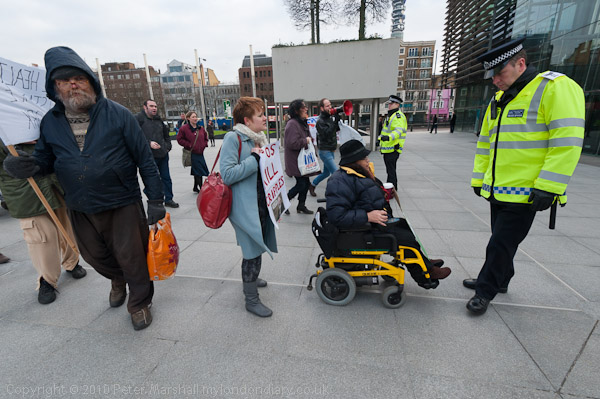
Justice for LSE Cleaners: Cleaners at the London School of Economics, one of the UK’s most prestigious universities, had begun their campaign to get decent working conditions at the end of September 2016. On 2nd December there was a protest at the LSE in support of this.

Justice for LSE Cleaners - 2016

The LSE itself could not possibly have been seen to employ the cleaners under the exploitative terms and bullying management they were working under, but were turning a blind eye to what was happening to workers on their site who were employed under a contract between the LSE and cleaning company, Noonan.

Justice for LSE Cleaners - 2016

Outsourcing contracts such as these are always a bad deal for workers. At the LSE they were getting only the statutory minimum holidays, sick pay and pension contributions, while workers on similar grades directly employed by the LSE have more generous terms.

Justice for LSE Cleaners - 2016

The cleaners had also lost rest facilities and were not allowed in the canteen with other workers. They were being exposed to dangerous chemicals without proper protection and were not allowed to use lifts to move heavy equipment between floors were are generally treated like dirt.

Justice for LSE Cleaners - 2016
David Graeber and Alba

At the start of the campaign one of the cleaners, Alba Pasimo, had shocked the meeting by standing up and describing how she had been sacked this week by the cleaning contractor after 12 years of service at the LSE.

Justice for LSE Cleaners - 2016

Their campaign, led by their union the United Voices of the World, was widely supported by LSE students, some teaching staff and others from the trade union movement.

A series of protests, including this on December 2nd 2016, supported the campaign for the re-instatement of sacked cleaner Alba, better management with achievable workloads and the same conditions of service including sick pay, pensions and paid leave from contractor Noonan as those of equivalent grade staff directly employed by the LSE. They were also calling for union recognition of the UVW.

Considerable building work taking place at the LSE meant that the only direct route between the Old Building in Houghton Street and the rest of the campus was through that building, and after a rally outside, the protesters marched into the building, ignoring attempts by security staff to stop them, to make their way through.

They marched around the rest of the campus and then to the offices used by both the LSE and the cleaner’s employers Noonan on the corner of Aldwych at No 1 Kingsway where they held a rally on the wide area of pavement.

They then went back onto the campus for a final rally outside the LSE Library, warning the LSE management that actions like this will continue until Alba is reinstated and the cleaners get an offer of equal treatment from Noonan and the LSE.

In August 2017 the UVW were “proud to announce that the LSE cleaners will be BROUGHT IN-HOUSE and become employees of the LSE from Spring 2018! This will ensure they get, among other things, 41 days annual leave, 6 months full pay sick pay and 6 months half pay sick pay, plus proper employer pension contributions of up to 13% of their salary.”

UVW’s Petros Elia photographs a LSE manager who has been photographing the protest

Alba had been reinstated following an industrial tribunal hearing in July 2017 which declared her “dismissal not only unlawful but profoundly and manifestly unfair.”. The UVW then stated “Alba was the 5th sacked cleaner we have got reinstated at the LSE in the last year.”

The UVW continues to fight for the LSE cleaners. In 2023 it forced the LSE to back down and reinstate a UVW strike leader and migrant cleaner from Colombia who had played an important role in a fight over the underpayment of holiday pay. And they forced the LSE to repay a significant part of the holiday pay which workers are owned, though a legal fight continues to get the rest. At the LSE and in many other workplaces and sectors the UVW continues to struggle for justice for low paid workers.

More on the protest on 2nd December 2016 at Justice for LSE Cleaners.


FlickrFacebookMy London DiaryHull PhotosLea ValleyParis
London’s Industrial HeritageLondon Photos

All photographs on this page are copyright © Peter Marshall.
Contact me to buy prints or licence to reproduce.

Adidas, West Papua, Egypt & Climate Crisis – 2012

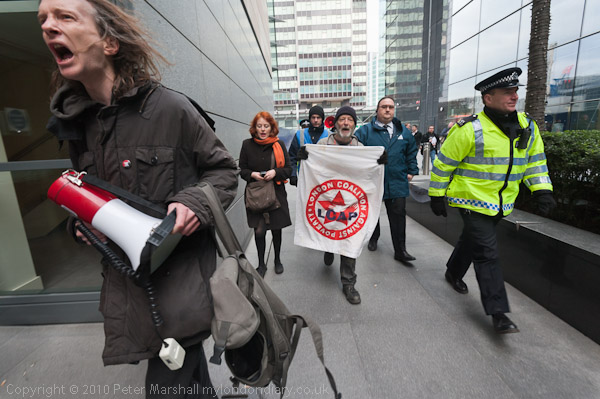
Adidas, West Papua, Egypt & Climate Crisis were all subjects of protests in London on December 1st 2012


Adidas ‘Pay Your Workers’ – Oxford St

Adidas, West Papua, Egypt & Climate Crisis - 2012

The PT Kizone factory in Indonesia had made sportswear for Adidas, Nike and Dallas Cowboys for many years, its employlees often working for as little as $0.60 an hour. In January 2011 its owner fled the country and the factory closed in April 2011.

Adidas, West Papua, Egypt & Climate Crisis - 2012

The 2,800 workers were left without jobs and by law were entitled to severance pay – a total of around US$2.8 million. Nike and Dallas Cowboys agreed to pay their share but Adidas were refusing to pay the $1.8 million they owed.

Adidas, West Papua, Egypt & Climate Crisis - 2012

This led to a worldwide campaign to get them to pay up and on 1st December 2012 there were protests outside Adidas stores across the UK including this one on Oxford Street. Around a doozen people turned up, some wearing masks of Justin Bieber, the ‘global style icon’ for their NEO label.

They pointed out that Adidas had paid $157m to sponsor the Olympics but were refusing to pay around one hundredth of that amount to the destitute workers who had created their profits.

Adidas, West Papua, Egypt & Climate Crisis - 2012

Pressure was growing on Adidas and in April 2013 they came to an agreement with those representing the former PT Kisone workers to pay compensation and in return the workers agreed to drop a legal case they were taking in the USA.

Adidas ‘Pay Your Workers’


Free West Papua – Indonesian Embassy, Grosvenor Square

December 1st is West Papua Independence Day, marking the day in 1961 when Netherlands New Guinea was granted its freedom by the Dutch, but that freedom did not last long.

The USA, driven by cold war fears that Indonesia might move towards the Soviet bloc decided in 1962 to set up a process that passed the area over to Indonesian control with a rigged election confirming this in 1969. Only a carefully selected group of 1,025 people out of the population of 800,000 were allowed to vote as representatives in a vote carried out by a show of hands and they were “coerced into voting against independence with threats of violence against their persons and their families.”

Since 1962 a movement for independence has continued, with peaceful protests outside the country and guerilla warfare guerrilla warfare against the Indonesian administration. The Free West Papua organisation is based in the UK and led by Benny Wenda, a tribal chief who escaped from an Indonesian prison and came to the UK. His wife, Maria Wenda and their children were present at today’s protest, along with other supporters of their struggle for freedom.

More on My London Diary at Free West Papua Independence Day.


Morsi’s Dictatorial Decree – Egyptian Embassy, South St, Mayfair

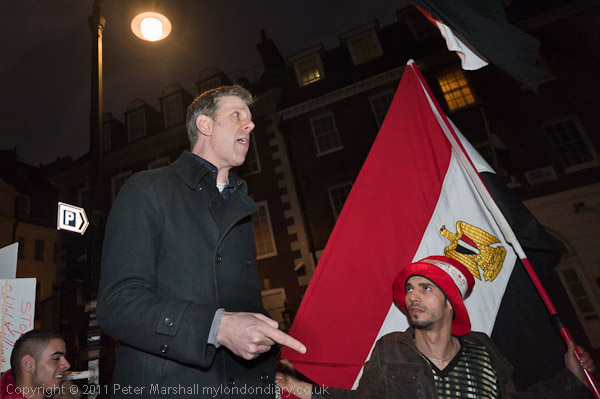
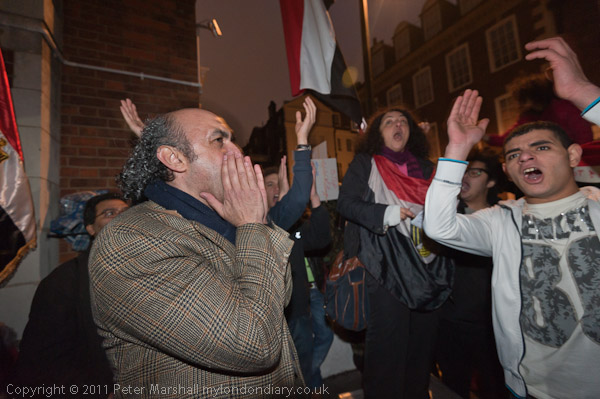
Over 50 protesters shouted noisily outside the Egyptian embassy condemning the decree by Egyptian President Mohamed Morsi calling him a dictator. The decree gave him sweeping powers and made him immune from legal challenges until a new parliament was elected, and had led to violent protests in Egypt.

Morsi’s Dicatatorial Decree


Climate March Says ‘NO’ to Fracking

On the Global Day of Action on Climate Change, activists laid a pipeline from the US to Canadian embassies before marching to Parliament to erect a giant mock fracking rig with the message ‘No Fracking in the UK’.

The event began with a rally outside the US Embassy, then still in Grosvenor Square, chosen because the fossil fuel lobby in the USA, including the Koch Brothers has made the USA the main barrier to any effective world action over the climate crisis.

They then laid a pipeline from the US embassy to the Canadian Canadian High Commission at the opposite end of Grosvenor Square in protest against the Canadian exploitation of incredibly damaging high carbon tar sands.

Then the march set off on its way to parliament and a further rally in Old Palace Yard.

I arrived there in time to photograph the protesters raising a mock fracking rig and listen to speeches by Eve Macnamara from Ribble Estuary against Fracking, John McDonnell MP and Green Party leader Natalie Bennett.

More on My London Diary at Climate March Says ‘NO’ to Fracking.


FlickrFacebookMy London DiaryHull PhotosLea ValleyParis
London’s Industrial HeritageLondon Photos

All photographs on this page are copyright © Peter Marshall.
Contact me to buy prints or licence to reproduce.


Class War Protest ‘Fascist Architect’ 2016

Class War Protest ‘Fascist Architect’: At lunchtime on Wednesday 30th November 2016 a small group of anarchists and communists protested outside Zaha Hadid Architects in Clerkenwell against their director Patrik Schumaker.

Class War Protest 'Fascist Architect' 2016
Ian Bone of Class War

The protest came after Schumaker had given a lecture in Berlin on the London Housing Crisis in which he had apparently said “We must destroy affordable housing and remove the unproductive from the capital to make way for my people who generate value.”

A Class War poster for the event put this quotation above pictures of Schumacher and Nazi architect Albert Speer with the question “Who said this?”.

Class War Protest 'Fascist Architect' 2016

Other posters were headed with the slogan “ARBEIT MACH FREI” much used by the Nazi party and best known for its use above the entrance of Auschwitz and other Nazi death camps and included pictures of the architect with minor variations on the quote.

Class War Protest 'Fascist Architect' 2016

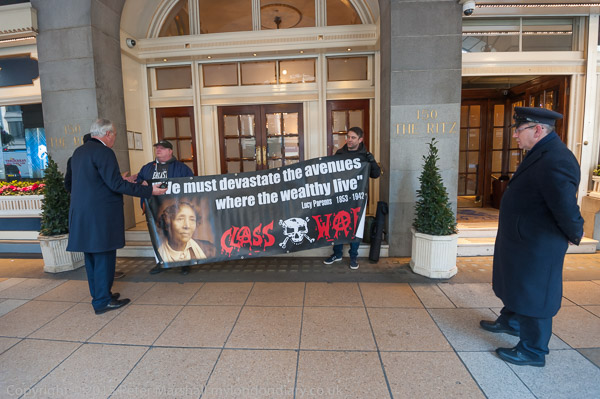
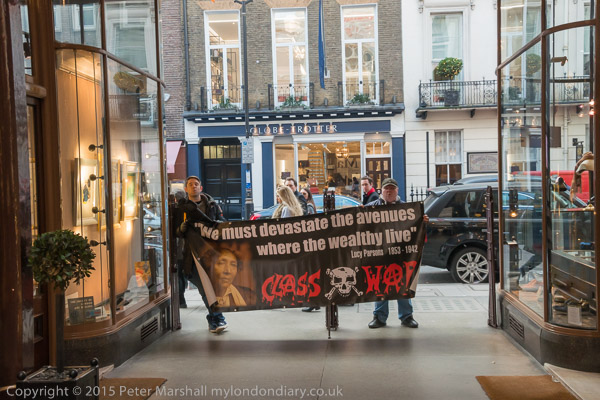
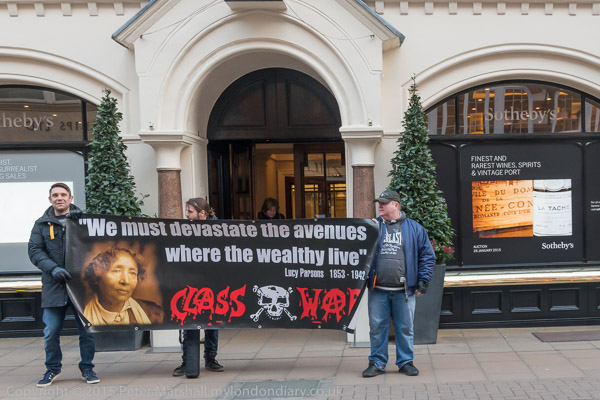
Class war had also brought their banner with and image of US Anarchist Lucy Parsons (1853-1942) who voiced a rather different view on architecture, “We must devastate the avenues where the wealthy live“. Ian Bone condemned Scuumaker’s suggestion that London should become a private enclave for the ultra-rich, with the rest of us forced out.

Class War Protest 'Fascist Architect' 2016

Other groups taking part in the protest included the Revolutionary Communist Group who labelled Schumaker as an enemy of the working class and called for social housing not social cleansing’ and two people from the London Anarchist Federation had come with their banner ‘Make London the Rebel City’.

There were a number of short speeches which among other things pointed out the “class-based absurdity of his neo-conservative proposals which would produce a London which was simply a playground for the ultra-wealthy, but would socially cleanse it of all the workers essential to its running.”

Schumaker’s Berlin lecture had been greeting with boos from the audience and had been widely disowned by architects and politicians including in an open letter from Zaha Hadid Architects.

Class War had also received a letter from one of the workers at Zaha Hadid Architects, where many are said to hate their boss. The letter suggested that Class War should protest outside his £2m home close to Highbury & Islington and gave the address, but they had decided instead to protest outside the practice.

They surrounded the entrance with “CRIME SCENE – DO NOT ENTER’ tape, and both Ian Bone and Lisa McKenzie tried to get an appointment to see Patrik Schumaker without success. According to his e-mails he was away in the Far East.

After an hour of peacefully making their point the protesters left, and I went with some of them to the nearby Betsey Trotwood before leaving for home.

More pictures on My London Diary at Class War protest ‘Fascist Architect’.


FlickrFacebookMy London DiaryHull PhotosLea ValleyParis
London’s Industrial HeritageLondon Photos

All photographs on this page are copyright © Peter Marshall.
Contact me to buy prints or licence to reproduce.


Cyclists ‘Die in’ at TfL HQ – Blackfriars Rd, London

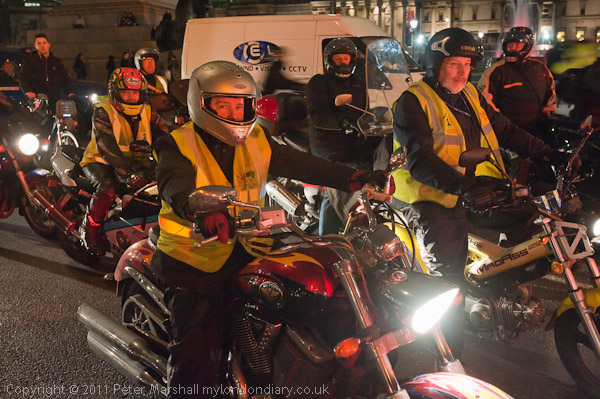
Cyclists ‘Die in’ at TfL HQ: On Friday evening on 29th November 2013 over a thousand cyclists came to demand safer roads for cyclists and pedestrians across London. 14 cyclists had been killed already that year on London streets, including six in the previous two weeks.

Cyclists 'Die in' at TfL HQ - Blackfriars Rd, London

Cyclists generally get a bad press here in the UK, and proposals and schemes that improve safety for cycling often meet with considerable opposition from non-cyclists, especially where these provide joint use of paths by pedestrians and cyclists.

Of course some cyclists are irresponsible – but so too are many not on bikes, whether driving vehicles or on foot. And we all sometimes do stupid things. Some may ride through red lights – but so do some motorists, and the statistics show that around 95% of pedestrians killed or injured in accidents caused by jumping lights are killed by drivers rather than by cyclists.

Cyclists 'Die in' at TfL HQ - Blackfriars Rd, London

Motorised vehicles – cars, motorbikes, vans, lorries, buses etc are far more dangerous than cyclists because of their higher mass and often much greater speeds which mean that they bring many times more energy to any collision – typically more than 10 times as much, sometimes very much greater.

It’s hardly surprising the of the around 400 pedestrians killed in road traffic accidents each year in the UK on average only 2.5 involve collisions with bicycles – even on those shared pavements you are many, many times more likely to be killed by a collision with a car or other vehicle.

Cyclists 'Die in' at TfL HQ - Blackfriars Rd, London
A cellist played during a long silent vigil

Cyclists are – like pedestrians – vulnerable road users. Unlike drivers in vehicles they are not surrounded by a protective shell of metal, and they have seat belts and air bags which proved extra safety – and its good that they do. But this does all remove them some way from the dangerous reality that all cyclists – however well-behaved and experienced – when sharing road space with them.

Cyclists 'Die in' at TfL HQ - Blackfriars Rd, London

It would not of course be feasible to provide entirely separate street networks for vehicles, cyclists and pedestrians, although it would be good to provide these where possible, and we have made some progress in doing so. But there are many more places where separate ‘dedicated’ cycle paths can and should be provided.

Encouraging cycling has many positives. It reduces the toxic air pollution in our cities – estimated to cause almost 10,000 early deaths in London alone, as well as a great deal of suffering from various lung conditions. And by reducing the number of vehicles on our roads it cuts the congestion on our roads which often brings transport in London to a near standstill (and which is also highly polluting.)

Donnachadh McCarthy announces it was time for the die-in

And cycling provides healthy exercise (which would be even healthier if we cut pollution by having more people on bikes) helping to cut the obesity which, particularly among children, is now a major health problem. It has also been shown to improve mental health.

Cycling is also the cheapest form of transport other than walking, and is often the fastest way to travel in London for relatively short journeys, including some that most of us would find too far to walk.

Worries about safety put many off cycling, as does the weather. But there are relatively few days when our weather makes cycling a real problem (and mudguards help.) Making our roads safer is more of a problem, but doing so would increase the quality of life in the city for all of us. Even drivers breathe the same air and have sometimes to get out of their cars and walk.

Things are happening slowly, but too slow. We are getting more dedicated cycle routes. 20mph zones make streets safer for pedestrians and cyclists, despite the outcry about them in some areas. Improvements in design of lorries to provide all-round vision are slowly coming in…

Protests such at outside the London HQ of TfL on 29 Nov 2013 to protest at the lack of safe road provision that leads to many deaths of cyclists and pedestrians, with a vigil, rally and a 15 minute ‘die-in’ on Blackfriars Road help to raise awareness of the need to improve our road system and encourage TfL to make a positive effort to do so. You can read more about it in my post on My London Diary, which includes the eight demands made by those taking part as well as a description of the event and many more pictures.

Cyclists ‘Die in’ at TfL HQ


FlickrFacebookMy London DiaryHull PhotosLea ValleyParis
London’s Industrial HeritageLondon Photos

All photographs on this page are copyright © Peter Marshall.
Contact me to buy prints or licence to reproduce.


Youth March For Jobs – 2009

Youth March For Jobs: Searching this morning for what to post I came across a piece I had written at the time about the Youth March for Jobs in London on Saturday 28th November 2009 and had forgotten about – and thought it worth sharing with you again.

Youth March For Jobs - 2009

This march was a national demonstration called by’Youth Fight For Jobs‘, an organisation founded earlier in that year “backed by 7 national British trade unions, the PCS, RMT, the CWU, Unite, UCU, TSSA and BECTU, as well as individual trade union branches, student unions and labour movement figures” to raise awareness and campaign for action over youth unemployment. I reproduce the text here (with just a few spelling corrections) along with a few of the many pictures I took at the event – you can find more on My London Diary.


Youth March For Jobs

Central London. Saturday November 28, 2009
Youth March For Jobs - 2009
Marchers make their feelings known at Downing St

I walked away from the Youth March for Jobs with a Polish man of around my age who had been watching the march as it came over Lambeth Bridge. “These people“, he told me, “do not understand what they are asking for.” I disagreed and we walked along the road talking. “I grew up under socialism, and there was no freedom. I couldn’t travel, couldn’t say what I thought…” he continued. We talked some more. He told me: “You weren’t allowed not to work; if a policeman saw you on the street not working he would order you top go to the job centre the following morning, and they would send you to a job.” We agreed that although we were against such compulsion, at least there was work for everyone, unlike here.

Youth March For Jobs - 2009

We talked more. About how terrible it was that there were so many young people that wanted to work, that were leaving school and university with qualifications but could not find a job. That the system here was all determined by money with no thought of the social consequences. That under socialism, culture had flourished, with arts centres and music supported by the state at a local level in a way that has never happened here, where Arts Council funding is directed at elites.

Youth March For Jobs - 2009

We went our different ways before I had a chance to tell him that the free education that these young people were demanding was something that my generation, born after the war, had taken for granted – along with the rest of the then new welfare state that our governments over the last 30 or more years have been cutting back on. Coming from a background that was economically scraping the barrel in a way perhaps hard to imagine today (but rich in some other respects) I would never have been able to attend university unless the state had paid for my fees and living expenses.

What we needed, we agreed before parting, was a system that combined both the freedom of thought and action we enjoy with full employment and a state that shows a real responsibility to support everyone, particular its poorest members. Actually something that many of the slogans chanted on the march were calling for.

A little under a thousand came to the start of the march outside the University of London Union in Malet St. Some were from around London, but there were also banners from Hull, Huddersfield, Birmingham and elsewhere. Many were students and most but not all were young. Many of the slogans chanted as they made their way through the crowded streets of Central London represented a disillusion with both the Government and politics generally:

Labour Cronies
Tory Snobs
Fight their cuts
Fight for jobs

but others were aimed specifically at Labour

Mandelson's a Tory
He wears a Tory Hat
And when he saw our top up fees
He said I'll double that!

Some contrasted the billions made available to rescue the failed bankers with the stringencies being imposed on students and the poor:

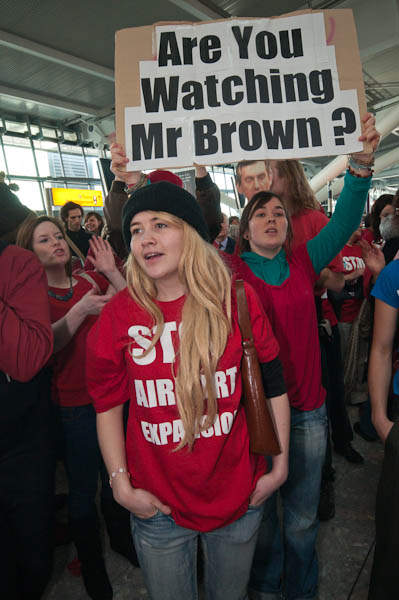
Gordon Brown, stop the rot
Give us what the bankers got,

Bail out the workers
Not the bankers!

The billions wasted on ill-conceived and probably illegal wars – currently the subject of yet another enquiry expected to state the clearly obvious – also came in for noisy and enthusIastic criticism.

What the marchers want is the right to education rather than it becoming a privilege for the wealthy, and for decent jobs. They oppose privatisation, which has so often led to lower standards, replacing a pride in work and a social responsibility by cost-cutting, minimum standards (often not achieved) and a loss of security for the workers with part-time working, short term employment and loss of rights and pensions.

The march halted for a few minutes outside Downing St, where, after a speech that only a few could hear as restrictive laws prohibit the use of megaphones in the area, a small delegation went to take a large petition to the Prime Minister, before continuing past the Houses of Parliament. I left the marchers as they crossed over the Thames on Lambeth Bridge on their way to their final rally.

More pictures at Youth March For Jobs.


FlickrFacebookMy London DiaryHull PhotosLea ValleyParis
London’s Industrial HeritageLondon Photos

All photographs on this page are copyright © Peter Marshall.
Contact me to buy prints or licence to reproduce.


COP29 March For Global Climate Justice, London, 2024

COP29 March For Global Climate Justice: When this march was taking place on Saturday 16th November 2024, COP19 was just beginning in Baku, and there was still some small room for optimism, even though it seemed to be dominated by fossil fuel lobbyists, from its president Mukhtar Babayev, Minister of Ecology and Natural Resources of Azerbaijan Republic and previously been Vice-President for Ecology at Azerbaijan’s national oil company SOCAR, down.

London, UK. 16 Nov 2024. The start of the march.

But now we know the agreement reached after many hours of argument at the end of the meeting we can only conclude ‘TOO LITTLE, TOO LATE’. Even in the unlikely event of the wealthier countries actually keeping their promises we will see dramatic catastrophes in much of the Global South in the coming years.

And of course we in the wealthier countries whose industrialisation created the mess the world is in as we burnt coal and oil resulting in a huge increase in carbon dioxide levels blanketing the world will also suffer.

Increasingly chaotic weather patterns, more and more serious storms with more floods and greater wind damage. Greater droughts too and more forest fires. More disruption of agricultural production and higher food prices.
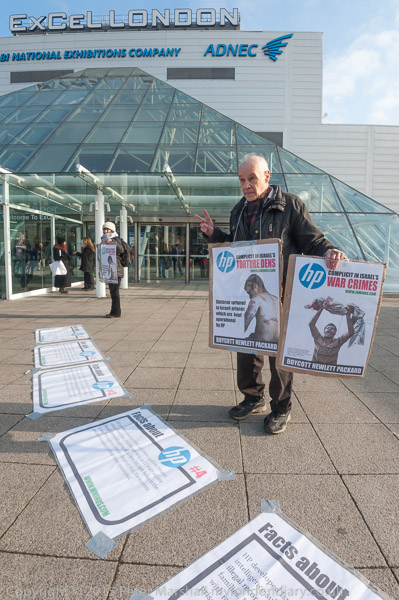
More loss of species too, aided by other of the ‘benefits’ of industrial production with new insecticides coming to support those currently decimating pollinating insects such as bees.

As many of the marchers pointed out with their placards and flags, war and militarisation are huge drivers of climate change, both from the production of weapons and their use. One poster pointed out that the Russian invasion of Ukraine in 2023 produced roughly half as much CO2 as the UK’s emissions in the same year. War doesn’t just kill people but also is ecocide on a grand scale.
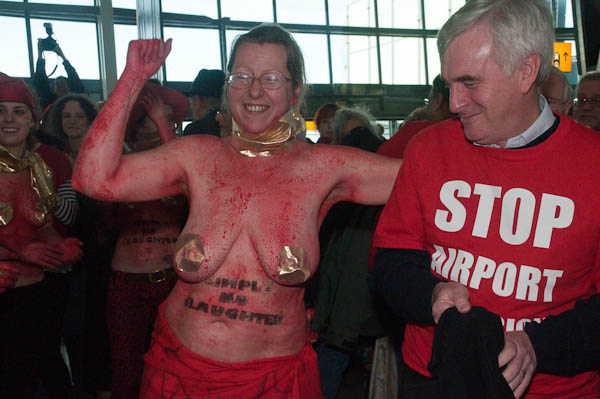
The continuing attacks by Israel on Gaza and Lebanon have also added huge amounts of carbon dioxide as well as killing many thousands of civilians both through direct bombing of homes, schools and hospitals but also through a deliberate policy of destroying infrastructure and preventing humanitarian supplies of food and medicines – for which the International Criminal Court recently issued arrest warrants for Benjamin Netanyahu and former defence minister Yoav Gallan.

Banners, posters and placards on the march rejected militarisation and called for an end to arming Israel. ‘THE CLIMATE MOVEMENT STANDS WITH PALESTINE – STOP FUELLING GENOCIDE AND CLIMATE BREAKDOWN’.

But however hopeless the world situation seems now, the election of Trump as US Pesident seems certainly to make things worse – already he has chosen Chris Wright, the CEO of Denver-based fracking company Liberty Energy as Energy Secretary to lead his promise of increasing US fossil fuel production under his campaign pledge “Drill, Baby, drill”.

The current world political system dominated by institutions such as the IMF and World Bank and by Western governments increasingly seems unable to come up with any effective solutions to the climate crisis – as COP 19 and the previous 28 UN climate Change Conferences have shown. As the placards carried by many of the marchers stated, we need system change.

More pictures from the march online


FlickrFacebookMy London DiaryHull PhotosLea ValleyParis
London’s Industrial HeritageLondon Photos

All photographs on this page are copyright © Peter Marshall.
Contact me to buy prints or licence to reproduce.