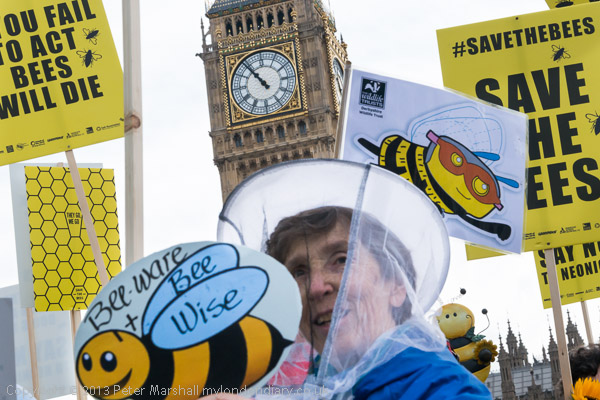
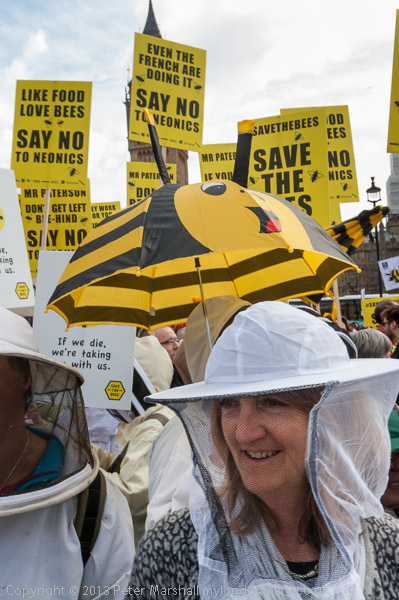
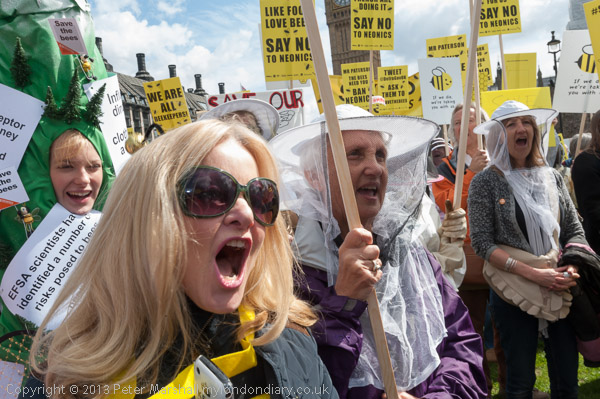
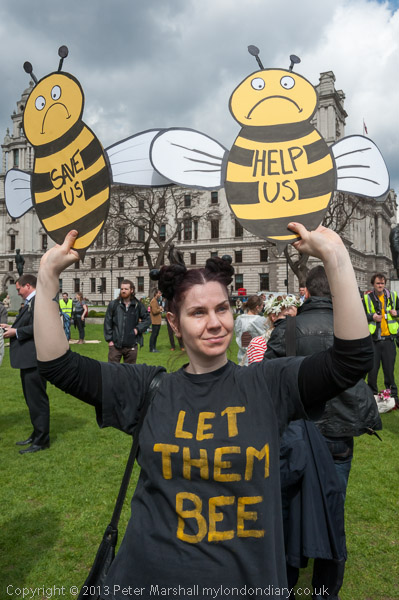
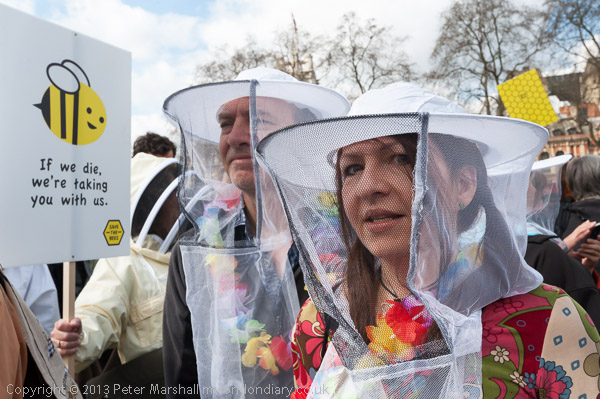
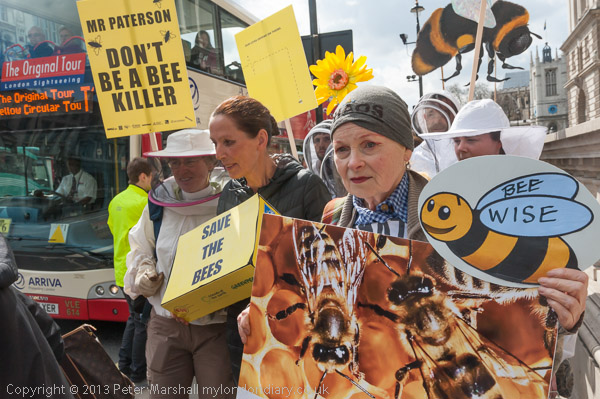
Save the Bees: On Friday 26th April I joined several hundred beekeepers and environmentalists outside Parliament, “many in bee veils and with flowers and fruit that rely on bee pollination to urge DEFRA’s Owen Paterson to back a ban on bee-killing neonicotinoid pesticides in Monday’s EU vote.”
These systemic pesticides are absorbed by plants and taken to their leaves and flowers including nectar and pollen. They kill insects by attacking their central nervous systems but there are also serious sub-lethal effects which for bees, including “difficulty navigating, learning, and foraging, suppressed immune response, lower sperm viability, shortened lifespans of queens, and reduced numbers of new queens produced.”
They disrupt to complex systems by which bees are able to communicate with each other about good sources of nectar, to fly to these and to return to the hive – and our worker bees can simply get lost.
As well as being absorbed by the commercial crops on which they are sprayed, these water-soluble insectides run off into ditches, streams and rivers and are then absorbed by plants growing in the wild.
These are not the only threats to our bee population, also endangered by climate change, habitat loss, invasive bees and other species, parasites and diseases spread in intensive commercial bee farming.
As well as bees, these pesticides also are a threat to all other pollinating insects. Around a third of food supplies around the world depend on plants being pollinated. They also effect birds, especially seed-eating birds as their major use is in seed coatings, but also by killing insects which birds rely on for food.
Neonicotinoids have also been found widely in our bodies – “in children, adults and neonates” but although large doses have been found to impair cognitive ability and memory in laboratory rats there is as yet no evidence that they are having any effect on us.
Katherine Hamnett and Dame Vivienne Westwood take the ‘Save the Bees’ petition to Downing St
In April 2013 the EU voted to restrict their use across the EU for two years – though despite this protest Britain was one of eight states to vote against this. In 2018 the EU passed a total ban on the three main compounds, despite continuing strong opposition from the manufacturers and some farmers. There has been a general ban on their use in the UK since 2017, but until 2025 sugar beet farmers were given “emergency authorisations” for their use. Ending this was a Labour election pledge and it was confirmed by a government press release in December 2024.
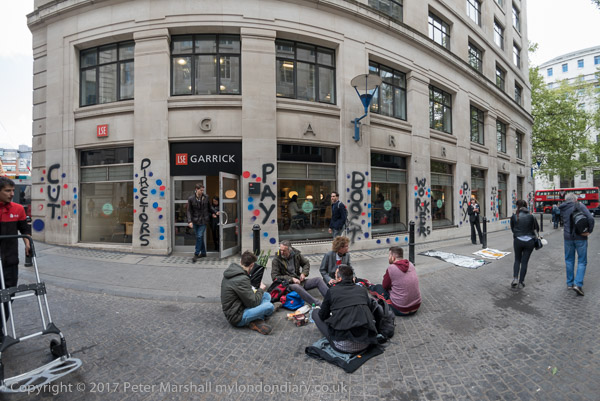
LSE Decorated Against Inequality & Corruption: On Tuesday 25th April 2017 students and workers in the ‘Life Not Money’ campaign took part in “a colourful nonviolent direct action calling on the LSE to change from what they say is thirty years of growing neglect, cruelty and outright corporate greed towards workers and staff at the school to something beautiful and life affirming.”
The main organiser of the protest was Roger Hallam, currently serving time in jail for conspiracy to cause a public nuisance for organising protests to block the M25 motorway in 2022, sentenced to five years, but marginally reduced on appeal to 4 years. At the time of the protest he was a Ph.D student at nearby King’s College London, “researching how to achieve social change through civil disobedience and radical movements.” I knew him from photographing him carrying out practical work on the subject on a number of occasions, mainly against air pollution from London’s traffic.
Hallam, centre with protests putting ‘£50 notes’ on the wall watched at left by the LSE security manager
At this protest, Hallam was one of a number of people who decorated the wall of the LSE Garrick Building with water-soluble chalk including the slogan ‘CUT DIRECTORS PAY BOOST WORKERS PAY WE ALL KNOWN IT MAKES SENSE’. They also blu-tacked some small posters resembling £50 notes to the wall.
The group then sat around in a small circle on the pavement in front of their work holding a party, talking and joking and eating sandwiches. Four of them had decided they would wait and hope that they were arrested to show up the LSE and its failure to live up to its stated aims.
They pointed out to the police that they had caused no real damage and offered to remove the markings with the damp sponges that they had brought with them for the purpose, but the LSE security manager refused to let them touch the wall.
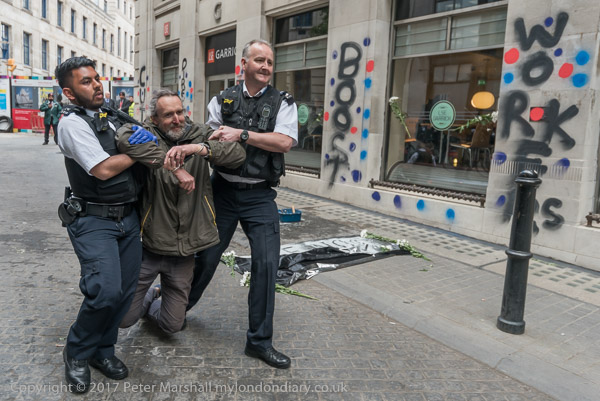
Police then handcuffed the four and took them away one by one. They offered no resistance, but Hallam went limp and police had to drag him away. I don’t think any of my pictures from the protest were used by the mainstream press at the time, but one of my pictures of the arrest did appear in quite a few newspapers at the time of his trial for the M25 incident and at his earlier trial after he was found with a toy drone without batteries close to Heathrow – in breach of bail conditions.
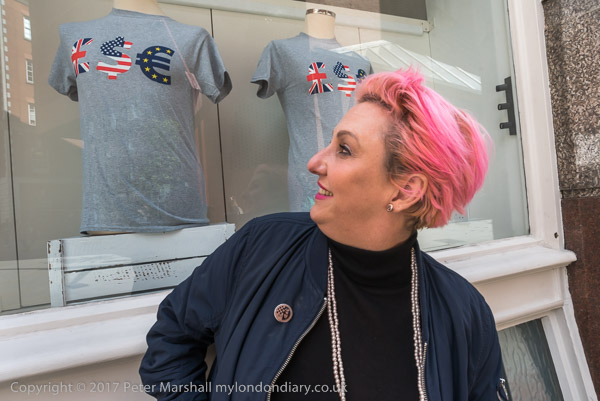
Earlier when I arrived at the LSE I met Lisa McKenzie who took me to the shop to show me the t-shirt with LSE written in currency symbols, pound, dollar and Euro, £$€.
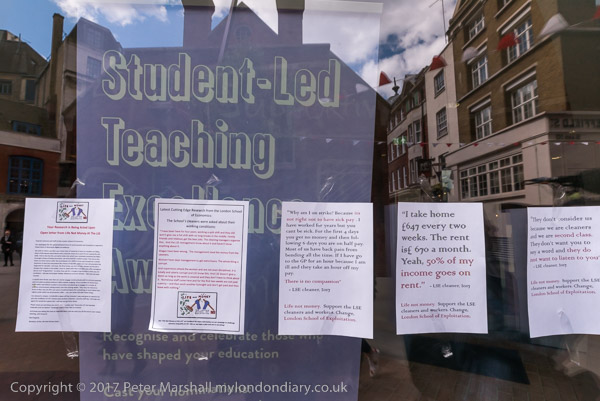
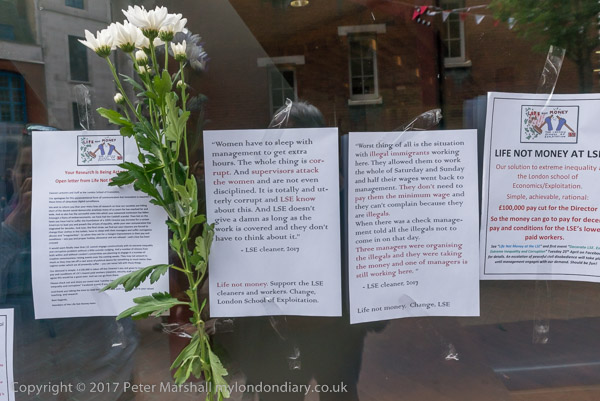
This was said by the protesters to show the true face of LSE management – an institution which values money above all else and students soon fixed posters and flowers to the shop window. After this protest the t-shirt was removed from display at the shop and is no longer on sale.
This, they said was an example of the ‘Student-Led teaching‘ the LSE prides itself on, condemning the LSE’s attitude to its key low paid workers. The also said that the cleaning contractor Noonan was an exemplar of spectacularly bad management, alleging among other things that “Women have to sleep with management to get extra hours…”
The protest was in support of the campaign launched in September 2016 by the United Voices of the World during the LSE’s 3-day ‘Resist’ Festival organised by McKenzie to bring the outsourced cleaning workers back into direct employment by the LSE.
I left shortly after the arrest, but returned 3 days later to view the alleged criminal damage, finding no trace of it but several security men guarding the wall.
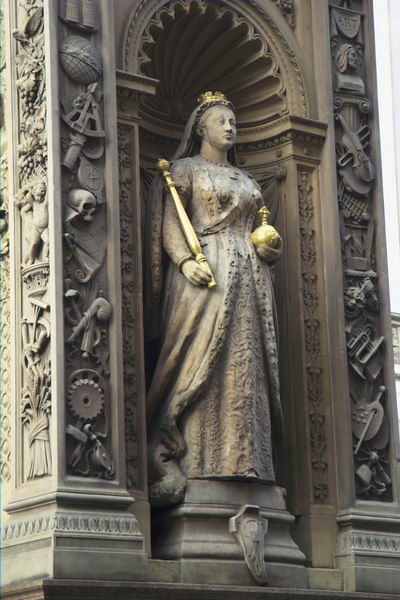
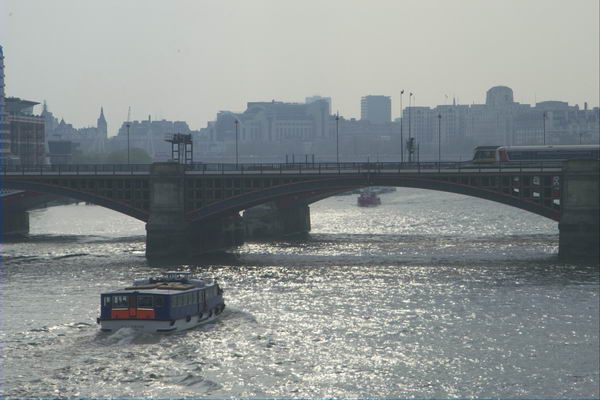
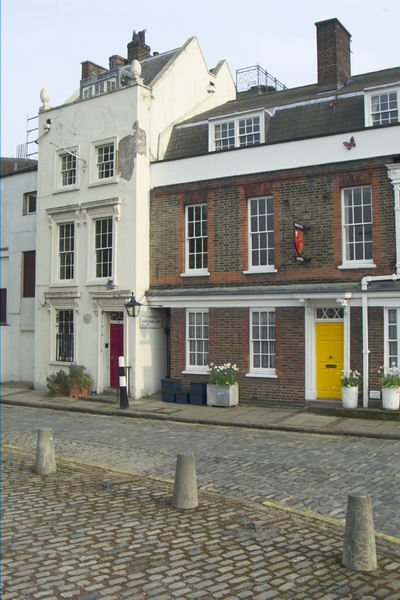
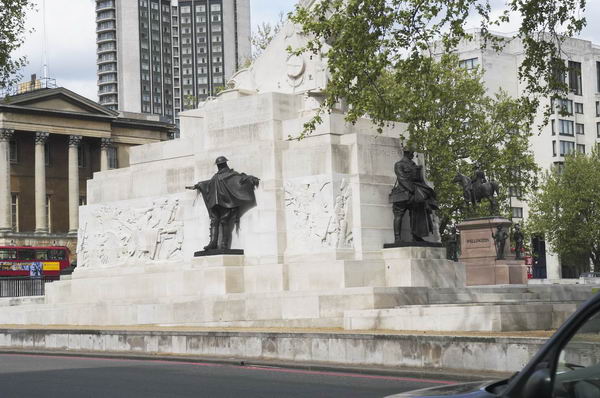
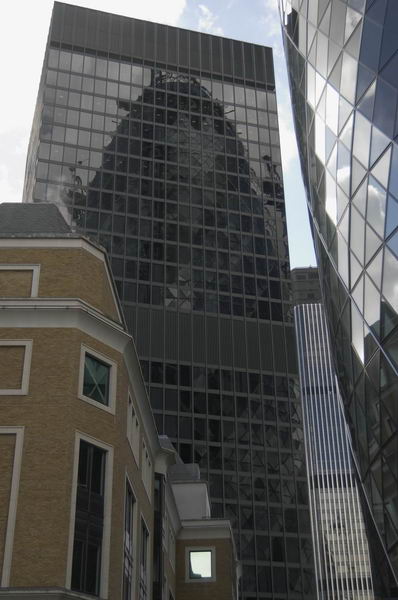
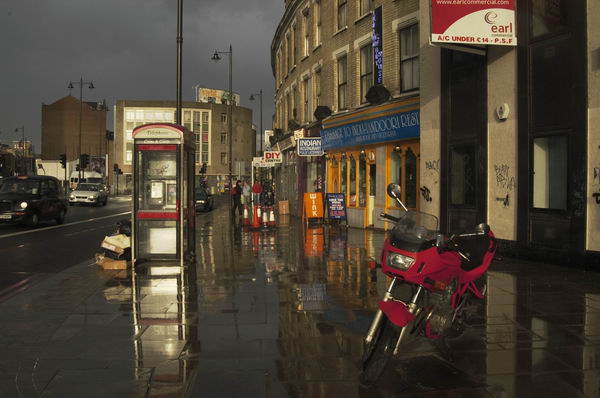
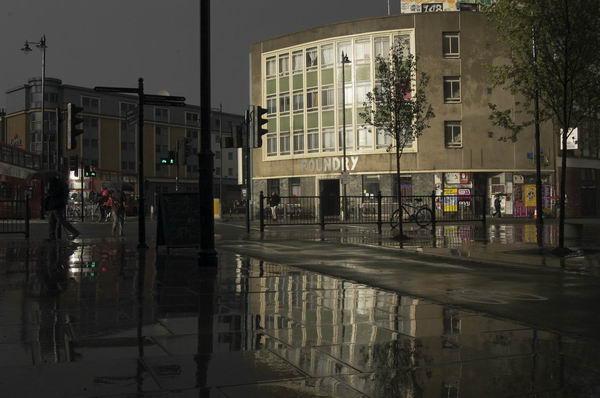
Pictures from London: On Thursday 24th April I had booked to go to an event in the evening and as it was a nice day went up earlier and took a walk around and a few pictures. Some of these along with others taken when walking to, from and between events at around the same date I posted later on My London Diary – without any captions.
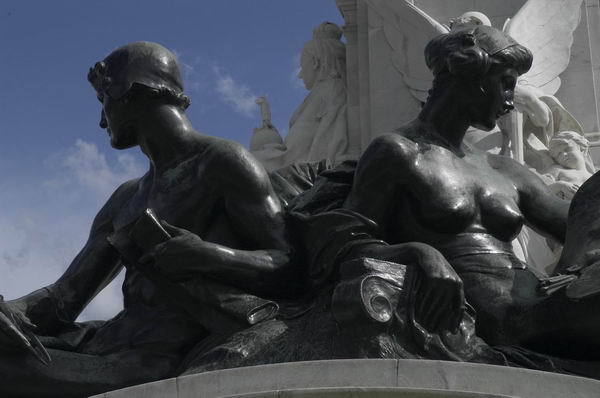
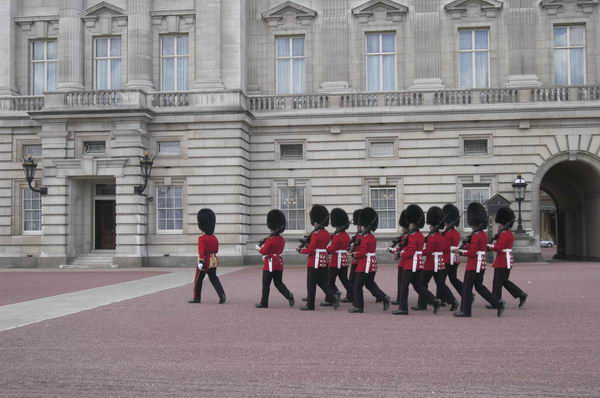
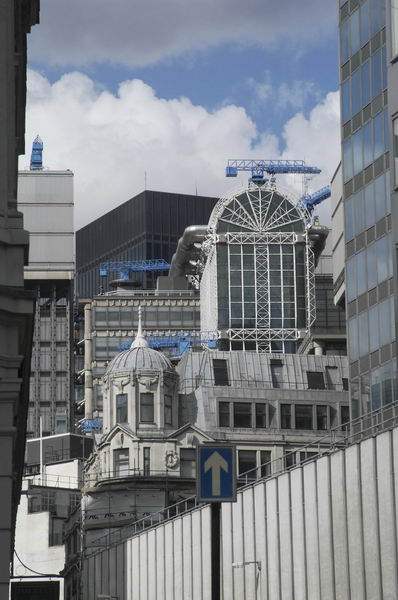
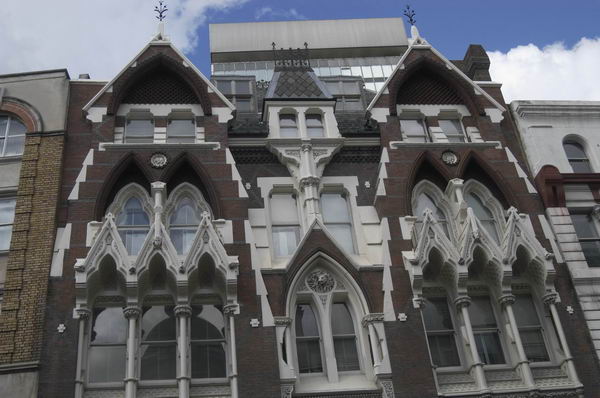
Here are some of those and you may like to guess exactly where in London they were taken – some are glaringly obvious, but others are difficult for me now to place, though I think I can still do so.
123456789101112
If you can place all twelve you are doing very well. There are rather more pictures on My London Diary which may provide some more clues. I’ll try to remember to post the answers – I’ve numbered the pictures – in a comment in a few days time if others have not done so.
Diamonds, Peace & St George: St George’s Day, 23rd April, celebrates the death of this Cappadocian Greek soldier in the Roman Army martyred on this day in AD 303 for refusing to recant his Christian faith. We know little about his life, but can be sure that he never killed a dragon.
As I commented back in 2005, “St George keeps busy as a patron saint of Canada, Catalonia, Georgia, Germany, Greece, Lithuania, Malta, Palestine and Portugal, as well as a number of cities including Moscow and Venice, a whole raft of trades including farmers and soldiers, as well as herpes and syphilis. It’s perhaps surprising he still has time for England, although until recently you would hardly have noticed it in any case.“
It is also at least 23 other national days around the world, a few of which are related to the birth of Shakespeare who was most probably born on April 23, 1564. But I won’t be celebrating National Talk Like Shakespeare Day, World Table Tennis Day, National Cherry Cheesecake Day or any of the rest, though I suppose there is just an outside chance I might dabble with German Beer Day (though I’m more partial to British Bitter, increasingly a rare species, which has its day on June 15th.)
My day began with two protests against the selling of blood diamonds from Sierra Leone at leading London stores, before I went to Trafalgar Square to briefly visit the unimpressive St George’s Day event there. I ate my sandwiches in the Peace Garden at the Imperial War Museum before going to a St George’s Day procession in Southwark from St George’s Cathedral to the church of St George the Martyr, and finally went to a pub in Southwark with a couple of friends where I met and photographed two St Georges.
Sierra Leone Blood Diamonds at Selfridges – Oxford St
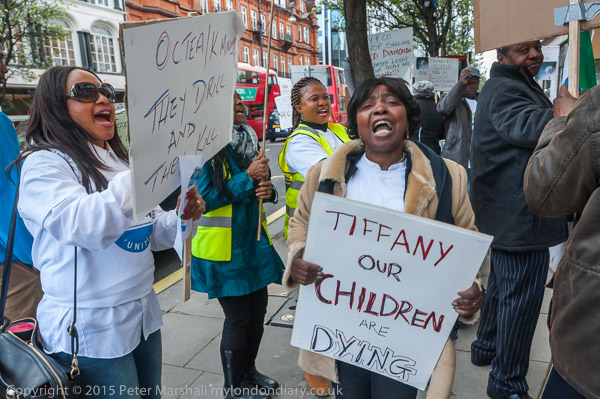
Octea mine diamonds in Sierra Leone, Tiffany sell them in Selfridges and children in Kono die
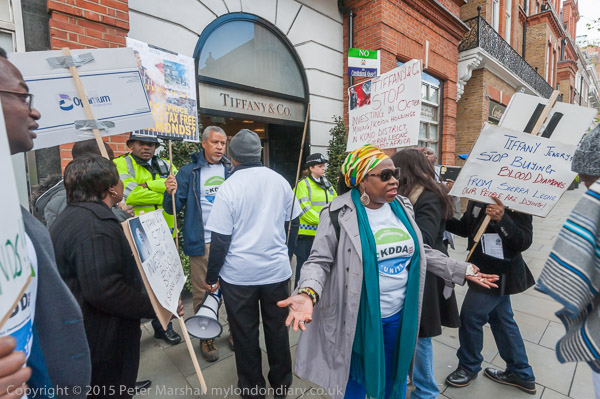
People from the Kono district of Sierra Leone protested at Selfridges on Oxford St as part of a global demonstration against the financial partnership of Tiffany & Co with Octea, the largest diamond mining company in Sierra Leone. They say people in Kono suffer and die because of Octea’s diamond mining.
Octea, wholly owned by Israeli billionaire, Benny Steinmetz is operated by former mercenaries and has been allowed to operate without a licence and tax free. The protesters say it’s operation defies all national and international legal norms and ethics.
Sierra Leone Blood Diamonds at Tiffanys – Sloane Square
From Selfridges the group went on to Tiffanys. Police told them they could not protest on the wide pavement there but must go across to protest in a pen set aside for them in the square opposite.
After some argument they did so, although there seemed to be no reason other than lessening the impact of the protest for the police to move them. Why UK police should take the side of Tiffany and support illegal diamond mining by Octea that defies all national and international legal norms and ethics is hard to understand.
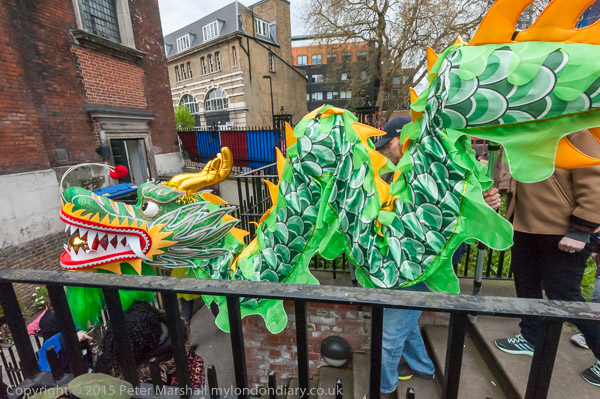
St George was there and you could have your picture taken with a dragon and the square was filled with long tables where you could sit and eat food from the many stalls set up around the edges of the square.
Everyone got handed little St George’s flags, but there seemed to be little going on and little real atmosphere. Perhaps things might have picked up later in the day, but I didn’t feel like returning.
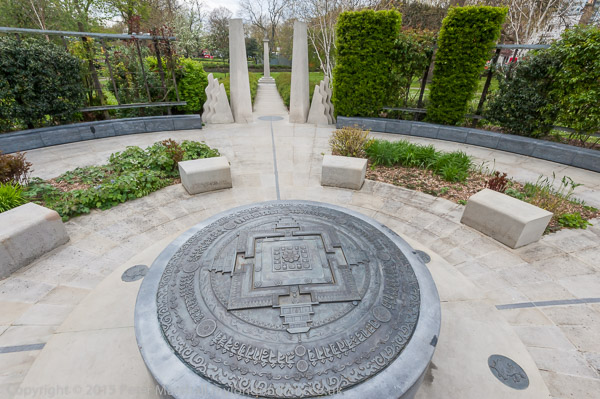
Instead I ate my sandwiches in the Samten Kyil (Garden of Contemplation) in Geraldine Mary Harmsworth Park commissioned by Tibet Foundation, designed by sculptor Hamish Horsley and opened by the Dalai Lama in 1999. A few yards from the Imperial War Museum it was conveniently just across the road from where my next event was to start.
St George in Southwark Procession – St George’s Cathedral to St George the Martyr
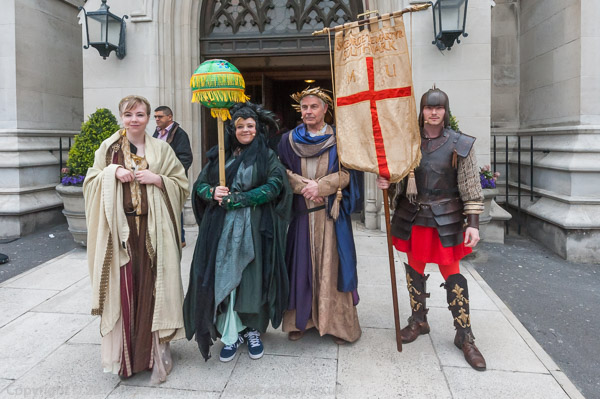
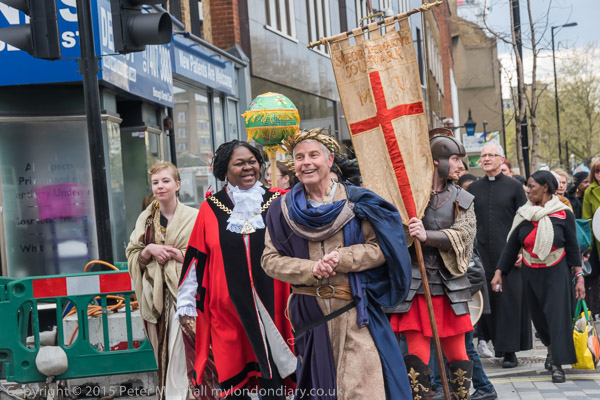
A procession for St George’s Day, led by St George, a Roman Emperor, the Mayor of Southwark and others and with a dragon at its rear made its way from the St George’s RC Cathedral to the Church of England St George the Martyr in Borough High Street. It was a part of ‘A Quest for Community’ with the aim of ‘Taming the dragon of difference’ and was followed by a play outside St George the Martyr telling the true story of St George, a Roman solider from Palestine who chose death rather than give up his Christian faith.
From right to left: St George, Emperor Diocletian, the priestess or haruspex and the emperor’s daughter
I’d not been inside this building before and we had an interesting tour of the building before the procession. Designed by Augustus Pugin it was gutted by incendiary bombing in 1942, left it with only walls and one chapel standing but was rebuilt to the same plan, finishing in 1958.
The route was an interesting one and along streets I had previously photographed – and went past the blue plaque where photographer Bert Hardy was born – and I was able to tell the Mayor something about one of Southwark’s more famous.
We arrived rather late at St George the Martyr and I had to leave shortly after the beginning of a play about St George being performed there by local children – possibly something of a relief.
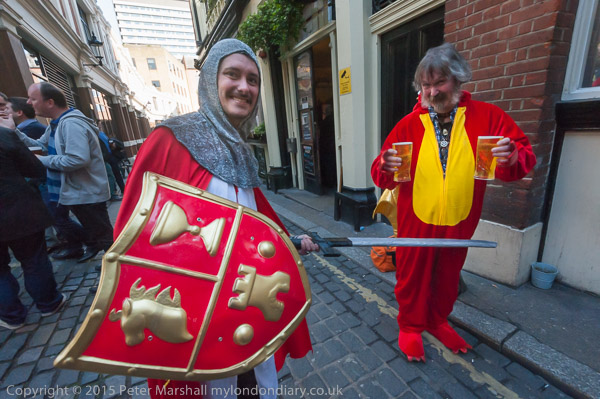
Two of my photographer friends had been going to come to the St George procession, but had apparently been unable to find St George’s Cathedral. Instead we had arranged to meet afterwards at the King’s Arms, a traditional British pub just off Borough High Street.
Among those drinking there were not one but two St George’s and I photographed both of them, one with his fortunately rather friendly dragon.
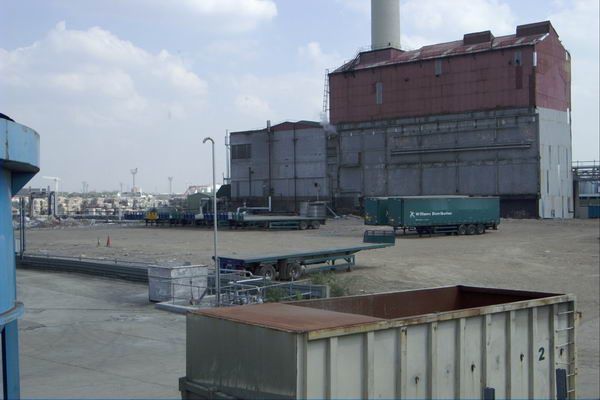
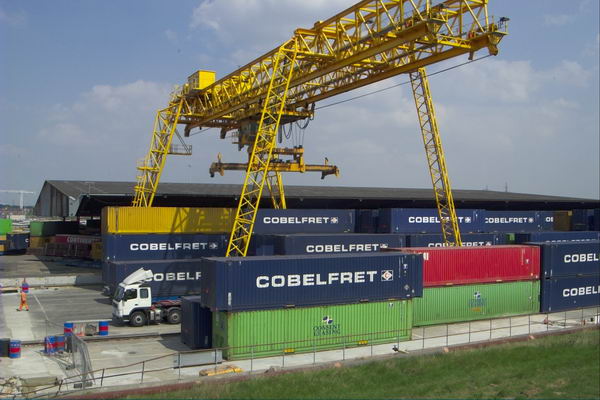
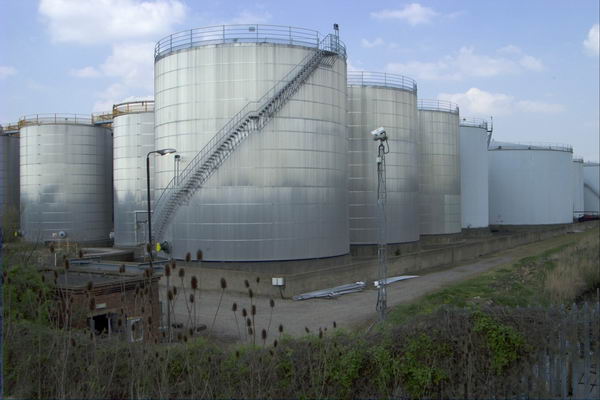
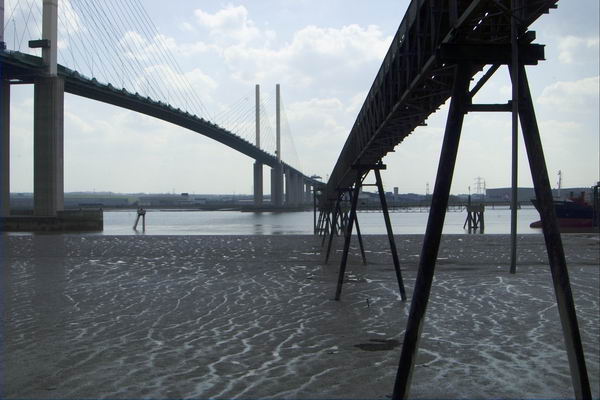
Purfleet & West Thurrock: Pictures taken on a ride along the Essex bank of the Thames on Tuesday 22 April 2003, the day following the Easter Bank Holiday.
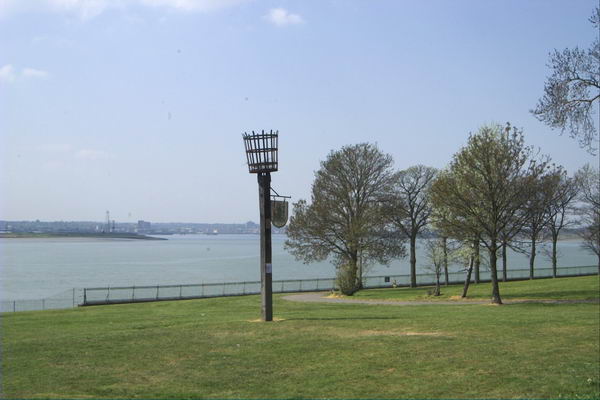
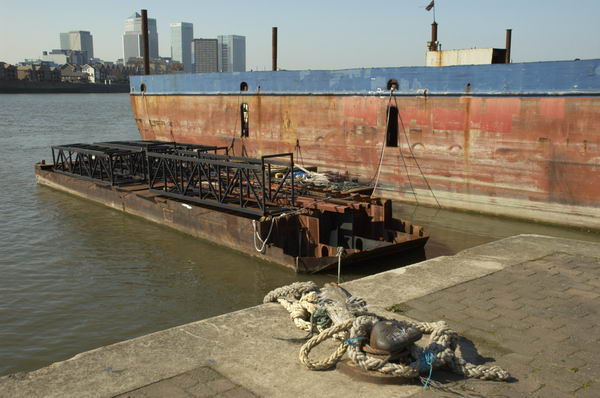
Silver Jubilee Beacon at Purfleet and upstream view of the River Thames
I only put these pictures onto My London Diary around a year after I made them and wrote nothing about them when I did so.
But these are more pictures that I took on a ride mainly along a footpath beside the River Thames where I rode on my Brompton folding bike.
My ride started not at Purfleet which is just on the outside edge of Greater London, but at Rainham, which was the last station coming out from London where a Travelcard was still valid.
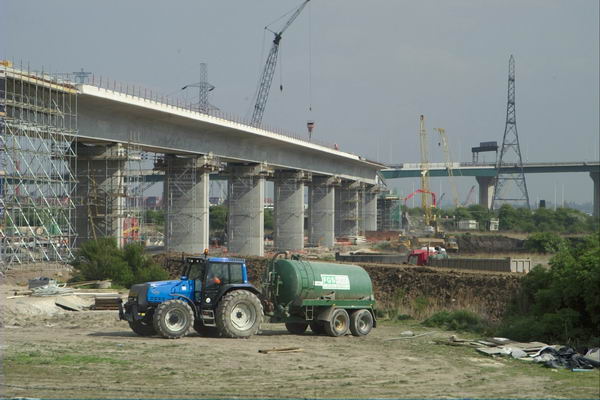
Part of my reason for coming to this area was the building that was taking place of the Channel Tunnel rail link, which tunnelled under the river at Swanscombe in Kent to West Thurrock in Essex. I had previously photographed on the Kent side, You can see some of the work on this high speed rail line in these pictures of this, particularly some from my return journey to Rainham where I followed its route as closely as I could.
The pictures were made with my first digital SLR, the Nikon D100 and a 24-85mm Nikon lens.
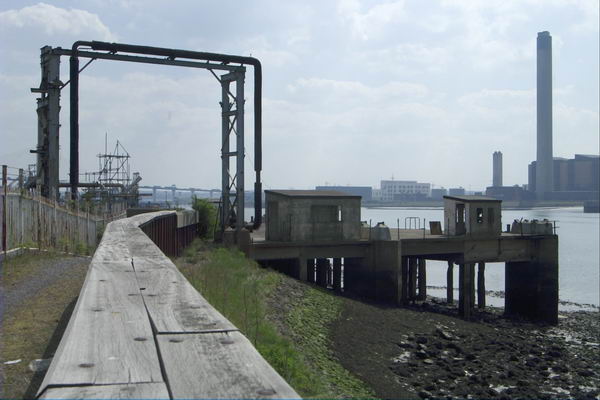
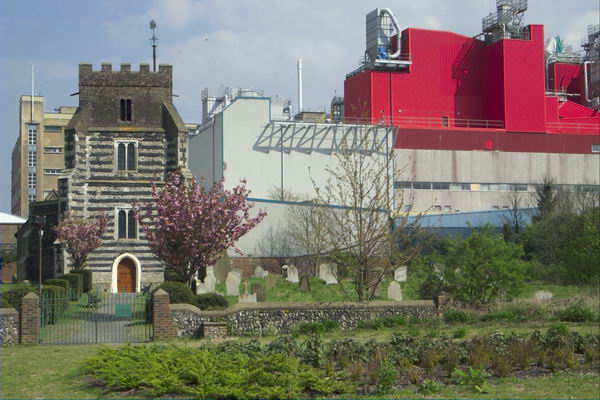
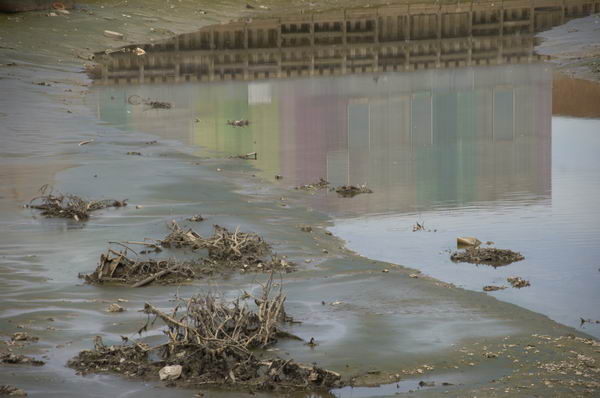
As well as riverside industry, including a detergent works at West Thurrock which overshadow an ancient church, there are also images of the QEII Dartford Bridge, container parks, oil storage depots and the CTRL viaducts as well as fairly desolate riverside and a giant pylon.
St Clement’s Church, West Thurrock was one of the four churches featured in the 1994 film ‘Four Weddings and a Funeral’Channel Tunnel Rail Link, QEII bridge and a giant pylon
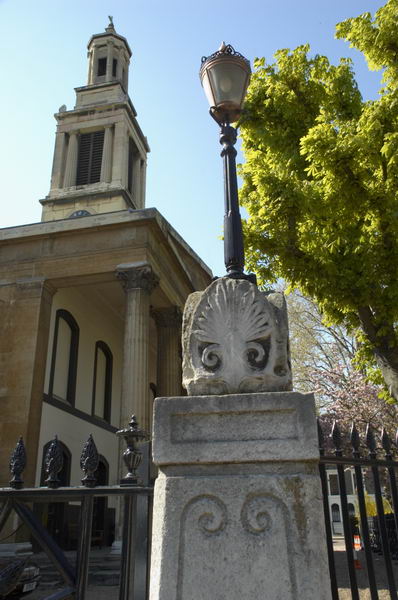
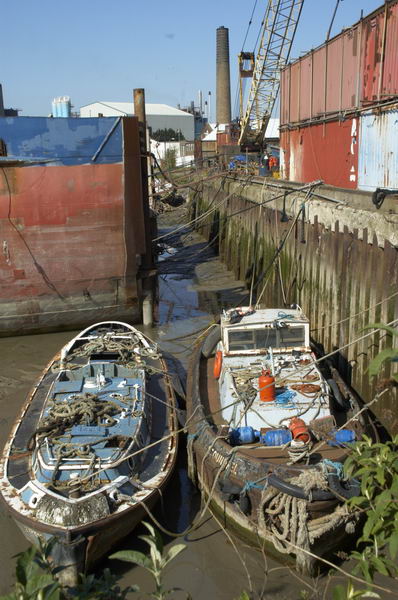
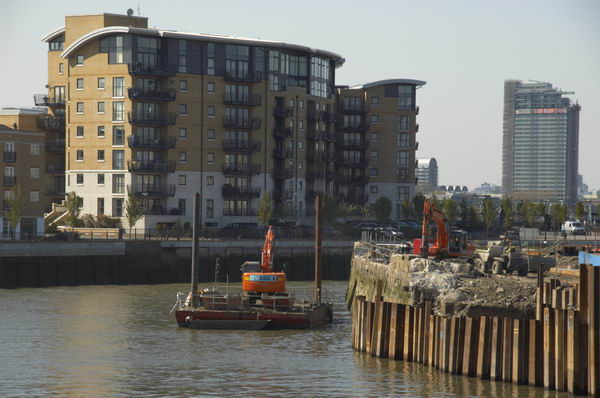
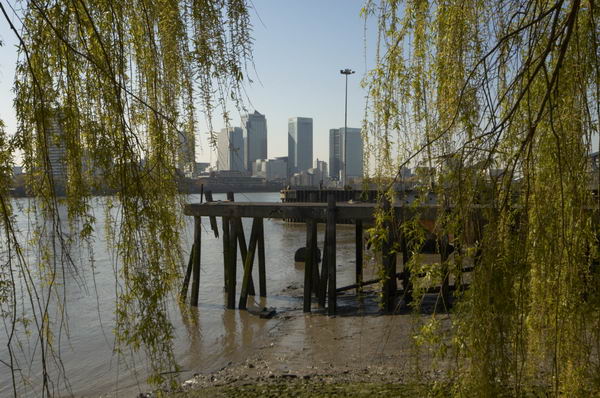
Deptford & Greenwich: Some pictures from two bike rides in April 2005, the second cut rather short by a puncture, around one of my favourite areas of London, mainly along the southern bank of the River Thames. The area has changed fairly dramatically in recent years with new blocks of riverside flats replacing riverside industry, much of which had already ceased work by 2005. I first photographed here around 1980 and it still now makes an interesting walk (or ride) and I’ve done most or all of it a few times since 2005.
River Thames and Drydock, North Greenwich.
As usual I’ll post a slightly amended version of what I wrote at the time on My London Diary together with links to that site which has some more pictures. But I didn’t write anything about the actual pictures except the captions.
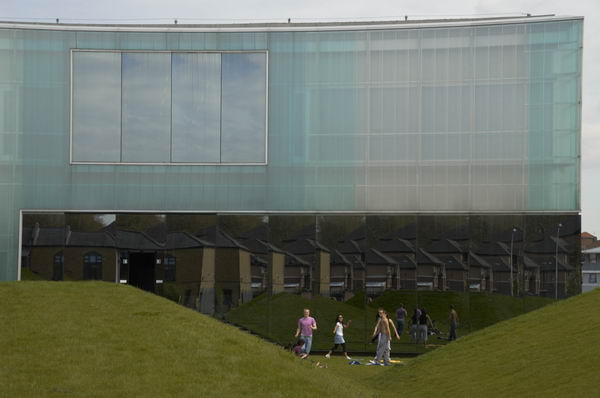
Reflection of the Laban building in Deptford Creek, London.
It was a fine sunny day on Thursday 21 April 2005 and I put my Brompton folding bike on the train to Waterloo, then cycled east from there to Deptford and Geenwich, taking another trip along one of my favourite riverside paths around the Greenwich Peninsula.
Trinity Square, Southwark, London SE1. Church is now a rehearsal studio
North Greenwich is still interesting, although the area by the Dome is now rather bleak. Time went surprisingly quickly, and I had only got just past the Dome when it was time to make my way back.
Dry Dock, North Greenwich, London.
Just over a week later I tried to take up the ride from where I left off, but only made it as far as the footbridge over Deptford Creek, when I heard a loud bang as my rear tyre punctured. I should have stopped, mended the puncture and gone on, but I couldn’t face it.
Deptford Creek close to its junction with RIver Thames, Deptford, London.
I wheeled the bike to Greenwich station, got on the train and came home. One of my few gripes about the Brompton is that mending punctures is a bit of a pain; the small tyres are hard to take off and even harder to replace, and if you want to take the rear wheel off, it is a rather tricky business that I’ve yet to master. I have tyres with kevlar inserts that are supposed to be puncture-resistant, but they don’t seem very effective.
Canary Wharf and River Thames from North Greenwich, London
After I’d arrived home and had a cup of coffee, the puncture turned out to be a straightforward job.
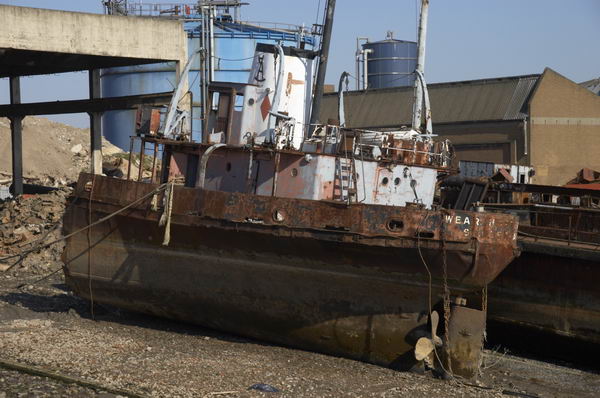
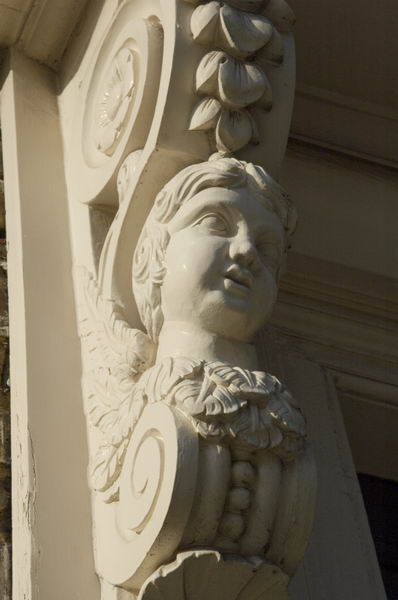
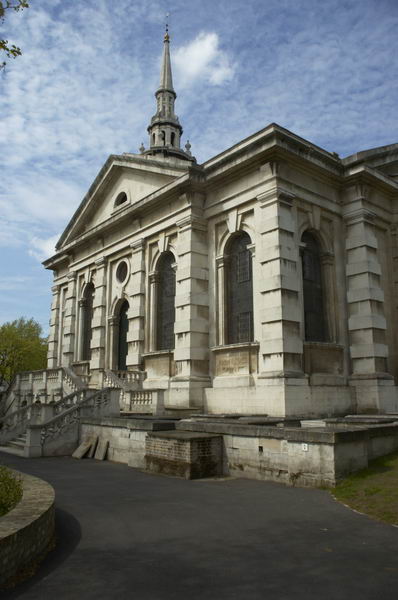
Ship breaker’s yard, North Greenwich, London, April 2005Doorway, Albury St, Deptford,St Pauls, Deptford, London built by Thomas Archer in 1713Laban dance centreDeptford Creek
From Northey Street I turned right into Brightlingsea Place, another street name still there in Limehouse although little of its buildings remain. The exception is Faraday House, a five storey block built by Stepney Borough Council in 1931 as a part of their Limehouse Fields slum clearance scheme. Much of the area to the east was also destroyed in the war, apparently by a V2 rocket and was finally cleared and excavated for the Limehouse Link Tunnel. It is now a public park, Ropemakers Field.
On the west side of Brightlingsea Place was the Limehouse Power Station (also known as Stepney Power station) built in 1907, decommissioned in 1972 and demolished.
Parts of the power station were still in place in 1990 and a notice on the gates at right confirm this is Stepney Transforming Station and warn of the danger of 66,000 volts. But Stepney – and Limehouse – was now undergoing a very different transformation.
The House They Left Behind, Ropemakers Fields, Narrow Street, Limehouse, Tower Hamlets, 1990, 90-1a-24
The pub, The House They Left Behind, at the entrance to the cleared area between Brightlinsea Place and Ropemakers Fields a few yards north of Narrow Street was indeed the only building left standing in this area. At 27 Ropemaker’s Fields built in 1857 it had previously been called The Black Horse and was on the edge of the Barley Mow Brewery Site. After several further name changes and becoming a bar/restaurant it closed around 2010 and is now residential.
An Instagram post by londondeadpubs tells the interesting story of the stabbing there in 1998 of “Christopher Dunhill, heir to the vast Dunhill tobacco (and, weirdly, cufflinks) fortune” who was then a resident there and “helping out at the oyster bar“. He had earlier in 1987 been convicted of drug dealing but somehow only served 15 months in prison and “today he appears to be CEO of a Bahamian financial company.” But do read the full post.
To the east are these tower blocks of the Barley Mow Estate on Oak Lane, seen here from Ropemakers Fields. These blocks were built on the Barley Mow Brewery site and were built around 1967 for the London County Council using the same “Large Panel System” which failed in the Ronan Point disaster in 1968.
Reports led to additional strengthening work on Brewster and Malting House, but it was decided to demolish Risby House as it would be adversely affected by the contruction of the Limehouse Link Tunnel.
This was one of the best-known lighterage firms on the river until the business was closed down in 1973 by ‘Dolly’ Fisher on her 79th birthday. In its heyday had around a hundred barges on and nine tugs on the river.
Dorothea Woodward Fisher and her husband William, a lighterman who she had married over the protests of her family had formed the company with only £20 and one barge. And when her husband died in the 1960s she took over the running of it – and was described by many on the river and in a 1972 BBC documentary as ‘Mother Thames‘.
Dunbar Wharf on Narrow Street backs onto Limekiln Dock. Duncan Dunbar came to Limehouse from Scotland and made a fortune as a brewer and wine merchant, leaving his son – also Duncan Dunbar – sufficient to found a shipping business in 1827. By 1842 he had 11 ships and in the next 20 years ordered another 42.
As well as trading in various goods iuncluding wine and spirits, Dunbar’s ship’s made 37 voyages taking convicts to Australia and were troop carriers for the Crimean War. When he died in 1862 his estate was worth £2 million. His family then sold up all of the business. Apparently one of his former ships, the Edwin Fox is a museum attraction in New Zealand.
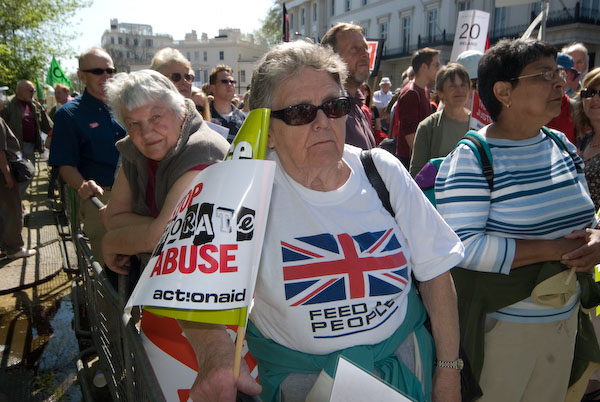
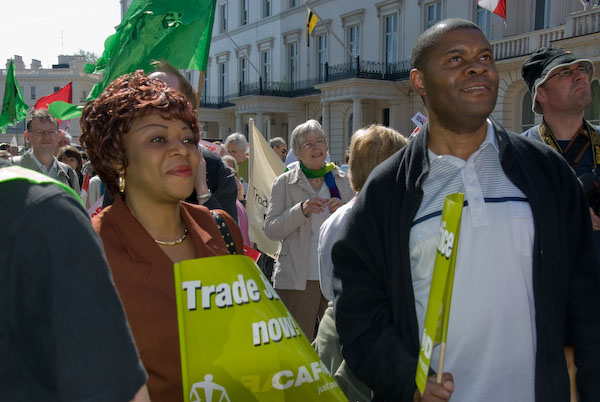
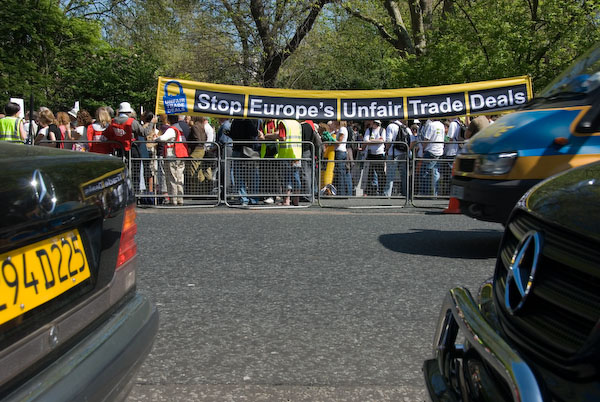
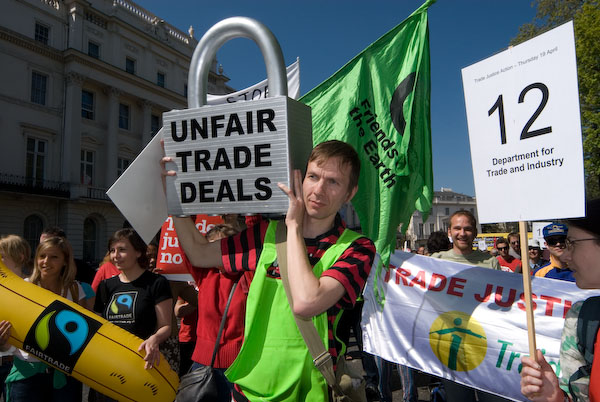
Trade Justice Mass Action. Thursday 19th April 2007 saw a mass action by the Trade Justice Movement in London which was a part of a wider global day of action by campaigners across Europe as well as in Africa, the Caribbean and the Pacific – the ‘APC’ countries.
The protest was particularly about the agreements between the APC countries and the EU, and the unfair trade deals (economic partnership agreements or EPAs) that the EU was negotiating. The African, Caribbean and Pacific Group of States organisation was founded in 1975 and the 71 countries then involved came to an trade agreement with the European Economic Community (EEC) in Lomé, Togo, the Lomé Convention.
This “provided for most ACP agricultural and mineral exports to enter the EEC free of duty. Preferential access based on a quota system was agreed for products, such as sugar and beef, in competition with EEC agriculture” from the 71 countries in the ACP and it also provided funds for aid and investment.
The Lomé Convention was twice updated but in 1995 the United States complained to the World Trade Organisation that it was unfair to them and the WTO Dispute Settlement Body ruled in their favour. Many argue that the WTO prioritizes the interests of wealthy nations and multinational companies and undermines national sovereignty, and hinders efforts to address global issues like poverty and climate change.
Negotiations between the European Union and the 78 ACP countries held in Coutonou, Benin in 2000 led to a new agreement, the Cotonou Agreement, signed by all except Cuba, which came into force in 2003 – and was later revised in 2005 and 2010.
According to Wikipedia, “The Cotonou Agreement is aimed at the reduction and eventual eradication of poverty while contributing to sustainable development and to the gradual integration of ACP countries into the world economy. The revised Cotonou Agreement is also concerned with the fight against impunity and promotion of criminal justice through the International Criminal Court.”
At the Spanish Embassy
The ACP, now renamed the Organisation of African, Caribbean and Pacific States, came to a new agreement, the Samoa Agreement, to replace this which entered into force provisionally in January 2024 but has proved more controversial, particularly because of its support for gender equality.
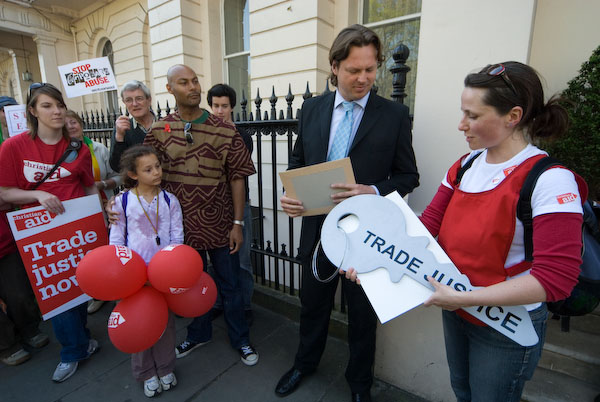
At the Spanish Embassy
The Mass Action in 2007 was organised by the Trade Justice Movement, which included 78 UK-based organisations including aid organisations such as Action Aid, Cafod, Christian Aid, Oxfam, Tearfund, War On Want and the World Development Movement, trade unions, churches, fair trade groups and more.
At the Austrian Embassy
It began with a rally in Belgrave Square, a square containing many empbassies. The rally was outside the German (and Austrian) embassies, with speakers from a number of the groups including Frances O’Grady from the Trade Union Congress, Tony Juniper of Friends of the Earth and speakers from some APC countries.
Setting off for the Department of Trade and Industry
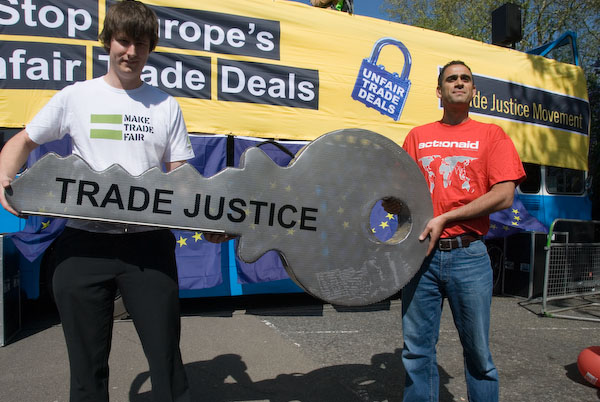
At the end of the rally groups left to deliver a letter and a large key to every EU country’s embassy with a letter and a key, demanding that the EU stops negotiating unfair trade deals (economic partnership agreements or EPAs) with developing countries. One group went to the Department of Trade and Industry to deliver to the UK. I could not go with all the groups going to all 27 locations to deliver these, but did manage to take photographs of the groups outside the Finnish, Spanish and Austrian embassies.
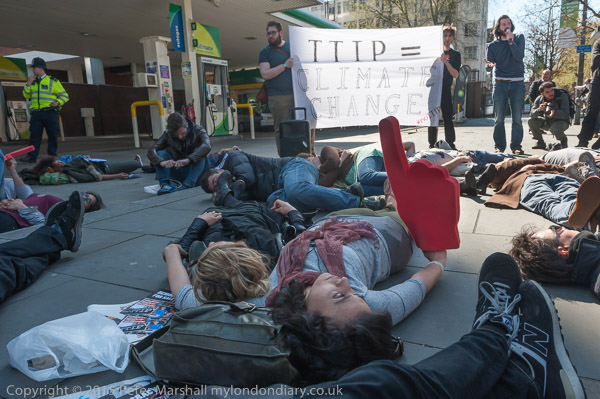
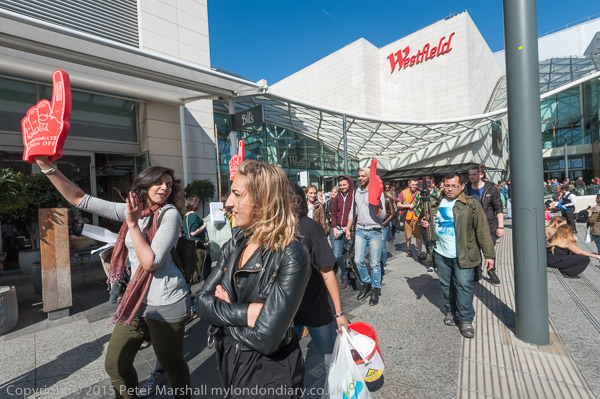
Armenians, Football, Tweed, TTIP, KFC, BP, NHS: Ten years ago on Saturday 18th April 2015 London was busy with protests and I rushed around covering seven events, though the last four at Shepherds Bush were all part of the Day of Dissent rally against TTIP, related to the problems which would be caused with a trade deal with the USA – and all threats now relevant to the current talks between our government and the Trump administration.
Centenary of Armenian Genocide
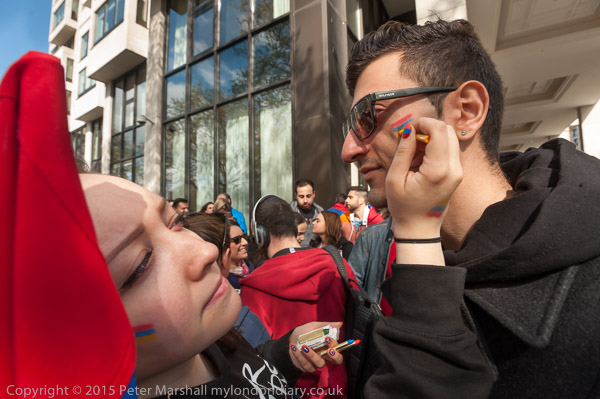
A woman paints an Armenian flag on a man’s cheek
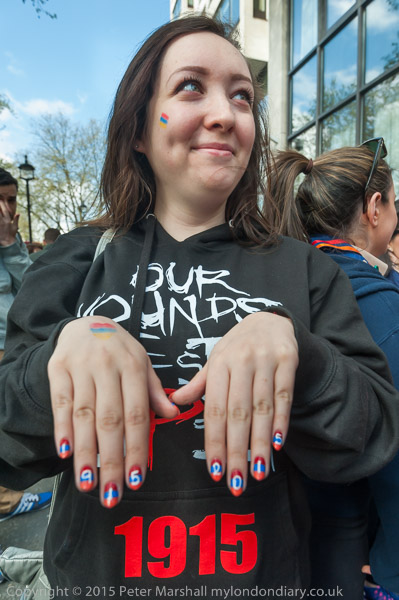
I met hundreds of Armenians close to Hyde Park corner on Piccadilly as they prepared for their annual march in protest against the Armenian Genocide. This year, 2015 marked the centenary of the start of the killing of 1.5m Armenians by Turkey between 1915 and 1923.
Turkey still refuse to accept the mass killings as genocide and the UK has not recognised the Armenian genocide. Armenians demannd that both countries should recognise this historic event and that it should be taught in the national curriculum.
Some carried placards with pictures of Hrant Dink who is described as ‘The 1,500,001st Victim of The Armenian Genocide‘. Editor of the Istanbul Turkish-Armenian newspaper Agos, he was prosecuted under Article 301 of the Turkish Penal Code which makes it a crime to publicly denigrate the Turkish government, republic or nation. After having received many death threats he was assassinated by a 17 year old Turkish Nationalist in January 2007.
I left the protest shortly before the march began, hoping to see them later at Downing Street but had left Westminster before they arrived.
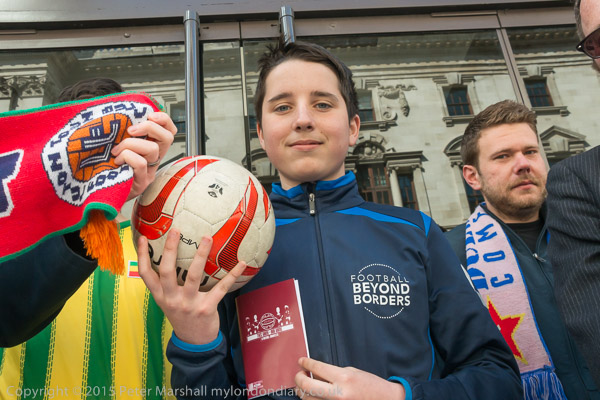
I went to Westminster to find the Football Action Network who were taking copies of their manifesto to the Labour, Tory and Lib-Dem offices, and finally caught up with them on the steps of the Lib-Dem offices.
Their demands include a Football Reform Bill, a living wage for all staff, fair ticket prices, safe standing, and reforms to clubs & FA.
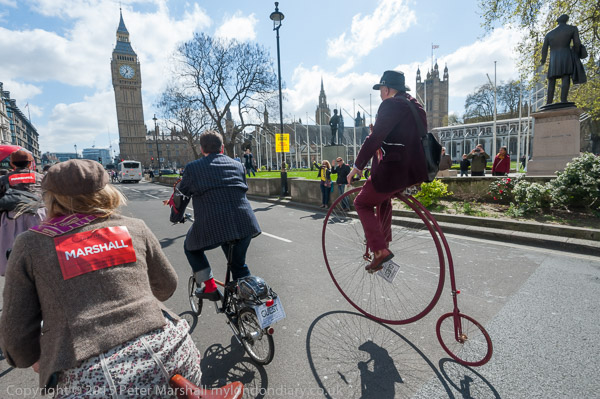
I briefly left the football fans as the Tweed Cycle Ride stopped on the road opposite and rushed to take pictures as it went into Parliament Square. The vintage-themed ride, “a jaunty bike ride around London in our sartorial best“, stops for tea and a picnic and ends with “a bit of a jolly knees-up” and raises funds for the London Cycling Campaign.
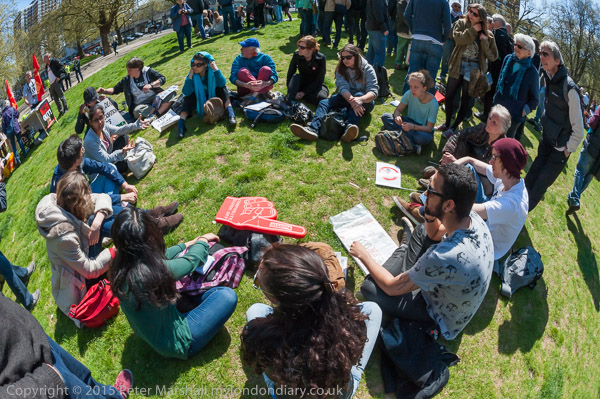
Shepherds Bush was the venue chosen for the Day of Dissent rally against TTIP, the Transatlantic Trade and Investment Partnership, a proposed trade treaty between the European Union (then still including Britain) and the United States which would have given excessive power to corporations, enabling them to override national laws.
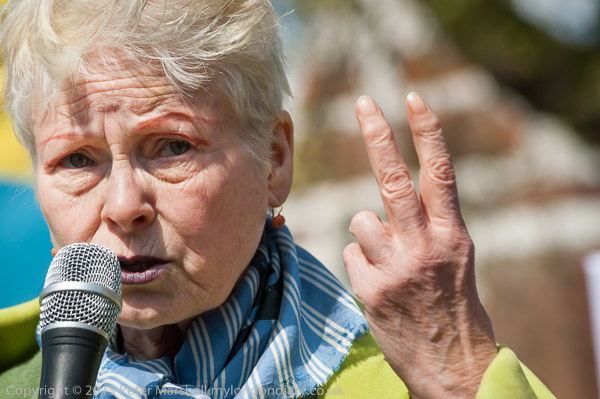
The event began with a rally on Shepherds Bush Green with speakers including Dame Vivienne Westwood, John Hilary of War on Want along with many others.
But much of the time was spent in a number of group discussions and it wasn’t an easy event to make interesting pictures. What was really clear was the threat that the TTIP treaty being negotiated by governments and corporations poses to democracy and all public services, that it would be a threat to public health and the NHS and would prevent changes made to combat climate change.
Campaigners then left to carry out the three separate actions I then photographed.
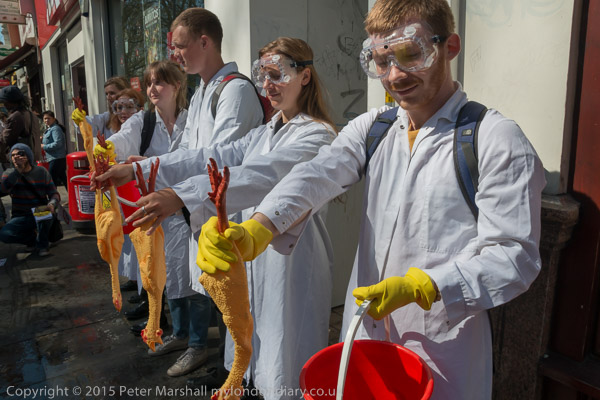
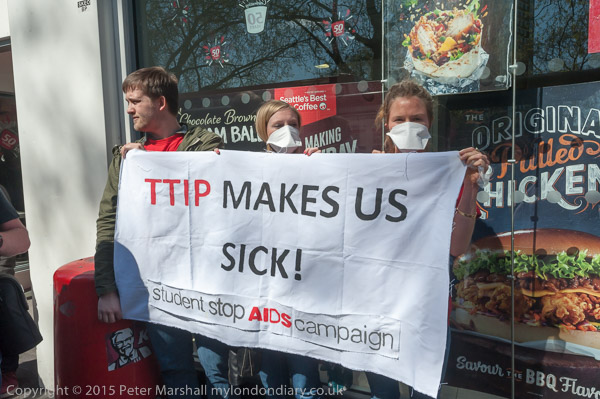
Protesters in white coats formed a line outside KFC at Shepherds Bush dipping rubber chickens in buckets of chlorine and acid, illustrating that TTIP would force the UK to accept unsafe agricultural and food practices (including GMO crops) allowed in the USA.
Chickens need chlorine washing because of lower farm hygiene standards and US meat contains much higher levels of hormones and other chemicals than here.
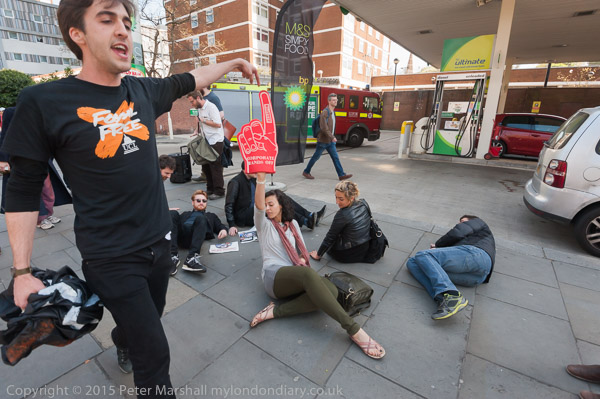
On the other side of Shepherds Bush Green protesters calling for a fossil fuel free future staged a die-in at BP Shepherds Bush against TTIP, which would force countries to use dirty fuels including coal, tar oil and arctic oil and seriously delay cutting carbon emissions and the move to renewable energy.
After some speeches about the protest the protesters got up from the garage forecourt and walked away.
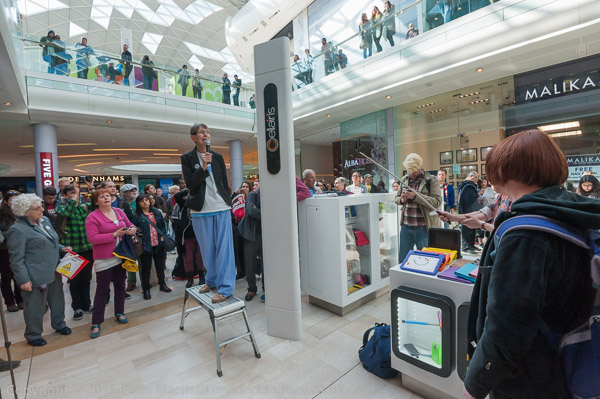
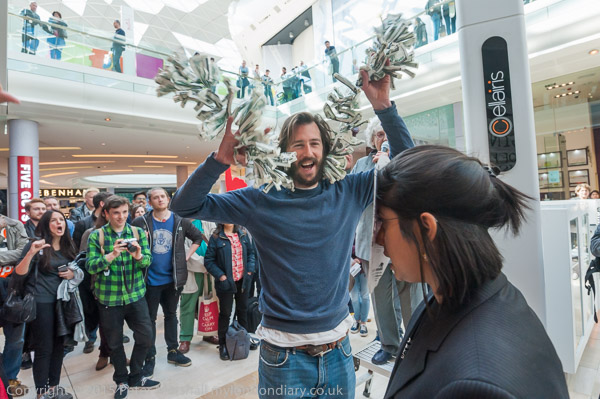
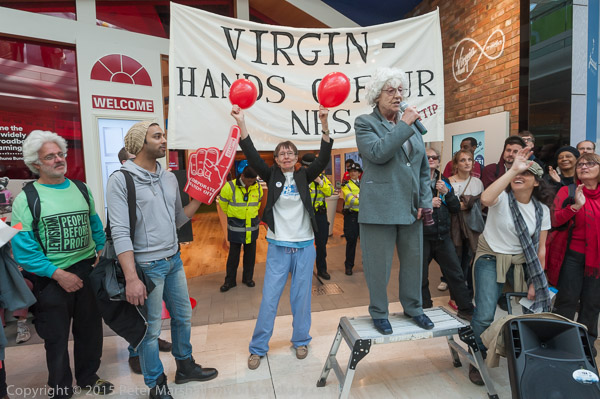
Protesters walked in to the Westfield Centre to protest outside the Virgin media shop over the danger that TTIP poses to our NHS. Virgin Healthcare, (in 2021 rebranded as HCRG Care Group) had already taken over providing large parts of the simpler services provided by the NHS, replacing the easily run parts of our National Health service, and taking money out of the system.
NHS campaigner Gay Lee introduces the protest and the short piece of street theatre
Campaigners urged that the NHS should be excluded from TTIP, but governments and business insist it should not be. Now in 2025 we are again worried that any US-UK trade agreement made by the Starmer Labour government may open up our health service to much greater privatisation by the giant US health companies.
George Barda offers his garland of dollars to ‘Richard Branson’
Many UK government members have significant financial interests in private healthcare companies, and coulld have expected rich profits if TTIP is agreed as it will force the NHS to contract out its services to them.
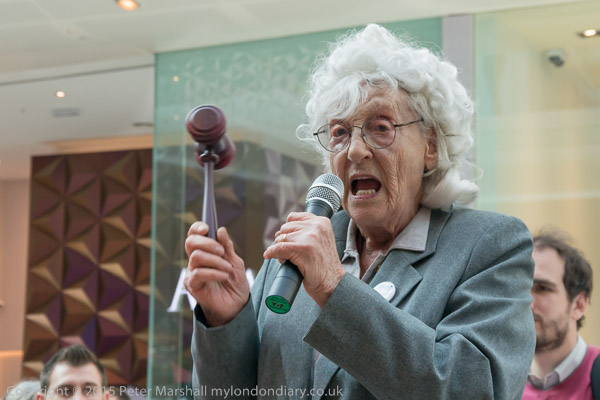
A pensioner in a wig acts as a judge
After Trump became president he stopped the TTIP talks so he could pursue a trade war with the EU. One of the few things we can thank him for.
I had been worried that security staff might try to stop photographers working as like most shopping centres, Westfield does not generally allow photography. Police and security watched the protest closely but did not generally try to stop it or photographers working.
The protesters were considering further protests, but I had been on my feet too long and left for home.
Limehouse Basin and Limehouse Cut: More pictures from my walk around Limehouse on on 6th January 1990. The previous post from this walk is Ratcliff Highway and Limehouse Basin – 1990.
The Limehouse Cut is London’s oldest canal, opened in 1770 to provide an easier route from the Lea Navigation, an important river for transporting grain into London from the agricultural areas to north in Hertfordshire. Used from the Bronze age and later by Viking raiders, alterations had been made to improve navigation on the River Lee since at least 1190 and was later followed by various Acts of Parliament. The first river lock in England was built on it at Waltham Abbey in 1577, but it was only the the River Lee Navigation Act 1767 that really began its modernisation.
Part of the work made under the 1767 Act when the navigation was surveyed John Smeaton was the suggestion to dig of the Limehouse Cut, allowing boats to avoid the treacherous and winding tidal lower reaches of Bow Creek on their way to the River Thames. The actual surveyor when the work began was his assistant Thomas Yeoman. It was a considerable short cut as it emerged into the river to the west of the long haul around the Isle of Dogs.
The original canal was narrow and had to be later widened and improved and it was only in the Victorian era that it was finally in something like its final state. The canal until 1968 entered directly into the Thames though Limehouse Lock in front of the row of small houses in these pictures, but it also had a basin, Limehouse Basin, at its southern end.
The first Limehouse Basin was at first simply a basin at the end of the Limehouse Cut, dug out by 1795. It had an island in it and on its bank was a a sawmill driven by a windmill, built a little earlier when sawmills were still widely thought to be illegal in England. It was attacked and the machinery destroyed by rioters – including hand-sawyers – in 1768. Restored the following year it closed around 35 years later. A lead mill opened on the island soon after and the company only ceased to exist in 1982. Victory Place is built on the site of this original Basin, and the old streets Island Row and Mill Place to its north are still there.
The Limehouse Cut was in 1854 linked to the Limehouse Basin of the Regent’s Canal which had opened in 1820 as the Limehouse Lock needed to be repaired. But this link was opposed by the boatmen from the Lee and Stort who fought a legal battle and in 1864 it was filled in and the site built on. It was not until over a hundred years later in 1968 that a new link – only 200 metres long – was made and Limehouse Lock finally closed.
The Limehouse Cut runs on a straight route through Poplar but curves around at its sourthern end. It was blocked here in 1990, probably in connection with the buildilng of the Limehouse Link tunnel between 1989 and 1993. But there was also work on the Cut around then, with the vertical guillotine gate on the north side of Britannia Bridge across the Commercial Road being removed.
Northey Street still has a bridge over the remains of the old route of the Limehouse Cut to Limehouse Lock, but all of the buildings including wharves and works on the banks of the Cut have now been replaced by modern development. The tower blocks beyond are on Oak Lane, and I think in the distance are cranes working on developments on the Isle of Dogs around Canary Wharf.