Walthamstow Housing Action & Class War at the Ripper Museum – 2015

Walthamstow Housing Action & Class War at the Ripper Museum: On Saturday 21st November 2015 I spent an hour covering a lunchtime rally and march about the housing problems in the London Borough of Waltham Forest before rushing to Whitechapel where Class War were holding another of their protests outside the sensational tourist attraction celebrating the horrific acts of ‘Jack the Ripper’.


Homes for All against social cleansing

Leyton & Walthamstow

Walthamstow Housing Action & Class War at the Ripper Museum

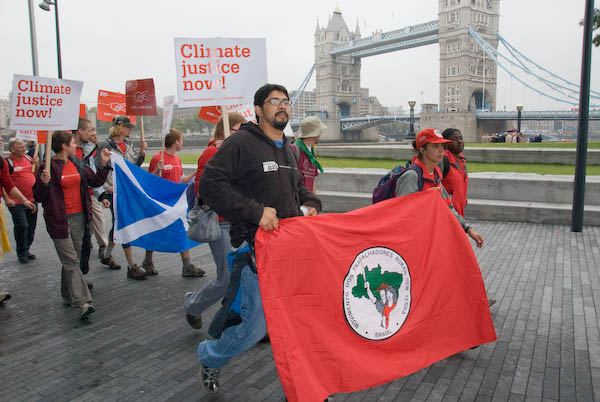
People met in Abbots Park Leyton for a rally organised by Waltham Forest Housing Action before they marched to a longer rally in the centre of Walthamstow. over the severe housing problems faced by those living in the borough of Waltham Forest.

Walthamstow Housing Action & Class War at the Ripper Museum
Green Party Deputy Leader Dr Shahrar Ali

The council has a housing waiting list of over 20,000 families, and although there is considerable home building taking place in the borough only 400 of 12,000 homes planned in Walthamstow in the next 5 years are for low earners.

Walthamstow Housing Action & Class War at the Ripper Museum

As in most of London’s boroughs, mainly held by Labour councils, the ‘regeneration’ schemes begun under New Labour has led to the loss of social housing, pricing most local people in the many lower paid and middle-income jobs which are essential for the city to run. Regeneration has led to social cleansing with poorer residents being forced out to areas further from the centre.

Walthamstow Housing Action & Class War at the Ripper Museum

The campaigners called for an end to housing evictions in the area – then taking place at twice the average rate for London, and the capping of private rents which are on average much higher than the maximum set by housing benefit, as well as a huge increase in social housing.

Walthamstow Housing Action & Class War at the Ripper Museum

Housing benefit acts as a huge public subsidy for landlords, passing money to them. The public and those who live in rented accommodation would be much better served by money being spent of building social housing which would give a return to local councils from the rents.

Private rents allow landlords to get housing benefit and the excess rent paid by the tenants to pay off the loans they take out so they can buy property and get the benefit of increasing their capital – at our and the tenant’s expense.

Rising rents have increasingly made it impossible for many key workers – teachers, firefighters and others – to afford to live in the boroughs they serve.

Press TV interviewed one of the campaigners who holds a placard ‘I have moved 4 times in 3 years! I want secure affordable housing’

Although Press TV covered the event there was (as usual) no interest shown by mainstream UK media

Among the trade unions supporting the march were the National Union of Teachers and the Fire Brigades Union – who provided their fire engine as a platform for speakers and to lead the march.

Local politicians also came for the event along with Green Party Deputy Leader Dr Shahrar Ali. Among local groups with banners were residents of Residents of Fred Wigg and John Walsh towers on the edge of Wanstead Flats in Leytonstone., where the 234 social housing units are to be replaced by only 160 and new private flats were to be sold to raise £30 million.

I left as the march was on its way to Walthamstow to go to Whitechapel.

More on My London Diary at Homes for All against social cleansing.


Class War at the Ripper ‘Museum’

Cable St, Whitechapel

I met Class War as they arrived outside the Jack the Ripper tourist attraction in Cable St with their ‘Womens Death Brigade‘ banner for another in their series of protests against the ‘museum’ which celebrates the brutal and macabre killings of working class women in Whitechapel in 1888.

Owner Mark Palmer-Edgecumbe’s partner Julian Pino and an employee in the shop

The murderer was an insane serial killer who ripped open the bodies of his victims, removing the uterus and heart and a whole industry has arisen over trying to establish his identity, spurred on by the particularly gory details of his crimes.

An officer tells Puno to stop phoning ‘999’ as the police are already here

Although the police at the time were unable to solve the case, they appear to have given up after Montague Druitt drowned himself in the Thames shortly after the final one of these murders. But those aiming to profit from the whole series of articles, books and films have done their best to build up doubt and uncertainty, putting forward others, often very unlikely such as painter Walter Sickert, as the criminal.

Lisa McKenzie speaks her mind

The protest was noisy but peaceful with many of those taking part wearing masks of the shop’s owner – who had lied about the site becoming a museum to celebrate women’s history to gain support and planning permission.

Jane Nicholl and Mark’s mask

It was enlivened by the arrival of activist singer/guitarist Cosmo who performed three appropriate songs which raised everyone’s spirits, and even the police obviously enjoyed the protest.

Shop owner Mark Palmer-Edgecumbe had left a shop worker and his partner Julian Pino inside the ‘museum’ to face the protesters and their was one spot of farce when a police officer went inside to tell him to stop continually phoning ‘999’ as the police were already there.

Cosmo sings

A man claiming to be a local resident and seemed to be a friend of the ‘museum’ came to complain to Class War against them protesting against a business that was bringing investment to an area that was so obviously in need of it. He was told that this kind of investmentglorified violence against women and was clearly detrimental to the area and offensive to many – including the living descendants of the victims.

It was hard to avoid the conclusion that his intervention had been prompted and possibly funded by the owner of this tacky tourist attraction, which noticeably attracted no customers while the protest was taking place.

More on My London Diary at Class War at the Ripper ‘Museum’.


FlickrFacebookMy London DiaryHull PhotosLea ValleyParis
London’s Industrial HeritageLondon Photos

All photographs on this page are copyright © Peter Marshall.
Contact me to buy prints or licence to reproduce.


Tollington to Holloway – 1990

Tollington to Holloway continues my walk on Sunday February 11th 1990 which began at Kings Cross with the post Kings Cross and Pentonville 1990. The previous post was More from Tollington Park – 1990.

House, Tollington Way, Finsbury Park, Islington, 1990, 90-2d-56
House, 1A, Cornwallis Rd, Finsbury Park, Islington, 1990, 90-2d-56

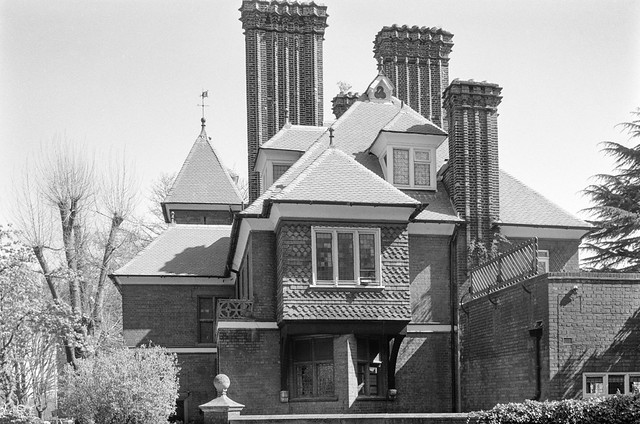
This 3 storey detached house on Cornwallis Road, just a few yards down from Tollington Way, attracted my attention for its unusual decoration above what seemed a very ordinary door and window. According to Streets With a Story the street was developed in three periods as Shadwell Road, Esher Villas and Cornwallis Road in 1863, 1879 and 1885. This house probably dates from the latter part of that development but I’ve found nothing about it on-line

Royal Northern Hospital, Tollington Way, Holloway, Islington, 1990, 90-2d-42

The Royal Northern Hospital was founded in York Rd (York Way) in 1856 at his own expense by a surgeon who had been sacked from University College Hospital for smacking a patient’s bottom. The hospital provided free services for North London’s Poor as well as treating railway workers. But the railway bought the house and they had to move, using several properties in the area. Finally it got is own home and the Great Northern Central Hospital opened on Holloway Road in 1888, changing its name to the Royal Northern Hospital in 1921 and expanding to Tollington Way in the 1930s. It merged with the Whittington Hospital in 1963. The facade of the main building has been retained on Holloway Rd and the building is the Northern Medical Centre

Holloway Rd, Holloway, Islington, 1990, 90-2d-43

This picture was made from Tollington Way looking to the rather grand Italianate terraced villas on the opposite side of Holloway Road, Belgrave Terrace. They were locally listed in 1978. At left is The Cock Tavern at 596 Holloway Road. The pub was built in the 1880s and in the 2000s became a live music venue and bar, now Nambucca. Damaged by fire in December 2008 it reopened in 2010 and was refurbished in 2014 only to close in 2022 but unexpectedly reopen in 2024.

VICTORY TO THE IRA, Landseer Rd, Holloway, Islington, 1990, 90-2d-46

Holloway is one of the more densely populated areas of London with a very multicultural population including many Irish among its residents, and among them a significant number who supported the Irish struggle against the English occupiers in Northern Ireland. In 1990 we were in the middle of active attacks by the Provisional Irish Republican Army (IRA) on targets in London – the following year they attacked Downing Street using mortar shells and in 1992 a powerful bomb at the Baltic Exchange destroyed it and other buildings in the City of London, following this in 1993 with another bomb in Bishopsgate.

The street was named after the animal painter and sculptor Sir Edwin Landseer, best known now for the lions at the base of Nelson’s column. He became a ‘national treasure‘ and his death in 1873 gave rise to mourning across the nation and large crowds lined the streets as his funeral cortège made its way to St Paul’s Cathedral. Probably the street dates from around then.

W Wooley, Egg & Butter Merchant, 541, Holloway Rd, Holloway, Islington, 1990, 90-2d-31

The building is still there on Holloway Road, but sadly is no longer an Egg & Butter Merchant and has a new shopfront – and a bus shelter on the pavement in front of it.

Tollington to Holloway - 1990
Lingerie, Stop Smoking, Royal Jelly & Ginseng, Holloway Rd, Holloway, Islington, 1990, 90-2d-32

As I made my way to the station at the end of my walk I could not resist this shop window with a rather strange mix of products including those listed and some rather strange health supplements. I only stopped long enough to take a picture and wasn’t tempted to buy anything.

My next walk a week later was also in North London and will be the subject of a later post.


FlickrFacebookMy London DiaryHull PhotosLea ValleyParis
London’s Industrial HeritageLondon Photos

All photographs on this page are copyright © Peter Marshall.
Contact me to buy prints or licence to reproduce.


Stop The War March, November 2001

Stop The War March: Although I’ve usually posted events from the past on the actual anniversary, this post comes a day late as by the time I remembered this I had already written a post for yesterday. So although I’m publishing this on 19th November, the march organised by Stop The War took place on November 18th 2001. It was a large one, although as I wrote the reports by police severely under-counted the numbers taking part.

Stop The War March, November 2001

The Stop the War Coalition had been founded in September 2001 in the weeks following 9/11 after George W. Bush had announced the “war on terror”. At first its protests were mainly directed against the war in Afghanistan, but later it opposed the the US-led military invasion of Iraq and since then has campaigned against other wars against Libya, in Syria and elsewhere.

Stop The War March, November 2001

In recent years it has been one of the groups involved in the many protests, small and large against the genocide taking place in Gaza along with CND and the Palestine Solidarity Campaign.

Stop The War March, November 2001

I had covered their first major march by Stop the War in October 2001 and have continue to photograph many of their events to the present day, though for medical reasons had to miss the largest public demonstration in British history on 15th February 2003 shortly before the invasion of Iraq on 20 March 2003.

Stop The War March, November 2001

Back in 2003 the coalition was a huge one. Wikipedia states “Greenpeace, the Liberal Democrats, Plaid Cymru and the Scottish National Party (SNP) were among the 450 organisations which had affiliated to the coalition, and the coalition’s website listed 321 peace groups.”

Stop The War March, November 2001

The Socialist Workers Party has always played a leading role in Stop the War and the Muslim community has been important from the start with the coalition recognising “a war against Afghanistan would be perceived as an attack on Islam and that Muslims, or those perceived as being Muslim, would face racist attacks in the United Kingdom if the government joined the war.” The Muslim Association of Britain was closely involve in organising this and other protests.

Stop The War March, November 2001

In 2001 I was still photographing using film, both black and white and colour, and all of the pictures I contributed to picture libraries were in black and white, as are those on My London Diary. Back then the demand from newspapers and magazines was still mainly for black and white and was still reproduced largely from prints.

Occasionally I would print images taken on colour negative as black and white prints to submit but mainly I had sufficient pictures taken as black and white. There are some people who now convert their colour digital images into black and white, feeling I think that it somehow makes them more ‘authentic’. It does occasionally make images stronger but mostly it simply makes them less descriptive and often confused.

Below is the post I wrote for My London Diary. It says nothing about why the protest was taking place, which would have been obvious to viewers at the time that it was against the war in Afghanistan.

“November 18 we were back again marching to stop the war. Two hours after the march started there were still marchers leaving Hyde Park, and we were getting messages that Trafalgar Square was full. The police estimate of 20,000 was pathetically low and even the organisers’ figure of 50,000 might have been on the low side. It’s always difficult to count such things (I usually give up counting around the one thousand mark when I’m covering demonstrations and make a guess above that, but this was certainly on a similar scale to the countryside march which is the largest event in recent years.

The march was more split up into factions than most, although the start was fairly mixed. There were large organised male and female sections of Muslims for Justice in the middle of the march and a big group of younger marchers, including anarchists, towards the end. Actually I didn’t manage to see the end of the march, and people were still arriving in Trafalgar Square when I left.”

A few more pictures on My London Diary


FlickrFacebookMy London DiaryHull PhotosLea ValleyParis
London’s Industrial HeritageLondon Photos

All photographs on this page are copyright © Peter Marshall.
Contact me to buy prints or licence to reproduce.


More City of London Panoramas – 1994

More City of London Panoramas: This is the final set of picturesI’ll post from those I made while working on a personal project on the City of London in July 1994. Of course I took many which I’ve not digitised, spending several days walking the City and making over 300 exposures. The camera I used makes negatives on standard 35mm film which are wider than normal and a ’36 exposure’ film only gets around 20 or 21 panoramic frames. Film loading is also trickier as the film has to go around a curve.

Each exposure took a few minutes to select a viewpoint, set up my tripod, level the camera, use a handheld lightmeter to check exposure and finally press the cable release. Most of those not uploaded are similar to those I have posted with just minor changes to the view.

London Bridge Walk, Tooley St, Borough High St, Southwark, 1994, 94-711-52

Not quite in the City, but made as I made my way from London Bridge Station to London Bridge along London Bridge Walk. The road in the background is Borough High Street which leads on to London Bridge and the City boundary is in the middle of the river. You can just see the pinnacles on the top of the tower of Southwark Cathedral.

After the operation of the Waterloo & City underground line from Network South East to London Underground in April 1994 I could no longer use my ‘London Terminals’ ticket on this route, and my cheapest journey became to go to London Bridge on this and walk across to the City.

This is one of a few pictures I had digitised but missed when I was uploading these images to Flickr.

High Walk, Wood St, City, 1994, 94-713-42

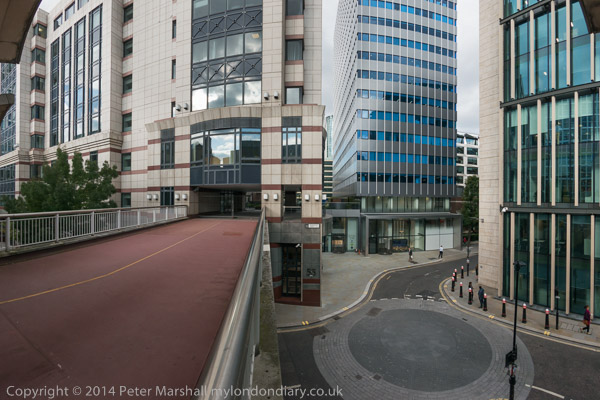
Another exposure from the highwalk at Wood Street, leading south along the east side of the street away from London Wall. In the centre of the picture is the City of London Police Headquarters, with two white police vans at bottom right. Steps lead down from the walkway to Wood Street but the highwalk also continued straight on at extreme left – though with more steps.

In the centre of Wood Street at right is the tower of St Alban Wood Street. The medieval church was destroyed in the Great Fire and rebuilt by Sir Christopher Wren. The church was largely destroyed in the Blitz in 1940. The tower remained and was Grade II* listed in 1950 and is now a private house; the remains of the rest of the church were demolished in 1965.

Lower Thames St, King William St, City, 1994, 94-711-12

Again on my way from London Bridge Station to the centre of the City, this is made from where London Bridge joins to King William Street and goes across Lower Thames Street. You can see a highwalk bridge going across Lower Thames street a couple of hundred yards to the east, still there in 2025.

Until around 1970 Thames Street was a fairly narrow street, just wide enough to allow a single lane of traffic in both directions. It was then turned into a major road and divided at London Bridge into Lower and Upper Thames Street. At the left you can clearly see where older buildings were cut through to widen the road.

Bank Junction, City, 1994, 94-712-33

The heart of the City. I made the picture close to the corner of Mansion House Street and Princes Street with the Underground entrance on the corner. At left is a corner of the Bank of England and the main modern building towering above it is the Stock Exchange Tower, home to the Stock Exchange until 2004.

Towards the centre is the Royal Exchange, I think then still home to the International Financial Futures Exchange rather than just an upmarket shopping mall. Two buildings full of banks and insurance companies book-end Hawksmoor’s St Mary Woolnuth and at the extreme right is the edge of the Mansion House with a gilded lamp on its steps.

Milton Court, Silk Street, City, 1994, 94-713-21

Another section of highwalks ran from close to Moorgate Station to the Barbican Estate and these last four pictures show sections of this, which could also be accessed from Ropemaker Street. This northern section has now been lost.

Milton Court was designed by Chamberlin, Powell & Bon and built as a part of the Barbican development in 1959 for various City services – “a fire station, Coroner’s Court, mortuary, office of weights and measures and a civil defence school.”

It was arguably London’s most outstanding single post-war building and English Heritage wanted to list it in 2001, but the government’s Department of Culture, Media and Sport objected and in 2007 Secretary of State James Purnell granted it immunity from listing. In a sad act of cultural vandalism this remarkable building was demolished in 2008.

Milton Court, Silk Street, City, 1994, 94-713-12

The building which replaced Milton Court was also given the same name but is a much more bland modern structure. The bridge which linked to the northern section of highwalk disappeared.

The new 115m tall Milton Court is described on its builders Sir Robert McAlpine web site: “Climbing to 36 storeys, Milton Court redefines luxury living in the Square Mile. In addition to a graceful residential tower, the development is home to a spectacular new annexe to the Guildhall School of Music & Drama.” But to me it looks like just another tall city office block.

Highwalk, Ropemaker St, City, 1994, 94-715-52

This enclosed section of highwalk ran from Ropemaker Street to the bridge across Silk Street to the Speed Highwalk still there along the north side of Speed House.

Ropemaker St, Islington, City, 1994, 94-715-32

Remarkably I think none of the buildings in this picture looking east along Ropemaker Street has ssurvived. Even the building at left, Ropemaker Place, a 60m high block which I photographed while it was being built in 1986 and was completed in 1987 and which I thought was one of the more attractive modern buildings in (or rather a few feet outside) didn’t last long and was demolished only 18 years later in 2005.

More colour from 1994 in later posts.


FlickrFacebookMy London DiaryHull PhotosLea ValleyParis
London’s Industrial HeritageLondon Photos

All photographs on this page are copyright © Peter Marshall.
Contact me to buy prints or licence to reproduce.


Sudan & Hong Kong Protests – 8 Nov 2025

Sudan & Hong Kong Protests: Last Saturday, 8th November 2025 I photographed a London rally and march against the horrific killings in Sudan before going to the Chinese Embassy where people were protesting for freedom of expression in Hong Kong, where three pro-democracy advocates were to go on trial this Tuesday for “subversion”.


End the UK-Complicit Genocide in Sudan

Gloucester Road Station

Sudan & Hong Kong Protests - 8 Nov 2025

Sudan has been a divided country more or less since it gained independence in 1956, suffering a long civil war which eventually led to independence for South Sudan in 2011 and a brutal 30 year military dictatorship under Omar al-Bashir which included an ethnic genocide in Darfur from 2003 -2020. Al-Bashir was finally ousted by a coup early in 2019 following huge protests. Since 2023 the country has been devastated by a civil war between the Sudanese Armed Forces (SAF), and the paramilitary Rapid Support Forces (RSF).

Sudan & Hong Kong Protests - 8 Nov 2025

The war is partly one over resources and access to the Red Sea, but also has a strong ethnic dimension with the RSF being “violently Arab supremacist or ethno-fascist“. They are backed financially by the United Arab Emirates who also supply them with arms. In return the RSF has taken control of Sudanese gold mines and illegally smuggles gold to Dubai.

The RSF also control the major gum arabic producing areas of the country. Sudan’s acacia trees produce around 80% of the world total of this vital ingredient used in many consumer products from Coca-cola to lipsticks and pet food. The RSF smuggles this out to be sold on world markets.

Sudan & Hong Kong Protests - 8 Nov 2025

The war between the RSF and the SAF has resulted in more than 200,000 people being killed, mainly civilians with huge numbers – perhaps 14 million -being displaced and according to the UN, “2025 will see 30.4 million people in Sudan in need of humanitarian aid due to the military conflict in the country.

Sudan & Hong Kong Protests - 8 Nov 2025

Both the RSF and the SAF are reported as carrying out war crimes. The ‘London for Sudan’ leaflet states:

The RSF are burning villages to the ground, recruiting child soldiers, poisoning water supplies, attacking hospitals & targetting journalists.

The SAF are carpet bombing indiscriminately, wiping out markets and other vital infrastructure in their bid for control over the region.”

Sudan & Hong Kong Protests - 8 Nov 2025

In the continuing El-Fasher massacre by the RSF, “an estimated 2,500 or more civilians have been executed or murdered since 26 October 2025.” though some analysts believe the actual numbers are in the tens of thousands. The RSF are known to use rape as a weapon and have have committed executions, torture, mass displacement and deliberate starvation, armed by weapons sold by the UK to the UAE. In May Sudan took the UAE to the International Court of Justice for complicity in genocide.

Sudan & Hong Kong Protests - 8 Nov 2025

The protesters pointed out the British complicity in supporting the RSF by selling arms to the UAE which are then smuggled to the RSF. They demanded that the UK government designate the RSF a terrorist organisation and called on them to impose sanctions on the UAE for their support as well as ending arms sales to them.

Sudan & Hong Kong Protests - 8 Nov 2025

After a short rally with several speeches and a moving poem in English by a Sudanese woman poet the march set off along the Cromwell Road heading for a final rally. I left them at South Kensington to go to a protest at the Chinese Embassy.

More pictures in the Facebook album End the UK-Complicit Genocide in Sudan


Free the Hong Kong Alliance Three

Chinese Embassy, Portland Place

Sudan & Hong Kong Protests - 8 Nov 2025

Trade unionists protested outside the Chinese Embassy in solidarity with the three Hong Kong pro-democracy leaders charged with inciting subversion under Beijing’s National Security Law for organising protests and vigils whose trial begins on 11 Nov.

Sudan & Hong Kong Protests - 8 Nov 2025

They called for Lee Cheuk-yan, Chow Hang-tung, Albert Ho and all political prisoners to be released.

Sudan & Hong Kong Protests - 8 Nov 2025

One man who continually tried to disrupt the event by shouting pro-China comments through a megaphone was finally pushed away across the road. Police argued with him and he was later arrested when he refused to obey police requests to stop.

Sudan & Hong Kong Protests - 8 Nov 2025

More pictures in the Facebook Album Free the Hong Kong Alliance Three


FlickrFacebookMy London DiaryHull PhotosLea ValleyParis
London’s Industrial HeritageLondon Photos

All photographs on this page are copyright © Peter Marshall.
Contact me to buy prints or licence to reproduce.


The Lord Mayor’s Show – 2005

The Lord Mayor’s Show. One of the largest ceremonial events in London every year is the Lord Mayor’s Show in November – in 2005 it was on Saturday 12th November. It is said to be the oldest civic procession in the world, first held after King John allowed the City of London to appoint its own Mayor in 1215.

The Lord Mayor's Show - 2005
Not a nightmare, but the Dunloy Accordion Band from Ireland. London, 12 Nov, 2005

I’d photographed the event in several earlier years, though in many ways for me it had often been more a social event than a serious part of my photography, meeting up with some of my photographer friends and after taking some pictures and finding a suitable pub. But as I wrote in 2005, that year I had decided to do it on my own and actually photograph it as if I were covering the event for a magazine rather than as a personal photographic project. Though to two things often overlapped considerably in my work.

The Lord Mayor's Show - 2005 Gog and Magog,
Gog and Magog, legendary giants, with the Society of Young Freemen

I have photographed it a few times since, mainly when other groups have decided to add their own input to the day. In 2011 Occupy SLX staged their ‘Not the Lord Mayors Show’ festival of entertainment and in 2021 Extinction Rebellion held a rival protest, Rise and Rebel XR at Lord Mayors Show.

The Lord Mayor's Show - 2005

The City of London is virtually its own country inside Britain, and has a unique position as a city, ceremonial county and local government district in England. And although it shares an MP with the City of Westminster, it also has the rather shadowy figure of the ‘City Remembrancer‘ who sits in the under-gallery of the House of Commons as a permanent lobbyist for the City and has the special privilege to see legislation as it is being drafted. Over the years this has led to the City being able to protect its interests in various ways, notably in the last century to prevent the reforms to the City’s status proposed by the postwar Attlee government.

The Lord Mayor's Show - 2005

Treasure Islands’ by Nicholas Shaxson, which includes a section on the City, often called ‘the money-laundering capital of the world‘ gives some insight as to how the lavish display of this event and much of the City’s activities are possible. The show does raise considerable amounts to support various charities.

The Lord Mayor's Show - 2005

This year, 2025, London had it’s first ‘Lady Mayor’s Show‘ though there have been two previous female Lord Mayors. The City calls it a ‘historic milestone’ but to me it seems not a blow for feminism but an anachronism in an age where we no longer have actresses or Chairladies. I had other things to do this year and didn’t go to see the show.

All the pictures in this post were taken by me in 2005 – there are many more on My London Diary – but below with the usual minor corrections is what I wrote then.

“Saturday I was back opposite Guildhall for the start of the annual Lord Mayor’s Parade. Although I’ve been to it on several occasions, I’ve never tried to photograph the actual event and people taking part in a straightforward way. Usually the things that happen before and after and on the fringes are of more interest to photographers (Cartier-Bresson photographing that guy sleeping it off on a pile of paper as the Coronation Procession moved by has a lot to answer for.)

After the end of the parade had passed the Guildhall, I took a short cut to St Paul’s to watch the Blessing Of The Lord Mayor and his lady, but unfortunately the crowd barriers holding back the public were too far away for a decent view, though I did take a few snaps.

It is a tightly policed event, very different from the Notting Hill Carnival parade, perhaps organised more with television in mind than letting those present actually take part – if you go to watch in the more crowded parts you often get a poor and distant view. Then I found a seat in the sun outside the new Stock Exchange and ate my sandwiches before photographing some of the fairground around the cathedral.

Then it was time to see the parade returning, and a short walk took me to opposite St Andrew-by-the-Wardrobe. I’d meant to stay on for the fireworks later, but I’d been standing up too long for my injured knee and decided to go home.”

Many more pictures begin here on My London Diary


FlickrFacebookMy London DiaryHull PhotosLea ValleyParis
London’s Industrial HeritageLondon Photos

All photographs on this page are copyright © Peter Marshall.
Contact me to buy prints or licence to reproduce.


Brexit Now, Save the Sunderbans, Close Ripper ‘Museum’ – 2018

Brexit Now, Save the Sunderbans, Close Ripper ‘Museum’: Saturday 10th November 2018 I began at a small protest by extreme right ‘Leave’ supporters against the lack of progress in leaving the EU. From there I went to a rally in Whitechapel which was part of a global day of protest to save the the world’s largest mangrove forest and then met Class War for another protest against the misogynist Ripper museum in Cable St.


Leave Voters say Leave Now!

Trafalgar Sq

Brexit Now, Save the Sunderbans, Close Ripper 'Museum' - 2018
Several had sticky tape over their mouths claiming they had been gagged

Only around a couple of hundred people had come to Trafalgar Square for a protest by extreme right wing groups led by what I think is the now defunct group UK Unity (their domain address is now for sale) and backed by others including the For Britain Movement and UKIP. There were faces familiar from other extreme-right protests.

Brexit Now, Save the Sunderbans, Close Ripper 'Museum' - 2018

They were angered by the lack of progress in exiting the UK and the concessions that they said Theresa May was making to the EU. This was one of five protests taking place that day, in Coventry, Norwich, Cardiff and Leeds as well as London.

Brexit Now, Save the Sunderbans, Close Ripper 'Museum' - 2018

They called for a 5 point plan:

  • Britain should leave the EU entirely without payments;
  • An end to mass immigration;
  • to properly run and fund our public services;
  • to scrap the House of Lords and reform democracy;
  • to put British Laws, British Culture and British People first.
Brexit Now, Save the Sunderbans, Close Ripper 'Museum' - 2018

Many also held posters calling for London Mayor Sadiq Khan to resign, though this appeared simply to be Islamophobia. I listened to a couple of speeches which I felt “reflected some irrational views on Brexit, fired by emotion and ignoring the realities.”

Brexit Now, Save the Sunderbans, Close Ripper 'Museum' - 2018

As I commented in 2018, “It was always the case that the kind of break with the EU that many voted for was impossible, and that if we are to leave there will be many unpalatable consequences. The best possible deal was always going to be a poor deal in many ways, and no responsible politician thinking about the future of the nation rather than their own personal fortunes would be campaigning or voting for leaving without a deal.

Leave Voters say Leave Now!


Global Day to save the Sunderbans

Altab Ali Park, Whitechapel

Brexit Now, Save the Sunderbans, Close Ripper 'Museum' - 2018

The UK branch of the National Committee to Protect Oil Gas & Mineral Resources, Bangladesh, supported by others including Fossil Free Newham were taking part in a global day of protest to save the Sunderbans, the world’s largest mangrove forest and a UNESCO World Heritage Site.

Among animals threatened with extinction is the Bengal tiger

The Bangladesh and Indian governments were building the giant Rampal coal-fired power plant, which would become the largest power station in Bangladesh. Clearly this will be disastrous for climate change, producing huge amounts of carbon dioxide, but it also threatens the nearby wetlands, and is in violation of the Ramsar Convention for the conservation of wetlands which Bangladesh has signed up to.

The power plant will take huge amounts of water from the river which flows through the Sunderbans, and release hotter water containing toxic materials which will endanger the mangroves, marine animals and the people living in the area.

The 4.72 million tons of coal per year to the plant on ships through the shallow rivers will seriously disturb the Sunderbans and will also result in considerable pollution.

The development “will also make around 50 million people more vulnerable to storms and cyclones, against which the Sunderbans serve as a natural safeguard.” Global warming and climate chaos is already making such climate events more frequent and more severe – and the extra greenhouse gases from this plant will add to this.

Bangladesh is already one of the countries most under threat from frequent flooding. There were huge protests against the plant with numbers of protesters being killed. Despite huge opposition in the country and around the world, construction at Rampal continued and the first stage of the plant was commissioned in October 2022.

More on My London Diary at Global Day to save the Sunderbans


Class War picket the Ripper Museum

Cable St, Whitechapel

Class War had come once again to protest outside tacky misogynist tourist attraction which gained planning permission by pretending to be a museum of the history of women in London’s East End after it had failed to comply with some of Tower Hamlet’s Council’s planning decisions about its frontage.

One protester walked into the shop but was pushed out by one of the shop staff and they then called the police who arrived in a few minutes, having been waiting for the protest a short distance away. An officer tried to persuade the protesters to move away from the front of the shop and hold their ‘Womens Death Brigade’ banner on the opposite side of the road, but the took no notice.

A woman officer, CE3200, her name carefully hidden, complained to Class War about their language and told them they can be arrested for swearing. They told her the law. Swearing isn’t an offence in itself, it has to offend people – and you are particularly unlikely to be found guilty of swearing at the police, who are not generally supposed to be easily shocked.

This was intended as a short protest and Class War were rolling up their banner when a small group arrived to enter the shop. Class War talked with them politely, making clear the disgusting nature of some of the displays which glorify the gory nature of the crimes and denigrate the poor working class victims in a brutally misogynist fashion, causing offence to some of their still-living relatives.

They listened, but still went into the museum, with police ensuring they could enter safely. Class War then left for a nearby pub and I went with them.

More on My London Diary at Class War picket the Ripper ‘Museum’


FlickrFacebookMy London DiaryHull PhotosLea ValleyParis
London’s Industrial HeritageLondon Photos

All photographs on this page are copyright © Peter Marshall.
Contact me to buy prints or licence to reproduce.

More from Tollington Park – 1990

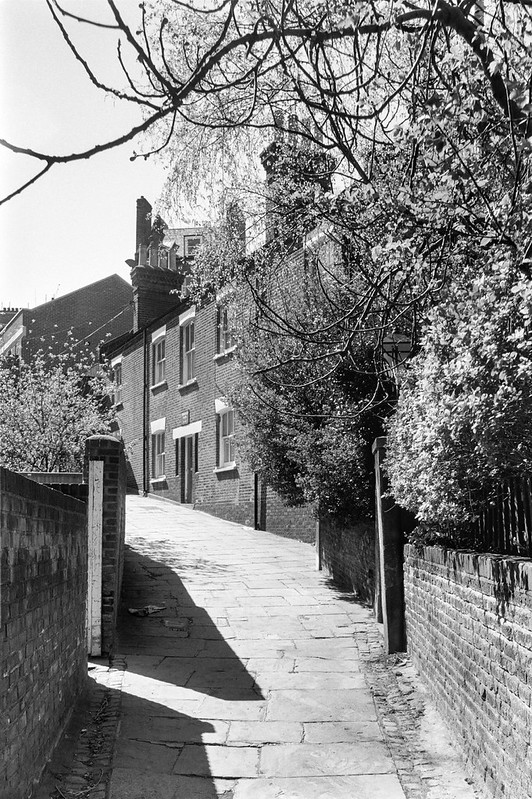
More from Tollington Park – 1990 continues my walk which began at Kings Cross on Sunday February 11th 1990 with the post Kings Cross and Pentonville 1990. The previous post was Fonthill & Tollington.

House, Tollington Park, Finsbury Park, Islington, 1990, 90-2c-12

Tollington is a district whose name dates back at lease into Saxon times. According to Eric A Willats’ ‘Streets With A Story‘, from which much of the information in this post comes, “It was spelt ‘Tollandune’ in the Anglo-Saxon Charters meaning the hill or pasture of Tolla. ‘Tolentone’ meant a pannage for hogs, a place of beechwood and mast. This area and Holloway were all then part of the Great Forest of Middlesex. It
had various spellings Tolesdone, Tolyndon, Tallingdon and Tallington
.”

Modern development of the area, then farmland, began early in the 19th century; “About 1818-1820 ‘a pretty range of villa residences were erected in the Italian style by Mr. Duerdin, with stabling and offices attached, from the designs of Messrs. Gough and Roumieu.’” These are now 96, 102, 106 and 110 Tollington Park.

House, Tollington Park, Finsbury Park, Islington, 1990, 90-2c-13

Like many other early and mid-19th century developments the villas were first given their own distinct subsidiary names and only became numbers in ‘Tollington Park’ in 1871, Willats gives the following details:

After 1871 subsidiary names were abolished, e.g., Belmont Terrace became nos2-6, Birnam Villas 8-10,St Marks Villas 16-22, Claremont Villas 24-36, Duerdin Villas 44-56, Fonthill Villas 60-70, Syddall Villas 59, Syddall Terrace 63-73, Regina Villas 89-101, Shimpling Place by 1882 nos15-155 Upper Tollington Park, Harrington Grove 1848/9 became after 1894 47 to 67 and 52 to 70 CHARTERIS ROAD. Nos96 to 108 have been attributed to Gough & Roumieu, built 1839-40

House, 53, Tollington Park, Finsbury Park, Islington, 1990, 90-2c-14

This corner house has been significantly modernised but retains its tall archway and fits in well with the adjoining houses out of picture to the left. It doesn’t get a mention on the fine map of ‘Historic Tollington’ which was “created by the incredibly vibrant Tollington Park Action Group in 1994.” As well as the plan of the streets this contains informative annotation on 26 sites in the area and would have been very useful to me as a guide to the area which I photographed four years before the map was made.

House, 20A, Turle Rd, Finsbury Park, Islington, 1990, 90-2c-15

Willats suggests the road was “Probably named after a John Turle of no.11 Tollington Park who was at that address in 1830 and in 1833.”

George Orwell School, Turle Rd, Finsbury Park, Islington, 1990, 90-2d-65

The former Tollington Park School first opened in 1886. It gained some new buildings to add to its Victorian main block in 1930 but these were demolished by bombing in 1940. I think my picture shows the new extension built in 1955.

It was renamed by the Inner London Education Authority in 1981 after Eric Arthur Blair, better known as George Orwell, in 1981. He had lived not far away at 27b Canonbury Square from 1944-7. The name of this ‘secondary modern’ school was changed when it was merged with Archway Secondary School and it disappeared in 1999 following a damning Ofsted inspection of all Islington’s schools, re-emerging as Islington Arts and Media School.

The school’s most famous former pupil is photographer Don McCullen who was born and grew up in Finsbury Park nearby.

St Marks, church, Church Hall, Moray Rd, Finsbury Park, Islington, 1990, 90-2d-53

Work began on building the church in 1853; its architect was Alexander Dick Gough (1804-71) who lived at 4 Tollington Park. He was a pupil of Benjamin Dean Wyatt and for some years worked in partnership with Robert Lewis Roumieu; their work together in North London included the Islington Literary and Scientific Institution (now the Almeida Theatre), the rebuilding of the Norman St Pancras Old Church and several Italianate villas in Tollington Park mentioned above.

After their partnership was dissolved in 1848, Gough designed or redesigned over a dozen churches in North London and elsewhere, many now demolished, along with other buildings. St Mark’s required some structural alterations in 1884 and was renovated in 1904.

Tollington Court, Tollington Place, Finsbury Park, Islington, 1990, 90-2d-54

These 1938 flats are on the corner of Tollington Place and Tollington Park and I was standing a few yards down Moray Road to make this picture, with the square and fluted round pillars of St Mark’s Mansions, 60 Tollington Park, at the left. This building is locally listed as a semi-detached Italianate villa dating from around 1850.

St Marks Mansions, Tollington Park, Finsbury Park, Islington, 1990, 90-2d-55

This shows the neighbouring semi-detached villa of St Mark’s Mansions and the poor decorative state of many of the buildings like this long converted into flats in Tollington Park. The area has been considerably gentrified since 1990 and it is hard to believe the state of the properties then when you look at them now.

See what Tollington looked like in the 60’s & 70’s has a collection of pictures by Leslie William Blake taken before the area had begun to receive any real investment following extensive bomb damage in the war. The article states “it wasn’t until the late Sixties that any real investment began” to come into the area, and my pictures from 1990 show that there was still much to do.

More pictures from my walk in a later post.


FlickrFacebookMy London DiaryHull PhotosLea ValleyParis
London’s Industrial HeritageLondon Photos

All photographs on this page are copyright © Peter Marshall.
Contact me to buy prints or licence to reproduce.

Around the Highwalks – Wood Street 1994

Around the Highwalks – Wood Street: London’s ambitious series of ‘highwalks’, aimed at separating movement on foot from traffic began after World War 2 when the City began to rebuild after extensive war damage – a process that really sprung into action on a large scale in the 1950s.

Highwalk, Wood St, City, 1994, 94-708-21

As Wikipedia states, “In 1947 architect Charles Holden and planner William Holford” had put forward a blueprint for “a network of first-floor walkways that would connect buildings across the City.”

Wood St, Escalator, London Wall, City, 1994, 94-709-12, 1994, 94-709-31
Wood St, Escalator, London Wall, City, 1994, 94-709-31

The City of London Pedway Scheme was later adopted by the City of London Corporation and to get planning permission by the 1960s all new developments were required to include first floor access to walkways. It worked where there had large areas destroyed by bombing – such as the Barbican, but elsewhere these walkways were often dead ends leading nowhere.

Wood St, Escalator, London Wall, City, 1994, 94-709-12

Although London had suffered greatly from the bombing, much survived – and many damaged buildings had been restored in the immediate aftermath of the war. Although some of the city’s older buildings were demolished there was an increasing recognition of the value of many of them. The 1944 Town and Country Planning Act had given the government power to create a statutory list of buildings of special architectural interest – and those powers were increased in the 1947 Act.

Green Cuisine, Highwalk, Wood St, London Wall Citry, 1994, 94-709-21

Listing of buildings began seriously after this, and many buildings in the City gained some protection from demolition – and a resurvey in 1968 began to add more to the lists. It became increasingly clear that the Pedway scheme would never be able to produce a really coherent scheme over most of the City and by the mid-1980s it was effectively discontinued.

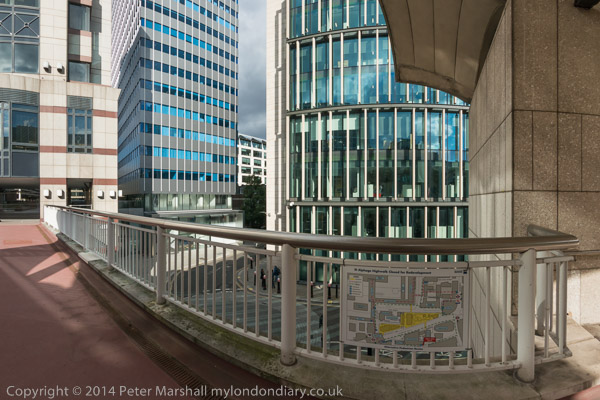
Highwalk, St Alphage Highwalk, London Wall, City, 1994, 94-710-22

Since then some parts of the walkway system have been lost, while some areas still remain. Around London Wall while some parts of it were closed. The part of the St Alphage Highwalk in these pictures had been demolished but it was partly replaced by a new section during redevelopment around 2017.

Highwalk, St Alphage Highwalk, London Wall, City, 1994, 94-710-12

Another problems with the Pedway is that London’s transport systems – buses and Underground largely leave passengers at street level. Getting to the highwalks generally requires going up steps and most people would prefer to simply continue to their destination at street level.

Highwalk, St Alphage Highwalk, London Wall, City, 1994
Highwalk, St Alphage Highwalk, London Wall, City, 1994, 94-710-11

For those with disabilities which make steps difficult or impossible this is a real barrier. There were very few places where escalators were provided to ease the problems as these were expensive.

More panoramic images from the City Highwalks in a later post.


FlickrFacebookMy London DiaryHull PhotosLea ValleyParis
London’s Industrial HeritageLondon Photos

All photographs on this page are copyright © Peter Marshall.
Contact me to buy prints or licence to reproduce.

Martyrdom of Ali, Save Fallujah – 2004

Martyrdom of Ali, Save Fallujah: I had a fairly long and busy day on Sunday 7th November 2004, beginning with the annual London celebration of the martyrdom anniversary of Imam Ali, the first Imam of Shi’ite Islam. From Park Lane I walked to Parliament Square where a protest demanded that the troops were withdrawn from Iraq.

This was the day when US and UK troops began the bloody offensive of the Second Battle of Fallujah, codenamed ‘Operation Phantom Fury’, fighting against Iraqis in militia of all stripes including both Sunni and Shia, united in opposition to the US-imposed Shia-dominated government.

Finally I went to Trafalgar Square and took a few pictures of the Diwali celebrations taking place there, although I didn’t post any of these at the time on My London Diary.

Diwali in Trafalgar Square, Martyrdom of Ali, Save Fallujah - 2004

In this post I’ll reproduce (with minor corrections) what I wrote in 2004, along with some of the pictures I took. These were made with the first digital DSLR camera I owned, the 6Mp Nikon D100, and most were made with a Nikon 24-85mm lens (36-127mm equivalent), though I had recently got a second lens, a Sigma 12-24mm (18-36 equivalent.) The Sigma wideangle was rather slow and working at f5.6 in low light was difficult as the D100 which did not have the high ISO capabilities of more modern cameras.


Muslims mourn in London

Hyde Park and Park Lane

Martyrdom of Ali, Save Fallujah - 2004
Talks and prayers before the procession started in Hyde Park

Sunday saw Muslims on the street for a religious event, a Jaloos & Matam on the Martyrdom anniversary of Imam Ali, organised by Hub-e-Ali, making its way from Hyde Park down Park Lane carrying a taboot or ceremonial coffin.

Martyrdom of Ali, Save Fallujah - 2004
A small boy carries burning incense sticks, while elders shoulder the heavy load of the taboot.

The event started with prayers, addresses and a mourning ceremony.

Martyrdom of Ali, Save Fallujah - 2004
The weight took a strain as bare-footed bearers carried the heavy black taboot with its red roses slowly along Park Lane

The banners carried included texts from the ‘purified five‘ members of the prophet’s family, but particularly Hasan Bin Ali Bin Abu Talib, the cousin and first believer in the prophet.

Martyrdom of Ali, Save Fallujah - 2004

There was some impressive chanting and much beating of breasts (matam or seena-zani) by the men, chanting and sticks of incense being burnt. The women followed quietly behind.

The women followed, their black-clad quiet dignity contrasting with the frenzied chest-beating of the men

More images start here on My London Diary


Withdraw the Troops from Iraq – Save Fallujah From Destruction

Parliament Square and Whitehall

Martyrdom of Ali, Save Fallujah - 2004
Code Pink activists carry a coffin “How many children will cease to play” in front of the Houses of Parliament.

I met Dave at the procession on Park Lane and walked with him to Parliament Square where a demonstration was to be held demanding the withdrawal of troops from the cities of Iraq. From the news that morning it seemed the Americans were about to storm Fallujah. [They did – see below *]

The large anti-war organisations seemed to be keeping strangely quiet, and there were only a hundred or two demonstrators here.
Among them of course was Brian Haw, now almost two and a half years into his permanent protest in the square, which seems likely to lead MPs to pass a bill specially to make such protests illegal.
I admire him for making such a stand, even if I don’t entirely share his views, and feel it will be a very sorry day for civil liberties in this country if such activities are banned.

There were a few placards and banners, and some people who had come with white flowers as requested.

There were few takers for the ‘open mike’ and nothing much was happening until a group of ‘Code Pink’ supporters intervened theatrically parading a black-dressed cortège around the square. The effect was literally dramatic.
There were a few more speeches, including a moving one by Iraqi exile Haifa Zangana.

It was getting dark (or rather darker, as it had been dull and overcast, with the odd spot of rain all day) as we moved off up Whitehall towards the Cenotaph, where the funeral wreath was laid on the monument.


Police tried (although it is impossible to see why) to restrict the number of those putting flowers on the monument to an arbitrary five, but those who had brought flowers were not to be so easily diverted.

People wait for police to allow them to lay their flowers at the Cenotaph

They ignored police orders and walked across the empty roadway to lay their flowers, and around 50 of the protesters staged a sit-down on the road.

Eventually the police warned them they would be removed forcibly if they did not get up, and then started to do so.

Police drag demonstrator away as peace protestor Brian Haw holds a placard “War Kills the Innocent” in front of Cenotaph and Code Pink wreath, “How Many Will Die in Iraq Today?”.

For the most part the police used minimum force, but there were one or two unnecessarily unpleasant incidents.

The protesters were then corralled for a few minutes on the pavement before being allowed to continue the demonstration in the pen opposite Downing Street.

Nothing much seemed to be happening, so I went home [via the Diwali celebrations in Trafalgar Square] when police refused to let me photograph from in front of the barriers.

It seemed an arbitrary and unnecessary decision, but this time I couldn’t be bothered to argue. I think they were just upset because I had taken pictures during the violence a few minutes earlier.

*More about Fallujah

The Second Battle of Fallujah lasted about six weeks and probably resulted in around 2,000 fighters dead and many wounded, mostly Iraqis, with just 107 of the coalition forces killed. Another roughly 1,500 Iraqis were captured.

US forces had stopped all men between 15 and 50 from leaving the city, and treated all those left inside as insurgents. Civilian deaths were later estimated at between 4,000 and 6,000. Civilians who were able to fled the city and around 200,000 became displaced across Iraq. Around a sixth of the city’s buildings were destroyed and roughly two thirds suffered significant damage.

The US forces were heavily criticised for their direct use of white phosphorus in the battle against both combatants and civilians. Highly radioactive epleted uranium shell were also used and a survey in 2009 reported “a high level of cancer, birth defects and infant mortality” in the city.”

More pictures from the protest on My London Diary.


FlickrFacebookMy London DiaryHull PhotosLea ValleyParis
London’s Industrial HeritageLondon Photos

All photographs on this page are copyright © Peter Marshall.
Contact me to buy prints or licence to reproduce.