No Borders: Harmondsworth Detention Centre – 2006

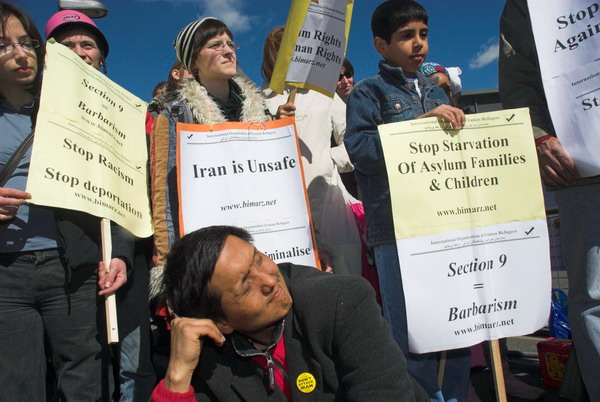
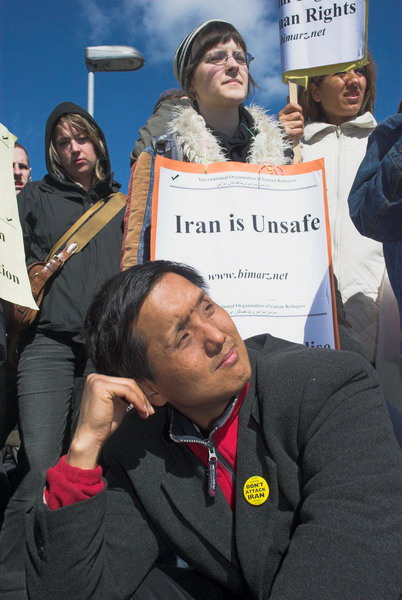
No Borders: Harmondsworth Detention Centre: Twenty years ago on April 8th 2006 I was outside the two large detention centres on the Bath Road at Harmondsworth on the northern edge of Heathrow Airport. A protest there had been called by No Borders and among those protesting with them were the International Organisation of Iranian Refugees,
No Borders: Harmondsworth Detention Centre - 2006

Detainees were kept way from the front of the building so they could not see the protes, but they could hear they were there.

It’s hard to find the text I wrote back in 2006 or the pictures, so I’ll include the text below along with a link to the start of the pictures.

No Borders: Harmondsworth Detention Centre

Harmondsworth, London
No Borders: Harmondsworth Detention Centre - 2006
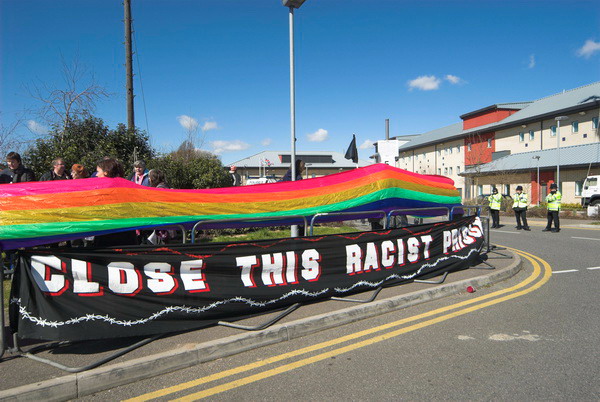
‘CLOSE THIS RACIST PRISON’

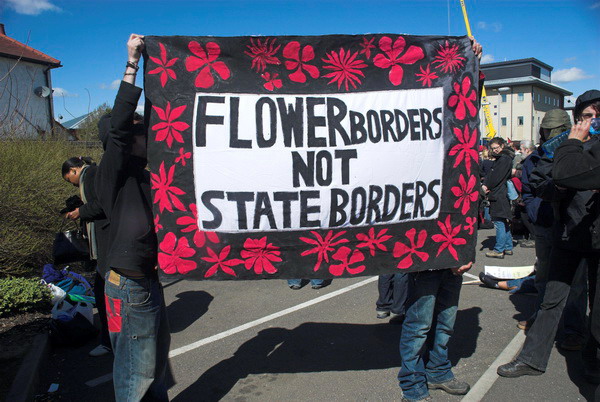
The No Borders demonstration outside Colnbrook and Harmondsworth detention centres – the two are separated only by a narrow road – was at times loud and noisy, so those kept in these secure prisons knew that they were receiving support, even though they were cleared from that side of the building so they could not hear the speeches. [Some who phone the protest clearly could hear them.]
No Borders: Harmondsworth Detention Centre - 2006
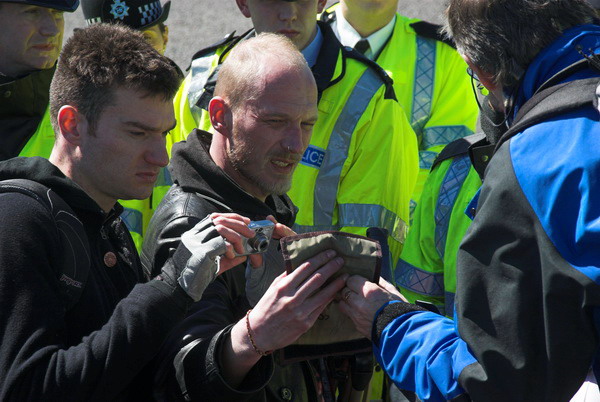
A senior officer informed them they are being held under Section 14 of the Public Order Act, though there seemed to be no likelihood of the serious public disorder required for this to apply.

Some demonstrators who went along a public footpath to a field at the back of the building were forcibly removed and detained for around an hour.
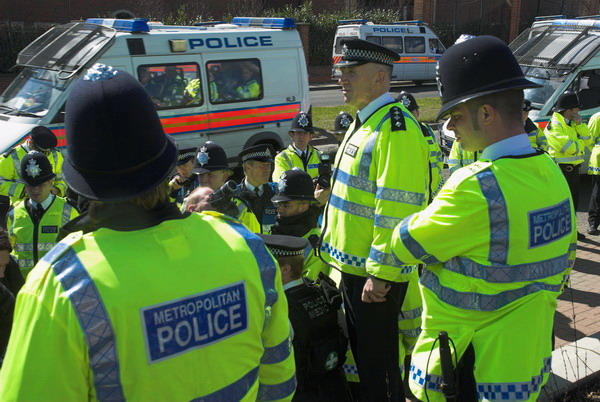
[Among those detained and kettled by police was a videographer, a fellow NUJ member, and when he showed his press card, police told him it wasn’t a real press card and refused to let him leave. He called up to me and a few other photographers asking one of us to come down and show them a press card, which is supposed to ensure that police let us get on with our job. I fished mine out from my pocket, then saw it had expired at the end of March, and put it back again. Another photographer went to his aid.

After around an hour the protesters were taken out from the kettle one by one and police demanded their names and addresses – threatending arrest if they did not give them – although the police had no power to do so.]
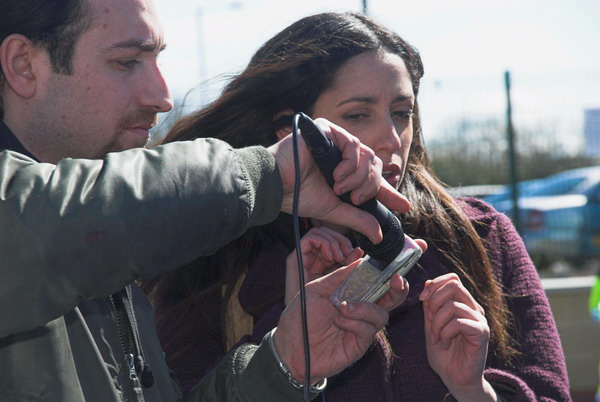
A number of the detainees actually did speak to protesters on their mobile phones [from inside Harmondsworth detention centre] and their calls were held to a microphone and relayed over the protester’s public address system. The detainees thanked the demonstrators for coming and also told us about the inhumane and arbitrary treatment they were receiving.
No Borders: Harmondsworth Detention Centre - 2006

Many of those held have fled from violence and repression in their own countries, only to arrive here and find that immigration officials refused to listen to or believe the stories they told. Some have been held in detention for more than 3 years.
No Borders: Harmondsworth Detention Centre - 2006

Detainees include some who have been living in this country for a number of years, working and paying taxes, setting up lives in this country and contributing to it. Then they are taken without prior warning and imprisoned in these units, sometimes more because the immigration service has targets to meet than anything to do with their case.

Possibly we need an immigration policy, although I’m not actually convinced. It’s an area where I have more faith in those market forces our governments now seem to worship than most. But whether or not we need one, if we have one it should be honest, transparent, just and efficient. At the moment it fails on every count.

Many of us are ashamed of the way our government has decided to let families and children in particular exist without proper support. Ashamed when we hear stories of families who get a knock on the door at 4am and are taken away in a matter of hours.Ashamed that we are sending people back to countries where we know they are almost certain to be imprisoned, tortured and possibly killed

More Pictures on My London Diary.


FlickrFacebookMy London DiaryHull PhotosLea ValleyParis
London’s Industrial HeritageLondon Photos

All photographs on this page are copyright © Peter Marshall.
Contact me to buy prints or licence to reproduce.


Bedford Park – 1989

Bedford Park – 1989: This is the third post on my walk which began at Kew Bridge Station on 10th of December 1989. The previous post was Turnham Green – 1989.

House, Priory Gardens, Bedford Park, Turnham Green, Hounslow, 1989, 89-12a-12
House, Priory Gardens, Bedford Park,989, 89-12a-12

Conveniently a large plaque on the house tells me this is Prioy Gardens and gives the date of its construction, 1880. The London Borough of Hounslow street sign confirms the street name and tells me it is in Chiswick, true, but more specifically it is in Bedford Park. Yet a third street name can be seen on the wall of the house in case anyone was still in doubt.

This Grade II listed house at 1 Priory Gardens is a part of the Bedford Park Estate, “a pioneering commercial development of some 350 houses and a few public buildings built between 1875 and 1886 by inexperienced developer Jonathan Carr.”

The estate was planned “to create a community of like-minded middle class aesthetes who were defined by modest financial resources and significant artistic aspirations” and was generally regarded soon after as ‘The First Garden Suburb’ and had a great influence on later suburban housing.

The whole estate reflects the Queen Anne Revival style of the period which the listing calls ‘Picturesque‘ and is also known as Domestic Revival. Most of the houses and public buildings on the estate built before 1880 were designed by Richard Norman Shaw, the leading architect of this style, but this was one of the earliest by his protégé E J May who had taken over as Estate Architect. A planning application to demolish the house and develop the site was turned down in 1973 and it is now the headquarters of the Victorian Society.

Flanders Rd, Bath Rd, Bedford Park, Turnham Green, Hounslow, 1989, 89-12a-14

The Tabard Inn at the right of this row also dates from 1880 and is Grade II* listed, one of the public buildings in the area designed by Richard Norman Shaw. This building was was “a pioneering ‘improved’ pub and represented a rejection of the Gin Palace in favour of a more traditionally inspired and respectable inn” and retains much of its original interior features. The exterior of this group of properties was inspired by the well-known Staples Inn on High Holborn – which some may remember featured on tins of Old Holborn hand rolling tobacco.

To the left of the pub is the managers house, and closer to my camera at left are the Bedford Park Stores. Wikipedia has a long and interesting entry on this group of buildings. The stores later became a showroom for coachbuilder H. J. Mulliner & Co.

The buildings of Bedford Park which had become run-down and many in multi-occupation by the middle of last century were saved from ruin by an influential campaign by the Bedford Park Society and all of Carr’s buildings were listed in 1967. Ealing and Hounslow Councils created conservation areas covering the estate in 1970.

Houses, Rupert Rd, Priory Avenue, Bedford Park, Turnham Green, Hounslow, 1989, 89-12a-16

This is I think 15 Priory Avenue, one of 4 houses at the crossroads with Rupert Road, where I could have faced in any direction and photographed a listed house, or walked down either of the roads lined with them. I think this was the most distinctive corner, but it was a rather overwhelming ensemble.

Wendy Wisbey Agency, Bath Rd, Bedford Park, Turnham Green, 1989, 89-12b-63

Back on the Bath Road the Wendy Wisbey theatrical agency, address 2 Rupert Road, occupied what had previously been The Phildene Stage School. In 2010 it became part of Orchard House School, now part of Dukes Education.

This was another building designed by Richard Norman Shaw. Unfortunately because of the mass nature of the listing of buildings in this area the listing text is almost devoid of any information.

Wendy Wisbey Agency, Bath Rd, Bedford Park, Turnham Green, 1989, 89-12b-64

Another picture of this agency which was also a dance school which shows the fine window at the east of the Bath Road frontage.

Houses, Bedford Park, Turnham Green, 1989, 89-12b-51

Another picture from Bedford Park showing some rather less grand houses. I can no longer recall the exact location – perhaps someone wlll be able to recognise it.

St Michael & All Angels', Parish Hall, Woodstock Rd, Bedford Park, Turnham Green, ,1989, 89-12b-44
St Michael & All Angels’ Parish Hall, Woodstock Rd, Bedford Park, Turnham Green, ,1989, 89-12b-44

The Parish Hall adjoins the church and is listed together with it. The church by Richard Norman Shaw was built in 1880 as a central element in the new Bedford Park Estate, but the parish hall was a later addition in 1887. The front of the church and the hall face The Avenue but there is a small grassed area in front and the street sign in the photograph is for Woodstock Rd.

The central pillar seems remarkably stout and the decorative ironwork includes two angels above each door.

I left the church and walked down past Turnham Green Station to Chiswick High Road to continue my walk. More later.


FlickrFacebookMy London DiaryHull PhotosLea ValleyParis
London’s Industrial HeritageLondon Photos

All photographs on this page are copyright © Peter Marshall.
Contact me to buy prints or licence to reproduce.