No Borders: Harmondsworth Detention Centre – 2006

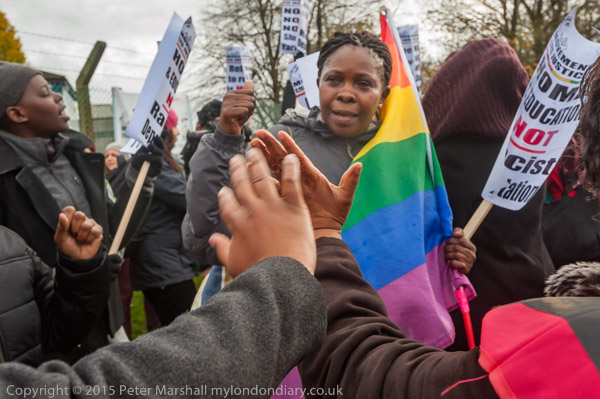
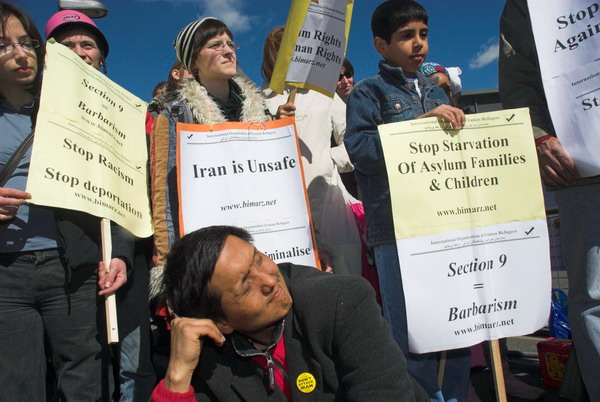
No Borders: Harmondsworth Detention Centre: Twenty years ago on April 8th 2006 I was outside the two large detention centres on the Bath Road at Harmondsworth on the northern edge of Heathrow Airport. A protest there had been called by No Borders and among those protesting with them were the International Organisation of Iranian Refugees,
No Borders: Harmondsworth Detention Centre - 2006

Detainees were kept way from the front of the building so they could not see the protes, but they could hear they were there.

It’s hard to find the text I wrote back in 2006 or the pictures, so I’ll include the text below along with a link to the start of the pictures.

No Borders: Harmondsworth Detention Centre

Harmondsworth, London
No Borders: Harmondsworth Detention Centre - 2006
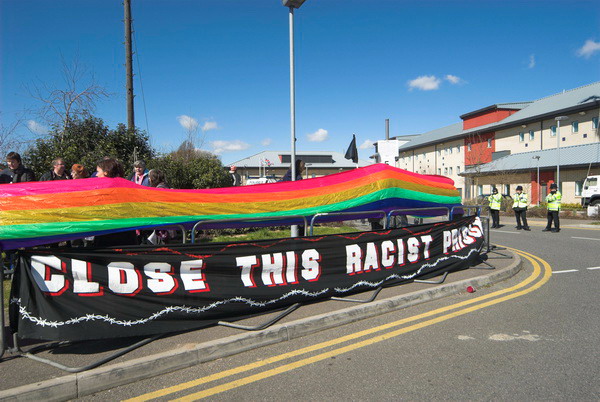
‘CLOSE THIS RACIST PRISON’

The No Borders demonstration outside Colnbrook and Harmondsworth detention centres – the two are separated only by a narrow road – was at times loud and noisy, so those kept in these secure prisons knew that they were receiving support, even though they were cleared from that side of the building so they could not hear the speeches. [Some who phone the protest clearly could hear them.]
No Borders: Harmondsworth Detention Centre - 2006
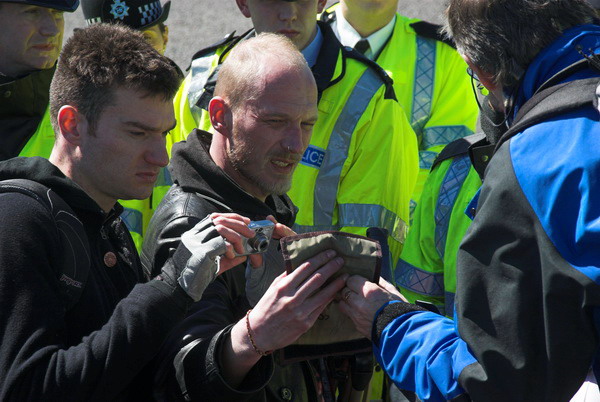
A senior officer informed them they are being held under Section 14 of the Public Order Act, though there seemed to be no likelihood of the serious public disorder required for this to apply.

Some demonstrators who went along a public footpath to a field at the back of the building were forcibly removed and detained for around an hour.
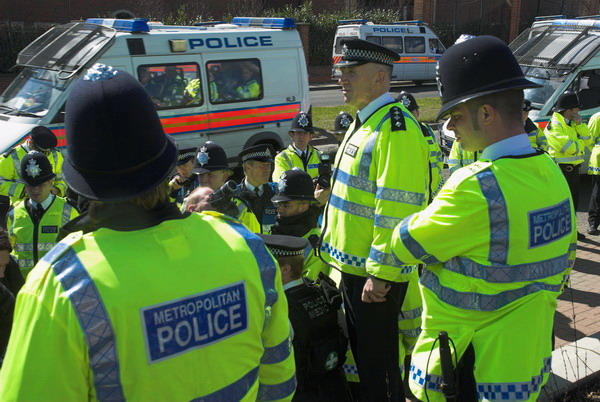
[Among those detained and kettled by police was a videographer, a fellow NUJ member, and when he showed his press card, police told him it wasn’t a real press card and refused to let him leave. He called up to me and a few other photographers asking one of us to come down and show them a press card, which is supposed to ensure that police let us get on with our job. I fished mine out from my pocket, then saw it had expired at the end of March, and put it back again. Another photographer went to his aid.

After around an hour the protesters were taken out from the kettle one by one and police demanded their names and addresses – threatending arrest if they did not give them – although the police had no power to do so.]
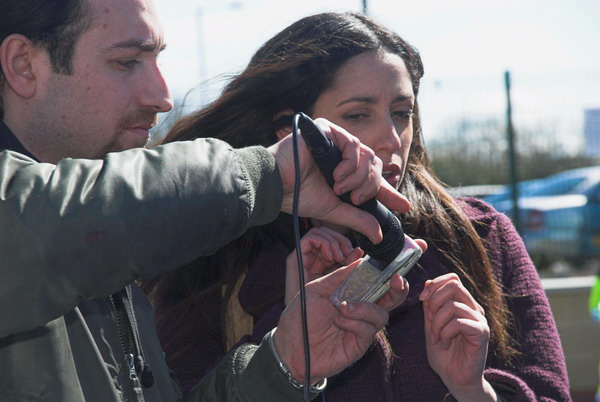
A number of the detainees actually did speak to protesters on their mobile phones [from inside Harmondsworth detention centre] and their calls were held to a microphone and relayed over the protester’s public address system. The detainees thanked the demonstrators for coming and also told us about the inhumane and arbitrary treatment they were receiving.
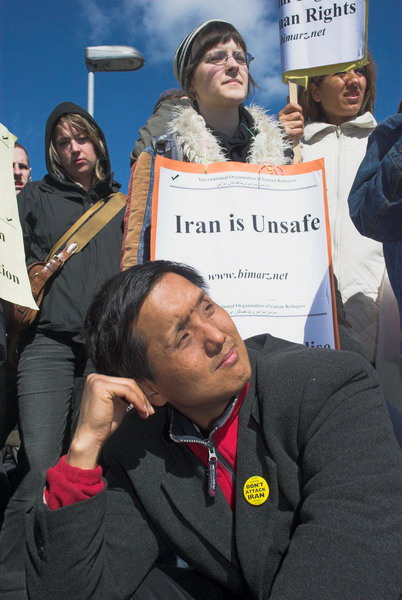
No Borders: Harmondsworth Detention Centre - 2006

Many of those held have fled from violence and repression in their own countries, only to arrive here and find that immigration officials refused to listen to or believe the stories they told. Some have been held in detention for more than 3 years.
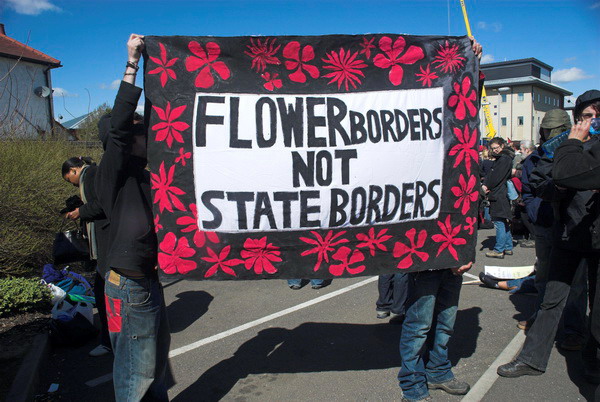
No Borders: Harmondsworth Detention Centre - 2006

Detainees include some who have been living in this country for a number of years, working and paying taxes, setting up lives in this country and contributing to it. Then they are taken without prior warning and imprisoned in these units, sometimes more because the immigration service has targets to meet than anything to do with their case.

Possibly we need an immigration policy, although I’m not actually convinced. It’s an area where I have more faith in those market forces our governments now seem to worship than most. But whether or not we need one, if we have one it should be honest, transparent, just and efficient. At the moment it fails on every count.

Many of us are ashamed of the way our government has decided to let families and children in particular exist without proper support. Ashamed when we hear stories of families who get a knock on the door at 4am and are taken away in a matter of hours.Ashamed that we are sending people back to countries where we know they are almost certain to be imprisoned, tortured and possibly killed

More Pictures on My London Diary.


FlickrFacebookMy London DiaryHull PhotosLea ValleyParis
London’s Industrial HeritageLondon Photos

All photographs on this page are copyright © Peter Marshall.
Contact me to buy prints or licence to reproduce.
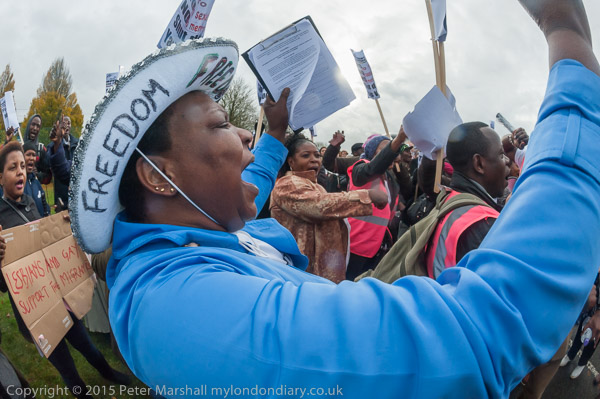
Movement For Justice at Yarls Wood – 2015

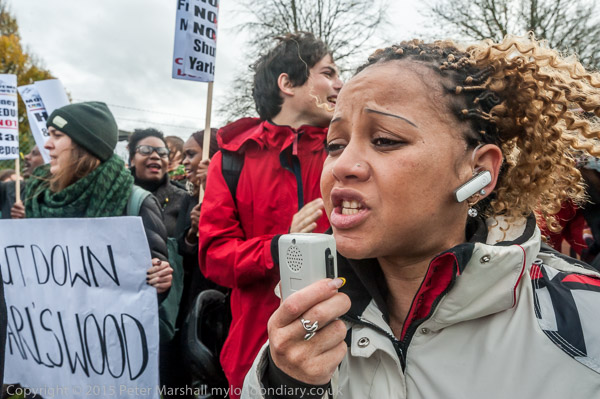
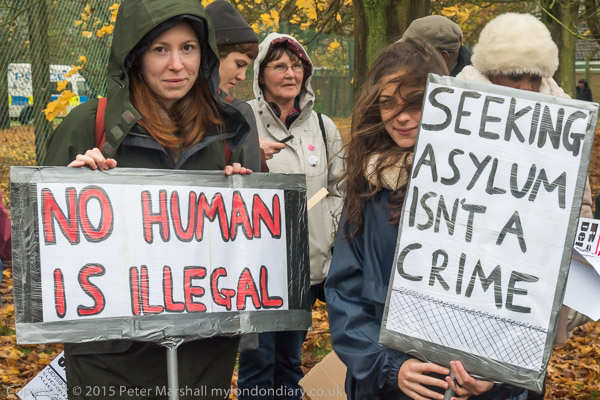
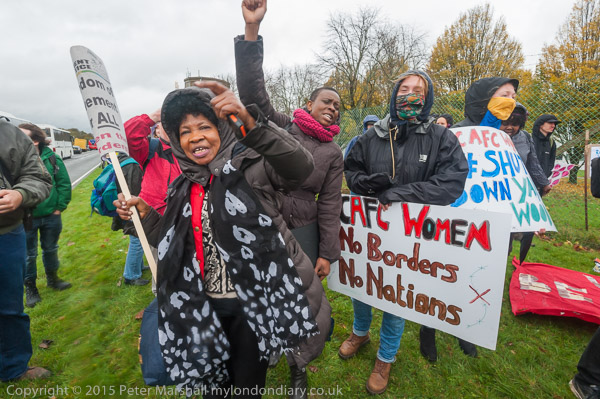
Movement For Justice at Yarls Wood – On Saturday 7th November 2015 Movement for Justice organised a large protest with other groups to show solidarity with the women locked up inside Yarl’s Wood immigration detention centre and to demand that all such detention prisons be shut down.


MFJ Meet To March to Yarl’s Wood – Twinwoods Business Park

Movement For Justice at Yarls Wood

Yarl’s Wood was built on a former wartime airfield in remote countryside five or six miles from the centre of Bedford, perhaps chosen in part for its remoteness, which makes it difficult for visitors or protesters to get there.

Movement For Justice at Yarls Wood

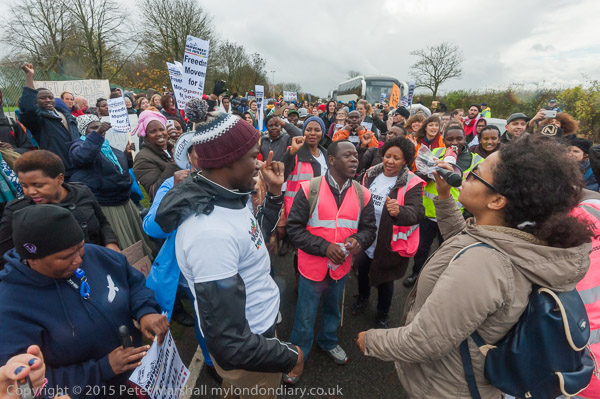
But Movement for Justice – MfJ – and others had organised coaches from around the country, including eight from London as well as one from Bedford Station to bring people with others arriving by car, taxi or bicycle. The road leading to the prison is private, but people were able to meet on a public road around a mile away outside the main entrance to the business park there.

Movement For Justice at Yarls Wood

While we were waiting for everyone to arrive there was lively rally with a great deal of dancing, singing and chanting, keeping everyone’s spirits high, and keeping us warm as a chilly wind with occasional spots of rain swept across the open site on top of a high plateau.

Movement For Justice at Yarls Wood

Among those at the protest were many immigrants who had themselves been detained at this or other detention centres around the country while waiting for a decision to be taken on their asylum claims. Sometimes this takes several years and those who are taken to prisons such as these are held indefinitely, never knowing if or when they will be released or taken under guard to be forcibly deported.

Movement For Justice at Yarls Wood

Many inside have fled their countries after violent attacks including sexual assault and rape and deserve humane treatment not imprisonment. Few if any pose any real threat and could be housed outside, often with friends or relatives in this country. If they were allowed to work many would make a positive contribution. They would also be much more able to contact their solicitors and collect information to support their asylum cases than from inside the detention centres where access is limited.

Instead the Home Office locks them away and sometimes seems to have forgotten them and lost the key. One woman was detained for a couple of days less than three years before being released – after which she returned with the MfJ and spoke at protests which give those still inside some hope and remind them that they have not entirely been forgotten.

More at MFJ Meet Outside Yarl’s Wood.


MfJ ‘Set Her Free’ protest at Yarl’s Wood

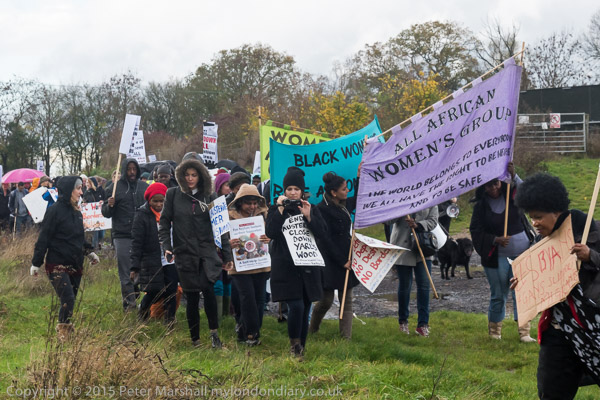
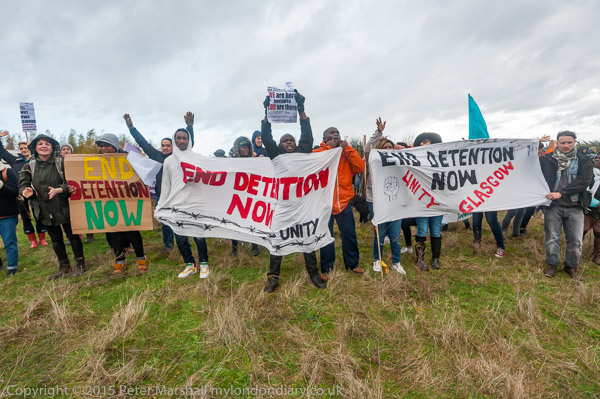
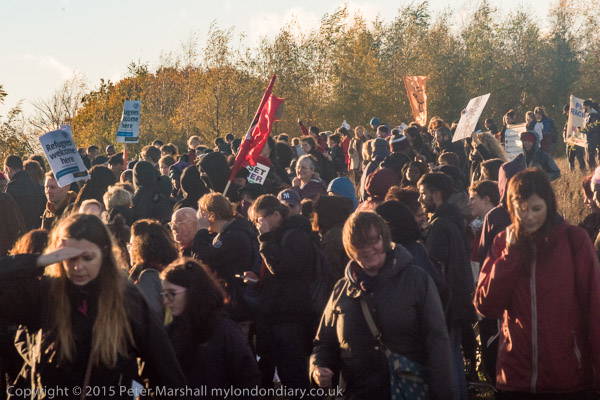
As well as MfJ, Sisters Uncut, Lesbians & Gays support the Migrants, All Africans Women’s Groups, Glasgow Unity and others had come to join in the protest. Eventually with around a thousand people gathered it was time to march, though a few coaches had not yet arrived.

We set off on the long walk to the detention centre, with banners and placards, a short distance along the road and then down the public footpath which runs through a couple of fields and across another track, and into a field on the north side of the prison, about a mile from where the campaigners had gathered.

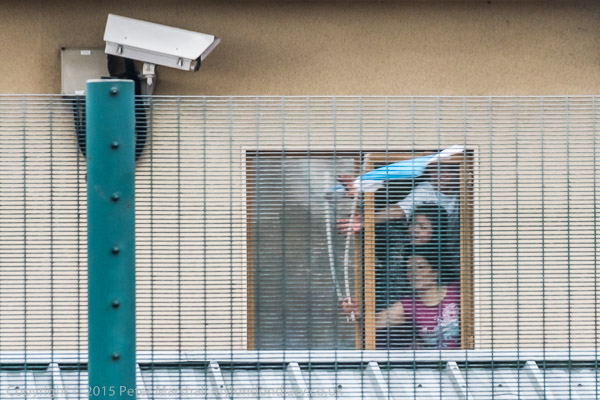
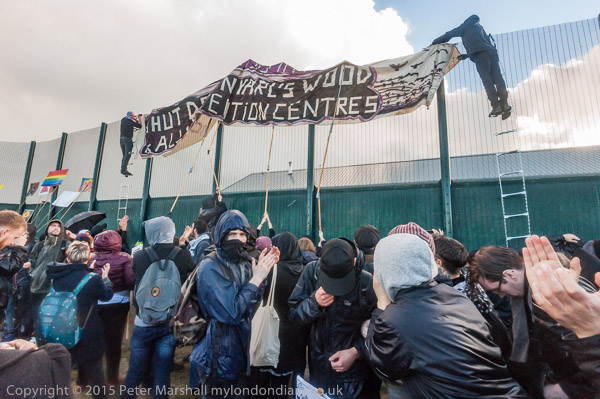
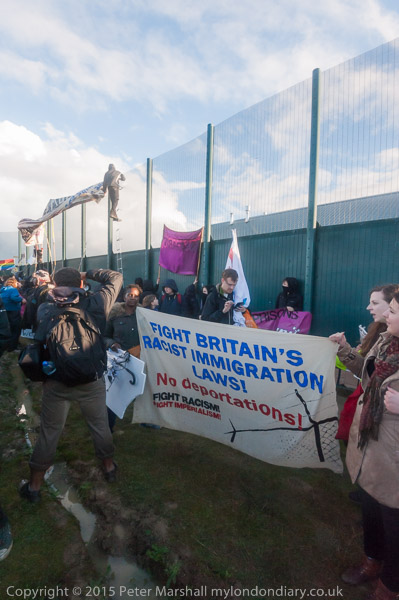
Here there was a fairly steep rise a few feet up a hill from the 20 foot high fence around the detention centre and from the top of this we could see the upper floor windows, some of which had women at them, though only through the dense thick wire grid of the upper half of the fence.

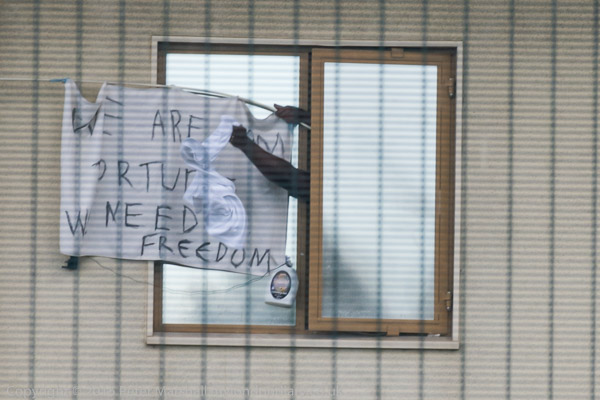
The windows do not have bars, but only open a few inches, but this was enough for the women inside to put their hands through and hold towels and clothing to greet the protesters. Some managed to hold out messages: one read ‘We came to seek Refuge. Not to be locked up’ and another ‘We are from torture. We Need Freedom’.

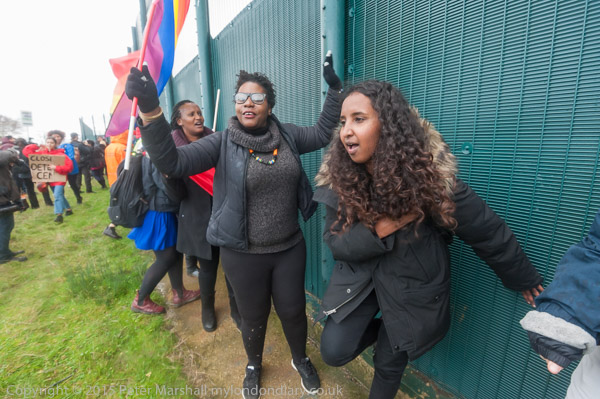
The lower 10 feet of the fence is made of stout metal panels, and beating or kicking on these makes a very loud noise. Later some protesters brought up rope ladders so they could hold placards and banners on the more open top of the fence so they could be seen by the women inside.

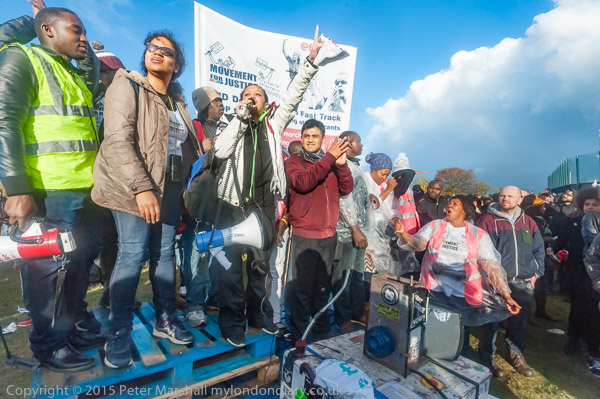
The prisoners are allowed to have phones which they need to contact their solicitors and advisers over their cases and some were able to use these to communicate with the protesters and to have their voices relayed over the PA system the protesters had brought.

There was a heavy rain shower during the protest, and the ground which was already muddy and with large puddles became very treacherous and getting up from the concrete and narrow flat area at the bottom of the fence became difficult. But soon the sun was back out again.

Most of those who spoke at the event were former detainees, some of whom had friends who were still inside the immigration prison.

The protest was still continuing when I had to leave and the low winter sun was beginning to make photography more difficult. It seemed a long and rather lonely journed as I made my way back to the road, boots heavy with mud. But I was free to go, while women who had come to this country seeking asylum from danger and violence in their own countries were still locked up by a hostile and unfeeling government.

More at MfJ ‘Set Her Free’ protest at Yarl’s Wood.