Fossil Fools Day: Tuesday 1st April was Fossil Fools Day, a day of protests around the world over our increasing use of fossil fuels, despite the effect they are having on global climate.
The ‘greenhouse effect‘ of various gases in the atmosphere had first been described in 1824, although the actual term only dates from 1901. But already in 1856 American scientist and women’s rights campaigner Eunice Newton Foote had shown that carbon dioxide was very effective in trapping the sun’s energy and warming the atmosphere.
Almost all polyatomic gases are ‘greenhouse gases’ with some such as methane much more effective than carbon dioxide. But its great importance is because of the huge amounts of it formed when carbon-containing fuels are used. And burning wood, coal and oil and their use in powering machines of all types and electricity production became the basis of the industrial revolution and our whole civilisation from around the beginning of the nineteenth century.
Wood is not of course a fossil fuel, and in pre-industrial times the carbon dioxide produced by burning it was more or less in balance with the amount that was removed from the atmosphere by photosynthesis producing new plants, trees and other organisms. CO2 levels remained roughly constant during human history at around 280ppm until they began to rise more and more rapidly after 1850, and increasingly rapidly since then. They are now around 430ppm and rising steeply.
The full effects of the current levels only become apparent over a period of around 50 years, though we are already seeing some of them already, particularly in the global South – though we too are beginning to see the effects on our climate, not just in terms of temperature but even more as instability.
For well over fifty years it has been obvious that we need to take urgent action to stop burning fossil fuels, but that urgency has not led to any really significant action. Talk, investment in renewable energy – but fossil fuel use, even of coal, is still increasing. If life on this planet is to have a future we need to see a rapid drop in the consumption of coal, oil and gas – and also aathe development of ways to use renewable energy to remove greenhouse gases from the atmosphere, as well as increasing natural ways such as planting more trees.
And there is another reason to end the use of oil for fuel, as I first mentioned in the 1970s. These finite resources are of much greater use as a chemical feedstock for producing other essential materials of our modern life, including plastics.
Everything at the moment is still going in the wrong direction – and the huge energy requirements of AI are making things worse.
Fossil Fools Day: No New Coal
Parliament Square

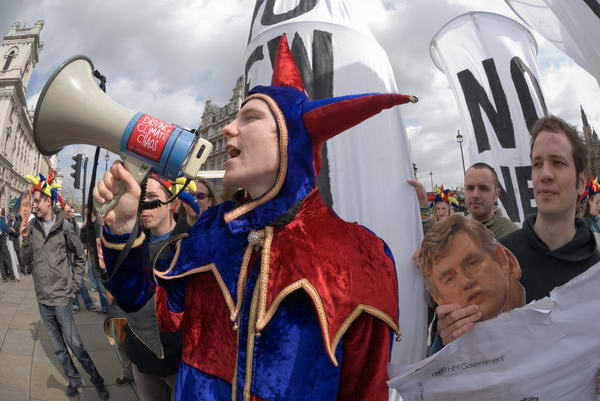
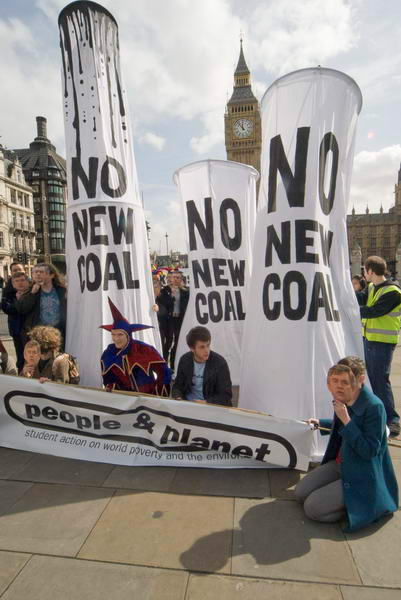
The focus of the protest by students from ‘People and Planet’ and other climate activists were the plans by E.ON to build a new new coal-fired power station at Kingsnorth in Kent.

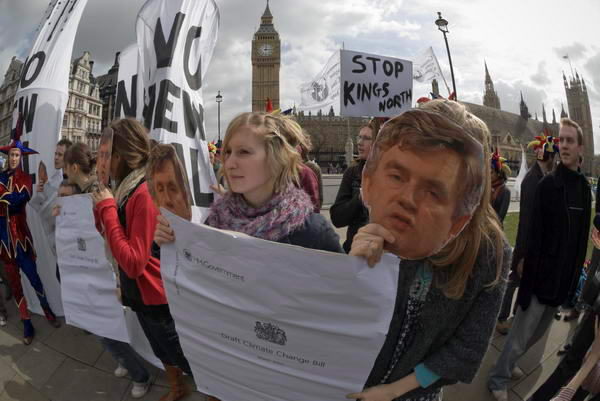
The protesters brought three large white ‘cooling towers’ and many had cutout masks of Gordon Brown’s face as they shouted out advice to him over the ridiculous Draft Climate Change Bill which would have resulted in an increase in carbon emissions.

They were joined by a group with the spoof launch of ‘ev-eon Unnaturally Carbonated Water’ a new carbon capture technology to be used at E.ON’s Kingsnorth Power Station.
“‘Ev-eon’ uses the CO2 from coal burning to carbonate water which you then swallow. And if you can swallow the governments coal-fired policy you can swallow anything. And of course with Ev-eon, should you burp, breathe or otherwise release that CO2 you’ve swallowed, global warming is all your fault – and not E.ON’s.”
As a result of this and other environmental protests and criticism by a wide range of organisations E.ON eventually dropped the plans.
More on My London Diary at Fossil Fools Day: No New Coal.
Fossil Fools Day: Opencast Coal
Albany Courtyard, Piccadilly

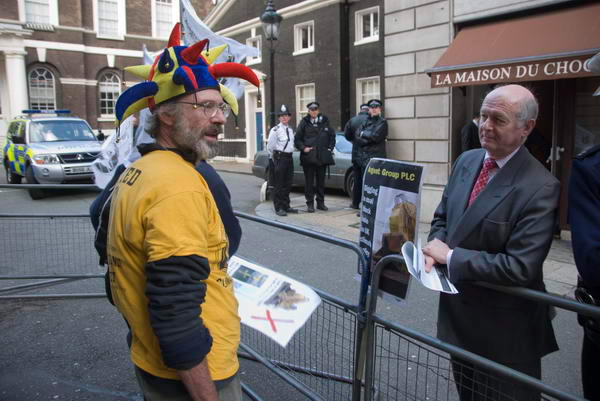
Campaign against Climate Change protest at the offices of Argent Group PLC in Piccadilly over the UK’s largest opencast coal mine, Ffos-y-Fran in Merthyr Tydfil, South Wales, run by Miller-Argent.
As well as the at least 30 million tons of CO2 of carbon dioxide from the coal the mine was expected to produce over the next 15 years, this mine was also only 36 metres from the nearest houses – compared to the Scottish Safety standards of 500 metres. The Welsh Office delayed the implementation of a Welsh safety standard to enable the mine to go ahead.
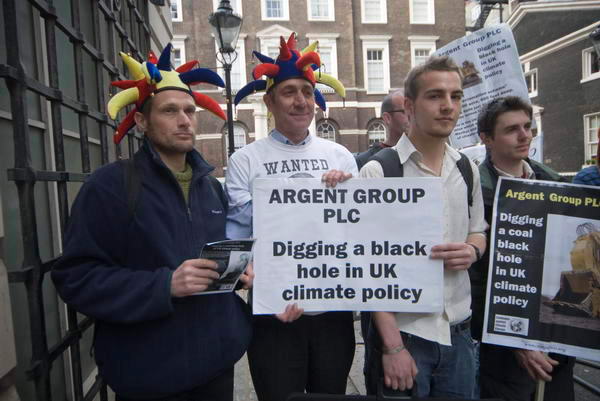
Locally it produced years of misery and health hazards through air-borne dust, diesel fumes and noise to the 70,000 or so people who live in Merthyr. A Health Impact Study commissioned by the authorities was so damning they refused to accept it.
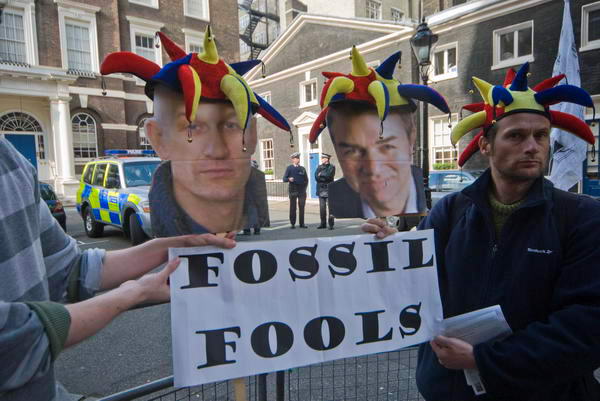
The initial scheme for the mine had been approved by the Welsh Assembly in 2005 despite huge local objections and residents took it to the High Court which quashed it – but this was reversed on appeal in 2006.
The mine licence expired in 2022 and an appeal for an extension was refused with the mine shutting down in November 2023.
London protest Welsh Opencast Coal
Flickr – Facebook – My London Diary – Hull Photos – Lea Valley – Paris
London’s Industrial Heritage – London Photos
All photographs on this page are copyright © Peter Marshall.
Contact me to buy prints or licence to reproduce.