Fossil Fools Day – 2008

Fossil Fools Day: Tuesday 1st April was Fossil Fools Day, a day of protests around the world over our increasing use of fossil fuels, despite the effect they are having on global climate.
Fossil Fools Day - 2008

The ‘greenhouse effect‘ of various gases in the atmosphere had first been described in 1824, although the actual term only dates from 1901. But already in 1856 American scientist and women’s rights campaigner Eunice Newton Foote had shown that carbon dioxide was very effective in trapping the sun’s energy and warming the atmosphere.

Almost all polyatomic gases are ‘greenhouse gases’ with some such as methane much more effective than carbon dioxide. But its great importance is because of the huge amounts of it formed when carbon-containing fuels are used. And burning wood, coal and oil and their use in powering machines of all types and electricity production became the basis of the industrial revolution and our whole civilisation from around the beginning of the nineteenth century.
Fossil Fools Day - 2008
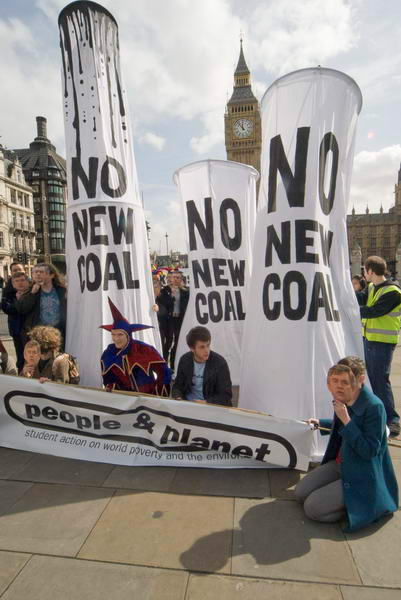
Protesters with power station ‘cooling towers’ in Parliament Square

Wood is not of course a fossil fuel, and in pre-industrial times the carbon dioxide produced by burning it was more or less in balance with the amount that was removed from the atmosphere by photosynthesis producing new plants, trees and other organisms. CO2 levels remained roughly constant during human history at around 280ppm until they began to rise more and more rapidly after 1850, and increasingly rapidly since then. They are now around 430ppm and rising steeply.

The full effects of the current levels only become apparent over a period of around 50 years, though we are already seeing some of them already, particularly in the global South – though we too are beginning to see the effects on our climate, not just in terms of temperature but even more as instability.
Fossil Fools Day - 2008

For well over fifty years it has been obvious that we need to take urgent action to stop burning fossil fuels, but that urgency has not led to any really significant action. Talk, investment in renewable energy – but fossil fuel use, even of coal, is still increasing. If life on this planet is to have a future we need to see a rapid drop in the consumption of coal, oil and gas – and also aathe development of ways to use renewable energy to remove greenhouse gases from the atmosphere, as well as increasing natural ways such as planting more trees.

And there is another reason to end the use of oil for fuel, as I first mentioned in the 1970s. These finite resources are of much greater use as a chemical feedstock for producing other essential materials of our modern life, including plastics.

Everything at the moment is still going in the wrong direction – and the huge energy requirements of AI are making things worse.


Fossil Fools Day: No New Coal

Parliament Square

Fossil Fools Day - 2008
Lighter fuel goes up in flames on the Climate BIll

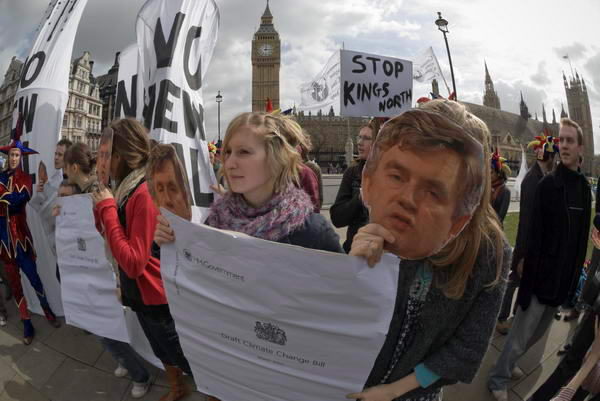
The focus of the protest by students from ‘People and Planet’ and other climate activists were the plans by E.ON to build a new new coal-fired power station at Kingsnorth in Kent.

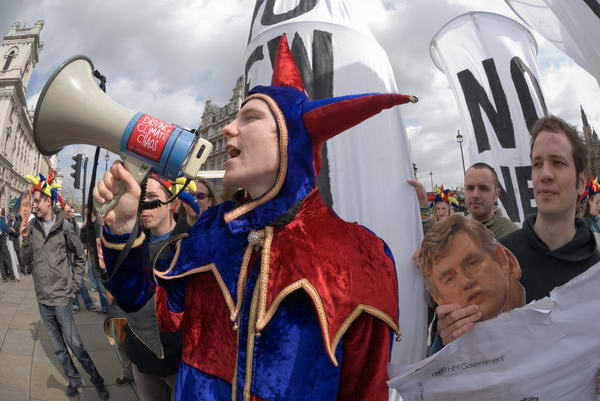
The protesters brought three large white ‘cooling towers’ and many had cutout masks of Gordon Brown’s face as they shouted out advice to him over the ridiculous Draft Climate Change Bill which would have resulted in an increase in carbon emissions.

The launch of ‘ev-eon Unnaturally Carbonated Water’

They were joined by a group with the spoof launch of ‘ev-eon Unnaturally Carbonated Water’ a new carbon capture technology to be used at E.ON’s Kingsnorth Power Station.

“‘Ev-eon’ uses the CO2 from coal burning to carbonate water which you then swallow. And if you can swallow the governments coal-fired policy you can swallow anything. And of course with Ev-eon, should you burp, breathe or otherwise release that CO2 you’ve swallowed, global warming is all your fault – and not E.ON’s.”

As a result of this and other environmental protests and criticism by a wide range of organisations E.ON eventually dropped the plans.

More on My London Diary at Fossil Fools Day: No New Coal.


Fossil Fools Day: Opencast Coal

Albany Courtyard, Piccadilly
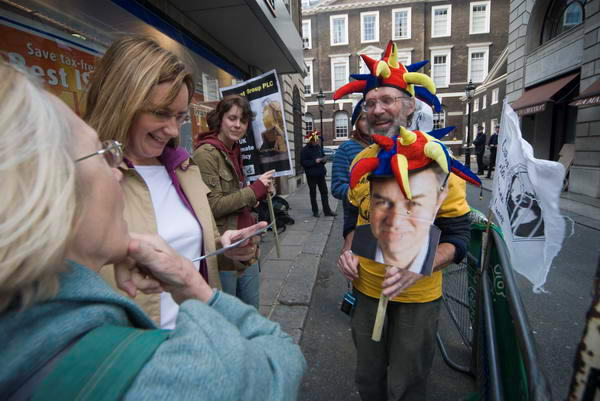
Campaign against Climate Change protest at the offices of Argent Group PLC in Piccadilly over the UK’s largest opencast coal mine, Ffos-y-Fran in Merthyr Tydfil, South Wales, run by Miller-Argent.
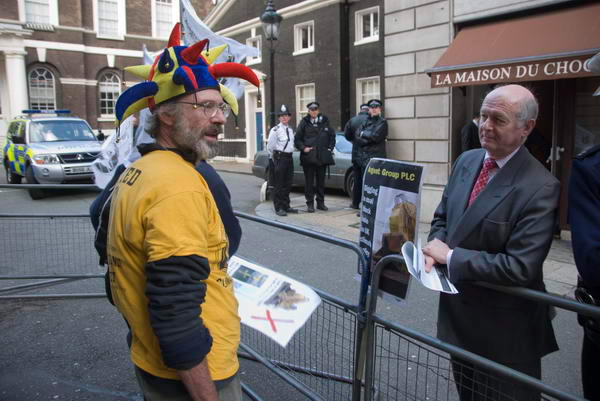
The manager of Albany talks with the demontrators, taking some information for Argent

As well as the at least 30 million tons of CO2 of carbon dioxide from the coal the mine was expected to produce over the next 15 years, this mine was also only 36 metres from the nearest houses – compared to the Scottish Safety standards of 500 metres. The Welsh Office delayed the implementation of a Welsh safety standard to enable the mine to go ahead.
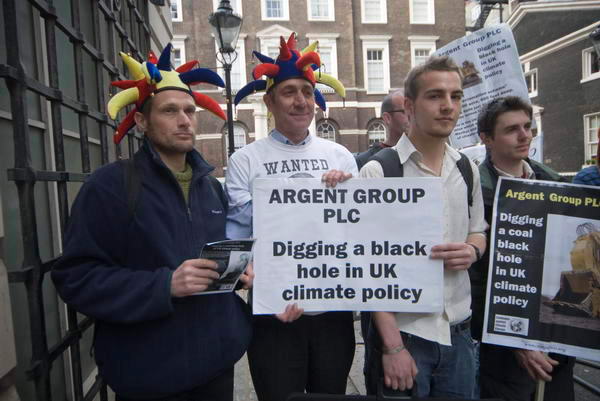
Locally it produced years of misery and health hazards through air-borne dust, diesel fumes and noise to the 70,000 or so people who live in Merthyr. A Health Impact Study commissioned by the authorities was so damning they refused to accept it.
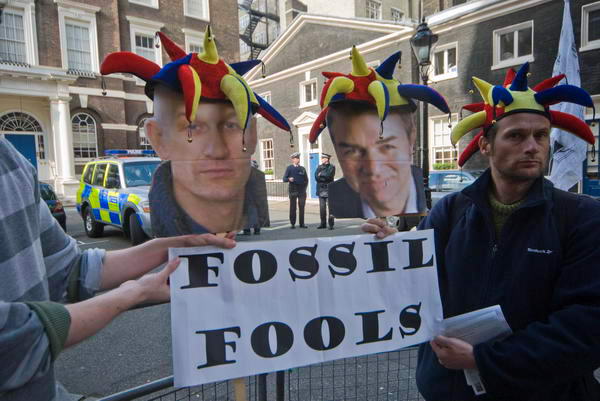
The initial scheme for the mine had been approved by the Welsh Assembly in 2005 despite huge local objections and residents took it to the High Court which quashed it – but this was reversed on appeal in 2006.

The mine licence expired in 2022 and an appeal for an extension was refused with the mine shutting down in November 2023.

London protest Welsh Opencast Coal


FlickrFacebookMy London DiaryHull PhotosLea ValleyParis
London’s Industrial HeritageLondon Photos

All photographs on this page are copyright © Peter Marshall.
Contact me to buy prints or licence to reproduce.
Bikes Not Bombs, Tibet, Deportation & Pillow Fight

Back on Saturday 22nd March 2008 I had a rather varied day in London, meeting protesters cycling to Aldermaston on my way to photograph a march for freedom in Tibet, then going to a protest against the deportation of a gay man to Iran and finally to a pillow fight.


Bikes Not Bombs: London – Aldermaston

Bikes Not Bombs, Tibet, Deportation & Pillow Fight

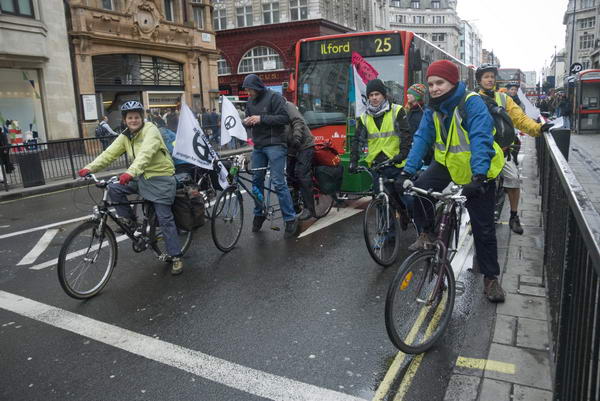
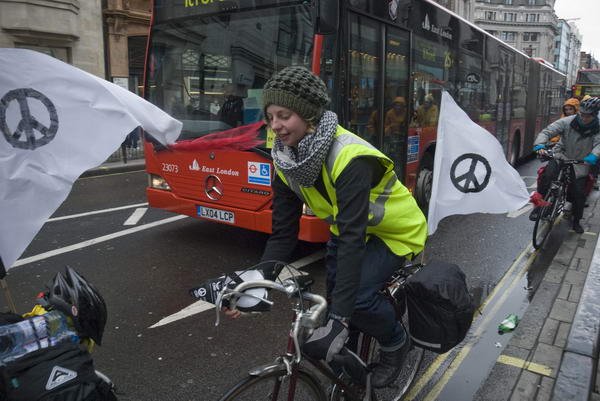
I was on foot and had just come out of Oxford Circus station when I saw the CND Bikes Not Bombs group of cyclists who had begun their ride in Trafalgar Square earlier and were on their way to ride to Aldermaston. Though when I took a few photographs as you can see from the bus they were cycling in exactly the wrong direction, east towards Ilford. Of course they weren’t lost, just trying to attract some attention to the protest, riding with a sound system along London’s busiest shopping street.

Bikes Not Bombs, Tibet, Deportation & Pillow Fight

I’d thought briefly about taking part myself in the event, as I’d used a bike to get around since I was six, having graduated then from a first a pedal car and then a tricycle. I did own a car briefly when I was around 21, but soon realised it was impractical in cities, expensive, polluting and environmentally unsound and never made the same mistake again.

But for the reasons I listed on My London Diary – sloth, other events, lousy weather and a dislike of early rising – I didn’t join this official ride, though I did cycle on my own from Reading to Aldermaston and back on the following Monday to join the protesters there.

Bikes Not Bombs: London – Aldermaston


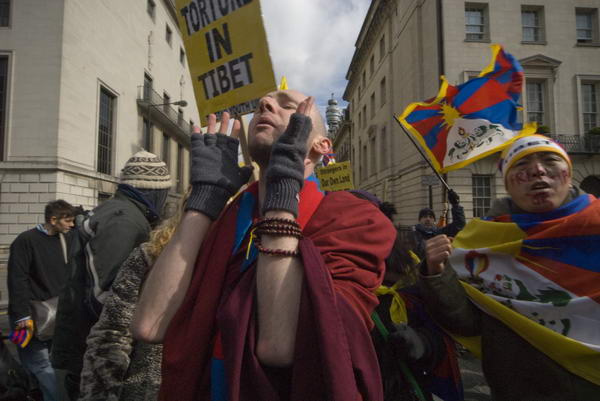
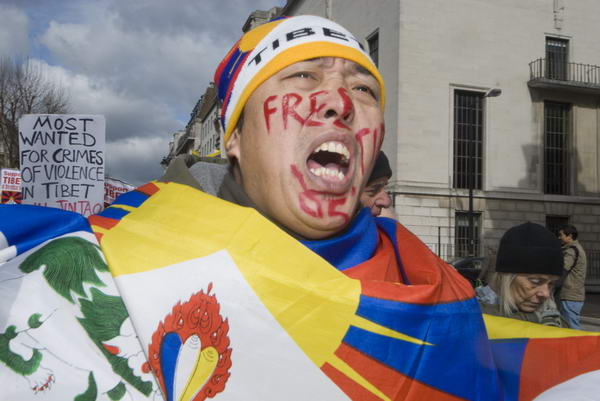
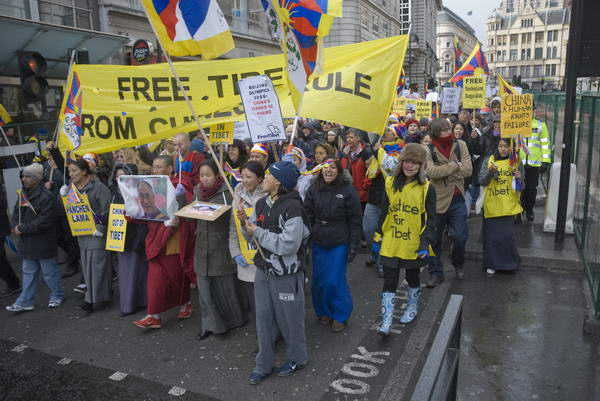
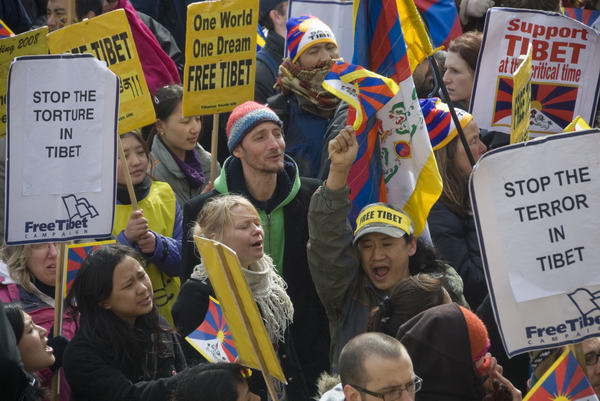
Support Tibet March

Bikes Not Bombs, Tibet, Deportation & Pillow Fight

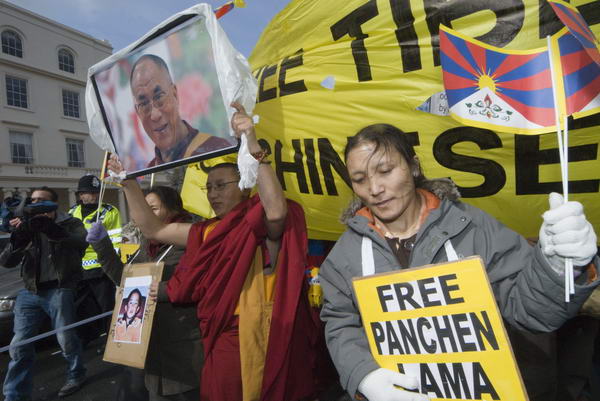
I was on my way to Park Crescent, a short walk north of the Chinese Embassy where Tibetans and supporters of freedom in Tibet were meeting to march through London on the 49th anniversary of the 1959 Tibetan uprising.

Bikes Not Bombs, Tibet, Deportation & Pillow Fight

Tibet came under effective control of the Chinese government in 1951, when an agreement had been come to the status of Tibet within the recently established People’s Republic of China. In 1949 Tibetan protesters feared the Chinese were about to arrest the 14th Dalai Lama. Protests were at first peaceful but were brutally repressed by the People’s Liberation Army and there was heavy fighting which also involved Tibetan separatists who had been carrying out guerrilla warfare against Chinese forces.

The Dalai Lama fled the country and set up an independent Tibetan government in India, where he still lives – and was awarded the Nobel Peace Prize in 1989. The Tibetan uprising had begun on 10th March 1959 and this day is celebrated each year as Tibetan Uprising Day and Women’s Uprising Day. Since 2009, following protests on 10th March 2008 in Lhasa, the Chinese-controlled authority in Tibet have celebrated the day they fully regained control, 28th March as the national anniversary of Serfs Emancipation Day.

The Tibetan Independence Movement who organise annual protests calling for freedom for Tibet was originally funded and trained by the CIA, but this was withdrawn following Richard Nixon’s visit to China in 1972. And the Dalai Lama who had originally backed it, and who appears as a large photograph carried reverently in the marches, also withdrew support for the independence movement in the 1970s.

It is clear from reports by Amnesty International and others is that there are considerable human rights abuses in Tibet. The 2021 US State Department report listing includes “unlawful or arbitrary killings, including extrajudicial killings by the government; torture and cases of cruel, inhuman, and degrading treatment or punishment by the government; arbitrary arrest or detention; political prisoners; politically motivated reprisals against individuals located outside the country; serious problems with the independence of the judiciary; arbitrary or unlawful interference with privacy; serious restrictions on free expression and media, including censorship; serious restrictions on internet freedom including site blocking; substantial interference with the freedom of peaceful assembly and freedom of association; severe restrictions on religious freedom….”

Support Tibet March


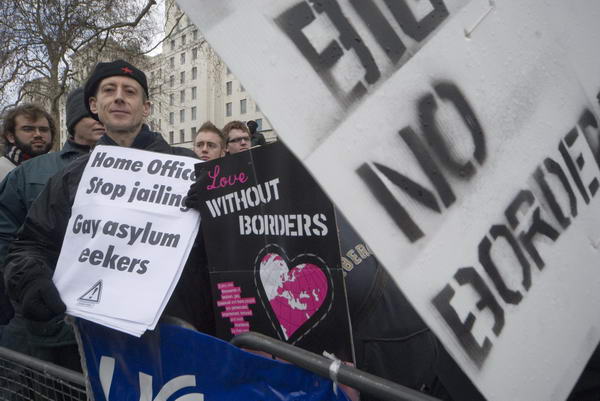
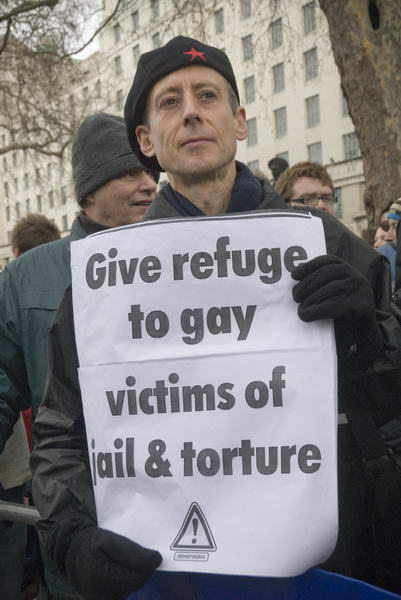
Defend Mehdi Kazemi – Downing St

But of course human rights are not always respected in this country, and we currently have a government which is proposing to withdraw from some international human rights conventions and proposing racist anti-immigrant policies which are deliberately in breach of them.

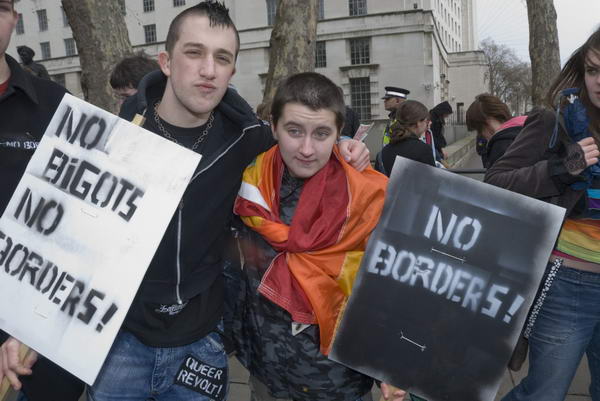
Back in 2008, the Labour government was also riding roughshod over the human rights of some immigrants, setting up a system of large-scale detention of asylum seekers and treating individuals unfairly in a bid to outflank the Tories on cutting immigration through blatantly right-wing policies.

Mehdi Kazemi had come to the UK to study after having been involved in a consensual homosexual relationship in Iran. After his boyfriend was executed for this he became a wanted man in Iran and he went to the Netherlands to apply for political asylum.

This was refused as he had come from the UK and so was not allowed under the 2003 Dublin Agreement. The Uk had refused him permission to stay in Britain and were proposing to deport him to Iran where he would be tried and executed.

His case was just one of many where the Home Office were failing to recognise the need for refugees to claim asylum on the grounds of persecution because of their sexual orientation, and for failing to have accurate and up-to-date information on homophobic persecution in countries to which LGBT asylum seekers might be deported.

Support for Kazemi at this protest and by a number of MPs, MEPs and human rights activists did eventually result in the Home Office agreeing to review his case and he was given leave to remain here in May 2008.

Defend Mehdi Kazemi


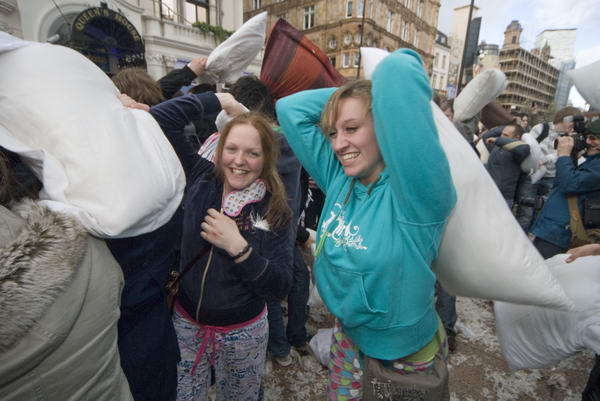
Flash Mob Global Pillow Fight – Leicester Square

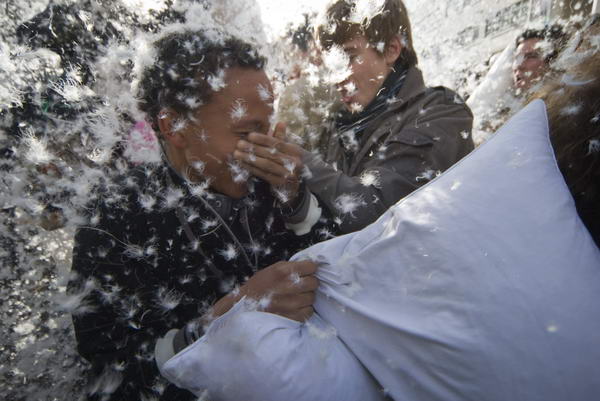
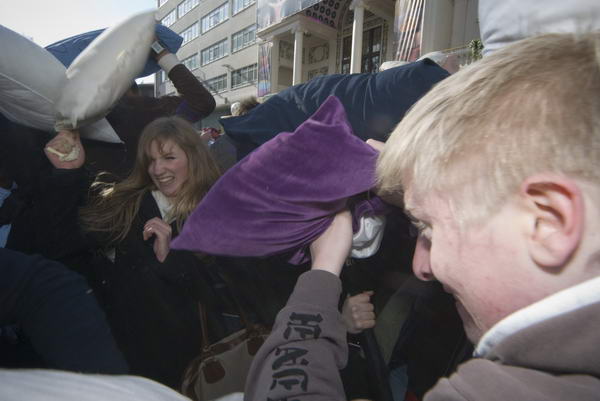
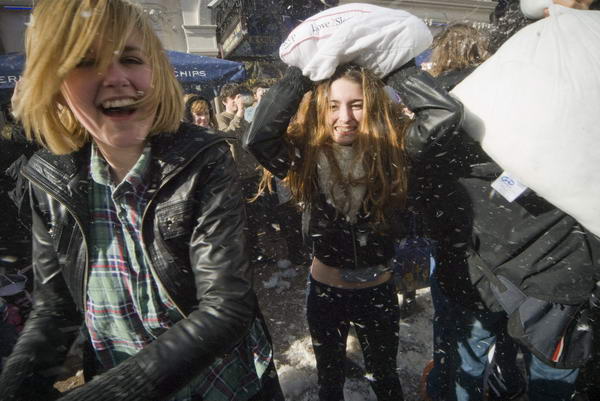
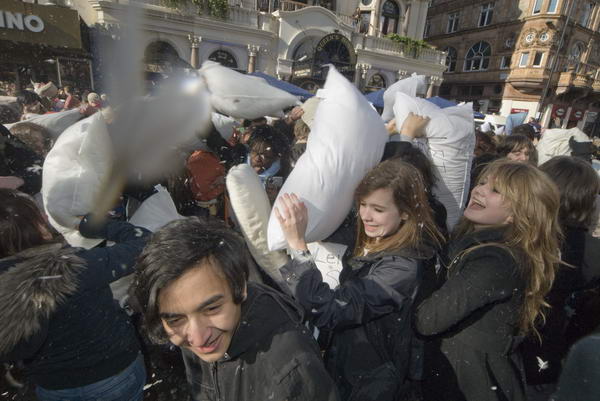
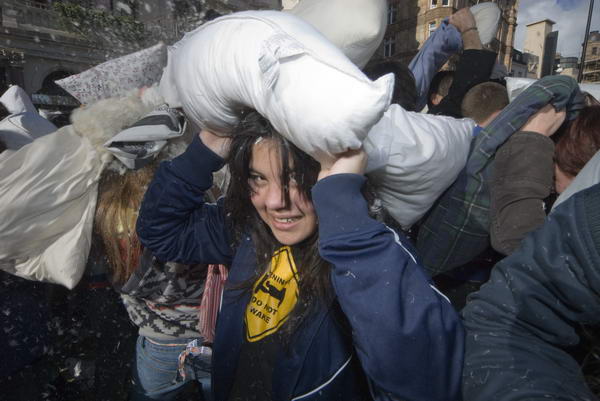
My day ended in very much lighter mood with a pillow fight in Leicester Square, one of many organised in capitals around the world due to kick off at 15.03PM.

I commented: “Of course its a trivial, silly event, but the idea and the kind of organisation involved I think represents something new and exciting, a kind of ‘Demo 2.0’ which we will surely see more of in the future.”

Perhaps this hasn’t had as much impact here in the UK as I had hoped, but I think may have been more important elsewhere in the world. To some extent it has been outgrown as Facebook, Twitter and other social media apps have become more important and even protests organised months and years in advance make use of them.

But it was interesting if rather tricky to photograph, and I got stuck in without a pillow and at some danger to my health, main not “from impact but suffocation when some pillows split open to fill the air with clouds of feathers and feather-dust. At times I wished I was wearing a mask to protect my lungs; keeping my mouth firmly closed and breathing though my nose only stopped the larger particles.

And I also found the the autofocus on my DSLR was too efficient at focusing on feathers in the air, and until I turned it off and went manual many of my pictures failed to be sharp for the people and pillows behind the screen of feathers.

Later as the pixel count on DSLRs increased and full-frame cameras appeared I found it very useful to work in many situations using just the central ‘DX’ half-frame area of the viewfinder – which would have been very useful to let me see the people and pillows coming for me, but on this occasion I found “chaos really rules taking pictures becomes a press and hope situation. I think some of them do give an idea of what it was like to be there.

Flash Mob Global Pillow Fight