Property Developer’s Awards – 2017

Property Developer's Awards - 2017

Property Developer’s Awards: On Tuesday 4th April 2017 I joined protesters on the pavement in front of the Grosvenor House Hotel in Mayfair where the annual Property Developers Awards were being held .

Property Developer's Awards - 2017

Property developers largely operate at one of the greedier ends of capitalism, many clearly putting their profits above everything else. Of course we need to build things, but we need to build the right things rather than those that maximise profits for the developers. Capitalism and the market doesn’t serve the interests of the vast majority.

Property Developer's Awards - 2017
Rev Paul Nicolson of Taxpayers Against Poverty speaks

In London we are clearly not building the right things. The desperate need is for social housing, while developers are working together with local councils to destroy this, demolishing council estates and replacing them with largely private developments with rents and prices beyond the reach of Londoners in desperate need of housing. And landlords are making obscene profits for lousy (sometimes literally) accommodation.

Property Developer's Awards - 2017
Landlord – Parasite!’ poster from Private Renters Unite – many rented properties suffer from damp and are infested by cockroaches etc

London councils have huge waiting lists for social housing and an estimated 210,000 Londoners are homeless and living in temporary accommodation, including 102,000 homeless children. The situation is now even worse than in 2017 and London councils now spend around £5.5 million per day on homelessness.

Property Developer's Awards - 2017

And yet there are huge developments taking place in London, but so many of these are for student housing and expensive private flats, many bought by overseas investors and remaining empty for all or most of the year. Because these are the kind of developments that make the largest profits for the property developers.
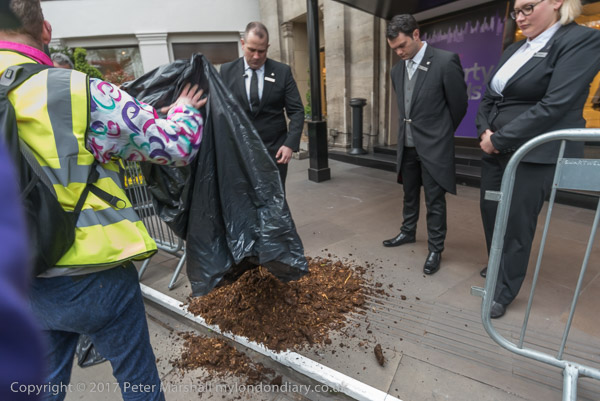
Property Developer's Awards - 2017
Activists rush up with a sack of horse manure and tip it on the hotel entrance

Of course gaining planning permission for many developments require them to include social housing and ‘affordable housing’. “Affordable housing is used by governments to mean 80% of market prices – something totally unaffordable for most people – the term true Orwellian doublespeak.” But if the developers feel they are not getting enough profit when building they can simply ask for a reduction in these and it gets granted.

Cockroaches crawl around a poster next to the manure
which a hotel employee tries to sweep up as Ian Bone walks in front with a siren

London Mayor Sadiq Khan has funding of up to £11.7 billion for a ‘London Social and Affordable Homes Programme 2026-36‘, but it remains to be seen what this will actually deliver – other of course than profits for the developers.
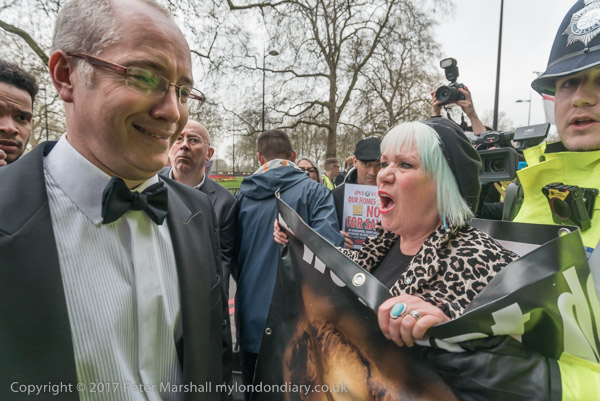
Jane Nicholl confronts a man going into the Property Developer’s Awards who seems amused by being accused of social cleansing

Of course both developers and councils who work with them do so in a political atmosphere which since Thatcher has made providing social housing much more difficult. But some councillors and officers have joined with developers in pursuing their personal fortunes rather than public good.
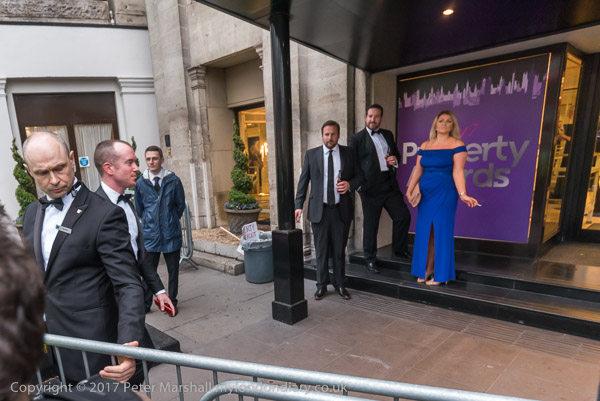
People from the Property Developer’s Awards came out to have a cigarette and watch the protest

“The protesters, who included queer coalition the Sexual Avengers and Class War say the developers demolishing social housing and community facilities across London in a process of social cleansing aided by largely Labour councils and led by Savills who sponsor the awards and were nominated for six of them. They are demolishing council estates and replacing most of their social housing with high cost private developments, often largely sold to foreign investors and making obscene profits – and tickets for this event were £396 per seat.”
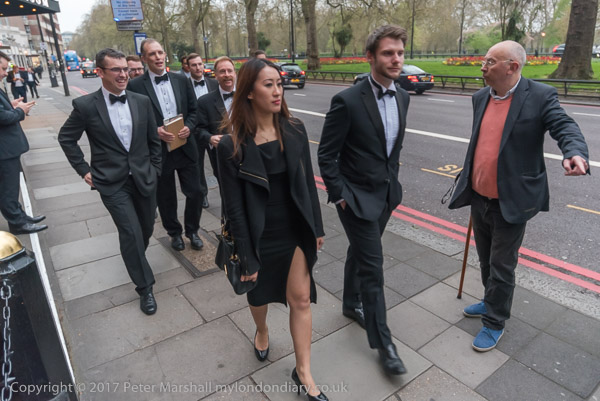
Ian Bone directs some of those coming to the Property Developer’s Awards, calling them “rich scum”

The protesters made their views very clear, calling those entering the Award beanfeast ‘scum’ and ‘parasites.’ A small group rushed up to the hotel entrance and dumped a sack of horse manure and coackroaches in front of it. A hotel employees came out with a bin and broom to try to sweep it up.
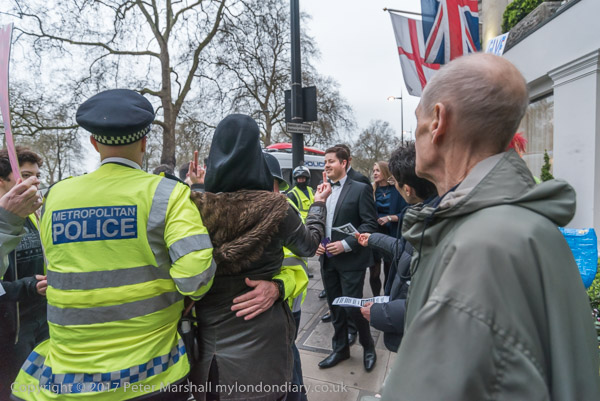
Police hold back a woman giving those coming to the awards the finger

The protest continued with Class War in particular confronting the developers as they arrived and police ensuring they could walk past and enter, holding back the protesters. Some of those entering appeared to be amused by the idea they were ‘social cleansing’ and a small group came out to watch the protest.
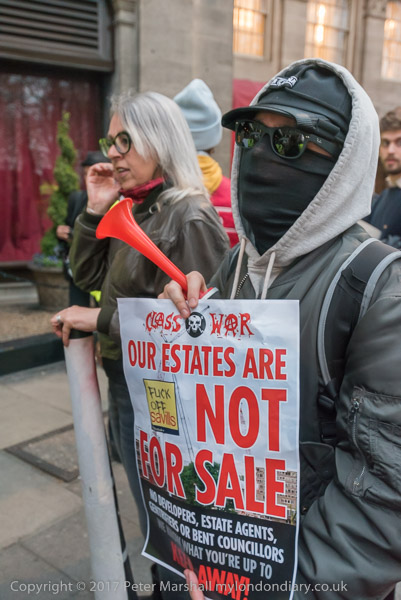
Class War – Our Estates Are Not for Sale – No Developers, Estate Agents, Gentrifiers or Bent Councillors – We Know What You’re Up to – Keep Away!

More pictures at Property Developer’s Awards.


FlickrFacebookMy London DiaryHull PhotosLea ValleyParis
London’s Industrial HeritageLondon Photos

All photographs on this page are copyright © Peter Marshall.
Contact me to buy prints or licence to reproduce.


Grosvenor Canal, Chelsea & Belgravia 1988

Grosvenor Canal, Grosvenor Rd, Chelsea, Westminster, 1988 88-4n-53-positive_2400
Grosvenor Canal, Grosvenor Rd, Chelsea, Westminster, 1988 88-4n-53

The Grosvenor Canal, now only vestigial, is one of London’s least-known canals, opened in 1824 when the Earl of Grosvenor decided to add a lock and turn what had been a tidal creek with a tide mill and feeding reservoirs for drinking water at Chelsea Waterworks (at right in picture) into a short canal, around three quarters of a mile long ending at a large basin, Grosvenor Basin. The lock needed two gates at the end where it connected to the river as the canal level could be higher or lower than the tidal river. The main traffic then on the canal was coal for the many houses in Westminster.

Victoria Station was built on much of this basin site in 1858, and when the station was expanded in 1902, the upper half of the canal was closed and the lower half sold to Westminster City Council who used it for barges carrying refuse. They closed more in 1925 to build the Ebury Bridge estate, but a short section was still in use, with barges taking Westminster’s rubbish onto the Thames, when I made this picture. It was then the last commercial canal in London. It closed in 1995 and has since been redeveloped as Grosvenor Waterside. More on Wikipedia

Savills, Sloane St, Sloane Square, Kensington & Chelsea, 1988 88-4n-61-positive_2400
Savills, Sloane St, Sloane Square, Kensington & Chelsea, 1988 88-4n-61

An estate agent selling the grand houses in the area with offices in a rather grand Grade II listed house on Sloane St, dating from the late 18th century. The listing text notes that the ground floor – reached up eight steps from the pavement – is in commercial use and describes the ground floor windows as wide, “with stucco fan motif lunettes above”.

Bourne St, Belgravia, Westminster, Kensington & Chelsea, 1988 88-4n-62-positive_2400
Bourne St, Belgravia, Westminster, Kensington & Chelsea, 1988 88-4n-62

A long white passageway with a charming lamp at the end hanging from wrought iron supports, behind a slightly more prosaic wrought iron gate. I wouldn’t have photographed it, not having a great love of the twee, but for the rather more practical lamp fitting at left with its cable housing leading rather nicely vertically down the wall to the curving shadow on the floor.

Bourne St, Belgravia, Westminster, Kensington & Chelsea, 1988 88-4n-63-positive_2400
Bourne St, Belgravia, Westminster, Kensington & Chelsea, 1988 88-4n-63

White fences have had a particular attraction for photographers since an iconic image by Paul Strand at Port Kent in 1916, though I make no suggestion that this is anywhere in the same league. But it did seem an awful lot of white fence in a rather confined space.

Skinner Place,  Belgravia, Kensington & Chelsea, 1988 88-4n-64-positive_2400
Skinner Place, Belgravia, Kensington & Chelsea, 1988 88-4n-64

Skinner Place looked like something from a rather meaner part of London, perhaps somewhere in Bethnal Green mysteriously translocated into Belgravia (which would have increased its price by a large factor.) But it was the huge union flag blocking the end of the street that I really liked, along with the rounded block of flats behind.

Cranley Mews, South Kensington, Kensington & Chelsea, 1988 88-4o-15-positive_2400
Cranley Mews, South Kensington, Kensington & Chelsea, 1988 88-4o-15

The Henry Smith Charity was established on the death of Henry Smith (1549-1628) who lived and profited through interesting times, lending money to many landed families and amassing large landholdings from their misfortunes. He left detailed instructions for the administration of his estates, and the charity trustees in 1640 bought “a marshy estate of mainly market gardens just outside London, in the parish of Kensington.” According the the charity web site, “Nearly four centuries after we were first established, The Henry Smith Charity is one of the largest grant making charities in Britain; making grants of £39.8 million in 2020.”

Smiths Charity, corruption, Cranley Mews, South Kensington, Kensington & Chelsea, 1988 88-4o-14-positive_2400
Smiths Charity, corruption, Cranley Mews, South Kensington, Kensington & Chelsea, 1988 88-4o-14

I spent some time reading the notices in this picture, but ended up little the wiser about the eviction of Major Parson in the 1970s, and the corruption alleged to have been involved. Reading a post from David Swarbrick about a 1974 legal case did little to help me but may held my legal friends.

Click on any of the above to see a large version and explore more pictures in my album 1988 London Photos.


All photographs on this and my other sites, unless otherwise stated, are taken by and copyright of Peter Marshall, and are available for reproduction or can be bought as prints.