World Health, Syria & a Pillow Fight – 2012

World Health, Syria & a Pillow Fight: Saturday 7th April 2012 was World Health Day and health campaigners protester against the increasing privatisation of the NHS. It was also International Pillow Fight Day which was celebrated by hundreds in Trafalgar Square. Between these I photographed Free Syria supporters calling for the UK government to do more over the atrocities by the Assad regime against their relatives still in Syria.


World Health Day: Lansley’s Bill

Dept of Health, Whitehall
World Health, Syria & a Pillow Fight - 2012
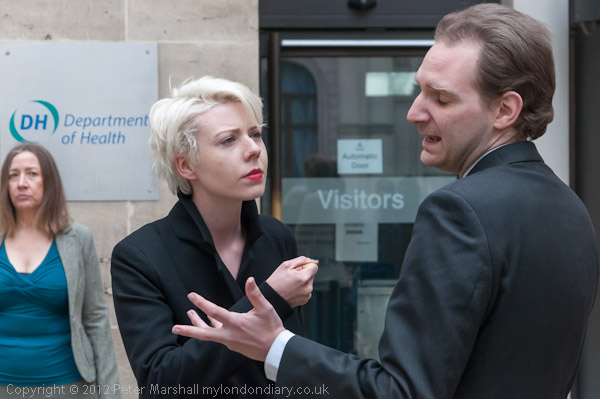
Lansley’s Bill – Lansley lies to the media in the play performed outside the Dept of Health

The Health and Social Care Act 2012 was now law, having gained royal assent on March 27th 2012. Secretary of State for Health, Andrew Lansley had pushed through the most extensive reorganisation of the structure of the NHS despite the united opposition of the Royal College of Nursing, the Royal College of Midwives, the British Medical Association and the Royal College of General Practitioners and many campaigning groups.
World Health, Syria & a Pillow Fight - 2012
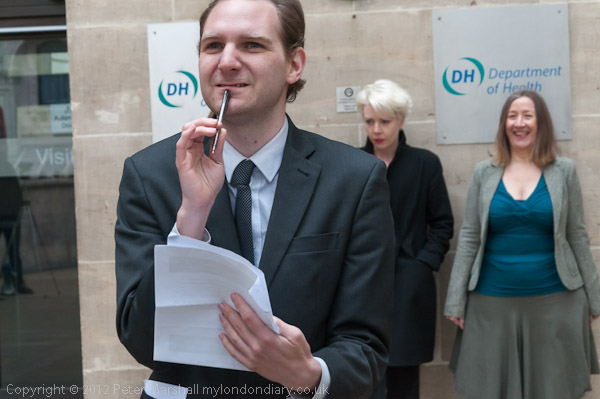
‘Lansley’ looks at the Tory plan to hand the NHS to private companies and decides to present it as giving more choice to the public

The Act led to a greater marketisation of the NHS with an greatly increased role for private companies who mainly ‘cherry picked’ the simpler and so more readily profitable areas of service, and its structural reforms were damaging, with new complex systems of governance and accountability, while removing the system leadership needed to cope with major changes. And it didn’t give any more choice to the public – unless they went private.

Lansley’s Act failed, largely because it tried to introduce a system based on competition into a an NHS where care and cooperation was the bedrock, but it did succeed in diverting much needed funds to the private sector. By 2019 the policy of competition was effectively abandoned. Labour in 2024 commissioned a report led by Lord Darzi which called it a “broken system” and conclude it “was a calamity without international precedent – it proved disastrous. The result of the disruption was a permanent loss of capability from the NHS“.
World Health, Syria & a Pillow Fight - 2012

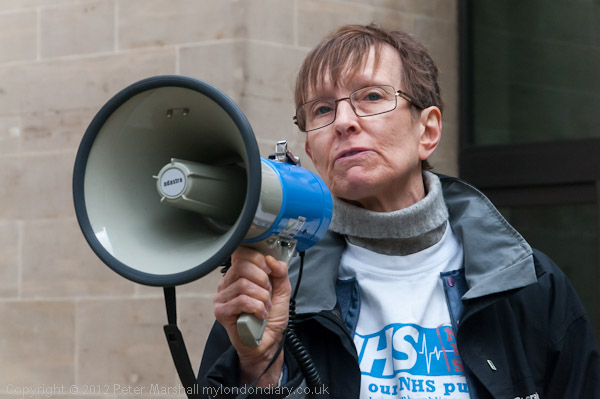
Nurse Gail Lee began the protest by explaining that the Act was designed to lead eventually to the NHS being converted to an insurance-based healthcare system that will provide high-cost medical services for those who can afford it while retaining only a basic provision for others. So far this has not happened but there are still politicians – Labour as well as Conservatives – who are urging this.
World Health, Syria & a Pillow Fight - 2012

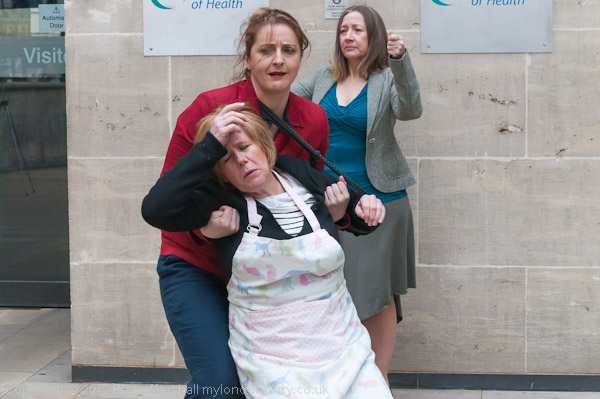
After her short talk there was a performance of the play ‘Lansley’s Bill’ by Mike Hart, based on the facts of the planning by McKinzey Consulting and the Tories which led to the Lansley Bill, a bundle of Tory lies which opens up healthcare to the market under the misleading mantras of ‘choice’ and ‘efficiency’.
World Health, Syria & a Pillow Fight - 2012
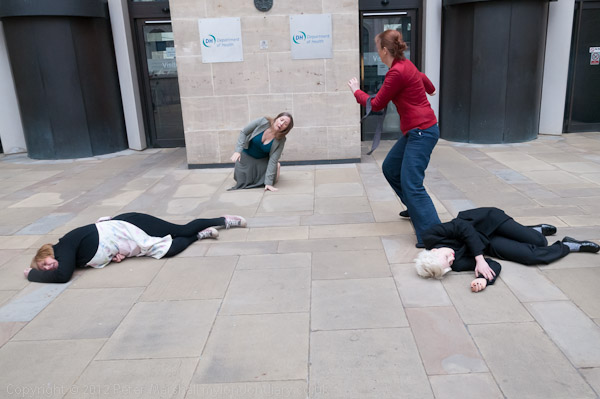
Without a public health service to treat them, people are dieing – we are told we must fight and throw out Lansley

Based around the problems of a cleaner who needs the help of the new version of the NHS but is told to wait, and wait – until she dies, it makes the point that “you have a choice. You can fight for the NHS, become rich, or you can make sure you are never ill. The least worst case is to get out there and fight.”

World Health Day: Lansley’s Bill


Syrians Continue Protest Against Assad

Downing St
World Health, Syria & a Pillow Fight - 2012

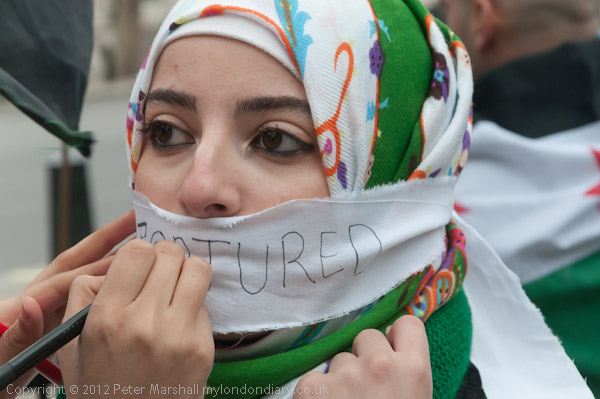
Free Syria Supporters protested aaginst the continuing killing, torture, imprisonment and abductions of their relatives by the Assad regime, calling on the UK government to take greater action
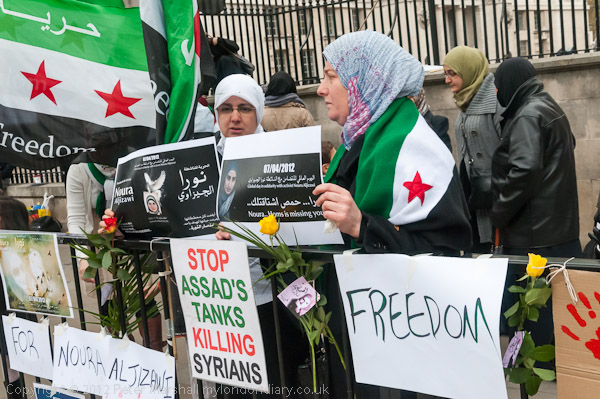
Some held up placards ‘For My Sister’, ‘For My Mum’ and for some at least of those wearing gags with the words ‘Freedom’ or ‘Tortured’ it was there own family who was tortured or missing or held in jail. Their protest over human rights violation was personal.
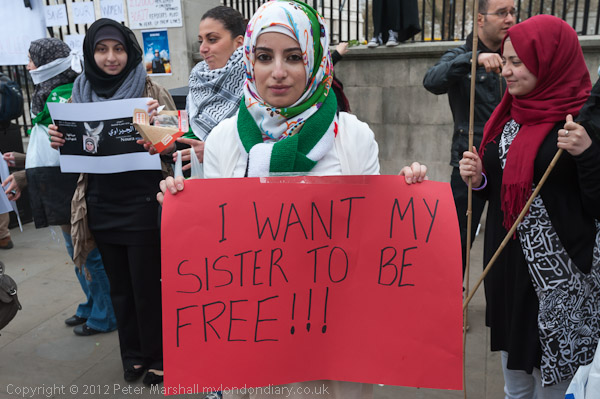
Some held family snapshots, blown up to A4, and others were taped to the railings along with lists of names, and roses dedicated to the missing and dead.
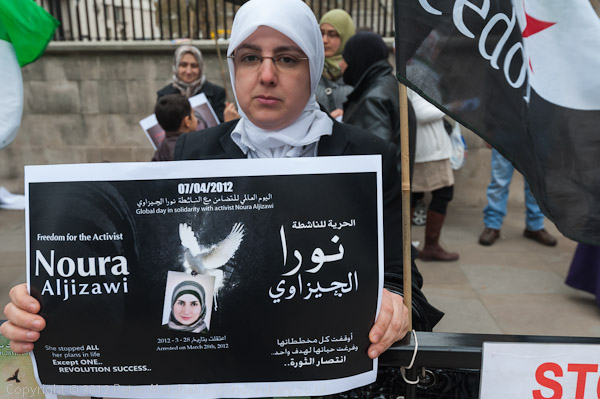
Many also called for the release of human rights activist Noura Aljizawi, who had led protests against the Asad regime, worked in hospitals to support women and children and written for the Syrian underground newspaper Hurriyat. Arrested on 28th March she was tortured and denied access to family and lawyer; an international campaign led by Reporters without Borders eventually led to her release and she fled to Turkey, continuing her campaign against the Assad government, finally relocating to Canada.
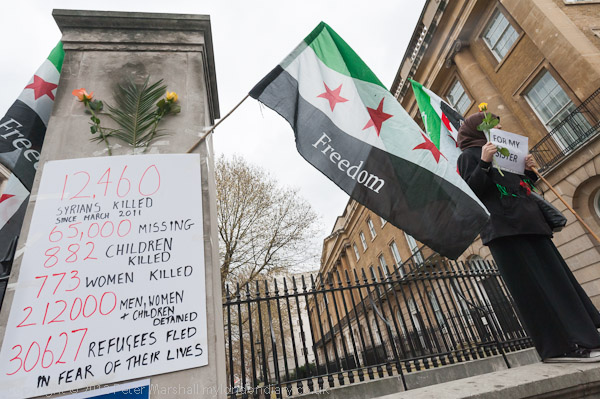
My final paragraph on the protest on My London Diary:
“On a pillar behind and on the leaflets handed out were the grim statistics. 12,460 Syrians killed since March 2011; 65,000 innocent Syrians are missing; 882 children and babies murdered, 773 women slaughtered; 212,000 men women and children are detained; 30,627 refugees fled in fear of their lives. And the numbers are still rising.”

Many more pictures at Syrians Continue Protest Against Assad.


International Pillow Fight Day

Trafalgar Square
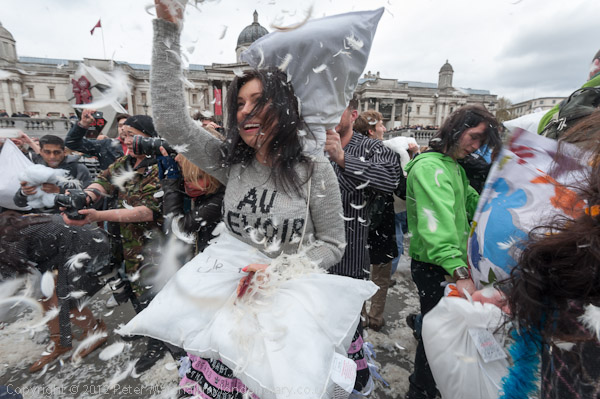
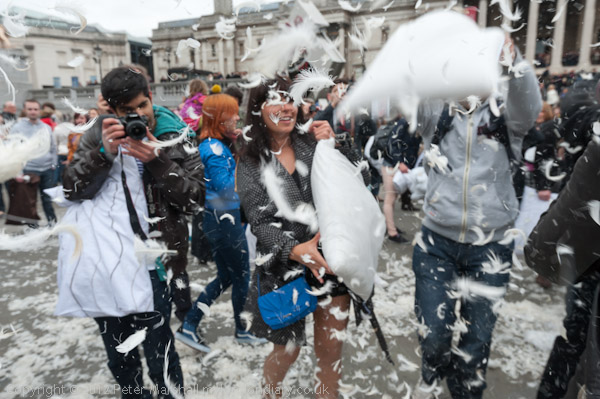
Feathers soon began to fly in the square

It was International Pillow Fight Day with fights arranged in 111 cities around the world in an event promoted by the urban playground movement.

A whistle signalled the start of the fight

As well as London there were fights in cities from Amsterdam to Zürich, with the majority being in the USA, but they were also in virtually every European country, as well as in Canada, Greenland, Turkey, Bahrain, South America, Cape Town, Australia, Hong Kong and China.

The organisers had set out a list of nine rules, some of which were adhered too, but others were clearly ignored – such as “6) NO FEATHERS, let’s not make a mess”.
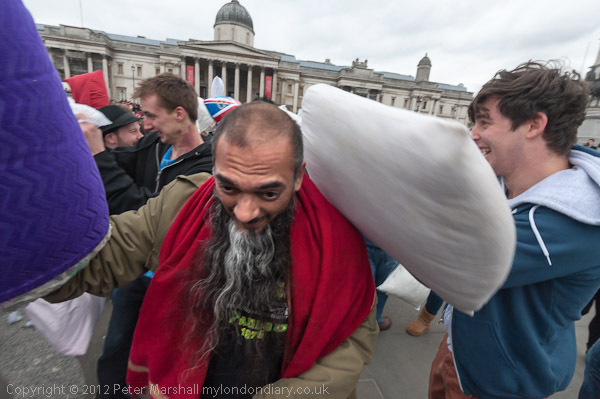
Another that was often ignored was “4) Do not swing at anyone without a pillow or holding a camera”, though some did apologise after hitting me.
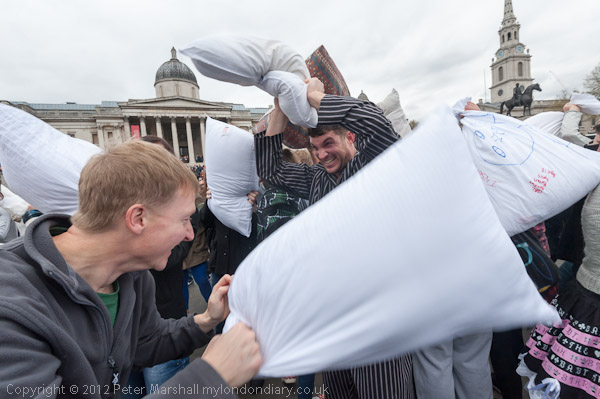
As I commented, it “was half an hour of glorious chaos as people of all ages – though mainly in their teens and twenties – rushed around attacking anyone with a pillow.”
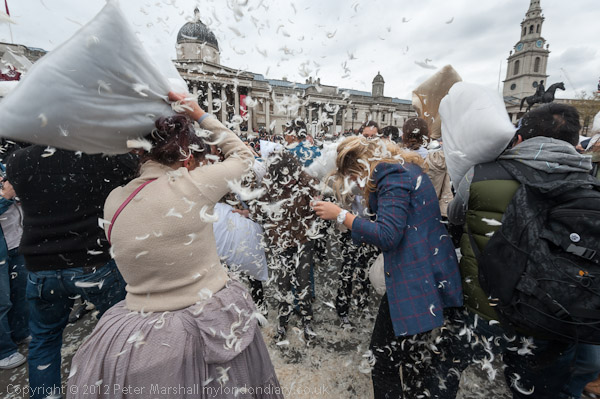
Generally the attacks were random, but there were occasional cries to “attack the panda, or the guy in stripes or spiderman or one of the others in identifiable costumes”.
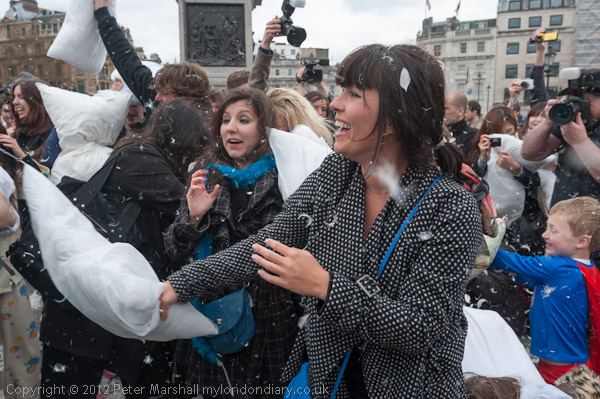
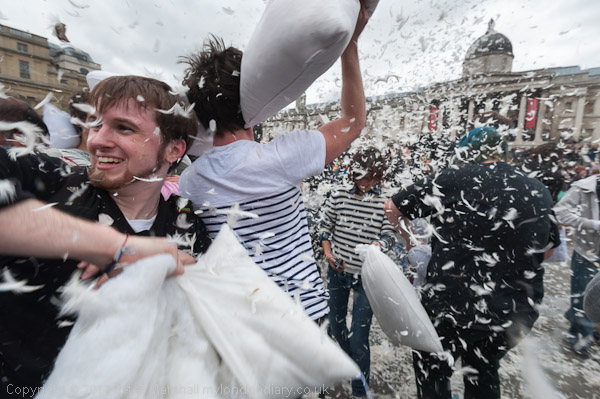
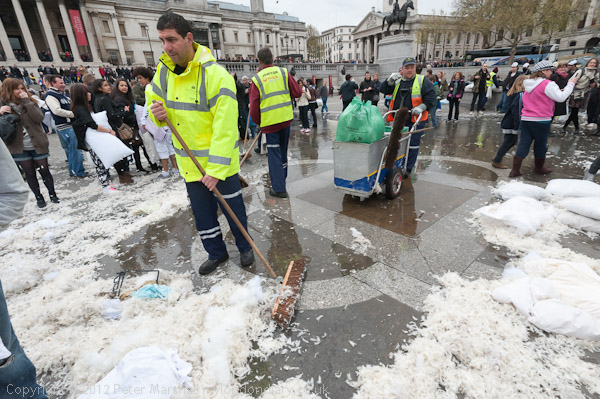
After around 20 minutes when the air (and my lungs) was full of dust and feathers the council cleaners began to pour buckets of water and sweep the dampened feathers away, but the fighting continued until a whistle blew to end the fight at the end of 30 minutes – with just a few continuing to fight.
Many more pictures at International Pillow Fight Day.


FlickrFacebookMy London DiaryHull PhotosLea ValleyParis
London’s Industrial HeritageLondon Photos

All photographs on this page are copyright © Peter Marshall.
Contact me to buy prints or licence to reproduce.
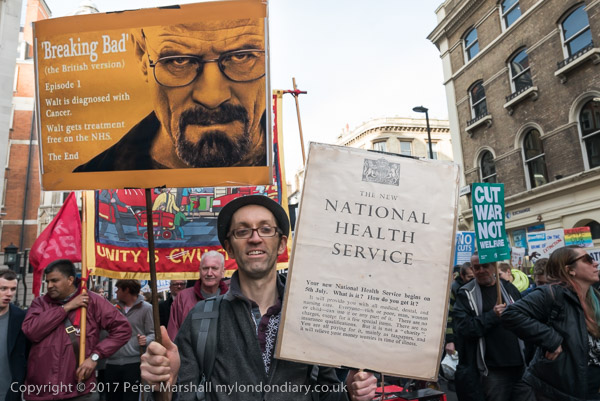
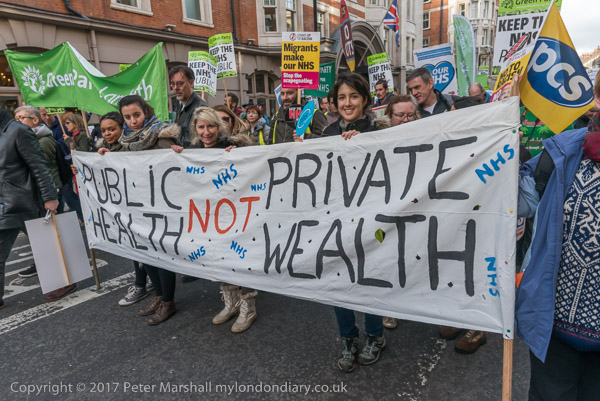
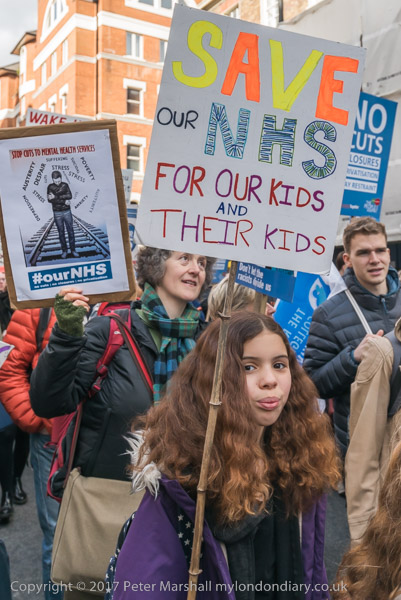
Save Our NHS – 4th March 2017

Save Our NHS – The NHS was under attack by the Conservatives before it was established in 1948 and has come under repeated attacks since by governments of both major parties particularly since the 1990s.

Save Our NHS

Providing universal healthcare costs and the current financial year (2023/24) figure of £160.4 billion is around one seventh of total government spending of around £1,200 billion. So it isn’t surprising that governments should wish to see that the money is being spent wisely. But that isn’t was most changes in government health policy have been about.

Save Our NHS

Even with that large sum, the UK is still getting healthcare on the cheap. According to Statista the spending per person is less than in the US, Switzerland, Germany, Norway, Netherlands, Austria, Belgium, Australia, France, Sweden, Luxembourg, Canada, Denmark, New Zealand, Ireland and Finland and roughly the same as in Iceland and Japan.

Save Our NHS

It’s perhaps not surprising given this that we often hear reports which compare the results of NHS care critically with those in other countries. But those reports on the BBC and in the papers seldom if ever mention the poorer funding the NHS receives than many of those with better health outcomes.

Save Our NHS

The US spend per person is considerably higher than all other countries and roughly two and a quarter times that in the UK. But many of the NHS reforms made this century have been based on making our health system more like the American model, which would be a disaster. But it would mean a great opportunity for private healthcare companies, particularly some of those US companies, to make huge profits at our expense.

A surprising number of our MPs have had some financial interest in healthcare either through shareholdings or by sponsorships. The Daily Mirror in 2014 published a list of 70 MPs with links to private healthcare firms which included almost every leading Tory and some from other parties. As well as then Prime Minister David Cameron, they included Former Health Secretary Andrew Lansley, responsible for the disastrous Health and Social Care Act 2012, Health Secretary Jeremy Hunt, former Health Minister Simon Burns, the Work and Pensions Secretary Iain Duncan-Smith, William Hague, Philip Hammond, Sajid Javid, Oliver Letwin, Chancellor George Osborne, Priti Patel, Jacob Rees-Mogg and many other leading Tories, along with Lib-Dems then in the coalition government Vince Cable, Nick Clegg and Simon Hughes.

It’s these people who have introduced policies which have led to large areas of NHS services being provided by private companies, though still retaining the NHS logo and still providing services free to the public. But generally these are the kind of simple, straightforward services and the more complex areas are still left to the NHS.

There is still huge public support for the NHS, despite its problems some of which have been created possibly deliberately by government reforms to erode that support, though more clearly in a drive to make more of its services available to be taken over by private companies.

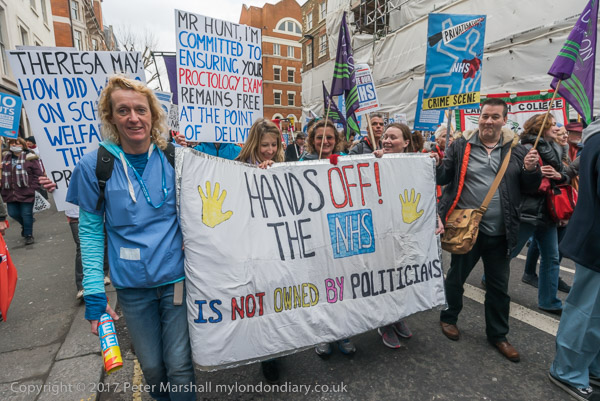
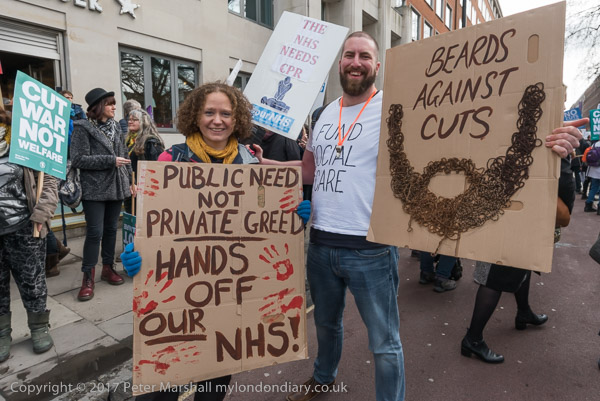
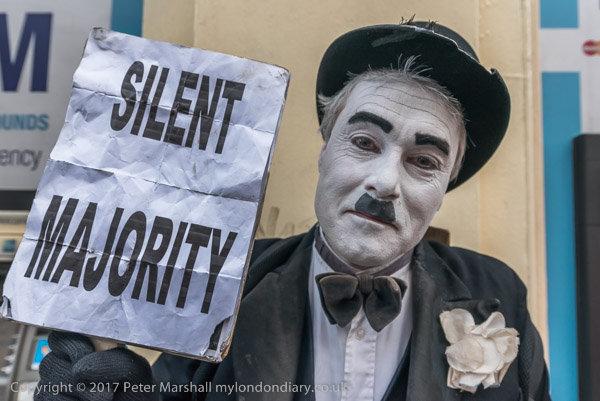
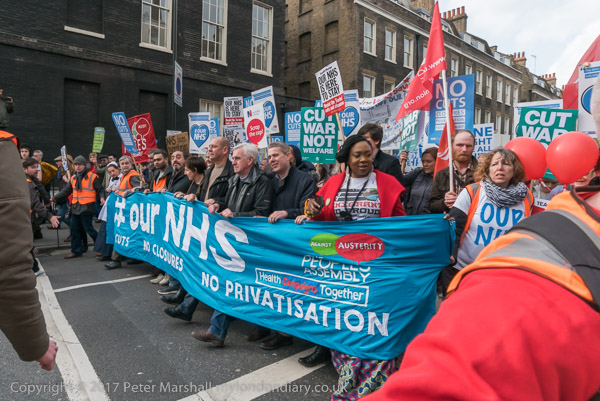
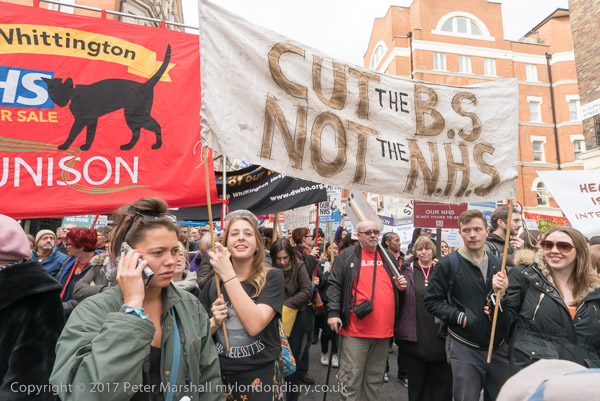
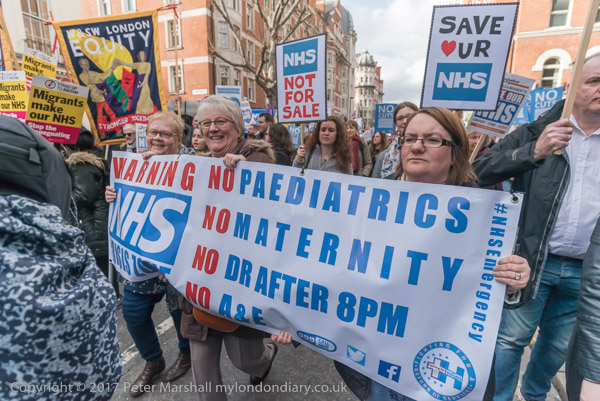
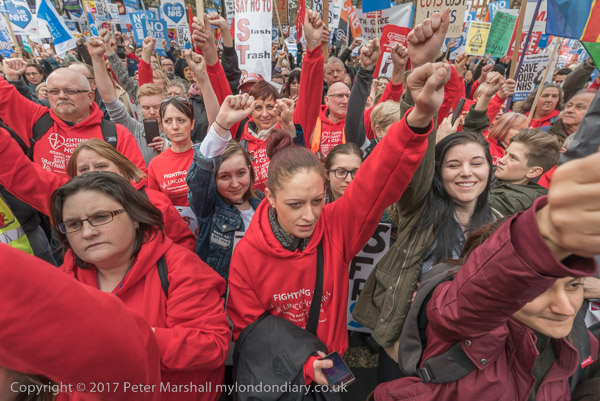
On Saturday March 4th 2017, thousands came to Tavistock Square, outside the BMA headquarters to march to Parliament Square in protest against the cuts and privatisation of the NHS which they said was at breaking point.

In particular they were protesting the Sustainability and Transformation Plans for hospital closures and cuts in services which had already caused many premature deaths. Doctors and other healthcare workers clearly saw these as a part of a rapid stealthy privatisation with medical services increasingly being run for private profit rather than public benefit.

In 2017 the STPs mutated into Sustainability and Transformation Partnerships and in 2018 these were told to transform themselves into Integrated Care Systems which have now replaced Clinical Commisioning Groups. These plan, buy, and provide health and care services in there areas and are subject to inspection under 70 performance metrics and can be put into ‘special measures’.

According to the Wikipedia article “A report from the Nuffield Trust in December 2021 found that there was very little evidence that integration policies across the UK – including pooling budgets and creating new integrated boards and committees – had dramatically improved patient experience, quality of services or supported the delivery of more care outside of hospitals.” But clearly they had diverted a considerable amount of expertise, time, energy and money away from the real business of the health service – and funding towards private companies.

Estimates for the number on the march varied even more wildly than usual, but it was clearly a large march. My guess was perhaps 30,000 but it could well have been twice that if not the 250,000 the organisers claimed. All the pictures in this post come from the march and the rally before the start, and I was too tired by the time it reached Westminster to photography the rally in Parliament Square.


FlickrFacebookMy London DiaryHull PhotosLea ValleyParis
London’s Industrial HeritageLondon Photos

All photographs on this page are copyright © Peter Marshall.
Contact me to buy prints or licence to reproduce.

Save the NHS – Lewisham 2013

Save Lewisham Hospital March & Rally – Saturday 26 January 2013

Save the NHS - Lewisham 2013

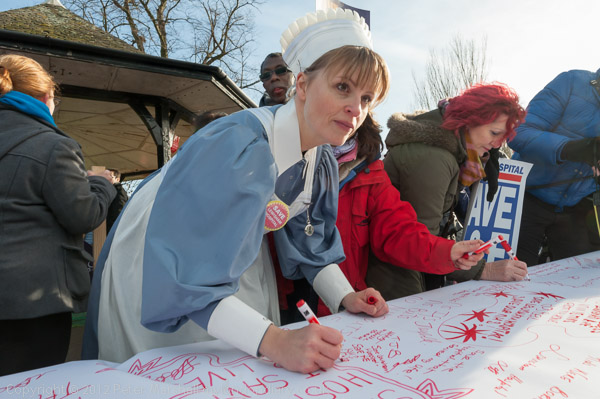
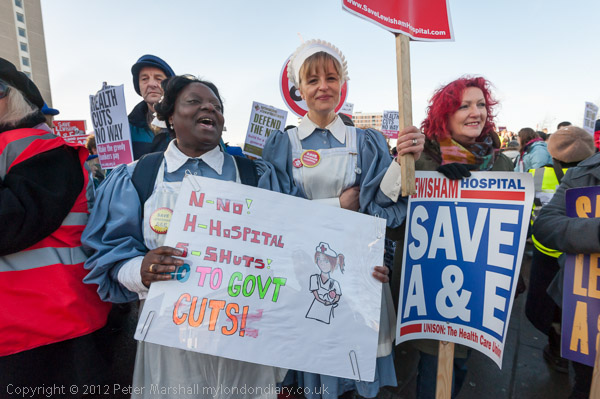
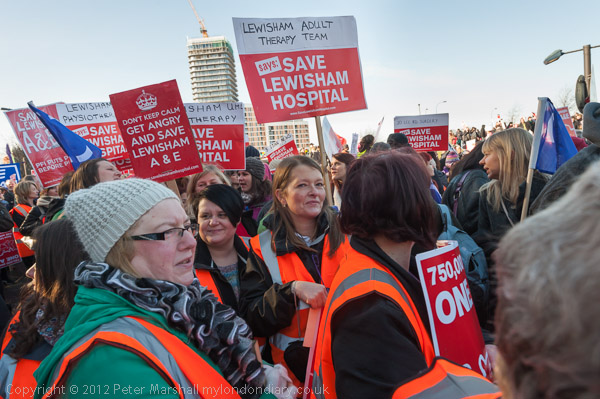
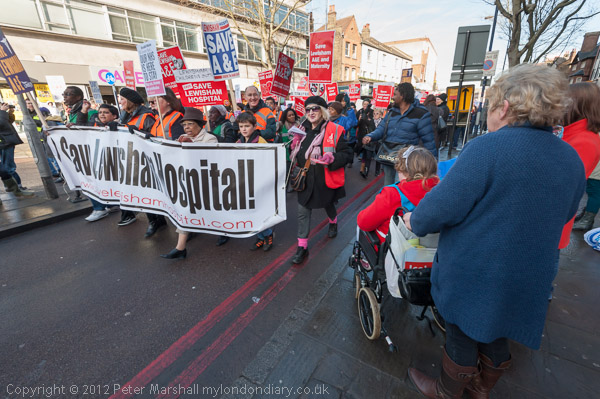
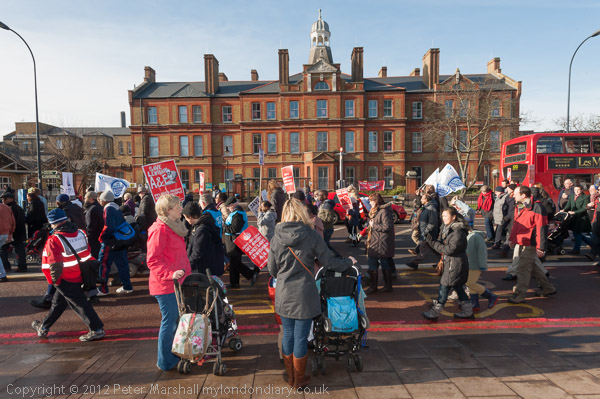
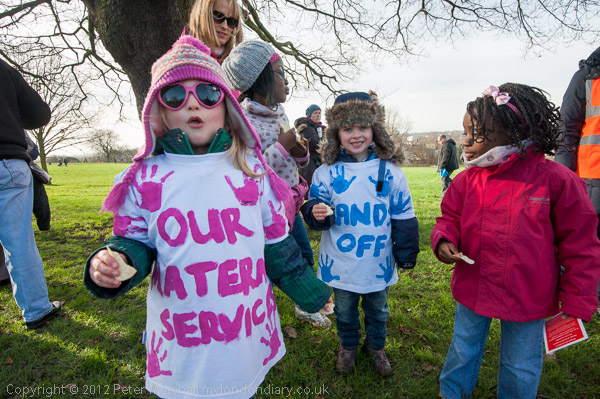
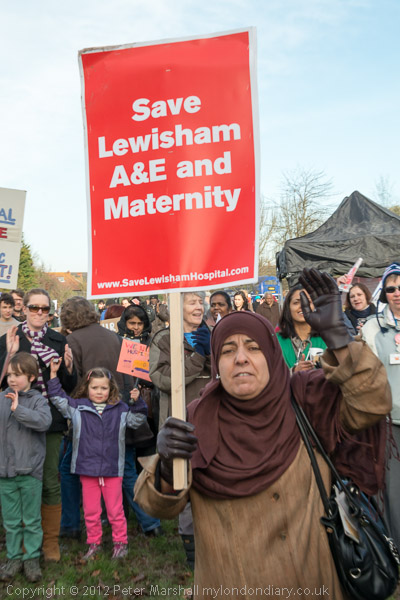
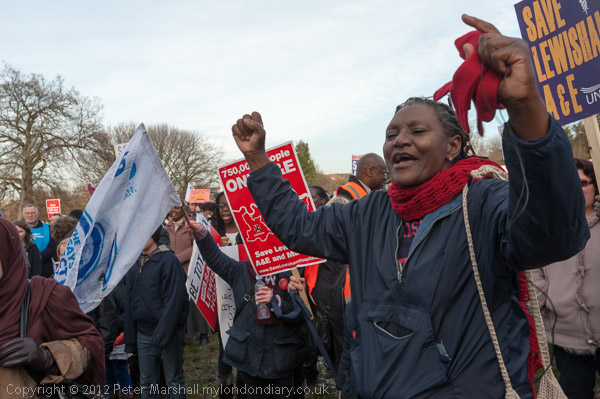
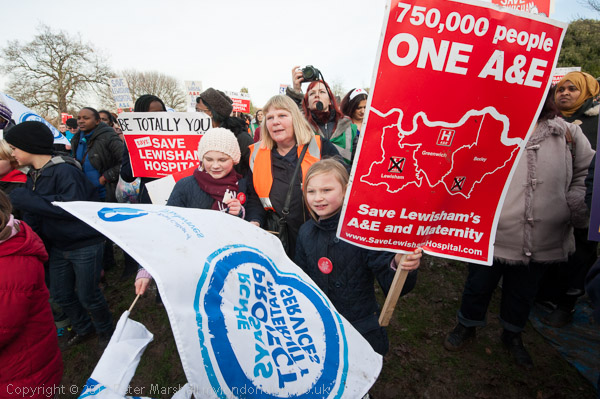
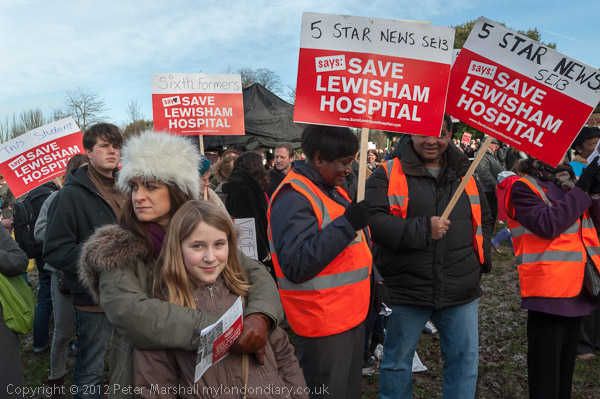
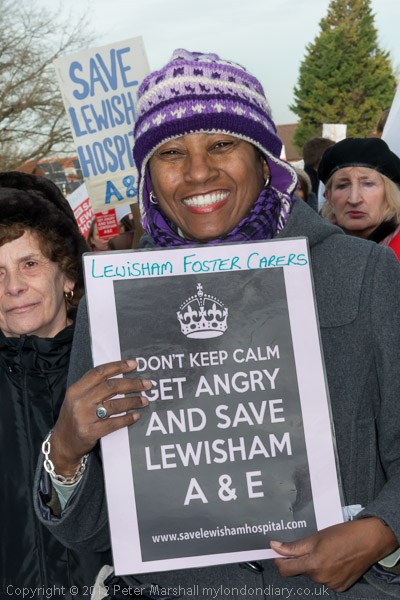
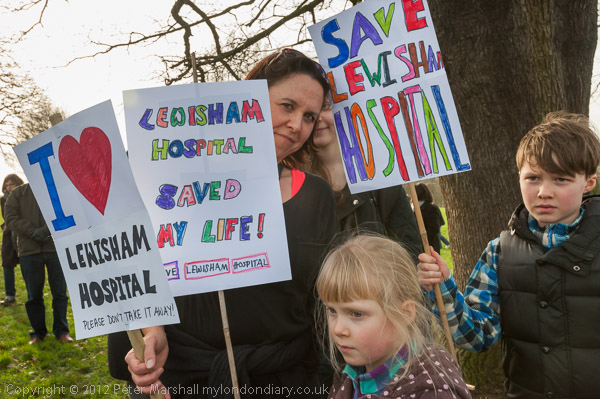
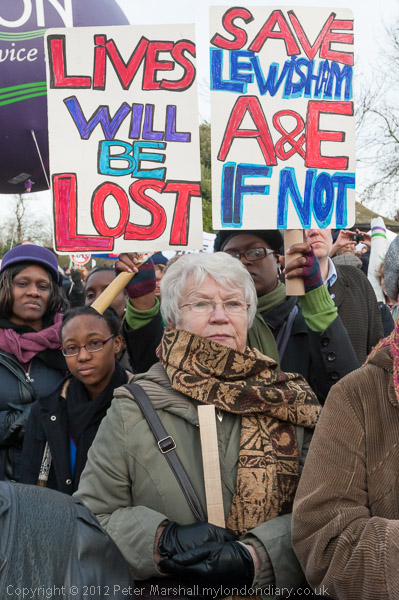
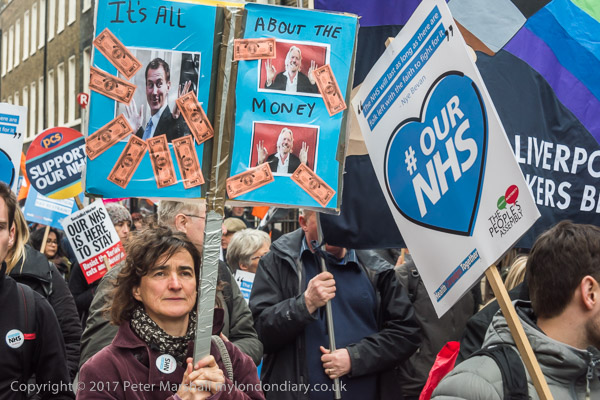
On Saturday 26th January 2013 an estimated 25,000 people marched through Lewisham to save their hospital from closure and to protect the NHS, showing south London united against the closure on pure financial grounds of its highly successful and much needed A&E and maternity departments.

Save the NHS - Lewisham 2013

Now the whole NHS is facing a crisis, and a similar united response across the country is needed to save it. It becomes clearer and clearer that this crisis has been deliberately engineered in order to destroy our health service and hand it over to private providers, particularly the US health giants.

Save the NHS - Lewisham 2013

Two years ago, US health insurance giant Centene Corporation took over 49 NHS GP surgeries and practices. Now as Jeremy Corbyn posted a couple of days ago on Facebook, “US health insurance giant, Centene, is the single largest provider of NHS primary care in England. Privatisation is the cause of — not the solution to — the NHS crisis. Stop wasting money on private contracts and start investing in a fully-public NHS instead.

Save the NHS - Lewisham 2013

Unfortunately both Tory and Labour parties have taken part in the move towards privatisation of the NHS, though Tories have been more open in their support of such changes as suggesting the introduction of charges to see a doctor. But both parties have introduced changes which have brought private companies into providing NHS services, have taken large donations from private health companies, and have leading members who profit from them.

It was under Labour that the NHS took on poorly thought out Private Finance Initiative contracts that have landed many local health trusts with huge debt repayments, many of which extend to the middle of the century, and it was these which led to the crisis in Lewisham.

The PFI contracts were negotiated by civil servants and were and are a bonanza for private companies. Under them we pay totally ridiculous charges for simple jobs – such as Hull and East Yorkshire Hospitals Trust paying £8,450 to install a dishwasher because they are locked into maintenance contracts. Changing a light bulb can cost a couple of hundred pounds.

Lewisham Hospital wasn’t directly affected by PFI, but it was in 2009 put into the South London Hospitals Trust, which had two hospitals at Orpington and Woolwich whose PFI contracts saddled the trust with debts of over £60 million a year until 2032.

Lewisham Hospital was successful both medically and financially, but Health Secretary Andrew Lansley appointed a special administrator to the trust with a remit to drastically cut the trusts costs. And Matthew Kershaw decided to do so by closing the highly successful and much needed A&E and maternity departments at Lewisham.

It was a decision that made no sense. There wasn’t the spare capacity at other hospitals to cope with those no longer able to get treatment at Lewisham – the system was actually working in the other direction, with these other hospitals having to send patients to Lewisham.

Financially it made no sense – the patients would still require treatment and this would cost more elsewhere. The small annual savings the closure would give would be more than offset by increases in costs elsewhere – though some of these might be in other trusts.

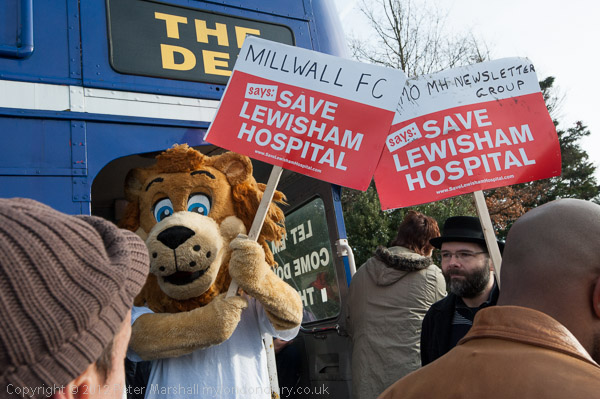
The proposal generated an incredible amount of local opposition, with the campaign to save the hospital supported by all local MPs and policitician both in the area and across south London. Community groups and organisations all came together to save the hospital – Millwall football club even changed their weekend fixture to Friday night so the team and supporters could join the march.

As I wrote back in 2013, “The fight to save Lewisham Hospital isn’t just a local issue, but very much a national one, with the provision of medical services that form the bedrock of the NHS under attack. If the government can close down services at Lewisham, no other successful hospital in the UK is safe in their hands.”

Nurses and ambulance workers are now striking not just for a better deal for themselves, but for the future of the NHS, which the Tories have deliberately run down with drastic underfunding and a deliberate failure to train and recruit staff. Perhaps their most obvious action was the removal of the bursary for nurse training, but as well there has been the continuing decrease in real salaries with below inflation wage rises over the years. Together with the failure to keep European staff in this country after Brexit and the impact of Covid the results have been disastrous – except for those private companies providing agency nurses and doctors, often at horrific cost to the NHS.

If the NHS is to be saved it will need the kind of public mobilisation that saved Lewisham Hospital, with the people as a whole getting behind the nurses and doctors and others who are fighting to save it. We need to fight the policies and greed of the Tories and of Labour and of the billionaire press to preserve the NHS as a national service free at the point of use and organised for the national good rather than for profit.

More pictures at Save Lewisham Hospital