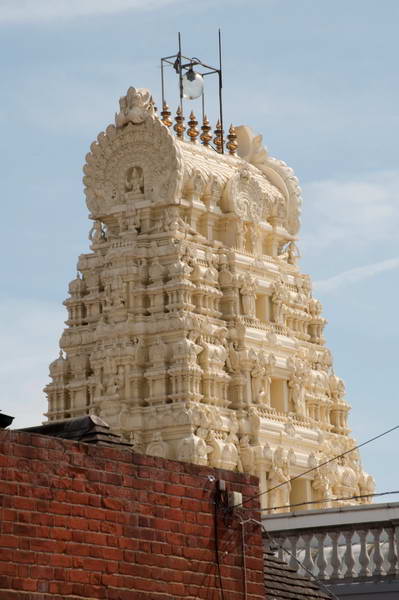
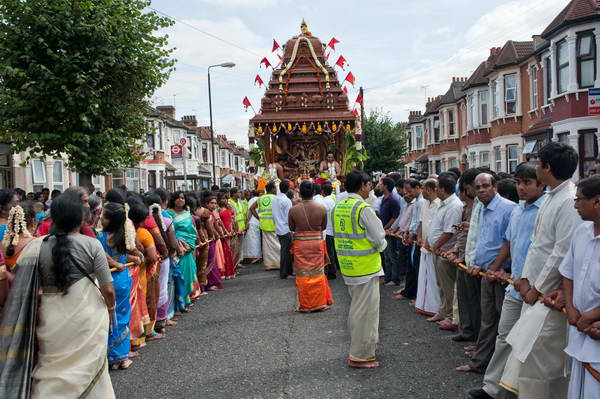
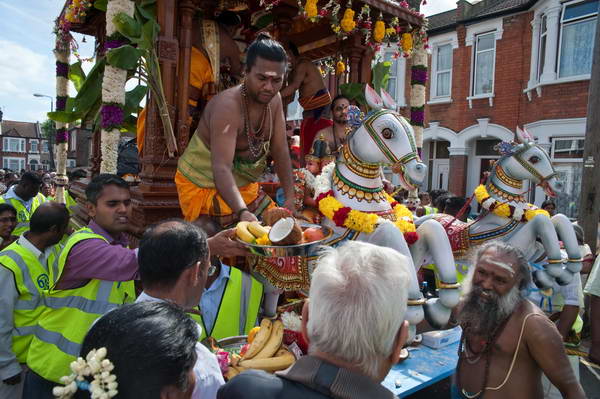
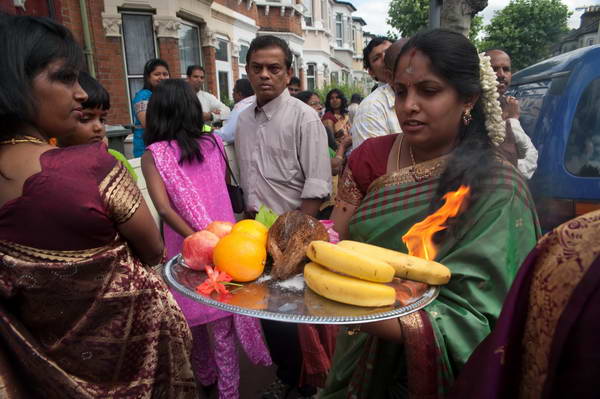
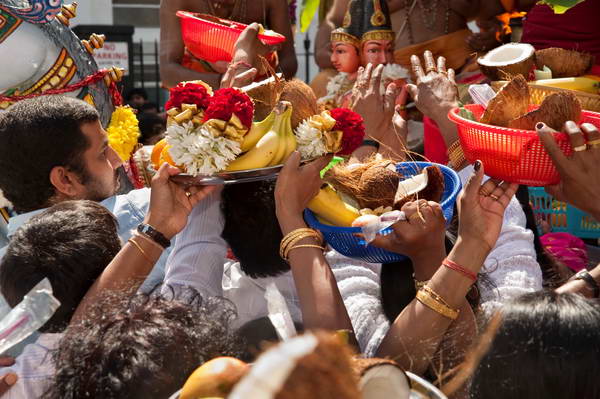
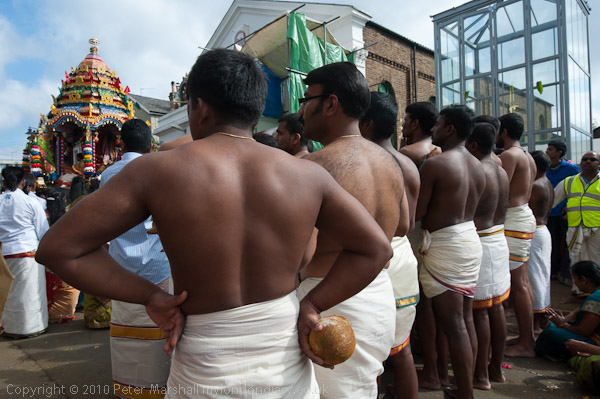
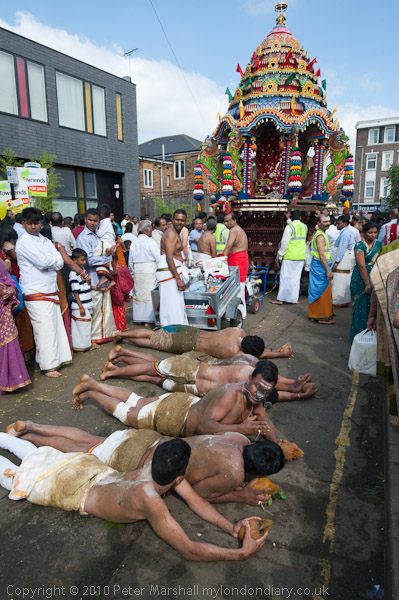
London Sri Murugan Chariot Festival: On Sunday 16th August 2009 I travelled to Manor Park in East Ham to photograph this annual festival. A small temple was consecrated here in 1984 but it was rebuilt in 2005 with a 50ft tall marble temple tower in Dravidian style and claimed to be the largest South Indian Hindu temple in Europe. Murugan is the patron deity of the Tamil language and the Hindu god of war. He is generally described as the son of the deities Shiva and Parvati and the brother of Ganesha.
Much of the description below is based on the account I wrote on My London Diary in 2009.
The chariot festival here in which Hindu deities are carried around the streets of East Ham was certainly on a grand scale, with the chariot pulled by people followed by a crowd of perhaps 5000 people, members of London’s Tamil community.
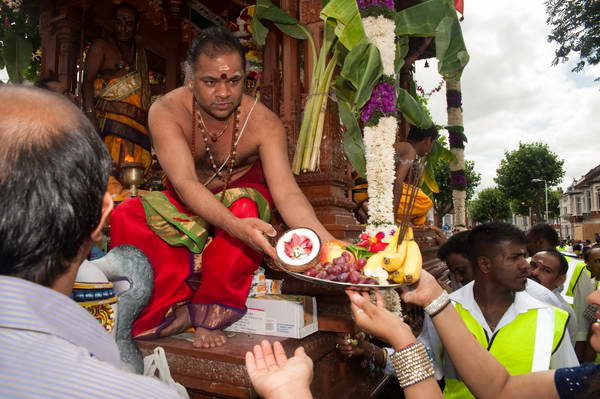
Along the route men and women stood in front of their homes and businesses with plates or baskets of fruit to hand to the temple priests riding on the chariot or walking in front for blessings by the Goddess; metal trays bearing fruits were returned bearing a flame and the families held out their hands to feel the warmth.
The chariot had two finely painted prancing horses at its front but was pulled by two ropes, on the right by women and on the left by men, with a large mixed crowd of followers behind. Those on the ropes and between them and many others walked barefoot through the streets, but many others kept their shoes on – and so did I, at least for most of the event.
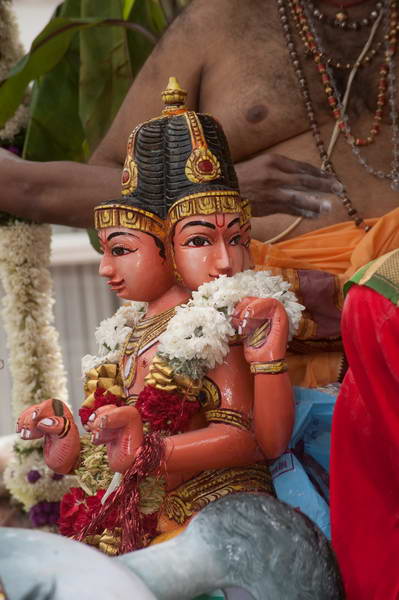
The Goddess Gayatri, mother of the Vedas
The chariot was too tall to pass unaided under some of the telephone wires on the streets and was accompnied by attendants with a long pole with a beam across its top to lift up the wires while the chariot passed beneath.
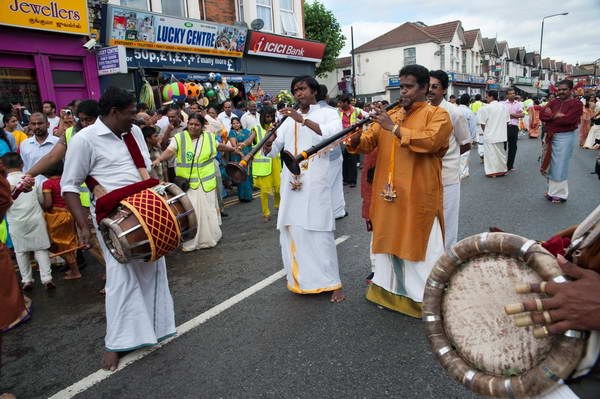
A group of musicians walked in front of the chariot stopping occasionally to play.
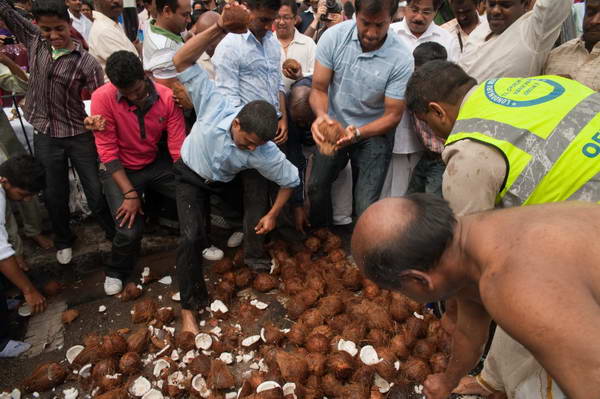
Men walking with the chariot carried short heavy knives which were used to halve the coconuts offered for blessing, and at several places along the route groups of men stood and threw large numbers of coconuts onto the road to smash.
Things began to get a little frenzied as the chariot came back in sight of the temple after around four hours going around the street, with people crowding around anxious to have their plates and bowls of fruit blessed.
Eventually the chariot turned into the large temple yard. I followed it in there and took a few more pictures. There was a very long queue for food and I left for home.
I put many of the pictures I took onto My London Diary and it was very hard to choose which to put in this post. You can see the others at London Sri Murugan Chariot Festival.
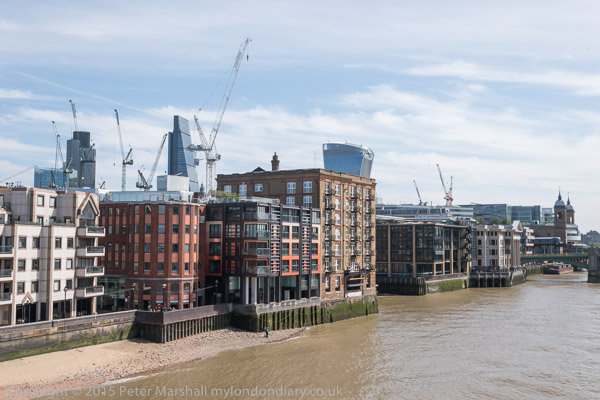
Gallery Protests, Sikhs, Kashmiris, Kurds, Sewol, Sotheby’s & Black Lives Matter: Saturday 15th August 2015 was probably the day I photographed more events than any other day, covering a total of 8 protests as well as taking a few pictures of London as I travelled around.
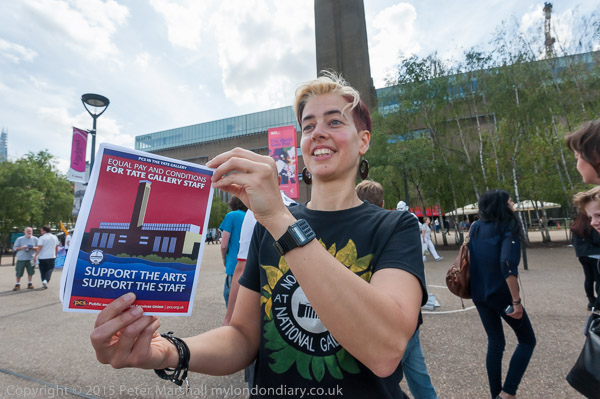
Handing out fliers at Tate Modern wearing a sunflower T-shirt supporting the National Gallery strikers
It was the 61st day of the PCS strike against privatisation at the National Gallery, and at Tate Modern staff were handing out leaflets calling for staff who had already been outsourced to get the same pay and conditions as directly employed workers.
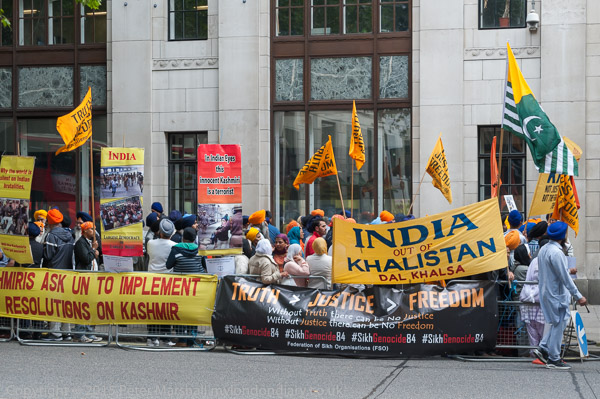
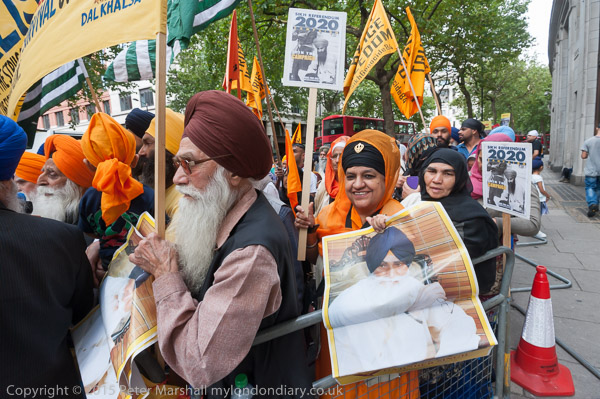
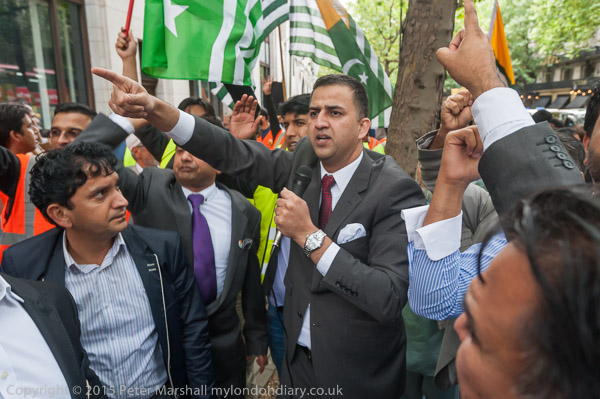
It was Indian Independence Day, and outside India House I photographed Sikhs calling for the release of political prisoners and Kashmiris calling for freedom.
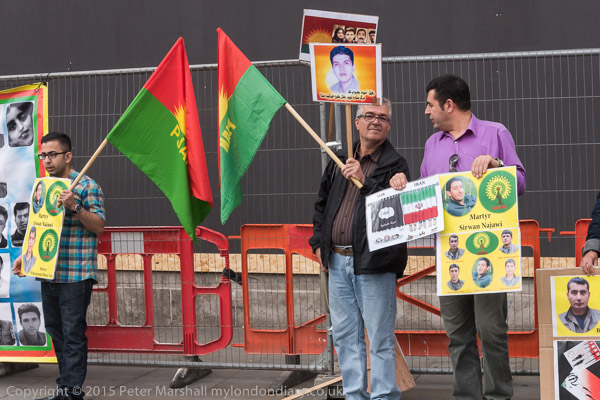
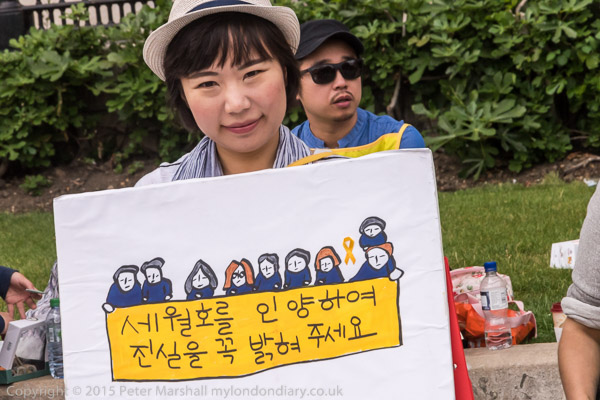
In Trafalgar Square Iranian Kurds remembered those killed in the fight for self-determination and a monthly silent protest remembered the Korean children killed when the Sewol ferry sank.
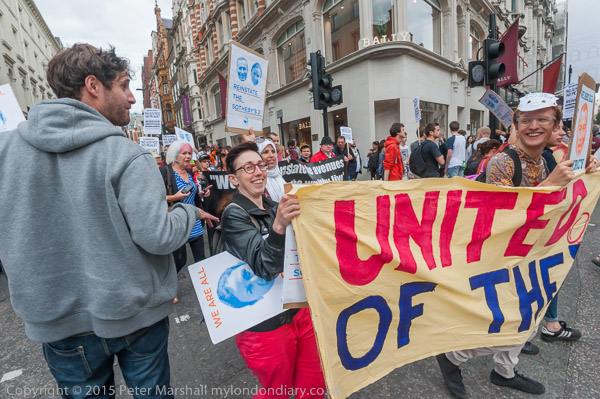
In Mayfair, United Voices of the World were protesting in the streets around Sotheby’s, calling for proper sick pay, paid holidays and pensions and demainding the reinstatement of two union members sacked for protesting.
Finally I went to Grosvenor Square for a protest close to the US embassy against the collective and systemic unlawful arrests and killings/attacks of black people in America.
You can read and see more pictures from all of these events – and a few pictures of London on My London Diary. Here I’ll post very short introductions to the events with a picture and a link.
National Gallery 61st day of Strike – Trafalgar Square
Cindy Udwin, PCS rep at the gallery, sacked for her union activities. The strikers were determined to get her re-instated – and eventually did
A short rally ended the daily picket on the 61st day of the PCS strike against privatisation at the National Gallery, with speeches and messages of support.
Vicky of Equalitate holds up their flyer calling for equal pay and conditions
Privatised visitor assistants at Tate Modern & Tate Britain get £3 an hour less than directly employed colleagues, are on zero hours contracts and do not get the same employment rights.
Sikhs call for release of political prisoners – Indian High Commission
On Indian Independence Day, Sikh protesters from Dal Khalsa supported the call by hunger striker Bapu Surat Singh for the release of Sikh political prisoners and for the ‘2020’ campaign for a referendum for an independent Sikh state, Khalistan.
Kashimiris Indian Independence Day call for freedom – Indian High Commission
Kashmiris protested at the Indian High Commission on Independence Day, observed as ‘black day’ in Indian military occupied Kashmir. They want freedom for their country, now a disputed territory with areas occupied by India, Pakistan and China.
Kurdish PJAK remembers its martyrs – Trafalgar Square
Iranian Kurds from the Party of Free Life of Kurdistan (PJAK) remembered its fighters killed in the fight against Iran and ISIS for self-determination.
The monthly silent protest remembered the victims of the ferry tragedy, mainly school children who obeyed the order to ‘Stay Put’ on the lower decks as the ship went down.
United Voices – Reinstate the Sotheby’s 2 – Mayfair
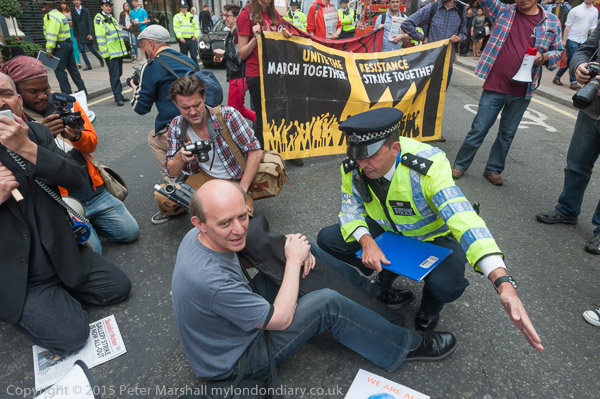
A police office tells Sandy Nicoll to get up and off the road with no success
The United Voices of the World marched noisily around the block at Sotheby’s demanding reinstatement of Barbara and Percy, cleaners sacked for protesting for proper sick pay, paid holidays and pensions. Several police attempts to clear the road and stop them failed.
BlackoutLDN solidarity with Black US victims – Grosvenor Square
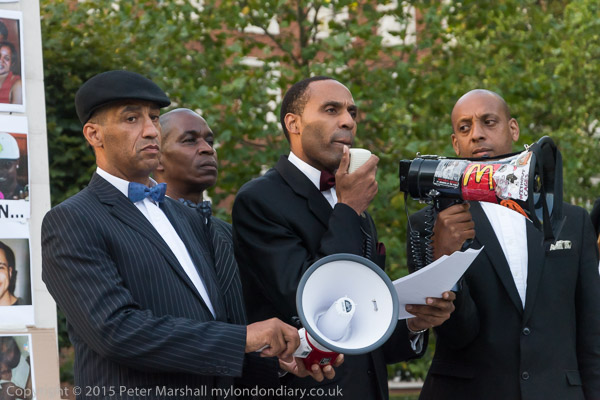
Bro Jeffrey Muhammad of the Nation of Islam speaking about police targeting attacks on the Black community in the UK
Two young women, Kayza Rose & Denise Fox, had organised a peaceful protest under the statue of Franklin Delano Roosevelt, close to the US embassy, in solidarity with events across the US against the collective and systemic unlawful arrests and killings/attacks of black people in America.
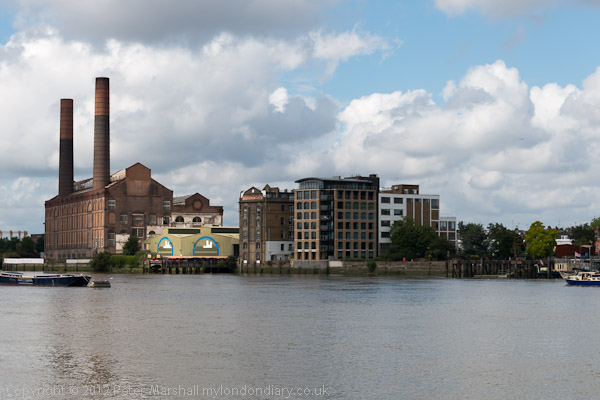
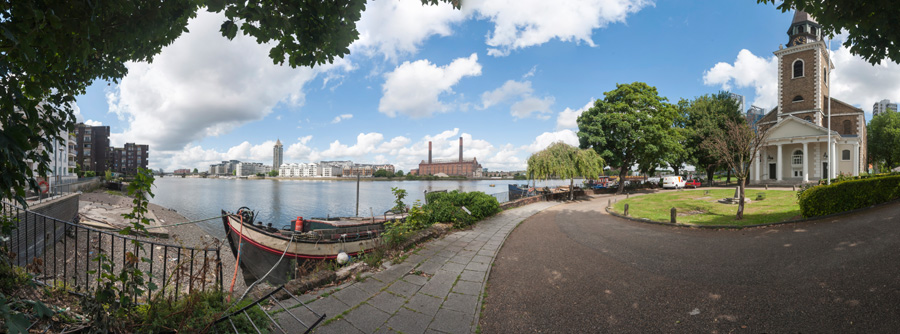
Battersea Riverside. The short walk from Battersea Bridge to Wandsworth is one I’ve done quite a few times over the years. For most of the walk you can now keep to the riverside, with views across the Thames, though a few short detours are needed. It’s on of my favourite walks in London and only a couple of miles, though if you want a longer walk it is now part of the Thames Path so you can continue for many miles either upstream or down.
Lots Rd
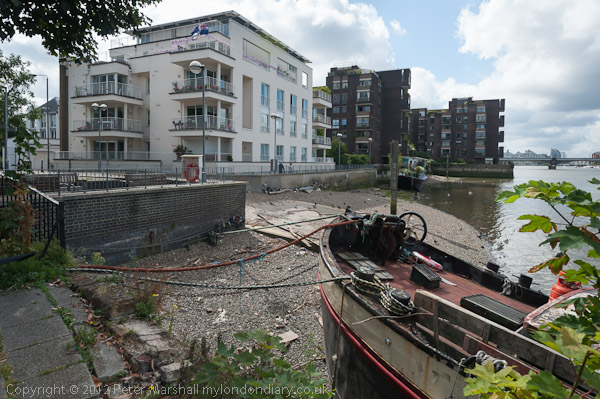
When I first made this walk in the 1970s the riverside was lined with industry and I could only access the river at a few locations. By 2012 the industry had almost all gone and there were blocks of private flats along most of this length. But ‘planning gain’ meant a riverside path even if it was lined behind by planning loss.
Thames at BatterseaSt Mary’s BatterseaOld Swan Wharf
People have to live somewhere and London needed extra housing, though almost all of these new developments were the wrong kind of housing and not the social housing desperately needed by Londoners. Back in the early post-war years we saw social housing being built to provide mixed communities and promote social cohesion, but Thatcher changed all that, and social housing became something only for the poor and that stigmatised residents as failures.
Overground train on its way to Clapham JunctionDemolition at Fulham WharfNew Flats and Wandsworth Bridge
The loss of industry also meant the loss of jobs in the area, and took place at a time of increasing gentrification in Battersea, with people moving in who worked in wealthier parts of the city.
Looking upstream from Wandsworth Bridge
As I wrote in 2012, “Every time I walk it a little more has gone with a new block of flats or hotel or other luxury development. But a few things remain.”
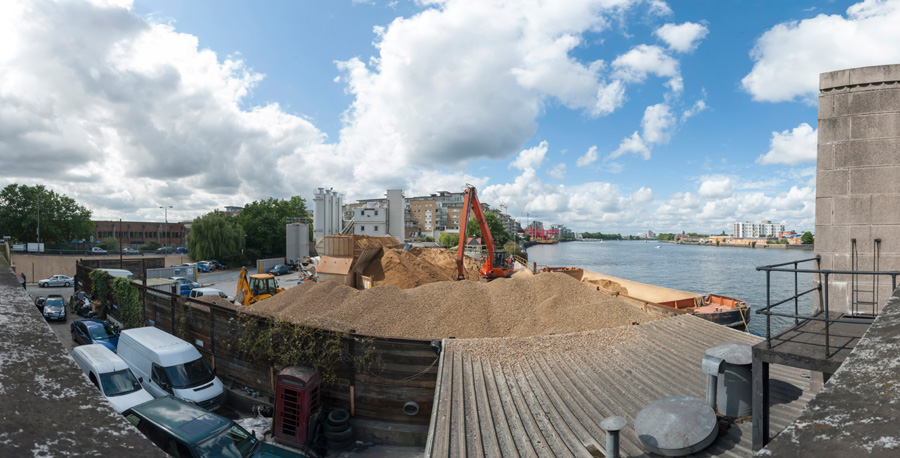
Waste transfer station, Wandsworth
You can see the panoramic images larger by right clicking on them and choosing Open Image in New Tab’ More pictures on My London Diary at Battersea Riverside.
Macleans Toothpaste, Great West Rd, Brentford, Hounslow, 1990, 90-1g-03
Toothpaste in my youth came as dentifrice, a usually pink powder or block in small tins, around 7 or 8 cm diameter and 2 cm tall, and Macleans had a patent aluminium tin. In my home we only changed to toothpaste in tubes at some time in the 1950s, but we could have been behind the times. And we used Gibbs Dentifrice, not Macleans.
Macleans was begun by a New Zealand born businessman, Alex C. Maclean in 1919, and moved into this splendid new factory on the Great West Road in 1932. The company was bought by Beechams in 1938 and later was swallowed up as a part of GlaxoSmithKline or GSK. You can still apparently get Macleans toothpaste though it bears little relationship to the orginal product and is now produced by Haleon
Macleans, Great West Rd, Brentford, Hounslow, 1990, 90-1g-04
The centenary of the Great West Road is celebrated in the book The Great West Road: A Centenary History by James Marshall, so far as I know not a relative of mine. “For two miles, from its junction with the North Circular Road and Chiswick High Road to Gillette Corner, a corridor of inter-war factory buildings emerged, a stylish celebration of art deco architecture.”
Macleans, Great West Rd, Brentford, Hounslow, 1990, 90-1g-61
Unfortunately many of the buildings have now gone, Trico and Macleans among them, although a few of the grander survive. I think I knew when I took these pictures two years before the business moved that these would shortly be demolished.
Trico, 980, Great West Rd, Brentford, Hounslow, 1990, 90-1g-51
The Trico Products Windscreen Wiper factory, No. 980, Great West Road, Brentford opened in 1928, three years after the new road was opened by George V in 2025 as the Brentford by-pass. Trico relocated to Pontypool, South Wales in 1992 and the building was demolished.
Certainly I took more pictures of these buildings than the others along this stretch of road, about three times as many as are in this post, though most of the rest are fairly similar to these.
Trico, 980, Great West Rd, Brentford, Hounslow, 1990, 90-1g-52
In the 1980s there was still little general appreciation of Art Deco or moderne buildings from the 1920s and 1930s and few had been give the protection afforded by listing. The most celebrated case of demolition was the Firestone Tyre Factory which had closed and been sold to Trafalgar House, a company run by Lord Victor Matthews and Nigel Broakes on 22nd August 1980.
A Department of the Environment inspector had the same week decided the building should be listed, but as it was the Bank Holiday weekend no civil servant was available to sign the emergency listing document. “On Saturday 23 August Lord Matthews ordered demolition men to destroy the main features of the facade – the ceramic tiles around the entrance, the white pillars, the pediment above and the bronze lamp standards.” And so one of the finest buildings on the stretch was destroyed.
Trico, 980, Great West Rd, Brentford, Hounslow, 1990, 90-1g-54
Victor Matthews, who as well as being Chairman of Trafalgar House was the proprietor of the Daily Express, had been made a Life Peer as Baron Matthews of Southgate a month before this despicable act of cultural vandalism.
Grand Union Canal, Trico, Great West Rd, Brentford, Hounslow, 1990, 90-1g-56
The canal which had been so important in earlier Brentford history was irrelevant to the companies which now set up along the new road. They were entirely based around road transport and very much used their impressive frontages as advertisements for their businesses to those driving along the new highway.
Grand Union Canal, Trico, Great West Rd, Brentford, Hounslow, 1990, 90-1g-41
More from other buildings along the Great West Road in the next instalment.
More Ponders End, Enfield Wash, Palmers Green & Brimsdown: Back in 1994 my main focus was on black and white images, some of which I was selling or putting into libraries. I was taking colour on colour negative film and my work was all ‘personal’, with a few being printed for exhibitions.
So while I kept fairly careful records of the black and white images, keeping a diary and annotating the contact prints I made far less documentation for the colour work. Images were filed in sheets which were numbered often for the month I developed them rather than when they were taken and there was no urgency to develop colour film, doing so in batches sometimes covering film from several months.
Here I’ve tried to present the images in the order they were taken. They come from a whole set of walks around parts of Enfield in the early months of 1994, though I think the first may haven been taken in December 1993.
Mural, Palmers Green, Enfield, 1994, 94-03-1-21
The previous post, Ponders End, Brimsdown, Enfield Wash & Waltham Cross – 1994, included some pictures from the same months, including a panorama made at the same place as one of the images here. I think these pictures speak for themselves so I’ll write nothing more about them.
Back to the Future, Bus, Brimsdown, Enfield, 1994, 94-03-1-23
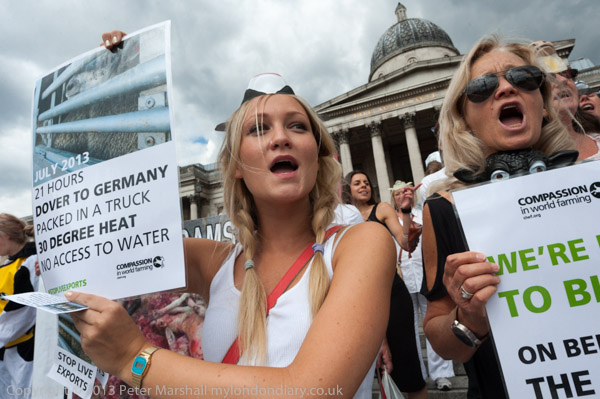
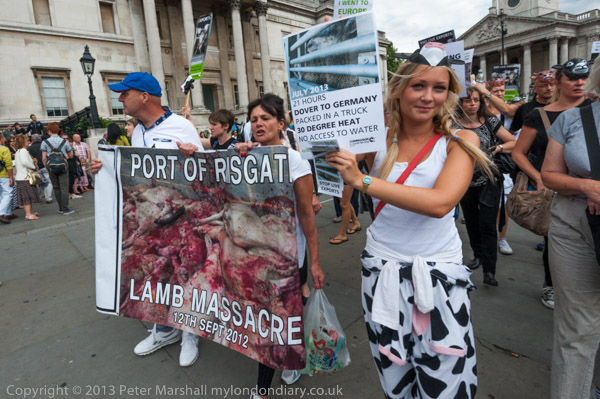
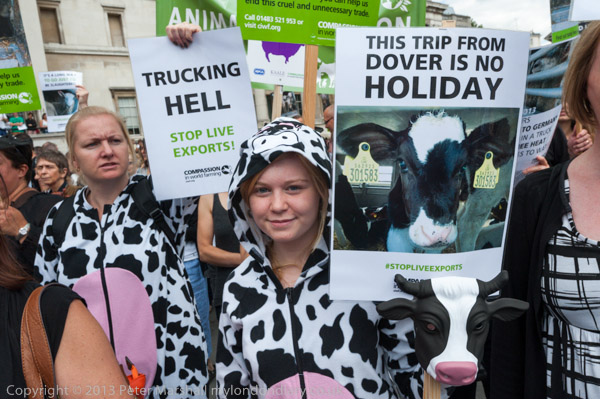
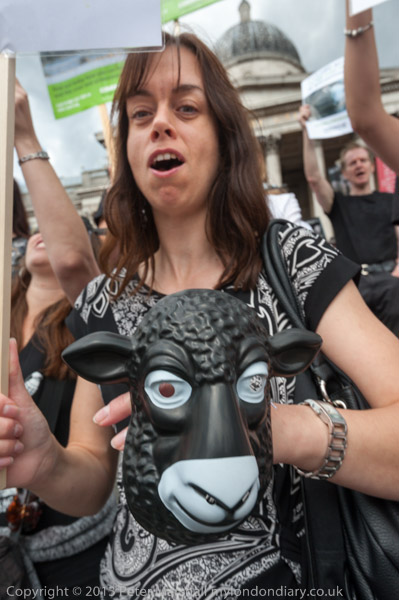
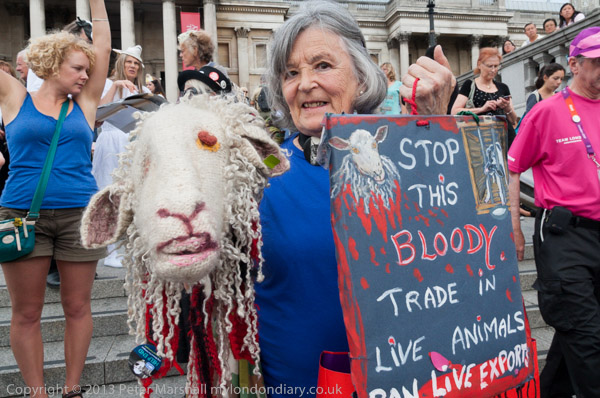
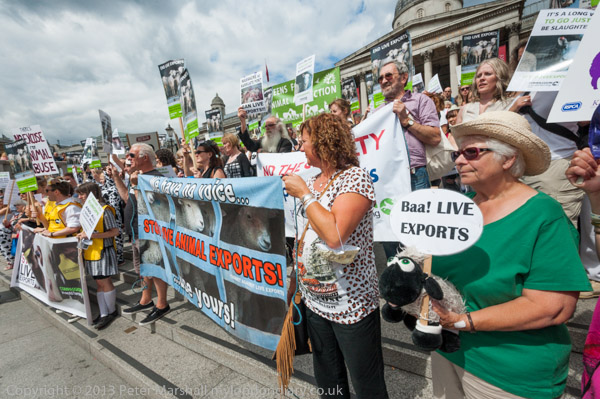
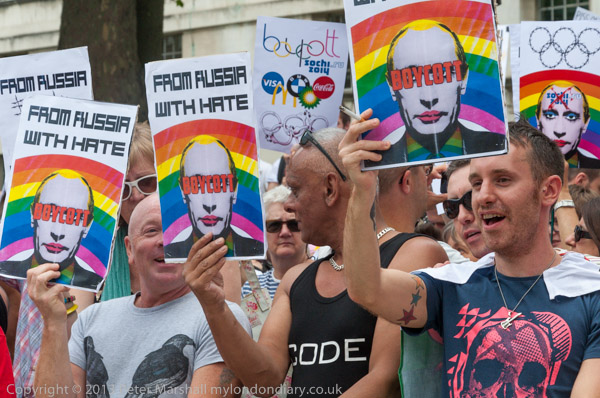
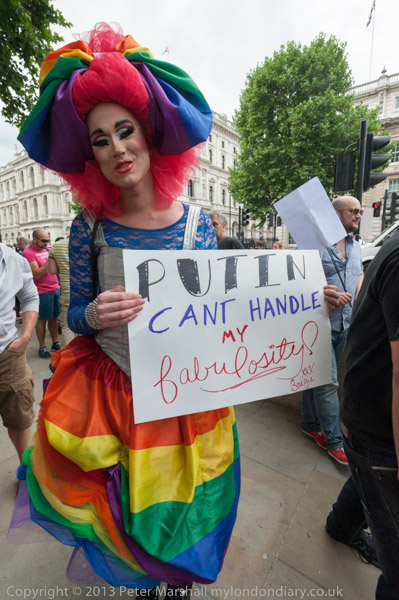
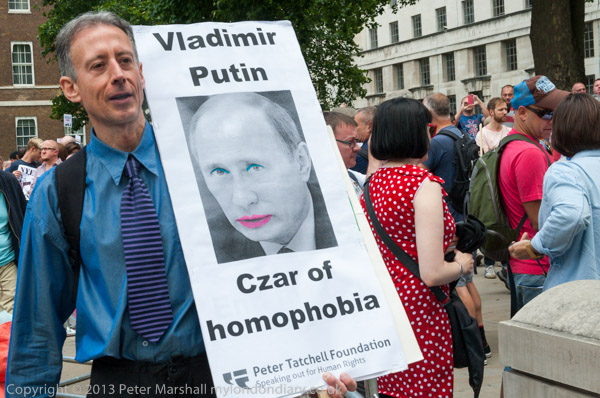
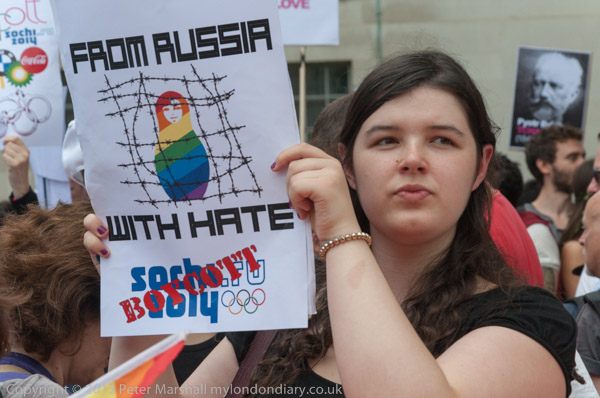
Frack Off, Animal Exports & Hands Off Queers! On Saturday 10th August 2013 I went to Trafalgar Square for a small anti-fracking protest, took a few more pictures there and met a march from Covent Garden against live animal exports which ended with photographs on the Trafalgar Square steps. Then I made a short walk down Whitehall to photograph a protest against the homophobic policies of President Putin.
Frack Off – Trafalgar Square
Protests were continuing at Balcombe, a small village in West Sussex, against test drilling and possible fracking for oil there by Cuadrilla, and a small group had come to Trafalgar Square to support their protests.
I took a few pictures and then wandered around the square a bit and missed them when they left to protest at Downing Street. Although a fracking ban later ended Cuadrilla’s attempts, Balcombe is still under threat from drilling for oil by another company, and legal battles continue.
I took a few pictures as I walked around Trafalgar Square, some including the blue cockerel then standing on the fourth plinth. It was hard to imagine why “Hahn/Cock” by German artist Katharina Fritsch had been selected other than to provide material for jokes, including many about us not needing another massive cock in London as we already had our then Mayor.
Trafalgar Square seems now more often to be used for religious events than political protest, and one of these was just starting, with a white-clad gosspel choir. But as I commented, “Nice hats, but some seem to have taken singing lessons from Florence Foster Jenkins” and I hope they got better after they had warmed up.
I was hanging around in Trafalgar Square waiting for a march by Compassion in World Farming against the live export of farm animals. I knew it was starting from Covent Garden but stupidly I hadn’t bothered to find out its route so I could meet it on the way.
Live exports take place under the 1847 UK Harbours, Docks and Piers Clauses Act 1847 which prevents public ports in Britain from refusing to export live animals as a part of the “free trade” in goods.
But EU law has recognised animals as sentient beings rather than “goods” since 1999, and different rules and regulations should apply to them.
In 2012, over 47,000 young sheep and calves were crowded into lorries for long journeys from as far afield as Wales and Lincolnshire across the channel to France, Germany, the Netherlands and Belgium. The journeys inflict great suffering on the animals concerned with animals having no access to water and with temperatures inside the are often 30 degrees or more, and they are sometimes confined for 80 hours or more.
In 2012, 45 sheep died in a lorry at Ramsgate that had previously been declared several times unfit for use.
The marchers defied attempts by the Heritage Wardens to stop them posing on the wide steps in Trafalgar Square for photographs at the end of the march.
Tamil Festival & Brentford Walk: On the morning of Sunday 8th August 2010 I photographed the annual Chariot Festival from the Tamil Hindu Temple in West Ealing and in the afternoon went for a walk in Brentford.
Tamil Chariot Festival in West Ealing
Men wait with coconuts outside the temple, ready to roll along the road
The annual Chariot Festival from the Tamil Shri Kanagathurkkai Amman (Hindu) Temple at a former chapel in West Ealing comes close to the end of their Mahotsavam festival which lasts for around four weeks each year.
In it a represtentation of the Temple’s main goddess Amman (Tamil for Mother) and priests are dragged around the streets on a large chariot pulled by men and women on long ropes.
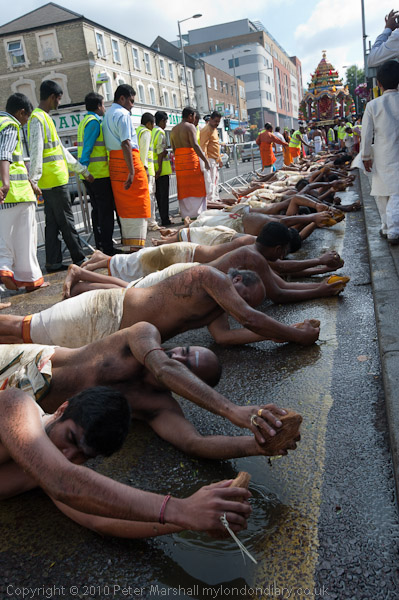
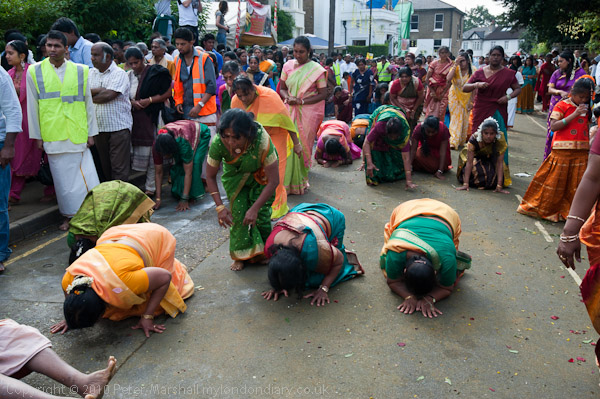
Behind them around 50 men naked from the waist up laid down on the street holding a coconut in front of them and rolled their bodies along the street for the half mile or so of the route. Men and women came and scattered Vibuthi (Holy Ash) on them. Following them were women who prostrated themselves to the ground every few steps.
From the Temple in Chapel Street the procession, led by a smaller chariot made its way along Uxbridge Road in the bus lane. People crowded around the chariot holding bowls of coconut and fruits (archanai thattu) as ritual offerings (puja) to be blessed by a temple priest.
To photograph the event I had – like those taking part – removed my shoes and my feet were soon soaked in coconut milk from the many cut open or smashed on the ground. Coconuts play an important role in many Hindu rituals and are a major product of the Tamil areas of India and Sri Lanka and many sacks of them were broken in the festival.
Further back in the procession were male dancers, some with elaborate tiered towers above their heads. Others had heavy wooden frames decorated with flowers and peacock feathers, representing the weight of the sins of the world that the gods have to carry; they had ropes attached to their backs by a handful of large hooks through their flesh. They turned and twisted violently as if to escape from the ropes, held by another man.
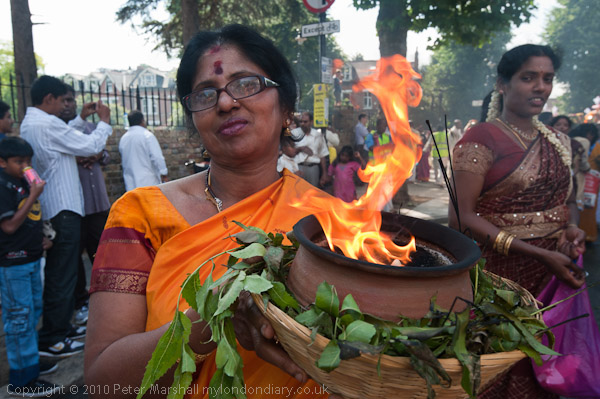
Women walked with flaming bowls of camphor which burns with a fairly cool flame and leaves no residue with others behind them carrying jugs on their heads.
The festival raises funds for various educational projects for children that the temple sponsors in northern Sri Lanka and other charitable projects in Sri Lanka devastated by the civil war and had sent more then £1.3 million in the previous ten years.
I left the festival, dried my feet as best I could, put on my socks and shoes and caught at bus to Brentford.
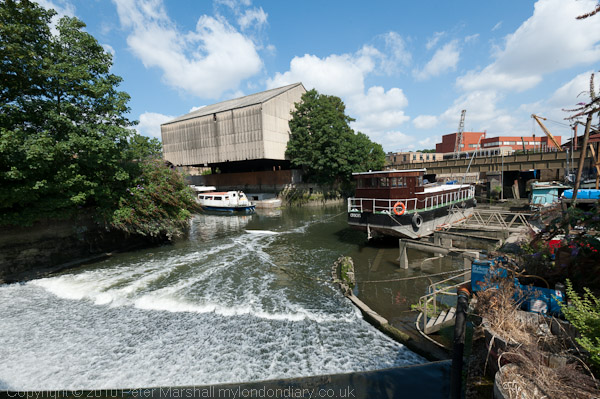
Overflow from the canal takes the River Brent to the Thames
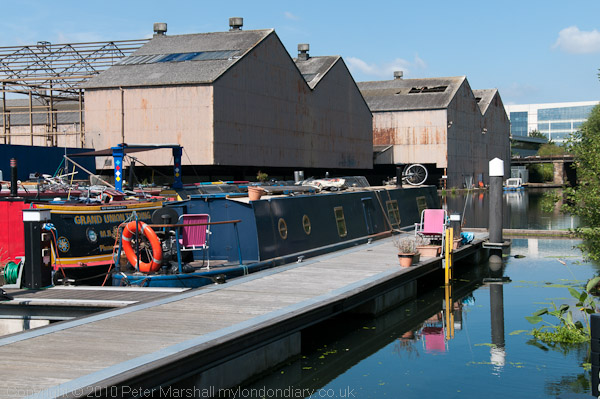
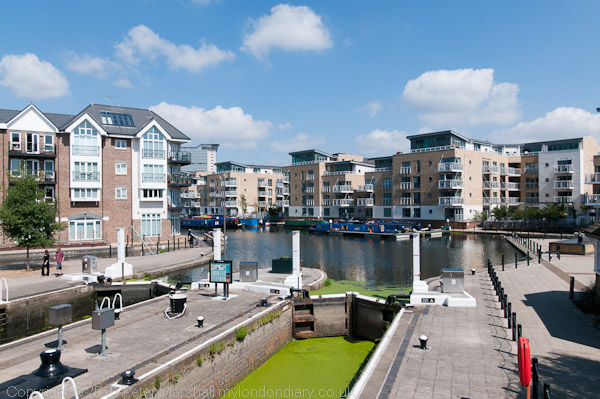
When I was young and lived not far away Brentford was an important canal port, the junction of the Grand Union Canal (also here the River Brent) with the River Thames. The docks by the Thames were now a private housing estate and by 2010 almost all of the British Waterways sheds had gone, replaced by blocks of flats.
Past the recent moorings were the last remaining loading sheds
But the canal and the locks are still there, along with the small docks and some of the boat repair businesses. Little is visible from the High Street except where it goes over the canal, but despite extensive redevelopment in the 1990s – and more going on now – it remains an interesting area to walk around.
From the footbridge over the Brentford gauging locks
I’d photographed a little in the area back before much redevelopment took place, and more extensively in the 1990s. On line you can see some pictures from 2003 when some of the more recent development was starting. And I’ve returned a few times since this walk in 2010 and you can find more pictures if you search on My London Diary.
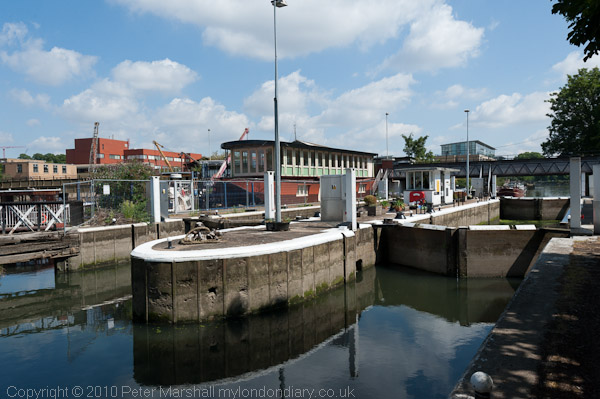
Thames Lock, connecting the canal system to the River Thames
As I noted in 2010, “Much of the walk that I took is now a part of the Thames Path, though it isn’t always well signposted, and some of the more interesting parts are a short detour away.”
Broadwater Farm & Mark Duggan: On Sunday 4th August 2017 I went to Tottenham to cover the march on the 6th anniversary of Mark Duggan being killed by police, and arriving early I took a walk around the Broadwater Farm Estate.
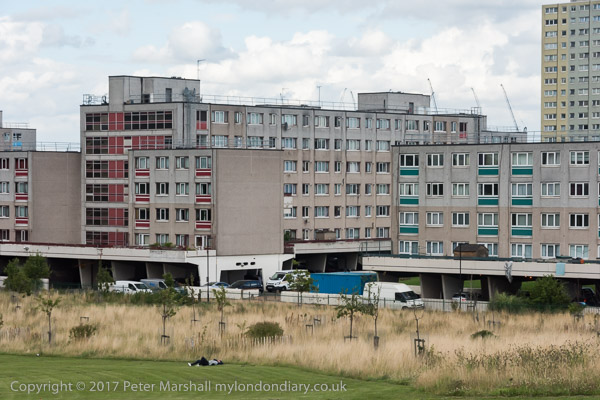
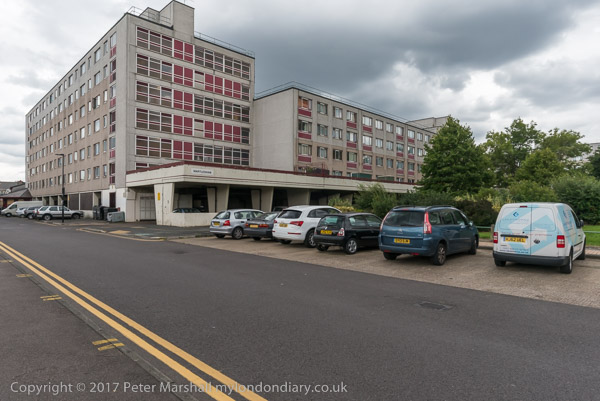
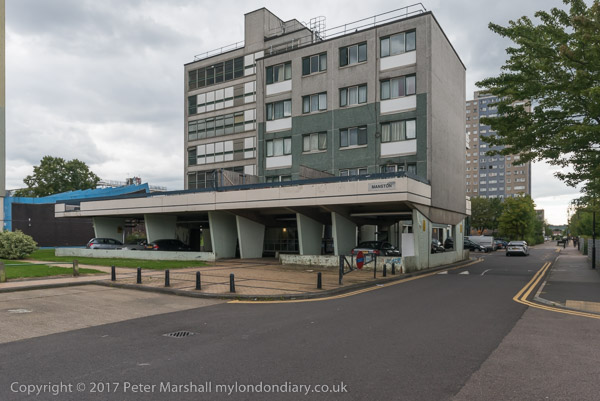
Broadwater Farm Estate – Tottenham
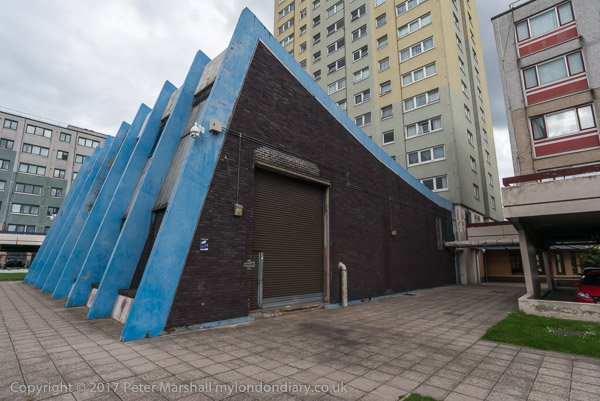
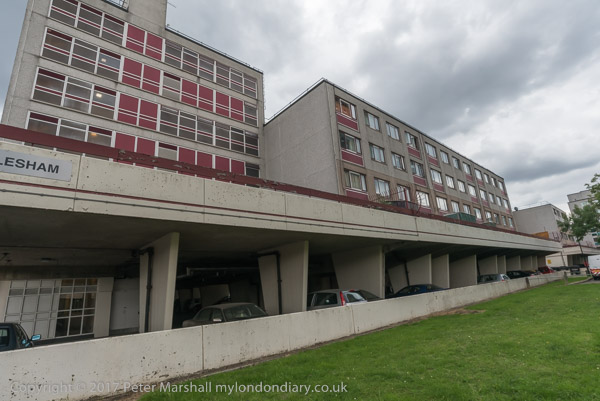
You can read the real story of the Broadwater Farm Estate on the excellent Municipal Dreams web site. In 1961 Haringey Council had a shortfall of 14,000 homes with many families living in squalid conditions in rented accommodation in overcrowded and run down Victorian back to back slums.
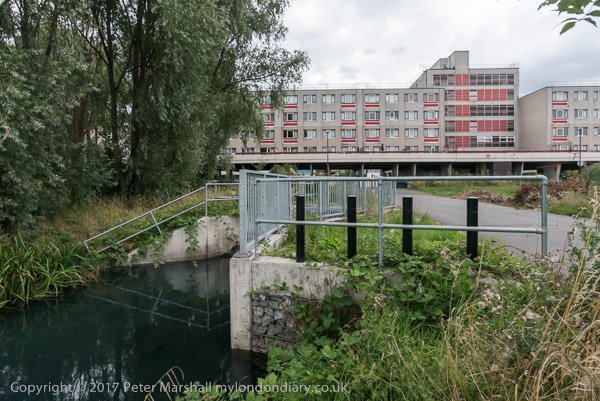
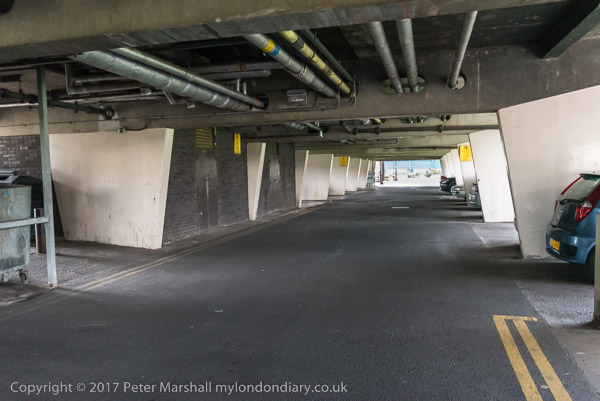
The estate was built on former allotments next to the Lordship Recreation Ground and above the River Moselle which was culverted. Its design was strongly influenced by the work of Le Corbusier and used ‘piloti’ to raise the homes above ground level both to combat the perceived flood risk from the river and to segregate pedestrians from traffic on walkways with the the ground level providing extensive parking for residents’ cars.
Construction began in 1967 and ended in the early 1970’s. The 1063 new homes were built to high standards, spacious and with all the ‘mod cons‘ expected in that era and with ‘constant hot water for heating and domestic use…supplied to all homes from the central oil-fired boiler’.
There are large green spaces between the blocks which were named after RAF wartime airfields
Things didn’t work out quite as expected, and although people were delighted at first, problems soon emerged. Flat roofs leaked, the heating system proved inefficient and noisy and there were cockroach infestations, lift breakdowns and fires of rubbish.
The huge parking spaces under the buildings were underlit and hidden from sight and “physically created a concrete ‘underworld’ for crime to thrive” and the many pedestrian walkways proved ‘impossible to police‘.” There were racial tensions too – the Tenants’ Association initially excluded black members and “its president was forced to resign in 1974 after a TV appearance speaking on behalf of the National Front.”
It became harder for the council to find tenants for the flats and the estate became a ‘dumping ground’ for difficult and disadvantaged tenants. In 1979 it became part of the government’s Priority Estates Project and Haringey council and the estate residents had mobilised to improve things. By 1984 homes were no longer hard to let and crime had been much lowered.
But policing was increasingly a problem, with many residents experiencing “heavy-handed and oppressive policing“. Things – as a second post on Muncipal Dreams details – came to a head after police raided the home of Cynthia Jarrett close to the estate looking for her son Floyd, a leading member of the Broadwater Farm Youth Association (BFYFA). She died of heart failure during the raid, and the following day, Sunday 6th August 1985, protesters set out from the estate to march for a peaceful protest outside Tottenham Police Station.
They were met and stopped by police in full riot gear, who sealed off all routes from the estate and a seven-hour riot began. As I wrote in 2017 “more and more police came into the estate with firefighters who put out a small fire. Faced by increasing attacks from residents the police withdrew, but two officers failed to escape. PC Richard Coombes was seriously injured and PC Keith Blakelock was beaten and hacked to death.”
After the disturbances shops were moved down to Willan Rd
Municipal Dreams continues: “A full-scale state of siege followed. Four hundred police officers occupied the Estate over the following weeks and some 270 police raids took place over the next six months. Some 159 arrests were made.” The inquiry into the disturbances at Broadwater Farm concluded that it “was essentially about policing – police activity and police attitudes.“
Work to improve the estate continued, helped in 1986 by a £33m grant from the Government’s Estate Action programme which enabled huge changes to the structures, eventually removing the walkways and bringing life to the ground level and with the BYFA leading improvements in the environment. By 2003 dit had become “a stable and safe community.”
The shooting of Mark Duggan, raised on the estate, by police on 4th August 2011 led to another march from Broadwater Farm to Tottenham Police Station three days later which sparked riots on Tottenham High Road and other areas of London and other towns and cities. Broadwater Farm was not the cause of these disturbances, which again were largely provoked by “a widespread resentment of police behaviour.“
Improvements to the estate continued after this but it is now under threat from further so-called regeneration which would see it “as ‘improved’ by importing middle-class owner-occupiers and private renters.“
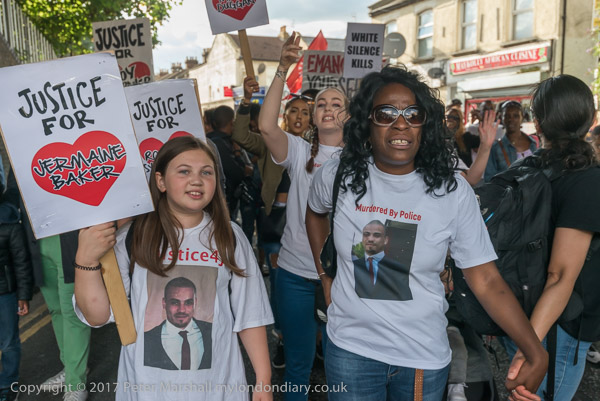
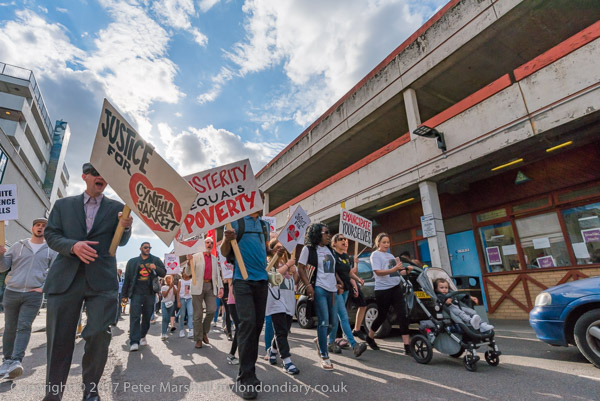
People met on Willan Road in the centre of the Broadwater Farm Estate for a peaceful march to a rally at Tottenham Police Station on the sixth anniversary of the shooting of Mark Duggan by police. The marchers included members of his family and the family of Jermaine Baker, shot dead by police on 11th December 2015 in Wood Green.
Baker was unarmed and although a public inquiry found there had been a failings in the police operation that his killing was lawful and no criminal charges would be brought against any police officers although one would face gross misconduct proceedings.
Mark Duggan’s shooting had been accompanied by various false reports from the police and officers gave contradictory evidence at the inquest, where finally after weeks of deliberation the jury in January 2014 returned an 8–2 majority verdict that his death was a lawful killing. Legal challenges to the verdict were later rejected but in 2019 Duggan’s family accepted a settlement of their civil claim from the Met.
Mark Duggan’s mother Pamela Duggan (centre) with family and friends
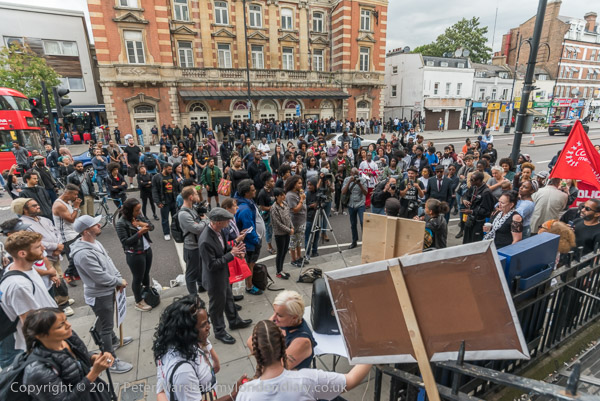
Speakers outside Tottenham Police station remembered the police killing of other members of the Tottenham community apart from Duggan and Baker – Cynthia Jarrett, Joy Gardner, Roger Sylvester, and the recent murders of Rashan Charles, Darren Cumberbatch and Edson Da Costa.
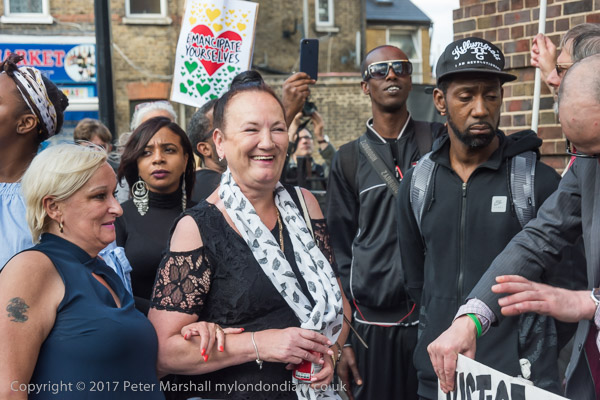
As well as a minute of silence, speakers from the two families and local activists including Stafford Scott there were also speeches from Becky Shah of the Hillsborough campaign and from the Justice for Grenfell campaign.
The crowd spread out into the street with a large group of mainly young men on the opposite side of the street
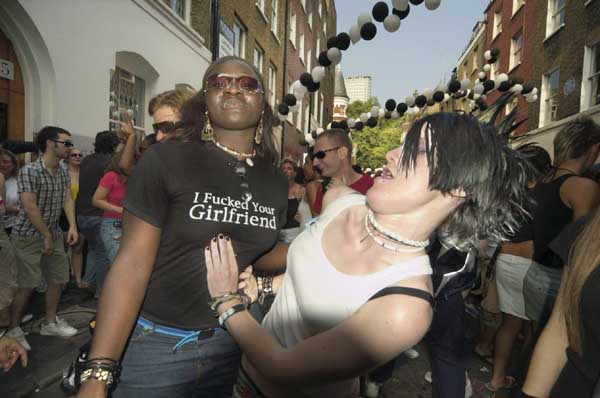
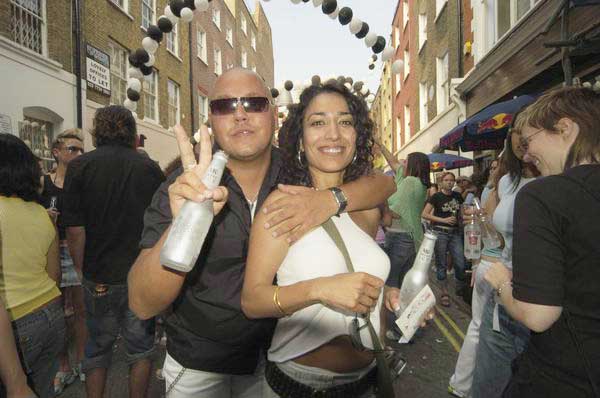
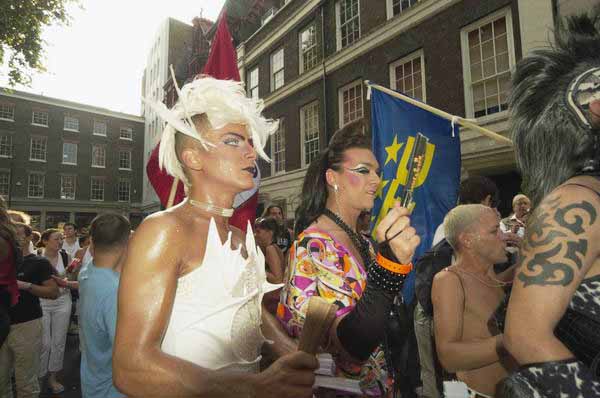
Soho Pride – 1st August 2004: Soho Pride was a festival celebrated in the streets around Old Compton Street from 2003-2008, a separate event from the annual London Pride parade which now takes over the whole area for after-parties on the day of the parade. You can read a little more about it # on the Historic England web site which has a “Self-Guided Virtual Heritage Walking Tour” 130 Years of Queer Soho (or thereabouts) which includes Soho Pride.
I paid the first Soho Pride a brief visit in 2003 on my way home from a busy 5th July after covering a protest calling for legal recognition of British Sign Language and the Somerstown Festival Of Cultures. There are just a few pictures of Soho and Soho Pride 2003 on My London Diary.
I spent rather longer at Soho Pride 2004, and here is what I wrote it on My London Diary – and all the pictures in this post come from the 2004 festival.
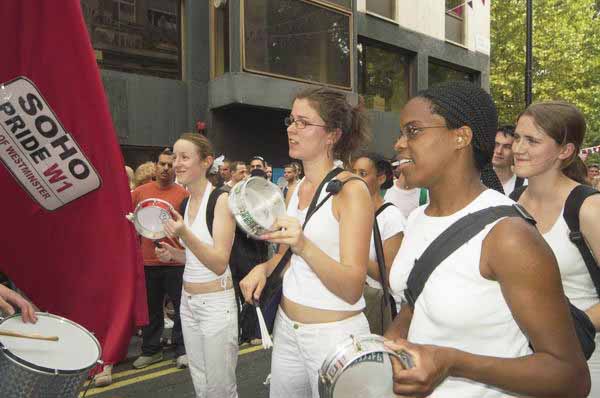
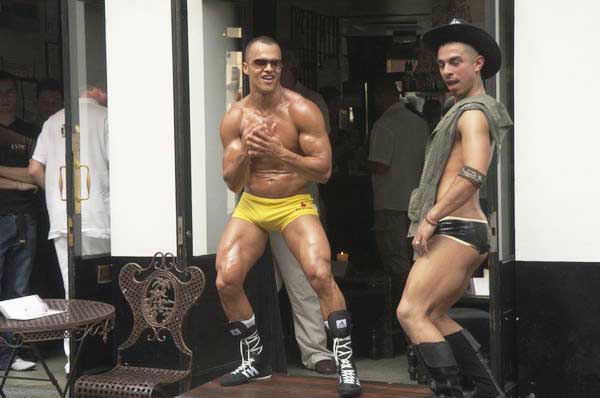
The first Soho Pride held last year was a great success, and this year's event followed the same pattern. Street closures, restaurant tables in the roadway, DJs and loud sounds, people out to eat, drink, dance and generally have a good time.
Even in mid-afternoon, the streets were beginning to get really packed, especially outside the more popular gay bars and around the club DJs.
Really it was one big party, and a party that catered for almost all tastes except in music, which was uniformly relentless club beats. Perhaps a pity that the Jazz On The Streets events had beat a retreat to Carnaby Street (surely forty years behind us with flower power.)
After a while I began to feel my age, and escaped to the Underground and home for a quiet and leisurely alfresco dinner with a few glasses of white wine.
Vantage London, Great West Rd, M4, Brentford, Hounslow, 1990, 90-1f-45
Built around 1970 as the 12 storey headquarters of Beecham Pharmaceuticals it was no longer needed after they became part of Glaxo Smith Kline and was refurbished as as Vantage London with offices let to a number of companies. The building was again refurbished in 2016 and in 2019 was sold to a Luxembourg based company for £30 million.
In 2024 a planning application was made by Resolution Property for its conversion into 178 flats. It was approved following some modifications in April 2025.
The elevated section of the M4 runs on top of the Great West Road in front of the building. The strucvture in the foreground is I think a gritting bin.
Great West Rd, M4, Brentford, Hounslow, 1990, 90-1f-35
Taken under the elevated M4 where slip roads link the A4 Great West Road with the motorway. One project I was working on at the time was inspired by J G Ballard’s 1973 novel ‘Crash’, key scenes of which were set in this area – although the 1996 film of the book by Cronenberg was made in Canada. Ballard who lived not far away in Shepperton obviously knew the area well.
Crash centres around a car crash victim who finds himself aroused by car accidents but my project was more simply about the domination of our culture by the car and I felt threatened by the powerfully enclosed architecture here which is perhaps a modern equivalent of the Roman coliseums, and was rather choked by the fumes.
On previous occasions I had photographed the iconic moderne 1930s buildings along the Great West Road, and this at right shows Beechams, which had this side entrance a few yards down Clayponds Lane. The factory building continues in a more utilitarian fashion but with a tall window, probably lighting a staircase which reflects the style.
Flats, Carville Hall, Carville Hall Park, Brentford, Hounslow, 1990,90-1f-22
The Carville Hall Estate was bought by Middlesex County Council in 1919 for the construction of the Great West Rd, and they sold the parts on both sides of the new road to Brentford UDC as a park, which opened in 1923. The house, orginally known as Clayponds, is now called Simmonds House. Originally built in the late 18th century, the front was re-modelled in the 19th century. It is locally listed.
The park is off Clayponds Lane and parts of it were once dug for clay, leaving ponds, marked as ‘Fishponds’ on the 1871 OS Map.
Lion, flats, Carville Hall Park, Brentford, Hounslow, 1990, 90-1f-23
Beyond the lion and the park are the tall blocks of the Brentford Towers Estate built for Hounslow Council in 1968-72.
The house here had extensive grounds and there is now a park on both sides of the A4/M4. The park to the north of the roads is larger than this but of little interest.
The house is thought to have been built for the “wealthy distiller and brewer David Roberts (c1733-97)” and was later home to “coal and horse racing magnate William Lancalot Redhead (c1853-1909) and his daughter“. It was later converted into flats.
Lion, Carville Hall, Carville Hall Park, Brentford, Hounslow, 1990, 90-1f-24
The fate of the lion appears to be a mystery. I was surprised on a later visit to find it no longer there and I’ve not been able to find what happened to it. The most I’ve come across is a suggestion that it was stolen.
I thought that it was probably a Victorian garden ornament made from artificial stone – Coade or Portland Stone etc – and would have been fairly heavy, so the thief would have needed a lorry with appropriate lifting gear.