Sri Guru Singh Sabha Gurdwara – Southall 2005

Sri Guru Singh Sabha Gurdwara: On Saturday 1st October 2005 I enjoyed a tour of the largest Sikh Gurdwara in Europe. Building had begun in 2000 and the temple opened at the end of March 2003. The tour had been arranged by art and urban historian Mireille Galinou for the now long-defunct and much missed group ‘London Arts Café‘ – and you can still read more about on the web site I wrote for it, although the group came to an end in 2008.
Sri Guru Singh Sabha Gurdwara - Southall  2005
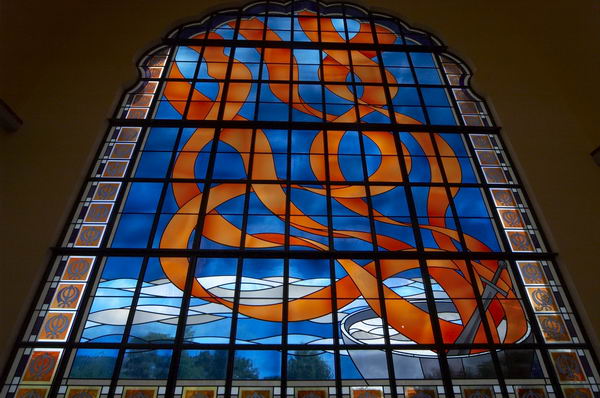
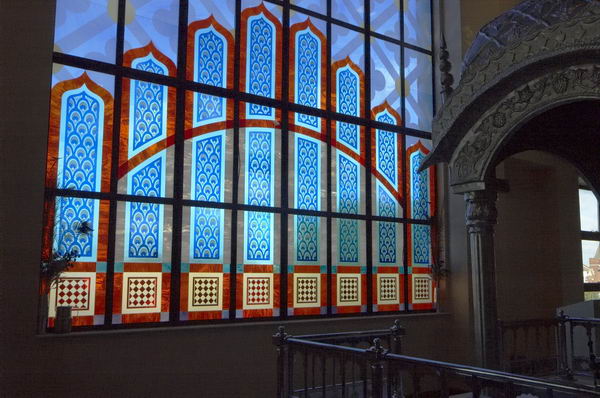
The use of stained galls is unusual in a Gurdwara

Here is what I wrote about the visit in 2005 and a few of the pictures I took at the Gurdwara – there are more on My London Diary.


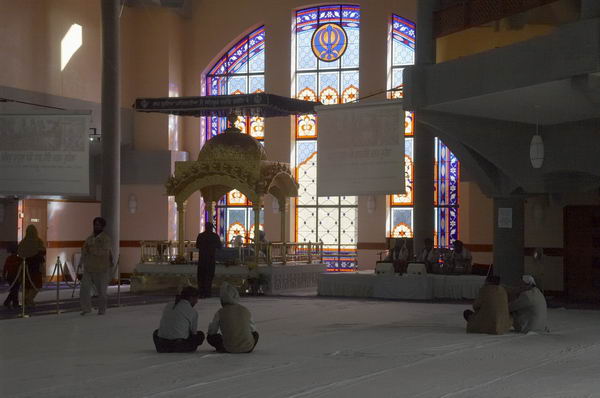
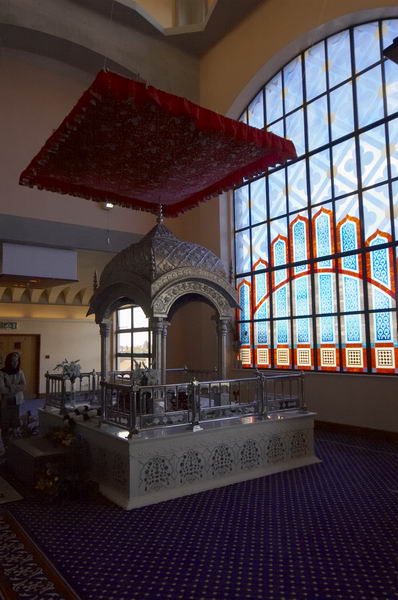
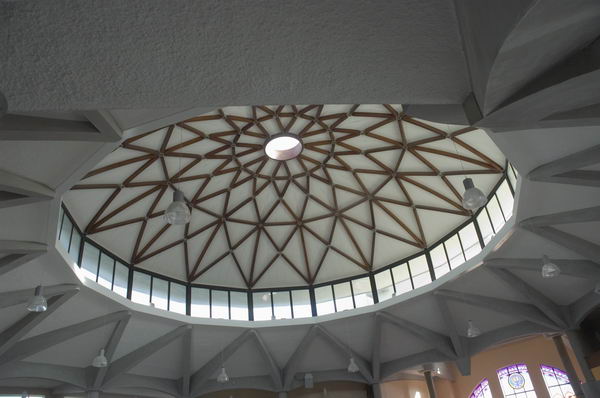
October started with a fine day, and I went to visit the largest Sikh Temple or Gurdwara in europe (and the fourth largest in the world) which opened a couple of years ago in Southall, along with a group of friends from the London Arts Café. We were shown around the building by one of the Sikh volunteer guides and also the architect, Richard Adams of Architect Co-Partnership, which had won the open competition to design the building. He had worked fully with the Sikh community to produce a building suited to their needs, and it does so impressively: clean simple surfaces, powerful colour in the windows and light streaming into the central stairway and lobby from the large window and glass roof areas.
Sri Guru Singh Sabha Gurdwara - Southall  2005
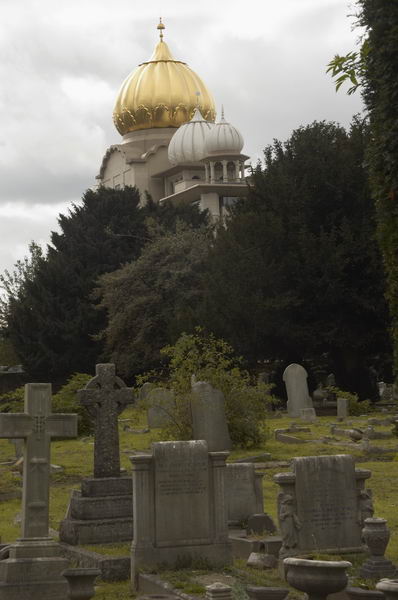
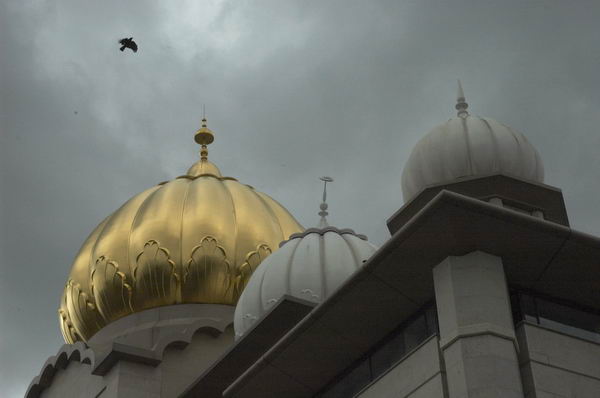
Gold leaf covers the main dome of the Gurdwara
Sri Guru Singh Sabha Gurdwara - Southall  2005
The Wedding Room
Sri Guru Singh Sabha Gurdwara - Southall  2005

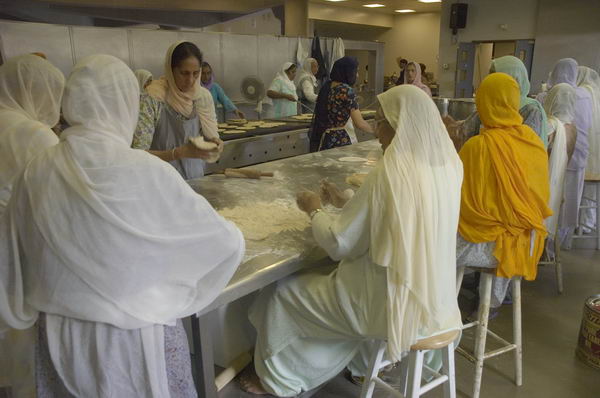
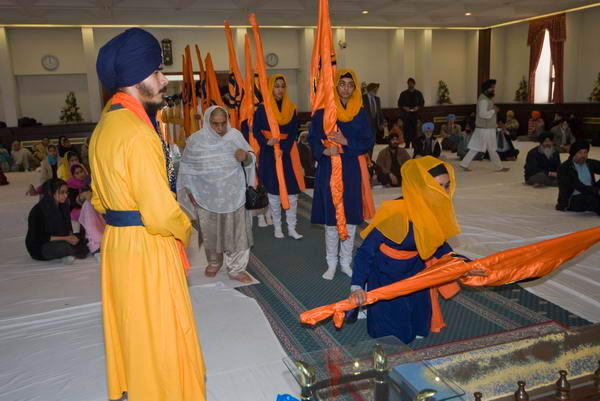
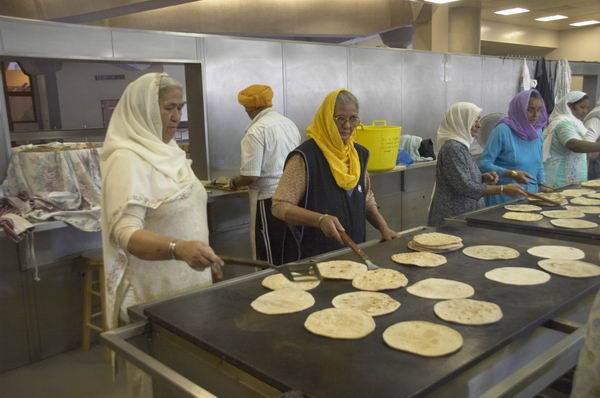
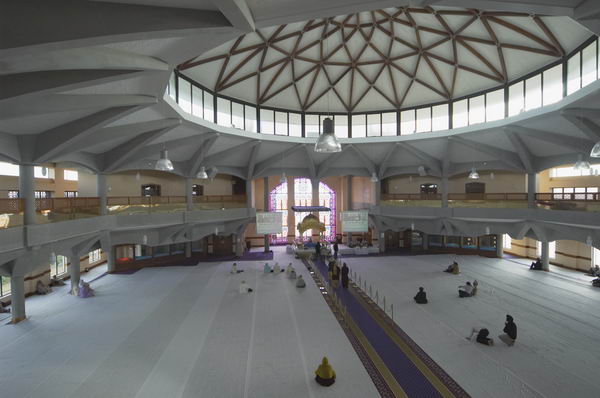
The Sri Guru Singh Sabha Gurdwara serves the community, both for workship and for other needs. As well as a vast prayer hall officially capable of seating up to 3,000 people (and actually holding rather more at major festivals) there is a fine marriage room, and various other facilities including a Langar (Dining Hall); this free community kitchen can serve over 20,000 vegetarian meals over a festival weekend.

Sri Guru Singh Sabha Gurdwara - Southall  2005
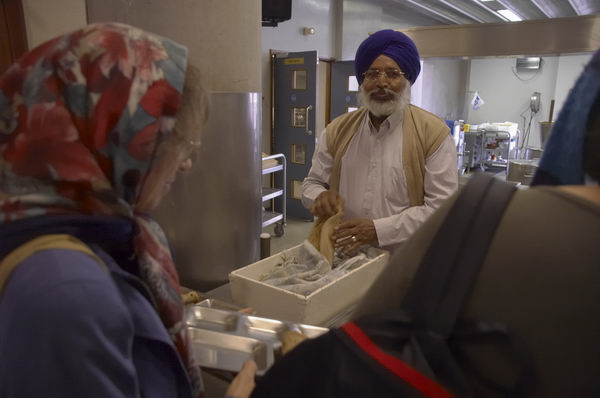
Preparing the vegetables
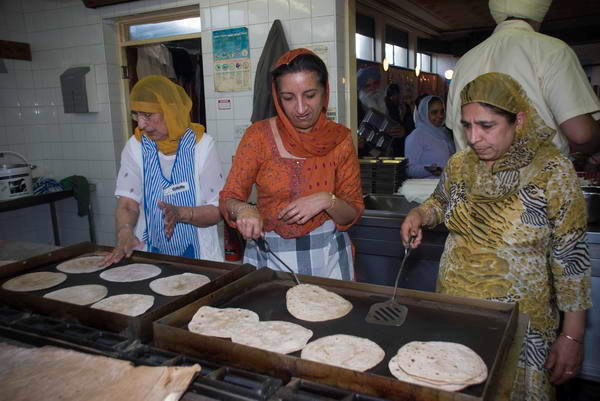
A team of women prepare pancakes

The Gurdwara had a powerfully religious atmosphere. On entering we followed the customary practice of removing our shoes, covering our heads with the scarves provided and washing our hands before commencing our visit.

The Prayer Hall

At various points both our guide and the architect explained how the building served the basic Sikh tenets of service, humility and equality, and also the spiritual guidance from the Sri Guru Granth Sahib, the religious writings which are were appointed as spiritual head of the Sikh religion, the Eternal Guru, by Guru Gobind Singh around three hundred years ago.

Musicians in the Prayer Hall

Although the architecture and the prayer hall in particular were impressive, what made the strongest impression on me was the kitchen, especially the team of women working together. The food was excellent, a real pleasure to eat, although my still rather painful knee made it easier for me to stand and eat at one of the tables rather than in the traditional manner seated on the floor. Although food is free, those eating may perform some service to the temple in thanks for their food, or give an donation of some kind, which we gladly did.

Southall is now Britain’s holy city, apparently with places of worship for over 50 religions or denominations. Brother Daniel Faivre’s ‘Glimpses Of A Holy City‘ published in 2001 after more than 20 years of living in Southall gives a good insight into some of this diversity.


Unfortunately Brother Daniel Faivre’s 104 page spiral bound book published in 2001 is no longer available. The Sri Guru Singh Sabha Gurdwara is, according to Wikipedia one of ten Sikh Gurdwaras in Southall, which also has two large Hindu ‘Mandir’ temples, six Mosques and “more than ten Christian churches including 5 Anglican, one Roman Catholic (St Anselm’s Church), Baptist, Methodist and several Pentecostal or Independent.” In the 2021 Census, 28.5% of the population were Sikh, 24.1% Muslim, 22.6% Christian 22.6% and 14.2% Hindu.

More pictures on My London Diary include some taken in Southall after leaving the Gurdwara.


FlickrFacebookMy London DiaryHull PhotosLea ValleyParis
London’s Industrial HeritageLondon Photos

All photographs on this page are copyright © Peter Marshall.
Contact me to buy prints or licence to reproduce.


Vaisakhi in Hounslow – 2008

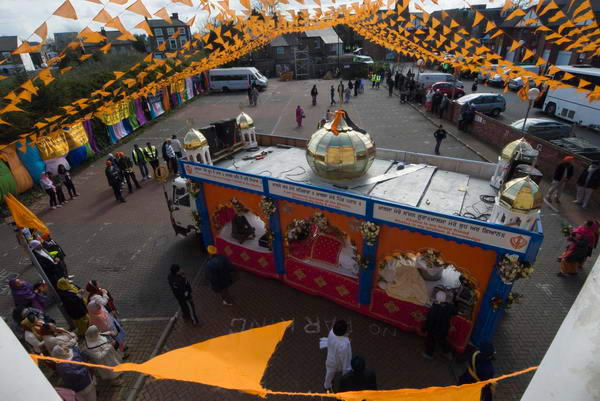
Vaisakhi in Hounslow – Sunday 30th March 2008

Vaisakhi in Hounslow - 2008

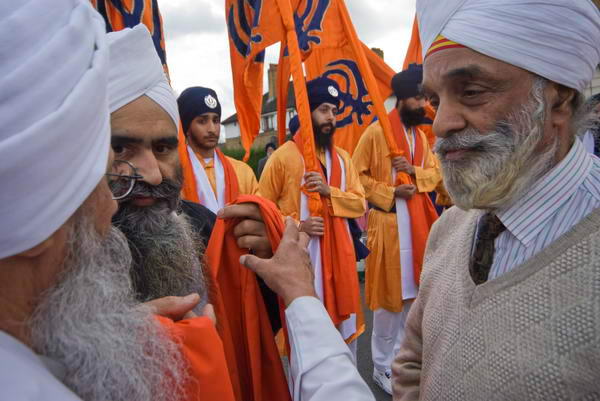
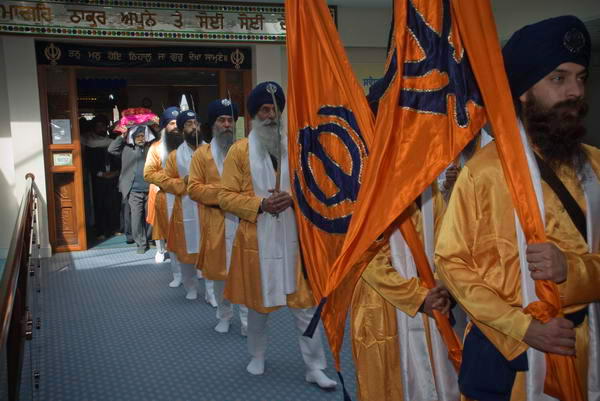
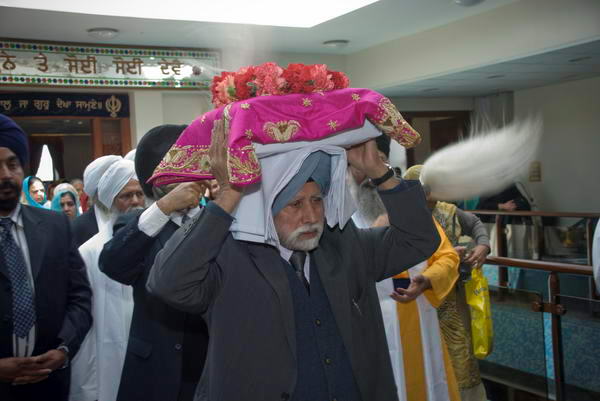
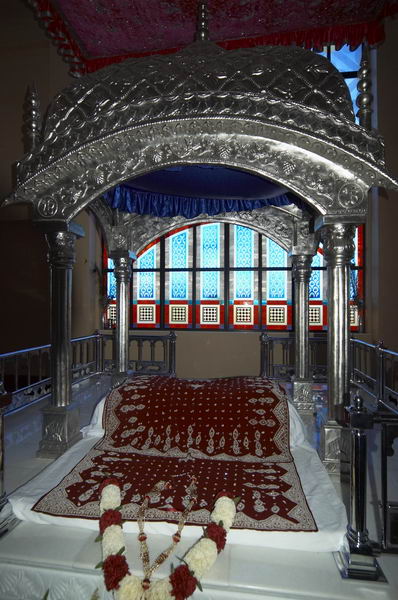
Vaisakhi is the traditional New Year and harvest festival of the Punjab in India and Pakistan and gained added significance for Sikhs, the majority population in the area when at Vaisakhi in 1699 Guru Gobind Singh, the 10th Guru, founded the Sikh nation with the establishment of the Khalsa Panth.

Vaisakhi in Hounslow - 2008

Vaisahki is actually the 13th or 14th of April each year, but the festival is celebrated over several weeks at different Gurdwaras. You can read more about Vaisakhi and see some of my earlier pictures from various Nagar Kirtan (Sikh processions) on My London Diary posts from 2004, 2005, 2006 and 2007 and although they follow a similar pattern there are differences. In Hounslow the event seemed to me to have more active participation by women and girls than in some of the others.

Vaisakhi in Hounslow - 2008

I’d previously photographed the celebrations at most of of the Gurdwaras around London as a part of a larger project on religious celebrations in London, but had somehow missed out on covering the festival in Hounslow.

Vaisakhi in Hounslow - 2008

I’d always enjoyed photographing Vaisahki as the Sikhs were always very hospitable – I was made very welcome and guided and encouraged to take photographs and Hounslow was no exception. I wrote a fairly long description of the event on My London Dairy and included some of my personal history in the area where I – and my father – grew up.

The procession began at the Gurdwara Sri Guru Singh Sabha which was built on the site of the dye factory where I had my first full-time job – and where many of the shop-floor workers were Sikh. On the route various people had set up stalls offering free food and soft drinks to everyone in the procession – and I enjoyed their hospitality, but was soon too full to be able to accept more.

It went along streets that were very familiar to me, past the clinic where I was weighed and measured as a baby and my mother was given free orange juice and cod-liver oil (which I didn’t thank them for.) Past the nursery school, Major Drake Brockman’s Academy, from which I was expelled aged 4, past the school my father left in 1913 at the age of 14 (though he wouldn’t recognise it now) on to the Gurdwara Guru Nanak Nishkam Sewak Jatha where the procession halted for more celebrations before continuing back to its starting point.

Much more – and many more pictures at Vaisakhi Celebration in Hounslow


FlickrFacebookMy London DiaryHull PhotosLea ValleyParis
London’s Industrial HeritageLondon Photos

All photographs on this page are copyright © Peter Marshall.
Contact me to buy prints or licence to reproduce.


Southall – Britain’s Holy City – 2005

Southall - Britain's Holy City - 2005

Seventeen years ago I was fortunate to be able to go on a tour of the Sri Guru Singh Sabha Gurdwara, opened in 2003 and said to be the largest Sikh temple (Gurdwara) in Europe and the fourth largest in the world, led by one of the Sikh volunteer guides and the architect, Richard Adams of Architects Co-Partnership.

Southall - Britain's Holy City - 2005

The tour had been organised by art and urban historian Mireille Galinou for the group London Arts Café, and was one of a series of interesting events and exhibitions between 1996 and 2007, which you can still read about on the rather messy London Arts Café web site that I was responsible for, though the front page of this makes very clear that the London Arts Café is no more. The site remains on line as a record of its activities.

Southall - Britain's Holy City - 2005

Architects Co-Partnership had won an open competition to design the building, and Adams had worked fully with the Sikh community to produce a building suited to their needs. It does so impressively: clean simple surfaces, powerful colour in the windows and light streaming into the central stairway and lobby from the large window and glass roof areas.

The Gurdwara has a vast prayer hall officially capable of seating up to 3,000 people, a fine marriage room (and two years later I photographed one of my wife’s colleagues getting married here), and various other facilities including a Langar (dining hall). This free community kitchen can serve over 20,000 vegetarian meals on a festival weekend.

The building had a powerfully religious atmosphere, and on entering we removed our shoes, covered our heads with scarves provided and washed our hands before continuing into the temple.

As we went around both our Sikh guide and the architect explained how the building served the basic Sikh tenets of service, humility and equality. The guide explained the spiritual guidance from the Sri Guru Granth Sahib, religious writings which were appointed as spiritual head of the Sikh religion by Guru Gobind Singh around three hundred years ago.

The building was extremely impressive, and there was a great atmosphere to in the community kitchen where volunteers, mainly women, were working together to prepare the free vegetarian meals. Although normally I would have sat to eat on the floor in the traditional way, a rather painful knee made it easier for me to stand and eat at one of the tables along with most of our group.

The food is free, but in return people are expected or welcomed to perform some service to the temple in thanks or give an donation which we gladly did. The meal was delicious and made a good end to a most interesting visit.

I ended my account on My London Diary:

Southall is now Britain’s Holy City, apparently with places of worship for over 50 religions or denominations. Brother Daniel Faivre’s ‘Glimpses Of A Holy City’ published in 2001 after more than 20 years of living in Southall gives a good insight into some of this diversity.

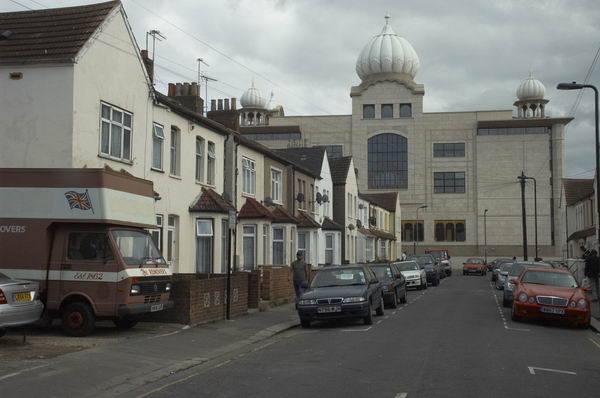
We didn’t on this occasion visit any of these others, but did go for a short walk before catching our bus home, going into the Christian cemetery opposite the Gurdwara and some streets around for some views of the building’s exterior, as well as some local views.

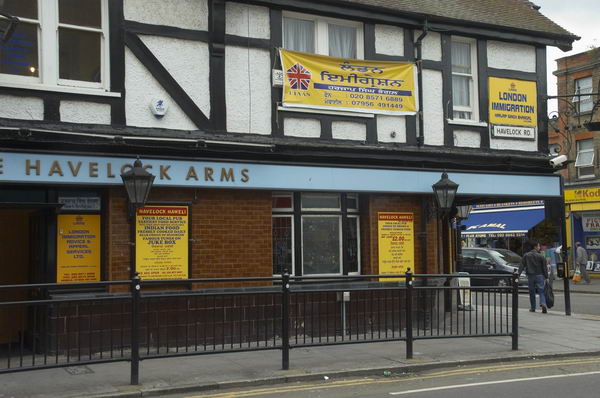
I’d visited Southall before to photograph some of the religious festivals – both Sikh and Hindu – in the town and there are pictures of some of these on My London Diary, as well as pictures from Vaisakhi celebrations here and in Hounslow, Slough, Woolwich, East Ham, Gravesend and Sikh protests in central London. You can find these by searching on My London Diary.

More pictures on My London Diary.


Sri Guru Singh Sabha Gurdwara 2005

Sixteen years ago on Saturday 1st October 2005 I was fortunate to be able to go with friends from the now long defunct London Arts Café on a visit to the Sri Guru Singh Sabha Gurdwara completed in Southall in 2003 with the building’s architect Richard Adams of Architect Co-Partnership and one of the Sikh volunteer guides. The temple, built with over £17m of local donations was said to be the largest in the western hemisphere, intended to be “a temple second only to the Golden Temple in Amritsar, with a life expectancy of a minimum of 100 years“.

The architects had won the commission in open competition and working with the Sikh community and had produced what I described as “a building suited to their needs, and it does so impressively:clean simple surfaces, powerful colour in the windows and light streaming into the central stairway and lobby from the large window and glass roof areas.” I hope my pictures convey something of this.

Here’s some of the text I wrote about the visit at the time, when I was posting entirely in lower case:

the sri guru singh sabha gurdwara serves the community, both for workship and for other needs. as well as a vast prayer hall officially capable of seating up to 3,000 people (and actually holding rather more at major festivals) there is a fine marriage room, and various other facilities including a langar (dining hall); this free community kitchen can serve over 20,000 vegetarian meals over a festival weekend.

the gurdwara had a powerfully religious atmosphere. on entering we followed the customary practice of removing our shoes, covering our heads with the scarves provided and washing our hands before commencing our visit. at various points both our guide and the architect explained how the building served the basic sikh tenets of service, humility and equality, and also the spiritual guidance from the sri guru granth sahib, the religious writings which are were appointed as spiritual head of the sikh religion, the eternal guru, by guru gobind singh around three hundred years ago.
although the architecture and the prayer hall in particular were impressive, what made the strongest impression on me was the kitchen, especially the team of women working together. the food was excellent, a real pleasure to eat, although my still rather painful knee made it easier for me to stand and eat at one of the tables rather than in the traditional manner seated on the floor. although food is free, those eating may perform some service to the temple in thanks for their food, or give an donation of some kind, which we gladly did.
southall is now britain’s holy city, apparently with places of worship for over 50 religions or denominations. brother daniel faivre’s ‘glimpses of a holy city’ published in 2001 after more than 20 years of living in southall gives a good insight into some of this diversity.
More pictures on My London Diary.


All photographs on this and my other sites, unless otherwise stated, are taken by and copyright of Peter Marshall, and are available for reproduction or can be bought as prints.