The Jewish East End & Al-Quds Day – 2006

The Jewish East End & Al-Quds Day: On Sunday 22 October 2006 I went on a morning guided walk around parts of the formerly Jewish East End, one of the activities of the now long gone (and still missed) London Arts Café. The name was rather misleading as it never achieved its aim to open a cafe dedicated to London and the arts in the city, but did organise some interesting talks as well as exhibitions at various venues showing painting and photography of London and walks and visits such as this. Some record of these is still on-line although the organisation closed down in 2007, though was continued as a short-lived Meetup group.

After lunch I went to Marble Arch for the start of the annual Al-Quds Day march. I didn’t stay long as it began to rain heavily.

Here (with minor corrections) is all I wrote in 2006 and a few of the pictures. You can still see more at the links to My London Diary.


The (formerly) Jewish East End
The Jewish East End & Al-Quds Day - 2006
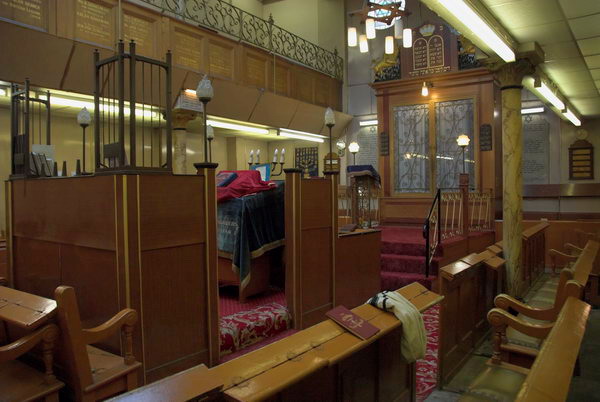
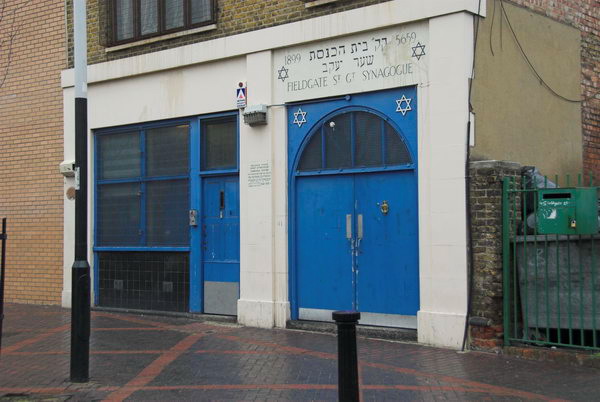
Fieldgate Street Great Synagogue, built in 1899 and one of the very few synagogues still open then in the East End.
The Jewish East End & Al-Quds Day - 2006
The synagogue was sold in 2015, and is now a mosque

On Sunday morning I took a walk with members of London Arts Cafe through the once Jewish areas of London’s East End. We were fortunate to be able to go in both the Fieldgate Street Great Synagogue, as well as the Bevis Marks Synagogue, Britain’s oldest standing Jewish place of worship, built in 1698, where unfortunately, photography is not allowed, but you can see some other pictures from our walk.
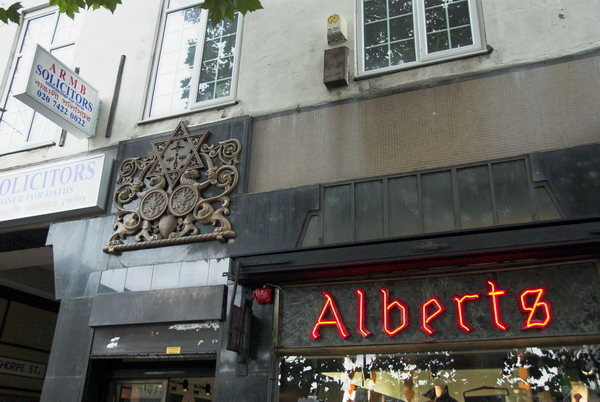
The Jewish East End & Al-Quds Day - 2006
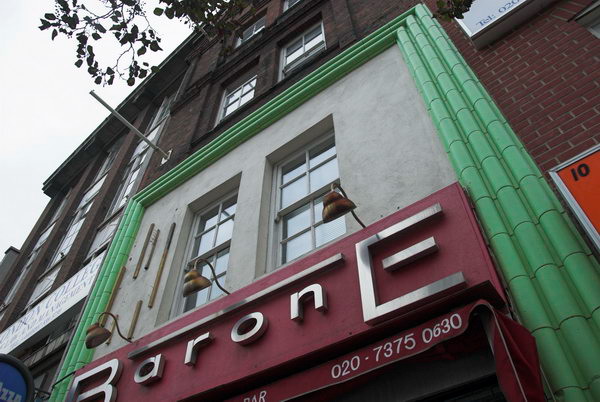
The famous Jewish portrait photographer ‘Boris’ (Boris Bennett)worked from this building.
The Jewish East End & Al-Quds Day - 2006
An emblem by Arthur Szyk in Arts and Crafts Style marks the former offices of the Jewish Daily News.

A few more pictures on My London Diary


International Al-Quds Day March

Marble Arch
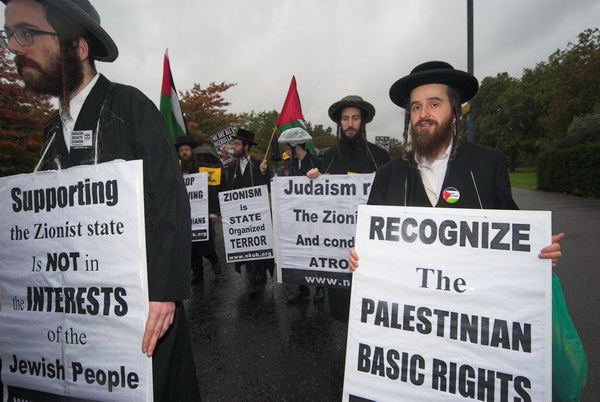
The Jewish East End & Al-Quds Day - 2006
Ultra-orthodox Neturei Karta Jews join in the protest for Palestine basic rights

Al-Quds is Jerusalem, and Sunday saw the annual march calling for its liberation, and that of Palestine.
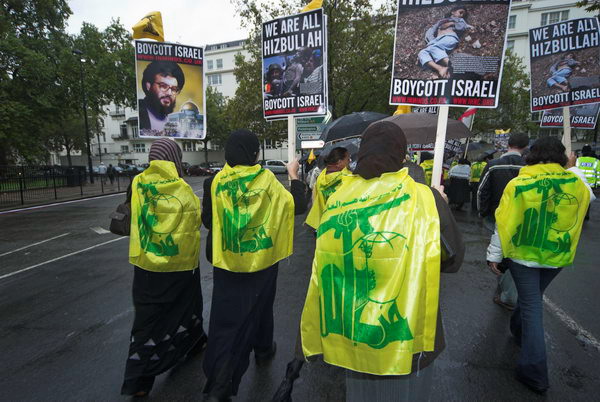
Hizbullah capes help keep some marchers dry

The idea of an international Al-Quds Day came from Ayatollah Khomeini, shortly after he gained power in Iran in 1979.
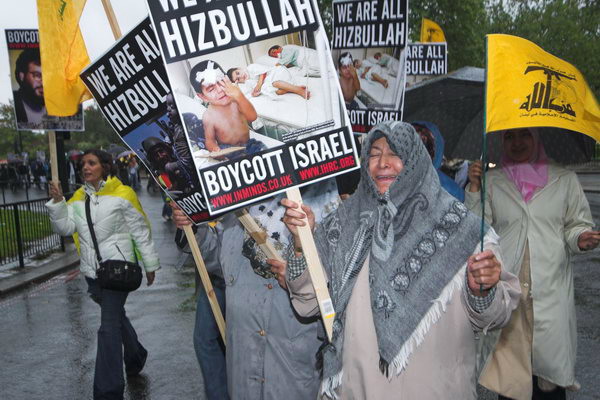
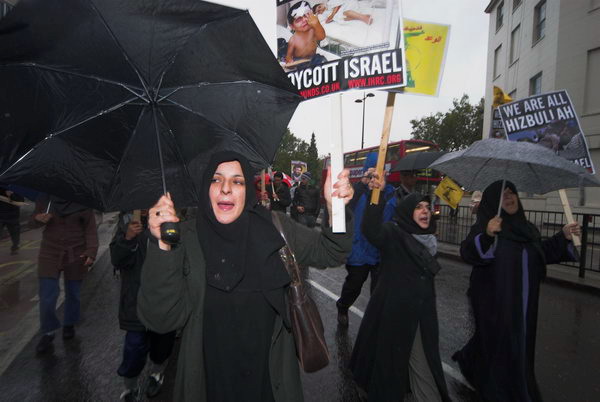
Shortly after the start of the march, it started to rain heavily and I came home rather than get my equipment soaked again.

A few more pictures on My London Diary.


The External Security Organisation of Hizbullah was proscribed in the UK in 2001, but it was only in 2008 that the whole of its military wing was proscribed. But Hizbullah is a Lebanese Shia Islamist political party with around 12% of the seats in the Lebanese Parliament, and operates a vast social services network in the country including schools and hospitals, as well as a satellite TV station. The party flag covers both the civil and the military wings of the party, and so its display was not an offence after the 2008 proscription. There were probably more Hisbullah flags on display than usual in 2006 because the march took place just a couple of months after the Israeli invasion and occupation of parts of Lebanon in July-August 2006.

Following years of lobbying the proscription was extended to cover the whole organisation in 2019 and it is now an offence to carry the flag. My pictures are a historical record and do not imply any support for the organisation.


Flickr – Facebook – My London Diary – Hull Photos – Lea Valley – Paris
London’s Industrial Heritage – London Photos

All photographs on this page are copyright © Peter Marshall.
Contact me to buy prints or licence to reproduce.
Sri Guru Singh Sabha Gurdwara – Southall 2005

Sri Guru Singh Sabha Gurdwara: On Saturday 1st October 2005 I enjoyed a tour of the largest Sikh Gurdwara in Europe. Building had begun in 2000 and the temple opened at the end of March 2003. The tour had been arranged by art and urban historian Mireille Galinou for the now long-defunct and much missed group ‘London Arts Café‘ – and you can still read more about on the web site I wrote for it, although the group came to an end in 2008.

Sri Guru Singh Sabha Gurdwara - Southall  2005
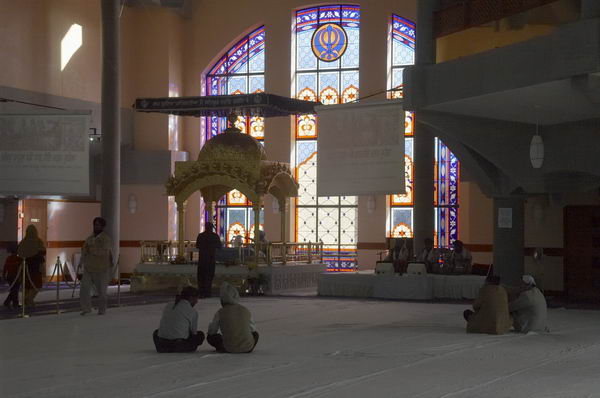
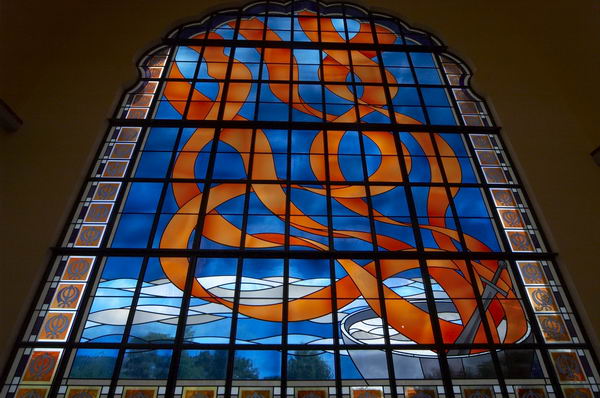
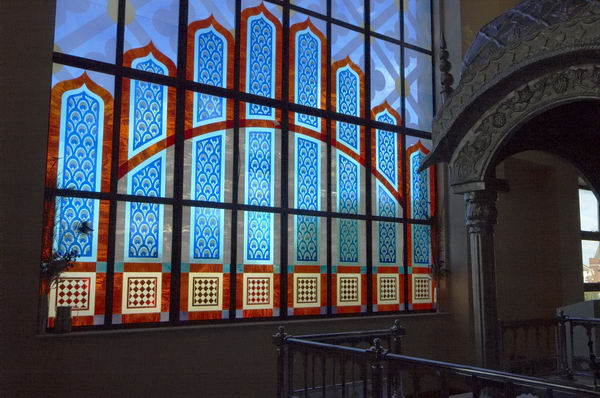
The use of stained galls is unusual in a Gurdwara

Here is what I wrote about the visit in 2005 and a few of the pictures I took at the Gurdwara – there are more on My London Diary.


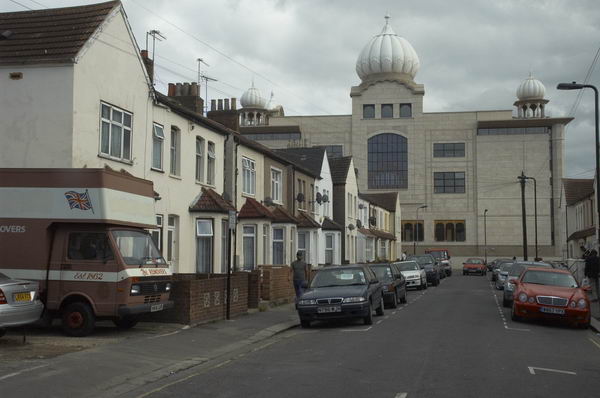
October started with a fine day, and I went to visit the largest Sikh Temple or Gurdwara in europe (and the fourth largest in the world) which opened a couple of years ago in Southall, along with a group of friends from the London Arts Café. We were shown around the building by one of the Sikh volunteer guides and also the architect, Richard Adams of Architect Co-Partnership, which had won the open competition to design the building. He had worked fully with the Sikh community to produce a building suited to their needs, and it does so impressively: clean simple surfaces, powerful colour in the windows and light streaming into the central stairway and lobby from the large window and glass roof areas.

Sri Guru Singh Sabha Gurdwara - Southall  2005
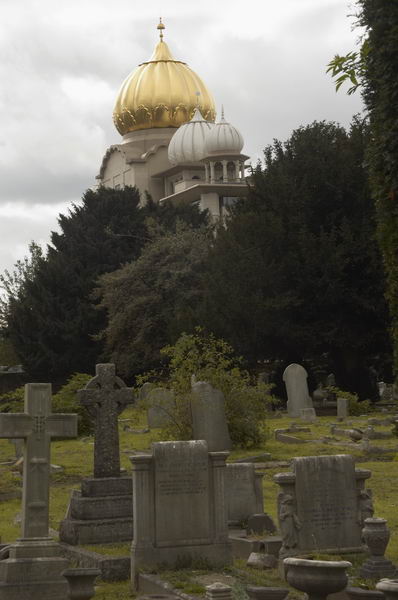
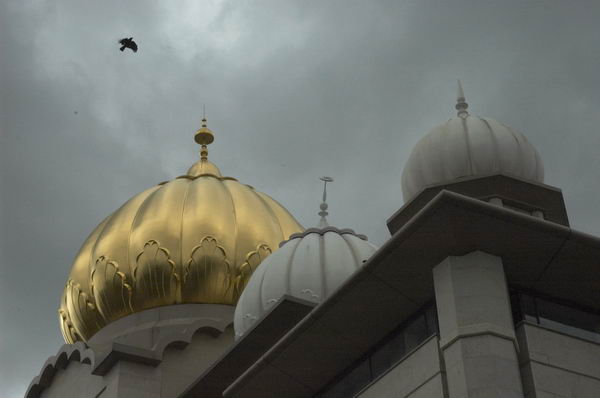
Gold leaf covers the main dome of the Gurdwara
Sri Guru Singh Sabha Gurdwara - Southall  2005
The Wedding Room
Sri Guru Singh Sabha Gurdwara - Southall  2005

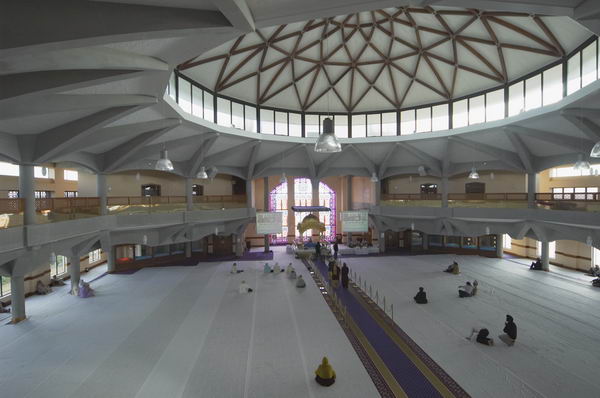
The Sri Guru Singh Sabha Gurdwara serves the community, both for workship and for other needs. As well as a vast prayer hall officially capable of seating up to 3,000 people (and actually holding rather more at major festivals) there is a fine marriage room, and various other facilities including a Langar (Dining Hall); this free community kitchen can serve over 20,000 vegetarian meals over a festival weekend.

Sri Guru Singh Sabha Gurdwara - Southall  2005
Preparing the vegetables
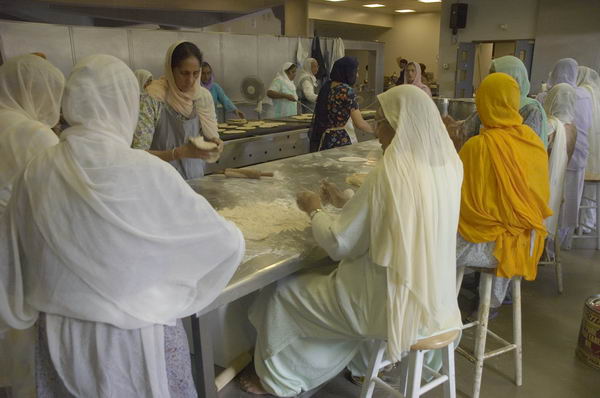
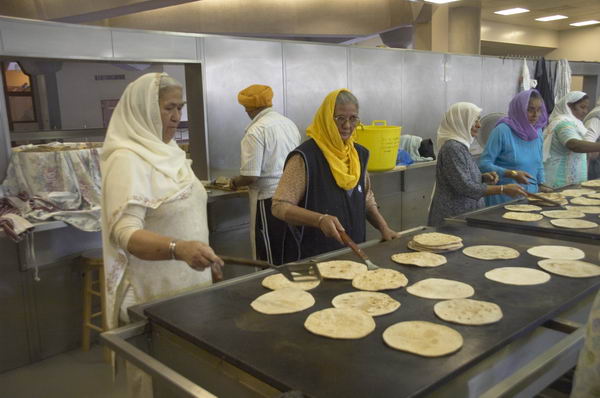
A team of women prepare pancakes

The Gurdwara had a powerfully religious atmosphere. On entering we followed the customary practice of removing our shoes, covering our heads with the scarves provided and washing our hands before commencing our visit.

The Prayer Hall

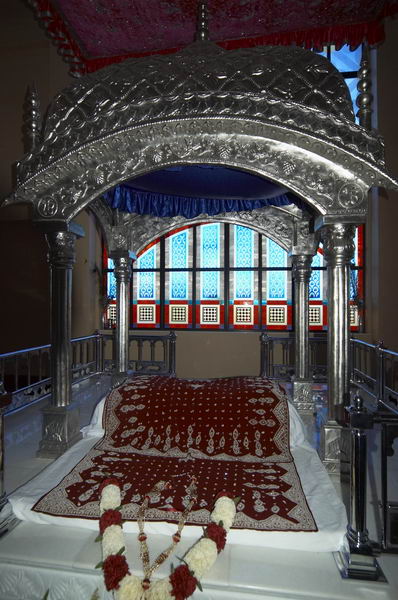
At various points both our guide and the architect explained how the building served the basic Sikh tenets of service, humility and equality, and also the spiritual guidance from the Sri Guru Granth Sahib, the religious writings which are were appointed as spiritual head of the Sikh religion, the Eternal Guru, by Guru Gobind Singh around three hundred years ago.

Musicians in the Prayer Hall

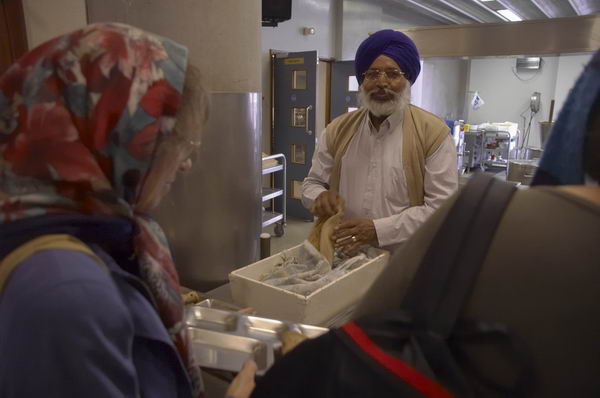
Although the architecture and the prayer hall in particular were impressive, what made the strongest impression on me was the kitchen, especially the team of women working together. The food was excellent, a real pleasure to eat, although my still rather painful knee made it easier for me to stand and eat at one of the tables rather than in the traditional manner seated on the floor. Although food is free, those eating may perform some service to the temple in thanks for their food, or give an donation of some kind, which we gladly did.

Southall is now Britain’s holy city, apparently with places of worship for over 50 religions or denominations. Brother Daniel Faivre’s ‘Glimpses Of A Holy City‘ published in 2001 after more than 20 years of living in Southall gives a good insight into some of this diversity.


Unfortunately Brother Daniel Faivre’s 104 page spiral bound book published in 2001 is no longer available. The Sri Guru Singh Sabha Gurdwara is, according to Wikipedia one of ten Sikh Gurdwaras in Southall, which also has two large Hindu ‘Mandir’ temples, six Mosques and “more than ten Christian churches including 5 Anglican, one Roman Catholic (St Anselm’s Church), Baptist, Methodist and several Pentecostal or Independent.” In the 2021 Census, 28.5% of the population were Sikh, 24.1% Muslim, 22.6% Christian 22.6% and 14.2% Hindu.

More pictures on My London Diary include some taken in Southall after leaving the Gurdwara.


Flickr – Facebook – My London Diary – Hull Photos – Lea Valley – Paris
London’s Industrial Heritage – London Photos

All photographs on this page are copyright © Peter Marshall.
Contact me to buy prints or licence to reproduce.


Southall – Britain’s Holy City – 2005

Southall - Britain's Holy City - 2005

Seventeen years ago I was fortunate to be able to go on a tour of the Sri Guru Singh Sabha Gurdwara, opened in 2003 and said to be the largest Sikh temple (Gurdwara) in Europe and the fourth largest in the world, led by one of the Sikh volunteer guides and the architect, Richard Adams of Architects Co-Partnership.

Southall - Britain's Holy City - 2005

The tour had been organised by art and urban historian Mireille Galinou for the group London Arts Café, and was one of a series of interesting events and exhibitions between 1996 and 2007, which you can still read about on the rather messy London Arts Café web site that I was responsible for, though the front page of this makes very clear that the London Arts Café is no more. The site remains on line as a record of its activities.

Southall - Britain's Holy City - 2005

Architects Co-Partnership had won an open competition to design the building, and Adams had worked fully with the Sikh community to produce a building suited to their needs. It does so impressively: clean simple surfaces, powerful colour in the windows and light streaming into the central stairway and lobby from the large window and glass roof areas.

The Gurdwara has a vast prayer hall officially capable of seating up to 3,000 people, a fine marriage room (and two years later I photographed one of my wife’s colleagues getting married here), and various other facilities including a Langar (dining hall). This free community kitchen can serve over 20,000 vegetarian meals on a festival weekend.

The building had a powerfully religious atmosphere, and on entering we removed our shoes, covered our heads with scarves provided and washed our hands before continuing into the temple.

As we went around both our Sikh guide and the architect explained how the building served the basic Sikh tenets of service, humility and equality. The guide explained the spiritual guidance from the Sri Guru Granth Sahib, religious writings which were appointed as spiritual head of the Sikh religion by Guru Gobind Singh around three hundred years ago.

The building was extremely impressive, and there was a great atmosphere to in the community kitchen where volunteers, mainly women, were working together to prepare the free vegetarian meals. Although normally I would have sat to eat on the floor in the traditional way, a rather painful knee made it easier for me to stand and eat at one of the tables along with most of our group.

The food is free, but in return people are expected or welcomed to perform some service to the temple in thanks or give an donation which we gladly did. The meal was delicious and made a good end to a most interesting visit.

I ended my account on My London Diary:

Southall is now Britain’s Holy City, apparently with places of worship for over 50 religions or denominations. Brother Daniel Faivre’s ‘Glimpses Of A Holy City’ published in 2001 after more than 20 years of living in Southall gives a good insight into some of this diversity.

We didn’t on this occasion visit any of these others, but did go for a short walk before catching our bus home, going into the Christian cemetery opposite the Gurdwara and some streets around for some views of the building’s exterior, as well as some local views.

I’d visited Southall before to photograph some of the religious festivals – both Sikh and Hindu – in the town and there are pictures of some of these on My London Diary, as well as pictures from Vaisakhi celebrations here and in Hounslow, Slough, Woolwich, East Ham, Gravesend and Sikh protests in central London. You can find these by searching on My London Diary.

More pictures on My London Diary.