Garford Street Limehouse: My walk in Limehouse on Sunday 6th January 1990 continued. The previous post from this walk is Around Emmett Street, Limehouse 1990. As usual you can click on the images here to view larger versions on my Flickr pages.
Garford Street is variously described as in Limehouse, Westferry and Poplar, although estate agents seem to prefer Canary Wharf, which is certainly isn’t, though fairly close by. Back in 1990 I think most of us thought it was Limehouse.
The 1994 LCC Survey of London deals with it in a chapter Limehouse Hole: The inland area. This tells us that a John Garford in the early 19th century had a wharf on the Thames at its western end on Emmett Street. Since the building of the Limehouse Link tunnel and the new route of Westferry Road for the Canary Wharf redevelopment it now starts around 200 yards to the east on Westferry Road. Its other end is still at the West India Dock Road.
I think the junction here is a part of the lost area on the north side of Garford Street. The chimney in the background is a remnant of the Lion Works, established here in “1896-7 by James Walker & Company, steam packing makers,” later Lion Packings Ltd who made “Patent metallic packing” here until around 1926. “The site was cleared for public housing in 1938–9” but as you can see the chimney survived until 1990.
Another view just a few yards from the previous image shows some large cable drums from AEI Gravesend. A notice tells those waiting for MOT tests at the Austin Rover garage where to queue.
This derelict warehouse building still has the remains of a hoist to the first floor entrance above its main door. There is now new housing on this site just to the west of the DLR railway bridge on the north side of the street.
Greig House, Garford St, Limehouse, Tower Hamlets, 1990, Built 1902-3 as accommodation for officers from Scandinavian ships docked in London it was taken over in 1930 as a Salvation Army hostel, and later used to house male alcoholics and more recently as a residential detoxification centre for men and women with drug or alcohol problems. Grade II listed along with the cottages on Garford St.
A second view of Greig House which shows some of the buildings of the West India Dock on Hertsmere Road in the background as well as the cranes building parts of Canary Wharf around Cabot Square. You can read much more about this and the associated buildings on the Lost Hospitals of London site.
From here I walked across the West India Dock Road in Poplar where my next post on this walk will begin.
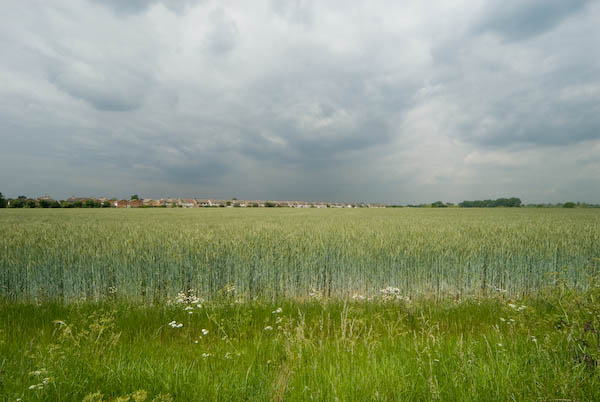
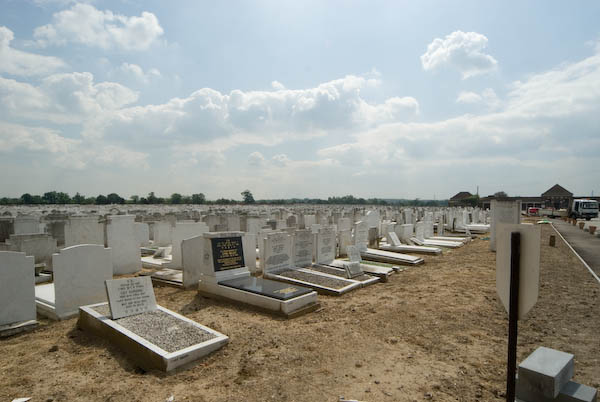
Thames Gateway – Essex: I didn’t write much about my bike ride in south Essex on 24th May 2007, though the pictures on My London Diary tell the story of my route. I began at Rainham on the edge of Greater London in the London Borough of Havering.
It wasn’t a linear ride but one where I went back and forth rather extensively exploring some of the areas.
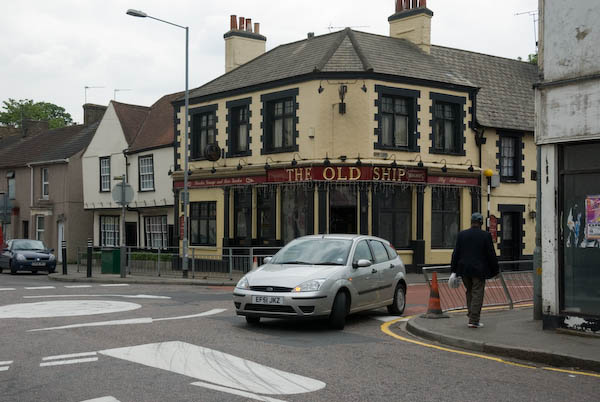
Next came the village of Aveley, where the Old Ship has a pub interior “of Outstanding National Importance” but I didn’t go inside.
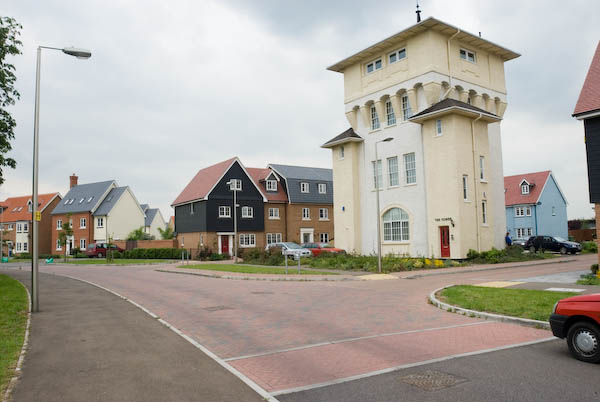
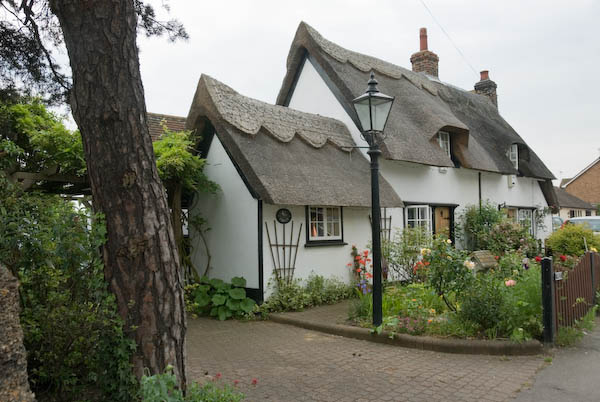
I photographed the Mar Dyke at North Stifford along with a number of houses, some thatched and cycled around the Stifford Green estate on site of Stepney Boys Home built around ‘The Tower’. This had been an approved school and then a community home until it closed in 1994.
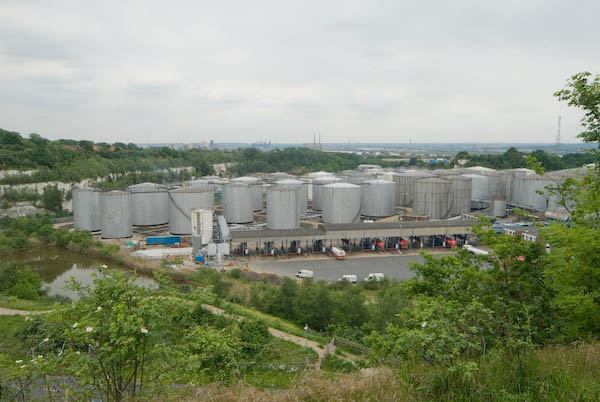
Next came Chafford Hundred, an area where chalk was extensively quarried from 1874 until the last quarry closeed in 1976. In 1986 a proposal by Blue Circle Industries, West Thurrock Estates and Tunnel Holdings to build 5,000 homes on derelict land was approved and the first were completed in 1989.
Parts of the area were still in industrial use in 2007 and there is a nature park with extensive lakes and ditches.
Lion Gorge, Chafford Hundred
From there I cycled a little deeper into Grays before going to Orsett Fen and Orsett and Horndon on the Hill which has a rather fine old pub I also didn’t go inside. Cycling and beer really don’t mix well with modern traffic.
There are more impressive ancient buildings, a reminder of the wealth that once came from the wool trade.
I made my way via Bulphan towards Upminster where I could use my railcard to start my journey home.
Here is the short text I wrote back in 2007 – with the usual corrections. The cost of the ticket I bought then is now £15.30 – an increase of around 9% above inflation – another of the costs of privatisation.
Thursday I bought an expensive ticket – just up from £6.60 to £7.90 – for a one-day railcard for Greater London from Staines, and put my folding bike aboard the train, changing to reach Rainham, Essex, (L B Havering) on the furthest edge of London from where I live.
Don’t let anyone tell you Essex is flat. O boring. Over a few hundred yards you can move from idyllic thatched cottages to post-industrial dereliction; from dramatic man-made scenery with lakes and chalk gorges to densely packed modern housing estates. From farms owned by city millionaires to council tower blocks.
Most of my winding route took me through Thurrock, one of the major growth sites of the Thames Gateway area.
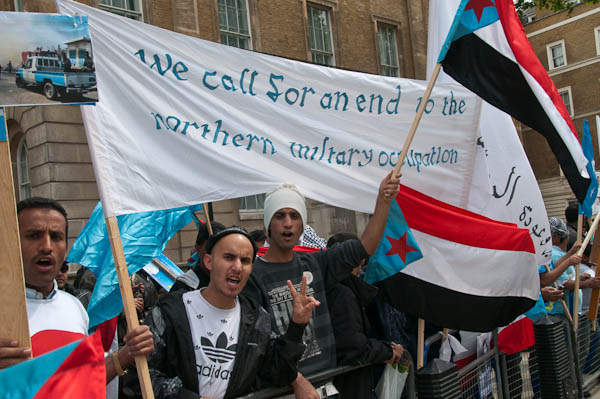
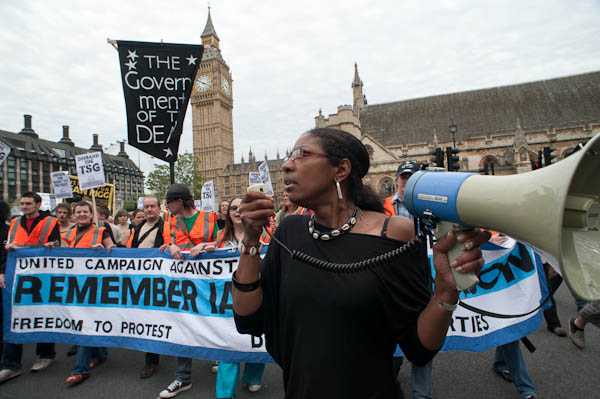
Jobs, Services, Education, Yemen, Rev Billy, Police Violence: Saturday 23 May 2009 was another busy day for protests in London. I began with the March to Defend Jobs, Services and Education in North London, moved to Whitehall for a protest by Southern Yemenis calling for independence and met the The Reverend Billy and his ‘Life After Shopping’ Gospel choir for a performance in front of the gates of Downing St. Later I met the Rev again on a march against police violence prompted by the killing of Ian Tomlinson by a police officer at he G20 protest at the start of the month.
March to Defend Jobs, Services and Education – Highbury Fields to Archway
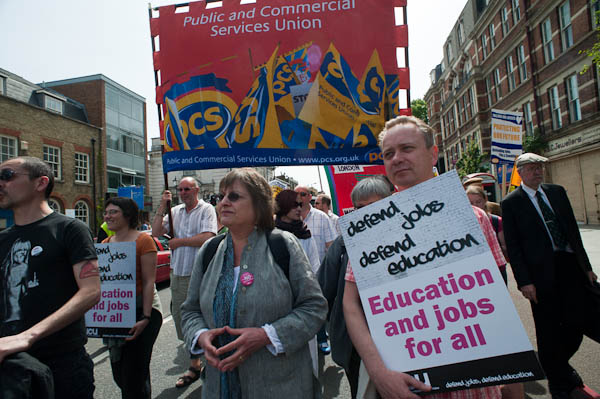
The march by around 500 workers in Islington from Highbury Fields to Archway followed the loss of 1500 jobs in the area, including 550 mainly support workers from London Metropolitan University, 500 civil servants from Archway tower and more at City University, where adult education is under threat.
It was supported by many local groups including the Islington National Union of Teachers, the Public & Commercial Services Union, London Metropolitan University Unison and the University and College Union. Among the speakers at the Archway rally were local MP Jeremy Corbyn and local trade union leaders.
Education in the area has been particularly important in giving people who have missed out in various ways in their schooling a chance to gain qualifications, and the cuts threaten the future of many of these courses as well as the support such as nurseries which enable many mature students to continue education. Islington has the highest population density of any local authority in England and Wales and a third of its residents live in poverty – well above the London average.
Southern Yemenis Demonstrate For a Separate State – Downing St, Whitehall
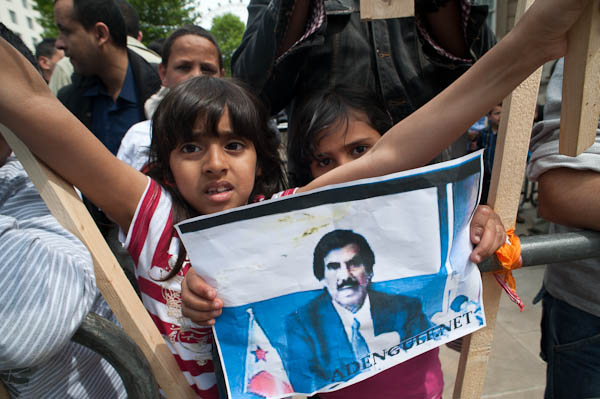
Southern Yemenis from the Southern Democratic Assembly (TAJ), based in London came to protest following protests in Aden the previous week on the 15th anniversary of the attempt by Southern Yemen to break away from the North which began the 1994 Civil War, a short but brutal conflict which ended in July 1994 with defeat for the South.
Southern Yemen, until 1967 the British protectorate of Aden, was granted independence and in 1969 became the People’s Democratic Republic of Yemen. Although a decision to unite with North Yemen – the Yemen Arab Republic – was made in principle in 1972 this only happened in 1990 when the Republic of Yemen was formed. South Yemen contains most of the reserves of oil and other resources and TAJ accuse the government of grabbing land and property and of human rights abuses.
Since 2004 the rise of the Houthis has dominated politics and armed conflict in Yemen with a full-scale civil war between them and a Saudi-led coalition backed by the US and the west since 2015.
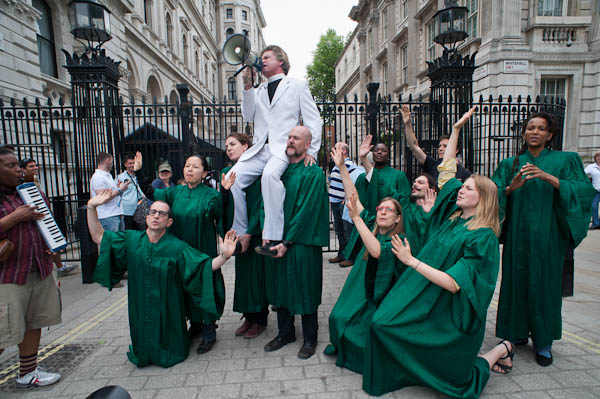
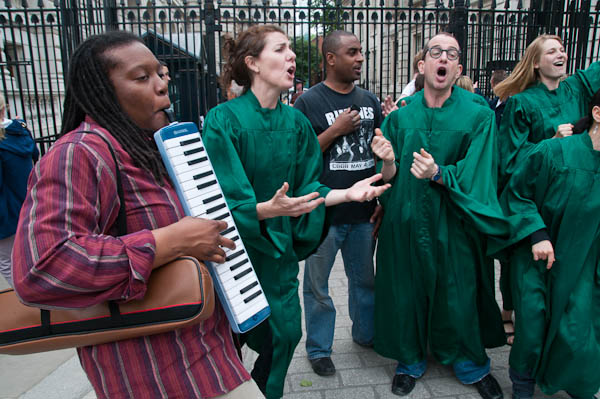
The Reverend Billy and his ‘Life After Shopping’ Gospel choir from New York were busy in London today on their 2009 UK Shopocalypse Tour.
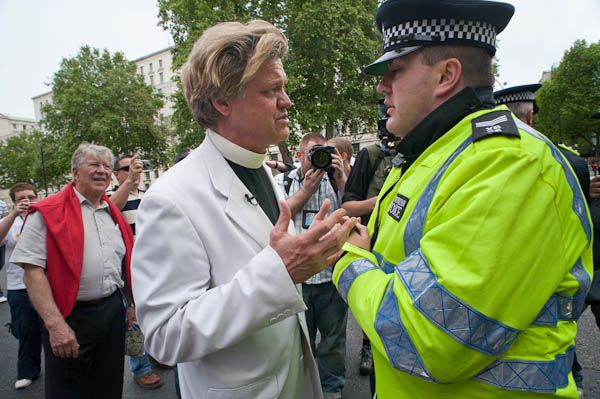
Police obviously had no idea of how to handle the Reverend and his green-robed choir when the came and gave a brief performance on the pavement in front of the tall gates with their armed guards.
As I wrote, ‘The Church of Life After Shopping believes that we need to “back away from the product” and resist the way that advertising and the media persuade us to live only thorough consuming corporate products, and get down to experiencing life directly. We can live more by consuming less – and at the same time help save the planet and put an end to climate change, which is a result of our excessive consumption. ‘
Consumerism is at the root of our government’s economic programme with its emphasis on growth but this comes at the expense of both personal fulfilment and the future of the planet, driving catastrophic climate change as we pursue this false God.
“As Billy says, following the G20 summit and the pathetic waste and greed shown in the continuing parliamentary allowances scandal, our government and MPs are clearly in need of the Life After Shopping Gospel.
National Demonstration against Police Violence Trafalgar Square to New Scotland Yard
The United Campaign Against Police Violence was set up after the G20 protest at Bank in London where Ian Tomlinson died following an assault by a police officer as he tried to make his way home from work through the area where the demonstration was taking place.
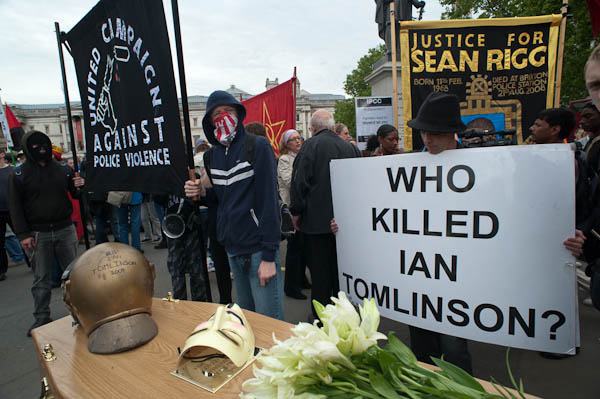
Who Killed Ian Tomlinson? And Sean Rigg?
Thee organisers included trade unionists and activists who had organised the G20 protest and campaigners against police violence, particularly those involved with the United Families and Friends Campaign by friends and the families of people who have died in police custody. Among those taking part were the families of two men who died in Brixton Police Station, Ricky Bishop and Sean Rigg.
In all these killings the police reaction to the deaths was to issue a number of highly misleading statements and to try to protect its officers by failing to make proper and timely investigations. This march attracted far more police attention and resources than any of these deaths where families have had to fight to get any information from police.
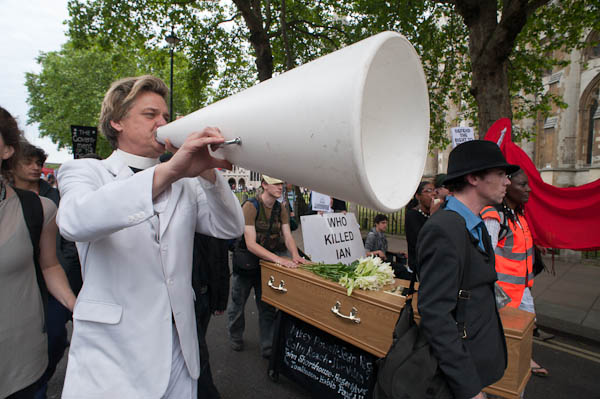
Leading the start of the march was a coffin and the red ‘Horse of the Apocalypse’ one of the four which headed the G20 protests – and gave the clear message at that protest that the intention was street theatre rather than the kind of insurrection that the police anticipated and then went on to themselves create.
Sean Rigg’s two sisters were on the march and making their views felt, and the Rev Billy came with his giant non-powered megaphone.
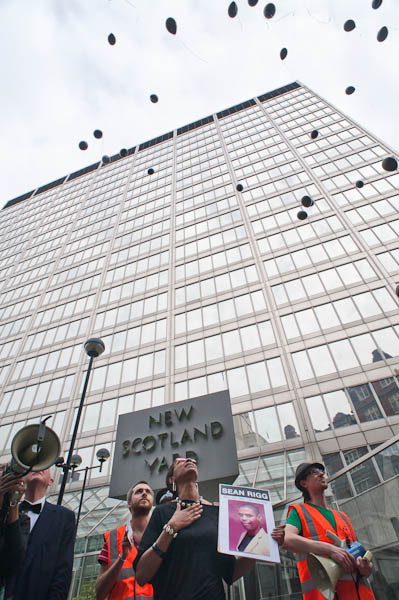
At Scotland Yard the mood became more solemn for a period of silence for those who had died and people linked hands to surround New Scotland Yard in a symbolic “kettle”.
Chis Knight spoke with Sean Rigg’s sisters on each side of him. A police officer stands impassive as people prepared to release black balloons in memory of the dead.
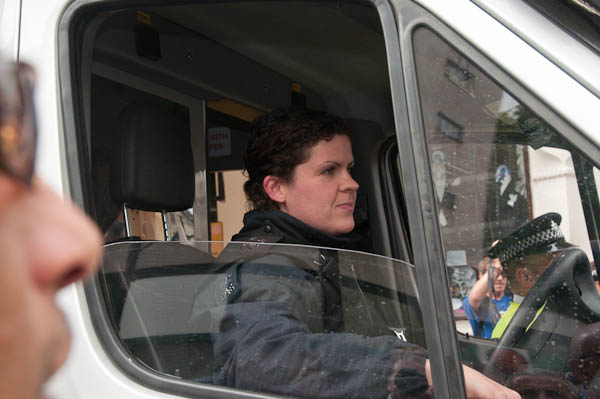
The mood was somber, solemn as we remembered those who have died. Suddenly the whole mood changes as an officer reads out a warning from her chief over the loudspeakers interrupting the ceremony.
For a few moments an angry crowd looks likely to attack the van – and it did seem an incredibly provocative action in what to this point had been a well ordered and restrained – although angry – demonstration against police violence.
Fortunately the moment passes and the release of balloons continues. It’s impossible to understand why police took this action at this time – unless they really wanted to provoke a riot. I can find no other explanation and it remains another of the many actions that has resulted in a loss of public confidence in the police as we drift relentlessly towards a police state.
Legal Aid Funeral & Daddy’s Pig: On Wednesday 22nd May 2013 lawyers held a mock funeral and rally against government proposals for further changes to legal aid proposed by Justice Secretary Chris Grayling. Legal aid had already been greatly restricted by the Civil Legal Aid (Remuneration) Regulations 2013 which had come into effect earlier in the year. I rushed away at the end of the rally to join Artist taxi-driver Mark McGowan who was pushing his Daddy’s Pig from Downing Street three miles to the Bank of England.
Lawyers Funeral for Legal Aid – Old Palace Yard, Westminster
The coffin of Legal Aid
Justice Secretary Chris Grayling having made huge cuts in legal aid was now proposing to end the right of legal aid clients to chose their solicitor with the work going to the lowest bidder in ‘price competitive tendering’, PCT. This would be open to “to large non-legal companies, including Eddie Stobart and Tesco, and remove the ability of those in need of legal aid to chose appropriate specialists in the legal area involved.”
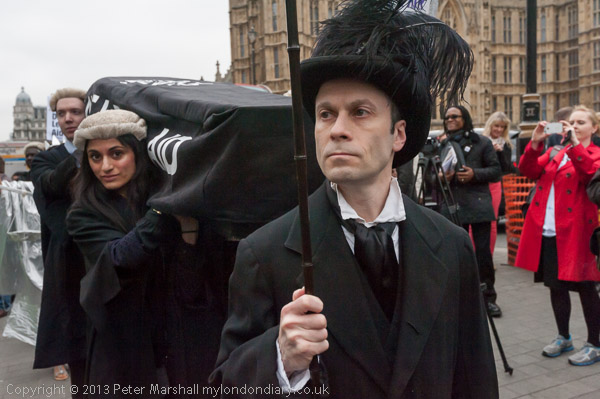
The short funeral procession to Parliament Square by the London Criminal Courts Solicitors’ Association was led by a marching jazz band, followed by robed and wigged figures carrying the coffin of Legal Aid and a woman dressed as the Scales of Justice.
As well as lawyers others joined the protest including Women from Winvisible, Women Against Rape, Defend The Right To Protest, Liberty and more. The proposed changes would particularly effect women involved in domestic violence and rape cases, and immigrants fighting for asylum.
There were many excellent speakers and on My London Diary I gave a partial list on My London Diary:
Labour MPs Sadiq Khan, Jeremy Corbyn and his fellow Islington MP Emily Thornberry, Natalie Bennett of the Green Party and senior figures involved with the law from both Tories and Lib-Dems. There were those who had been involved with legal aid over cases of injustice, including Gerry Conlan, one of the Guildford 4, a member of the family of Jean Charles De Menzes, Susan Matthews, mother of Alfie Meadows and Breda Power, the daughter of Billy Power, one of the Birmingham 6. Solicitors who spoke included Clive Stafford Smith, the founder of Repreive, and Blur drummer Dave Rowntree, and notable among the QCs, Helena Kennedy. There were many memorable quotes (almost all of which I’ve forgotten) with Gerry Conlan making clear “Back in the 1970s they sent innocent people to jail by the van load. But if these cuts go through they’ll be sending them in by the Eddie Stobart truckload“.
The rally ended with “a summary by leading barrister John Cooper QC after which the whole assembly delivered its verdict on Grayling, guilty as charged.”
The plans for PCT were dropped in September 2013 but didn’t go away entirely with new plans to introduce it in 2016, and it took a High Court ruling in 2018 to quash proposals to use PCT for Housing Possession Court Duty schemes.
Legal aid remains unfairly restricted and in only the very wealthy and those of the very poor who are able to access legal aid are almost “equal under the law”, with the great majority of us being able to afford it. And of course the wealthy are able to use much greater legal resources than legal aid will ever provide.
True equality under the law would only become possible if we made a huge systemic change to essentially nationalise our whole justice system, making it entirely a public service.
Daddy’s Pig heads for the Trough – Downing St to Bank
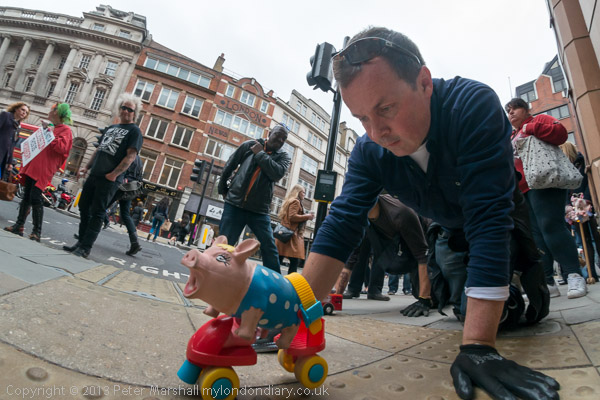
Artist taxi-driver Mark McGowan pushed his Daddy’s Pig, accompanied by another protester pushing a fire engine, the three miles from Downing St to the Bank of England, hoping to present it to the governor for services to austerity and the criminal activities of the City of London.
McGowan had a small group of supporters with him as he undertook the second stage of his gruelling journey on hands and knees, pushing the pig on its plastic roller skate.
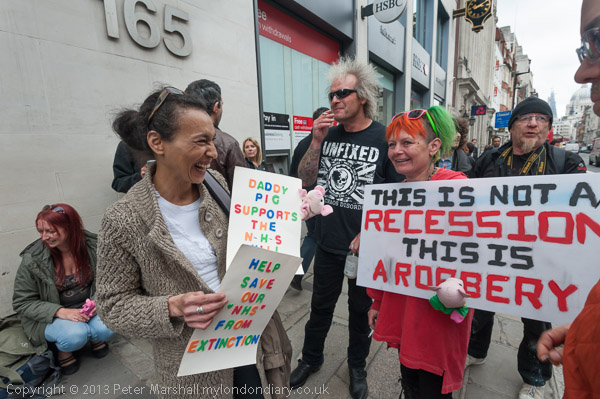
A few days earlier, he had pushed the pig from from Kings College hospital in Camberwell where he is receiving cancer treatment to Downing street as a protest against the privatisation of the NHS which is being driven by the bankers and private equity firms.
I walked with him and his pig on part of the second half of his painful slow route, joining him at the Royal Courts of Justice and leaving him and his colleague with the fire engine as they rested briefly before reaching Ludgate Circus. Even with knee pads and gloves the going was tough and Mark was struggling to meet his appointment with a banker at 3pm.
Vedanta, Tampon Tax, Roma, Monsanto & Mental Health: Saturday 21 May 2016 was another busy day for me covering protests across London. It started with a protest against mining company Vedanta at the Royal Festival Hall, then across the river to Parliament Square where protesters were calling on the government to meet their pledge to axe the tax on tampons and later Roma, Gypsies and Travellers arrived with horses and carts to protest against increasing attacks on their way of life.
A short distance up Whitehall was a small protest against Monsanto, part of a world-wide ‘March Against Monsanto’. My work ended out to the east in Stratford where Focus E15 housing campaigners held a march and rally against the mental health problems that Newham Council’s housing policy is creating.
Foil Vedanta at Jaipur Literary Festival – Royal Festival Hall
Foil Vedanta were inside the Royal Festival Hall to protest against the sponsorship of the Jaipur Literature Festival taking place there by Vedanta “the most hated company on Earth, causing pollution, illness, displacement, poverty and deaths by its mining operations, sometimes criminal, in India, Zambia, South Africa and Australia” in an attempt to whitewash its image.
An open letter by Foil Vedanta and Round Table India signed by around 50 mainly Indian writers, poets, academics and activists had persuaded several authors to withdraw from the event and some others had promised to criticise Vedanta in their presentations.
The protesters took to the stage for a brief presentation of the case against Vedanta and then withdrew to continue protesting inside the venue but outside the area containing the festival stage. They intended to continue their protests for a couple of hours but I had taken enough pictures and left to walk across the river.
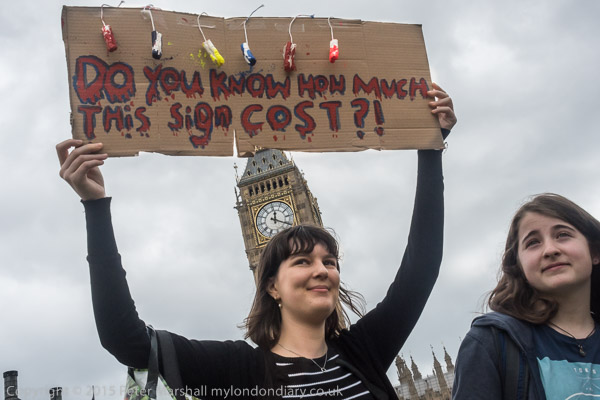
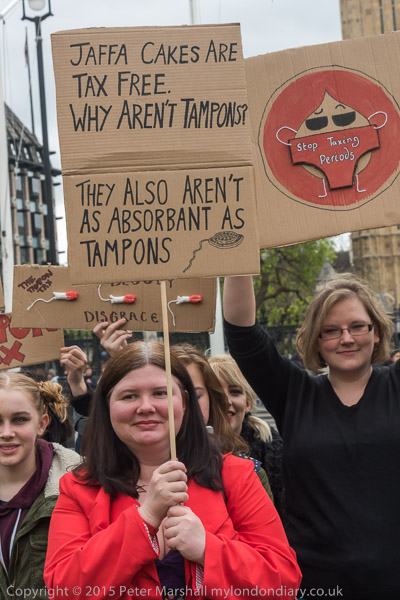
A massive campaign and lobby had resulted in the removal of regulations preventing the removal of tax, but the government had so far failed to implement the removal. Protesters held a short rally and then marched to Downing Street to deliver their message to Chancellor of the Exchequer George Osborne.
Among the protesters were ’50:50 Parliament’ who call for equal representation of women and men in Parliament. They say that if there were more women in Parliament there would not be taxes such as this – and rather less of the public-school bickering that often dominates the House of Commons.
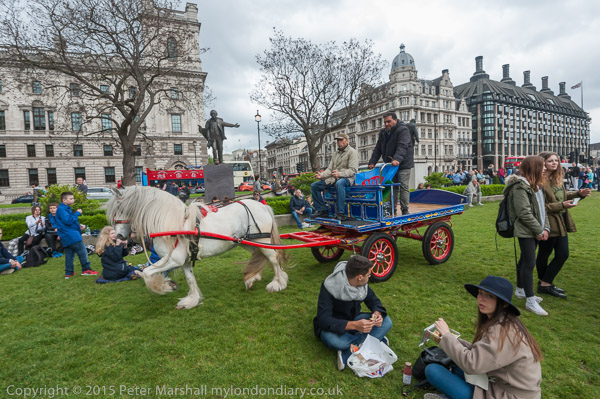
Roma, Gypsies and Travellers came to Parliament Square on four horse-drawn vehicles to protest against the increasing attacks by governments which make their way of life difficult.
You are not allowed to bring your horse onto Parliament Square
Changes have let local authorities stop providing traveller sites and made it harder to find places to stop as they move around the country. And where travellers have bought sites local authorities have used planning laws in a discriminatory way to prevent them using it – as at Dale Farm near Basildon.
They say changes to the planning guidance are an attack on their ethnicity and way of life and they call for an end to 500 years of persecution.
Police and heritage wardens forced them to move off the grass in Parliament Square and they made a few circuits on the road before leaving as a rally began.
I left too, to cover another protest at Downing Street.
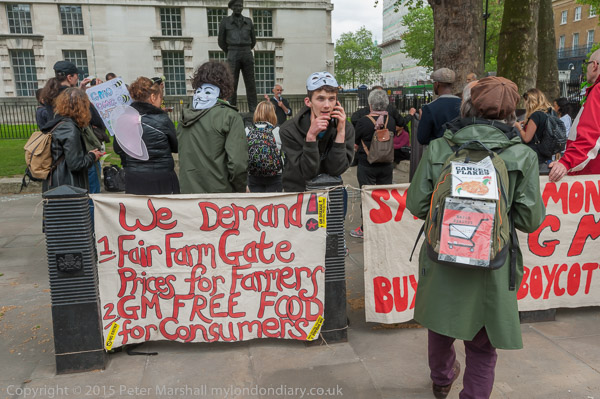
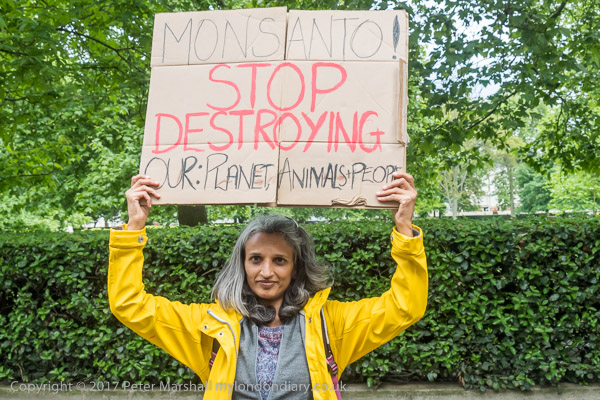
I’d looked earlier for the ‘March Against Monsanto’ but the march in London – part of a world-wide series of annual protests – was small and I had failed to find them until they arrived for a rally oppposite Downing Street.
Monsanto’s widely used herbicide Roundup was said by the WHO to be “probably carcinogenic to humans” and its neonicotinoid insecticides contribute to the killing of bees and other pollinators. Campaigners also oppose the genetically modified crops which they say are dangerous to human health.
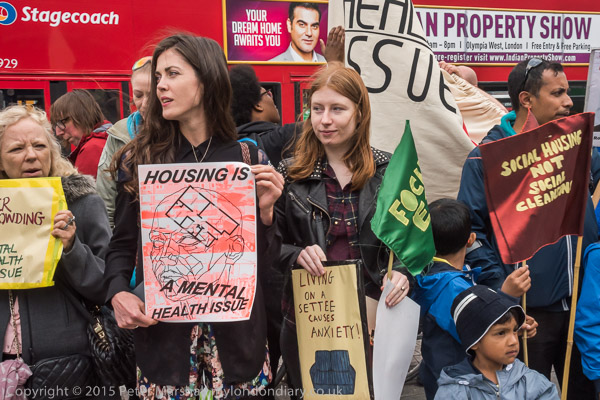
‘Your Dream Home Awaits You’ a bus advert for a property show at Olympia. Only for the rich
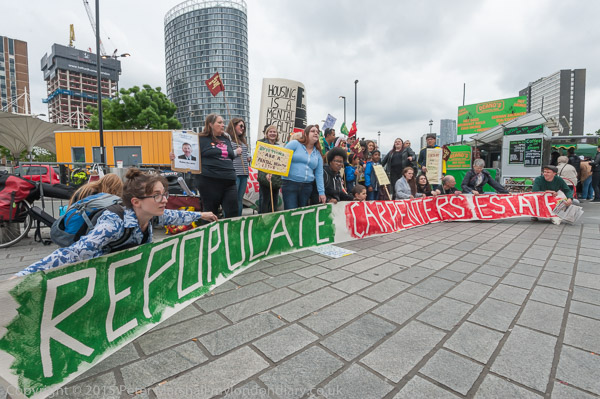
As a part of Mental Health Awareness Week, housing campaigners Focus E15 held a rally outside Stratford Station against Newham Council which they say is causing mental health problems for vulnerable people through evictions and placements with insecure tenancies and away from families, friends and support systems in cities and towns across the UK.
Newham Council has kept some properties on the Carpenters Estate empty since 2004, despite a desperate housing shortage in the borough
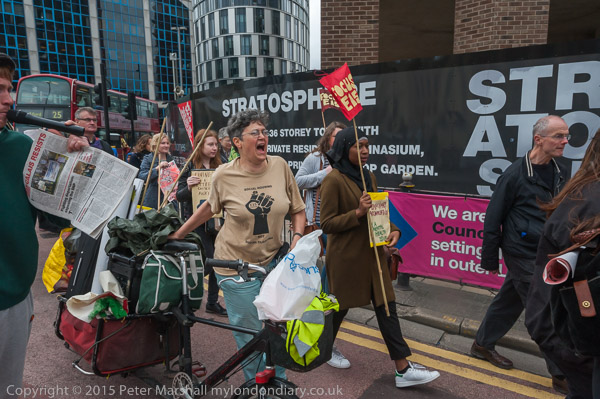
After the rally with speeches, songs and poems, the group marched around central Stratford where new high-rise building to house wealthy newcomers to the area or simply bought as investments and often kept empty is rapidly springing up “while those unable to afford sky high market rents are being forced out.”
These tall blocks also create inhospitable micro-climates at ground level which make areas such as these unpleasant for people at street level – and a sudden gust in front of one block tore one of the banners in two.
The short march ended on Stratford Broadway where despite harassment by police and council staff Focus E15 continue to hold a regular Saturday morning street stall.
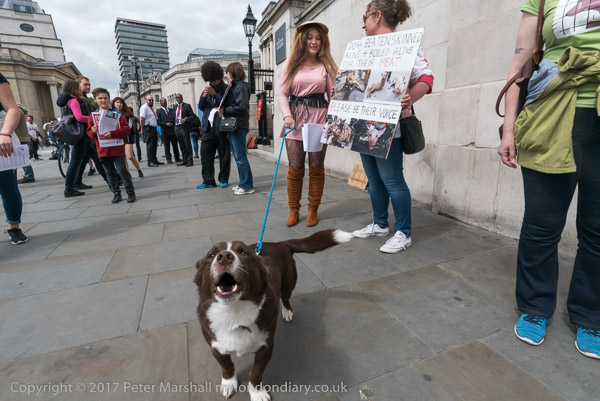
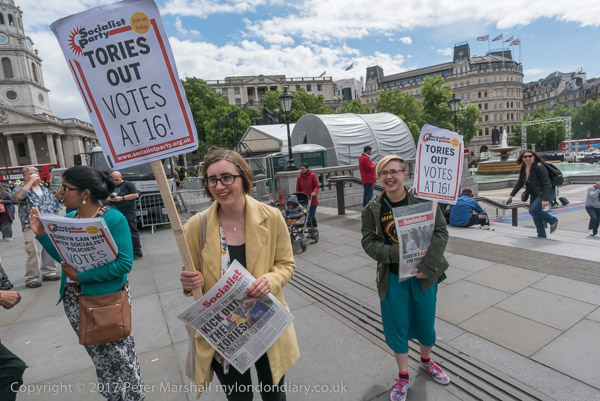
Cat Meat, Teen Votes, Venezuela, Newham Nag & Monsanto: My day on Saturday 20th May included a very wide range of protests, beginning in Trafalgar Square with protests calling for an end to the killing of dogs and cats for their fur and meat as well as a protest demanding for votes in all UK elections at 16.
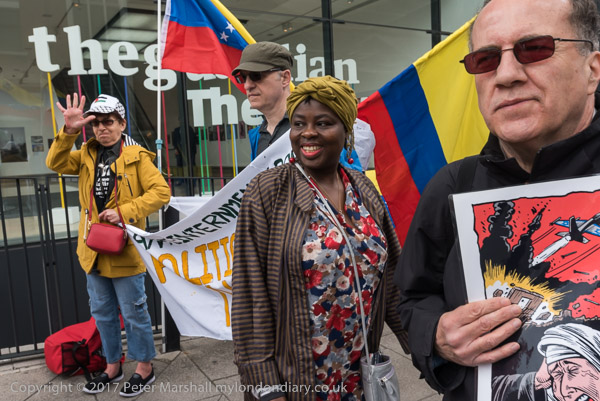
From there I went to a protest outside the offices of The Guardian newspaper against their biased reporting on political events in Venezuela – opposed by a handful of Venezuelans who called President Maduro a murderer.
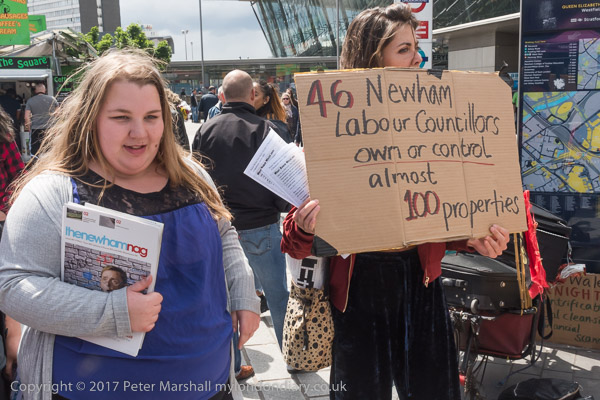
Housing campaigners Focus E15 were outside Stratford Station handing out copies of ‘The Newham Nag’, based on Newham Council’s information sheet but condemning the council for their financial mismanagement and failure to address housing problems in the borough.
Finally at the US Embassy in Grosvenor Square March Against Monsanto were holding a rally, part of an international grassroots movement and protest supported by Bee Against Monsanto.
More details of all these and more pictures on My London Diary at the links to them below.
End dog and cat meat trade – Trafalgar Square
Apparently it was ‘Fight Dog Meat Kindness and Compassion Day‘ and there were protests across the world calling for laws to protect animals, especially dogs and cats, who are cruelly killed for their fur and to be eaten.
Teen Voice, who last year protested over 16-18 year olds having no say in the Brexit vote, came to Trafalgar Square to call for votes in all UK elections at 16. Had young people been given a vote we would almost certainly have voted to remain in Europe.
They say it is unfair that while they can work, pay taxes and even join the armed forces they have no say in votes which effect their future to an arguably greater extent than anyone who is allowed to vote in elections at the moment.
There were a few short speeches before I had to leave but the group were still waiting for other teenagers to join them. Probably holding a protest early on a Saturday morning was not the best idea.
People protested outside The Guardian in London calling for an end to the lies and censorship of the UK press about the events in Venezuela.
They say that the current unrest is a right-wing coup attempt to overthrow President Maduro and the working class Bolivarian revolution, backed by the US, which the privately-owned Venezuelan press misrepresents as ‘pro-democracy’ protests and fails to report their attacks on hospitals, schools and socialist cities which have led to many deaths.
Focus E15 launch The Newham Nag – Stratford Station
The protesters had to keep telling people their ‘Nag’ wasn’t from the council and so was worth reading
Housing campaigners Focus E15 launched their latest handout, ‘The Newham Nag’, based on Newham Council’s information sheet, handing it out outside Newham Station.
Police came and harassed them and Newham Council staff handed out a fixed penalty notice of £100 for alleged obstruction of the highway in the very wide public pedestrian open space in front of the station.
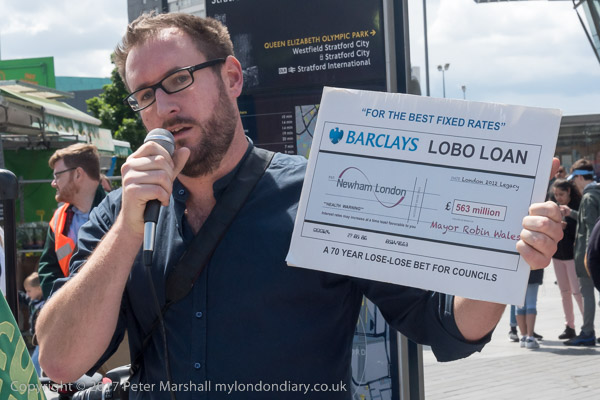
Newham’s use of risky and expensive long-term loans had resulted in 80% of the income from Newham’s council taxpayers going directly to the banks as interest payments. And one in 27 Newham residents are homeless – the largest proportion in any local authority in England. They say the council led by Mayor Robin Wales has failed in its duty to provide housing for residents.
March Against Monsanto – US Embassy, Grosvenor Square
he March Against Monsanto protest outside the US Embassy was a part of the international grassroots movement and protest supported by Bee Against Monsanto.
Speakers addressed various issues around the use of genetically modified organisms (GMOs), Roundup, a glyphosphate herbicide, dangerous bee-killing neonicotinoid pesticides, and the need for improved protection victims of multinational corporations.
Campiagner Linda Kaucher speaks about the danger of trade deals such as TTIP which override national laws which protect our health and safety and endanger the integrity of our food supplies.
Around Emmett Street, Limehouse: My walk in Limehouse on Sunday 6th January 1990 continued. The previous post from this walk is Three Colt Street & Limekiln Dock – 1990.
You won’t find Emmett Street on a map of Limehouse now. It ran from the southern end of Three Colt Street to meet West Ferry Road a few yards to the north of the Limehouse Entrance and Limehouse Basin the the West India Docks. Along its west side were a number of wharves – Taylor’s Wharf, Aberdeen Wharf, River Plate Wharf etc, the dry docks of Limekiln Dockyard and Limehouse Dry Dock and a dock at Aberdeen Wharf. This area was Limehouse Hole and included Limehouse Stairs from which a ferry once ran to Rotherhithe from what later became called Limehouse Pier.
Dundee Wharf, Aberdeen Wharf and the River Plate Wharf were were all part of the Dunbar Wharves. They ran regular twice weekly services to Scotland as well as importing goods from around the world – including meat from Argentina, and Oxo cubes were at one time wrapped here.
Emmett Street had at some time been known as Limekiln Hill – and West Ferry Road was earlier Bridge Road. These names were still used on the 1870 OS map, although The Survey of London says it was known as Emmett Street about 1830.
The land in this area was owned by the Emmett family who began selling it off in 1809 but their name remained on the street until it was completely obliterated with the building of the Limehouse Link Tunnel shortly after I made these pictures.
Much of the area had been cleared earlier by wartime bombing and the some large warehouses were rebuilt in the following years. The remaining 1870s warehouses were demolished in 1971-2 and the rest destroyed for the building of the road tunnel and Canary Riverside including Westferry Circus. You can read a detailed and well-illustrated article Limehouse Hole by Mick Lemmerman on the Isle of Dogs web Site.
Datakeep set out to provide secure storage for computer backup tapes in the largest warehouse in the area, formerly use for tea and coffee. The company later stored all kinds of things, including a 1935 vintage Bentley and offered a wide range of services to companies for their stored items.
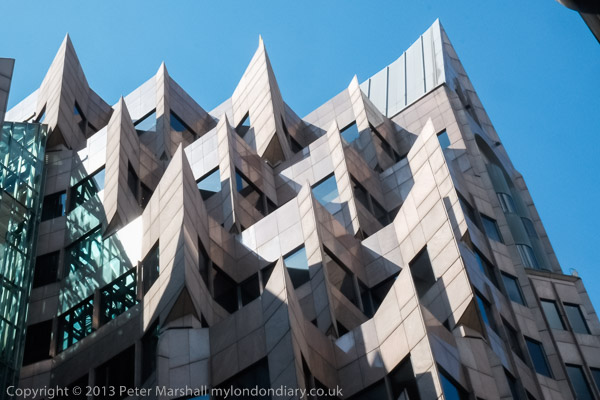
Circle The City: On Sunday 18th May 2014 I accompanied my wife who was taking part in a sponsored walk around churches in the City of London to raise money for Christian Aid, part of the activities in Christian Aid Week. The 2025 Christian Aid Week ended yesterday (17 May 2025) but it isn’t too late to donate towards their work with local partners and communities in countries around the world “to fight injustice, respond to humanitarian emergencies, campaign for change, and help people claim the services and rights they are entitled to.”
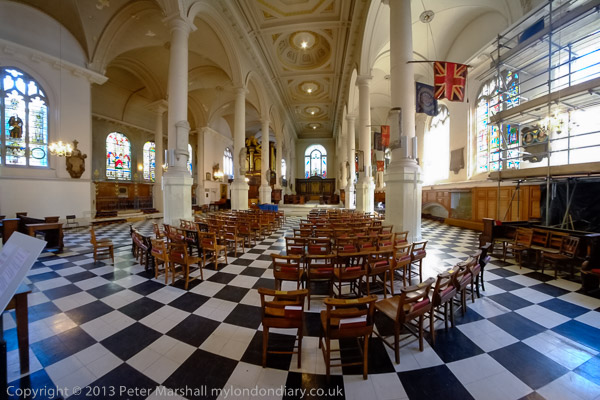
Hawksmoor’s St Mary Woolnuth
Christian Aid is one of the better aid charities, currently working through local grass roots organisations in some of most vulnerable communities in 29 countries in Africa, Asia, the Middle East, Europe and Latin America and the Caribbean. They don’t give money to governments and the projects they support are organised and managed by local people – with robust procedures to ensure the money is spent effectively. Some of those they support are Christian but many are not – something which has led to some churches failing to support their work.
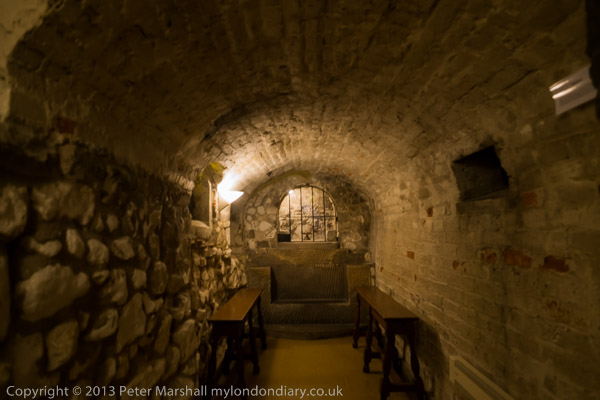
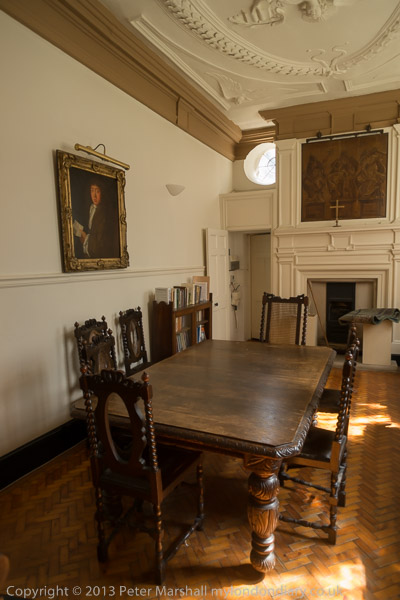
The crypt of All Hallows by the TowerMinster Court, Mark Lane
Other churches have decided against supporting Christian Aid because of their political campaigning, “pressing for policies that can best help the poor…. All we care about is eradicating poverty and injustice and the causes of these.” Compared to some other large charities they are more efficient, with 84p in every pound donated “working for long-term change, responding to humanitarian emergencies and using our voice to call for global change“.
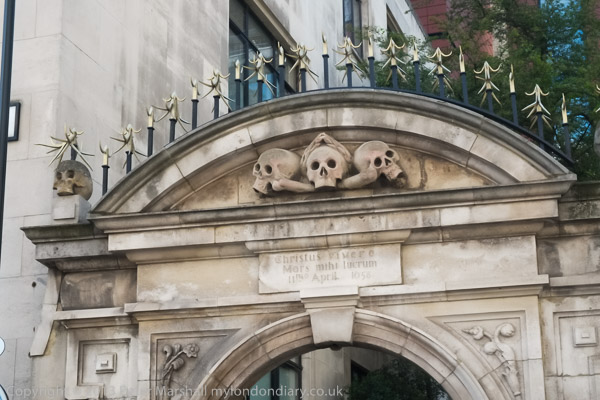
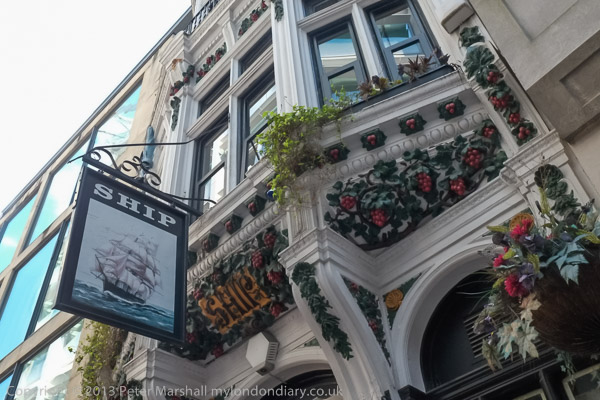
Gateway to “the churchyard of Saint Ghastly Grim”, St Olave Hart St.St Olave Hart StThe Ship, Hart St
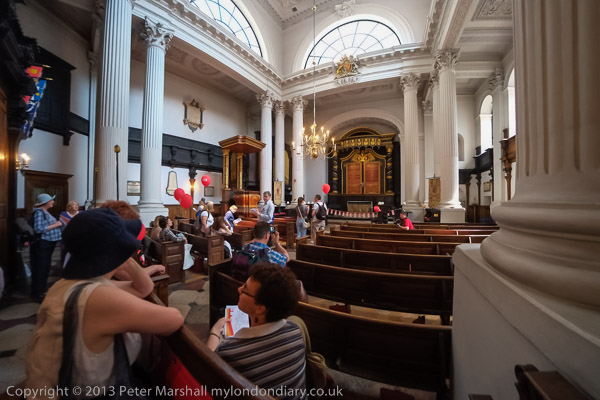
The event was extremely well organised, with those taking part getting maps and directions at St Mary-le-Bow on Cheapside where there was a service before the walk. People also collected red helium-filled balloons to carry on the walk, and some of these were tied to mark the route and the various points – mainly churches where marchers could get their sponsorship forms signed as they walked around which also had Christian Aid bunting.
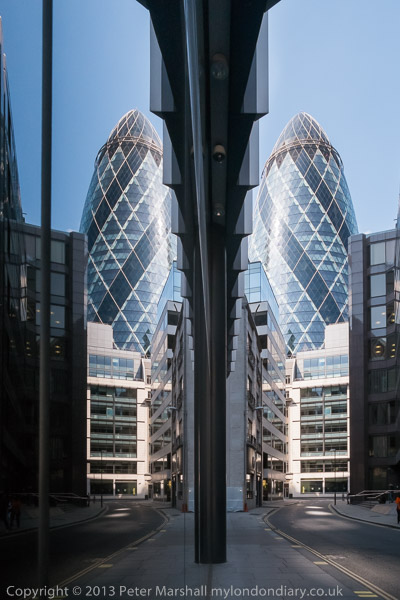
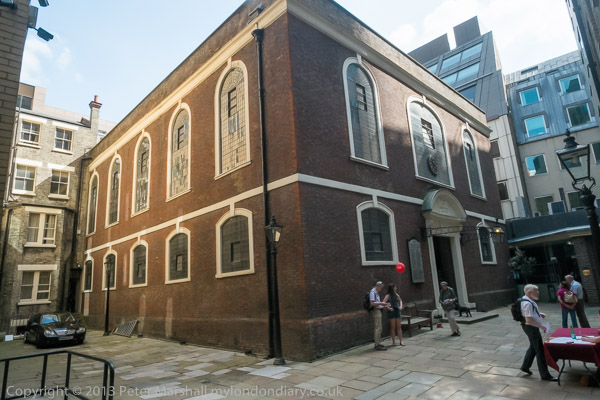
A double GherkinBevis Marks Synagogue is the oldest synagogue in Great Britain, built in 1701
Most of the churches were open for people to walk around and some had refreshments and toilets. It would have been hard to get lost, but some people have zero sense of direction and find it difficult to hold a map the right way up and my presence was helpful. But I had really gone along to keep my wife company – and of course to take some pictures, some of which appeared in her church magazine.
A yurt at the rear of St Ethelburga-the-Virgin within Bishopsgate
I’d visited most of the City churches before and photographed inside them, but there are a few that are seldom open to the public but opened up for the occasion, and I also took other pictures as we walked around. Most of them, even those of other buildings include other marchers and some of the churches were crowded with them. Those red balloons didn’t always improve my pictures, but I also ate more cake than on my other city walks.
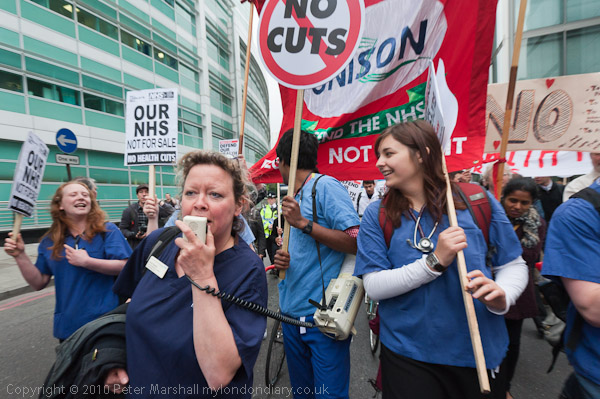
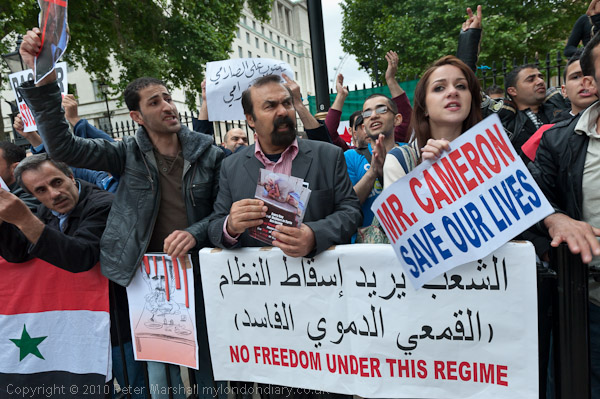
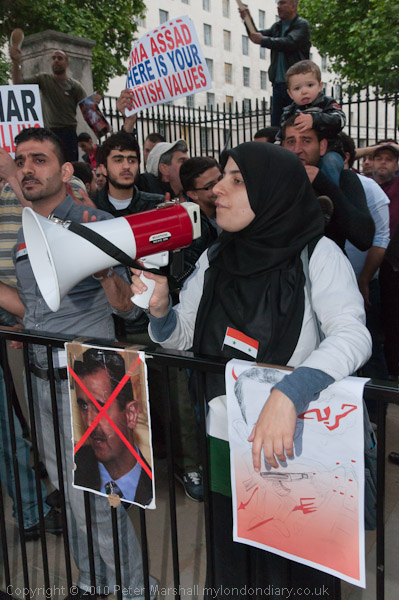
Free Syria & Keep the NHS Public: On Tuesday May 17th 2011 I photographed two protests, a march against the continuing privatisation of parts of our NHS and the Health & Social Care Bill then going through parliament, and a protest at Downing Street calling for the government to support the revolution against the Assad regime in Syria and work to end the bloodshed taking place there.
Fourteen years later the NHS is still under threat with more and more of its services being taken over by private healthcare companies, and although some changes have been made to the disastrous ‘reforms’ introduced under Andrew Lansley but implemented by Jeremy Hunt who later called the fragmentation that it caused ‘frankly, completely ridiculous’ and tried hard to ignore much of it.
What Hunt thought was the only successful part of the Act was that it established the independence of NHS England from the government. On 13th March 2025 the Labour government announced they were scropping NHS England, putting the NHS firmly under the control of Prime Minister Keir Starmer and Health Secretary Wes Streeting, two men who one of my Facebook friends posted should not be in charge of a first aid kit let alone the NHS. If only, many of us think, had Leanne Mohamad got another 529 votes in Ilforn North in 2024 and she had become the MP for Ilford North rather than Streeting. It was perhaps the greatest disappointment of that General Election.
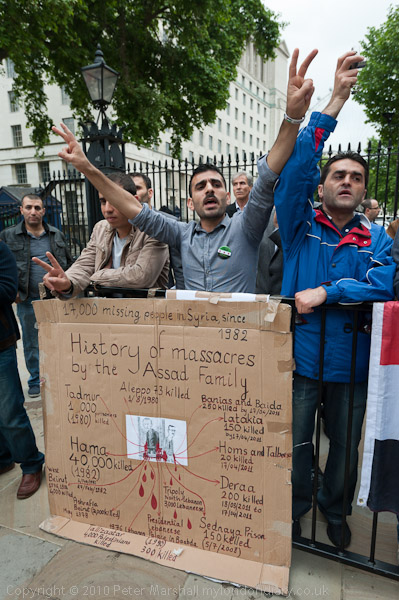
History of massacres by the Assad family – 17,000 missing people in Syria since 1982.
Both Britain and the USA failed to support the Arab Spring in Syria with much more than weak words and when Russian put the forces behind Assad his survival was ensured until finally ousted by Hay’at Tahrir al-Sham (HTS) and others after 13 years of brutal civil war in December 2024.
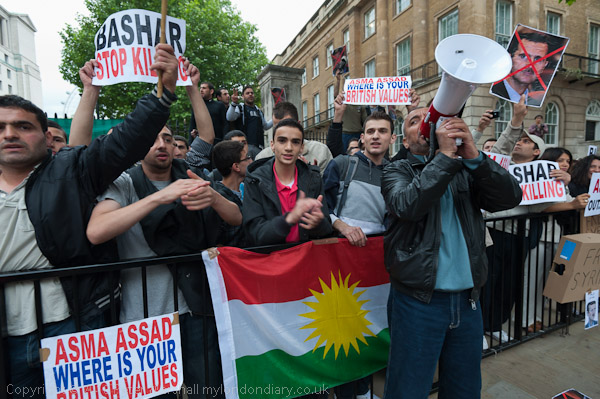
Protesters with a Kurdish flag
The US gave some support to the Kurds to enable them to defeat ISIS (Islamic State of Iraq and al-Sham) despite the support ISIS received from our NATO ally Turkey. But by 2024 lamost half a million Syrians had been killed and around 6.7 million refugees had fled Syria with another 5 million internally displaced. And Turkey had taken advantage of the situation to invade and occupy some largely Kurdish areas.
In deference to Turkey, the UK government proscribed the Partiya Karkeren Kurdistani (PKK) or Kurdish Workers Party in 2001, later adding a whole list of other names it used, KADEK, Kongra Gele Kurdistan, Teyre Azadiye Kurdistan (TAK) and Hezen Parastina Gel (HPG). For some years the PKK had moved from fighting for an independent state of Kurdistan to calling for greater autonomy and civil rights for Kurds in Turkey and a few days ago at a PKK conference it announced it was to disband and disarm.
Keep The NHS Public – UCH Euston Road to Whitehall
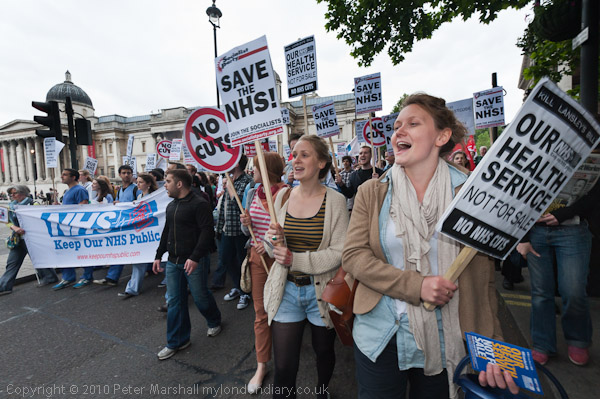
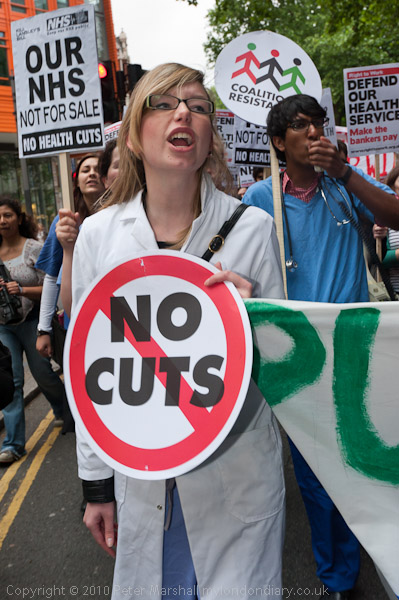
Over a thousand people, including many medical professionals and medical students, marched through London to show their opposition to government reforms which threatens jobs and many feel would destroy the NHS.
After a rally at University College Hospital on Euston Road the march, the second large march in London aimed at saving the NHS and killing Andrew Lansley’s Health & Social Care Bill, set off for Westminster.
There was a brief ‘die-in’ at Cambridge Circus and a small ‘sit-in’ outside Downing Street before the marchers held a final rally in front of the Department of Health at Richmond House before dispersing.
You can read a fuller account of the protest and see many more pictures on My London Diary at Keep The NHS Public.
Syrians Ask For Support at Downing St
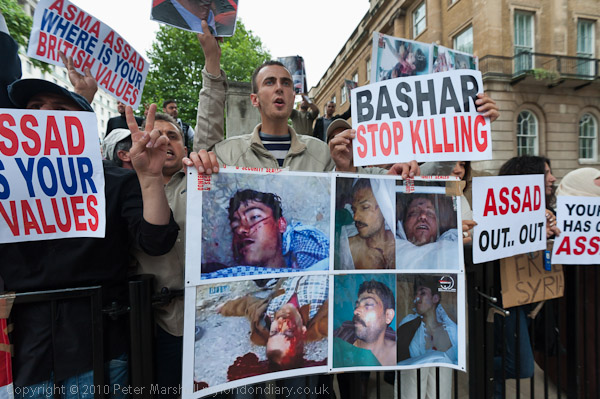
Syrians supporting the ‘People’s Revolution’ in their country called for support from the British people and government to support their demands for reform and to stop the bloodshed in Syria.
A large group of Syrians including Kurds from Northern Syria called for support from David Cameron and the British people for the Syrian people.
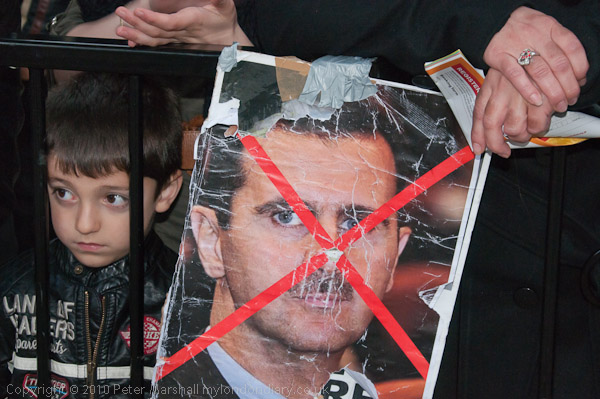
Since demonstrations for political and economic freedom and an end to the tyranny and bloodshed of the Assad regime started in Syria on March 15th 2011, more than 800 innocent protesters have been killed, over 2000 injured and many more detained.
Assad’s father Hafez al-Assad was president of Syria from 1971 until he died in 2000, and was responsible for many deaths and disappearances, including a massacre of 40,000 people at Hama in 1982. His son Bashar Al-Assad, nicknamed as ‘The Butcher’ continued the “arbitrary arrests and detention, torture, extrajudicial killings, enforced disappearances, rape, and mass surveillance.”
Vietnam – Who Took The Picture? Whenever you think or talk with anyone about the US war against the people of Vietnam back in the sixties and seventies the one image that is in everyone’s mind is of a nine-year-old girl, Phan Thi Kim Phuc, running naked down a road screaming after a napalm attack on her village by the South Vietnam Air Force following misleading US intelligence. She saved her life by stripping off her burning clothing and running but was badly burnt. And the photographer who made this iconic image also saved her life.
Although this image is in the public domain in the USA because of it’s date of publication, I think it is still in copyright in the UK, so I won’t post it here. If you need to look at it again it is widely on the web, including on Wikipedia. It’s title is ‘The Terror of War‘, though it is better known simply as ‘Napalm Girl’.
The picture was taken by and credited to a young Vietnamese photographer Nick Ut (Huynh Công Út) working for Associated Press, the US not-for-profit news agency based in New York, and Ut took the 8 films he had shot that day into AP’s Saigon agency – after he had rushed her to hospital – where the film was processed. This image stood out immediately but the AP staff were reluctant to send it to New York because of its full-frontal nudity. They called agency director Horst Fass back into the office and he saw the power and news value of the image and transmitted it to New York demanding they publish it despite the nudity. They did and it won the 1973 Pulitzer Prize for Spot News Photography and the 1973 World Press Photo of the Year.
As so often in covering events, Ut was not the only photographer at the scene, but his image was the most visceral and Fass who was a noted photographer and fighter for the right of photographers to be credited saw that Ut’s name was attached to the picture – and AP had very careful procedures to ensure that pictures were accurately credited. So we can be sure that this picture was the picture taken by Ut.
And we all were convinced until a rival agency, VII led by its co-founder Gary Knight, working largely on the stories of a disgruntled former AP employee challenged this a few years ago and set up a two-year investigation which culminated in the film “The Stringer” released this year. This argues that the picture was actually taken by another, much less well known, Vietnamese photographer, Nguyen Thanh Nghe, who also took his film from that day into AP.
The film puts forward some evidence – enough to convince some reviewers – but I think few actual photographers who have read the truly comprehensive report of the investigation by AP into circumstances will be left with any real doubt that the published picture was by Ut.
Of course many of those who could have given relevant evidence are now dead, and film negatives contain little of the evidence that would be available from digital metadata, though AP did conduct extensive testing of the two negatives that remain from the film. The only people who denied them access to evidence were the film makers, who demanded AP sign a non-disclosure agreement which would have prevented AP from disclosing anything it found – which would have defeated the purpose of the investigation. And both “Nguyen Thanh Nghe, who says he took the photo, and former AP photo editor Carl Robinson, who claims he was ordered to change the credit” declined to be interviewed, instead providing written statements.
The AP investigation which took more than a year points out a number of lies, deliberate misrepresentations, omissions and errors in the film and points to the failures of a report commissioned for “The Stringer” on material still available from the day’s events from the commercial company INDEX which has also so far failed to work with AP. AP carried out a similar but more comprehensive study with significantly different conclusions and shows that the film makes use of “a flawed graphic 3D render of the scene.“
As so much of the relevant evidence has disapppeared, AP are very circumspect in their conclusions. They conclude that Nick Ut could have taken the picture but there are some questions which it is impossible to be sure about largely because of the passage of time.
They say that they cannot now prove conclusively that Nick Ut took the photo, but the “no proof has been found that Nguyen took the picture” and also that there were other photographers who were in a position to have taken it.
And they conclude:
We applied AP’s photo standards to guide us to an outcome. AP’s standards say “a challenged credit would be removed only if definitive evidence … showed that the person who claimed to have taken the photo did not.”
All available evidence analyzed by AP does not clear that bar. Thus, the photo will remain attributed to Ut.
Some photographers have been very much clearer – including some of those who were invloved and gave evidence to AP and it seems almost certain that the accusations made in the film are both untrue and slanderous and that Ut took the picture used by AP which won him the Pulitzer.
I wasn’t in Vietnam and have no connection with either AP or VII or any of the photographers involved. But often I see published pictures of events or places I have photographed and cannot always decide if they are my work or that of another photographer. Particularly on Facebook, where most weeks I come across several of my pictures appearing without any attribution. I have to go back to my files to make sure if a picture is really mine or if someone else has taken a very similar picture. But usually when I have a suspicion a picture could be mine it is.
It seems to me quite likely that Nguyen took a similar but less powerful image on the roll that he claims went in to the AP office. He says AP paid him for bringing the picture in – something they often did even for pictures they could not use, though the records from the office show no record of any payment – and gave him back a print of his picture – but that later his wife threw that away. As the negatives no longer exist we cannot compare his picture with that by Ut. If his wife had kept that print I feel sure we would not now be having this controversy.
Ut deserves a grovelling apology and compensation from the film makers for questioning his integrity – as do many of the others involved. Of course they won’t get it.
Hanging on my living room wall (and there are copies on walls and at least one mug elsewhere) is a picture I made of a sculpture of a lion at Chatsworth. Years after taking it I opened a book by Fay Godwin – a photographer whose work I admired and who I knew personally – and found that very same lion staring out at me.
It’s part of the nature of photography that photographers can make very similar images to each other – and sometimes very minor differences or even chance can make one a masterpiece and another an also-ran – though in this case I think we both did pretty well. Her picture was taken from a position that must have been within an inch of where I had held the camera eight years earlier. Even though we were not there at the same time we saw the scene in the same way. More about this in my post Fay Godwin – Land Revisited.