Bromley-by-Bow Gasholders

Bromley-by-Bow Gasholders: A week ago on Monday 28th March I was invited to go with a team from Cody Dock on a site visit to the gasholders which are a prominent feature of the local landscape, seen by many thousands every day from the Underground and National Rail lines as they travel in and out of London as well as local residents and walkers along the Lower Lea and Bow Creek, including those following The Line sculpture trail. We were there invited to study the heritage, history and ecology of the Bromley-by-Bow Gasworks site which has just been sold by its future developers.

Bromley-by-Bow Gas Holder Site Visit

The seven gas holders, all to a similar design were built between 1872 and 1882 and are all Grade II listed. Nine were built on the site but two are no longer there, the base of one now forming a large circular lake in the site. Holder No 1 was given an extra upper tier in steel in 1925-7 to more than double its capacity. All were taken out of use in the 1980s.

Bromley-by-Bow Gas Holder Site Visit

The real value of the site is not in the individual holders although these were some of the “most aesthetically distinguished and finely detailed gasholders ever built” (according to the listing text) but in the ensemble, thought to be “the largest group of Victorian gasholders known to remain in the world, which is testament to the scale of Britain’s pioneering gas industry and its contribution to the Industrial Revolution.” It is a heritage site not just of national importance but of world importance.

Bromley-by-Bow Gas Holder Site Visit

Given their importance the group, together with the adjoining memorial garden with its Grade II listed memorial lamp and statue of Sir Corbett Woodall surely deserves both Grade I listing and preservation, and the former gas works offices could form a heritage centre for the area. The offices were for some time a gas museum.

Bromley-by-Bow Gas Holder Site Visit
The circular pond is the base of a former gasholder

Just across the Channelsea river from the site is the Grade I listed Three Mills and a little to the south the former gas works Dock at Cody Dock, now a thriving creative and community hub, the sites linked by a riverside path which currently stops at Cody Dock but which should long ago have been opened as planned to lead to the Thames at Trinity Buoy Wharf, passing on the way the Bow Creek Ecology Park. Many sites along here played an important part in Britain and the world’s industrial history, but unfortunately little evidence remains, making it essential to preserve what does.

Bromley-by-Bow Gas Holder Site Visit

We were shown around the site in the morning by two of those responsible for planning the development who expressed their wish for the development to retain these elements which make the site unique and to open them up to the public, but good intentions are not enough, particularly for company accountants.

Bromley-by-Bow Gas Holder Site Visit

Given what has happened at other sites greater protection is required to make sure that any development in the area leaves the gasholders intact and preserves their landscape value, in particular the views of the ensemble from the railway and Underground lines, from Three Mills and the riverside footpaths by the Channelsea River and River Lea and the navigation. We do need more housing, or at least more social housing rather than luxury flats many of which remain largely unoccupied as investments, but we also need to preserve important monuments such as these which record and could celebrate our history.

Many more pictures from the day, mainly inside the holder site in my album Bromley-by-Bow Gas Holders. You can click on any of the images above to see a larger version in the album – and browse from there. Most of the images have an horizontal angle of view of approximately 145 degrees. There are more pictures of the area in various posts on My London Diary including Bow and The Fatwalk, Bromley-by-Bow to Star Lane and Gasworks Dock Revived.


Canonbury, Green Lanes and Balls Pond Road

My next walk on Wednesday 3rd August 1988 began on a train going over the River Thames at Strand on the Green, the North London Line, taking me to Highbury & Islington from where I walked through Canonbury to Green Lanes, where I photographed an interesting pair of houses and found some rather poetic graffiti on my way to Newington Green and went on the the Balls Pond Road.

Grosvenor Ave, Canonbury, Islington, 1988 88-8c-14-Edit_2400
141 Grosvenor Ave, Canonbury, Islington, 1988 88-8c-14

In my dreams last night I was sitting in front of my computer and just turning it off after searching for the location of this house, which on my contact sheet is simply given as ‘?Highbury Grove’, and it flashed onto Google Streetview as the application closed. I was just coming round and wasn’t sure whether this was dream or memory, so as soon as I got back in front of the screen today I looked up where I thought it had been – and found no such street existed. However a few more minutes searching – and looking at the next image on the contact sheet helped – I recognised it as 141 Grosvenor Ave in Canonbury.

The house next door in the semi-detached also had those distinctive vertical brick panels in the colums of the porch and at the side of the windows, but they have been disguised I think by white masonary paint, and possibly others have suffered a similar fate.

But the dream got me thinking more about taking these pictures and about my photography generally as I lay half awake in bed. I think I had walked around half a mile before making my first picture on this walk, past many other houses and shops I might have stopped to photograph but had not done so and I reflected on this. I’ve always been a rather timid photographer and often find it difficult to start taking pictures until something jolts me out of this, and once I’ve got going my reluctance fades. Making a photograph exposes not just the film (or these days the sensor) but also the photographer.

Green Lanes, Highbury, Islington, Hackney, 1988 88-8d-65-Edit_2400
Green Lanes, Highbury, Islington, Hackney, 1988 88-8d-65

I can’t remember the exact route I took to Green Lanes, perhaps up Petherton Road, as the few pictures I made (not on-line) are typical of the area but not easy to locate, but I then walked south towards Newington Green, but a grid reference written on this frame of the contact sheet together with the street name Green Lanes suggests this shop window was near Aden Grove.

The curling notices suggest that Enright & Co Ltd m(established 1875) had left the building some time earlier, and although they say Houses Wanted, the upper left ‘Sorry Nothing’ was probably more appropriate. I rather liked the rather ghosty reflections in the glass, including my legs in the centre of the frame.

Roughly one in four of the pictures I made on this walk are on-line, and four of the ten from this particular film are these consecutive images from this section of Green Lanes.

Green Lanes, Highbury, , Islington, Hackney, 1988 1988 88-8d-66-Edit_2400
Green Lanes, Highbury, Islington, Hackney, 1988 1988 88-8d-66-Edit_2400

There are still several of these ‘Mid-Late 19c’ houses on Green Lanes, roughly oposite Aden Grove and they are locally listed at 57-63 for their ‘truncated Dutch gables’. The bars on the windows at right have gone but they still otherwise look much the same.

Graffiti, Green Lanes, Highbury, , Islington, Hackney, 1988 88-8d-51-Edit_2400
Graffiti, Green Lanes, Highbury, , Islington, Hackney, 1988 88-8d-51

Two writers appear to have taken advantage of this long stretch of white wall, probably empty industrial premises of some kind. Possible the “BIRD Turning in the sky air below the clouds’ there is no corner…” got in first complete with its extra apostrophe and the later writer (perhaps F. Ratttttl)tadded a line above and below, with some other additions including from an Arsenal fan.

Green Lanes here is on the border of the two London Boroughs of Hackney and Islington and I’ve included both boroughs in the captions even when I’m sure which side of the border I took the pictures on.

Graffiti, Green Lanes, Highbury, , Islington, Hackney, 1988 88-8d-52-Edit_2400
Graffiti, Green Lanes, Highbury, Islington, Hackney, 1988 88-8d-52

On the side of a boarded up shop, just off Green Lanes on the corner of Springdale Road was a more organised piece of writing, possibly advice to Fred to build a cradle for his baby. The reflecttion at left clearly shows the two buildings still on either side of Pegasus Close.

Annette Works, Halliford St, Ecclesbourne Rd, Islington, 1988 88-8d-31-Edit_2400
Annette Works, Halliford St, Ecclesbourne Rd, Islington, 1988 88-8d-31

For once a picture which includes precise information on its location, the Annette Works on the corner of Halliford St and Ecclesbourne Rd in Islington. The house at 61 Halliford Street was or had been home to Multi-Print Co, and this side of it has now been extensively rebuilt. I wondered briefly if there might be some connection to Annette Crescent, a listed crescent not far away on the Essex Road, but failed to find any further information. It seems unlikely as Annette Crescent was named for its developer, Thomas James Annett, only picking up the ‘e’ in later years.

Southgate Rd, Kingsland, Islington, Hackney, 1988 88-8d-36-Edit_2400
Southgate Rd, Kingsland, Islington, Hackney, 1988 88-8d-36

Southgate Road is another street on the Hackney/Islington border. There were no Vacancies at No 81, which is now together with No 83 ‘The Sydney Building’ a ‘warehouse conversion’ into flats with a rather prettier garden, roses replacing the buddleia.

Mildmay Rd, Canonbury, Islington, Hackney, 1988 88-8d-26-Edit_2400
Mildmay Rd, Canonbury, Islington, 1988 88-8d-26

This picture appears to show a woman looking out of a upper floor window but this is actually a painting on the wall. But there was a real woman coming along the street towards me. There is still a mural visible on the wall which can be seen rather better from Wolsey Road, but is largely obscured by an overgrown tree. I’m not sure if this upper part above and behind the main painted wall is still there.

The mural was painted in 1981 by Carolyne Beale for Mildmay Housing Action Area and is now in very poor condition, cracking badly. You can see a good colour picture of it all before the tree grew online, with a second picture of this lady at the window. I don’t think I photographed the mural properly, though I may have done.

More from the Balls Pond Road and Dalston in another post.


Click on any of the images in the post to see a larger version in my album 1988 London Photos, from where you can browse other images.


Matches, Care Spares, Flats and the Roman

Fairfield Works, Wick Lane, Bow, Tower Hamlets, 1988  88-8b-21
Fairfield Works, Wick Lane, Bow, Tower Hamlets, 1988 88-8b-21

This is the east side of the Bryant and May match factory. The main Grade II listed building was built in 1909-10, architects Holman and Goodsham, making this the largest match factory in Britain. But parts of the building are earlier, and Quakers, William Bryant and Francis May who had gone into business making matches in 1843 (at first because of their religious conviction only making safety matches) moved to a former candle factory on Fairfield Road in 1861. Various new buildings were added before the 1910 building. The factory closed in 1979, was listed in 1988 and is now the Bow Quarter, a gated private estate with 19 houses and 714 flats. The building at right of the picture was demolished and replaced by a new block.

But safety matches, which needed a special striking surface containing red phosphorus were not as popular as the strike-anywhere matches (lucifers) made with the more dangerous white phosphorus in the match-heads and the factory soon switched to producing these as well. The relatively few men and the several thousand “matchgirls” working in the plant, mainly of Irish descent, commonly suffered from phosphorus necrosis of the jaw, known as ‘phossy jaw’ cause by white phosphorus vapour. The first symptoms were usually toothaches – and the company insisted that any workers suffering got all their teeth removed or be sacked. This poisoning led to a disabled jaw and eventually to death in around a fifth of cases.

Complete removal of teeth was common in the UK before the beginning of the National Health Service after World War II, as only the wealthy could afford any proper dentistry. Toothache can be agonising and was often treated by tying strong twine around the offending tooth, fixing the other end to a door handle and getting someone to slam the door. Both my parents (born around 1900) were given full extraction of teeth and a replacement ‘Full Set’ of upper and lower teeth as a wedding present in 1932.

The match-girls were not only subject to this horrible occupational disease, but discipline at work was excessively strict, with fines taken from their wages for trivial reasons – lateness, a dirty workbench, talking or having dirty feet – as well as having to pay for their own glue and brushes. The sacking of one of the girls in 1888 provoked the Matchgirls Strike – which they won after two weeks, getting better working conditions and a proper grievance process and ending the fines and other deductions from their wages.

Old Ford Rd, Old Ford, Tower Hamlets, 1988 88-8b-12-Edit_2400
Old Ford Rd, Old Ford, Tower Hamlets, 1988 88-8b-12

This scrapyard, for all makes of car spares, open seven days a week was next to the A102 (M) East Cross Route, built between 1967 and 1973 as a part of Ringway 1, most of which was then quickly abandoned after it became clear the complete environmental destruction building it would take. It became the A12 after being transferred to TfL in 2000, as they were not given the powers needed to run motorways.

The massive 1970s slab block flats of Lefevre Walk were replaced in 1993-2006 by the Tower Hamlets Housing Action Trust with a mix of houses and flats with a traditional street layout designed in close consultation with the community.

Old Ford Rd, Old Ford, Tower Hamlets, 1988 88-8b-16-Edit_2400
Old Ford Rd, Old Ford, Tower Hamlets, 1988 88-8b-16

A view from the edge of the scrapyard.

Look, Roman Rd, Bethnal Green, Tower Hamlets, 1988 88-8c-63-Edit_2400
Look, Roman Rd, Bethnal Green, Tower Hamlets, 1988 88-8c-63

As well as the Olympus SLR with which I made most of the pictures on my walks and with a second SLR body with colour negative film, I also carried a small Minox 35 camera in my jacket pocket whenever I went out. This was the smallest 35mm camera ever made, only 3.9 x 2.5 x 1.2 inches, just large enough to hold a 35mm cassette at on side and the take-up spool on the opposite side of the film gate. The 35mm f2.8 lens folded back into the camera body when not in use and the camera fitted easily even into a shirt pocket.

I had several models of the camera over the years, and often used it when I wanted to be less conspicuous, carrying the camera in one hand it was almost invisible. It was also virtually silent in operation. At times on my walks when I had packed away the SLRs in my camera bag it was more convenient to take pictures on the Minox, but the 36 exposure film might contain pictures from several walks and other occasions.

It isn’t always easy to fit the pictures into place in my walks but I think from Old Ford Road I spent some time taking pictures – including this and those below – on Roman Road in the centre of Bethnal Green, but they may have been made the previous day.

Roman Rd, Bethnal Green, Tower Hamlets, 1988 88-7u-12-positive_2400
Roman Rd, Bethnal Green, Tower Hamlets, 1988 88-7u-12

Two women with a push chair on Roman Road talk as they walk along the street. Just visible behind them are two other children with them.

Roman Rd, Bethnal Green, Tower Hamlets, 1988 88-7u-13-positive_2400
Roman Rd, Bethnal Green, Tower Hamlets, 1988 88-7u-13

Men walk on the opposite side of the stree in front of Shirley’s Antiques – Houses Cleared, with the text from a previous occupier still visible on the first floor frontage.

Roman Rd, Bethnal Green, Tower Hamlets, 1988 88-7u-15-positive_2400
Roman Rd, Bethnal Green, Tower Hamlets, 1988 88-7u-15

Men walk on the opposite side of the street in front of Shirley’s Antiques – Houses Cleared, with the text from a previous occupier still visible on the first floor frontage.

The next installment on this walk will include more pictures from Roman Road taken as I made my way to Bethnal Green tube and the end of the walk.


You can click on any of the images to see a larger version in my album 1988 London Photos, from where you can browse the album.


Brent St Patrick’s Day Parade

Brent St Patrick’s Day Parade

Brent is the London Borough with the largest Irish population and there are also significant numbers in the neighbouring boroughs of Camden and Islington and Hammersmith & Fulham, with Kilburn and Willesden Green being the in particular having large populations of Irish descent,

Brent St Patrick's Day Parade
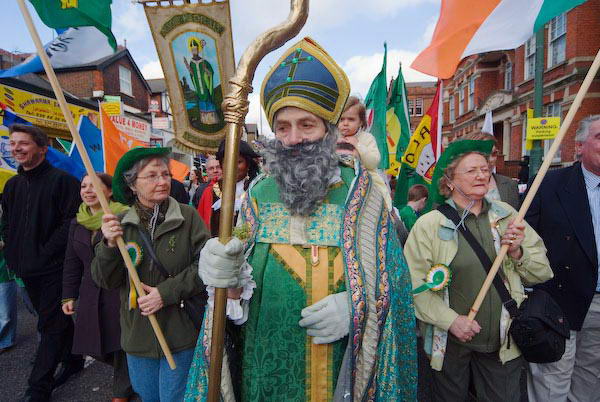
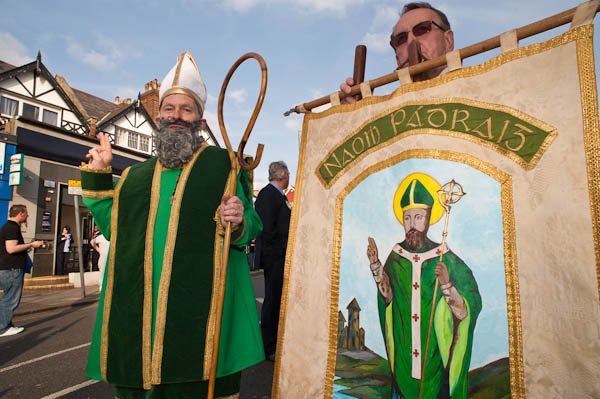
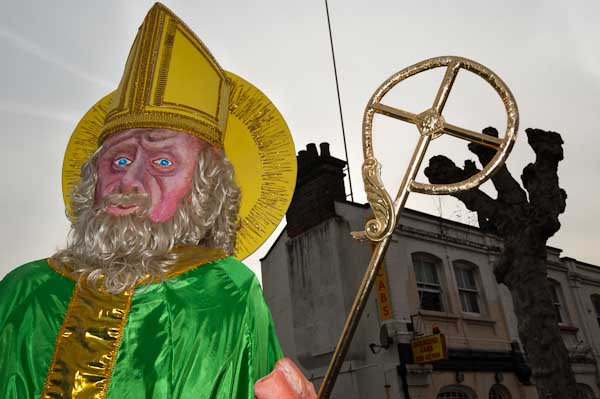
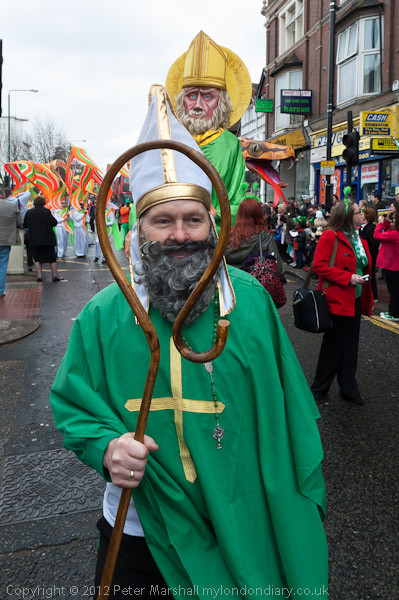
St Patrick, Willeden Green, 2007

So it was hardly surprising that Willesden Green for some years had its own St Patrick’s Day procession, held on the day itself, March 17th, as well as the London celebration begun in 2002 when Ken Livingstone was Mayor on the nearest Sunday. Labour Brent also celebrated days for some of its other communities until recently cuts in funding from a Tory dominated central government made this no longer possible.

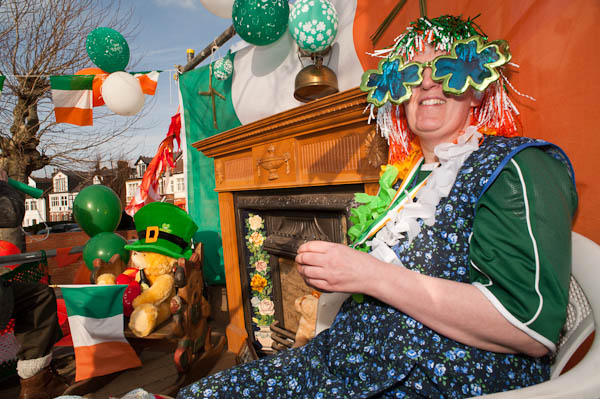
Willeden Green, 2007

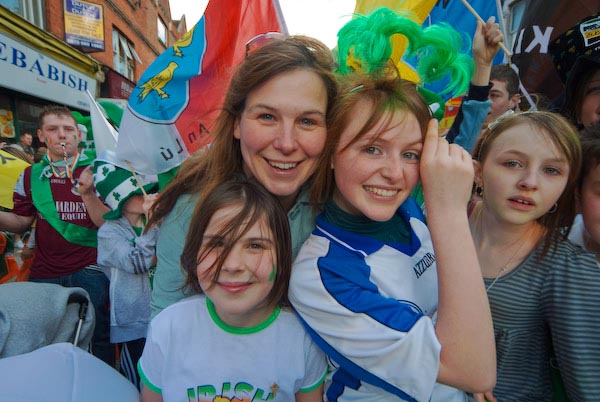
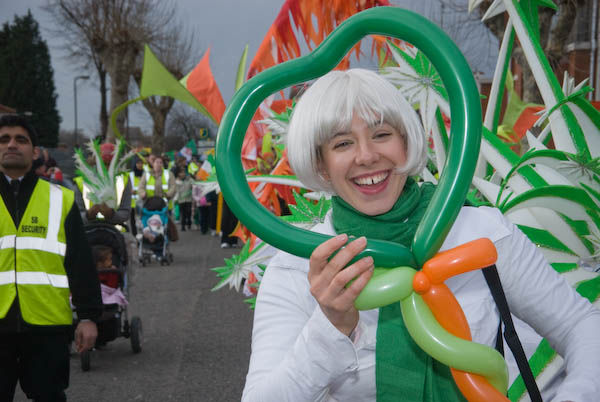
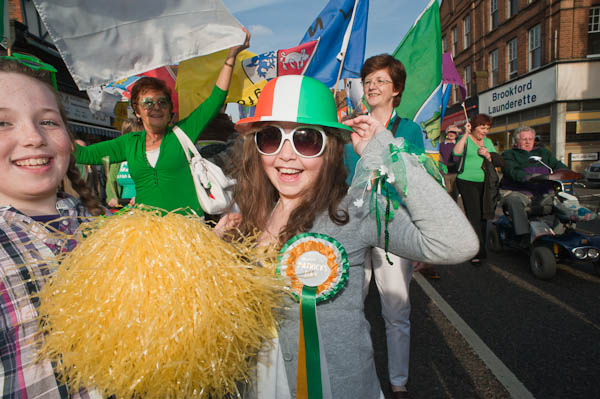
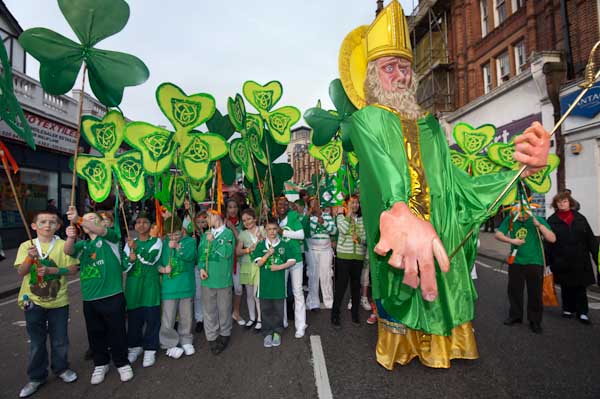
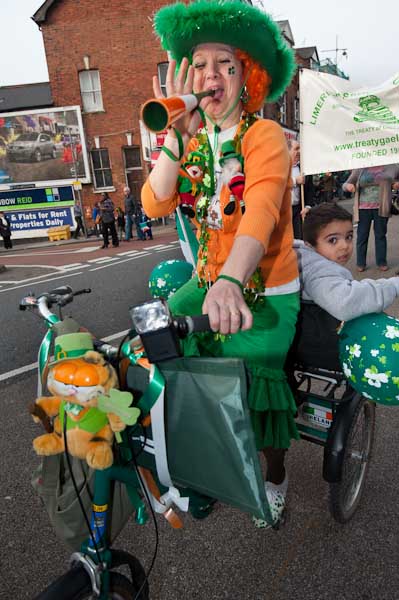
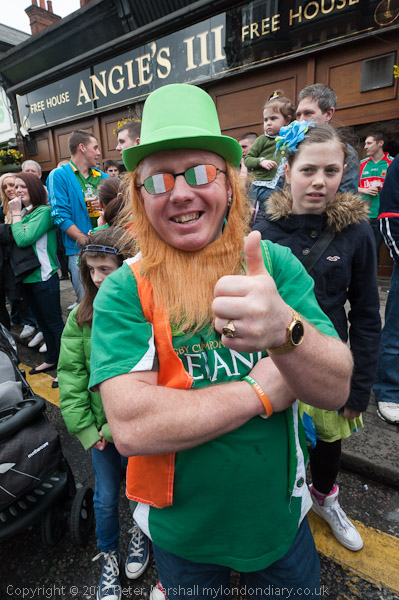
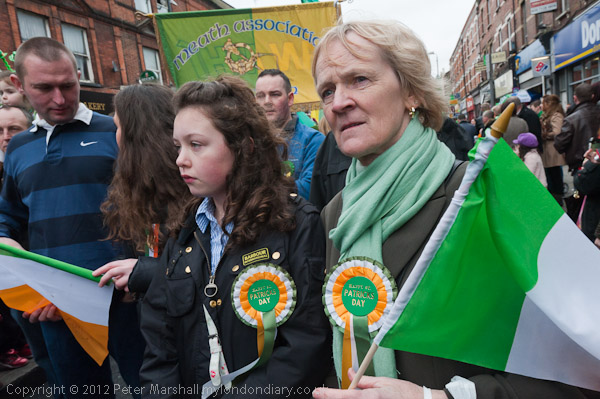
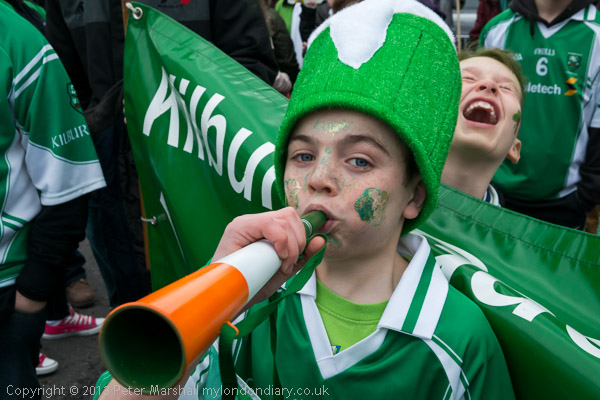
The parade in Brent was on a smaller and friendlier scale than the London parade, and far more a community festival on the street, with others as well as the Irish joining in and having a good time.

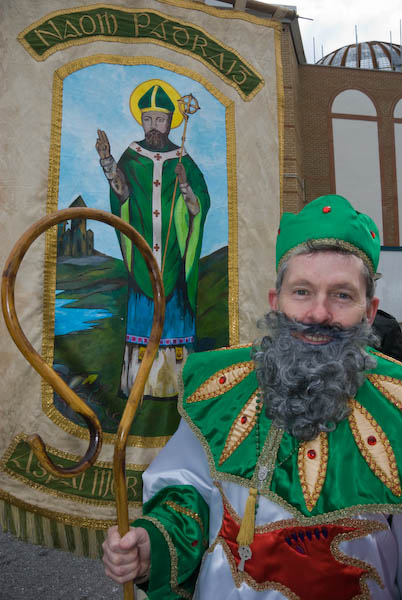
St Patrick, Willesden Green, 2008

The multi-cultural nature of Brent was clear in that the parade began outside an Islamic Cultural Centre and those taking part included many local school-children from a whole mix of heritages. Brent as well as St Patrick’s Day also then celebrated Diwali, Eid, Christmas, Chanukah and Navrati, and Holocaust Memorial Day, along with a black history programme, its own ‘Respect’ festival and a world food and music festival.

Willesden Green, 2008

St Patrick blesses the photographer, Willesden Green, 2009

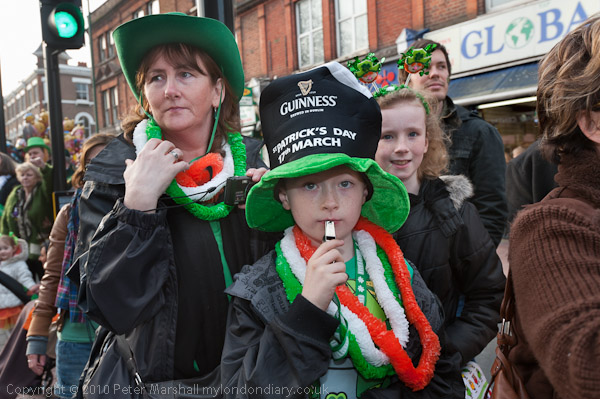
But it was very clearly an Irish event, with Irish people from all across London coming to watch and take part, both in the parade and in the various pubs and bars along the route.

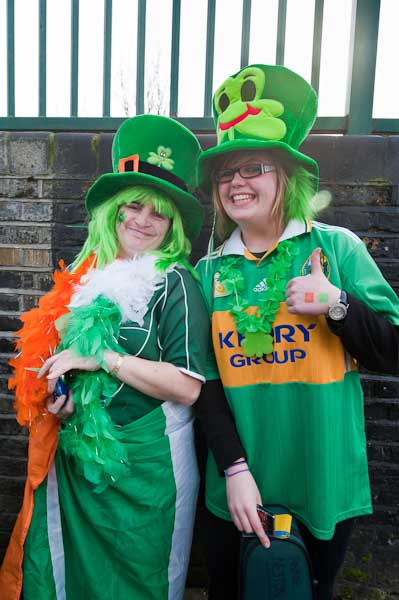
Willesden Green, 2009

Some of the floats in the parade were also in the main London St Patrick’s Day parade, but the atmosphere here was much more relaxed. Here are a few pictures that I made from 2009-2013.

Willesden Green, 2009
Willesden Green, 2010
Willesden Green, 2011
Willesden Green, 2012
Two St Patricks, Willesden Green, 2012
Willesden Green, 2012
Willesden Green, 2013

In 2013, the event was much smaller as council funding had been cut, thanks to Tory austerity policies. And because St Patricks Day that year was on the Sunday, the celebration in Brent was held a day earlier so not to clash with the London parade.

I think this was the last St Patrick’s Day Parade in Brent – certainly it was the last I photographed. You can see many other pictures from Brent St Patrick’s Day Parade on My London Diary

Brent St Patrick’s Day Parade 2007 (scroll down the page)
Brent St Patrick’s Day Parade 2008
Brent St Patrick’s Day Parade 2009
Brent St Patrick’s Day Parade 2010
Brent St Patrick’s Day Parade 2011
Brent St Patrick’s Day Parade 2012
Brent St Patrick’s Day Parade 2013


More Bow – a Grave, Halls, Co-op, Canal & Pub

More Bow – a Grave, Halls, Co-op, Canal & Pub continues my walk on Monday 1st August 1988 – the previous post was Bow, Kingsly Hall, a Nursery, Grime, Quakers & more.

Bear Family, Memorial, Tower Hamlets Cemetery, Mile End, Bow, Tower Hamlets, 1988 88-8b-54-Edit_2400
Bear Family, Memorial, Tower Hamlets Cemetery, Mile End, Bow, Tower Hamlets, 1988 88-8b-54

The family vault of the Bear Family is marked by one of the more impressive monuments of Tower Hamlets Cemetery, with a long list of names, ages ad date of death which is headed by George Huxley Bear, who died in 1855 aged 4 years and six months. Several of the other entries are also for children, though their father lived to the age of 76. Child mortality was very much a feature of Victorian life.

I made two other pictures of this memorial, with its stems of wheat at the bottom and the consoling text from John XII, v 24 “Except a corn of wheat fall into the ground and die, it abideth alone: but if it die, it bringeth forth much fruit.” As with all the other pictures you can click on this one to get a larger version and then browse back and forward to see them.

Bromley Public Hall, Bow Rd, Bow, Tower Hamlets, 1988 88-8b-41-Edit_2400
Bromley Public Hall, Bow Rd, Bow, Tower Hamlets, 1988 88-8b-41

Until last year this was the Tower Hamlets Register Office. The Grade II listed building dates from 1880 and was built as the vestry hall for St Leonard’s parish and extended in 1904. At least one web site confuses this with the much older and very different Bromley Hall, on the Blackwall Tunnel Approach road, though to be the oldest brick building in London, built around 1490 but extensively remodelled with a Georgian frontage around 1700.

Former Co-op store, Bow Rd, Bow, Tower Hamlets, 1988 88-8b-42-Edit_2400
Former Co-op store, Bow Rd, Bow, Tower Hamlets, 1988 88-8b-42

Stratford Co-operative & Industrial Society built this splendid store on Bow Road in 1919, proudly listing the names of its leading members under the bee hive signifying co-operation.

In my youth every high street (and some rather lower) had its own Co-operative store, benefiting from the huge buying power of the Cooperative Wholesale Society. We bought most of the few new clothes we could afford there as well as shoes and other items, and it was the Co-op who delivered our milk seven days a week. My mother’s Co-op number is still etched in my memory, essential when making any purchase, and leading to a ‘divi’ at the end of the year which saw us through Christmas.

In 1988 this was the PLH Kakkad Supermarket and although it sold a wide range of goods its frontage was devoted to Rothmans, “The best tobacco money can buy“. More recently it became a Costcutter and then a Nisa local since around 2008.

Lea Navigation, St Thomas Creek, Bow Back Rivers, Stratford, Newham, 1988 88-8b-46-Edit_2400
Lea Navigation, St Thomas Creek, Bow Back Rivers, Stratford, Newham, 1988

I walked further east and crossed the busy Bow roundabout to take this picture looking across the Lea Navigation and up St Thomas Creek, one of the Bow Back Rivers. Stratford High Street at right is now lined with tall flats, and Global Caravans with one stacked on top of a couple of containers is long gone, along with almost all of the rest of the industrial buildings. A few of those nearest on the left before Cooks Road remained but in derelict condition in 2021.

Bow Theatre, Bow Rd, Bow, Tower Hamlets, 1988  88-8b-32-Edit_2400
Bow Theatre, Bow Rd, Bow, Tower Hamlets, 1988 88-8b-32

Walking back west up Bow Road took me to Bow Theatre on the west corner of Fairfield Road. This Grade II listed building was a new Poplar Town Hall built in 1937-8 and was said to be the first modernist town hall, designed by Ewart Culpin and his son Clifford. The frieze by David Evans depicts the various trades of the builders of the town hall and is said to include a welder, a labourer, a mason, a carpenter and an architect. Unfortunately it is hard to decide the occupations of some of those in my picture, partly as they are not critically sharp.

After Poplar became a part of Tower Hamlets, this was no longer a town hall, but remained in use for some years as council offices and also as a theatre. The council sold it in the 1990s and it is now Bow Business Centre.

Caledonian, pub, Fairfield Rd, Blondin St, Bow, Tower Hamlets, 1988 88-8b-34-Edit_2400
Caledonian Arms, pub, Fairfield Rd, Blondin St, Bow, Tower Hamlets, 1988 88-8b-34

The Caledonian Arms on the corner of Blondin St is still standing but no longer a pub, having closed around 2000 and extensively converted to office and residential use in 2010. The building possibly dates from 1851 though it may have replaced a former building later that century. For years a Watney’s pub it later became owned by Shepherd Neame.

The cafe on the opposite corner has gone completely, its site part of a car park for new buildings down Blondin St. The name suggests that the street was built at the time of the famous tightrope crossing of the Niagra by ‘The Great Blondin‘ in 1859.

Douro St, Bow, Tower Hamlets, 1988  88-8b-35-Edit_2400
Douro St, Bow, Tower Hamlets, 1988 88-8b-35

This was a short street with small houses shown in the picture with front doors opening directly onto the street and a car breakers behind the fence at left.

The cobbles and the small houses are still there, but the car breakers have been replaced by a large block of flats, Altius Apartments, at 714 Wick Lane, with 4 floors and a roof garden, at a taller 9 floor tower at the east end. The guide price for one of those small houses in the ‘Bow Quarter’ is given as £800,000 and the estate agents rather creatively describe Douro St as ‘tree-lined’.

Tredegar Rd, Bow, Tower Hamlets, 1988 88-8b-36-Edit_2400

Tredegar Rd is just to the north of Douro St, on the other side of the flats. I think this is at its junction with Wick Lane and I think absolutely nothing of what was in my picture remains, with even the road layout having altered at least slightly.

What was H Bates & Son Scrap dealers is now occupied by a block of around 12 floors, offices at ground level and flats above, but the ‘Bow Quarter’ area is so different that this could well be another nearby corner – also covered with new housing. But my next pictures show I turned south down Wick Lane to the rear of the former Bryant & May match factory, where the next instalment of this walk will begin.


Click on any image to see a larger version in my album 1988 London Photos, from where you can browse other images. You can view most of the sites today on Google Streetview.


Bow, Kingsly Hall, a Nursery, Grime, Quakers & more

This post continues from my previous post on this walk by me on 1st August 1988, Coventry Cross, Gandhi, Graffiti, Drag Balls …

Stroudley Walk, Bow, Tower Hamlets, 1988 88-8a-21-Edit_2400
Stroudley Walk, Bow, Tower Hamlets, 1988 88-8a-21

The buildings of the Diary and the Rose & Crown are still standing at the north end of Stroudley Walk where it meets the end of Bromley High St, but the closed diary became Hussains Convenience Store and then Jalalabad Grocers and half is now a mobile phone repair shop.

The Rose & Crown had opened here around 1720, as the Bowling Green Inn, though the building here is from the 1880s. It closed in 2007, was boarded up for some years before reopening around 2014 as a coffee bar and fast food restaurant.

This was formerly the north end of Devons Road, and a sign for this painted on the brickwork at the left of the pub had virtually disappeared when I made this picture in 1988. Later repainted it has now almost disappeared again.

Kingsley Hall, Powis Rd, Bromley-By-Bow, Tower Hamlets, 1988 88-8a-25-Edit_2400
Kingsley Hall, Powis Rd, Bromley-By-Bow, Tower Hamlets, 1988 88-8a-25

I wrote more about Kingsley Hall and the sisters Muriel and Doris Lester in the previous post on this walk. They used a legacy from their younger brother Kingsley to set up a house where they lived in relative poverty and served the neighbourhood as well as campaigning for peace and justice across the world. A plaque on the building records that Mahatma Gandhi lived in a small cabin here during his three month stay attending a government conference as a representative of the Indian National Congress. You can read and see more about his visit and the sisters on the Muriel Lester web site.

This image gives a better view of the whole building, which dates from 1928. It faces the Devons Estate, built for the London County Council in 1949 and described by Pevsner as being in their ‘pre-war manner, but with all the drabness of post-war austerity‘. Those moved from slums into its maisonettes and flats would have taken a far more positive view and the estate was solidly built and well-designed to the standards of the day.

Clyde House, Bruce Rd, Bromley-by-Bow,  Tower Hamlets, 1988 88-8a-26-Edit_2400
Clyde House, Bruce Rd, Bromley-by-Bow, Tower Hamlets, 1988 88-8a-26

Clyde House is still there at 46 Bruce Road, looking in rather better condition now. Built in 1884 it appears to have been built as a pair with its double-fronted neighbour at 48.

Children's House, Nursery School, , Bruce Rd, Bromley-by-Bow,  Tower Hamlets, 1988 88-8a-11-Edit_2400
Children’s House, Nursery School, Bruce Rd, Bromley-by-Bow, Tower Hamlets, 1988 88-8a-11

Sisters Muriel and Doris Lester helped to set up the Children’s House on Bruce Road 1923. Doris had trained as a teacher and they commissioned Charles Cowles-Voysey to design a building based on Maria Montessori’s ideal learning environment for young children. The school was opened in 1923 by H G Wells and is still a school, run by Tower Hamlets Council.

Inside there is a 12 metre mural painted in 1935 by Eve Garnett, the illustrator, artist and writer of the first children’s book about working class characters, The Family from One End Street, in 1937. There is now a campaign to save and restore the mural which is dirty and damaged and the web site is asking for donations to pay for this.

Regent Square, Bow, Tower Hamlets, 1988  88-8a-15-Edit_2400
Regent Square, Bow, Tower Hamlets, 1988 88-8a-15

The Crossways Estate, built in 1970 was apparently at the time known as the ‘Pride of Bow’, for its three 25 storey towers and a low rise block, Holyhead Close, built over the railway line. Later it was more prosaically referred to as the ‘three flats.’

It was here that Grime developed in 2003, after Rinse FM squatted in a flat and broadcast illegally from here, and it was also where Dizzee Rascal and others grew up.

Like many council developments the area around the estate was hard to navigate, with walkways and roads often not shown on maps. My contact sheet says ‘Regent Square and gives grid reference 375827 for the first of the five images I made. The three towers were Hackworth Point, Mallard Point and Priestman Point and are on Rainhill Way.

And also like many council estates, it was subjected to a policy of ‘managed decline’ and by 1999 was in a very poor state, so bad its demolition was under consideration. Tower Hamlets decided to retain and refurbish the estate which passed to Swan Homes after a residents ballot in 2005. Its towers now refurbished and clad more brightly this is now the Bow Cross Estate.

Bow Church, station, DLR,  Crossways estate, Bow, Tower Hamlets, 1988 88-8b-56-Edit_2400
Bow Church, station, DLR, Crossways estate, Bow, Tower Hamlets, 1988 88-8b-56

The ‘three flats’ seen from Bow Road and Bow Church DLR station which opened on 31 August 1987.

Mornington Grove, Bow, Tower Hamlets, 1988 88-8b-61-Edit_2400
Mornington Grove, Bow, Tower Hamlets, 1988 88-8b-61

Mornington Grove not only gets a mention in the London 5: East volume of Pevsner (p619) which describes these houses as “unusually grand for the area” but also has an extensive web site covering its history by Ken Ward, a resident in the street, from which this information is extracted – and which has far more detail. And it really is an interesting history – if you have the time do click the link and read more.

The land of a nursery here was bought by the Quaker meeting in Ratcliff in 1812, and houses on Mornington Road were developed by them from 1854-1889 – those on the east side in this picture being among the later development. Arthur Wellesley, the 1st Duke of Wellington was the son of the first Earl of Mornington, and the fourth Earl lived nearby on the north side of Bow Road.

Many of the houses in Mornington Road were compulsory purchased and demolished for the Whitehapel and Bow Railway (later the District Line) and others by World War II bombing of what had in 1939 been renamed Mornington Grove. Under the Quakers, at least 5/7th of the rents of the houses went to the support of the poor.

Most of the houses in the street, by then under multiple occupation, were sold by the Quakers to a housing association in 1980, becoming social housing, though many have now been sold off.


More from Bow in the next post from my walk in 1988. You can see larger versions of any of these pictures by clicking on the image which will take you to my album 1988 London Pictures from where you can browse.


Coventry Cross, Gandhi, Graffiti, Drag Balls …

Coventry Cross, Gandhi, Graffiti, Drag Balls …

Stanstead House, Devas Street, Bromley-By-Bow, Tower Hamlets 1988 88-8a-53-Edit_2400
Stanstead House, Devas Street, Bromley-By-Bow, Tower Hamlets 1988 88-8a-53

My previous walk on 31st July ended at Bromley-by-Bow, and I returned there the following day to continue my wanderings, starting on Devas St and the Coventry Cross West Estate, built by the LCC in the early 1950s, and in 1988 it had recently passed from the GLC to Tower Hamlets. Like all council housing it was very much compromised by the opposition under Thatcher to social housing, with the ‘right to buy’ policies selling off properties to tenants on the cheap and local authorities being largely prevented from building more as well as being starved of cash.

The estate serves as a reminder of an age where councils were able to provide large numbers of socially rented homes before we moved to an era dominated by private profit. Many council tenants who bought their own properties found it very impossible to pay back the loans they had taken on, and sold them as soon as they were able, with many of them now privately rented as ‘buy to let’ properties with rents several times social housing rates.

The six-storey Newmill House at left is linked to the four storey Stansted by a massive archway, with another the west linking to another six storey block, Brimsdown. The estate is now managed by Poplar HARCA and has been renovated around ten years ago.

Stanstead House, Devas Street, Bromley-By-Bow, Tower Hamlets 1988 88-8a-54-Edit_2400
Stanstead House, Devas Street, Bromley-By-Bow, Tower Hamlets 1988 88-8a-54

A portrait orientation view of the same arch into the estate. When built Newmill House at left, a long block running parallel to the Blackwall Tunnel Approach, contained 55 flats.

Gandhi plaque, Kingsley Hall, Powis Rd, Bromley-By-Bow, Tower Hamlets 1988 88-8a-42-Edit_2400
Gandhi, plaque, Kingsley Hall, Powis Rd, Bromley-By-Bow, Tower Hamlets, 1988 88-8a42

North of the railway line, my walk took me to Patrick Connolly Gardens, now rather lost in the Devons estate, and then on to Powis Road where I made this picture of Kingsley Hall.

Kingsley Hall was opened in 1928 by philanthropists and peace campaigners Muriel and Doris Lester who opened the centre using the legacy from their brother Kingsley who died in 1914 when only 26. They had previously helped to set up a Children’s House on Bruce Road nearby in 1923. Muriel Lester (1883-1968) was one of the world’s leading pacifists, and is thought to have been unsuccessfully nominated for the Nobel Peace Prize in the 1930s.

The building had previously been Zion Chapel built by Strict Baptists but was then disused. The sisters were also Baptists, but of a very different nature, they were radical and committed to a social gospel and justice issues and the hall became a centre for their community work with Muriel also serving as its pastor. They donated their wealth to serving the people of Bow and lived a simple and humble life.

Muriel had met and travelled with Mahatma Gandhi often in her work as Travelling Secretary of the International Fellowship of Reconciliation and when he came to London as the representative of the Indian National Congress Party to argue in a conference for independence he rejected the suite offered him by the government at the Hilton Hotel, saying he would rather stay with Muriel Lester at Kingsley Hall. He stayed there for three months, living in a cell on the roof in the same simple style he did in London.

Bromley-By-Bow, Tower Hamlets, 1988
Bromley-By-Bow, Tower Hamlets, 1988 88-8a-44

I doubt if I would have photographed this street corner were it not for the message ‘big Love’ in large letters on the corrugated iron sheeting. Though it does look as if the writer went on to write something beginning with HATE. This was somewhere fairly close to Kingsley Hall.

Edgar Rd, Bromley-By-Bow, Tower Hamlets, 1988 88-8a-46-Edit_2400
Edgar Rd, Bromley-By-Bow, Tower Hamlets, 1988 88-8a-46

The fence here has several messages as well as some peeling posters. The longest text reads ‘AS LONG AS WE HAVE NOT SMASHED EVERYTHING THERE WILL BE RUINS!!’, an exceedingly philosophical example of graffiti which I’ve not seen elsewhere, though I wonder if it could be from a song lyric.

Considerably more common is the ‘VICTORY TO THE MINERS’, and I think the Female Sign – the planetary symbol for Venus ♀ – may mean the painter was a woman.

Tudor Lodge, Bromley High St, Bromley-By-Bow, Tower Hamlets, 1988 88-8a-31-Edit_2400
Tudor Lodge, 85, Bromley High St, Bromley-By-Bow, Tower Hamlets, 1988 88-8a-31

This may have had some connection with Tudor House, whose grounds were bought in 1898 by the LCC to make a public park, which is now Bromley Recreation Ground a couple of hundred yards away, but more likely just with the Tudor family who lived in Tudor House and in the Old Palace closer to where Tudor Lodge used to be.

The archway informs us that this was Tudor Lodge Sports and Social Club, catering for Weddings and Funerals; over a door at left it tells us the ‘Bow Bridge Sports & Social Club Meets Here’. It was by then a large men’s social club, but the impressive cross above the doorway suggests that this was originally a Christian institution of some kind, perhaps a convent or priory

In the 1980s it became a venue for Drag Balls which had begun as the Chelsea Arts Ball, before moving to the Parchester Hall and then on to here. Later in the 90s was the home of Ron Storme’s Transvesti Extrodinaire club.

There is now a completely different modern Tudor Lodge at 95 Bromley High St on the corner with St Leonard’s Road.

How Memorial Gateway, St Leonards Priory, St Leonard's St, Bromley-by-Bow, Tower Hamlets, 1988 88-8a-33-Edit_2400
How Memorial Gateway, St Leonards Priory, St Leonard’s St, Bromley-by-Bow, Tower Hamlets, 1988 88-8a-33

The only part of the parish church of St Mary with St Leonard to survive following bombing in 1942 and the building of the Blackwall Tunnel Approach Road. The church was built in 1843 to replace the former chapel of St Leonard’s Priory, a Benedictine nunnery first recorded in 1122 and destroyed after the dissolution of monasteries in 1536, after which its chapel had been used as a parish church. Chaucer wrote of the nunnery as the “Scole of Stratford atte bowe“.

The How Memorial Gateway was erected in 1893 as a memorial to the Rev G A How, vicar of the church from 1872-93. It is Grade II listed and in poor condition.

Bromley High St, Bromley-By-Bow, Tower Hamlets, 1988 88-8a-34-Edit_2400
Bromley High St, Bromley-By-Bow, Tower Hamlets, 1988 88-8a-34

There is still a large tree and a telegraph pole on the corner of Bromley High St with St Leonards Street, but the lower buildings on the left of the picture were demolished a year or so ago.

Just visible in this picture is the coat of arms of the London County County on 72-4 Bromley High St (Barry wavy of six Azure and Argent on a Chief of the last the Cross of St. George charged with a Leopard of England. The Shield is ensigned with a Mural Crown Or – though it’s too small on the photo to see any details) announcing this as the Bow Bridge Estate, which was completed in 1934. I hope Poplar HARCA kept this when they demolished the building.

My walk through Bow will continue in a later post. Click on any of the images above to see a larger version in my album 1988 London Photos, from where you can browse the album.


Spratt’s, Far Famed Cakes and Bromley by Bow

Spratt’s, Far Famed Cakes and Bromley by Bow. My walk on 31st February 1988 was coming to an end as I made my way towards Bromley-by-Bow District Line station to begin my journey home. You can see the previous part at Lansbury, Brownfield, Teviot and St Leonards Road.

Footbridge, Railway, Spratt's Patent, Clutton St, Poplar, Tower Hamlets, 1988 88-7t-15-positive_2400
Footbridge, Railway, Spratt’s Patent, Clutton St, Poplar, Tower Hamlets, 1988 88-7t-15

St Leonard’s Road beyond Langdon Park becomes Uamvar St, an odd name whose origin I can’t find. It used to be a little west of its current route and I think with St Leonard’s Road used earlier to be Bow Lane. I soon turned left onto Clutton St and climbed onto the footbridge over the railway. The bridge has now been replaced by a metal structure on which it would be rather harder to write ‘Happy Birthday’ and ‘I Love You’.

The railway line here carries the Docklands Light Railway line from Poplar to Stratford, but had been a part of the North London Railway (founded in 1846 as the East and West India Docks and Birmingham Junction Railway.) The Spratt’s Patent Limited Offices Fenchurch St are still there, with an entrance from Fawe St.

Farfamed Cake Company, Fawe St, Footbridge, Poplar, Tower Hamlets, 1988 88-7t-16-positive_2400
Far Famed Cake Company, Fawe St, Footbridge, Poplar, Tower Hamlets, 1988 88-7t-16

The Far Famed Cake Company began in 1881, and was bought by Fitch Lovell in 1950. They merged it with another company to form Hales Trent Cakes in 1962. In 1974 this was bought by Lyons. The factory had employed around 320 people. I think this site is now occupied by a large new block of flats with some shops on Morris Road.

Spratt's Patent Limited, Fawe St, Poplar, 1988 88-8a-62-Edit_2400
Spratt’s Patent Limited, Fawe St, Poplar, 1988 88-8a-62

Separated by a long yard from the block of Spratt’s Patent beside the DLR is another block of Spratt’s Patent Limited, still there and now the A B Fine Art Foundry.

Foresters Arms, pub, St Leonards Road , Poplar, Tower Hamlets, 1988 88-8a-63-Edit_2400
Foresters Arms, pub, St Leonards Road , Poplar, Tower Hamlets, 1988 88-8a-63

The Foresters Arms at 253 St Leonards Road, on the corner with Clutton St, a former Charrington & Co pub closed in 2004 and was sold. It was extended and converted to 6 flats in 2005. There had been a pub on this site since before 1856. It still has an address on St Leonards Road lthough my map calls the road huere Uamvar St.

Limehouse Cut, Blackwall Tunnel Northern Approach, Bromley-by-Bow, Tower Hamlets, 1988 88-8a-64-Edit_2400
Limehouse Cut, Blackwall Tunnel Northern Approach, Bromley-by-Bow, Tower Hamlets, 1988 88-8a-64

I continued my walk up Uamver St and on to the Blackwall Tunnel Northern Approach, and this picture was taken beside Tweed House, part of which can be seen at the extreme left. The buildings in the centre have now been replaced by a lower-rise redevelopment but that visible above the wall at the right of the picture is still there.

This section of the Limehouse Cut towpath was then rather overgrown and little used. It is now much busier, with a new floating section taking the path from Bow Locks under the busy tunnel approach road.

Nursery, Flats, Blackwall Tunnel Northern Approach, Bromley-by-Bow, Tower Hamlets, 1988 88-8a-52-Edit_2400
Nursery, Flats, Blackwall Tunnel Northern Approach, Bromley-by-Bow, Tower Hamlets, 1988 88-8a-52

I photographed this mural on a nursery and clinic in the flats beside the Blackwall Tunnel North Approach close to Devas St. This was part of the Coventry Cross West Estate, built by the LCC in the early 1950s as an addition to their 1935 Coventry Cross Estate. The name Coventry Cross came from a long-closed pub in the area since 1690 – at 68 St Leonards Street in 1861. The estate passed to the GLC and then TOwer Hamlets before after consultation and vote they joined Poplar HARCA.

From here is was a short distance to the end of my walk at Bromley-By-Bow District line station – from where I began my next walk in early August 1988

This had been an good walk for me and I hope readers will have found the pictures and text about them interesting. There are some more pictures from it in my album 1988 London Photos including some from earlier in the day at Petticoat Lane, in Whitechapel and Tower Hamlets cemetery before I started the walk proper.


Lansbury, Brownfield, Teviot and St Leonards Road

Lansbury, Brownfield, Teviot and St Leonards Road. My previous post in the series on this walk, Back to Poplar in 1988 contained information about George Lansbury, a leading politician in Poplar and around from when first elected as an MP in 1910 to his death in 1940. From 1932-35 leader of the Labour Party he was forced to resign because he stuck to his principles.

Lodore St, Poplar, Tower Hamlets, 1988  88-7t-45-positive_2400
Lodore St, Poplar, Tower Hamlets, 1988 88-7t-45

Because of its closeness to the docks and the River Thames Poplar had been one of the worst hit areas by bombs from German Zeppelins and bombers in World War I, but suffered far great damage in WW2, with almost a quarter of the buildings in the area being destroyed.

Redvelopment of the area after the war was slow, although part was finished in time to be included as the Live Architecture Exhibition section of the 1951 Festival of Britain, development of the whole of the area designated as the Lansbury Estate, between the East India Dock Road, Burdett Road, Limehouse Cut, and the North London railway line was only completed in the 1980s. The area at the south-east of this was developed by the GLC as an eastern extension to Lansbury, now known as the Brownfield Estate, designated in 1958.

By then its nature had changed with the original and highly praised plans begun under Patrick Abercrombie in 1943 and carried forward by Frederick Gibberd and the LCC Architect’s Department for the Festival being greatly modified, particularly after the Conservative Government which came to power in 1950 altered the housing priorities to provide more homes – which meant more high-rise.

From the GLC, the Lansbury estate passed to Tower Hamlets Council and was badly affected by Thatcher’s ‘right to buy’ and other policies against council housing. Much was transferred in 1988 to Poplar HARCA.

Balfron Tower, Willis St, Poplar, Tower Hamlets, 1988  88-7t-46-positive_2400
Balfron Tower, Willis St, Poplar, Tower Hamlets, 1988 88-7t-46

The iconic block of Balfron Tower is one of three – Balfron Tower, Carradale House
and Glenkerry House – listed blocks by architect Erno Goldfinger on the Brownfield Estate and dates from 1965-8. His development of Carradale House was held back so displaced local residents could be housed in Balfron and it was comleted in 1967-8, with Glenkerry House by Goldfinger’s studio being completed in 1972-5.

Goldfinger and his wife lived in one of the flats in Balfron for 8 weeks after completion. Balfron passed from Tower Hamlets to Poplar HARCA in 2007, promising residents to refurbish the building and re-house them there. They reneged on that promise, converting the block to luxury flats sold at market prices.

St Leonard's Arms, St Leonard's Rd, Poplar, Tower Hamlets, 1988  88-7t-32-positive_2400
St Leonard’s Arms, St Leonard’s Rd, Poplar, Tower Hamlets, 1988 88-7t-32

The St Leonard Arms at 162 St Leonards Rd is said to have closed in 1988 and was later converted to flats, probably in 2002. It had been there at least since 1861, when its address was 17 Wilson Terrace and St Leonard’s Road was then Bow Lane. In my picture from 1988 it looks as if it had closed some time earlier.

At the left the Grade II listed St Michael and All Angels, built 1864-5 is undergoing extensive building work – probably part of its conversion to flats as St Michael’s Court.

Five Ways Mission, War Memorial, St Leonard's Rd, Poplar, Tower Hamlets, 1988  88-7t-33-positive_2400
Five Ways Mission, War Memorial, St Leonard’s Rd, Poplar, Tower Hamlets, 1988 88-7t-33

Close to the church is an impressive war memorial with the “Christ with one hand raised in blessing and the other holding a wreath above the head of a kneeling warrior in the armour of a crusader“, sculptor A R Adams erected in 1920 with funds from a public “appeal, a football match and tickets for a special matinee performance at the queen’s theatre, high street on Saturday 24 April 1920“.

On the opposite side of the road is the former Fiveways Mission and a car hire service. This building is now smartened and extended at right as private housing.

Five Ways Mission, St Leonard's Rd, Poplar, Tower Hamlets, 1988  88-7t-34-positive_2400
Five Ways Mission, St Leonard’s Rd, Poplar, Tower Hamlets, 1988 88-7t-34

A closer, head-on view of the properties at 161-165 St Leonard’s Rd, with some light flare.

St Leonard's Rd, Bright St, Poplar, Tower Hamlets, 1988  88-7t-36-positive_2400
St Leonard’s Rd, Bright St, Poplar, Tower Hamlets, 1988 88-7t-36

A view of from the side of the two properties and the adjoining former London Cooperative Society with a fading and crumbling advertisement for BALSAM for COUGHS and Colds (perhaps the word FRIARS’ had already gone.) Above the shuttered frontage is the word HEADACHES.

St Leonard's Rd, Bright St, Poplar, Tower Hamlets, 1988  88-7t-22-positive_2400
St Leonard’s Rd, Bright St, Poplar, Tower Hamlets, 1988 88-7t-22

On the side of the building is a giant sign for the TEVIOT FESTIVAL, OPEN TO ALL and an arrow pointing in its direction. I also photographed this sign in colour. Much of this area was redeveloped as the Teviot Estate, which is now being redeveloped by Poplar HARCA. It is now often called Langdon Park, a green area at the end of Bright St where there is a newish DLR station.

Teviot Festival, Bright St, Poplar, 1988TQ3881-001

My walk will continue in a later post.


Outsourcing, North Woolwich & Class War v. Rees-Mogg

Outsourcing, North Woolwich & Class War v. Rees-Mogg. Three years ago on Tuesday 26th February I spent the morning photographing several protests against outsourcing, had a rather late pub lunch, then went to North Woolwich for a short walk before rushing back to meet Class War who were protesting outside a Palladium show by Jacob Rees-Mogg.


Rally for an end to Outsourcing

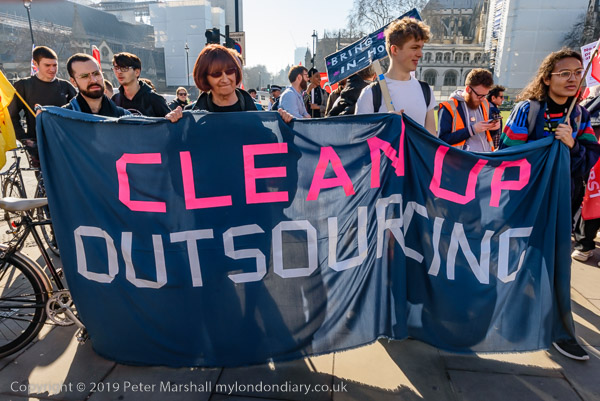
A legal challenge was taking place at the High Court on this day to extend the employment rights of the 3.3 million workers whose jobs are outsourced from the companies where they work to contracting companies which then sell them back to their place of employment at cut rates.

Labour Shadow Business minister Laura Pidcock

The contractors do this by cutting wages, trimming things such as pensions, maternity pay and holiday pay to the bare legal minimum, increasing workload and reducing hours of work and often bullying managers. Outsourced workers generally have little job security and are often denied necessary safety equipment and not given proper safety training.

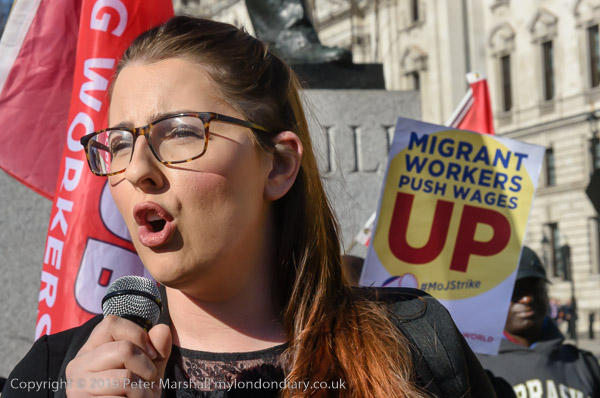
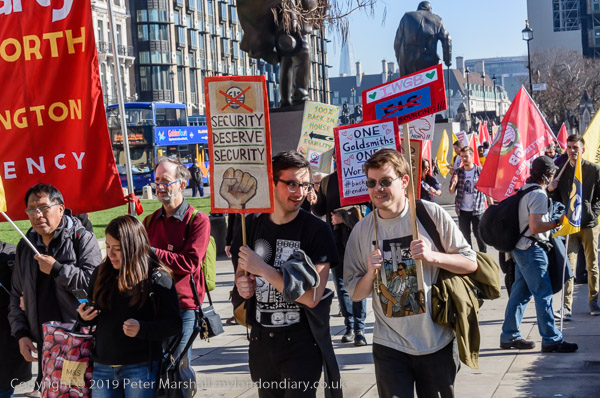
Workers, mainly migrants who work for the Ministry of Justice, Dept for Business, Energy & Industrial Strategy and the University of London were taking part in a one day strike in a coordinated action by the UVW and IWGB trade unions and the BEIS PCS branch to demand an end to outsourcing and the insecurity, discrimination and low pay it causes. They had started their march at 8.00am at the University of London and after a rally outside the High Court had marched to Parliament Square where I met them at 11am.

Rally for an end to Outsourcing


Outsourced Workers protest at BEIS

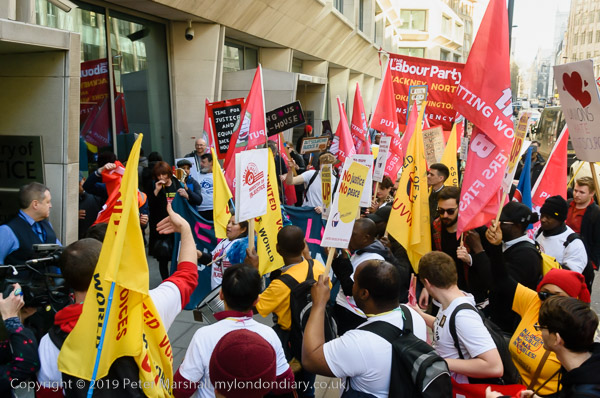
From Parliament Square the marchers went on to hold a further rally outside the Dept for Business, Energy & Industrial Strategy in Victoria St. Those striking at the BEIS included catering and security staff who are members of the PCS and are demanding the London Living Wage as well as end to outsourcing and the insecurity, discrimination and low pay it causes.

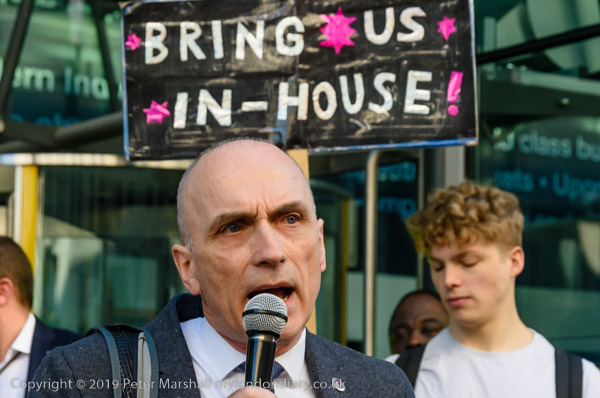
The PCS strikers led a lively rally with plenty of singing, dancing and shouting of slogans expressing their demands, which was followed by several speeches, including from Labour MP Chris Williamson, who brought messages of support from Labour shadow cabinet members and promises that a Labour government would end outsourcing.

Outsourced Workers protest at BEIS


Outsourced Workers at Justice ministry

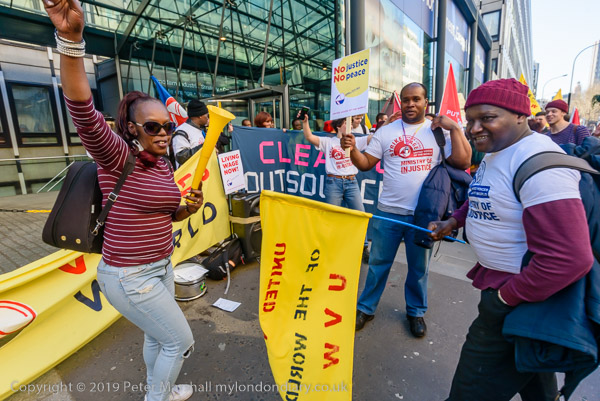
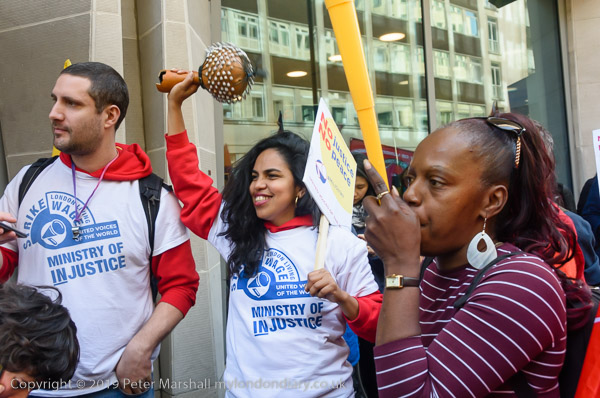
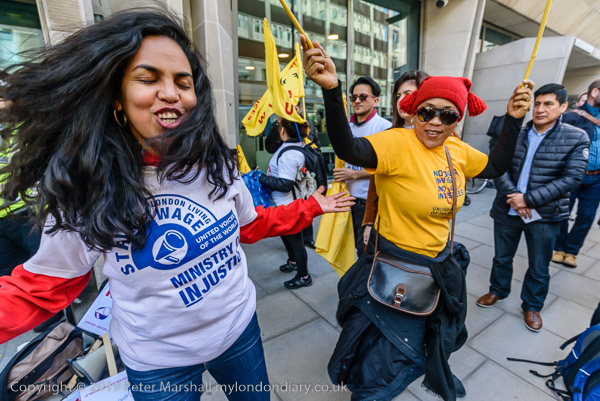
The marchers continued the short walk to the Ministry of Justice in Petty France, where low paid workers belonging to the United Voices of the World union at the Ministry of Justice have been campaigning for some time to get the London Living wage, but the Justice Minister has refused to talk with them. Many wore t-shirts calling it the Ministry of Injustice.

During the rally outside the building some of the UVW workers who had already been on strike for 24 hours went back into the ministry to resume work, to cheers and hugs from those on the street outside. The rally ended with music and dancing on the pavement, and I left for a rather late pub lunch in Holborn.

Outsourced Workers at Justice ministry


North Woolwich

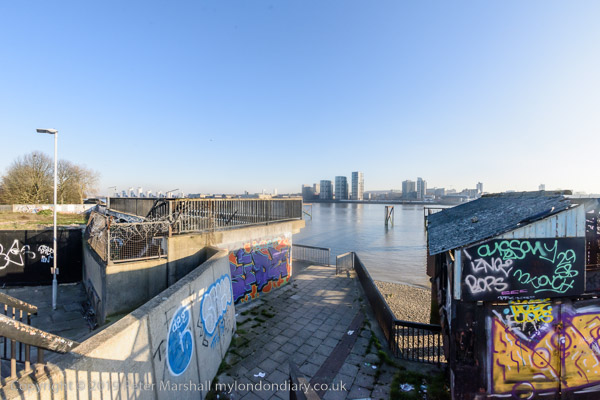
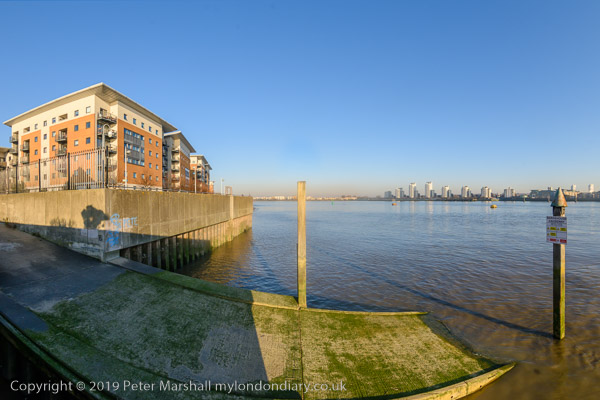
I’d been intending to walk a short section of the Capital Ring, mainly beside the River Thames, for some months as it had been quite a few years since I’d last been there and wanted to see how it had changed. I had an afternoon with nothing else I needed to photograph and although the sunny weather with clear blue skies was not ideal it seemed a good opportunity.

Panoramic photographs almost always have large expanses of sky, and on days like this it tends lack interest, as well as often giving unnatural looking variations in tone when getting closer to the sun. Getting to North Woolwich should have been simple and reasonably fast, but unfortunately there was trouble on the DLR and I had to make a less direct route, so had to rather rush on the walk and leave it half-finished. It was a few months later before I found time to go back and complete it.

North Woolwich


Class War protest Rees-Mogg freak show

I find it hard to understand why anyone should want to come and listen to Jacob Rees-Mogg, let alone pay £38 for a ticket to do so at the London Palladium.

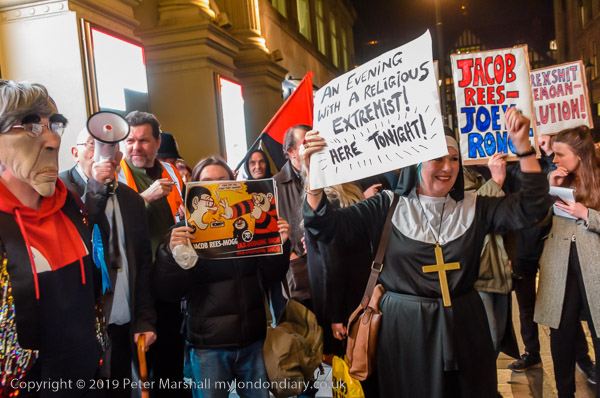
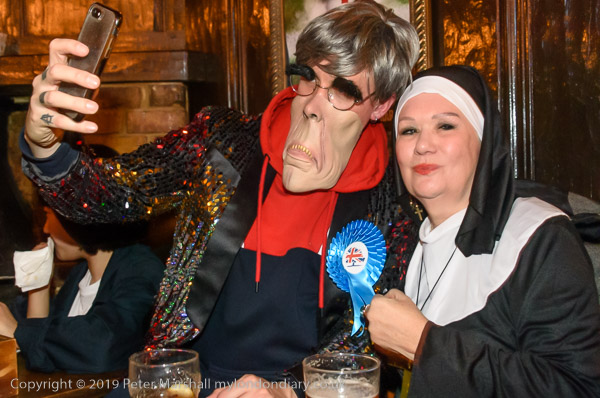
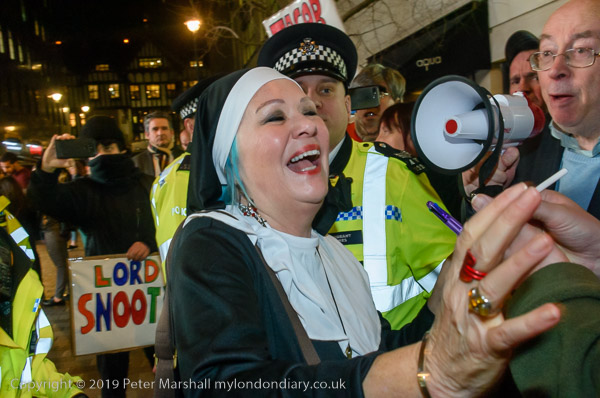
So too did Class War, and with Jane Nicholl dressed as a nun, Mother Hysteria, and Adam Clifford as Jacob Rees Mogg they loudly asked why people had come to listen to him “spout homophobic, transphobic, racist, pro-hunting, misogynist, classist, privileged” nonsense.

Their show on the street outside was almost certainly a better show than anything that would take place later inside the venue, and all for free. Police spent a considerable amount of public money on harassing them, and provided their own rather hilarious input by searching Mother Hysteria and threatening to arrest her for carrying offensive weapons after some novelty stink bombs were found in her handbag. When I left the officer who had stopped and searched her had already spent 20 minutes trying to write her notice of stop and search, probably at a loss trying to find some way to put it that doesn’t make it sound incredibly stupid.

Class War protest Rees-Mogg freak show