More Hampstead – 1990

More Hampstead: More from my walk in Hampstead on Sunday 9th April 1990. The previous post was Hampstead Alleys, Hospital, Baths, House, Heath – 1990.

Hampstead wasn’t (and isn’t) an area of London I feel particularly sympathetic or comfortable in and I prefer the less affluent areas of the capital and those with more industry and that are less arty.

I worked hard at taking pictures but somehow find many of them less interesting and looking back at them over 30 years later have digitised a rather smaller proportion. The eight in this post come from around 60 that I took on this section of the walk, almost all carefully composed and correctly exposed. Probably I should go back and digitise more, but I think Hampstead is a part of London that many others have photographed and so my pictures are perhaps less important.
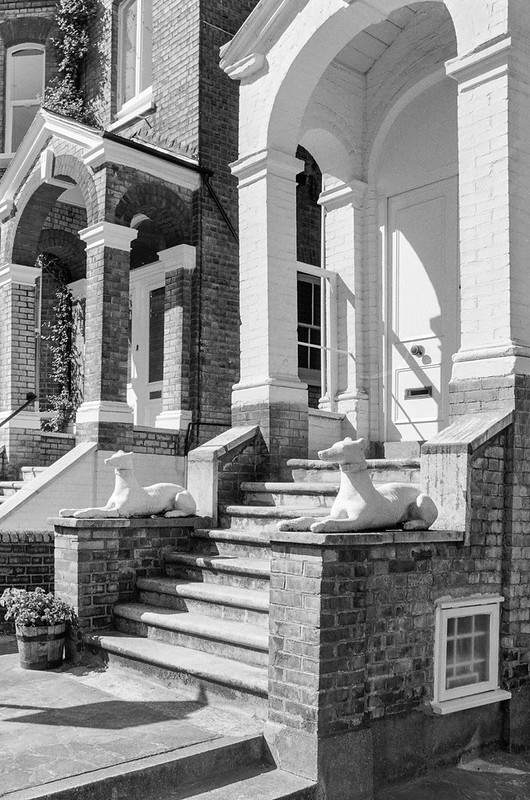
Houses, Cannon Place, Hampstead, Camden, 1990, 90-4e-31

I walked down from Hampstead Heath and turned into Cannon Place, where Sir Gerakd Du Maurier lived in Cannon Hall from 1916 until his death in 1935, and the childhood home of Daphne du Maurier and her siblings. The last Secretary of the East India Company had bought Rous Hall around 1838 and put a few old naval cannons in its grounds, renaming the house Cannon Hall. I haven’t digitised my picture of the Hall but found these two dogs mguarding the steps of one of the substantial Victorian houses in the neighbourhood.
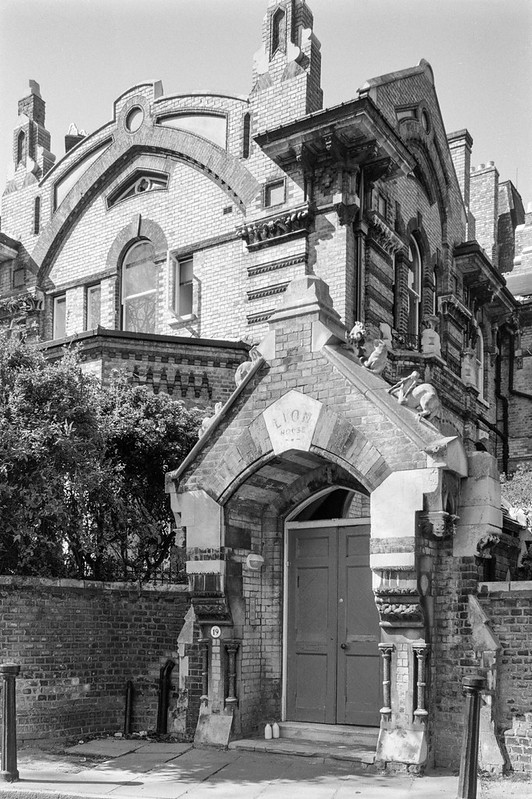
Lion House, 19, Well Rd, Hampstead, Camden, 1990, 90-4e-22

Back on Well Road I took this picture of part of the Grade II listed Italianate Gothic Lion House, part of the large detached villa The Logs, built for civil engineer Edward Gotto (1822-1897) who was for several years in charge of North London’s sewers and went on to build sewers around the world. For him muck was obviously brass and this large house was designed by J.S. Nightingale and built by Charles Till in 1861. This section was named Lion House when the property was divided in 1951. Boy George lived in the Logs from the mid 1980s, and he sold his part of the house for £22million in 2022.
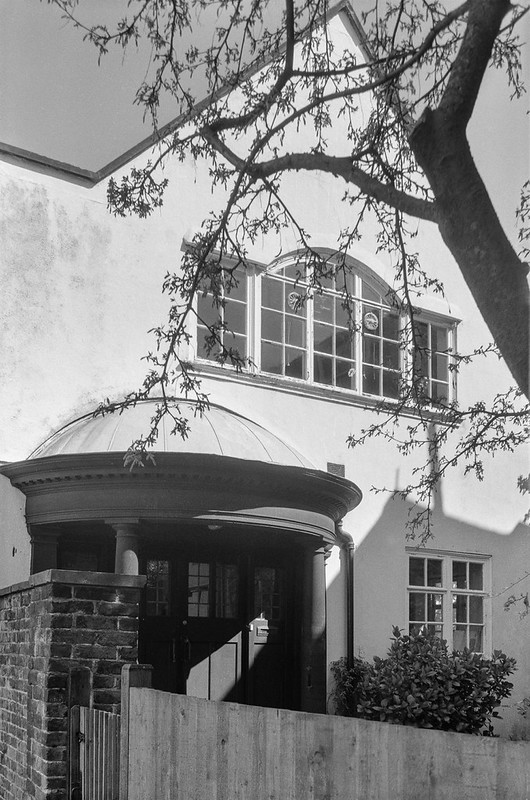
House, Heath St, Hampstead, Camden, 1990, 90-4e-12

This is the doorway of the Grade II listed Friends Meeting House at 120 Heath Street designed by Frederick Rowntree in the Arts and Crafts style, very much under the influence of Voysey and built in 1907. Among its famous visitors was Mahatma Gandhi who spoke here in 1909.
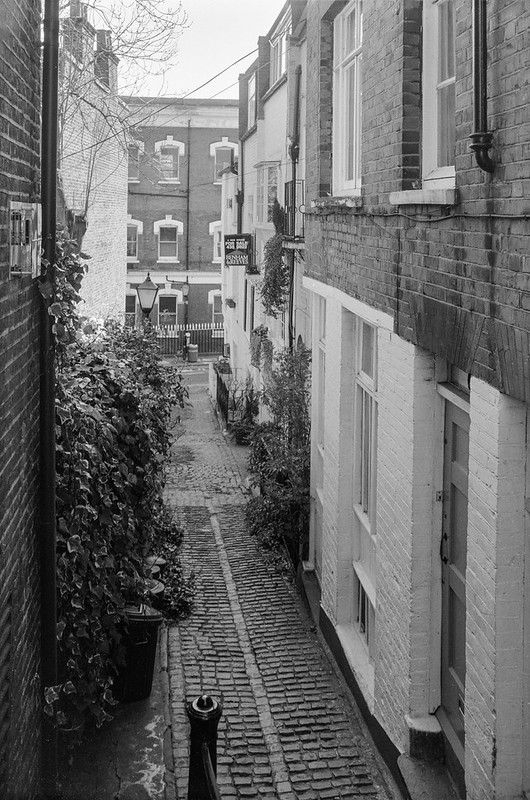
Elm Row, Hampstead, Camden, 1990, 90-4e-16

I think this is the alley with steps which leads from Elm Row to New End.
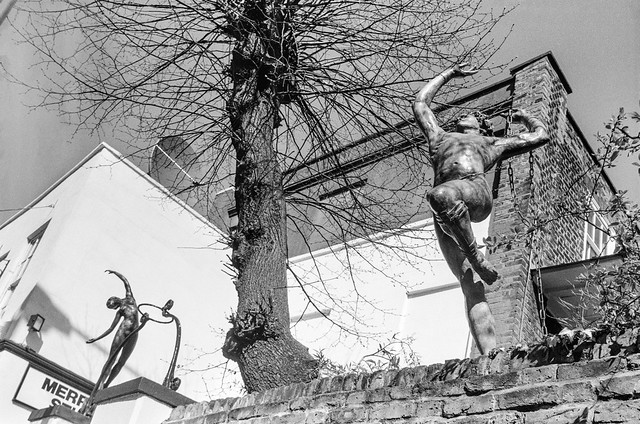
Heath St, Hampstead, Camden, 1990, 90-4f-62

The leaping sculptures here have long gone, and there are fences on top of the wall to give greater privacy to the residents of the property on the east side of the street just north of Elm Row. I think it was here that D H Lawrence and Frieda lived rather miserably after their return from New Mexico in 1923, along with Catherine and Donald Carswell, who was the lawyer who checked his work for possible libel claims.

But I can find nothing more about these sculptures.

Hampstead Grove, Hampstead, Camden, 1990, 90-4f-51

“The Hampstead Scientific Society observatory is one of the few places left in London that provides regular public viewings of the Moon, planets and other objects of interest in the night sky.” Though skies in London have so much light pollution that the view must be rather dim though being on the edge of the heath must help. It would still be interesting to book a free ticket if I lived closer.

The site is on the top of a Victorian covered reservoir, the Kidderpore Reservoir built in 1867 by the West Middlesex Water Company which still stores around 2.5 million gallons pumped here from water works at Hampton to supply 11,000 homes in the area. Still in use it was re-roofed in 2015 but still has its impressive Victorian architectural brickwork hidden away in the water.

The Mount, Hampstead, Camden, 1990, 90-4f-23

1 The Mount, on the corner of Hollybush Steps, has lost almost all of its interest since I made this picture in 1990. There is a new brick wall and tall hedging hides the front garden, though I think everything in it has gone, along with the vases on the steps, the lions and even the little roof over the door. It just looks neat and plain now.

The Mount, Hampstead, Camden, 1990, 90-4f-24

Most of this had changed by the time there appears to have been major building work on the site around 2019. What had been quirky and interesting is now rather dull. This large 3 bedroom end terrace house sold in 2017 for £2.64million.

Still more from Hampstead to come.


Flickr – Facebook – My London Diary – Hull Photos – Lea Valley – Paris
London’s Industrial Heritage – London Photos

All photographs on this page are copyright © Peter Marshall.
Contact me to buy prints or licence to reproduce.


Coventry Cross, Gandhi, Graffiti, Drag Balls …

Coventry Cross, Gandhi, Graffiti, Drag Balls …

Stanstead House, Devas Street, Bromley-By-Bow, Tower Hamlets 1988 88-8a-53-Edit_2400
Stanstead House, Devas Street, Bromley-By-Bow, Tower Hamlets 1988 88-8a-53

My previous walk on 31st July ended at Bromley-by-Bow, and I returned there the following day to continue my wanderings, starting on Devas St and the Coventry Cross West Estate, built by the LCC in the early 1950s, and in 1988 it had recently passed from the GLC to Tower Hamlets. Like all council housing it was very much compromised by the opposition under Thatcher to social housing, with the ‘right to buy’ policies selling off properties to tenants on the cheap and local authorities being largely prevented from building more as well as being starved of cash.

The estate serves as a reminder of an age where councils were able to provide large numbers of socially rented homes before we moved to an era dominated by private profit. Many council tenants who bought their own properties found it very impossible to pay back the loans they had taken on, and sold them as soon as they were able, with many of them now privately rented as ‘buy to let’ properties with rents several times social housing rates.

The six-storey Newmill House at left is linked to the four storey Stansted by a massive archway, with another the west linking to another six storey block, Brimsdown. The estate is now managed by Poplar HARCA and has been renovated around ten years ago.

Stanstead House, Devas Street, Bromley-By-Bow, Tower Hamlets 1988 88-8a-54-Edit_2400
Stanstead House, Devas Street, Bromley-By-Bow, Tower Hamlets 1988 88-8a-54

A portrait orientation view of the same arch into the estate. When built Newmill House at left, a long block running parallel to the Blackwall Tunnel Approach, contained 55 flats.

Gandhi plaque, Kingsley Hall, Powis Rd, Bromley-By-Bow, Tower Hamlets 1988 88-8a-42-Edit_2400
Gandhi, plaque, Kingsley Hall, Powis Rd, Bromley-By-Bow, Tower Hamlets, 1988 88-8a42

North of the railway line, my walk took me to Patrick Connolly Gardens, now rather lost in the Devons estate, and then on to Powis Road where I made this picture of Kingsley Hall.

Kingsley Hall was opened in 1928 by philanthropists and peace campaigners Muriel and Doris Lester who opened the centre using the legacy from their brother Kingsley who died in 1914 when only 26. They had previously helped to set up a Children’s House on Bruce Road nearby in 1923. Muriel Lester (1883-1968) was one of the world’s leading pacifists, and is thought to have been unsuccessfully nominated for the Nobel Peace Prize in the 1930s.

The building had previously been Zion Chapel built by Strict Baptists but was then disused. The sisters were also Baptists, but of a very different nature, they were radical and committed to a social gospel and justice issues and the hall became a centre for their community work with Muriel also serving as its pastor. They donated their wealth to serving the people of Bow and lived a simple and humble life.

Muriel had met and travelled with Mahatma Gandhi often in her work as Travelling Secretary of the International Fellowship of Reconciliation and when he came to London as the representative of the Indian National Congress Party to argue in a conference for independence he rejected the suite offered him by the government at the Hilton Hotel, saying he would rather stay with Muriel Lester at Kingsley Hall. He stayed there for three months, living in a cell on the roof in the same simple style he did in London.

Bromley-By-Bow, Tower Hamlets, 1988
Bromley-By-Bow, Tower Hamlets, 1988 88-8a-44

I doubt if I would have photographed this street corner were it not for the message ‘big Love’ in large letters on the corrugated iron sheeting. Though it does look as if the writer went on to write something beginning with HATE. This was somewhere fairly close to Kingsley Hall.

Edgar Rd, Bromley-By-Bow, Tower Hamlets, 1988 88-8a-46-Edit_2400
Edgar Rd, Bromley-By-Bow, Tower Hamlets, 1988 88-8a-46

The fence here has several messages as well as some peeling posters. The longest text reads ‘AS LONG AS WE HAVE NOT SMASHED EVERYTHING THERE WILL BE RUINS!!’, an exceedingly philosophical example of graffiti which I’ve not seen elsewhere, though I wonder if it could be from a song lyric.

Considerably more common is the ‘VICTORY TO THE MINERS’, and I think the Female Sign – the planetary symbol for Venus ♀ – may mean the painter was a woman.

Tudor Lodge, Bromley High St, Bromley-By-Bow, Tower Hamlets, 1988 88-8a-31-Edit_2400
Tudor Lodge, 85, Bromley High St, Bromley-By-Bow, Tower Hamlets, 1988 88-8a-31

This may have had some connection with Tudor House, whose grounds were bought in 1898 by the LCC to make a public park, which is now Bromley Recreation Ground a couple of hundred yards away, but more likely just with the Tudor family who lived in Tudor House and in the Old Palace closer to where Tudor Lodge used to be.

The archway informs us that this was Tudor Lodge Sports and Social Club, catering for Weddings and Funerals; over a door at left it tells us the ‘Bow Bridge Sports & Social Club Meets Here’. It was by then a large men’s social club, but the impressive cross above the doorway suggests that this was originally a Christian institution of some kind, perhaps a convent or priory

In the 1980s it became a venue for Drag Balls which had begun as the Chelsea Arts Ball, before moving to the Parchester Hall and then on to here. Later in the 90s was the home of Ron Storme’s Transvesti Extrodinaire club.

There is now a completely different modern Tudor Lodge at 95 Bromley High St on the corner with St Leonard’s Road.

How Memorial Gateway, St Leonards Priory, St Leonard's St, Bromley-by-Bow, Tower Hamlets, 1988 88-8a-33-Edit_2400
How Memorial Gateway, St Leonards Priory, St Leonard’s St, Bromley-by-Bow, Tower Hamlets, 1988 88-8a-33

The only part of the parish church of St Mary with St Leonard to survive following bombing in 1942 and the building of the Blackwall Tunnel Approach Road. The church was built in 1843 to replace the former chapel of St Leonard’s Priory, a Benedictine nunnery first recorded in 1122 and destroyed after the dissolution of monasteries in 1536, after which its chapel had been used as a parish church. Chaucer wrote of the nunnery as the “Scole of Stratford atte bowe“.

The How Memorial Gateway was erected in 1893 as a memorial to the Rev G A How, vicar of the church from 1872-93. It is Grade II listed and in poor condition.

Bromley High St, Bromley-By-Bow, Tower Hamlets, 1988 88-8a-34-Edit_2400
Bromley High St, Bromley-By-Bow, Tower Hamlets, 1988 88-8a-34

There is still a large tree and a telegraph pole on the corner of Bromley High St with St Leonards Street, but the lower buildings on the left of the picture were demolished a year or so ago.

Just visible in this picture is the coat of arms of the London County County on 72-4 Bromley High St (Barry wavy of six Azure and Argent on a Chief of the last the Cross of St. George charged with a Leopard of England. The Shield is ensigned with a Mural Crown Or – though it’s too small on the photo to see any details) announcing this as the Bow Bridge Estate, which was completed in 1934. I hope Poplar HARCA kept this when they demolished the building.

My walk through Bow will continue in a later post. Click on any of the images above to see a larger version in my album 1988 London Photos, from where you can browse the album.