Lumsdale & Matlock

Lumsdale & Matlock: There are quite a few places I’ve been to which claim to be where the industrial revolution started, but Lumsdale near Matlock where I went for a walk with Linda on Wednesday 23 October 2019 perhaps has a better claim than most apart from the nearby Arkwright mill in Cromford built in 1771, the first modern factory.

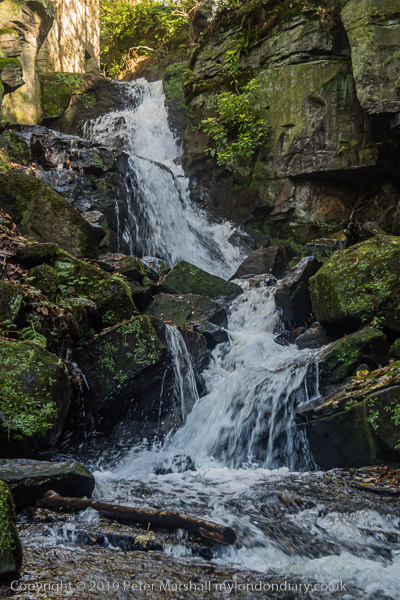
Water from the Bentley Brook powered the early days of the industrial revolution

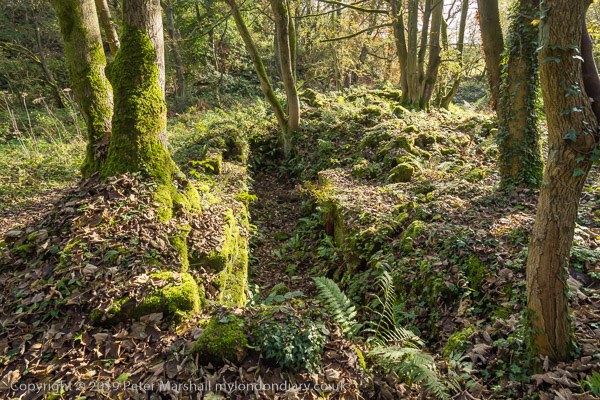
Lumsdale is a steeply sloping valley with a small stream the Bentley Brook tumbling down it, apparently never running dry. It housed industrial mills from the 17th century on and is a site of national archaeological and historic importance. Among the industries that worked there were lead, textile, paint and timber.

The mills at Lumsdale were on a smaller scale than Arkwright’s Cromford Mill and are now only ruins – I think the last closed in 1927.

The area is now owned by the Arkwright Society and can be explored on a permissive footpath. Parts have been fenced off since my visit for safety reasons and I think some of my pictures were taken in these. But it remains an area where you need to take great care near steep drops, especially if like me you sometime suffer from a little vertigo.
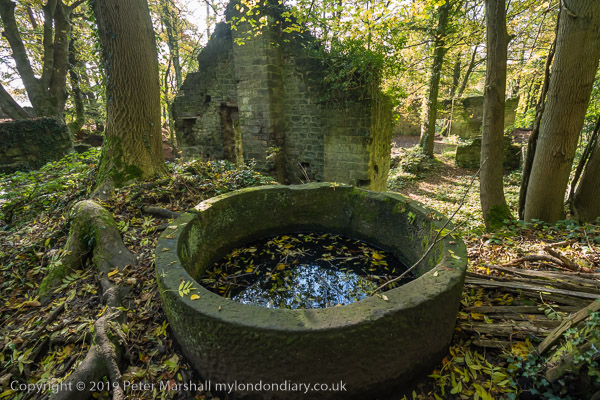
A large single stone bleaching vessel

Although there is little or no parking in the area there have always been quite a few visitor in my several visits to the area. In 2014 it became a scheduled Ancient Monument.

I played a little with various shutter speeds by decided I like it best with those that more or less stopped movement rather than blurred it
The Lower Pond built in the 1850s has been restored several times, most recently in 2014
This was the site of the oldest mill in Lumsdale, a former lead smelting mill which was converted to a bone mill
around 1600. Bones were heated and then crushed to be used as pigments. The mill only closed in 1920.

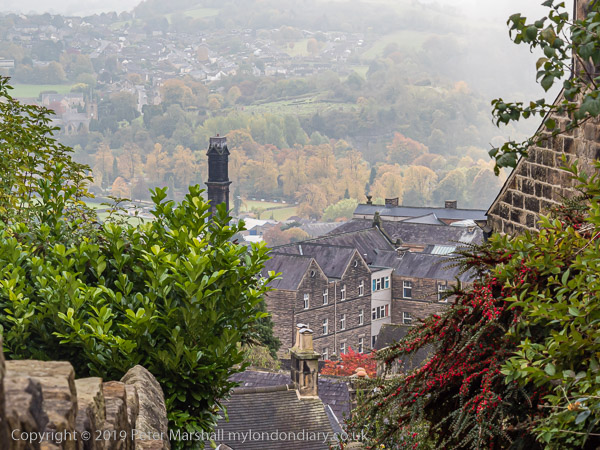
Linda and I were in Matlock to look after grandchildren and walked up from Matlock after taking them to school. After exploring the valley we walked across to the top of Matlock for an unexciting pub lunch and then walked on to the top of Matlock Bank.
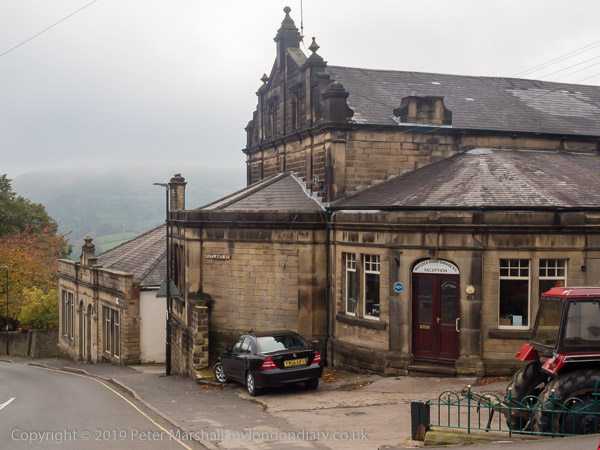
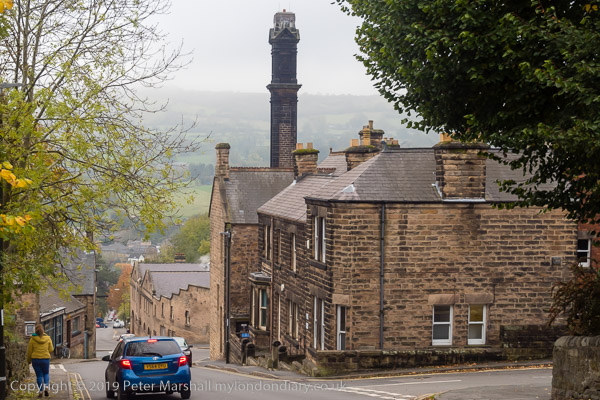
Former tram depot
The hill drops steeply

We walked around a little at the top of the Bank then came down the steep hill to the bridge over the Derwent. In 1893 when Matlock was a popular spa town a cable-hauled tramway was built to take people up and down the 300ft hill. The fare was 2d up and 1d down. It felt a little mean to me charging for taking people down as I think their weight would actually be helping to pull people up. But the tramway closed in 1927, being replaced by a bus service. So far I’ve always walked up, but usually feel by the time I near the top I should have taken a bus.
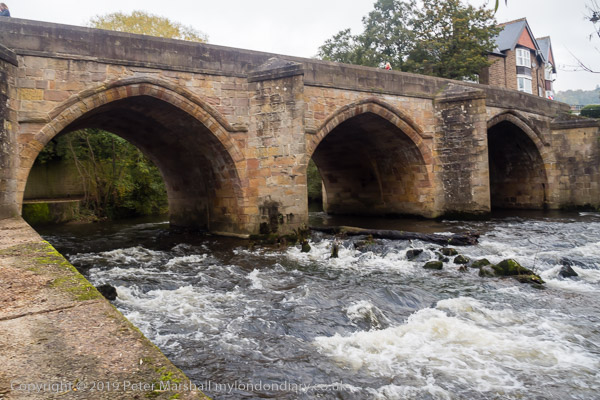
And back down to the River Derwent. I think we remembered to collect the kids from school.

More on My London Dairy at Lumsdale & Matlock.


Flickr – Facebook – My London Diary – Hull Photos – Lea Valley – Paris
London’s Industrial Heritage – London Photos

All photographs on this page are copyright © Peter Marshall.
Contact me to buy prints or licence to reproduce.


Bromley-by-Bow Gasholders

Bromley-by-Bow Gasholders: A week ago on Monday 28th March I was invited to go with a team from Cody Dock on a site visit to the gasholders which are a prominent feature of the local landscape, seen by many thousands every day from the Underground and National Rail lines as they travel in and out of London as well as local residents and walkers along the Lower Lea and Bow Creek, including those following The Line sculpture trail. We were there invited to study the heritage, history and ecology of the Bromley-by-Bow Gasworks site which has just been sold by its future developers.

Bromley-by-Bow Gas Holder Site Visit

The seven gas holders, all to a similar design were built between 1872 and 1882 and are all Grade II listed. Nine were built on the site but two are no longer there, the base of one now forming a large circular lake in the site. Holder No 1 was given an extra upper tier in steel in 1925-7 to more than double its capacity. All were taken out of use in the 1980s.

Bromley-by-Bow Gas Holder Site Visit

The real value of the site is not in the individual holders although these were some of the “most aesthetically distinguished and finely detailed gasholders ever built” (according to the listing text) but in the ensemble, thought to be “the largest group of Victorian gasholders known to remain in the world, which is testament to the scale of Britain’s pioneering gas industry and its contribution to the Industrial Revolution.” It is a heritage site not just of national importance but of world importance.

Bromley-by-Bow Gas Holder Site Visit

Given their importance the group, together with the adjoining memorial garden with its Grade II listed memorial lamp and statue of Sir Corbett Woodall surely deserves both Grade I listing and preservation, and the former gas works offices could form a heritage centre for the area. The offices were for some time a gas museum.

Bromley-by-Bow Gas Holder Site Visit
The circular pond is the base of a former gasholder

Just across the Channelsea river from the site is the Grade I listed Three Mills and a little to the south the former gas works Dock at Cody Dock, now a thriving creative and community hub, the sites linked by a riverside path which currently stops at Cody Dock but which should long ago have been opened as planned to lead to the Thames at Trinity Buoy Wharf, passing on the way the Bow Creek Ecology Park. Many sites along here played an important part in Britain and the world’s industrial history, but unfortunately little evidence remains, making it essential to preserve what does.

Bromley-by-Bow Gas Holder Site Visit

We were shown around the site in the morning by two of those responsible for planning the development who expressed their wish for the development to retain these elements which make the site unique and to open them up to the public, but good intentions are not enough, particularly for company accountants.

Bromley-by-Bow Gas Holder Site Visit

Given what has happened at other sites greater protection is required to make sure that any development in the area leaves the gasholders intact and preserves their landscape value, in particular the views of the ensemble from the railway and Underground lines, from Three Mills and the riverside footpaths by the Channelsea River and River Lea and the navigation. We do need more housing, or at least more social housing rather than luxury flats many of which remain largely unoccupied as investments, but we also need to preserve important monuments such as these which record and could celebrate our history.

Many more pictures from the day, mainly inside the holder site in my album Bromley-by-Bow Gas Holders. You can click on any of the images above to see a larger version in the album – and browse from there. Most of the images have an horizontal angle of view of approximately 145 degrees. There are more pictures of the area in various posts on My London Diary including Bow and The Fatwalk, Bromley-by-Bow to Star Lane and Gasworks Dock Revived.