Barking and the River Roding – 2007

Barking and the River Roding: Another post from what now seems to me a distant past, Saturday 3rd February 2007, when I took my Brompton folding bike across London on three trains to Barking. Easy as it is to ride, I think I would find lugging it up and down all the stairs to change trains and enter and exit stations rather too tiring now, 19 years later. There are some very much lighter titanium models now than my ageing steel bike – but at an eye-watering cost. And as well as the bike my camera gear probably put the total weight I was carrying up to more than 20kg.
Barking and the River Roding - 2007
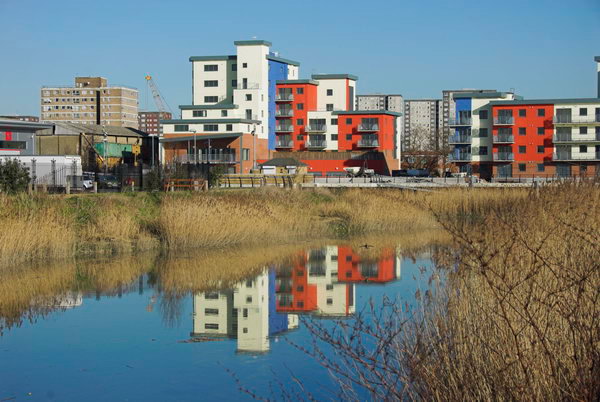
Barking riverside from Hand Trough Creek

So this is a ride I’m unlikely to repeat, though I’ve often thought of doing so – but perhaps on foot. And although I describe this as a ride, much of it was a walk pushing the bike, not a good off-road bike and impossible on muddy paths. Fortunately it was mainly dry in February 2007 though some paths were quite overgrown.
Barking and the River Roding - 2007
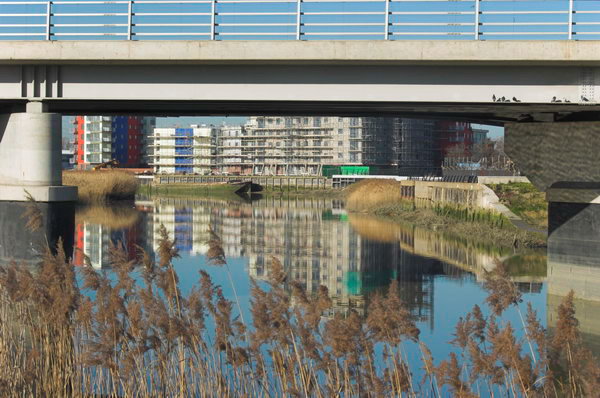
A13 Alfred’s Way crosses the River Roding

As usual I’ve put the account into normal case to make it more readable, corrected the odd typo and made a few comments on things that have changed and have given a link to more pictures on My London Diary than on this page.
Barking and the River Roding - 2007
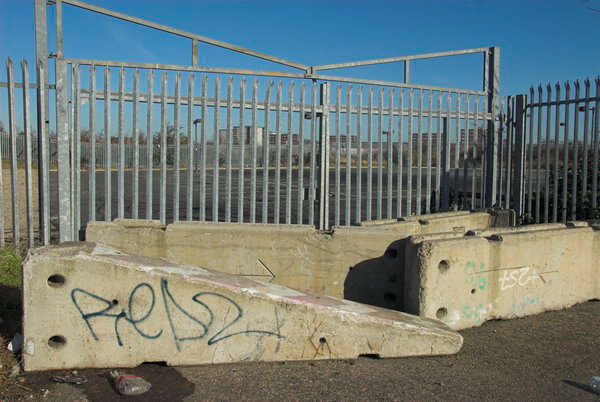
This car park in Jenkins Lane was a possible site for relocated Clay’s Lane travellers

Barking and the River Roding

Barking, Ilford & Redbridge
Barking and the River Roding - 2007
I had taken the train to Barking

The River Roding runs into the River Thames at Barking Creek. I’d hoped to be able to ride alongside it to the Thames, but although the London Borough of Newham had spent a small fortune on getting ARUP to produce 2.4km of riverside path in 2001-2, it still wasn’t opened for public use. The large and expensive gates at its northern end remain locked. [The path leading to the Beckton Creekside Nature Reserve has apparently since been opened and there a plans for it to go on and no longer be a dead end. But I had to change my plans and instead go north by the Roding.]
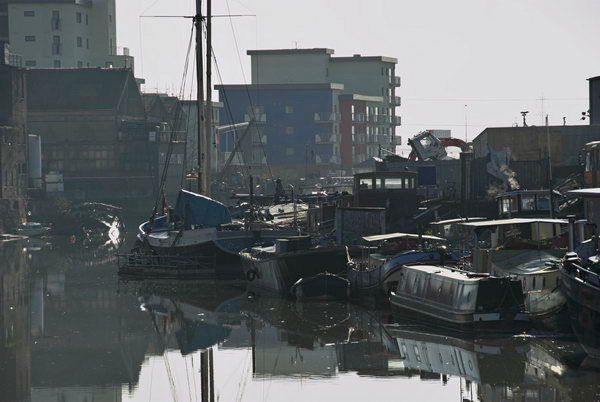
Barking and the River Roding - 2007
River Roding in Barking

I don’t know what it is about Newham and footpaths. At Canning Town, the exit from the station to the riverside path remains firmly closed after the riverside walk was completed some years back, with the end of the bridge over the DLR coming from Tower Hamlets also being fenced off. [Now open, but the path still a dead end in both directions, though there is a new bridge to take you across Bow Creek and so further on.]
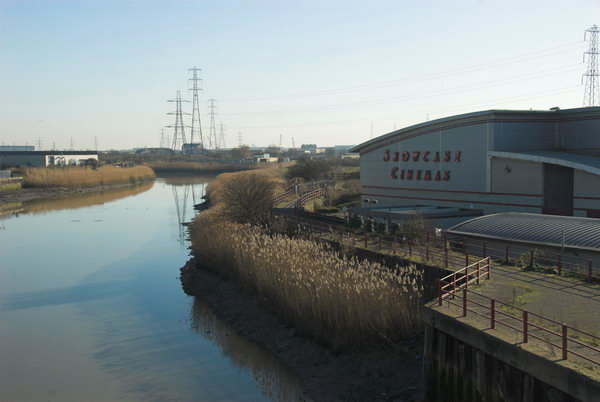
Barking and the River Roding - 2007
River Roding, riverside path and Showcase Cinemas

This would be the end of The Roding Valley Way, started in 1996, but still largely non-existent, leading to the as yet unbuilt Thames Gateway Bridge and the dream of a park across the river. Don’t hold your breath.
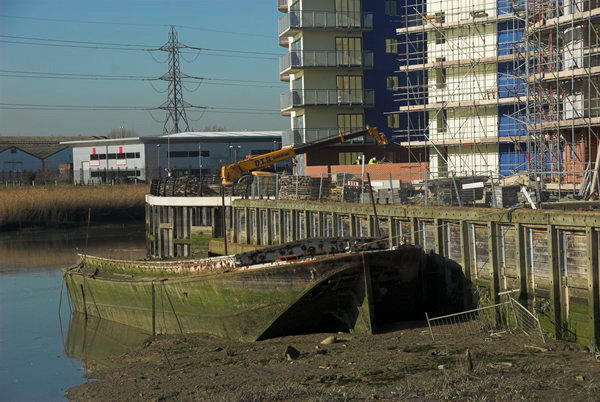
River Roding, Barking

I’d gone to Barking partly to have a look at the Jenkins Lane Car Park underneath the A13 flyover being offered by the London 2012 Olympics developers to relocate travellers from the Clays Lane site. It’s in a kind of wasteland adjoining the Roding, handy for the council yard at the end of the lane, the cinema complex, the sewage works and the new refuse transfer station, and not far from the East Beckton megastores. Just down the road there is still the Horse Sanctuary, a home for neglected old horses. [I think this may have gone.]
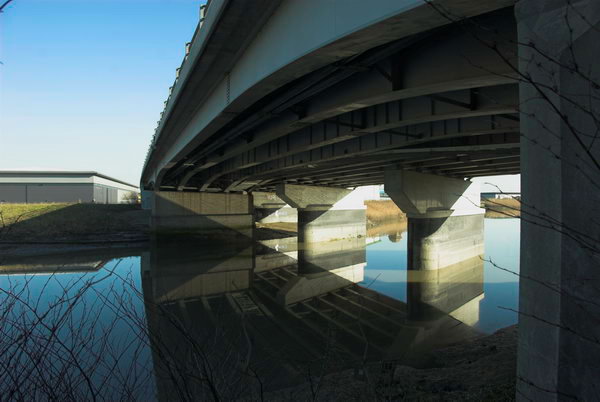
A13 Flyover over River Roding

It is just possible to force your way along the riverside path north from the Hollywood Bowl and Showcase Cinema, but on a bicycle it’s easier to follow Jenkins Lane under the A13 and then take the new path to the riverside walk and Cuckold’s Point, and its viewing area, with some convenient seats where I sat in the February sun and ate my sandwiches. Unfortunately the path ends at the head of Hand Trough Creek a couple of hundred yards further on, with a long detour under, beside and over the North Circular to reach Highbridge Road and the town dock.
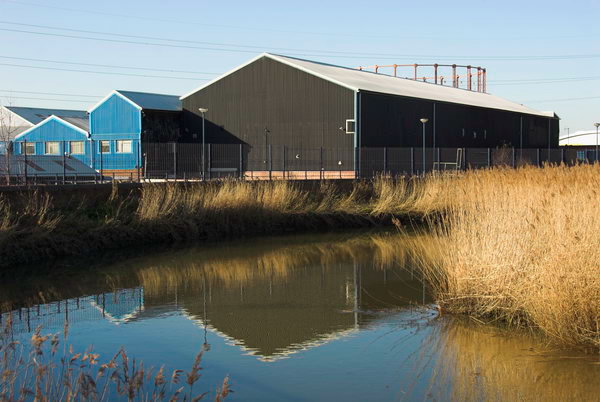
From there you can walk along the river in Tesco’s car park and on from there all the way to the railway line, although it gets rather overgrown. Today I left the path and went through Little Ilford, meeting the river again at the side of the City Of London Cemetery, then going off through Wanstead Park and the Redbridge Roundabout.
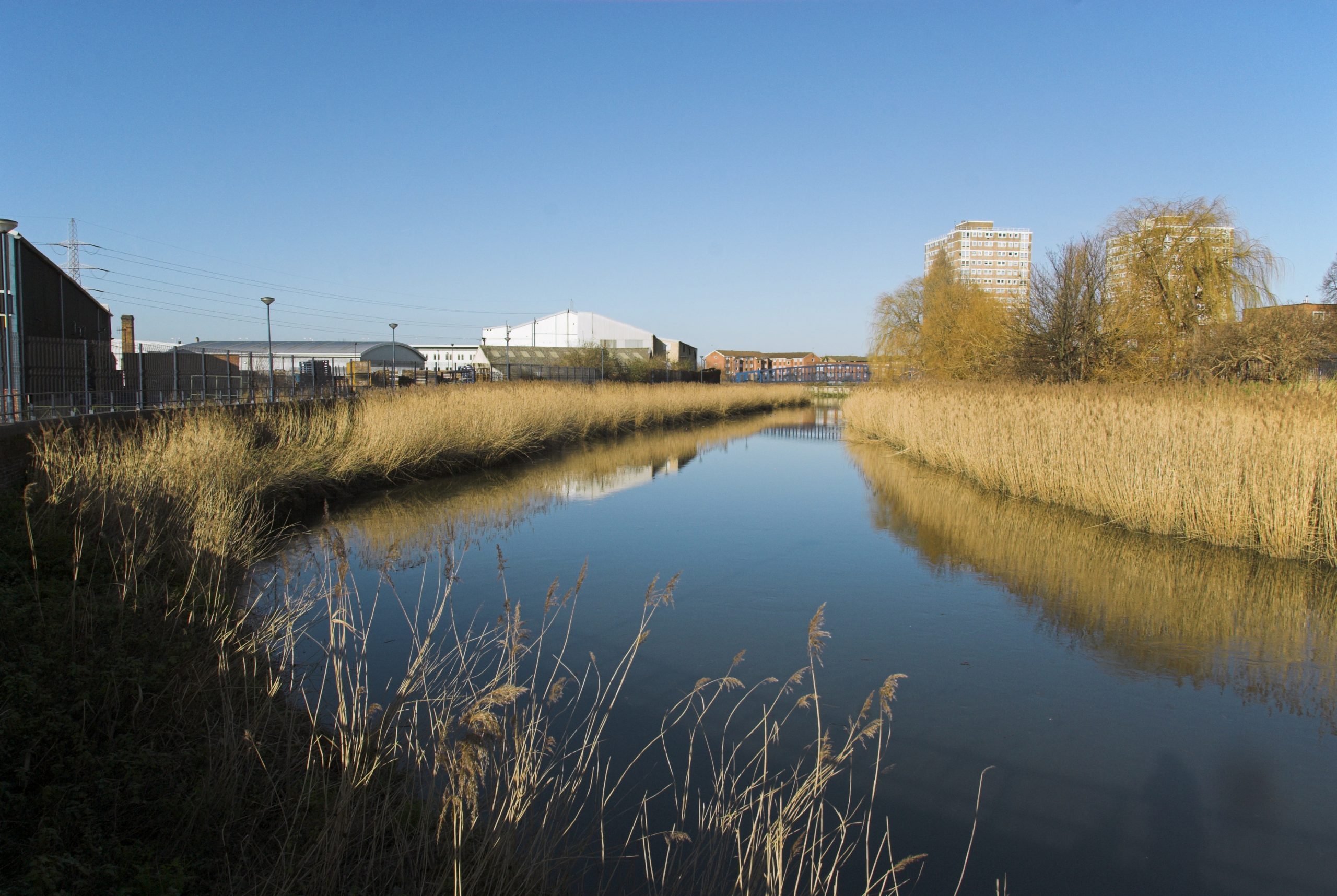
From the Redbridge Roundabout going north is another finished section of the Roding Valley Way, although I only followed it as far as the bridge across to Roding Lane South, where I turned south and rode back to Ilford and the trains home.


Remote London has a well illustrated description of walking along my route (and more) in 2023. More pictures from my ride begin here on My London Diary.


FlickrFacebookMy London DiaryHull PhotosLea ValleyParis
London’s Industrial HeritageLondon Photos

All photographs on this page are copyright © Peter Marshall.
Contact me to buy prints or licence to reproduce.


Matches, Care Spares, Flats and the Roman

Fairfield Works, Wick Lane, Bow, Tower Hamlets, 1988  88-8b-21
Fairfield Works, Wick Lane, Bow, Tower Hamlets, 1988 88-8b-21

This is the east side of the Bryant and May match factory. The main Grade II listed building was built in 1909-10, architects Holman and Goodsham, making this the largest match factory in Britain. But parts of the building are earlier, and Quakers, William Bryant and Francis May who had gone into business making matches in 1843 (at first because of their religious conviction only making safety matches) moved to a former candle factory on Fairfield Road in 1861. Various new buildings were added before the 1910 building. The factory closed in 1979, was listed in 1988 and is now the Bow Quarter, a gated private estate with 19 houses and 714 flats. The building at right of the picture was demolished and replaced by a new block.

But safety matches, which needed a special striking surface containing red phosphorus were not as popular as the strike-anywhere matches (lucifers) made with the more dangerous white phosphorus in the match-heads and the factory soon switched to producing these as well. The relatively few men and the several thousand “matchgirls” working in the plant, mainly of Irish descent, commonly suffered from phosphorus necrosis of the jaw, known as ‘phossy jaw’ cause by white phosphorus vapour. The first symptoms were usually toothaches – and the company insisted that any workers suffering got all their teeth removed or be sacked. This poisoning led to a disabled jaw and eventually to death in around a fifth of cases.

Complete removal of teeth was common in the UK before the beginning of the National Health Service after World War II, as only the wealthy could afford any proper dentistry. Toothache can be agonising and was often treated by tying strong twine around the offending tooth, fixing the other end to a door handle and getting someone to slam the door. Both my parents (born around 1900) were given full extraction of teeth and a replacement ‘Full Set’ of upper and lower teeth as a wedding present in 1932.

The match-girls were not only subject to this horrible occupational disease, but discipline at work was excessively strict, with fines taken from their wages for trivial reasons – lateness, a dirty workbench, talking or having dirty feet – as well as having to pay for their own glue and brushes. The sacking of one of the girls in 1888 provoked the Matchgirls Strike – which they won after two weeks, getting better working conditions and a proper grievance process and ending the fines and other deductions from their wages.

Old Ford Rd, Old Ford, Tower Hamlets, 1988 88-8b-12-Edit_2400
Old Ford Rd, Old Ford, Tower Hamlets, 1988 88-8b-12

This scrapyard, for all makes of car spares, open seven days a week was next to the A102 (M) East Cross Route, built between 1967 and 1973 as a part of Ringway 1, most of which was then quickly abandoned after it became clear the complete environmental destruction building it would take. It became the A12 after being transferred to TfL in 2000, as they were not given the powers needed to run motorways.

The massive 1970s slab block flats of Lefevre Walk were replaced in 1993-2006 by the Tower Hamlets Housing Action Trust with a mix of houses and flats with a traditional street layout designed in close consultation with the community.

Old Ford Rd, Old Ford, Tower Hamlets, 1988 88-8b-16-Edit_2400
Old Ford Rd, Old Ford, Tower Hamlets, 1988 88-8b-16

A view from the edge of the scrapyard.

Look, Roman Rd, Bethnal Green, Tower Hamlets, 1988 88-8c-63-Edit_2400
Look, Roman Rd, Bethnal Green, Tower Hamlets, 1988 88-8c-63

As well as the Olympus SLR with which I made most of the pictures on my walks and with a second SLR body with colour negative film, I also carried a small Minox 35 camera in my jacket pocket whenever I went out. This was the smallest 35mm camera ever made, only 3.9 x 2.5 x 1.2 inches, just large enough to hold a 35mm cassette at on side and the take-up spool on the opposite side of the film gate. The 35mm f2.8 lens folded back into the camera body when not in use and the camera fitted easily even into a shirt pocket.

I had several models of the camera over the years, and often used it when I wanted to be less conspicuous, carrying the camera in one hand it was almost invisible. It was also virtually silent in operation. At times on my walks when I had packed away the SLRs in my camera bag it was more convenient to take pictures on the Minox, but the 36 exposure film might contain pictures from several walks and other occasions.

It isn’t always easy to fit the pictures into place in my walks but I think from Old Ford Road I spent some time taking pictures – including this and those below – on Roman Road in the centre of Bethnal Green, but they may have been made the previous day.

Roman Rd, Bethnal Green, Tower Hamlets, 1988 88-7u-12-positive_2400
Roman Rd, Bethnal Green, Tower Hamlets, 1988 88-7u-12

Two women with a push chair on Roman Road talk as they walk along the street. Just visible behind them are two other children with them.

Roman Rd, Bethnal Green, Tower Hamlets, 1988 88-7u-13-positive_2400
Roman Rd, Bethnal Green, Tower Hamlets, 1988 88-7u-13

Men walk on the opposite side of the stree in front of Shirley’s Antiques – Houses Cleared, with the text from a previous occupier still visible on the first floor frontage.

Roman Rd, Bethnal Green, Tower Hamlets, 1988 88-7u-15-positive_2400
Roman Rd, Bethnal Green, Tower Hamlets, 1988 88-7u-15

Men walk on the opposite side of the street in front of Shirley’s Antiques – Houses Cleared, with the text from a previous occupier still visible on the first floor frontage.

The next installment on this walk will include more pictures from Roman Road taken as I made my way to Bethnal Green tube and the end of the walk.


You can click on any of the images to see a larger version in my album 1988 London Photos, from where you can browse the album.