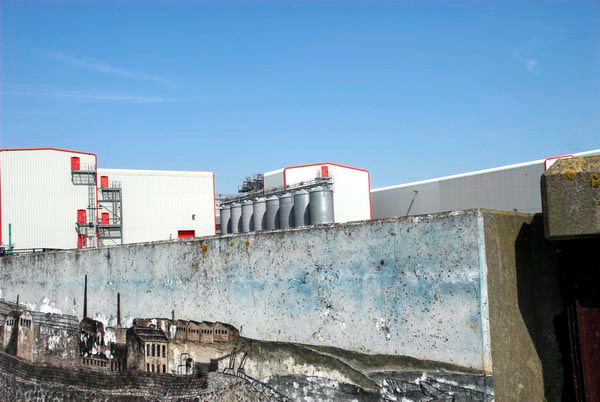
Around Emmett Street, Limehouse: My walk in Limehouse on Sunday 6th January 1990 continued. The previous post from this walk is Three Colt Street & Limekiln Dock – 1990.
You won’t find Emmett Street on a map of Limehouse now. It ran from the southern end of Three Colt Street to meet West Ferry Road a few yards to the north of the Limehouse Entrance and Limehouse Basin the the West India Docks. Along its west side were a number of wharves – Taylor’s Wharf, Aberdeen Wharf, River Plate Wharf etc, the dry docks of Limekiln Dockyard and Limehouse Dry Dock and a dock at Aberdeen Wharf. This area was Limehouse Hole and included Limehouse Stairs from which a ferry once ran to Rotherhithe from what later became called Limehouse Pier.
Dundee Wharf, Aberdeen Wharf and the River Plate Wharf were were all part of the Dunbar Wharves. They ran regular twice weekly services to Scotland as well as importing goods from around the world – including meat from Argentina, and Oxo cubes were at one time wrapped here.
Emmett Street had at some time been known as Limekiln Hill – and West Ferry Road was earlier Bridge Road. These names were still used on the 1870 OS map, although The Survey of London says it was known as Emmett Street about 1830.
The land in this area was owned by the Emmett family who began selling it off in 1809 but their name remained on the street until it was completely obliterated with the building of the Limehouse Link Tunnel shortly after I made these pictures.
Much of the area had been cleared earlier by wartime bombing and the some large warehouses were rebuilt in the following years. The remaining 1870s warehouses were demolished in 1971-2 and the rest destroyed for the building of the road tunnel and Canary Riverside including Westferry Circus. You can read a detailed and well-illustrated article Limehouse Hole by Mick Lemmerman on the Isle of Dogs web Site.
Datakeep set out to provide secure storage for computer backup tapes in the largest warehouse in the area, formerly use for tea and coffee. The company later stored all kinds of things, including a 1935 vintage Bentley and offered a wide range of services to companies for their stored items.
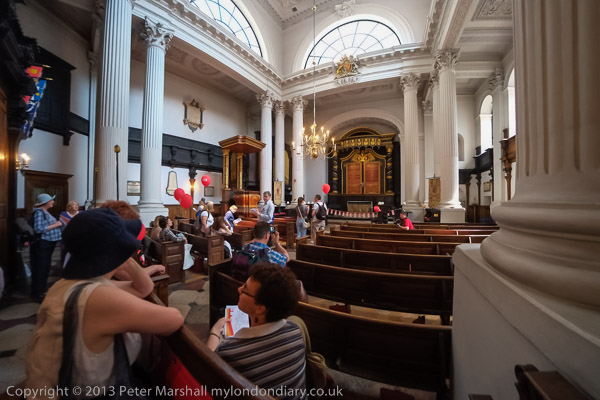
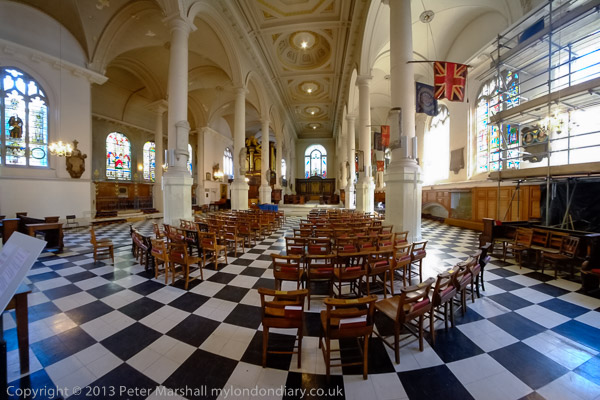
Circle The City: On Sunday 18th May 2014 I accompanied my wife who was taking part in a sponsored walk around churches in the City of London to raise money for Christian Aid, part of the activities in Christian Aid Week. The 2025 Christian Aid Week ended yesterday (17 May 2025) but it isn’t too late to donate towards their work with local partners and communities in countries around the world “to fight injustice, respond to humanitarian emergencies, campaign for change, and help people claim the services and rights they are entitled to.”
Hawksmoor’s St Mary Woolnuth
Christian Aid is one of the better aid charities, currently working through local grass roots organisations in some of most vulnerable communities in 29 countries in Africa, Asia, the Middle East, Europe and Latin America and the Caribbean. They don’t give money to governments and the projects they support are organised and managed by local people – with robust procedures to ensure the money is spent effectively. Some of those they support are Christian but many are not – something which has led to some churches failing to support their work.
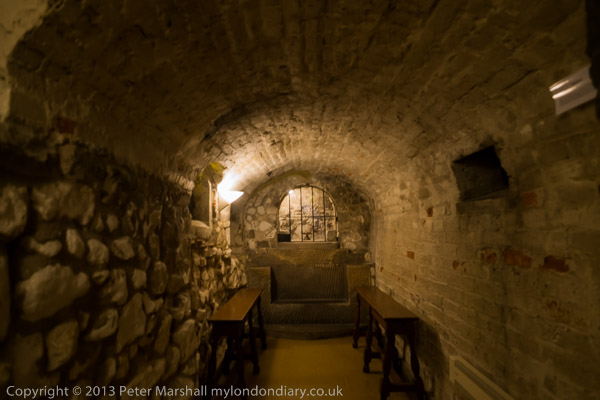
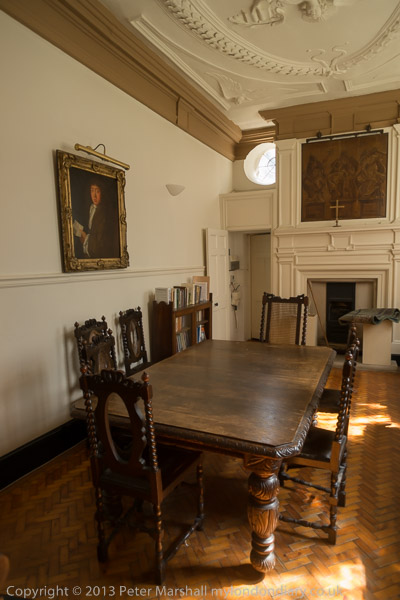
The crypt of All Hallows by the TowerMinster Court, Mark Lane
Other churches have decided against supporting Christian Aid because of their political campaigning, “pressing for policies that can best help the poor…. All we care about is eradicating poverty and injustice and the causes of these.” Compared to some other large charities they are more efficient, with 84p in every pound donated “working for long-term change, responding to humanitarian emergencies and using our voice to call for global change“.
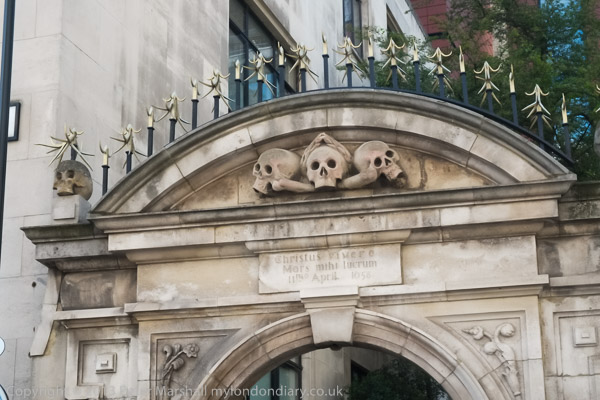
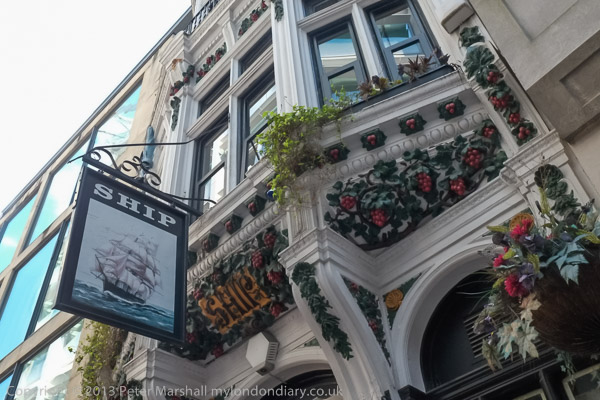
Gateway to “the churchyard of Saint Ghastly Grim”, St Olave Hart St.St Olave Hart StThe Ship, Hart St
The event was extremely well organised, with those taking part getting maps and directions at St Mary-le-Bow on Cheapside where there was a service before the walk. People also collected red helium-filled balloons to carry on the walk, and some of these were tied to mark the route and the various points – mainly churches where marchers could get their sponsorship forms signed as they walked around which also had Christian Aid bunting.
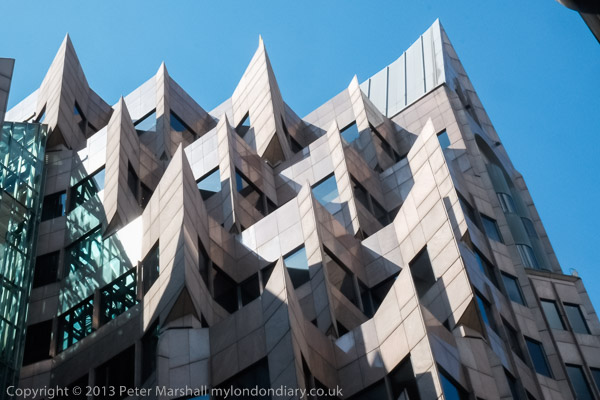
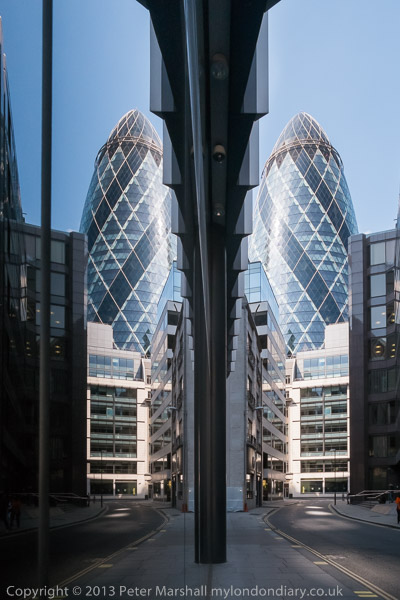
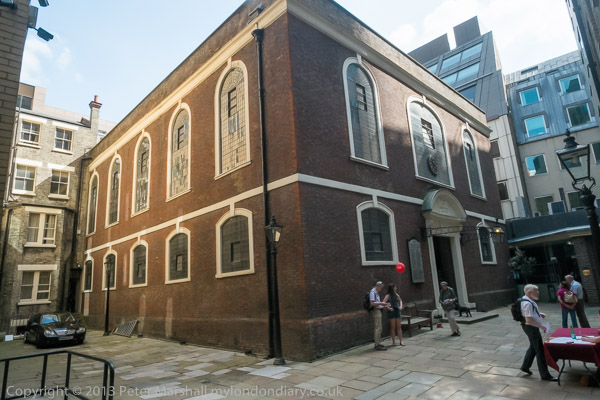
A double GherkinBevis Marks Synagogue is the oldest synagogue in Great Britain, built in 1701
Most of the churches were open for people to walk around and some had refreshments and toilets. It would have been hard to get lost, but some people have zero sense of direction and find it difficult to hold a map the right way up and my presence was helpful. But I had really gone along to keep my wife company – and of course to take some pictures, some of which appeared in her church magazine.
A yurt at the rear of St Ethelburga-the-Virgin within Bishopsgate
I’d visited most of the City churches before and photographed inside them, but there are a few that are seldom open to the public but opened up for the occasion, and I also took other pictures as we walked around. Most of them, even those of other buildings include other marchers and some of the churches were crowded with them. Those red balloons didn’t always improve my pictures, but I also ate more cake than on my other city walks.
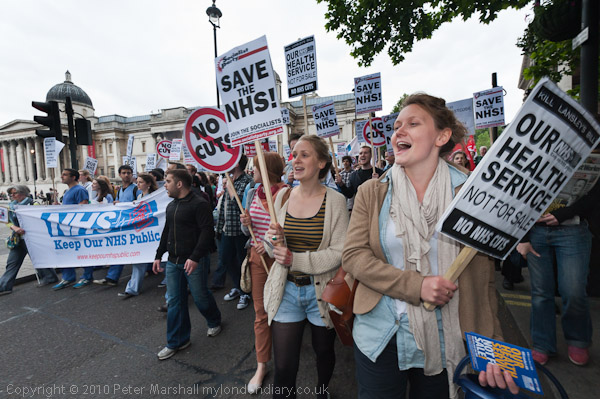
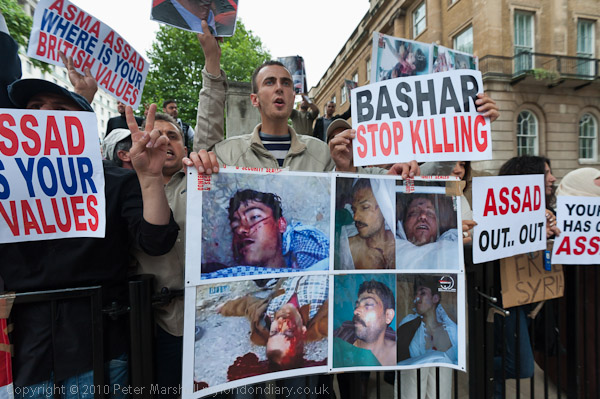
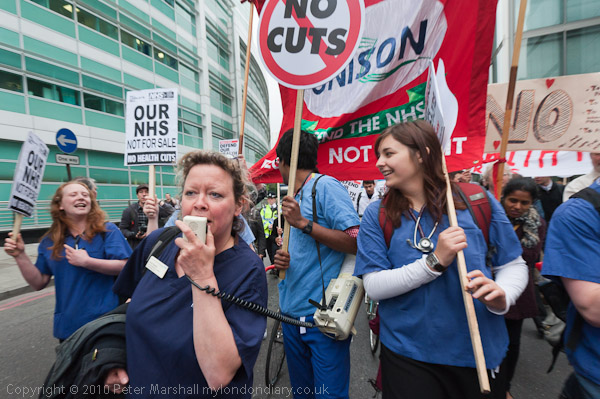
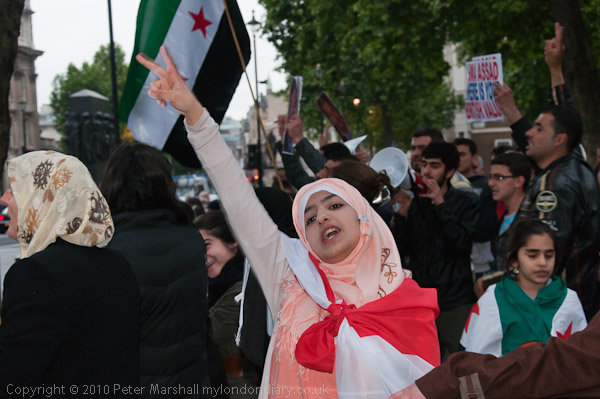
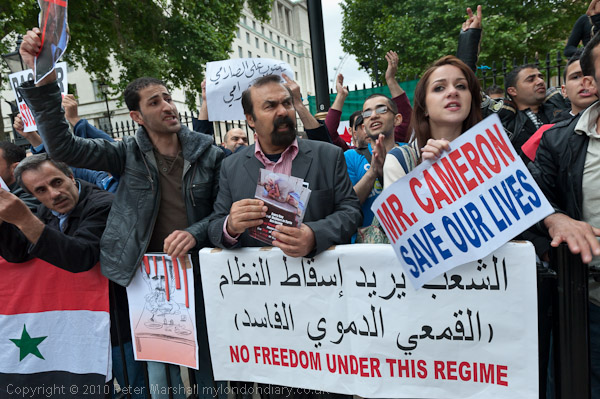
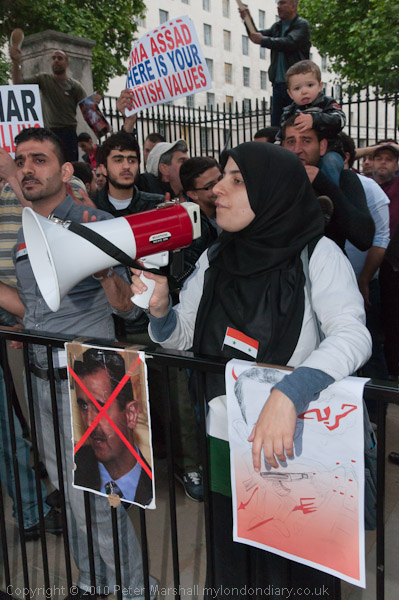
Free Syria & Keep the NHS Public: On Tuesday May 17th 2011 I photographed two protests, a march against the continuing privatisation of parts of our NHS and the Health & Social Care Bill then going through parliament, and a protest at Downing Street calling for the government to support the revolution against the Assad regime in Syria and work to end the bloodshed taking place there.
Fourteen years later the NHS is still under threat with more and more of its services being taken over by private healthcare companies, and although some changes have been made to the disastrous ‘reforms’ introduced under Andrew Lansley but implemented by Jeremy Hunt who later called the fragmentation that it caused ‘frankly, completely ridiculous’ and tried hard to ignore much of it.
What Hunt thought was the only successful part of the Act was that it established the independence of NHS England from the government. On 13th March 2025 the Labour government announced they were scropping NHS England, putting the NHS firmly under the control of Prime Minister Keir Starmer and Health Secretary Wes Streeting, two men who one of my Facebook friends posted should not be in charge of a first aid kit let alone the NHS. If only, many of us think, had Leanne Mohamad got another 529 votes in Ilforn North in 2024 and she had become the MP for Ilford North rather than Streeting. It was perhaps the greatest disappointment of that General Election.
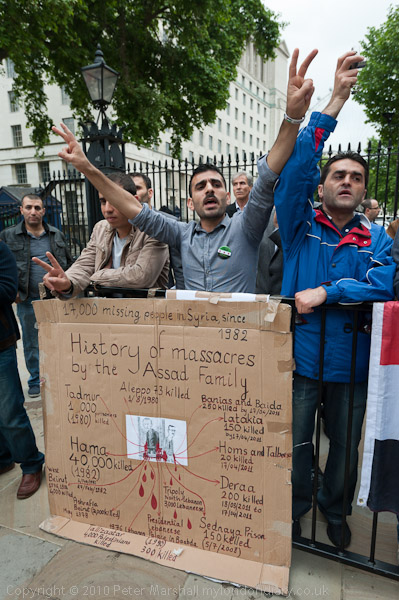
History of massacres by the Assad family – 17,000 missing people in Syria since 1982.
Both Britain and the USA failed to support the Arab Spring in Syria with much more than weak words and when Russian put the forces behind Assad his survival was ensured until finally ousted by Hay’at Tahrir al-Sham (HTS) and others after 13 years of brutal civil war in December 2024.
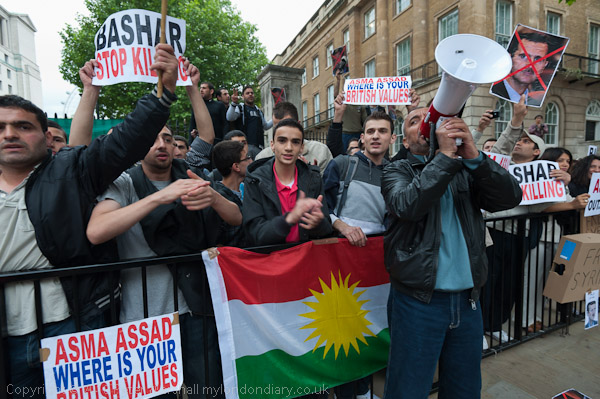
Protesters with a Kurdish flag
The US gave some support to the Kurds to enable them to defeat ISIS (Islamic State of Iraq and al-Sham) despite the support ISIS received from our NATO ally Turkey. But by 2024 lamost half a million Syrians had been killed and around 6.7 million refugees had fled Syria with another 5 million internally displaced. And Turkey had taken advantage of the situation to invade and occupy some largely Kurdish areas.
In deference to Turkey, the UK government proscribed the Partiya Karkeren Kurdistani (PKK) or Kurdish Workers Party in 2001, later adding a whole list of other names it used, KADEK, Kongra Gele Kurdistan, Teyre Azadiye Kurdistan (TAK) and Hezen Parastina Gel (HPG). For some years the PKK had moved from fighting for an independent state of Kurdistan to calling for greater autonomy and civil rights for Kurds in Turkey and a few days ago at a PKK conference it announced it was to disband and disarm.
Keep The NHS Public – UCH Euston Road to Whitehall
Over a thousand people, including many medical professionals and medical students, marched through London to show their opposition to government reforms which threatens jobs and many feel would destroy the NHS.
After a rally at University College Hospital on Euston Road the march, the second large march in London aimed at saving the NHS and killing Andrew Lansley’s Health & Social Care Bill, set off for Westminster.
There was a brief ‘die-in’ at Cambridge Circus and a small ‘sit-in’ outside Downing Street before the marchers held a final rally in front of the Department of Health at Richmond House before dispersing.
You can read a fuller account of the protest and see many more pictures on My London Diary at Keep The NHS Public.
Syrians Ask For Support at Downing St
Syrians supporting the ‘People’s Revolution’ in their country called for support from the British people and government to support their demands for reform and to stop the bloodshed in Syria.
A large group of Syrians including Kurds from Northern Syria called for support from David Cameron and the British people for the Syrian people.
Since demonstrations for political and economic freedom and an end to the tyranny and bloodshed of the Assad regime started in Syria on March 15th 2011, more than 800 innocent protesters have been killed, over 2000 injured and many more detained.
Assad’s father Hafez al-Assad was president of Syria from 1971 until he died in 2000, and was responsible for many deaths and disappearances, including a massacre of 40,000 people at Hama in 1982. His son Bashar Al-Assad, nicknamed as ‘The Butcher’ continued the “arbitrary arrests and detention, torture, extrajudicial killings, enforced disappearances, rape, and mass surveillance.”
The Wall Must Fall & Kyoto: There were two protests on May 15th 2004 over major issues still very relevant now. The first was against the separation wall being built by Israel which was breaking up many Palestinian urban settlements and dividing some farmers from their lands. Designed for the convenience of IsraelI Security forces it reconfigures many boundaries and paved the way for further IsralI settlements on Palestinian land, in complete disregard of the needs and civil rights of Palestinians.
Later I joined the march from Leatherhead to the US Embassy for the final few hundred yards of their march in protest against the failure of the US to ratify the Kyoto climate accord. US policies on climate change were and now are largely driven by the fossil fuel companies and have led to our current position with global temperatures continuing to rise towards levels the science tells us endangers human life on our planet. Though warming in the oceans may lead before long to a loss of the Gulf Stream which makes life in the UK tolerable and bring in a new Ice Age in the UK!
As with other events in the early years of My London Diary, the page design separated text and images, and the text was made less legible by eschewing capitals, a victory of style over sense which made no sense when I had begun to post more events on the pages with longer stories – but which it took me until 2008 to redesign. Below I’ll reunite some of the pictures with the text I wrote and links to the many more pictures still on their own pages on My London Diary.
The Wall Must Fall – Free Palestine Rally, Trafalgar Square
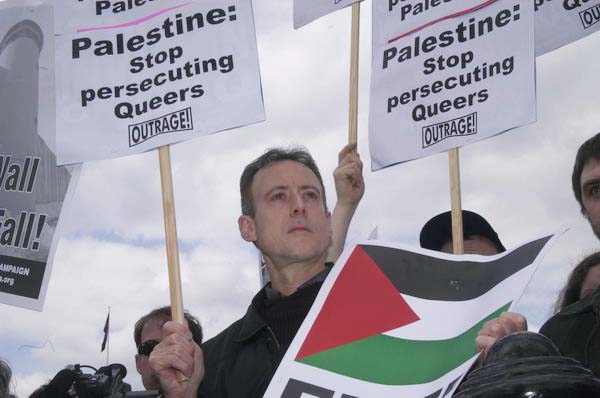
Peter Tatchell demonstrating against both the IsraelI persecution of Palestine, and also the persecution of gays by the Palestinians
The Wall Must Fall rally in Trafalgar Square on 15 May started with an an ugly scene, when stewards stopped Peter Tatchell and a group from Outrage from being photographed in front of the banners around Nelson’s Column. The rally organisers argued that raising the question of the persecution of gays in Palestine distracted attention from the Palestinian cause. Their childish attempts to distract the attention of photographers by jumping in front of the Outrage protesters, holding placards in front of theirs and shouting over them simply increased the force of Tatchell’s arguments and coverage they gained.
Jamal Jumaa
Fortunately the rally soon got under way. The main speaker was Jamal Jumaa – Director of the Stop The Wall Campaign In Palestine, although there were many others, including Sophie Hurndall, the mother of murdered peace activist Tom, Green MEP Caroline Lucas, Afif Safieh the Palestinian General Delegate to the UK, George Galloway and more. Too many more for most of us.
Zionism and Judaism are extreme opposites – Neturei Karta were there with placardsStreet Theatre in Trafalgar SquareThe wall at the start of Whitehall
War On Want activists came with a wall to dramatise the effect of the wall in Palestine. When the march moved off down Whitehall, the wall walked with them, and it was erected again opposite Downing Street. Here there was a short sit-down on the road before the event dissolved.
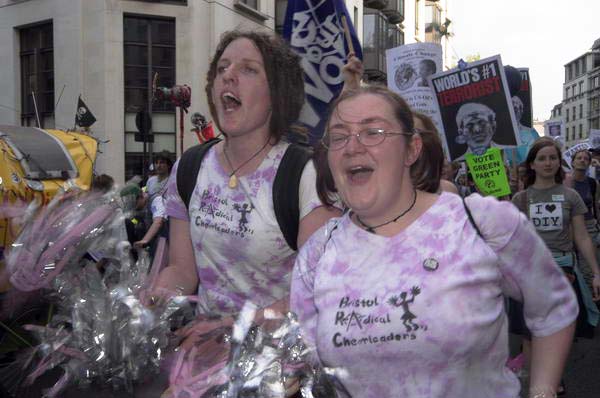
Bristol Radical Cheerleaders in the Kyoto march to the US embassy
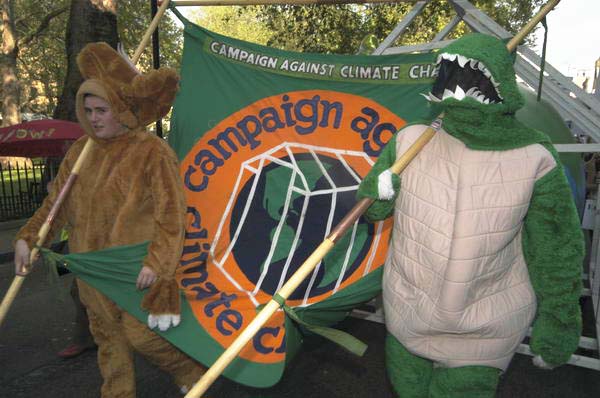
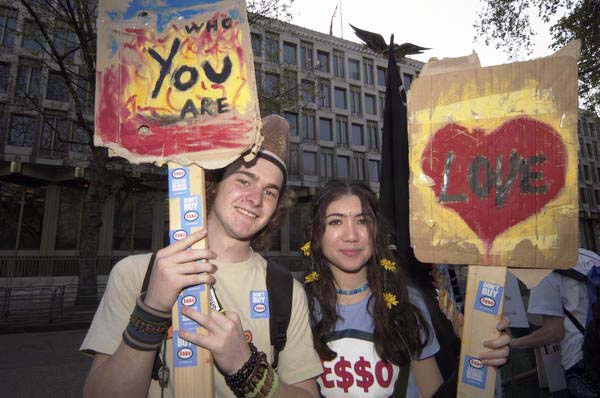
I caught up with the Kyoto march, organised by the Campaign Against Climate Change, as it reached Berkeley Square on the last quarter-mile or so of its long trek [around 19 miles] from the Esso British HQ in Leatherhead. Esso are seen as being one of the main influences behind the refusal by President George Bush and the US administration to ratify the Kyoto Accord.
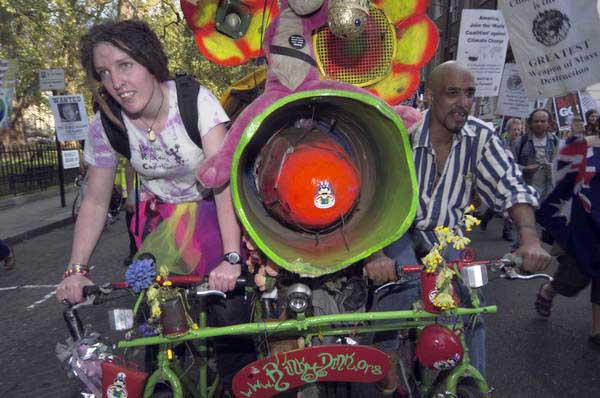
Pedal-powered Rinky Dink sound system supports the Campaign against Climate Change
The campaign had previously organised a number of marches in london, and this was an annual event.
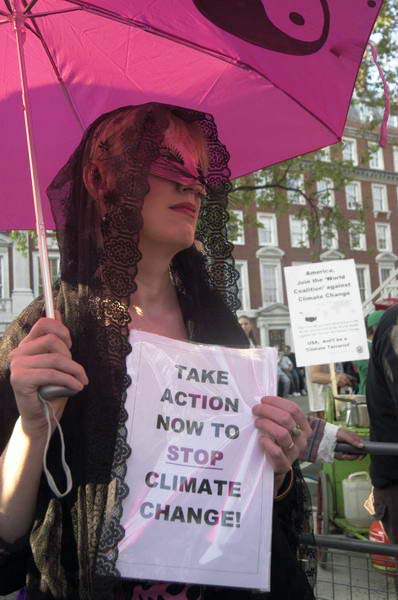
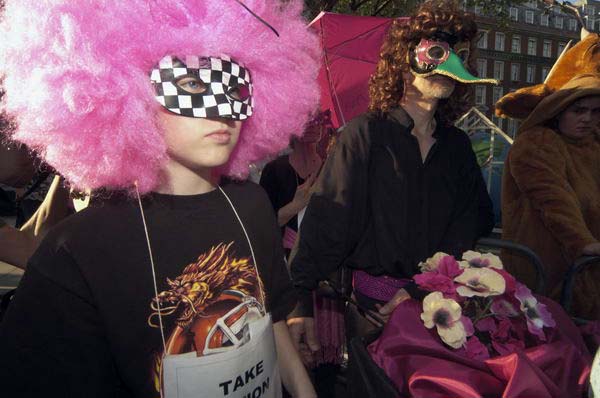
Marchers ready for the ‘Dinosaur Party’ at the US EmbassyCodePink campaigners with a coffin carrying planet Earth: TAKE ACTION NOW TO STOP CLIMATE CHANGE
Among the marchers it was good to find a number dressed ready for the promised ‘Dinosaur Party’ at the US Embassy, as well as the fantastic Rinky Dink cycle-powered sound system. It was also good to meet a few of the Bristol Radical Cheerleaders again, bouncing with energy as ever. A little colour was also added by a small group of of Codepink activists forming a funeral cortège, carrying the globe on their coffin.
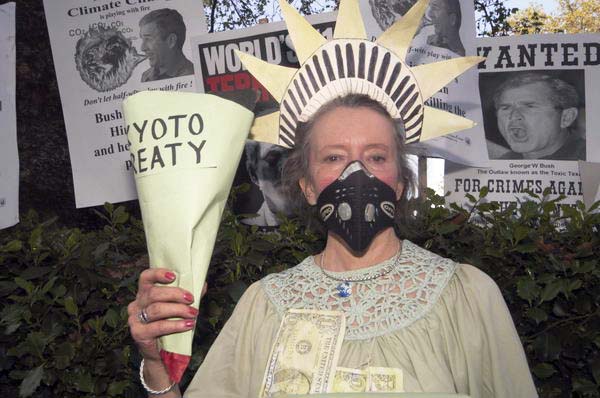
Even the Statue of Liberty implores Bush to sign KyotoE$$o campaigners in front of the US Embassy in Grosvenor Square
The police in Grosvenor Square were not helpful, but eventually the speeches got under way in a corner of the square.
Ray-Jones & London May Queen: The very first London May Queen event I photographed was on Saturday 14th May 2005. Previously I had thought that such events had died out years earlier. They had been recorded in the late 1960s and 1970s by photographers including the late Tony Ray-Jones whose work in his book ‘A Day Off‘ published posthumously in 1974 (and earlier publications in Creative Camera magazine and elsewhere) had a great influence on myself and other young photographers in the UK.
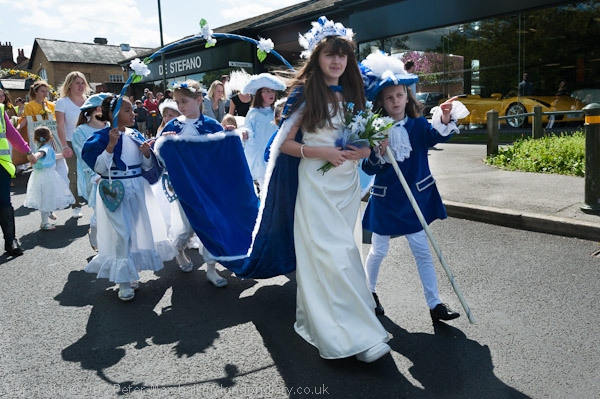
The Queen’s carriage is pulled by the Girls Brigade. All photographs here by Peter Marshall
Ray-Jones had won a scholarship to the USA to study design at Yale in 1961 and there he had been greatly influenced by the work of Robert Frank in his book ‘The Americans’ published in France in 1958 and in the USA the following year as well as the work of a younger generation of American photographers Frank’s work had inspired. After Yale Ray-Jones worked for several years in the USA and attended workshops with the legendary art directory Alexey Brodovitch.
He returned to the UK and as well as taking photographs promoted his US-acquired views on photography with an evangelistic fervour. In this he found an ally in the Bronx-born photographer John Benton-Harris, another ‘Brodovitch Boy’ who had settled in London – who I later became friends and worked with. After Ray-Jones died tragically young from Leukaemia in 1972 it was Benton-Harris who made the prints that were used in ‘A Day Off’, printed very much in the style of the time.
Among the several images in the ‘Summer Carnivals’ section of the book were several from May Queen festivals, including a large group photograph of over twenty young girls all wearing crowns in front a maypole. The caption ‘May Queen gathering, Sittingbourne, still used on the Getty site, 1968′ was incorrect (as were some others as the photographer was no longer alive and they were captioned by others.) Possibly the least characteristic image of the book it was actually from the crowning of the 1968 London May Queen on Hayes Common in the London Borough of Bromley.
From two of my close photographic friends following in the footsteps of Ray-Jones and Benton-Harris photographing English Carnivals with an Arts Council grant I found that these events were still taking place and I decided to find out more. It was hard to find information but I was finally able to find the date and time of the 2005 crowning.
I arrived at Hayes Common with some trepidation. Since Ray-Jones had taken his pictures there had been several decades of warnings from the government and media over “stranger danger” and panic over men pointing cameras at young girls was rife. Although this was a public event, before taking any pictures I went to find the organisers and explained what I hoped to do. I had for some years been part of a group of photographers, London Documentary Photographers, organised by Mike Seaborne at the Museum of London and had ID from them as well as a Press card which, unusually for me, wore visibly on my jacket for the event. This possibly wasn’t a good idea as the organisers were worried that some of the older girls taking part might be embarassed to have their pictures in the local press. They were less worried about me posting them on the web or elsewhere.
The children – many girls but with a few brothers among them – were almost all eager to have their pictures taken, and their mothers (and there were a few fathers too) were also happy to have a record of the day. From this first event I got requests to photograph other events in the London May Queen cycle the following year and for years later, though I was often busy elsewhere and unable to do so.
A few days after the event I put the pictures on-line with a long explanation about the event and an invitation to the mothers to ask me if I had other pictures of their children and for larger files they could use to make prints. I’d also given out copies of my business card to many of thembut made it clear I would be happy to provide digital images without charge.
Here – with minor corrections – is what I wrote in 2005.
Merrie England and London May Queen Festival Hayes Common and Hayes Village, Kent, 14 May 2005
The ‘Merrie England And London May Queen Festival’ was founded by a master at Dulwich School, Joseph Deedy in 1913, making this year’s festival the 93rd. [Later I was told he was from Whitelands College where John Ruskin had started a May Queen festival in 1881 – still continuing at Roehampton University as a May Monarch.]
The tradition of May Queens is much older, coming from pre-Christian times, as the Goddess Of The Spring, who the Romans called Flora. It was a traditional time for young women to come to the villages from the farms to find a husband, and the maypole is a symbol of virility.
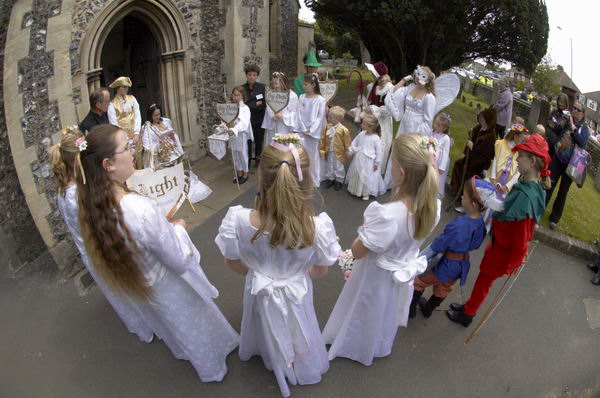
Deedy’s folklorique version is rather different from this with an uplifting script, still read by the participants as a part of the festival. Some of the texts are on the back of the signs carried by the attendants of the London May Queen, the ‘Joy Bells Of Merrie England’ representing ‘Music’, ‘Company’, ‘Beauty’, ‘Light’…
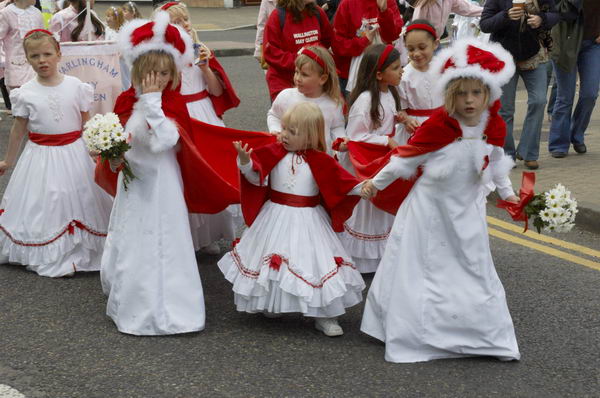
The London May Queen is also attended by ‘The Prince Of Merrie England‘ (also female) along with the Fairy Queen, Bo-Peep and Robin Hood. The event is also attended by a couple of dozen ‘Realm Queens’ each also with her attendants: a Prince, Banner Bearer, Crown Bearer, Pages, Fairies and Flower Girls, from half a dozen to twenty or more girls, all dressed in the particular Realm Colours and with their own Realm Flower. At its peak in the 1920s and 1930s there were 120 realms with well over a thousand children taking part in the event on Hayes Common.
The various positions are decided entirely by seniority in the organisation – children can join when they are three and continue until their sixteenth birthday. Many of the mothers I talked to at this and later May Queen events had been May Queens or taken part in the ceremony in their childhood; one of the organisers was May Queen in 1932 and her grandchildren were taking part in 2005.
As well as the Hayes festival, there is another a week earlier in Beckenham, where most of the realm queens are crowned. The queens and realms also take part in other fêtes and carnivals, take flowers to the elderly and attend flower services in churches in their areas. Almost all the realms come from the surrounding areas in surburban Kent and Surrey (now mainly in Greater London.)
The children process, [in their realms in alphabetical order] from the Common to Hayes village, where there is a short ceremony, ‘Little Sanctum’ outside the village church.
The procession then continues around Hayes, returning to the Common. This is rather a long walk for some of the younger children.
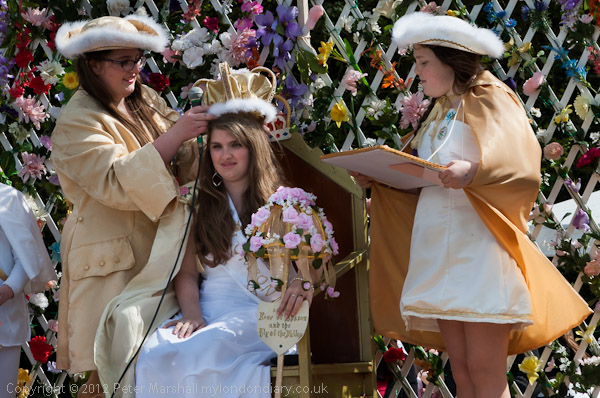
Back at the Common there is a short ceremony using Mr Deedy’s words read by the Fairy Queen, Bo-Peep, Robin Hood and others, before the London May Queen is crowned by the Prince Of Merrie England. The realm queens are then presented to the London May Queen, and have their pictures taken as a group in front of the maypole [as in that Ray-Jones picture.]
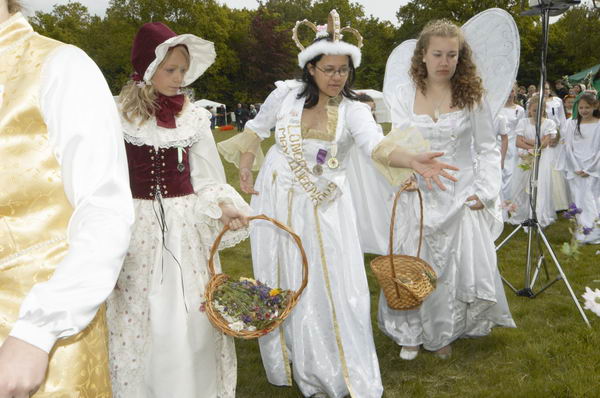
The London May Queen then goes around the field with her main attendants as Flora, with baskets of flowers which she throws to the realm children.This is followed (after the rather lengthy raffle draw) by dancing round the maypole in a fairly energetic and undisciplined fashion.
Ravensbourne Walk: On Sunday 13th May 2012 I decided to take a walk alongside one of London’s rivers, the Ravensbourne. It isn’t one of London’s best-known rivers and perhaps lacks the glamour of the so-called ‘lost rivers’.
The Ravensbourne still flows largely above ground, and its final tidal section before it enters into the Thames is the rather better-known Deptford Creek, once an important industrial area. It also once powered a number of mills along its length.
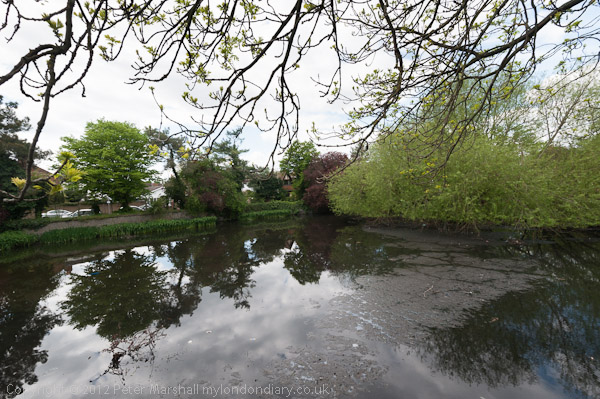
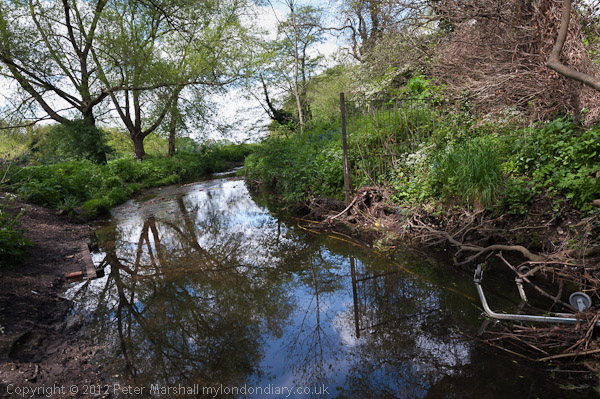
I’d decided not to begin at its source at Caesar’s Well in Keston but to join it around 4 miles to the north at Bromley where I could join it by a short downhill walk from Bromley South station. The area around Bromley has several culverted sections of the river and it emerges from one of these into a lake at the west of Church House Gardens, disappearing again for a short section before coming into the open in parkland in Martins Hill Open Space north of Glassmill Lane.
It then goes underground for around a quarter of a mile before appearing again along the edge of a golf course, but non-members have to walk along Ravensbourne Avenue before seeing it again at the bridge under Farnaby Road.
From there on the river flows in the open through Beckenham Place Park and I could walk beside it or close to it, having to weave my way through various roads in an estate here. Just to the east of the river on Brangbourne Road is a large council estate with blocks named after various rivers, mostly I think London Rivers, and a block on the corner with Old Bromley Road is Ravensbourne.
After a small green area on the corner of Bromley Rd and Beckenham Hill Rd which it then goes under to feed a large pond at Homebase. The map I was using for the walk shows this as a stream with a weir in the middle. Part was once the mill pond for Lower Mill, a corn mill (which was at different times a mustard mill and a cutlery mill) on the corner of Southend Lane. Upper Mill stood roughly here on the corner of Beckenham Hill Rd.
Overlooking the pond at Hoomebase I photographed the sculpture The Whisper, Andre Wallace 1984 and the church hall opposite. The river leaves the pound overground, emerging into the open again a couple of hundred yards on as it goes under Watermead Lane where it runs between houses and flats. You can follow this on a back-street but I took the more interesting route along the Bromley Road.
Allerford Rd
At Randlesdown Road it flows into the Catford Trading Estate, then goes under Fordmill Rd just north of the railway bridge. Shortly after here it joins what is usually called its largest tributary, the River Pool, though I think this is usually a larger river than the Ravensbourne, though shorter before continuing under Catford Road next to Catford Bridge Station.
It was a hot day, and I had done rather more walking around than the relatively short route taken by the river, and I was tired. I had intended to walk on to Lewisham or perhaps even Deptford, but abandoned my plans and caught a train here.
Punch, Morris, Nakba & London May Queen: Saturday 12th May 2012 was an unusually busy day for me, rushing from Covent Garden to Westminster and then out to Hayes Common. There were two very different events I was determined not to miss, the Nakba Day protest at Downing Street remembering the anniversary of the eviction of around 750,000 Palestinians from their homes by Israeli forces in 1948 and the crowning of London’s 100th May Queen taking place on Hayes Common on the edge of London, around a hour’s travel away. And a couple of other events I could fit in too.
I wrote all of these up on My London Diary and you can read those accounts there on the links in this post – as well as finding many more pictures, so I won’t repeat myself too much here.
Punch Celebrates 350th Birthday – Covent Garden
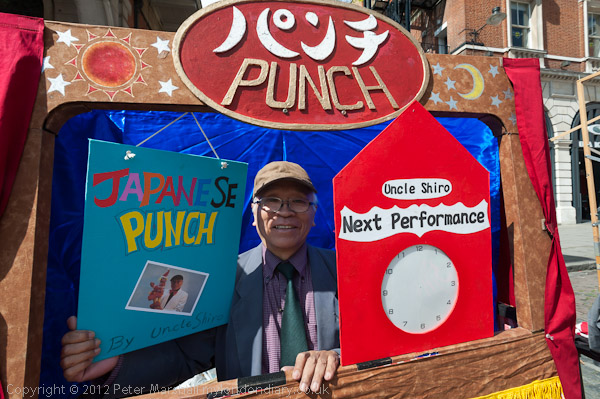
‘Professors’ had come from around the world including Uncle Shiro the only Japanese Punch
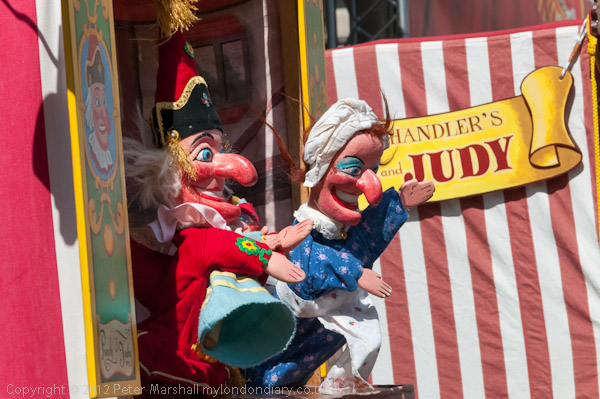
Punch and Judy professors from around the country and around the world brought their booths to Covent Garden this weekend to celebrate 350 years since Samuel Pepys first recorded a performance there in his diary.
His was the first recorded performance of the “Italian puppet play” and though Punch was then called Pulcinella and has obvious earlier roots in Italy it is regarded as the start of Punch and Judy in England.
The fun was only just starting when I left for more serious matters in Westminster. More about the day and many more pictures at Punch Celebrates 350th Birthday
Morris Men Occupy Westminster
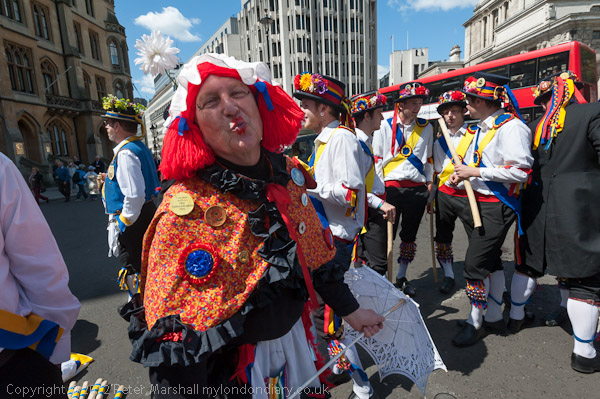
A Morris dancer dressed as a woman, who plays the fool, blows me a kiss
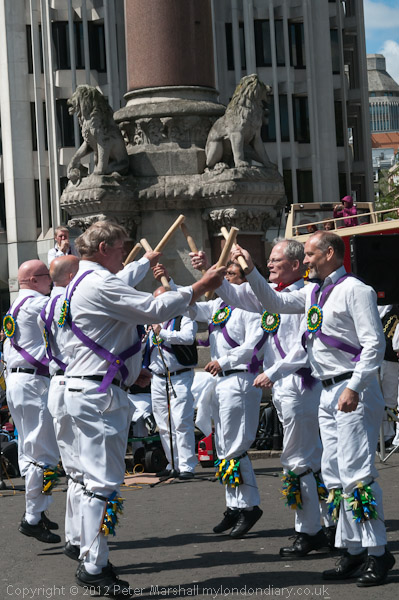
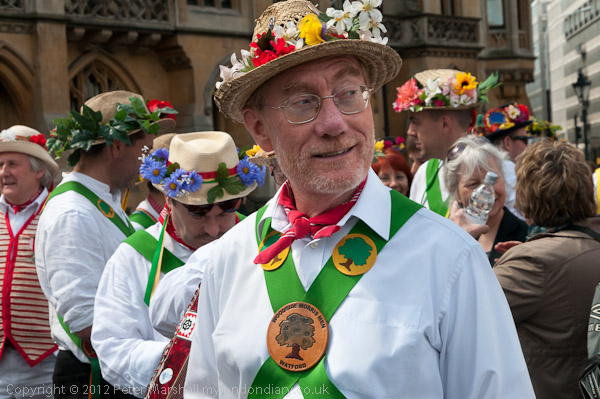
Pavements across Westminster were filled with gaily dressed men with bells on them leaping and dancing as twelve Morris sides performed in around twenty sets over the day in Central London on the Westminster Day of Dance.
The performances were taking place at various locations in the City of Westminster, including the Victoria Embankment, St Margarets Westminster, Westminster Cathedral and Tate Britain, with the various Morris sides rotating between them throughout the day.
I left as the morning sessions ended and the Morris Men had a break for a doubtless mainly liquid lunch (dancing really is thirsty work) before the afternoon sessions which, after a euphemistically named ‘Tea Break’ were to conclude with a mass performance south of the river in Lambeth by the National Theatre.
Nakba Day Protest at Downing St
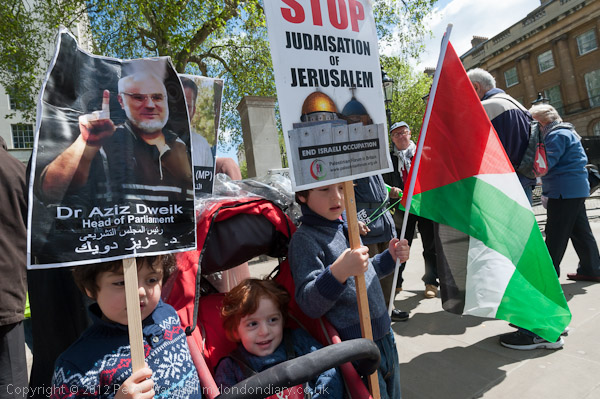
This was a family protest – young protesters hold a Palestinian flag and placards
Nakba Day is generally commemorated on 15 May and remembers the eviction of around 750,000 Palestinians from their homes by Israel forces in 1948. This London protest opposite Downing St was on the nearest Saturday.
At the time of the protest around 2000 Palestinians were on hunger strike in Israeli jails in protest against ‘administrative detention’ which allows them to be detained for consequtive periods of up to six months without any charge or trial.
Israel was still displacing Palestinians from their homes – and is currently in 2025 planning to clear them entirely from Gaza, either killing them through starvation, bombing or military eviction. Back in 2012 they were planning to forcibly displace around 40,000 Palestinian Bedouin from the Naqab desert, threatening to demolish the homes of around 85,000 Palestinians in East Jerusalem and to forcibly evict 2,000 from the West Bank.
Unfortunately I had to rush away while people were still arriving for the protest as I had promised to photograph the crowning of London’s 100th May Queen and was only able to take very few pictures to accompany the text.
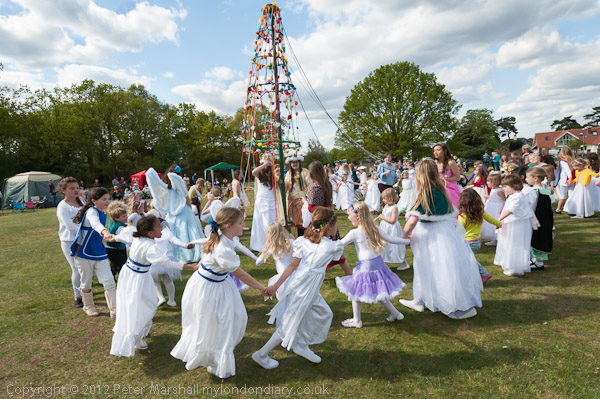
The Merrie England Children Dance around the maypole with the newly crowned Queen at its centre
The 100th London May Queen was crowned at the Merrie England and London May Queen Festival on Hayes Common, Kent, part of an unbroken tradition stretching back to 1913. 20 other Queens and their realms took part.
The ceremonies at Hayes Common, now a part of the London Borough of Bromley, continued even during both World Wars, though they were then carried out inside the local church as it was feared the procession around the village might attract unwanted attention from the German air force.
I’ve written often here and elsewhere about the London May Queen organisation and events, including a long account in my book London’s May Queens. [You can read a little more about this book – also available much more cheaply as an e-book – on >Re:PHOTO and can read the text and see many of the pictures at the book link.]
But there is one section of my post in 2012 which adds something to the story, so I’ll repeat it here.
“Whitelands College in London started its May Queen festival rather earlier in 1881 at the prompting of John Ruskin, and this still continues at the college (now part of the University of Roehampton) although since the college now admits men, some years they have a May King in place of a queen. Talking to one of the organisers of the event yesterday I learnt that Deedy had worked at Whitelands – contrary to the published information on him.”
Fortunately I arrived at Hayes Common just in time – though rather out of breath having run from Hayes Station – for the start of the procession around the village before the crowning.
Rainham and Hornchurch: On Thursday 11th May 2006 I put my Brompton folding bike on the train for the journey across London to Rainham Station. The journey, around 31 miles in a straight line, though rather longer on the ground, took me almost two hours on three trains, one Underground. As usual I took a book to read and relaxed on the journey.
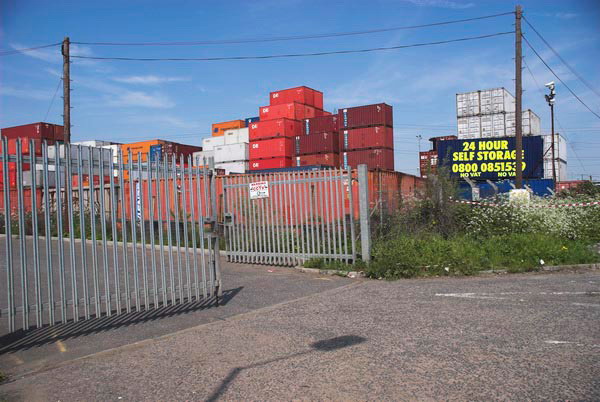
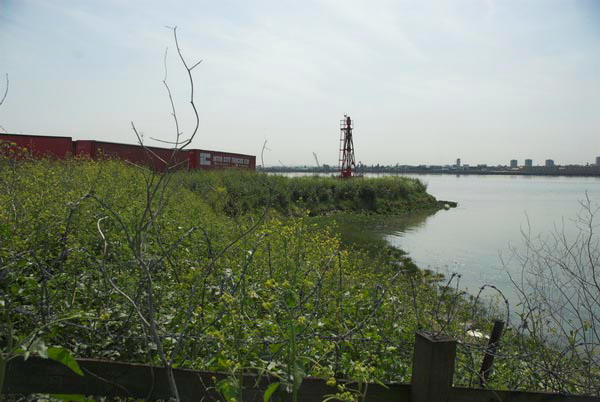
Containers on Rainham Marshes
Rainham is in Havering, part of Greater London and is the last station out to the east on the C2C rail service where the Travelcard I used covered. I did several rides and walks from here into Essex over the years, but I on this one stayed inside Greater London.
Mural of previous industry in the area and Tilda Rice works
The first part of this bike ride followed the route of the London Loop path around the outskirts of London, which at that date came to a dead and desolate end at Coldharbour Point. The path now continues to end in Purfleet, and if you have the stamina you can continue walking on a riverside path which ends at Tilbury Docks before having to retrace your steps to Grays.
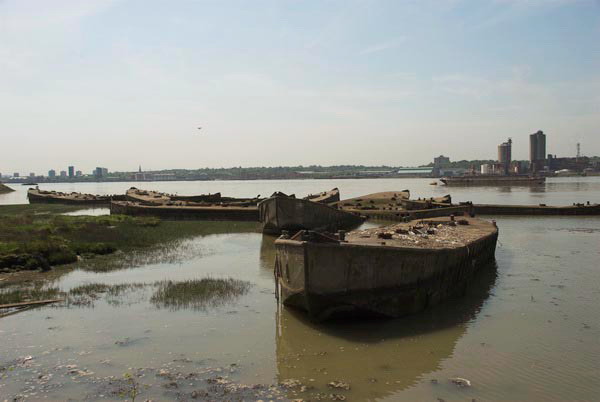
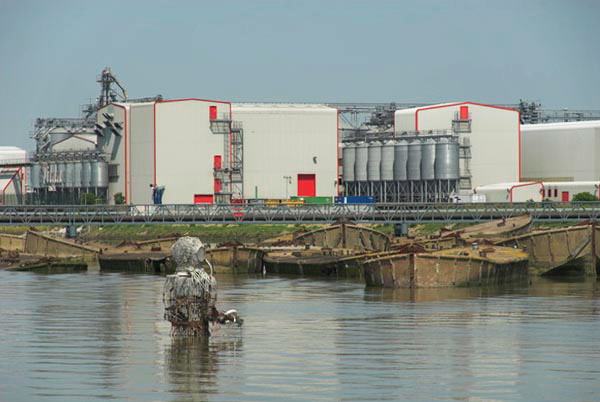
Derelict concrete barges in the Thames built for the Mulberry Harbour used for the D-Day landings
I didn’t write much about the ride back in 2006, and I didn’t ride very far. After returning from the end of the path I had a short ride west along the A13, which I don’t recommended as it is certainly not cycle friendly with much fast-moving traffic. The Mardyke Estate, where I went after that is now called ‘Orchard Village’ which at least avoids confusion with the Mardyke, a small river a few miles to the east. I continued roughly north through South Hornchurch, finally ending my ride at the District Line station of Elm Park.
The sculpture in the river facing the barges and the Tilda Rice plant is Diver: Regeneration by local sculptor John Kaufman, who died in 2002, not long after it was placed here in the mud in 2000. Some of the funding for it came from the landfill company which carried waste here to raise parts of the marshes above sea level.
Waste Transfer Jetty – Landfill is raising much of the below sea-level marshes
My pictures don’t reflect the nature of the area which has large areas of open with marshes and country parks and two rivers flowing through it, the Beam River and the Ingrebourne which flows into the Thames at Rainham Creek. I think it is also an area which has seen considerable regeneration since 2006 in the London Riverside area of Thames Gateway redevelopment.
Coldharbour Point and the barbed wire where the London Loop then ended
Here’s my account with the usual minor corrections from 2006:
Rainham is at the eastern edge of London, an area of marsh, industry, warehouses, container stacks, dereliction and landfill on the Essex (north) bank of the Thames, cut across by the elevated A13 trunk road which sweeps across the creek and on over the marshes to Purfleet, alongside the new Channel Tunnel Rail Link.
Rainham Creek from the A13
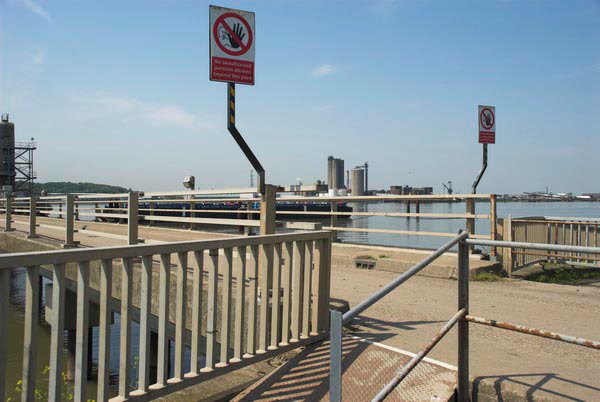
One day the Thames Path will continue past Coldharbour Point, but for the moment it’s a dead end. I eat my sandwiches and then turn back, making my way up onto the elevated roadway, but the views are disappointing.
Mardyke Estate, South Hornchurch
At the next roundabout west I take a look around, leave the main road and then head north, past disused areas of the Ford Dagenham site and up through the Mardyke Estate and South Hornchurch.
At Elm Park the heat of our first hot day if the year – 25 Celsius in the shade, but I’ve been constantly in sun – gets to me and I give up and take the Underground towards home.
One of many houses decorated for the Cup Final. Unfortunately West Ham lost to Liverpool
The heat has buckled some of the rails and the District Line train has to crawl along, more or less at my cycling speed, but at least I can just sit and rest.
Rathmore Benches & Greyladies – New Charlton 1995: You can still see these mosaic decorated concrete benches on Troughton Rd and around the corner in Rathmore Rd. A short walk from Charlton Station, the building they are outside has for some years been the New Covenant Church Charlton.
Rathmore Community Centre & Rathmore Benches (Former Good Shepherd Mission Hall), 61a, Troughton Road, New Charlton, Greenwich, 1995, 95c5-714
The mosaic covered benches were installed here together with a mural on the walls behind in 1980. By 1995 the mural had been painted over but the benches remained, still in fairly good condition.
Rathmore Community Centre & Rathmore Benches (Former Good Shepherd Mission Hall), 61a, Troughton Road, New Charlton, Greenwich, 1995, 95c5-713
The benches were created as a part of a ‘Past, Present and Future of Charlton‘ project with the help of adults and children from the community centre by Greenwich Mural Workshop, who got funding to restore them in 2019 as they had suffered from wear and tear and some vandalism.
Rathmore Community Centre & Rathmore Benches (Former Good Shepherd Mission Hall), 61a, Troughton Road, New Charlton, Greenwich, 1995, 95c5-835
On the For Walls With Tongues web site of Greenwich Mural Workshop you can see pictures of the missing mural as well as the benches and learn more about their creation.
Rathmore Community Centre & Rathmore Benches (Former Good Shepherd Mission Hall), 61a, Troughton Road, New Charlton, Greenwich, 1995, 95c5-834
The centre had been built as the Good Shepherd Mission Hall and the Greenwich Local Heritage List states it is a 200-seater mission hall built 1900 to designs of architect J Rowland and was developed from Holy Trinity Mission run by Greyladies College.
Rathmore Community Centre & Rathmore Benches (Former Good Shepherd Mission Hall), 61a, Troughton Road, New Charlton, Greenwich, 1995, 95c5-833
Greyladies College for Women Workers was based in Dartmouth Row , in “a delightful country house, once the mansion of Lord Dartmouth, and stands on the breezy heights of Blackheath, in the midst of its own beautiful grounds, and with far-stretching views over the surrounding country to the Crystal Palace.“
“The great aim of the Greyladies’ College is to bring together lonely women working in isolation without a definite plan, and also women who are possibly daughters in a large family and find it difficult to separate themselves from social distraction in order to follow religious and philanthropic work.“
The Greyladies worked in 22 parishes in South London “helping in the work of the Church of England under the incumbents of the diocese.” The description of them in Volume 1 of Every Woman’s Encylclopaedia published in 1910-12 is fascinatingly and charmingly dated.
Three Colt Street & Limekiln Dock: My walk in Limehouse on Sunday 6th January 1990 continued. The previous post from this walk is More from Narrow Street – 1990.
Limehouse gets its name from the making of quicklime here, an industry dating back here into antiquity getting its first written reference in 1335. The newly developed flats of Limekiln Wharf and Dundee Wharf on the south side of Limekiln Creek (or Limekiln Dock) are probably on the site of old lime kilns (lime oasts) where chalk (calcium carbonate) brought by boats from Swanscombe or Northfleet or other areas of North Kent was brought ashore in the Creek and roasted to give quicklime (calcium oxide) the vital ingredient for cement, mortar and concrete and with many other uses. When water is then added it forms slaked lime (calcium hydroxide.)
Along the street are the late-Victorian buildings of the Dundee, Perth, and London Shipping Co. which were used by the London Docklands Development Corporation which was responsible for the redevelopment of docklands, over-riding the normal functions of the local authorities and still have the LDDC logo as a weathercock, though this was not in place in 1990.
Limekiln Dock, Three Colt St, Limehouse, Tower Hamlets, 1990, 90-1b-36
The always interesting ‘A London Inheritance‘ has a fascinating and very detailed account of the area, based on considerable research, Limekiln Dock and the Black Ditch.
The Black Ditch has been much mythologised as one of ‘London’s Lost Rivers‘ and its lower parts were after the 1855 replaced by the Limekiln Dock Sewer. I imagine the Black Ditch and this were both subsumed into Bazalgette’s grand designs in the 1860s and now flow to Beckton.
The view here is looking out towards the River Thames. Since 1996 there has been a swing bridge taking the Thames Path across the mouth of the creek. It had to be built as a swing bridge because of the ancient rights of navigation into the dock, though I would be surprised to find that it has ever needed to be swung to allow this.
Limekiln Dock, Three Colt St, Limehouse, Tower Hamlets, 1990, 90-1b-25
There seemed to be quite a lot of rubbish in the dock in 1990, but in earlier years things were much worse. The post in ‘A London Inheritance’ quotes a court case from 1893 where it is described as “the common receptacle for the sewerage of part of Fore-street, and also being a harbour for a large portion of the animal refuse of the Thames.”
J R Wilson, Ship Stores, Limekiln Dock, Three Colt St, Limehouse, Tower Hamlets, 1990, 90-1b-26
J R Wilson, Ship Stores at Limehouse Wharf has a frontage on Narrow Street and its back faces Limekiln Dock. I think the area from which I took this and the other pictures is no longer open to the public, but gave access to the Thames Path before the footbridge across the dock was built. In the foreground is the white-painted flood wall which was built around the Thames in London in the 1970s. Together with the Thames Barrier this has protected London from the serious floods of earlier years, but with rising sea levels will soon become inadequate.
110, Three Colt St, Limehouse, Tower Hamlets, 1990, 90-1b-11
The late-Victorian buildings of the Dundee, Perth, and London Shipping Co were in 1990 in use by D D Repro Limited, ‘Plain Paper & Dyeline Specialists. Their board on the building depicts the rough outline of the Thames from Tower Bridge around the Isle of Dogs and on to Beckton.
The Enterprise, pub, Milligan St, 145, Three Colt St, Limehouse, Tower Hamlets, 1990, 90-1b-12
The sign on the pub shows a three-masted ship caught in ice. The ships on Sir John Franklin’s doomed 1845 search for the North-West Passage were last seen by the whaler ‘Enterprise’, and I think this picture may be a depiction of one of his two ships, which were abandoned after being ice-bound for over a year. It was a story that very much caught the Victorian imagination.
The pub is said to have closed in 1963, but was open again in 1990, It closed in 2001, the pub became an Indian restaurant but is now an estate agents with another floor added in recent years.
Still more to come from my Limehouse walk in 1990.