Turnham Green – 1989

Turnham Green – 1989: The second post on my walk which began at Kew Bridge Station on 10th of December 1989. The previous post was Kew Bridge & Gunnersbury 1989.

Empire House, Chiswick High Rd, Turnham Green, Hounslow, , 1989 89-12a-64
Empire House, Chiswick High Rd, Turnham Green, Hounslow, 1989 89-12a-64

It might be thought odd that this tall office building which was built starting in 1959 should have been called Empire House, when the British Empire was almost completely gone, but the Empire from which this tower got its name was the Chiswick Empire, built for theatre owner and manager Oswald Stoll at 414 Chiswick High Road, replacing some shops and a smithy which opened in 2012.

The architect was the leading theatre architect Frank Matcham and it was a grand example of the Edwardian ‘Jacobean’ style. Built to seat 4,000 it featured mainly variety shows, but also more serious theatre and perhaps was in its heyday in the 1940s and early 50s. Wikipedia has a great list of some of those who appeared in its final years “Tommy Cooper, Max Miller, Max Bygraves, Julie Andrews, Morecambe and Wise, Ken Dodd, Max Wall, Dickie Valentine, the Ray Ellington Quartet, Peter Sellers and Dorothy Squires (1952), Laurel and Hardy on a return visit (1954), Al Martino, Alma Cogan, Terry-Thomas (1955) and Cliff Richard (1959).” Cliff wasn’t quite the man who brought the house down, with the final shows being by Liberace with the theatre being demolished within a month of his stepping away from the piano.

I don’t know who was the architect responsible for Empire House. It has recently been bought and redeveloped into flats and town houses.

Sandersons Wallpaper. Factory, Barley Mow Passage, Turnham Green, Hounslow, 1989, 89-12a-52

This elegant wallpaper factory was designed by C F Voysey and built in 1902. It was the only commercial building designed by the celebrated Arts & Crafts architect and designer and is Grade II* listed.

Arthur Sanderson & Sons Ltd, now just Sanderson, was founded in Islington in 1860 and made fabrics and wallpaper. The company came to Chiswick in 1879 and this building was an extension on the other side of the road to their earlier factory, built in 1893. After a fire in 1928, the company moved to Perivale selling off the Voysey building. They had also built a factory in Uxbridge in 1919 to produce fabrics. Sandersons moved back to into the Voysey building in 2024.

Sandersons had bought the business of Jeffrey & Co who had printed William Morris’s wallpapers and in 1940 when Morris & Co dissolved they also bought the rights to use the Morris name.

House, Dukes Avenue, Turnham Green, Hounslow, 1989, 89-12a-41

Dukes Avenue runs south from Turnham Green towards Chiswick House. Lord Burlington’s grandson was able after the Chiswick enclosures act of 1814 to build the road from his estate to Chiswick High Road. The road is lined with lime trees.

Houses along here seem seldom to be sold, but one went recently for over £3 million. Most appear to be large, solid and Edwardian but of no great interest.

Gateway, House, Dukes Avenue, Turnham Green, Hounslow, 1989, 89-12a-42
Devonshire Works, Dukes Avenue, Turnham Green, Hounslow, 1989, 89-12a-43

This former Sandersons factory, the “Devonshire works”, was used for light engineering in the 1960s by Evershed & Vignoles of Acton Lane. From 1971 it stood empty until restored by the Cornhill Insurance Co. as the Barley Mow Workspace, for individuals or small firms of designers or craftsmen, the first of whom arrived in 1976.”

Devonshire Works, Dukes Avenue, Turnham Green, Hounslow, 1989, 89-12a-44

After Lord Burlington who built Chiswick House died the property was inherited by the Dukes of Devonshire. I think this works probably dates from 1893.

Chiswick Memorial Club, Afton House, Bourne Place, Turnham Green, Hounslow, 1989, 89-12a-45

Afton House, built around 1800 is the only remaining example of the grand houses which were bilt in around 1800 along Chiswick High Road, and it Grade II listed. In the 1850s it was called Falkland House and was a school, but was renamed Afteon House in 1861. From then until 1887 it remained a school but then became a laundry until 1913. Empty and bcoming derelict it was bought in 1919 by Dan Mason of the Chiswick Polish Company (best remembered for their Cherry Blossom Shoe Polish) and given as a club for ex-servicemen.

Linden Gardens, Chiswick High Rd, Turnham Green, Hounslow, 1989, 89-12a-34

Dr Ralph Griffiths who founded the Monthly Review and edited it for 50 years was one of the many “noble, artistic and scholarly residents” of the area in the 18th century and he lived in Linden House where Linden Gardens now is. He was a London bookseller and publisher Ralph Griffiths, with “bookshops at St. Paul’s Churchyard from 1747 until 1753, then at 20 Pater Noster Row until 1759, and finally on the Strand near Catherine Street until 1772 – all under the sign of the Dunciad.”

Griffiths was notably involved in the 1746 publication of Acanius or the Young Adventurer, a fictionalized account of the Young Pretender, and may have been its author. The government attempted unsuccessfully to suppress the book and it remained in print for over 150 years.

Chiswick Fire Station, Chiswick High Rd, Turnham Green, Hounslow, 1989, 89-12a-36

Chiswick Fire Station at 197 Chiswick High Road is an elegant building with a tower and is now a bar and restaurant. It was for sale when I made this picture. Built in 1891 the tower at right was used to hang up fire hoses to dry and also to store the long fire escape ladder. A new fire station was built in 1963 and this became redundant.

War Memorial, Turnham Green, Hounslow, 1989, 89-12a-26

Erected in 1921 ‘In grateful and affectionate memory of the men of Chiswick who fell in the Great War, 1914 – 1918’ this simple obelisk is a rather plain reminder of their sacrifice designed by Edward Willis FSI, Engineer and Architect to the Chiswick Urban District Council. More names were added after the Second World War. There seems to be little reason to justify its Grade II listing

I walked on to Bedford Park. More from there in a later post .


FlickrFacebookMy London DiaryHull PhotosLea ValleyParis
London’s Industrial HeritageLondon Photos

All photographs on this page are copyright © Peter Marshall.
Contact me to buy prints or licence to reproduce.


Kew Bridge & Gunnersbury 1989

Kew Bridge & Gunnersbury 1989: I didn’t get our for a walk again in 1989 until the 10th of December, probably partly because of the weather with drizzle, mist, fog and some very cold days. But it was just a little warmer and I decided to go out. But at this time in London sunset is before 4pm and so I decided to take pictures fairly close to home so I could make an earlier start. Kew Bridge station is only around a half hour journey from my home.

Brentford, from Footbridge, Kew Bridge Station, Kew Bridge, Hounslow, 1989 89-11i-42

I made my first picture from the footbridge in the station taking me to the station exit. As you can see the station buildings were in pretty poor condition. The view includes the local landmark water pumping tower and the top of the engine house of Kew Bridge Engines, opened as a remarkable museum in 1975 (now renamed as London Museum of Water & Steam) and the tower blocks further down Green Dragon Lane. Six 23 storey blocks were built here as the Brentford Towers Estate in 1968 to 1972 by the London Borough of Hounslow.

Green Dragon Lane apparently got its name from a 17th century pub but there appears to be no record of where this was, though there are or were around 40 other pubs of that name elsewhere in the country. The name is usually thought either to have come from the Livery Badge worn by servants of the Herbert family, the Earl of Pembroke, which showed a bloody arm being eaten by a dragon or a reference to King Charles II’s Portuguese Catholic queen, Catherine of Braganza whose family badge was the Green Wyvern.

Kew Bridge station gets rather crowded at times now, as Brentford’s new football stadium is next door.

Spenklin House, Gunnersbury Avenue, Gunnersbury, Hounslow, 1989 89-11i-46

I walked up to Gunnersbury Avenue where on the north-east corner of the Chiswick roundabout was this magnificently derelict former works of Spenklin Ltd. They appear to have made Power-operated work clamping devices and other engineering tools including boosters, clamps, cylinders and hydraulic ram heads. The company name was a contraction of Spencer Franklin. I think the next factory along – demolished by the time I took this – had been Permutit water softeners.

I think this building probably dates from around 1925 when the Brentford Bypass – soon better known as the Great West Road – was opened. The roundabout here came later along with its flyover in 1959.

Spenklin House, Gunnersbury Avenue, Gunnersbury, Hounslow, 1989 89-11i-31

A closer view of the entrance with its boards showing it had been acquired by Markheath Securities PLC a London property developer, though 49 per cent owned by The Adelaide Steamship Co Ltd. They appear to have been responsible for several developments in the area and to have made Section 106 contributions to Hounslow Council for improvements to nearby Gunnersbury Park.

National Tyres, Gunnersbury Avenue, Gunnersbury, Hounslow, 1989 89-11i-33

My memory – often false – tells me that this was on the west side of Gunnersbury Avenue (the North Circular Road) to Spenklin House and I think is probably from the same era. At least it is clear what the business of the National Tyre Service was and the building has a rather fine squad of Michelin men.

Chiswick Rd, Acton Lane, Chiswick Park Station, Chiswick Park, Houslow, Ealing, 1989 89-11i-36

Quite a long walk along Chiswick High Road took me to Acton Lane where I took this picture on the corner of Chiswick Road. A station was built here in 1879 when the District Railway was extended from Turnham Green to Ealing Broadway, but clearly that in the distance here is from the 1930s.

On the corner we have a rather unremarkable post-war building but with some rather remarkable Christmas decorations. The long shop front is now divided into separate shops.

Chiswick Park Station, Chiswick Park, Ealing, 1989 89-11i-23

A closer view of Chiswick Park Station, one of many characteristic stations by architect Charles Holden for London Underground and built in 1931-2. Holden’s first complete Underground stations were built on the Northern Line southern extension from 1926, but he later designed many more. This station remains almost as it was built and shares its features with many of his others. It was Grade II listed in 1987.

Chiswick Park Station, Chiswick Park, Ealing, 1989 89-11i-1

The interior of the tall drum-shaped ticket hall with a shop, Midas Gold Exchange at right. Useful signs above the exit tell the way to buses and to Acton Green, while the lower advertising panels are all for Underground posters. The Underground were pioneers in various ways in advertising – not least in the tall tower at this and other stations whose main if not only purpose was to carry their branding with the trade-mark roundel and station name.

I think the brick building at left which I think housed the ticket office was perhaps a later addition to the building which otherwise has been altered little.

To be continued.


FlickrFacebookMy London DiaryHull PhotosLea ValleyParis
London’s Industrial HeritageLondon Photos

All photographs on this page are copyright © Peter Marshall.
Contact me to buy prints or licence to reproduce.


1995 Colour Part 4 – Around Dartford

1995 Colour Part 4 – Around Dartford: More of my panoramic images. These were taken in and around Dartford in Kent in March 1995 on a walk which took me from the centre of the town and along by the River Thames to an area close to the QEII Dartford Bridge. All these were taken on Sunday 19th March 1995. Dartford is a part of the Thames Gateway area around the Thames Estuary.

Dartford

Gasholder, Hythe St, Victoria Rd, Dartford, 1995, 95p03-531

I walked up Hythe Street and then turned right to a path that led me to a bridge across Dartford Creek.

Bridge, Dartford Creek, Nelsons Row, Dartford, 1995, 95p03-533

Dartford Creek is the tidal creek of the River Darent and was once important navigable creek to wharves in the centre of Dartford. Work has now been going on for years to restore the half-lock and make the creek navigable again. I made more panoramic images along the footpath beside the creek later in the year, but on my first visit was keen to get to the River Thames and left the Creek to walk up Joyce Green Lane and Marsh Street to the River Thames.

Littlebrook

Littlebrook Power Station, Dartford Bridge, QEII Bridge, River Thames, Dartford, 1995, 95p03-612

The first power station at Littlebrook was coal fired and opened in 1939 and was joined by a second in 1949 and a third in the 1950s with the final station Littlebrook D shown here opening in the 1980s. The earlier stations had been converted to burn oil by 1958 and were all decommisioned by 1981 when the final station began to be put into use. This continued to produce power until 2015 and was finally demolished in 2019. You can read much more detail on Wikipedia.

River Thames, Dartford Bridge, QEII Bridge, Dartford, 1995, 95p03-631

Google’s map now shows Littlebrook Beach as a ‘tourist attraction’ but I’m fairly sure I was the only person there on the day I made this picture.

Jetty, Littlebrook Power Station, Dartford Bridge, QEII Bridge, River Thames, Dartford, 1995, 95p03-643
Littlebrook Jetty, Dartford Bridge, QEII Bridge, River Thames, Dartford,  1995, 95p03-661
Littlebrook Jetty, Dartford Bridge, QEII Bridge, River Thames, Dartford, 1995, 95p03-661
National Power, River Thames, Dartford, 1995, 95p03-663

Crossways

As I walked along the path beside the river taking these and rather more black and white images I kept looking for a gate or gap in the fence betweent the riverside path and Crossways I could go through, but there was none. It was only when I got to Stone Marshes that I was able to leave the river and then walk along St Mary’s Road and into Crossways Business Park.

Warehouse, Crossways Business Park, Crossways, Dartford, 1995, 95p03-873

The area has been considerably expanded now, with a new major road to Greenhithe as well as new housing and commercial development.

Lake, Crossways Business Park, Crossways, Dartford, 1995, 95p03-733

The lake now has much new development around it, including a pub, The Wharf on Galleon Boulevard, close to where I made these pictures

Lake, Crossways Business Park, Crossways, Dartford, 1995, 95p03-721
Lake, Crossways Business Park, Crossways, Dartford, 1995, 95p03-723

I walked back into Dartford taking quite a few more black and white images but no more panoramas. The black and white pictures from this walk start here.


FlickrFacebookMy London DiaryHull PhotosLea ValleyParis
London’s Industrial HeritageLondon Photos

All photographs on this page are copyright © Peter Marshall.
Contact me to buy prints or licence to reproduce.


Peace, Congo, Iran, Egypt, Bikers, Trafalgar Square… 2012

Peace, Congo, Iran, Egypt, Bikers, Trafalgar Square: On Wednesday 25th January 2012 I went up to London in the middle of the afternoon and continued to take photographs at various places and events for several hours.


Parliament Square Peace Camp

Peace, Congo, Iran, Egypt, Bikers, Trafalgar Square… 2012

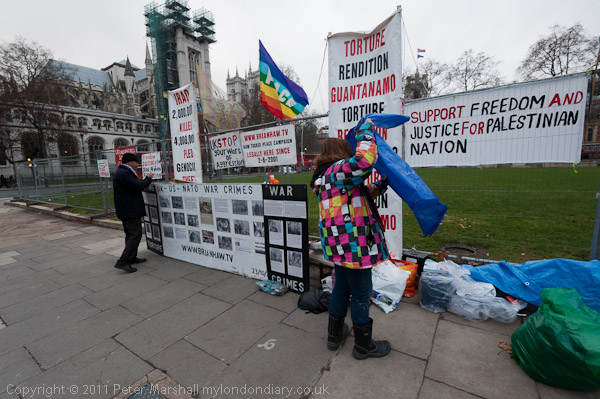
I began with a brief visit to the Peace Camp – as I often had over the years – but found that Barbara Tucker was busy tidying up in anticipation of yet another police raid in their long campaign of harassment of her and here supporters and on this occasion didn’t have time to talk. So I just took a couple of pictures and then walked up to Trafalgar Square. On May 10th 2012 the protest had been 4000 Days in Parliament Square but was evicted shortly after.


Congolese Keep Up Protests – Trafalgar Square

Peace, Congo, Iran, Egypt, Bikers, Trafalgar Square… 2012

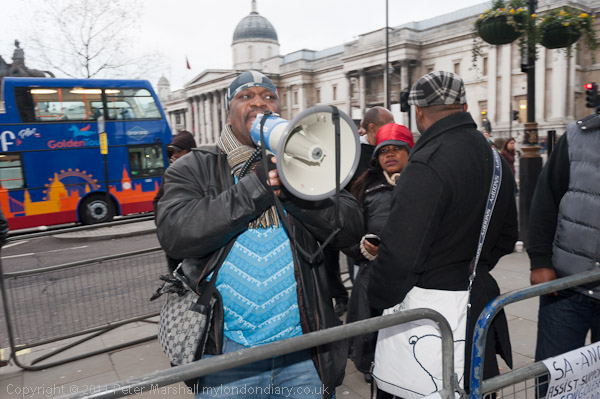
In Trafalgar Square I found a small group of Congolese protesters in a pen on the pavement outside South Africa House, calling on South Africa to put pressure on the Congo regime. They called on South Africa to free political prisoners and recognise opposition leader Étienne Tshisekedi wa Mulumba as the duly elected President of the Democratic Republic of Congo. The 2011 elections were widely regarded as having been fixed and it is unclear whether he or the incumbent Joseph Kabila whose election was confirmed by the Supreme Court of the Democratic Republic of Congo actually got more votes.

The protesters told me that more people were expected to arrive for the protest soon and I promised to return. But I got a little held up elsewhere and by the time I returned everyone had left.


Peace For Iran – No To War – Foreign & Commonwealth Office, Whitehall

Peace, Congo, Iran, Egypt, Bikers, Trafalgar Square… 2012

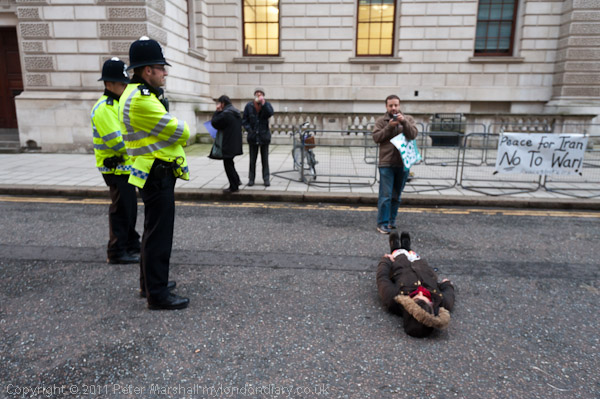
I walked back along Whitehall to the Foreign & Commonwealth Office in King Charles St where a small group were protesting against going to war with Iran, calling for peace.

I waited with the protesters who told me they expected more to arrive, but had to leave after around 20 minutes. I think few were coming as a large protest was to happen a few days later (you can see my report and pictures on this at No War Against Iran & Syria)


Egyptians Protest Against SCAF – Egyptian Embassy

Peace, Congo, Iran, Egypt, Bikers, Trafalgar Square… 2012

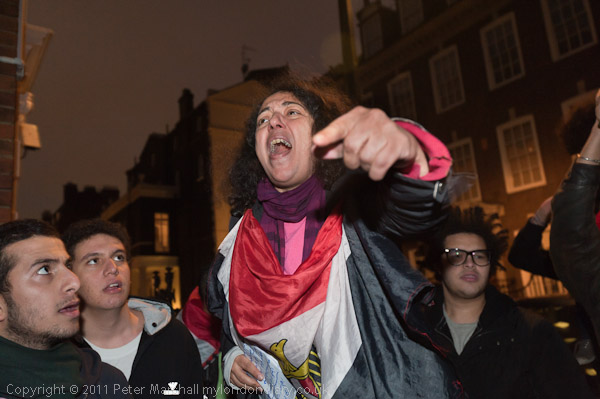
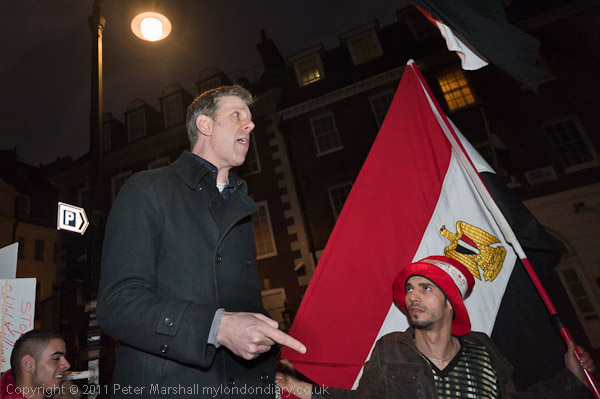
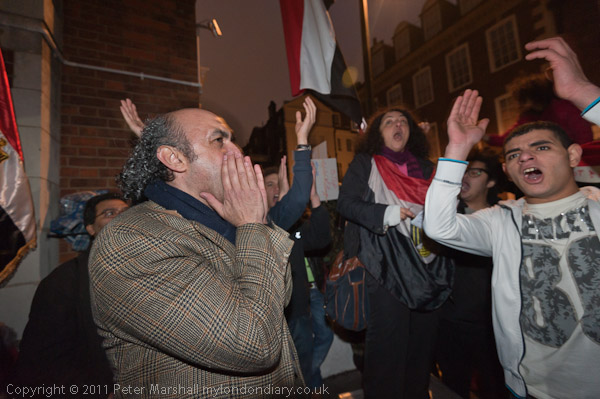
I had to leave to go to the main event I had come into London to report, the protest by Egyptians on the first anniversary of the Egyptian revolution. Egypt was then suffering under the Supreme Council of the Armed Forces (SCAF) and they called for the revolution to continue and an end to military rule.

This was an energetic and protest by over a hundred Egyptians in solidarity with the estimated 300,000 who had marched to Tahrir Square earlier in the day.

A few from the British left had come to give their support, including Chris Nuneham of Stop the War who was one of those who spoke.

The speakers urged solidarity with the Egyptian people and also with the other revolutions of the Arab Spring, and called for an end to the Western attempts to enforce an agenda on the Arab nations.

They voiced their opposition to the increasingly likely military action against Iran, and called on those present to join the No War Against Iran & Syria protest at the US Embassy on the following Saturday.

Many more pictures from the Egyptian Embassy protest on My London Diary.


Westminster Bikers First Olympic Jubilee Demo Ride – Trafalgar Square

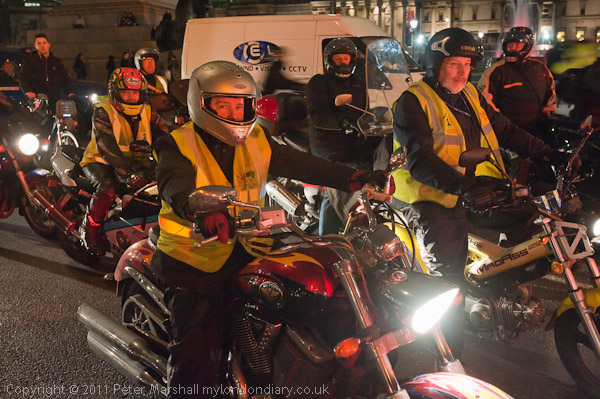
I returned to Trafalgar Square for a protest by motorbike riders, incensed by the so-called experimental parking charges for powered two wheelers.

‘No To the Bike Parking Tax’ see the parking charges introduced by Westminster Council as a simple money-making racket and have been making regular Wednesday protests against it as well as lobbying and making a legal challenge.

The daily fee for parking in a solo motorcycle bay is now only £1, and bikers can move from bay to bay.

More pictures


Around Trafalgar Square

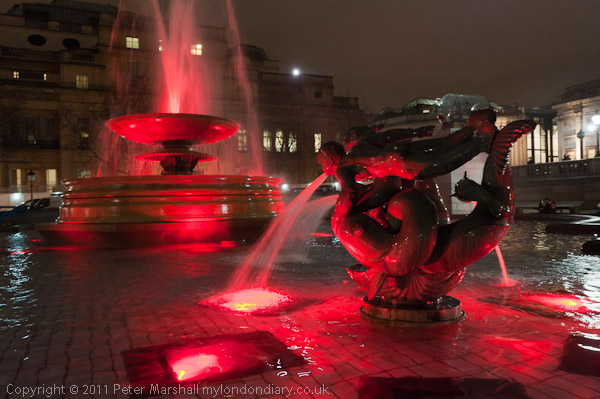
After the bikers rode away I took a few pictures in Trafalgar Square under its dramatic red lighting then walked away. There had been a traffic accident on Northumberland Avenue which seemed to have involved two bikers and a cyclist and the police were now in attendance. I took a single frame as I approached but I didn’t investigate this further, walking down Whitehall.

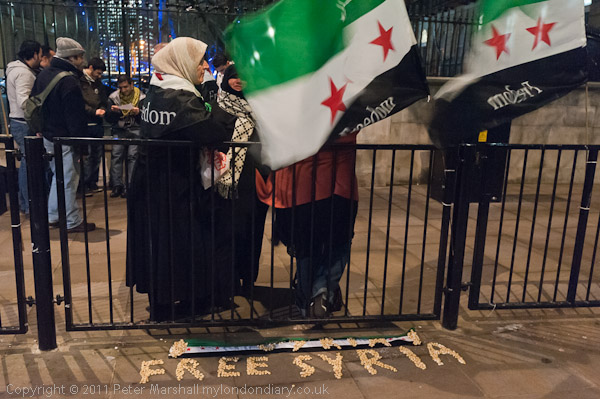
Opposite Downing St a small protest was taking place calling for Freedom for Syria from the Assad regime, but nothing much was happening there and after making a couple of pictures I moved on, now in a hurry to get home and have something to eat.

You can read and see more pictures of these events on the January 2012 page of My London Diary


FlickrFacebookMy London DiaryHull PhotosLea ValleyParis
London’s Industrial HeritageLondon Photos

All photographs on this page are copyright © Peter Marshall.
Contact me to buy prints or licence to reproduce.


Atos Protest & Camden Town 2011

Atos Protest & Camden Town: – Monday 24 January 2011

Atos Protest & Camden Town

Disability benefits are now under attack by our Labour government, who have insisted they will implement the Tory plans to cut the amount paid in incapacity benefits by £3 billion by 2028. And the House of Lords economic affairs committee a few days ago published a report calling for a fundamental review of the benefits system to tackle the rising social and fiscal costs of disability benefits.

Atos Protest & Camden Town
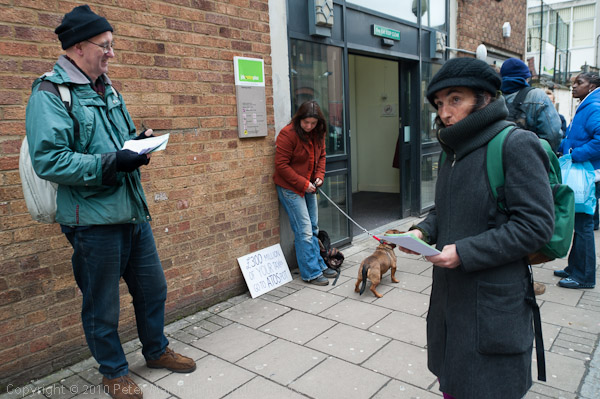
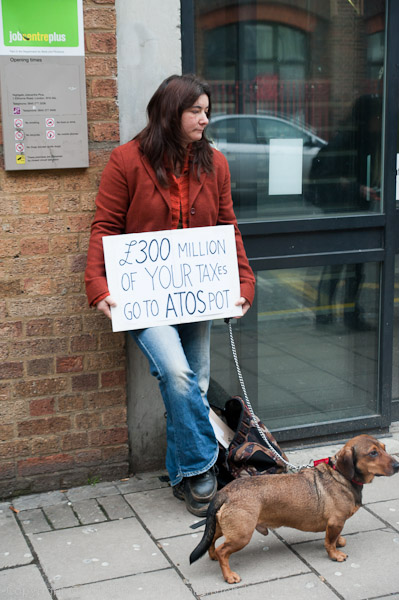
Picket at the Archway Job Centre Plus Atos test centre

Also last week the High Court ruled that the previous government’s consultation on changing incapacity benefits was unlawful as “it presented the changes as a way of supporting disabled people into work but failed to make clear that 424,000 vulnerable claimants would see their benefits cut by £416 a month.”

Atos Protest & Camden Town

When the Tory coalition government came into power in 2010 it picked on the disabled who it thought would be an easy target for the cuts it was making to support the bankers. Protests such as this on Monday January 24th 2001 showed how wrong they were, with determined opposition to the unfairness of their cost-cutting reforms from disabled groups including Disabled People Against Cuts (DPAC) and the Black Triangle Campaign.

Atos Protest & Camden Town
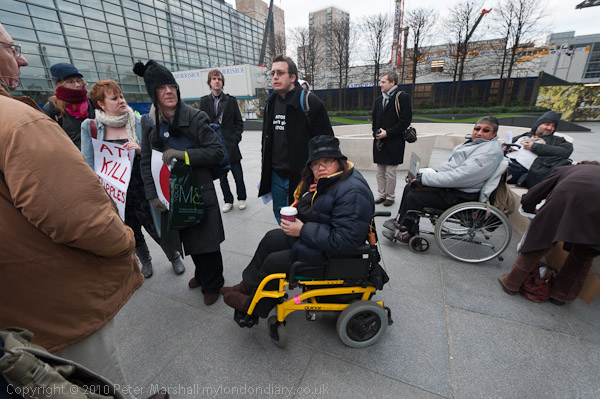
Protesters meet up in Triton Square

One part of the campaign by successive governments has been to give huge publicity and priority to benefit fraud, which according to the national Audit Office only amounts to 0.6% of the DWP budget and is a “drop in the ocean compared to the losses by tax evasion by the super-rich and the amounts lost by them and major corporations exploiting tax loopholes.

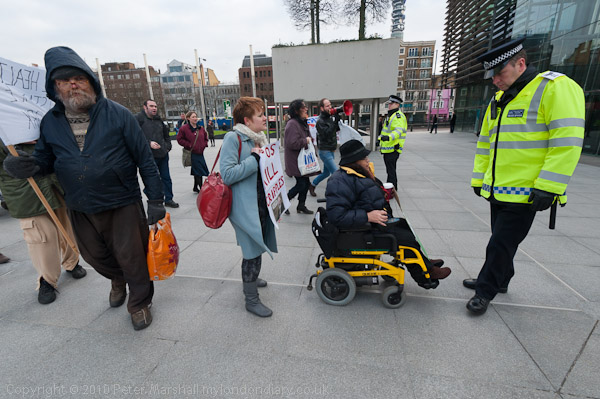
Police try rather ineffectually to stop protesters heading for the Atos offices

In 2011 a major source of unfairness in the system was the attempts to cut costs by the use of computer-based ability to work assessments carried out for the DWP by European IT company Atos. The interviews were administered by ‘healthcare professionals’, often poorly trained and lacking the qualifications and experience to assess many types of disability, particularly mental illness. Almost 70% of those assessed were moved onto the lower benefit rates of the Job Seekers Allowance with some being refused any benefits at all.

An independent review for the DWP made fundamental criticisms of the assessments, and around 40% of those who appealed the decisions eventually had their benefits restored to previous levels – but only after months of hardship, and often just in time for their next review when their benefits would again be axed. Part of the problem was the pressure applied on the assessors to meet targets in cutting benefits by the company so they could justify their costs to the DWP.

And there were plenty of true horror stories. People assessed fit for work who died within days of the assessments, those who committed suicide and some who starved to death. Benefit cuts really do kill.

Atos went on to gain other contracts from the DWP until September 2024 when the contract for Personal Independence Payment (PIP) and work capability assessment (WCA) were given to Serco. The DWP had acknowledged there were flaw in the Atos assessments but few believe that Serco will be any fairer.

Monday January 24th was a a National Day of Protest Against Benefit Cuts, with actions around the country, including protests in Leeds, Birmingham, Burnley, Hastings, Crawley, Chesterfield, Livingston, near Edinburgh (Atos’s Scotland HQ) and Glasgow. I began by photographing a local protest at Archway in North London before going on to a protest outside the London HQ of Atos Origin in Triton Square close to the Euston Road.

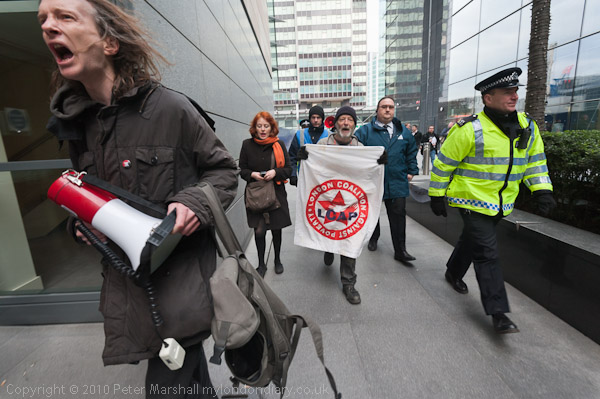
On My London Diary back in 2011 I wrote much more about the Atos tests and also about the details of the two protests. The protest in Triton Square was heavily policed but the organisers and those taking part, including Disabled People Against Cuts, WinVisible (Women with Visible and Invisible Disabilities) and London Coalition Against Poverty were intent on this being a peaceful protest.

Police have problems in dealing with disabled protesters. Many want to treat them carefully and their officers certainly realise that images of them being roughly handled would be terrible PR. But they were annoyed that the protesters decided to protest close to the actual Atos offices rather than in a pen they had set up a short distance away. And when one elderly man walked through the spread out police line he was roughly pushed to the ground and dragged away, though later he was allowed to rejoin the other hundred or so protesters.

The police then brought more barriers and erected them around the protesters, telling them they could only exit the fenced area when they were dispersing at the end of the protest. There seemed to be no real justification for this and they seemed simply to be a simply a matter of pique that the protesters had not followed their instructions.

More at Atos Tests Unfair to Disabled.


Camden Market – Camden High St/Chalk Farm Rd

I had plenty of time to get from Archway to Triton Square and got off the bus in Camden Town for a walk and to make use of one of London’s rapidly disappearing public toilets in the middle of the busy road junction there (but I think closed a few years ago.)

I’d photographed around Camden High Street and Chalk Farm Road quite often in the 1990s, often on my way home from taking pictures elsewhere in North London, and walking from Camden Town station to Chalk Farm. Then the lemon sorbets from Marine Ices were the best in London if not the world. But that’s gone too now, and in January 2011 it wasn’t the weather for it.

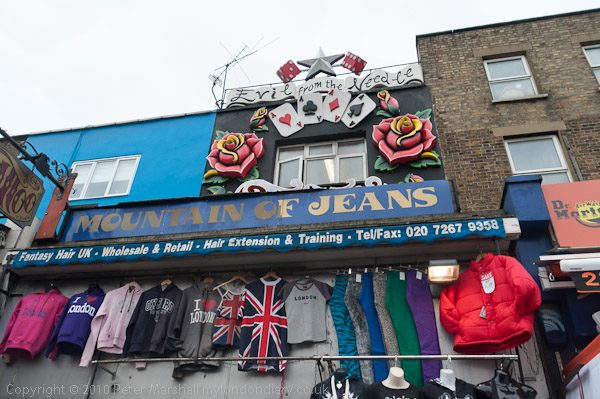
Back in the 1990s the streets would have been pretty empty except at weekends, but by 2011 there were plenty of tourists wandering around even on a cold Monday in January, though business was fairly slack. But mainly I pointed my camera up to the decorations above the shops

More pictures: Camden Market.


FlickrFacebookMy London DiaryHull PhotosLea ValleyParis
London’s Industrial HeritageLondon Photos

All photographs on this page are copyright © Peter Marshall.
Contact me to buy prints or licence to reproduce.


More Around the Meridian – 1995 Colour – Part 3

More around the Meridian – It’s seldom possible to actually walk for more than a few yards actually on the Greenwich Meridian in London and while planning my Meridian Walk I often wandered around considerably, having to make detours and also looking for the more interesting routes. So not all these images are exactly on the Meridian, but most were taken within a short distance from it.

Greenway, Abbey Lane, Abbey Rd, Stratford, Newham, 1995, 95p4-1151

When I began this project the Meridian was not marked on the Ordnance Survey or Street maps, and one of may first tasks was to get a ruler and pencil it on to them. In 1999 it was added to the OS maps of the area, but does not seem to be on the latest versions. In 1995 there were no smart phones with online maps and GPS which would have made things so much easier.

Greenway, Abbey Lane, Abbey Rd, Stratford, Newham, 1995, 95p4-1152

The Greenway was the recently rebranded path above the Northern Outfall Sewer which rans across East London from Hackney Wick to the sewage treatment plant at Beckton, going under the road here close the the bridge over Abbey Creek on the Channelsea River, where Abbey Lane becomes Abbey Road. You can see the bridge at the left of the picture.

Greenway, Channelsea River,  Stratford, Newham, 1995, 95p4-1153
Greenway, Channelsea River, Stratford, Newham, 1995, 95p4-1153

The Greenway is a great traffic-free cycle route for pedestrians and cyclists, running straight and level and this picture gives some evidence of that.

Channelsea River, Long Wall, Stratford, Newham, 1995, 95p4-1111

I’m not sure what this pipe was for, perhaps for taking gas across the river. Not far away on the other side of this tidal creek was one of the largest gas works in London – and you can still see its listed gasholders, though the view is likely to change soon with the site being redeveloped.

But behind me when I made this picture was the Abbey Mills sewage pumping station and on the edge of the creek below were the storm outfalls where sewage would be released after heavy rains. With the changing tides it would flow downstream a little and then could be taken miles upriver along the Prescott channel and the River Lea.

Gasholders, Leven Rd, Poplar, Tower Hamlets, 1995, 95p4-1332
Flats, East India Dock Rd, South Bromley, Tower Hamlets, 1995, 95p4-1321

I think the Meridian went through the centre of the taller gas holder at Poplar Gas works.

Flats, East India Dock Rd, South Bromley, Tower Hamlets, 1995, 95p4-1321

Another view with the gasholders in the background.

Clove Crescent, East India, DLR, South Bromley, Tower Hamlets, 1995, 95p4-1273

My pencilled line for the Meridian shows it going through both the water in the dock and the brick building at left which was the former Blackwall Power Station in both of these pictures.

Clove Crescent, East India DLR, South Bromley, Tower Hamlets, 1995, 95p4-1263

South of the East India Docks the line crosses the River Thames above and between the two bores of the Blackwall Tunnel, closer to the original western tunnel now used by northbound traffic. I couldn’t take photographs in the tunnel – though it was possible for those on foot to take a bus across, but these would have been rather boring in any case.

Blackwall Tunnel Entrance, Greenwich, 1995, 95p4-1672

This picture shows the southern entrance to the tunnel with its 1897 Grade II listed gatehouse by the London County Council’s Superintending Architect Thomas Blashill. In front of it a less ornate red and white striped arch with heigh and weight restriction signs and hangers to hit any overtall vehicles and hopefully prevent damage to the gatehouse.

Dorringtons, Blackwall Tunnel Southern Approach, Greenwich, 1995, 95p4-1551

One picture not I think actually on the Meridian but not far from it, taken from the long footbridge over the Blackwall Tunnel Southern Approach.

Riverside Path, Greenwich, 1995, 95p4-1762

My path continued south along the riverside path, with the Meridian going into the River Thames on the extreme left of this picture.

Riverside Path, Greenwich, 1995, 95p4-1742

I kept to the land continuing along a path I’ve walked many times and making a few more pictures.

Riverside Path, Greenwich, 1995, 95p4-1743

Like much of London’s riverside almost all of the industry has now gone, but some relics remain, though most of this part of my route is now lined by rather boring flats.

I rejoined the Meridian where it made landfall in Greenwich – where I made some of the pictures at the end of my earlier post.

More colour work from 1995 including some more panoramas in a later post.


FlickrFacebookMy London DiaryHull PhotosLea ValleyParis
London’s Industrial HeritageLondon Photos

All photographs on this page are copyright © Peter Marshall.
Contact me to buy prints or licence to reproduce.


London Walk January 2006

London Walk January 2006: I now have no idea why I spent around two and a half hours wandering around London on the afternoon of 20th January 2006, but the pictures tell the story of my route. These images are a selection from a rather larger number I actually made. [The pictures are larger than they appear in this post and you may download them, but like all pictures on this blog are copyright; they must be attributed if posted on social media and a licence is required for any commercial use.]

London Walk January 2006
© 2006, Peter Marshall

I suspect I was going to some evening event and simply took advantage of some fine weather to go up earlier and take some pictures. The first one shows some of the sculptural detail above the outpatients entrance of the former Royal Waterloo Hospital for Children and Women on Waterloo Road the roundabout close to the station, where I will have arrived by train.

London Walk January 2006
© 2006, Peter Marshall

I then walked on to Waterloo Bridge, pausing to take a picture of the National Theatre, with the roof of the film museum in the foreground.

London Walk January 2006
© 2006, Peter Marshall

There was an exhibition ‘after the wave’ on square pillars in front of the National Theatre which rather seemed to echo the shape of the building.

London Walk January 2006
© 2006, Peter Marshall

On Waterloo Bridge I took several pictures looking downstream across the River Thames, this one concentrating on the north bank and St Paul’s Cathedral.

© 2006, Peter Marshall

A wider view shows boats moored in the river and the skyline of London, now rather more crowded.

© 2006, Peter Marshall

Another with St Paul’s at the left .

© 2006, Peter Marshall

On Strand I photographed this lion and two Chinese men relaxing above Twinings, providers of tea to the Queen.

© 2006, Peter Marshall

And these fine fish on Lloyds Bank Law Court Branch at 222 Strand, then still open as a bank – it closed in 2017. It had been called the most beautiful bank in the country. The fish are presumably because this Grade II listed building was built in 1882 by Goymour Cuthbert and W Wimble for the Palsgave Restaurant for the Royal Courts of Justice opposite and was only taken over by Lloyds in 1894.

© 2006, Peter Marshall

Some fine ironwork and a beehive above the doorway to the bank.

© 2006, Peter Marshall

Above the doorway at 193 Fleet Street is this figure of statue of Kaled, the page of Byron’s Count Lara by Giuseppe Grandi, dating from 1872. More about it on Ornamental Passions.

© 2006, Peter Marshall

The building was built for pawnbrokers George Attenborough and Son in 1883 and has some fine sculptural detail including these winged lions, on either side of the wrought iron support from which originally the pawnbrokers three balls were hung. The Latin motto underneath is ‘Sub Hoc floresco‘, Under This I flourish.

© 2006, Peter Marshall

On each side of the clock of St Dunstan’s in the West on Fleet Street are the two mythical giants, Gog and Magog (Corineus and Gogmagog) described in the biblical book of Revelation as the allies of Satan against God when we come to the end of days, but also the guardians of London – and the City is surely on Satan’s side as the money laundering capital of the world. They strike the chimes for the clock here, said to be the oldest public clock in London.

My walk continued – and I’ll post some more from it at some later date. You can already see some of the pictures on My London Diary.


FlickrFacebookMy London DiaryHull PhotosLea ValleyParis
London’s Industrial HeritageLondon Photos

All photographs on this page are copyright © Peter Marshall.
Contact me to buy prints or licence to reproduce.


1995 Colour – Part 2 – Greenwich Meridian

1995 Colour – Greenwich Meridian: The second of a series of posts on my colour work, mainly in London, from 1995, 35 years ago and when I’d been working extensively with colour negative film for ten years, though still continuing to work with black and white.

Obelisk, Trig Point, Pole Hill, Chingford, Waltham Forest, 1995, 95p03-841

In 1992 I began making colour panoramas using a Japanese Widelux F8 swing lens panoramic camera – and later I used a Russian Horizon which gave similar results. Both worked with normal 35mm film but produced negatives that were a little under 60mm wide rather than the 36mm of normal cameras. Both use clockwork to swing the taking lens around a third of a circle exposing the film through a narrow slit behind the lens. The film was held in a curved path – again around a third of a circle – with the lens at the centre of the circle so that the lens to film distance remained constant.

Peacham Hall, King's Head Hill, Woodberry Way, Chingford, Waltham Forest, 1995, 95p03-411
Peacham Hall, King’s Head Hill, Woodberry Way, Chingford, Waltham Forest, 1995, 95p03-411

This arrangement avoided the change in distance from the lens to film that gives some stretching of the subject towards the edges of the frame – and begins to become very noticeable in ultra-wide lenses, particularly wider than around 18mm focal length on a 35mm camera.

95p03-552-Edit
Level Crossing, Highams Park, Waltham Forest, 95p03-552

Using the curved film plane avoids this distortion and enables a much wider field of view, while using a fairly moderate focal length – the Widelux has a 26mm f2.8 lens and gives negatives 24x56mm with a horizontal angle of view of 123 degrees.

Bridges, North Circular, Hale End Rd, Hale End, Waltham Forest, 1995, 95p03-463

But there is a downside. Creating the image in this way gives a curvature to objects which is unlike our normal vision which is particularly noticeable on any straight lines, though lines parallel to the axis the lens rotates around remain straight – so if you hold the camera level, verticals will remain straight. But other lines become curved with the effect increasing away from the image centre, giving what is often called a “cigar effect“.

Raglan Rd, Lea Bridge Rd, Whipps Cross, Waltham Forest, 1995, 95p4-373

This is a constraint which makes composition far more difficult using a swing lens camera, and was not helped by a rather poor viewfinder on the Widelux. Usually for landscape work I tried to visualise the effect of the curvature and chose a suitable camera position, levelled the camera on a heavy Manfrotto tripod using the spirit level on the camera top plate, lining the camera up using two arrows on the top plate to show the extent of the view (more accurately than the viewfinder) and then pressing the cable release to make the picture.

Stratford Bus Station, Great Eastern Rd, Stratford,, 1995, 95p4-922
Stratford Bus Station, Great Eastern Rd, Stratford, Newham, 1995, 95p4-922

For photographing events and some creative effects this is a camera you can use handheld, but you have to remember that even when using its fastest speed of 1/250 second the camera actually takes quite a lot longer to scan around the curved film.

Crowley's Wharf, River Thames, Greenwich, 1995, 95p4-672
Crowley’s Wharf, River Thames, Greenwich, 1995, 95p4-672

These pictures are from a project I began in 1995 with the approaching Millennium in mind. It seemed to me to make sense to carry out a project based on the Greenwich Meridian.

Greenwich Boating Pond, Park Vista, Greenwich, 1995, 95p4-1431

So I set about walking the Meridian, photographing it at various points in London and used some of these pictures in an attempt to get public funding for a Meridian Walk with some markers in pavements and a web site and publication. Panoramic images seemed a very appropriate format for illustrating the line.

Greenwich Meridian, Royal Observatory, Greenwich, 1995, 95p4-1242

Unfortunately my grant application as usual was unsuccessful, but I did go on to take some more photographs. In 2009 others produced a Greenwich Meridian Long Distance Path covering all of the Meridian in England from Peacehaven to Sand La Mere which of course goes through London and we also have The Line Sculpture Trail. Quite a few more Meridian markers were also added in London since I made this walk.

Many more panoramas from my Meridian project and other colour images from 1995 in the album 1995 London Colour.


FlickrFacebookMy London DiaryHull PhotosLea ValleyParis
London’s Industrial HeritageLondon Photos

All photographs on this page are copyright © Peter Marshall.
Contact me to buy prints or licence to reproduce.


Hackney Wick & Manor Gardens – 2007

Hackney Wick & Manor Gardens: On Tuesday January 16 2007 I took a walk in Hackney Wick on my way to what was to become one of many casualties to the London Olympics, the Manor Gardens allotments, for an open day when the press and public were invited to see the vibrant site that was under threat.

Hackney Wick & Manor Gardens

Here with a few corrections and some of the pictures is what I wrote about the day. Many more pictures are still on My London Diary.


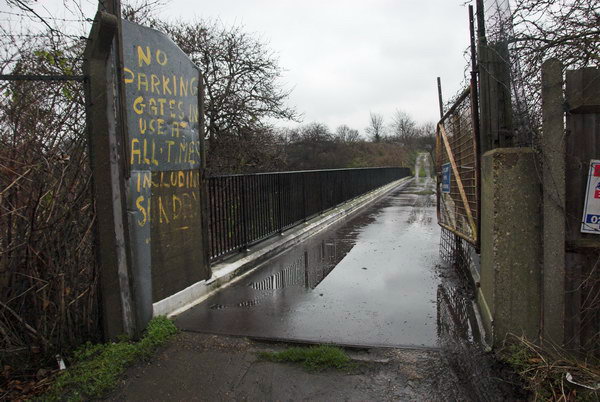
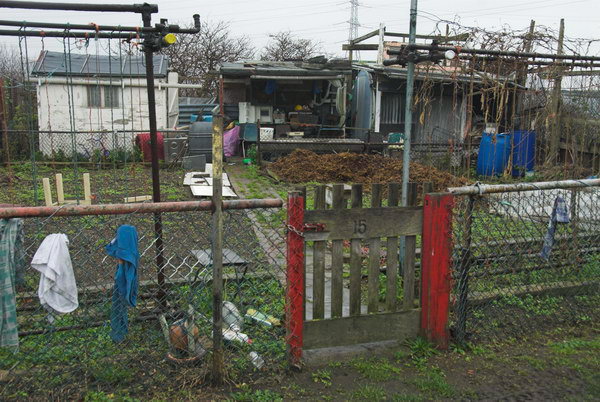
Hackney Wick remains one of the more interesting areas of London, and I took a few pictures despite the light rain on my rather meandering way to the Manor Gardens Allotments off Waterden Road.

Hackney Wick & Manor Gardens
A bridge over the River Lea led to Manor Garden Allotments

The Manor Gardens Allotments were another of the charitable provisions that came out of the link with Eton College and the Eton College Mission set up in Hackney Wick.

Hackney Wick & Manor Gardens

Arthur Villiers was one of four Old Etonians (the others were Gerald Wellesley, founder of the Eton Manor Old Boys Club for over 18s, Alfred Wagg and Sir Edward Cadogan) who in 1924 set up a charitable trust to keep the clubs running.

Hackney Wick & Manor Gardens

Villiers, who was a director of Barings Bank, had previously in around 1900 provided the Manor Gardens Allotments on an adjoining site as a means of providing both healthy exercise as well as suitable nutrition for the young men of the area. The land was provided for the community to use in perpetuity.

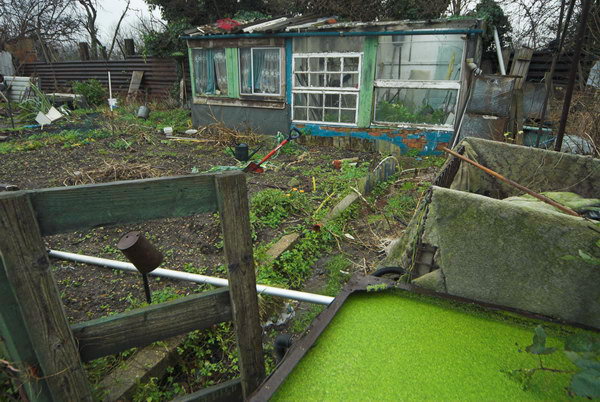
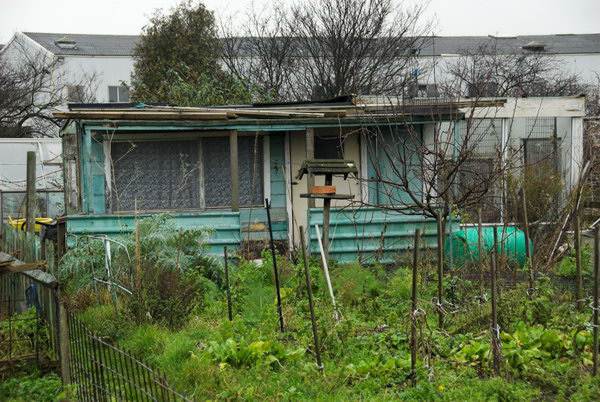
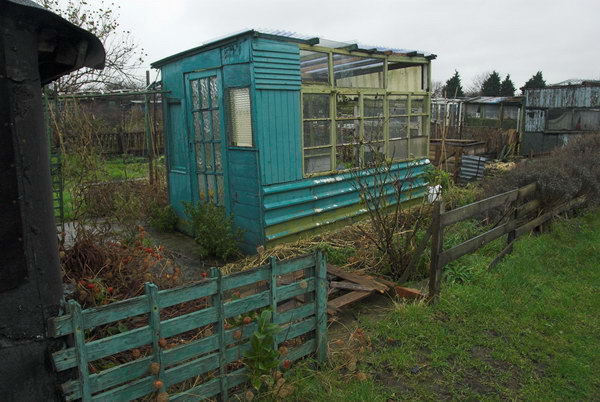
Since then it has continued in use, with a short break when the area was used for a wartime gun battery. At least a couple of the allotment ‘sheds’ are heavy concrete structures left over from this use.

Over the years it has been a thriving community of cultivators, recovering in recent years from some slight loss of interest, with the current renewal of interest in green and healthy living and eating.

Then came the London Bid for the 2012 Olympics, which put the allotments within the site. It could have been seen as a golden opportunity to give the games some green credibility behind the lip-service the bid gave to biodiversity and sustainability, and certainly as a commitment to the post-2012 legacy of the games – to leave sites such as Manor Gardens and the adjoining nature reserve as a green centerpiece to the site. Unfortunately the architects and developers seem hell-bent to create a brown Olympics, creating an irredeemably distressed site that will only be economically recoverable when all the concrete has crumbled.

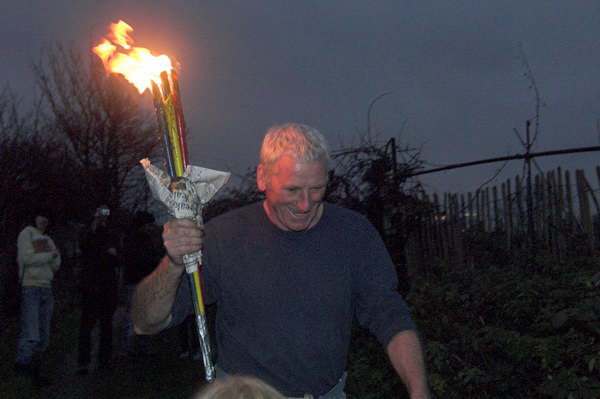
The New Year Feast was an Open Day at Manor Garden Allotments, inviting the public and press to see the site and the 80 plots for themselves. A rather low-tech ‘Olympic torch’ was carried across the bridge to the site and used to start a bonfire.

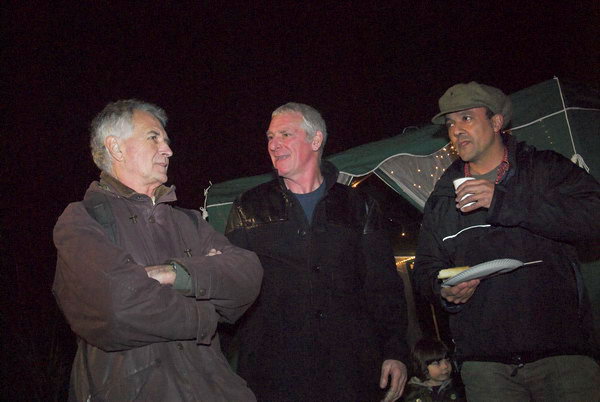
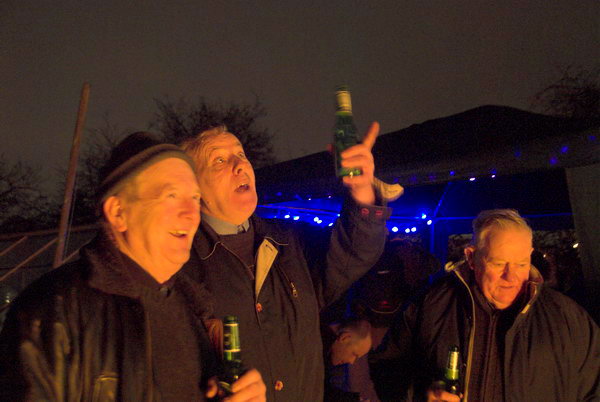
Then we had a party around it, with a couple of speeches and some tasty refreshments. There was support from some celebrities, as well as the opportunity to meet some of the plot-holders, some of whom have raised crops here since the 1940s – and those whose parents had plots in the 1920s. There are also many newer tenants, very much reflecting the multicultural nature of the surrounding area.

It would be a great shame to lose this splendid facility for four weeks of use in 2012, when it could easily be built around. It isn’t in a critical area but will simply be under concrete as a footpath, and probably also the site of a huge advertising ‘scoreboard’ for the games sponsor.

What will it say about the 2012 Olympics for a site that is currently a beacon for healthy green eating to be selling Big Macs?

The planning application was to submitted on 1st Feb 2007, with eviction expected on 2nd April 2007. it is unlikely that the replacement site offered at Marsh Lane can be ready before 2008. Hopes are not high, but it would certainly be a great green miracle if the allotments survive.


Of course the miracle did not happen, and the Olympic juggernaut took its course, destroying the allotments and much else. By June 2008 allotment holders were struggling to grow crops on a new site on common land at Leyton. The move was expensive and the contractors used to prepare the site had ruined it by sterilising and compacting soil with heavy equipment and much of the site was waterlogged, with the only healthy crops being grown in grow-bags.

The allotment holders had been promised they would be able to return to their old home after the Olympics, but this promise was not kept. Eventually in 2017 some were able to go to a much smaller new site at Pudding Mill Lane. It’s future came under threat in 2022 by plans for extensive development around its edges which will overshadow it restricting cultivation on much of the site.

Many more pictures of the allotments, some of the surrounding areas and of the New Year Feast on My London Diary.


FlickrFacebookMy London DiaryHull PhotosLea ValleyParis
London’s Industrial HeritageLondon Photos

All photographs on this page are copyright © Peter Marshall.
Contact me to buy prints or licence to reproduce.


Arbaeen Procession in London – 2012

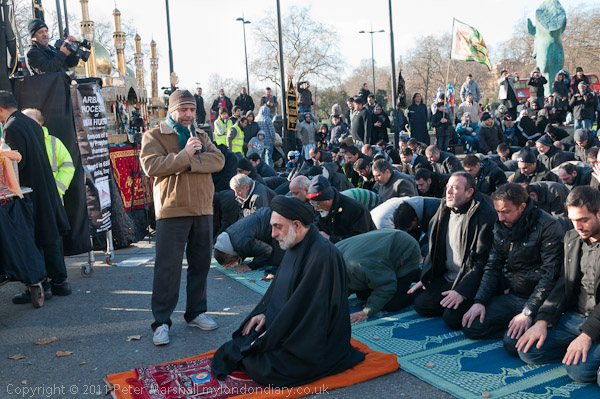
Arbaeen Procession in London: On Sunday 15 January 2012 around 5000 Shi’ite Muslims gathered at Marble Arch for London’s 31st annual Arbaeen procession.

Arbaeen Procession in London - 2012
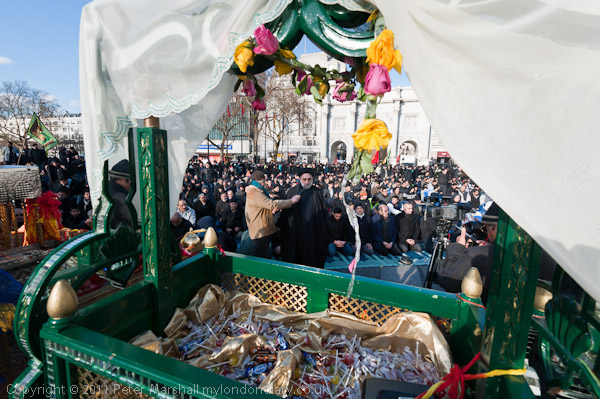
The cradle commemorating Imam Husain’s murdered baby son and people at prayer before the procession.

Organised by the Hussaini Islamic Trust UK, the process with its colourful flags, large gold and silver replica shrines and men and women beating their breasts in a symbol of mourning for Imam Husain went along Park Avenue.

Arbaeen Procession in London - 2012

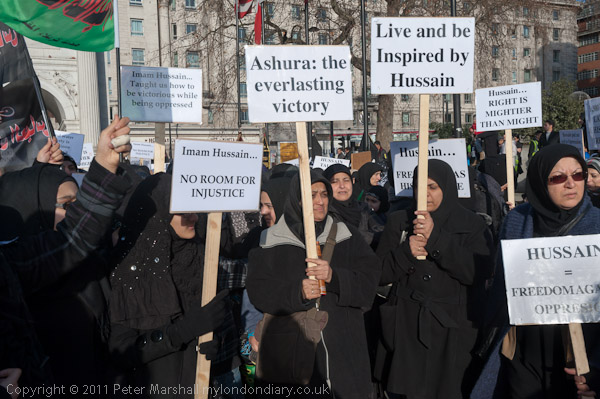
Imam Husain, the grandson of Mohammed, was killed with his family and companions at Kerbala in 680AD. Shi’ites celebrate his martydom with 40 days of mourning each year, beginning with Ashura and ending with Arbaeen.

Arbaeen Procession in London - 2012

Husain is seen by Shia Muslims as making a great stand against the oppression of a tyrant and representing the forces of good against evil. Although hugely outnumbered he and his companions chose to fight on to death rather than compromise their beliefs.

Arbaeen Procession in London - 2012

Their stand remains a symbol of freedom and dignity, and an aspiration to people and nations to strive for freedom, justice and equality. Among many who have admired Husain are Ghandi, Charles Dickens and historians Edward Gibbon and Thomas Carlyle.

Arbaeen also celebrates the return of the wives and families of the martyrs to Kerbala the following year from Damascus where the had been marched as captives.

Millions now attend the annual Arbaeen event in Kerbala although it was banned when Saddam Hussein was in power.

The London procession was first held in 1982 and is the oldest Arbaeen/Chelum Procession of Imam Husain in the west. It was the first annual Muslim procession to take place in Central London and is still one of the larger annual Muslim processions in the UK, attracting Muslims from across the UK.

I arrived at Marble Arch in time for the prayers, recitation, speeches and chanting at the start of the event and to admire the three large gold and silver replicas of the shrines of Karbala; known as Shabbih, over 10 feet high and the largest in Europe,the decorated and blood-stained white horse Zuljana, the cradle remembering his 6 month old child Hazrat Ali Asghar and a ceremonial coffin before the procession began.

Both men and women on the procession beat their breasts – the men with great energy and the women much more decorously as they moved slowly down Park Lane.

The event was continuing when I left hours later.

You can read more about the procession and follow it in my pictures on My London Diary at Arbaeen Procession in London.


FlickrFacebookMy London DiaryHull PhotosLea ValleyParis
London’s Industrial HeritageLondon Photos

All photographs on this page are copyright © Peter Marshall.
Contact me to buy prints or licence to reproduce.