River Wandle, Armoury Way, Wandsworth, 1990, 90-3b-34
The area between Armoury Way and the River Thames was and still is very much an industrial one. I think most of the pictures in this post, probably including this one were taken from The Causeway, a street that leads from the junction between Armoury Way and Dormay Street, running beside the west bank of the River Wandle. A dead end for vehicles you can walk along it to reach a footpath which leads to the path beside the Thames towards Putney – or if you turn east, to Smugglers Way. Here across the Wandle you can see a cement plant and cement lorries.
Bell Lane Creek, The Causeway, Wandsworth, 1990, 90-3c-42
Bell Lane Creek is the western of two mouths of the River Wandle and I think part of its original course though it was described as ‘a marshy area’ and might have had more channels. It was improved by the addition of a half lock from the Thames in the 1970s and apparently remains navigable from the River Thames an hour or two each side of high tide, though only as far as where I was standing to take this picture, next to a weir. The sluice gates here – which I photographed on another visit – have a bell on them inscribed ‘I AM RUNG BY THE TIDES’. The area to the right of the creek is Causeway Island.
To the left had once been the Wandsworth Royal Laundry and the creek had also extended further west to several wharves.
River Wandle, Railway Bridge, The Causeway, Wandsworth, 1990, 90-3b-35
Looking south up the Wandle under the railway bridge which carries the line from Reading and Windsor to Waterloo. Above it as left is the giant Wandsworth gasholder.
Railway Bridge, The Causeway, Wandsworth, 1990, 90-3c-51
The Staines and Windsor line is on a viaduct here, with three bridges. As well as one over Bell Lane Creek and this one, a few yards to the east is one built to carry the lines over the Wandsworth Cut – later called McMurray’s Canal – there is a very clear map from 1891 here.
This quarter-mile long canal was built in 1802 to link the Surrey Iron Railway to the Thames and had an entrance lock from the river a few yards east of the Wandle where the Wandsworth Solid Waste Transfer Station now is. The horsedrawn Surrey Iron Railway, the first public railway ceased operation in 1846 and the canal was sold to the owners of a nearby flour mill.
The mill was later owned by William McMurray who made paper from esparto grass brought from farms owned by his family in Spain and North Africa – and from the docks by barge to his Royal Paper Mills in Wandsworth. After a fire bankrupted the company, the canal was sold to the Wandsworth and District Gas Company in 1910. In the 1930s they filled it in and built over its route.
River Wandle, The Causeway, Wandsworth, 1990, 90-3b-23
A rather confusing array of bridges and pipe bridges across the Wandle just to the north of the railway bridge. At right past the parked concrete lorries is the Wandsworth Solid Waste Transfer Station.
Footpath, River Wandle, The Causeway, Wandsworth, 1990, 90-3c-63
A narrow footpath leads to the section of The Causeway at the west end of Smugglers Way. aAt right is the Waste Transfer Station and just getting into the picture at left a little of a large electrical substation.
River Wandle, The Causeway, Wandsworth, 1990, 90-3c-64
And from exactly the same position looking across the Wandle. I had probably intended to produce a panoramic image from these two exposures.
River Wandle, The Causeway, Wandsworth, 1990, 90-3b-26
And I too a third picture moving closer to the river at the same location.
I found this a fascinating area and continued to take pictures for some time – and will share a few more in a later post.
World Health, Syria & a Pillow Fight: Saturday 7th April 2012 was World Health Day and health campaigners protester against the increasing privatisation of the NHS. It was also International Pillow Fight Day which was celebrated by hundreds in Trafalgar Square. Between these I photographed Free Syria supporters calling for the UK government to do more over the atrocities by the Assad regime against their relatives still in Syria.
World Health Day: Lansley’s Bill
Dept of Health, Whitehall
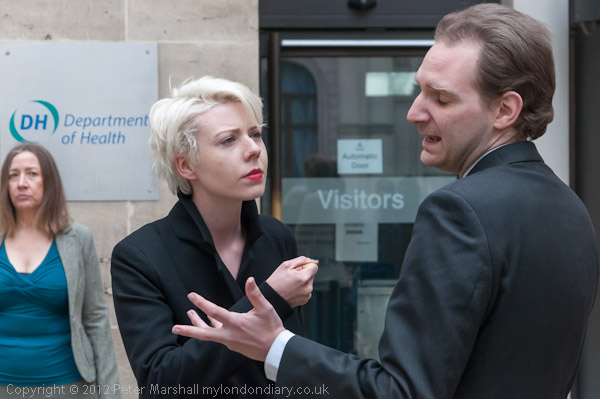
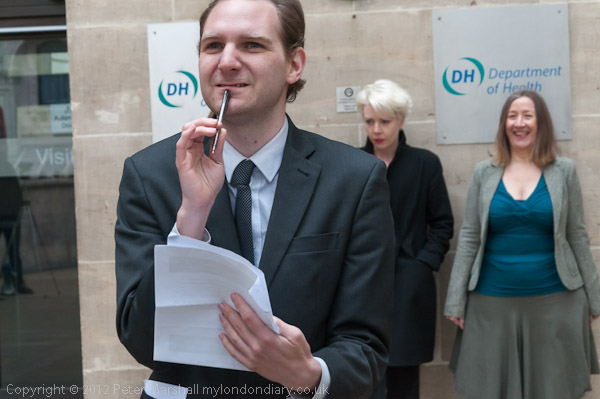
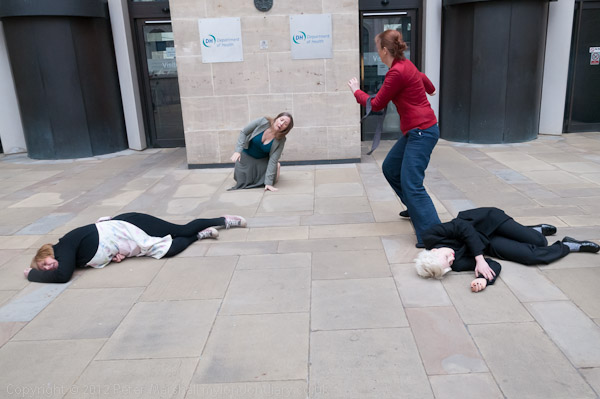
Lansley’s Bill – Lansley lies to the media in the play performed outside the Dept of Health
The Health and Social Care Act 2012 was now law, having gained royal assent on March 27th 2012. Secretary of State for Health, Andrew Lansley had pushed through the most extensive reorganisation of the structure of the NHS despite the united opposition of the Royal College of Nursing, the Royal College of Midwives, the British Medical Association and the Royal College of General Practitioners and many campaigning groups.
‘Lansley’ looks at the Tory plan to hand the NHS to private companies and decides to present it as giving more choice to the public
The Act led to a greater marketisation of the NHS with an greatly increased role for private companies who mainly ‘cherry picked’ the simpler and so more readily profitable areas of service, and its structural reforms were damaging, with new complex systems of governance and accountability, while removing the system leadership needed to cope with major changes. And it didn’t give any more choice to the public – unless they went private.
Lansley’s Act failed, largely because it tried to introduce a system based on competition into a an NHS where care and cooperation was the bedrock, but it did succeed in diverting much needed funds to the private sector. By 2019 the policy of competition was effectively abandoned. Labour in 2024 commissioned a report led by Lord Darzi which called it a “broken system” and conclude it “was a calamity without international precedent – it proved disastrous. The result of the disruption was a permanent loss of capability from the NHS“.
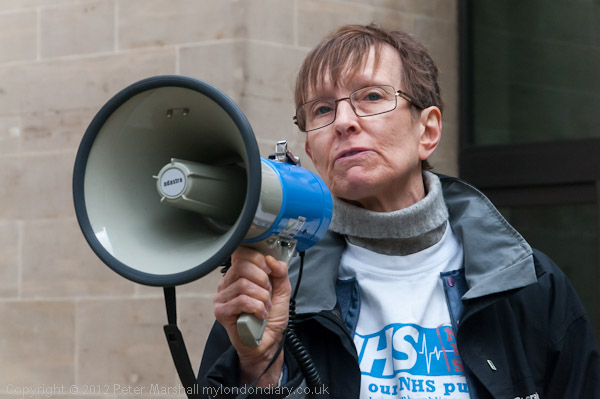
Nurse Gail Lee began the protest by explaining that the Act was designed to lead eventually to the NHS being converted to an insurance-based healthcare system that will provide high-cost medical services for those who can afford it while retaining only a basic provision for others. So far this has not happened but there are still politicians – Labour as well as Conservatives – who are urging this.
After her short talk there was a performance of the play ‘Lansley’s Bill’ by Mike Hart, based on the facts of the planning by McKinzey Consulting and the Tories which led to the Lansley Bill, a bundle of Tory lies which opens up healthcare to the market under the misleading mantras of ‘choice’ and ‘efficiency’.
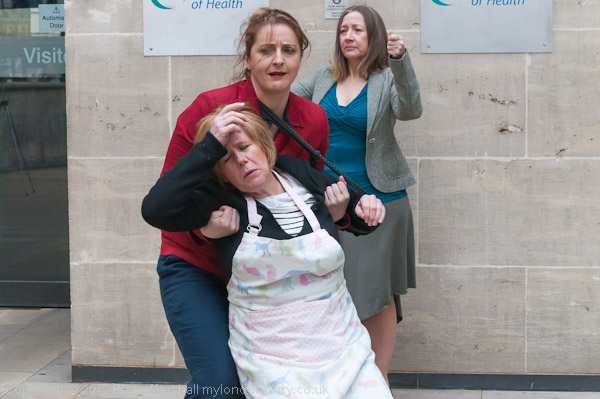
Without a public health service to treat them, people are dieing – we are told we must fight and throw out Lansley
Based around the problems of a cleaner who needs the help of the new version of the NHS but is told to wait, and wait – until she dies, it makes the point that “you have a choice. You can fight for the NHS, become rich, or you can make sure you are never ill. The least worst case is to get out there and fight.”
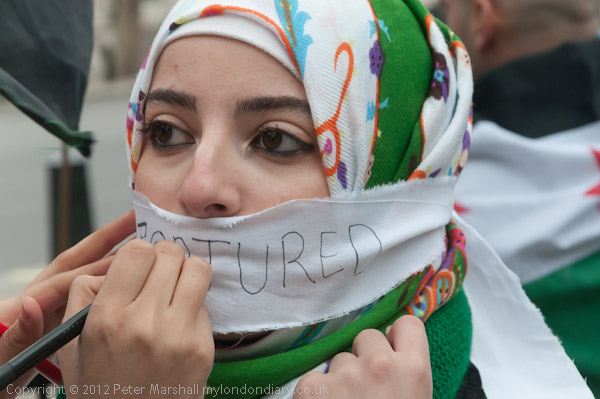
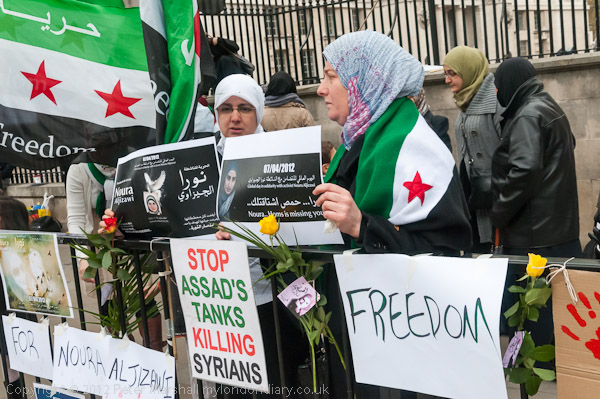
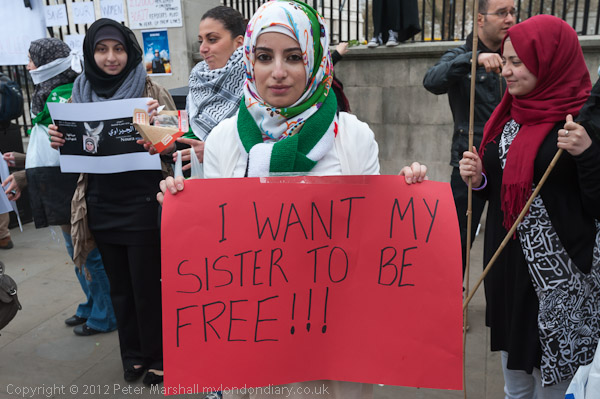
Free Syria Supporters protested aaginst the continuing killing, torture, imprisonment and abductions of their relatives by the Assad regime, calling on the UK government to take greater action
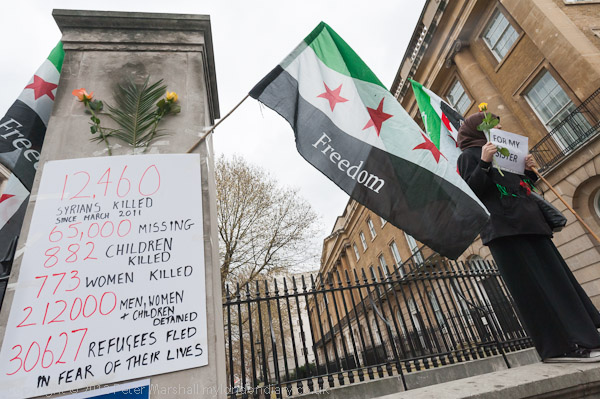
Some held up placards ‘For My Sister’, ‘For My Mum’ and for some at least of those wearing gags with the words ‘Freedom’ or ‘Tortured’ it was there own family who was tortured or missing or held in jail. Their protest over human rights violation was personal.
Some held family snapshots, blown up to A4, and others were taped to the railings along with lists of names, and roses dedicated to the missing and dead.
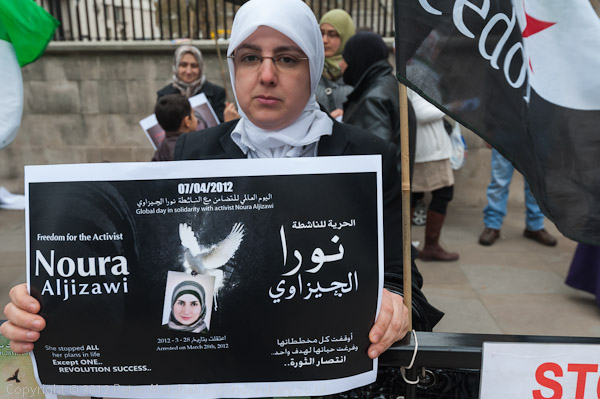
Many also called for the release of human rights activist Noura Aljizawi, who had led protests against the Asad regime, worked in hospitals to support women and children and written for the Syrian underground newspaper Hurriyat. Arrested on 28th March she was tortured and denied access to family and lawyer; an international campaign led by Reporters without Borders eventually led to her release and she fled to Turkey, continuing her campaign against the Assad government, finally relocating to Canada.
My final paragraph on the protest on My London Diary: “On a pillar behind and on the leaflets handed out were the grim statistics. 12,460 Syrians killed since March 2011; 65,000 innocent Syrians are missing; 882 children and babies murdered, 773 women slaughtered; 212,000 men women and children are detained; 30,627 refugees fled in fear of their lives. And the numbers are still rising.”
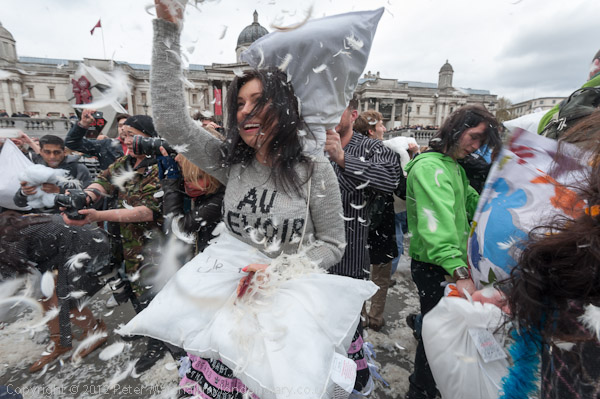
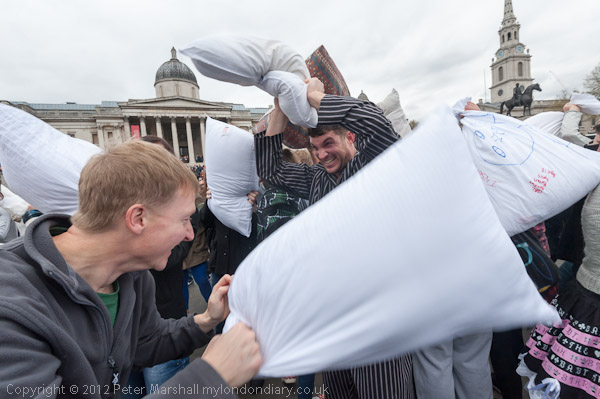
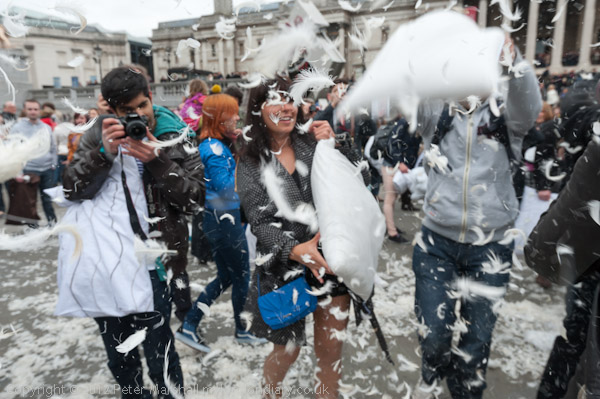
It was International Pillow Fight Day with fights arranged in 111 cities around the world in an event promoted by the urban playground movement.
A whistle signalled the start of the fight
As well as London there were fights in cities from Amsterdam to Zürich, with the majority being in the USA, but they were also in virtually every European country, as well as in Canada, Greenland, Turkey, Bahrain, South America, Cape Town, Australia, Hong Kong and China.
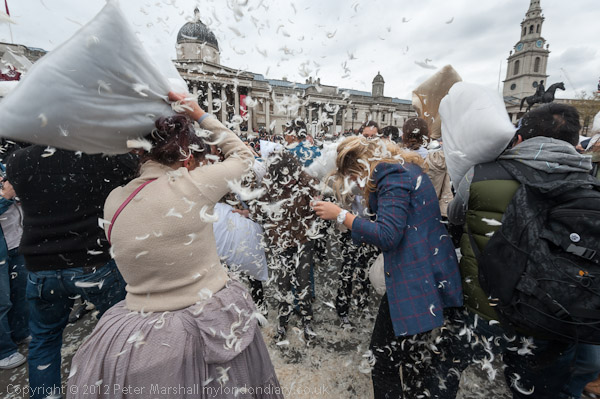
The organisers had set out a list of nine rules, some of which were adhered too, but others were clearly ignored – such as “6) NO FEATHERS, let’s not make a mess”.
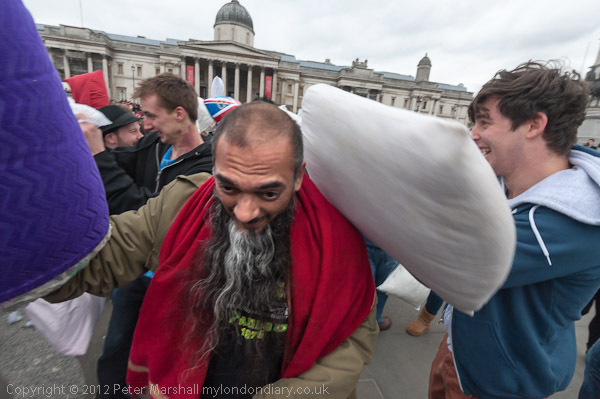
Another that was often ignored was “4) Do not swing at anyone without a pillow or holding a camera”, though some did apologise after hitting me.
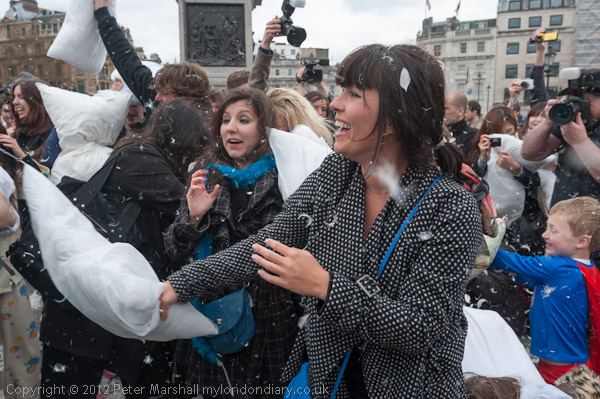
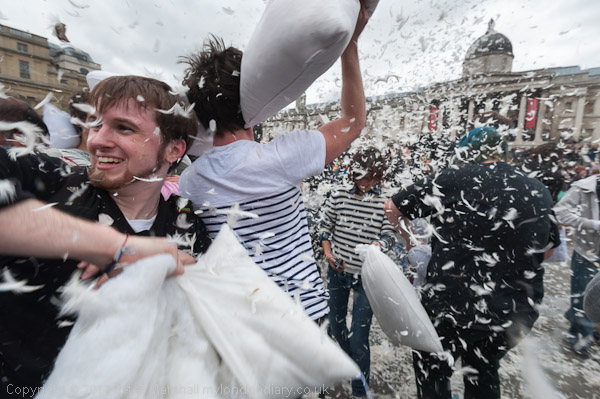
As I commented, it “was half an hour of glorious chaos as people of all ages – though mainly in their teens and twenties – rushed around attacking anyone with a pillow.”
Generally the attacks were random, but there were occasional cries to “attack the panda, or the guy in stripes or spiderman or one of the others in identifiable costumes”.
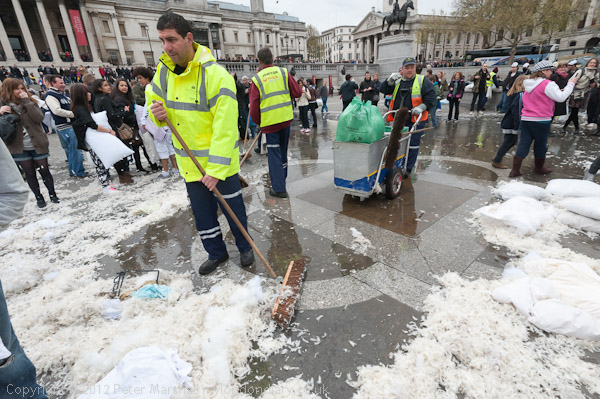
After around 20 minutes when the air (and my lungs) was full of dust and feathers the council cleaners began to pour buckets of water and sweep the dampened feathers away, but the fighting continued until a whistle blew to end the fight at the end of 30 minutes – with just a few continuing to fight.
Good Friday: On Friday 6th April 2007 I got up early and took a train to London to photograph several of the Christian walks of witness and other events taking place around London. The accounts and pictures of my day are still on My London Diary, but rather hidden away. So here is what I wrote (with the usual minor corrections) in 2007, with a few of the pictures and links to the rest.
Good Friday Walk of Witness: North Lambeth
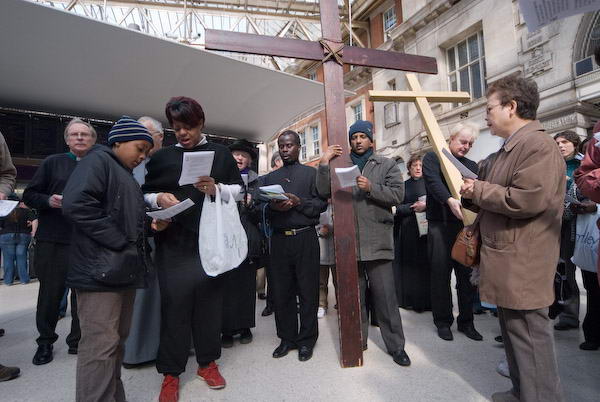
My day started in North Lambeth at 10am, where Churches Together gathered for a short service in the gardens at the front of the Imperial War Museum, before their walk of witness through the locality.
After a short services in a council estate, and the small neighbourhood park they met with others from St Johns, Waterloo for a service on the concourse of Waterloo Station, where I left them.
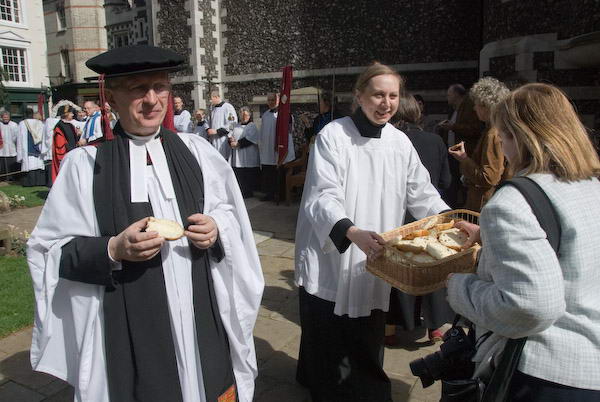
A number 4 bus took me close to London’s oldest church, St Bartholomew the Great in Smithfield, where the Butterworth Charity was to be distributed.
A member of the publishing company gave money in 1887 to ensure the continuation of the established custom of providing 6d (increased to 4 shillings in the 1920s) to 21 poor widows of the parish, and buns to children who came to watch the proceedings.
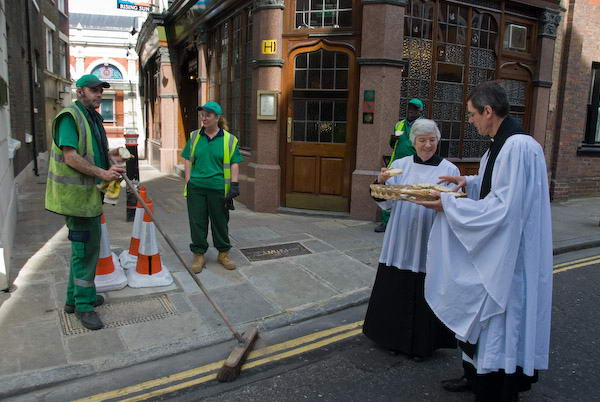
This year, no poor widows declared themselves and the buns were shared by all present.
Even the workers on the street next to the church.
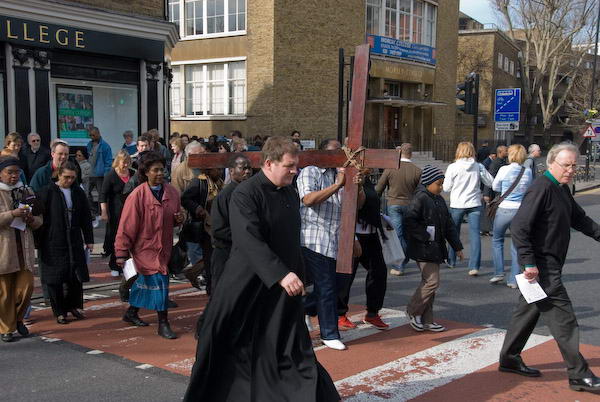
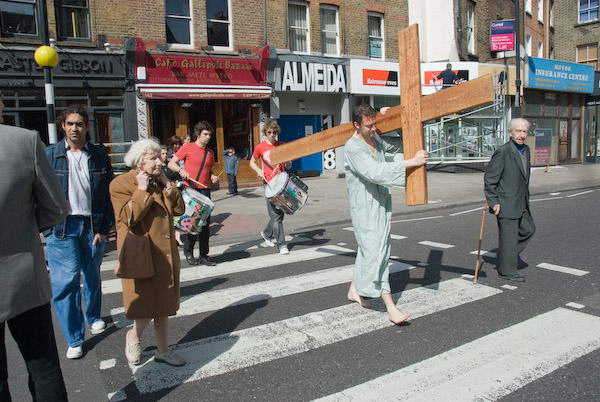
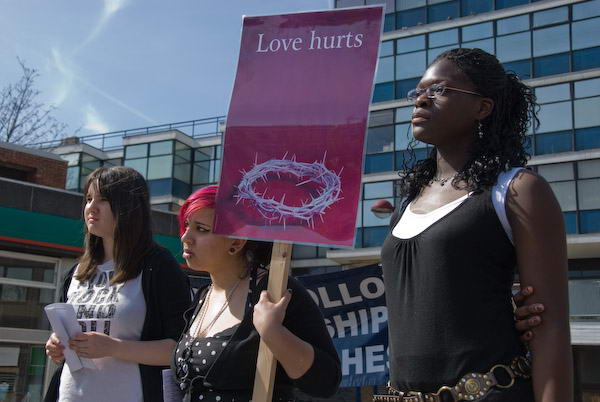
I left before the end of the service at St Bartholomews and despite just missing a bus and a long wait, caught the end of the procession through Islington to St Mary’s Church.
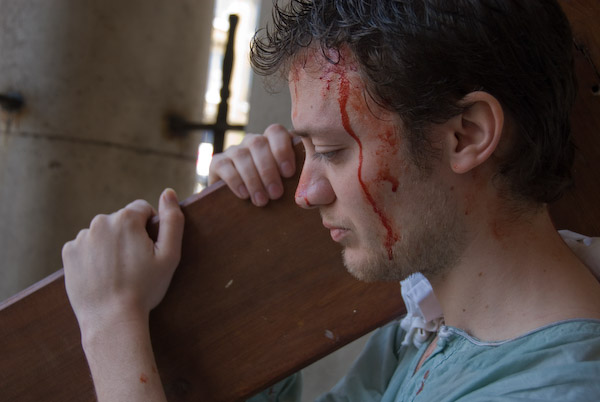
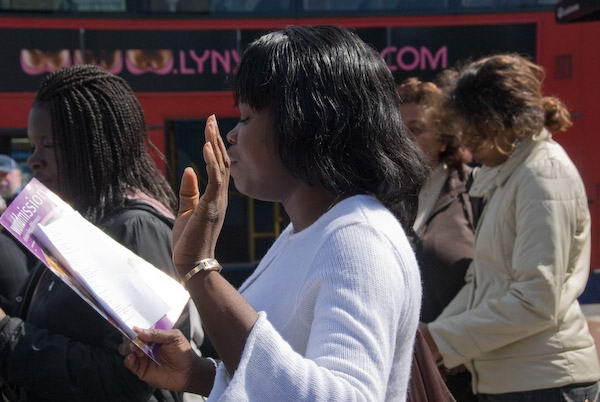
At first I failed to notice the large crowd making it’s way along the busy pavement rather than the road, and the noisy surroundings drowned out the two drums behind the bloody carrier of the Cross at its head.
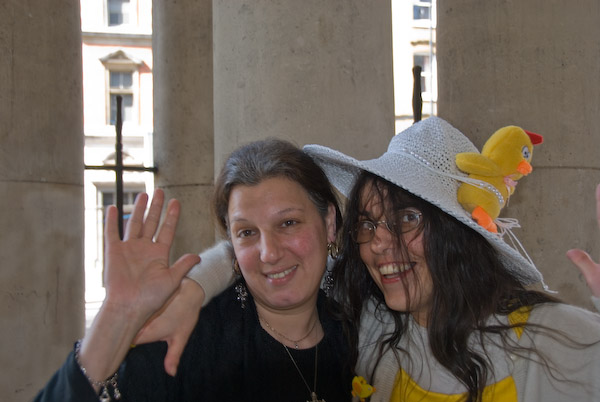
One of the women in the crowd behind had the best Easter Hat I met on the day, which contrasted rather with the sober black of her Ggreek friend.
Upper Holloway Fellowship of Churches, The Mall, Archway
Another bus took us to Archway. However it was held up in the queue of traffic behind the march there, so I arrived just as the service was starting.
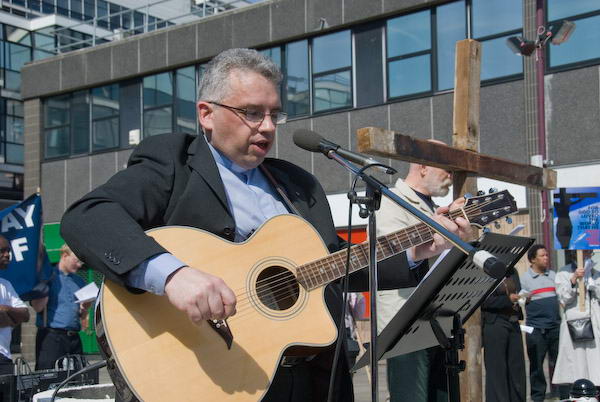
Perhaps 200 people had assembled and a lively service followed. The singing improved when the generator ran out of petrol, and I felt moved to join in.
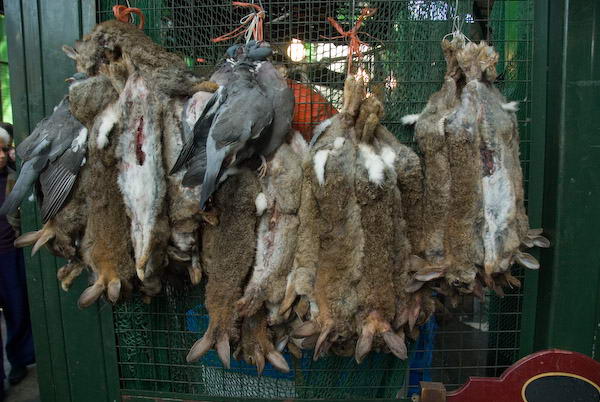
From Archway I took several buses to meet up with a friend in Borough Market, which in the past 10 years has transformed itself from dying old-fashioned fruit and veg business to catering for the an affluent mainly young ‘foody’ market. There is an incredible range of produce on sale now, and some at incredible prices. Some great stuff, some at surprisingly reasonable prices, but plenty of ripoff also.
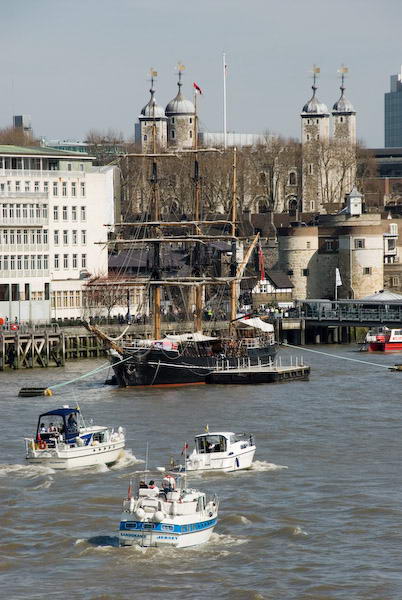
Windsor Boat Club Easter Cruise, Slave replica ship ‘Zong’ and the Tower of London.
I’d come here mainly to meet one of my friends who was photographing the would-be trendy young who where fluttering around its flame. But it wasn’t really my thing, and the Nikon I use wasn’t really the right tool for the job.
This was the end of what I wrote in My London Diary, and there are many more pictures on the links above. We soon get fed up with Borough Market and made our way to a nearby pub before going home.
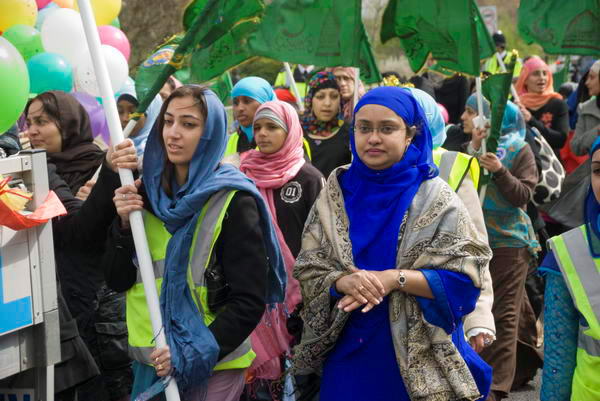
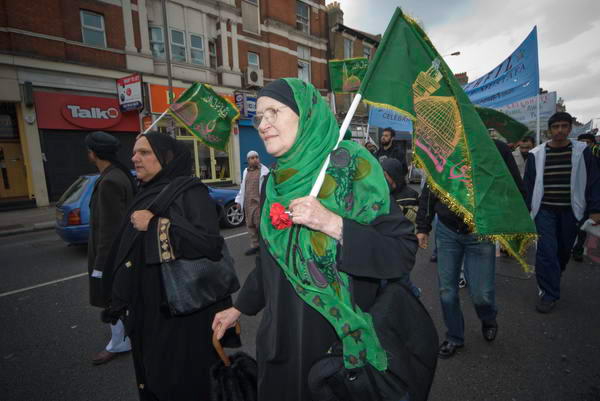
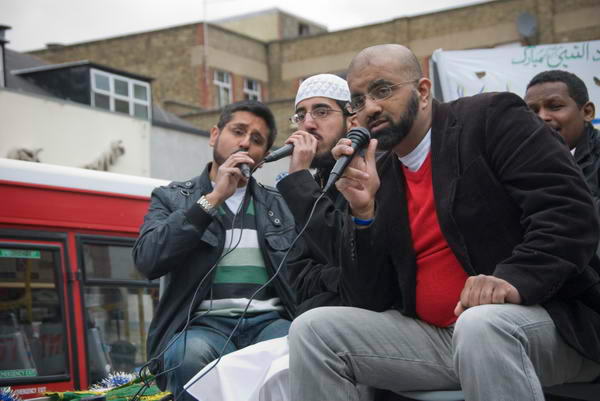
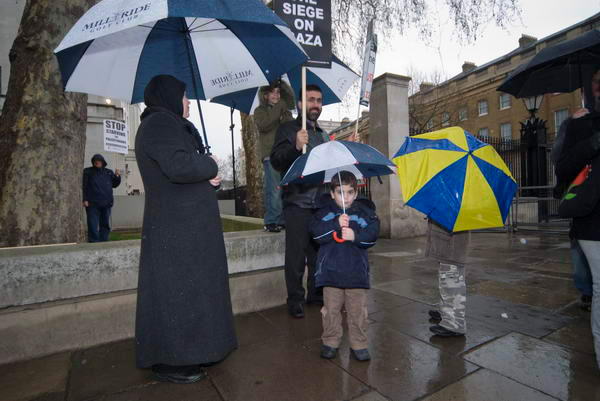
Eid Milad-Un-Nabi & End the Siege of Gaza: On Saturday 5th April 2008 was a rather frustrating day for me. I struggled to get to Tooting for the procession honouring the birthday of the Prophet as rail services to the west of London came to a halt. I finally made it but left as the procession neared its end. Thankfully the tube was working to take me into central London to view some exhibitions and photograph a protest at Downing Street calling for an end to the Israeli siege of Gaza.
Milad 2008 – Eid Milad-Un-Nabi
Procession and Community Day, Tooting
As usual I’d planned my journey into London carefully, intending to arrive in Tooting well before the start of the procession but a cable fire stopped all services into Waterloo with trains piling up back along the lines. Mine “came to a halt in Feltham, then crept forward slowly to Twickenham where it expired completely. Ten minutes later another service took me the few hundred yards further to St Margarets, where I abandoned rail and jumped onto a passing bus to Richmond.”
Then as I commented “Should you ever want a slow and frustrating ride through some of the more obscure southwest London suburbs I recommend the 493 route, which even includes a ride past Wimbledon Park and the world’s most famous tennis club before taking you past the dog track and on to Tooting.”
A full 50 stops and over an hour later I jumped off the bus and ran the last mile or so towards where the procession was to start on Tooting Bec Road, meeting the procession a few hundred yards from its start. Back in 2008 I wrote “half a mile” but I’ve just measured it and my run was at least double that. The Tooting Sunni Muslim Association’s procession for Eid Milad-Un-Nabi had started ‘promptly’ only around 20 minutes late so I hadn’t missed too much.
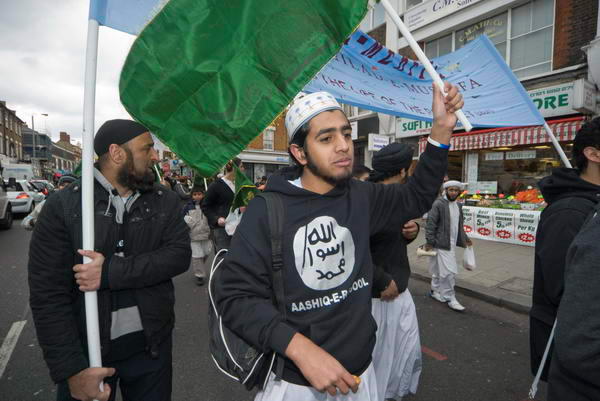
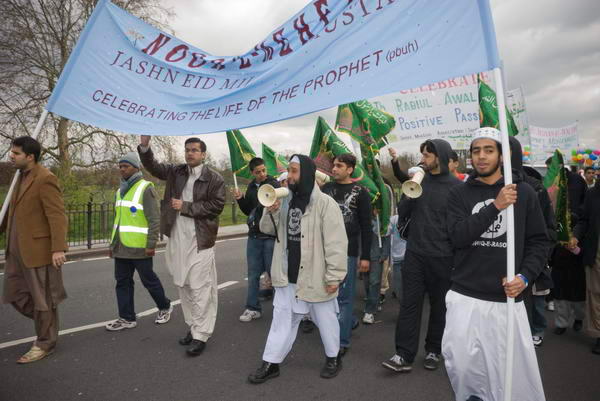
The Juloos to honour the birthday of the Prophet was part of an all-day community event and as well as the Muslims there were other local community representatives taking part including the Deputy Mayor of Wandsworth, Councillor Mrs. Claire Clay.
The previous year I’d gone on after the procession to the celebrations at Tooting Leisure Centre, including the impressive whirling dervishes – who I photographed again there in 2009. But in 2008 there were exhibitions I wanted to see in London – and a protest at Downing Street, so I left as the procession turned into Garratt Lane and took the tube from Tooting Broadway.
A demonstration on a wet Saturday afternoon at Downing St
In September 2007 the Israeli government had imposed a siege which was preventing vital medicines and other supplies from entering Gaza. This was a collective punishment against the population, illegal under international law and had by April 2008 already resulted in a number of deaths.
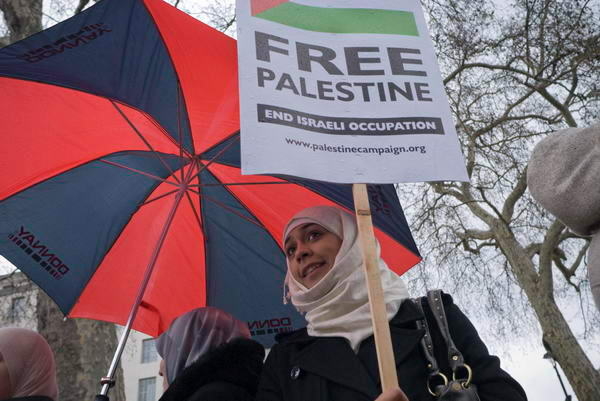
It was one of a series of protests organised by the Palestine Solidarity Campaign on a rather smaller scale than the hundreds of thousands in some more recent demonstrations, but sharing similar aims. It called on the British government to end the arms trade with Israel, and to press Israel to abide by international law, end its illegal occupation and allow the return of refugees.
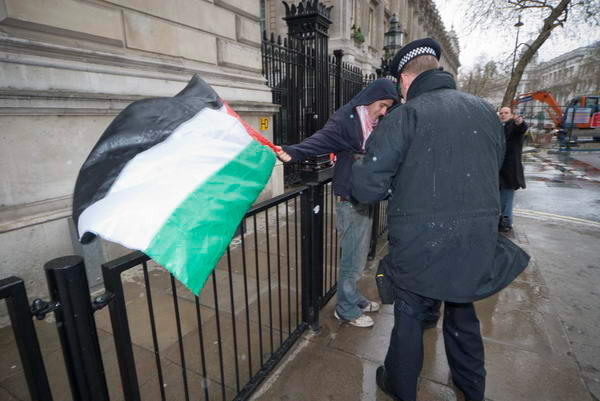
During the protest one young man with a Palestinian flag crossed the road and stood in front of the gates of Downing Street holding it. It was the police reaction to this – and their attempts to stop me photographing it that made up most of my report in 2008.
The man picks his flag up from the wet pavement and the officer shouts at him, telling him to put the f***ing flag down
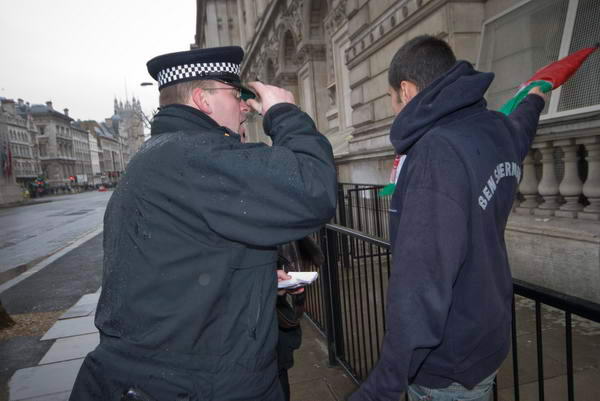
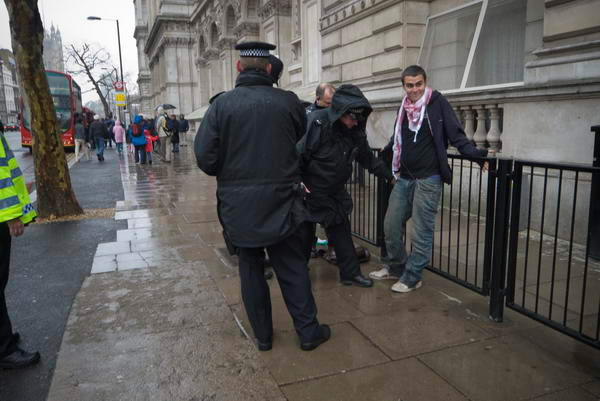
Police pulled him to one side and questioned him, telling him that the SOCPA had made it a crime to protest there. They pulled his flag from his hands and dropped it on the pavement, and when he picked it up an officer swore at him, dragged it out of his hands and dropped it on the pavement again. He was then told he was being stopped and searched under the Terrorism Act 2000, though waving a flag is clearly not terrorism.
Clearly I was a already a good distance away when the officer on the left edge of this picture ordered me to move away
At this point an officer stood in front of me to stop me taking photographs. I told him I was press but he insisted I move further ways as I was “interfering with the actions of the police.” Clearly I wasn’t and I made this clear to him before moving back as ordered.
A woman officer came up and held her hand in front of my lens. I told her that this was illegal and a senior officer in the Met had told a colleague that he would consider it “a sacking offence” and she hurriedly moved off across the road and away from the area. Unfortunately I failed to get a good picture of her or to take her number.
I went back across the road to continue photographing the protest. Police officers at the protest on the other side of the road were approached by the event organisers about the man being held but denied any connection with the officers on the other side of Whitehall. The officer did attempt to excuse their actions on possible grounds of security, but I didn’t feel he felt too happy about it. The man was still being held by police when I left the area.
The Woolwich Ferry: Continuing my walk in Plumstead and Woolwich in August 1994 I came to the Woolwich Ferry and couldn’t resist taking a ride across the river on it. And since I wanted to continue my walk in Woolwich, rather than in North Woolwich, I stayed on the ferry to come back.
Woolwich Ferry, River Thames, Woolwich, Greenwich, 1994, 94-808-41
There had almost certainly been a ferry across the Thames at Woolwich at least since the Norman Conquest, though the first written reference by name only came when it was sold together with a house by William de Wicton to William atte Halle for £10. In the early years of the 19th century there were three Woolwich Ferry Acts (1811, 1815 and 1816) establishing a commercial ferry.
These were passed in particular for the movement of troops and supplies from Woolwich Arsenal across the river. From 1846 there was also a rail connection from North Woolwich to Stratford and eventually there were three steam ferries on the route
Woolwich Ferry, Ambulance Station, River Thames, Woolwich, Greenwich, 1994, 94-807-11
After the Metropolitan Board of Works (MBW) was created in 1855 it had taken over toll bridges in West London and made them free to use. People to the east of London in Greenwich and Woolwich argued that they should also be able to cross the river without paying. Eventually in 1884 the MWB agreed and tasked Sir Joseph Bazalgette to oversee the provision of approaches, bridges and pontoons for the ferry. These were built by the still familiar name of Messrs Mowlem in 1887-9. (The company is no longer; having got into financial difficulties it was acquired by its rival Carillion in 2005.)
Woolwich Ferry, River Thames, Woolwich, Greenwich, 1994, 94-807-12
The London County Council was established on 21st March 1889, two days before the Free Ferry was due to open and so it was Lord Roseberry, the LCC’s first chairman who led the huge procession and festivities to the new ferry terminal in Woolwich and announced to a crowd of thousands “The free ferry is open to the public.“
There was only one paddle steamer working the ferry that weekend and it must have got very crowded. As well as those in Woolwich , “the Great Eastern Railway Company carried 25,000 people to its North Woolwich terminus, most of whom were intent on riding the ferry.”
Woolwich Ferry, River Thames, Woolwich, Greenwich, 1994, 94-807-13
The initial fleet of two paddle steamers soon became three and were replaced by newer paddle steamers in the 1920s. It was these that inspired the story and wonderful illustrations by Charles Keeping in his 1968 children’s classic ‘Alfie and the Ferryboat (1968), very much enjoyed a few years later by myself and my two boys. So of course we had to come to Woolwich and I took my first crossing with them in the early 1980s.
Woolwich Ferry, Ambulance Station, River Thames, Woolwich, Greenwich, 1994, 94-807-11
But by the time that book was published the paddle steamers had gone, replaced from 1963 by the diesel-powered double ended James Newman, John Burns and Ernest Bevin which enabled vehicles to drive up newly built causeways with hinged bridges and drive directly onto the ferries, greatly speeding up the loading. As they were double-ended vehicles could also drive off forwards on the other side and the ships did not need to reverse. They were steered from a central bridge over their roadways.
Woolwich Ferry, River Thames, Woolwich, Greenwich, 1994, 94-807-12
The ferries in my pictures continued in service until 2018, when the ferry closed down for four months waiting the arrive of replacements. These have had various problems with London May Sadiq Khan apologising and saying the new vessels “aren’t good enough.”
Woolwich Ferry, River Thames, Woolwich, Greenwich, 1994, 94-807-13
Woolwich Ferry, Ambulance Station, River Thames, Woolwich, Greenwich, 1994, 94-807-22
I had just missed the ferry and spent it walking around the area and taking pictures.
Woolwich Ferry, Ambulance Station, River Thames, Woolwich, Greenwich, 1994, 94-807-33
All of the pictures before this one have been of a vessel not in use, moored at Woolwich but in this picture you can see one ferry at the North Woolwich terminal and another approaching Woolwich, and I hurried up the approach to catch it. In my next post from 1994 I will include some pictures I made on the ferry.
Good Friday 2nd April 2010 I went to London first for the annual procession on Victoria Street in Westminster and later for the first Passion Play to be produced in Trafalgar Square since 1965.
Crucifixion on Victoria St
Westminster
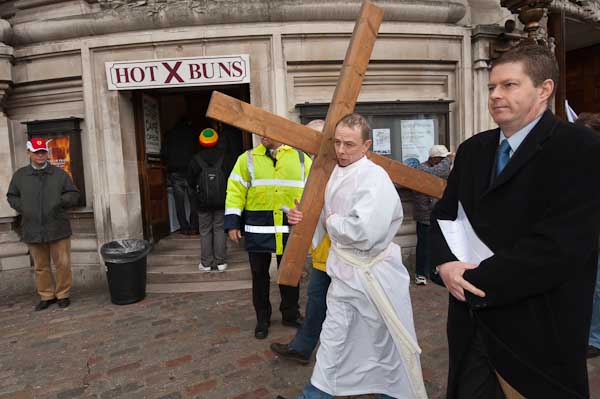
A man carrying the cross leaves Westminster Methodist Central Hall
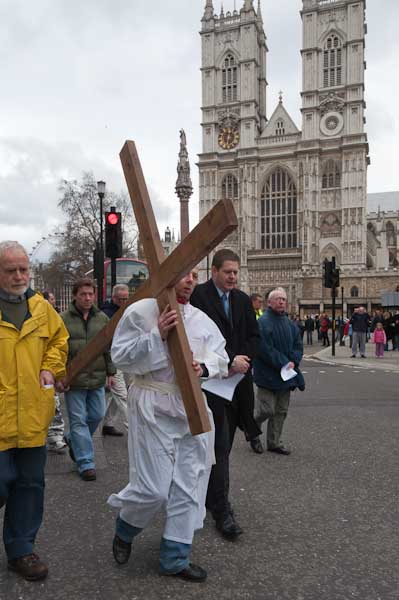
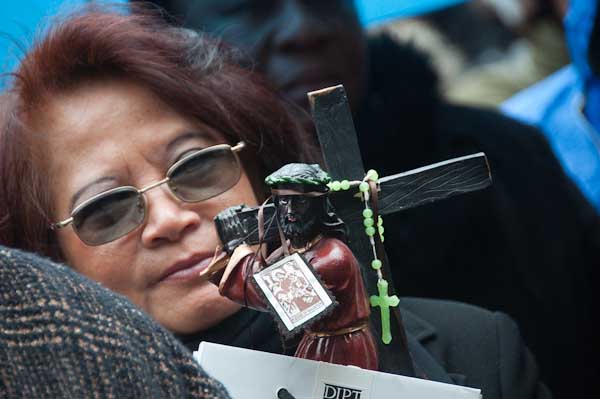
There are three major Christian churches on or around Victoria Street in Westminster, Methodist Central Hall, the Catholic Westminster Cathedral and Anglican Westminster Abbey, and for some years there has been a procession, ‘The Crucifixion on Victoria Street’ up and down the street between them.
The procession included clergy and people from other churches and organisations in the area. It was led by a large wooden cross carried by men from The Passage, a project for homeless people. Following this were around 500 people including members of The Passage, children from St Vincent de Paul Primary School, the Lord Mayor of Westminster, Councillor Duncan Sandys as well as Westminster clergy and members of various congregations.
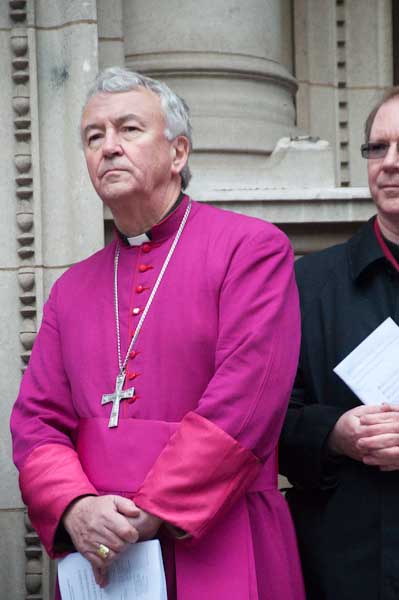
It began outside Methodist Central Hall before making its way up Victoria St to Westminster Cathedral where on the plaza outside the cathedral it was met by the Most Reverend Vincent Nicholls, Archbishop of Westminster. He became the third Archbishop of Westminster I’ve photographed on these steps.
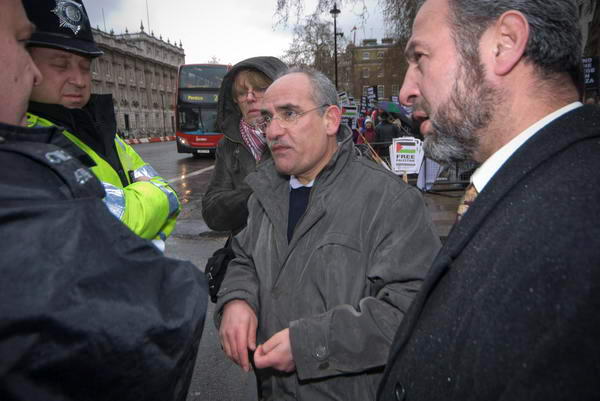
After hymns, a bible reading by The Reverend Philip Chester, Vicar of St Matthew’s Westminster, a mediation by the Reverend Martin Turner from Methodist Central Hall, a prayer by Mr Mick Clarke, CEO of The Passage and a reflection on peace by the Archbishop the procession went back along Victoria Street for a service in Westminster Abbey, but I left them to get out of the rain then falling steadily.
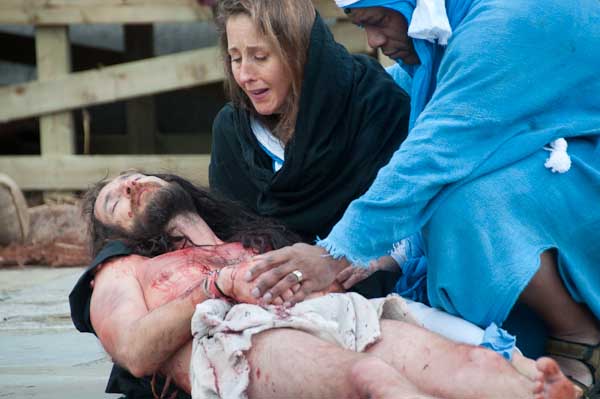
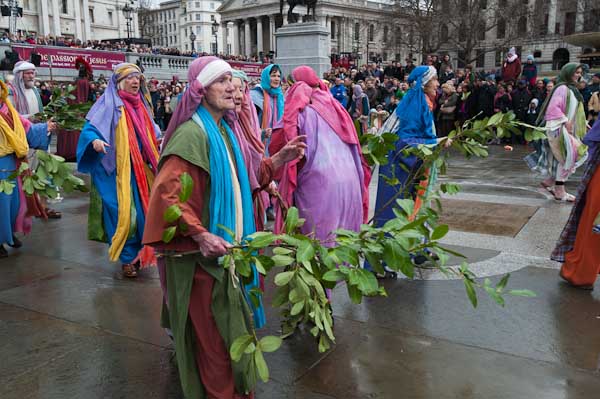
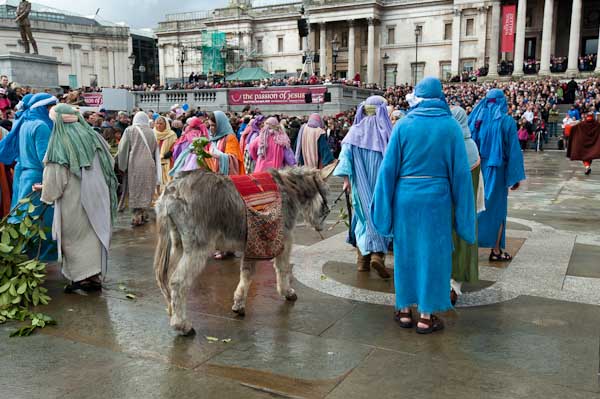
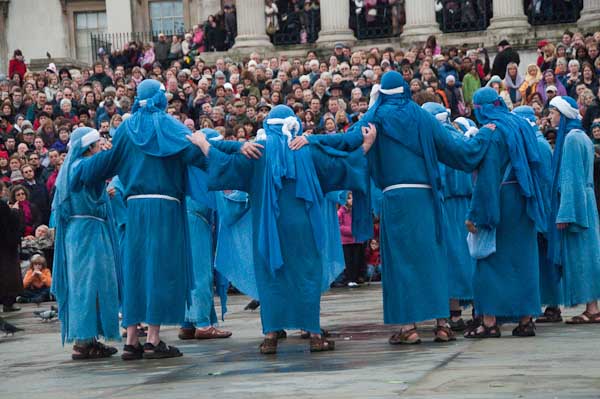
Trafalgar Square was packed for the The Passion of Jesus, the first Passion Play there since 1965, performed by around 150 devout Christians and a donkey by a group based on the Wintershall estate in Surrey.
Property developer Peter and Ann Hutley, owners of the 1,000 acre estate and retreat centre began staging religious events after a visit to the Catholic pilgrimage centre of Medjugorje in Bosnia and Herzegovina, beginning with a Nativity event in a barn they had just bought in 1989.
They first staged ‘The Life of Christ’ on their estate in 1999, a five or six hour open air production around a lake in the grounds, with over a hundred actors as well as camels and a flock of sheep.
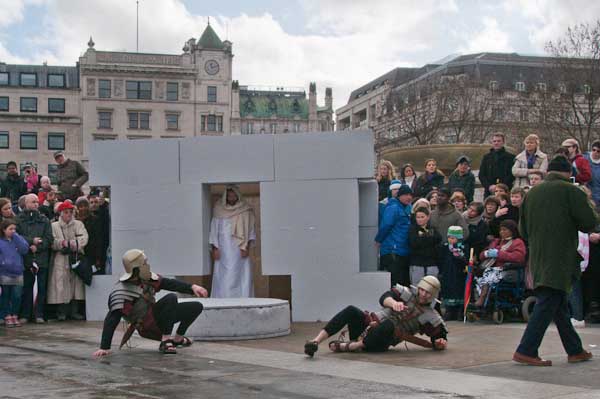
The ‘Passion of Jesus’ in Trafalgar Square was on a slightly reduced scale, but still very impressive and colourful, and a dramatic rendition of the traditional story from the four gospels, with some touches of added spectacle.
As I reported, “Although the flogging of Jesus occurred off-stage and the sound effects were rather unconvincing, the crucifixion that followed was a pretty gory sight.
As in the Gospel narrative, the Jewish hierarchy of the time was typecast as villains, perhaps too typecast, and the resurrection too presents some dramatic problems.”
Wintershall stages performances elsewhere – and I photographed their Staines Passion at Easter in 2014. There is another Passion of Jesus in Trafalgar Square tomorrow, Good Friday 3rd April 2026, with two free performances at 12 noon and 3:15 pm open to all. You can also watch it on Youtube if you can’t get there in person.
Courthouse Community Centre, 11, Garratt Lane, Wandsworth, 1990, 90-3b-42
This was built in 1858 apparently as one of the first courts under the 1846 County Courts Act and is Grade II listed.
It was alleged to be near-derelict in the 1970s when it was first Grade II listed and was handed over to Wandsworth Council, becoming a community centre for the Arndale Estate. Then it became the Wandsworth Museum but that was closed in 2008 to turn it into Wandworth Library. The museum was moved West Hill Library then closed in 2015. In 2014 the council decided to move the library and to sell or let the building . I think it is now offices.
Salvation Army Citadel, Ram St, Wandsworth, 1990, 90-3b-43
I crossed Wandsworth High Street and walked up Ram Street. stopping to take this view of the Salvation Army Citadel, built in 1907, but now replaced in 2008 by a more modern building. Doubtless a much more functional building its rounded lines have nothing of the military features of the old with its castellated tower.
The Wandsworth Gas Company gasholder is no longer visible. Gasholders such as this were still in use for storage and to regulate gas pressure for some years after the changeover to natural gas and the closure of our gas works. Once a common feature of our townscapes, most have now gone, with just a few of the guide frames of particular interest being listed and saved, some converted to contain flats.
I think this one was dismantled around 15 years ago, but at least until recently its base could be seen from the railway line to the north.
Gas Holder, Swandon Way, Wandsworth, 1990, 90-3a-54
A closer view of the gasholder which clearly shows the three sections which would be lifted up inside each other by the gas as more gas was pumped into the holder (and were known as lifts.) The first ‘telescopic’ gasholder was invented in 1824. This example was built in 1972 and was said to be the largest of its type in the UK. Gas was stored at only a little above atmospheric pressure
Gas Holder, Houses, Barchard St, Ram St, Wandsworth, 1990, 90-3b-44
Controversial plans were approved by Wandsworth council for the redevelopment of the gas works site to include a 29 storey tower – rather taller than the old gasholder. I think that the massive concrete base which held the water to seal the bottom of the gas holder is to be retained to save the huge environmental cost of its removal.
I rather liked the way the old gasholders – here and elsewhere – contributed to the townscape, and they were certainly local landmarks. But the Wandsworth Society and other objectors are correct to point out the main tower block of the development with a height of 29 storeys, “is quite ‘out of context’ next to the River Wandle. The site of the tower cannot be considered to be a ‘town centre’ site nor is it close to a ‘cluster’ of buildings of a similar nature. The application cannot be considered to ‘make a positive contribution to local character and context’“.
Gas Holder, Armoury Way, Wandsworth, 1990, 90-3b-31
A final picture of the gas holder.
Ram Brewery, River Wandle, Wandsworth High St, Wandsworth, 1990, 90-3c-12
The rest of the area north of the town centre has also seen massive redevelopment, though at least the major historic elements of the Ram Brewery have been retained – and now contain the Sambrook Brewery.
Here you can see one of the more modern parts of the brewery, which looked more like a chemical plant than how I imagine real beer being made.
The area is now covered by large bocks of around 4-7 storeys and I think the only thing visible in this image that remains is the brewery chimney. There is now a walk alongside the Wandle, but little of interest to see from it.
Ram Brewery, River Wandle, Wandsworth High St, Wandsworth, 1990, 90-3c-15
Young’s beers are now brewed by Carlsberg Marston’s Brewing Company in Bedford, though they have re-branded them to include London in their names.
River Wandle, Armoury Way, Wandsworth, 1990, 90-3b-32
Plumstead is a hilly place, rising quite steeply from the River Thames as I remember from my first visit to the area when still in short trousers, trudging up a long hill holding my mother’s hand to visit some distant relatives, whose names I no longer remember, nor exactly where they lived. Their back garden went up steeply behind the terrace house.
I don’t think it was this road was the one I walked up back then, but it was still hilly and you can see the houses going down on both sides and I think in the distance to trees and buildings on the other side of the river.
Park, Plumstead Common, Plumstead, Woolwich, Greenwich, 1994, 94-809-61
The previous picture was taken just a few yards from Winn’s Common, one of several areas also including Bleak Hill and The Slade which make up Plumstead Common. I think this is close to Lakedale Road and shows the foundations of a building with beyond it the rose garden in the next picture.
Park, Plumstead Common, Plumstead, Woolwich, Greenwich, 1994, 94-808-13
I made several other pictures on Plumstead Common, though I can’t remember exactly where on the common this was and can find no traces now of this sunken garden with walkways which must once have been covered by plants and flowers but seem to have left in a semi-derelict state, though there are still some rose bushes.
Here I deliberately tilted the panoramic camera to give a curved horizon rather than try to level it with a spirit level as I usually did, partly to include the lower edge of the bushes and small trees, but also to create a kind of enclosed space.
Across the common is a pub, the Woodman, one of the 5 Plumstead Common Idlers, ‘the Woodman who never felled a tree’ at 35 The Slade.
“The Star which doesn’t shine in the sky, the Woodman who doesn’t cut down trees, the Ship that cannot sail the seas, the Mill which doesn’t grind corn, and Who’d a Thought it!”
Radnor Crescent is some distance to the east on the edge of Winn’s Common and I’m not sure exactly which direction I was looking to make this picture, perhaps looking towreds Shooters Hill.
Waste Land, Woolwich Church St, Woolwich Ferry, River Thames, Woolwich, Greenwich, 1994, 94-807-42
From here I walked to Woolwich and the Woolwich Ferry. More pictures from Woolwich in a later post.
Abolition of the Slave Trade Act: Bicentenary. Events on Sunday 25th March 2007 commemorated the 200th anniversary of the passing of an Act of Parliament to end the slave trade. The previous day I had photographed a Church of England walk of witness to mark the abolition, but on Sunday I covered events in Brixton and Clapham. Sunday was the actual anniversary of the Act which marked a change from Britain being a major partner in the slave trade to opposing slavery worldwide, though it was not until 26 years later in 1833 that slavery was abolished throughout the British Empire. The text below is basically what I wrote in 2007 accompanied by a few of the pictures I made.
Abolition of the Slave Trade Act: Bicentenary
There is no escaping that all of us who live in Britain – whatever the colour of our skin or our personal history – are now benefiting from the proceeds of the trafficking of African people and their forced labour in our colonies over around four centuries. Fortunes made from slavery helped to build many of the institutions from which we still benefit, including our many of our great galleries and museums. Slavery founded many of our banks and breweries and other great industries, and made Britain a wealthy nation.
But it is also true that the same wealthy elite that treated Africans so callously exploited the poor in Britain. My ancestors were thrown off their land and probably some were imprisoned for their religious beliefs by these same elites. Almost certainly my forebears were a part of the movement that campaigned against slavery and called for an end to the trade in human beings, although equally certainly they had little or no political power at the time, and probably no vote.
Of course that in no way diminishes the horror of the trade, but it does colour my personal attitude to the celebrations of the 200th anniversary of the abolition. The abolition movement was an important turning point in the history of our empire and the world leading to the act banning the trade in people and later in 1833 the abolition of slavery throughout the British Empire. The abolition movement changed Britain from being a country that enslaved millions in its own colonies to one that opposed slavery worldwide.
Slavery of course still exists, even in Britain, and we still need to oppose it in all its forms. Much of present day slavery here only flourishes because of our current immigration policies and their implementation, which makes many immigrants illegal, and impoverishes them, denying them human rights or making them afraid to claim them.
Clapham Commemoration Walk
One of the three groups at the probable site of the African Academy
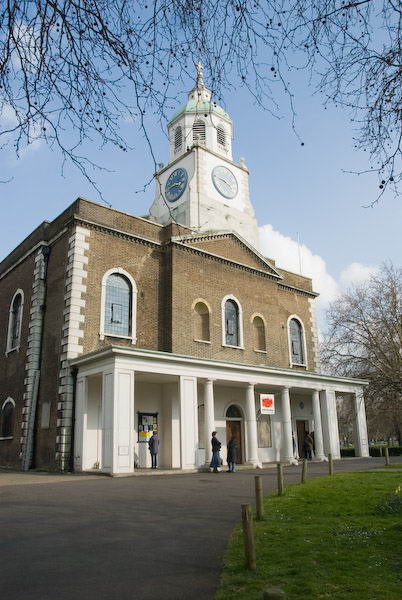
For the 200th anniversary of the passing of the Slave Trade Act on 25 March 2007, I went to Clapham, the spiritual and physical home of the abolition movement, where the London Borough of Lambeth had organised a commemoration walk. This started at Holy Trinity Church, where the Clapham Sect at the centre of the movement, including William Wilberforce, Granville Sharp, John and Henry Thornton, John Venn, Zachary Macaulay and others had worshipped.
Holy Trinity, Clapham, the home of the Clapham Sect
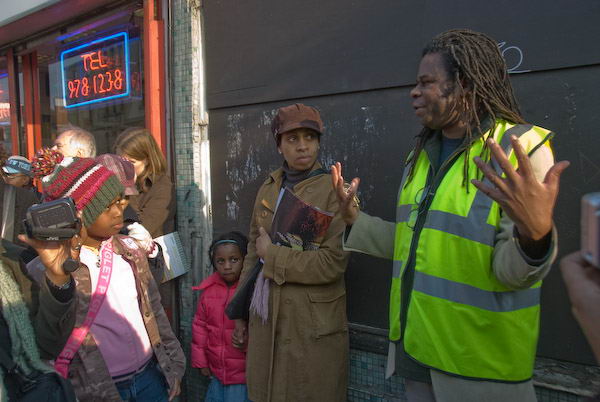
Steve Martin, our guide for the walk emphasised that Clapham was also home to many who had made fortunes from the trade and opposed the abolition, with both sides worshipping in the same parish church.
Nearby, at 5 The Pavement, now occupied by an ‘Evans’ shop, an LCC plaque marks the home of Zachary Macaulay, and also of his more famous son, Lord Macaulay.
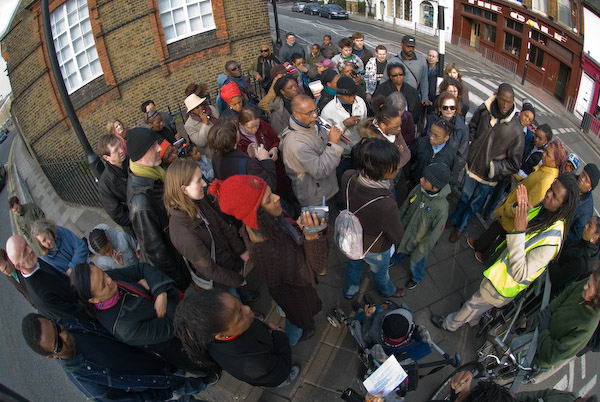
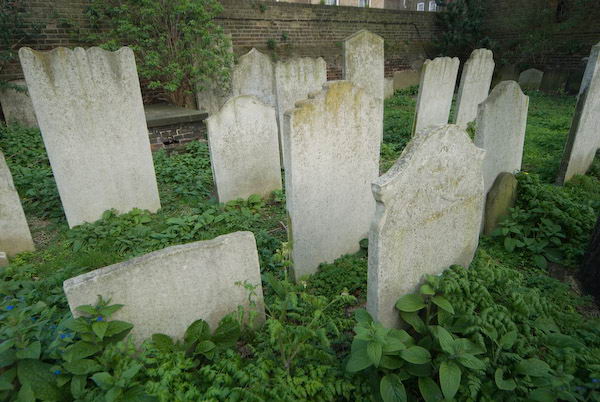
Zachary was a former plantation manager in Jamaica and governor of Sierra Leone who had become an abolitionist. As a part of a project to return freed Africans to Sierra Leone he brought 21 boys and 4 girls back from Sierra Leone and set up an African Academy in Clapham to educate them to return to run their country. The walk took us to two possible sites for this school, as well as to a nearby church cemetery, as unfortunately many of them died of measles and were buried there.
Measles killed most of the African students who were buried in this churchyard.
Down Matrimony Place we came to Wandsworth Road, and turned along it to a former brewery and the pub next door. One local family that had made considerable fortune from plantations worked by slave labour were the Barclays (later they became abolitionists and freed their slaves much to the anger of other plantation owners.) When they sold their plantations, the money went into businesses including breweries and banks.
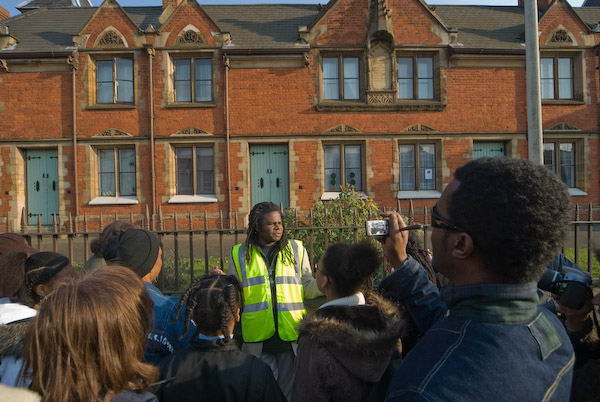
At the Hibbert Almshouses
One of those most prominent in the campaign against abolition was George Hibbert, chairman of the West India Dock Company which profited hugely as the slaving ships brought back the produce of the plantations to London. The Hibbert Almshouses on Wandsworth Road were built to house elderly poor residents of Clapham by his two daughters.
At the end of the walk there was some argument about whether the Tate fortunes depended on slavery
As we turned back up towards Clapham Common, Steve informed us that the street along which we walked had been built on what were once the back gardens of the houses of these wealthy traders in human beings who lived in the extensive houses facing the common on Clapham Northside. The tour ended outside no 29, once the home of George Hibbert (Robert Barclay lived next door at 31), a couple of hundred yards from Holy Trinity, where our walk had started.
Across the middle of the Clapham Common is of course a dividing line – between the London boroughs of Lambeth and Wandsworth. It would have prolonged our walk to take in the plaque to Wilberforce in Broomwood Road (Broomfield where he lived was demolished in 1904) or to Battersea Rise, the ‘home’ of the Clapham Sect where he lived earlier with his friend and fellow MP Henry Thornton (the house there was demolished in 1908 despite a campaign and public appeal to save it because of its connection with the abolition movement.)
I could find no mention of the bicentenary on the London Borough of Wandsworth site, although the mayor was to attend a church service at All Saints organised by the local churches on 31 march. One of the bas-reliefs on Wandsworth Town Hall shows Wilberforce with the act in his hand, next to Macaulay. Rather to my surprise I found Wandsworth Museum, instead of celebrating its contribution to abolition, was currently showing a Museum Of London travelling show, ‘Queer Is Here’ which in their words included “Peter Marshall’s dynamic black and white photographs capturing a decade of the annual London gay pride event” – which you can still see on line on My London Diary.
Brixton Commemoration – Windrush Square
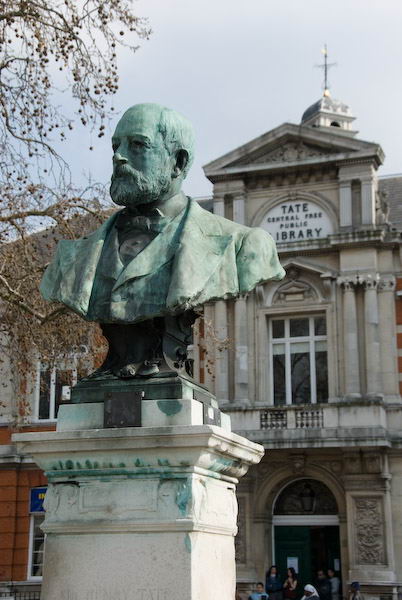
Earlier in the day I’d been at another Lambeth event, in the centre of Brixton, outside the Tate Library.
At the end of the Clapham walk there had been a fairly intense argument about whether Tate’s sugar fortunes had come, at least in part, from slave labour on Brazilian plantations after the abolition in the British Empire.
Sozo House of Praise Gospel Choir performing.
Organised by the Brixton Society, the commemoration of the abolition took place next to Windrush Square and the site of the proposed Black Cultural History Centre in Raleigh Hall. It was opened by an African drummer and singers from the Sozo House Of Praise gospel choir. There were then some speeches mainly concerned with commemorating the abolition of slavery from the Mayor of Lambeth, Cllr Liz Atkinson, local MP Keith Hill, and Superintendent Paul Wilson for Metropolitan Police in Lambeth.
A woman with a remarkable record as a foster parent speaking
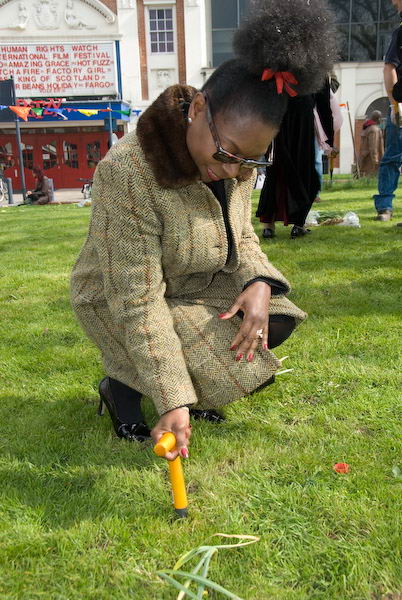
Those present were then invited to plant bulbs in the grass as a permanent memorial, after which Rev Stephen Sichel of St Matthew’s with St Judes across the road led prayers.
Dr Floella Benjamin, OBEplants a bulb
Norma Williamson, the treasurer of the Brixton Society introduced a the next section celebrating the contribution of those of Black Afro-Caribbean origin to life and culture in Britain now. Floella Benjamin, OBE gave a very powerful address particularly stressing the need for black kids to get educated to empower themselves. It was a hard act for Derrick Anderson, CBE, Lambeth’s chief executive, and Devon Thomas, the chair of Brixton Business Forum to follow.
Linda Bellos, former leader of the Labour group on Lambeth council, but rejected by the party as a candidate for a local parliamentary seat gave another powerful performance, putting the issue strongly into its political perspective. Power isn’t just about race, it’s also about class, and gender. The event closed with more fine gospel singing from the Sozo House Of Praise choir.
Society of Friends, Quakers, Wandsworth High St, Wandsworth, 1990, 90-3b-62
My view here today would be very similar. The norices have chanted and at left there is now a large sign QUAKER MEETING HOUSE over much of the area where you can just make out a bricked up window. Even the sign for WINDOVER PIANOS – GRAMOPHONE RECORDS MUSIC – STRINGS AND SMALL GOODS – CASH OR EASY TERMS remains, though perhaps a little less visible. Then and now it is over a branch of William Hill. The bracket for a hanging sign remains empty, but the gatepost at left has gone – replaced further back for a new gate.
The Grade II listed Quaker Meeting house was built in 1778 but later enlarged and this frontage dates from 1927 with later alterations. It is the oldest Quaker Meeting House in London. Unlike much of the old High Street it survived the widening of the road, now a busy part of the South Circular.
Palace Theatre, Gaumont, For Sale, 52, Wandsworth High Street, Wandsworth, 1990, 90-3b-63
The Palace Theatre was a pupose-built cinema, architect John Stanley Coombe Beard (1890-1970) who designed many cinemas around London. It opened in 1920 and in 1958 was renamed The Gaumont, closing in 1961 and becoming a bingo club and then a church. For sale when I made this picture it was bought for use as a night club, The Theatre. It now has columns at each side of the entrance and houses a gym.
The Brewery Tap, Ram Brewery Tap, Wandsworth High Street, Wandsworth, 1990, 90-3b-64
Now called The Ram, this fine 1883 pub building on the corner of Ram Street and with a ram above its doorway at at 68 Wandsworth High Street was still in 1990 the brewery tap for the Ram Brewery. Beer has been brewed here since 1533 and from 1831 by 2006 Young’s & Co who moved out to Bedford.
When I last visited a year or two back the tradition was being continued in the Ram Brewery, now Sambrook’s Brewery – and you can go on tours, even make your own beer there, though I simply enjoyed the Sambrook’s Brewery Wandle, first brewed there in 2008.
You can see the brewery behind the pub in my picture and to the left. This Grade II* building is now ” a premium boutique bowling venue, including traditional bowling, duckpin bowling, electronic darts and shuffleboard under one roof.”
Borrodaile Rd, Wandsworth, 1990, 90-3b-66
I turned south down Garratt Lane and wnet donw an alley leading to The notice tells us that this “122 luxury one and two bedroom flats set in courtyard development, with private parking”, but those were yet to come.
Linstone Court looks to me like 1960s council flats, though many will have been bought under ‘right to buy’ and sold on.
River Wandle, Mapleton Rd, Wandsworth, 1990, 90-3b-51
The River Wandle, once an important industrial river, flows underground though the large Southside Shopping Centre south of Wandsworth High Street. I had come down Garratt Lane mainly to see the river upstream from there.
This was the view downstream from Mapleton Road with Wandsworth Medical Centre on the right.
River Wandle, Mapleton Rd, Wandsworth, 1990, 90-3b-52
And I think this is the view upstream from the same bridge or possibly the next bridge upstream. There has been considerable building around this area since 1990.
Ram Brewery, Wandsworth High Street, Wandsworth, 1990, 90-3b-41
I walked back up Garratt Lane to Wandsworth High Street and made another picture of the Ram Brewery, with its Ram on the weathervane. Then I walked back to Garratt Lane where the next post on this walk will begin.