Tollington to Holloway – 1990

Tollington to Holloway continues my walk on Sunday February 11th 1990 which began at Kings Cross with the post Kings Cross and Pentonville 1990. The previous post was More from Tollington Park – 1990.

House, Tollington Way, Finsbury Park, Islington, 1990, 90-2d-56
House, 1A, Cornwallis Rd, Finsbury Park, Islington, 1990, 90-2d-56

This 3 storey detached house on Cornwallis Road, just a few yards down from Tollington Way, attracted my attention for its unusual decoration above what seemed a very ordinary door and window. According to Streets With a Story the street was developed in three periods as Shadwell Road, Esher Villas and Cornwallis Road in 1863, 1879 and 1885. This house probably dates from the latter part of that development but I’ve found nothing about it on-line

Royal Northern Hospital, Tollington Way, Holloway, Islington, 1990, 90-2d-42

The Royal Northern Hospital was founded in York Rd (York Way) in 1856 at his own expense by a surgeon who had been sacked from University College Hospital for smacking a patient’s bottom. The hospital provided free services for North London’s Poor as well as treating railway workers. But the railway bought the house and they had to move, using several properties in the area. Finally it got is own home and the Great Northern Central Hospital opened on Holloway Road in 1888, changing its name to the Royal Northern Hospital in 1921 and expanding to Tollington Way in the 1930s. It merged with the Whittington Hospital in 1963. The facade of the main building has been retained on Holloway Rd and the building is the Northern Medical Centre

Holloway Rd, Holloway, Islington, 1990, 90-2d-43

This picture was made from Tollington Way looking to the rather grand Italianate terraced villas on the opposite side of Holloway Road, Belgrave Terrace. They were locally listed in 1978. At left is The Cock Tavern at 596 Holloway Road. The pub was built in the 1880s and in the 2000s became a live music venue and bar, now Nambucca. Damaged by fire in December 2008 it reopened in 2010 and was refurbished in 2014 only to close in 2022 but unexpectedly reopen in 2024.

VICTORY TO THE IRA, Landseer Rd, Holloway, Islington, 1990, 90-2d-46

Holloway is one of the more densely populated areas of London with a very multicultural population including many Irish among its residents, and among them a significant number who supported the Irish struggle against the English occupiers in Northern Ireland. In 1990 we were in the middle of active attacks by the Provisional Irish Republican Army (IRA) on targets in London – the following year they attacked Downing Street using mortar shells and in 1992 a powerful bomb at the Baltic Exchange destroyed it and other buildings in the City of London, following this in 1993 with another bomb in Bishopsgate.

The street was named after the animal painter and sculptor Sir Edwin Landseer, best known now for the lions at the base of Nelson’s column. He became a ‘national treasure‘ and his death in 1873 gave rise to mourning across the nation and large crowds lined the streets as his funeral cortège made its way to St Paul’s Cathedral. Probably the street dates from around then.

W Wooley, Egg & Butter Merchant, 541, Holloway Rd, Holloway, Islington, 1990, 90-2d-31

The building is still there on Holloway Road, but sadly is no longer an Egg & Butter Merchant and has a new shopfront – and a bus shelter on the pavement in front of it.
Tollington to Holloway - 1990
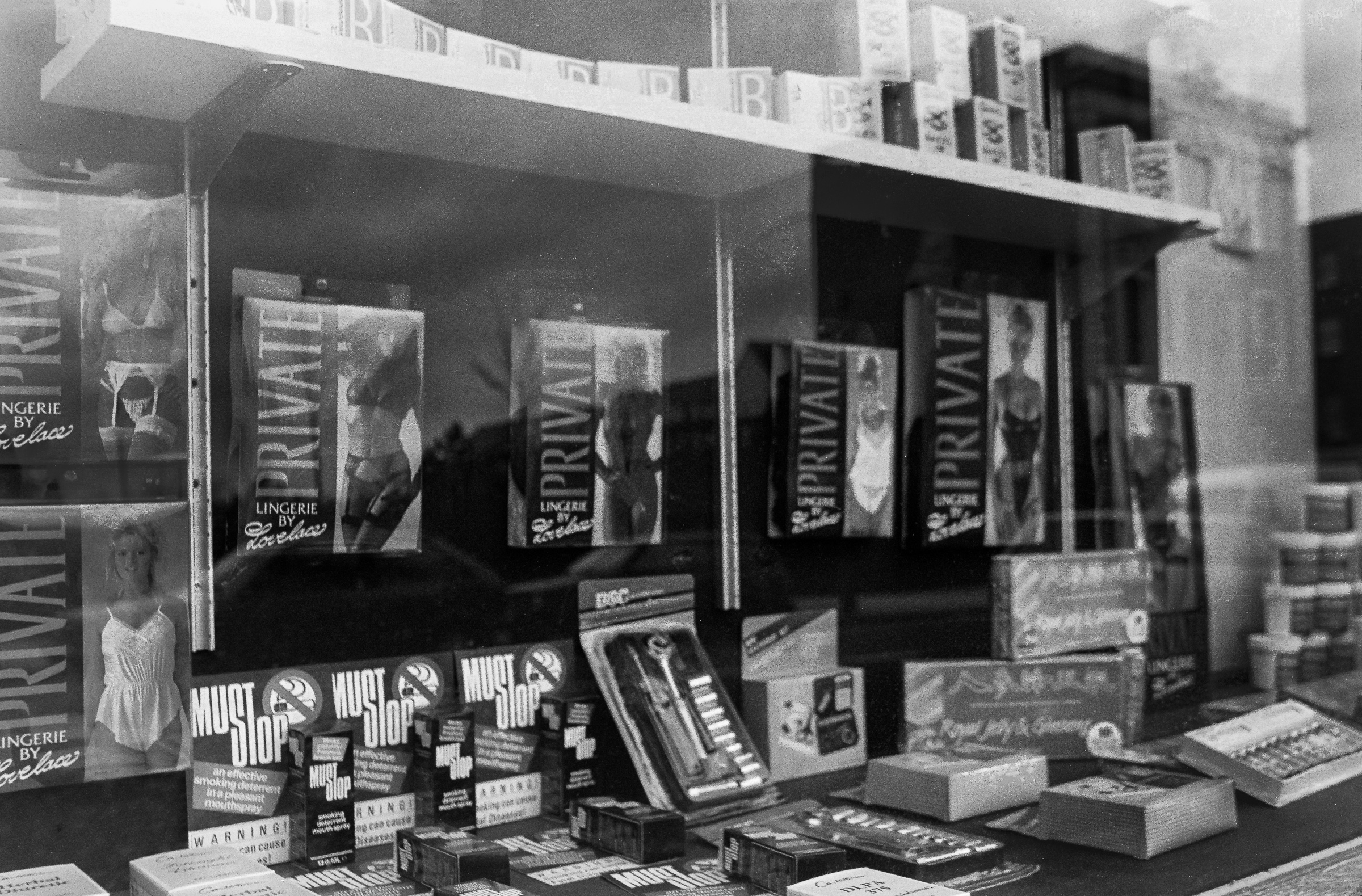
Lingerie, Stop Smoking, Royal Jelly & Ginseng, Holloway Rd, Holloway, Islington, 1990, 90-2d-32

As I made my way to the station at the end of my walk I could not resist this shop window with a rather strange mix of products including those listed and some rather strange health supplements. I only stopped long enough to take a picture and wasn’t tempted to buy anything.

My next walk a week later was also in North London and will be the subject of a later post.


FlickrFacebookMy London DiaryHull PhotosLea ValleyParis
London’s Industrial HeritageLondon Photos

All photographs on this page are copyright © Peter Marshall.
Contact me to buy prints or licence to reproduce.


More from Tollington Park – 1990

More from Tollington Park – 1990 continues my walk which began at Kings Cross on Sunday February 11th 1990 with the post Kings Cross and Pentonville 1990. The previous post was Fonthill & Tollington.

House, Tollington Park, Finsbury Park, Islington, 1990, 90-2c-12

Tollington is a district whose name dates back at lease into Saxon times. According to Eric A Willats’ ‘Streets With A Story‘, from which much of the information in this post comes, “It was spelt ‘Tollandune’ in the Anglo-Saxon Charters meaning the hill or pasture of Tolla. ‘Tolentone’ meant a pannage for hogs, a place of beechwood and mast. This area and Holloway were all then part of the Great Forest of Middlesex. It
had various spellings Tolesdone, Tolyndon, Tallingdon and Tallington
.”

Modern development of the area, then farmland, began early in the 19th century; “About 1818-1820 ‘a pretty range of villa residences were erected in the Italian style by Mr. Duerdin, with stabling and offices attached, from the designs of Messrs. Gough and Roumieu.’” These are now 96, 102, 106 and 110 Tollington Park.

House, Tollington Park, Finsbury Park, Islington, 1990, 90-2c-13

Like many other early and mid-19th century developments the villas were first given their own distinct subsidiary names and only became numbers in ‘Tollington Park’ in 1871, Willats gives the following details:

After 1871 subsidiary names were abolished, e.g., Belmont Terrace became nos2-6, Birnam Villas 8-10,St Marks Villas 16-22, Claremont Villas 24-36, Duerdin Villas 44-56, Fonthill Villas 60-70, Syddall Villas 59, Syddall Terrace 63-73, Regina Villas 89-101, Shimpling Place by 1882 nos15-155 Upper Tollington Park, Harrington Grove 1848/9 became after 1894 47 to 67 and 52 to 70 CHARTERIS ROAD. Nos96 to 108 have been attributed to Gough & Roumieu, built 1839-40

House, 53, Tollington Park, Finsbury Park, Islington, 1990, 90-2c-14

This corner house has been significantly modernised but retains its tall archway and fits in well with the adjoining houses out of picture to the left. It doesn’t get a mention on the fine map of ‘Historic Tollington’ which was “created by the incredibly vibrant Tollington Park Action Group in 1994.” As well as the plan of the streets this contains informative annotation on 26 sites in the area and would have been very useful to me as a guide to the area which I photographed four years before the map was made.

House, 20A, Turle Rd, Finsbury Park, Islington, 1990, 90-2c-15

Willats suggests the road was “Probably named after a John Turle of no.11 Tollington Park who was at that address in 1830 and in 1833.”

George Orwell School, Turle Rd, Finsbury Park, Islington, 1990, 90-2d-65

The former Tollington Park School first opened in 1886. It gained some new buildings to add to its Victorian main block in 1930 but these were demolished by bombing in 1940. I think my picture shows the new extension built in 1955.

It was renamed by the Inner London Education Authority in 1981 after Eric Arthur Blair, better known as George Orwell, in 1981. He had lived not far away at 27b Canonbury Square from 1944-7. The name of this ‘secondary modern’ school was changed when it was merged with Archway Secondary School and it disappeared in 1999 following a damning Ofsted inspection of all Islington’s schools, re-emerging as Islington Arts and Media School.

The school’s most famous former pupil is photographer Don McCullen who was born and grew up in Finsbury Park nearby.

St Marks, church, Church Hall, Moray Rd, Finsbury Park, Islington, 1990, 90-2d-53

Work began on building the church in 1853; its architect was Alexander Dick Gough (1804-71) who lived at 4 Tollington Park. He was a pupil of Benjamin Dean Wyatt and for some years worked in partnership with Robert Lewis Roumieu; their work together in North London included the Islington Literary and Scientific Institution (now the Almeida Theatre), the rebuilding of the Norman St Pancras Old Church and several Italianate villas in Tollington Park mentioned above.

After their partnership was dissolved in 1848, Gough designed or redesigned over a dozen churches in North London and elsewhere, many now demolished, along with other buildings. St Mark’s required some structural alterations in 1884 and was renovated in 1904.

Tollington Court, Tollington Place, Finsbury Park, Islington, 1990, 90-2d-54

These 1938 flats are on the corner of Tollington Place and Tollington Park and I was standing a few yards down Moray Road to make this picture, with the square and fluted round pillars of St Mark’s Mansions, 60 Tollington Park, at the left. This building is locally listed as a semi-detached Italianate villa dating from around 1850.

St Marks Mansions, Tollington Park, Finsbury Park, Islington, 1990, 90-2d-55

This shows the neighbouring semi-detached villa of St Mark’s Mansions and the poor decorative state of many of the buildings like this long converted into flats in Tollington Park. The area has been considerably gentrified since 1990 and it is hard to believe the state of the properties then when you look at them now.

See what Tollington looked like in the 60’s & 70’s has a collection of pictures by Leslie William Blake taken before the area had begun to receive any real investment following extensive bomb damage in the war. The article states “it wasn’t until the late Sixties that any real investment began” to come into the area, and my pictures from 1990 show that there was still much to do.

More pictures from my walk in a later post.


FlickrFacebookMy London DiaryHull PhotosLea ValleyParis
London’s Industrial HeritageLondon Photos

All photographs on this page are copyright © Peter Marshall.
Contact me to buy prints or licence to reproduce.


Fonthill & Tollington – 1990

Fonthill & Tollington continues my walk on Sunday February 11th 1990 which began at Kings Cross with the post Kings Cross and Pentonville 1990. The previous post was Caledonian Road, Barnsbury & Lower Holloway – 1990.

Tower House, 149, Fonthill Rd, Finsbury Park, Islington, 1990, 90-2c-32

The Tower House it at the south end of a late Victorian terrace at 141-9 Fonthill Road close to the junction with Seven Sisters Road. This was the factory and showroom for Witton, Witton & Co. In an advertisement in Musical Opinion & Music Trade Review they describe it as ‘BRITAIN’S FINEST FACTORY’ producing ‘”THE IDEAL BRITISH PIANO” Specially made for Variable Climates’. According to the Pianoforte-makers in England web site the company was formed in 1874, although earlier Wittons had made pianos from 1838. They held two patents related to pianos. The name continued in use after production went abroad in the 1930s. Their grand pianos are said to be not well made.

By 1990 the tower had lost its top floor topped by a cupola. Like much of Fonthill Road the building was mainly in use by clothing manufacturers and wholesalers in 1990.

Goodwin St, Finsbury Park, Islington, 1990, 90-2c-35

The 3 storey house in this picture is still present on Goodwin Street, a turning off Fonthill Road which now leads through City North House to Finsbury Park Station. This is 11 Goodwin St, owned by the Trustees of Peace News and the home of CND, the Campaign Against Arms Trade as the hanging sign above the double door indicates, along with various other groups. I think the right hand door was number 13, though the numbering around here seems rather random.

Shops, Fonthill Rd, Finsbury Park, Islington, 1990, 90-2c-36

The rather strangely staggered roofline is still there at 138 Fonthill Road and all the shops are still in the clothing trade, though I think all the names are changed. Photographer Don McCullin grew up in the area in the 1940s and described the area as “a battlefield” and later he was to photograph on many real ones, including in Cyprus.

It was the Cyprus emergency with the UK fighting EOKA in the the late fifties and the later war between Greeks and Turks that led to many Cypriots to come to live in North London – and a number of them set up clothing factories and wholesale businesses here – and others from Turkey, the Caribbean and Africa came too. At first shops here were simply wholesale, but then many began to open on Saturdays for retail sales, and the street was crowded with people – mainly women – buying real bargains.

Fonthill Metal Co, Fonthill Rd, Finsbury Park, Islington, 1990, 90-2c-21

I don’t think any trace remains of the Fonthill Metal Co or the garage next door on Fonthill Road which were almost at the end of Fonthill Road close to Tollington Park. There used to be many similar small scrap metal dealers who would pay cash on the spot for non-ferrous metals – Copper, Brass, Lead, Zinc and Ali – aluminium.

BRAIZERY here means copper pipes and other material which has been soldered and so contains small amounts of other metals, particularly tin and lead. If you have a decent load of this you can probably get around £6 a kilo for it – but no longer on Fonthill Road.

Velvet Touch, Fonthill Rd, Finsbury Park, Islington, 1990, 90-2c-22

Later retail clothes shops elsewhere in the country found they could buy clothing cheaper abroad than garments made in the UK, and manufacturing here started to fall away. Slowly more and more wholesalers welcomed retail customers and many new wholly retail shops opened.

More recently the retail trade has fallen away too as the area becomes increasingly gentrified. Most of the clothes still on sale are now made abroad, particularly in Turkey.

Velvet Touch at 1 Fonthill Road was at the far end to the other clothing manufacturers, wholesalers and importers and although you can still read that line of their shopfront, (rather faded now) their name and the large sign on the side wall are long gone and I think the building is now residential. The very small window on the first floor is still bricked up.

St Mellitus, RC, Church, Tollington Park, Finsbury Park, Islington,, 1990, 90-2c-23

Built as the New Court Chapel in 1871 by Congregationalists from New Court, Carey St, Lincoln’s Inn Field after their chapel had been demolished to build the Royal Courts of Justice.

The Neo-classical church, designed by C G Searle seated 1,340 and in the early years was often full in the early years, but after the war congregations dropped away. It was sold to the Catholic Church in 1959, becoming St Mellitus RC Church. St Mellitus was the first Bishop of London in 604CE and later in 619CE became Archbishop of Canterbury.

House, Tollington Park, Finsbury Park, Islington, 1990, 90-2c-24

Tollington Park was one of the first streets in this northern part of Islington in Finsbury Park (estate agents like to call it Stroud Green, but that seems rather a stretch too far) to be laid out and its grand semi-detached villas date from the 1830’s and 40’s.

Before that cows had grazed its fields to supply milk to London across north Islington which had what was claimed to be the largest dairy farm in the country, run by Welsh dairy farmer Richard Laycock.

By WW2 the area had deteriorated and become a poor working-class area. It was heavily bombed in WW2 and much still remained in a mess twenty years later. By the 1970s it was home to many migrants from across the world, including “Welsh, Irish, Jamaican, and others from all over the world.”

House, Tollington Park, Finsbury Park, Islington, 1990, 90-2c-26

Many of the damaged properties and some others were demolished in 1970 to form a park, Wray Crescent, and gentrification of the area set in. The Friends of Wray Crescent history page contains a number of pictures of Tollington in the 1960s and 1970s, taken by Leslie William Blake when “local campaigners and the Tollington Park Action Group began to fight to preserve some of the buildings, including the creation of the local conservation zone.”

Houses like those in my picture are now all or almost all a number of flats. Only 4 houses in Tollington Park are Grade II listed (along with the two churches) but many are locally listed including these two at 104 and 106, thought to have been built in 1840.

More from this walk to follow.


FlickrFacebookMy London DiaryHull PhotosLea ValleyParis
London’s Industrial HeritageLondon Photos

All photographs on this page are copyright © Peter Marshall.
Contact me to buy prints or licence to reproduce.