Around Shooters Hill Road: Continuing my walk on Saturday 20th January 1990 which began with the previous post, Westcombe Park and Blackheath 1990.
Heath House, 1 Shooters Hill Rd, Greenwich, 1990, 90-1i-34
This is an area full of mostly large houses, and this, at 1B Shooters Hill on the corner of Vanbrugh Terrace – the A2 ancient main road Watling Street from London to Dover via Canterbury – is one of the larger and is extended by the substantial conservatory.
According to its Grade II listing it was “built by Benjamin Cooke the cooper and shipowner of Dock Head, Bermondsey, about 1850” though the glazed conservatory was a later extension.
House, 19, Shooters Hill Rd, Greenwich, 1990, 90-1i-21
One of a long line of large houses on the north of Shooters Hill Road Grade II listed as 7-33 Shooters Hill Road. The listing is rather vague about dates, stating “2nd quarter of C19” and is mainly about the relatively minor differences between the pairs of houses mentioning the extra windows of 19 and its pair 21 at each side of the tympanum – probably why I chose this pair as one of two I photographed (the other not online.)
Houses, Stratheden Rd, Greenwich, 1990, 90-1i-24
I turned northeast from Shooters Hill up Stratheden Road, to photograph this impressive row of late Victorian large semi-detached houses leading up to St John the Evangelist Church. Two of the blocks at 15-17 have been joined with a new central entrance as Bardon Lodge.
St John the Evangelist Blackheath was designed by Arthur Ashpitel (1807–1869) in a largely Perpendicular style and was completed in 1853. It was built as a landmark to be seen from the west as the centre of the Vanbrugh Park development and is Grade II listed.
House, St John’s Park, Greenwich, 1990, 90-1i-26
This house immediately to the south of St John’s Church in St John’s Park was then surrounded by far more overgrown vegetation than now. There are two similar detached houses here and this is No 32. I saw it as a villa in some Gothic mystery – and may have deliberately chosen the viewpoint to exaggerate this.
These two detached villas are both locally listed and were built in 1873.
House, Vanbrugh Park, Shooters Hill, Greenwich, 1990, 90-1i-11
I’m rather surprised I didn’t photograph the rather fine pub on the corner as I turned from Stratheden Road into Vanbrugh Park, but my next frame was of these three storey houses at 30 and 31 Vanbrugh Park – there is another pair to their left.
I think these are probably late Victorian, built after many of the others in this street.
House, 90, Shooters Hill Rd, Charlton, Greenwich, 1990, 90-1i-14
Originally this was a semi-detached house, but the left half was lost with the construction of the ‘Sun in the Sands’ roundabout to take Shooters Hill Road over the the Rochester Way Relief Road which opened in 1988.
Limehouse, Poplar, Blackwall and East India Panoramas: In June 1994 I took a walk east from Limehouse, making a new series of panoramic images as well as taking some more normal photographs. I think these images were taken on a couple of different walks, but here I’ll present them in a roughly geographical order, going east from Limehouse Basin to East India Dock Basin station and largely following the Docklands Light Railway.
Limehouse Dock in 1994 was not surrounded by flats and there was a clear view from the the council flats – John Scurr House – on the corner of Ratcliffe Lane and Branch Road – which you can see at the right.
And in 1994, as in many such blocks, there was little or no entrance security so I could simply walk in and up the stairs to take pictures such as this. The DLR viaduct runs from the left side to St Anne’s Church and the marina is almost empty, while Canary Wharf Tower in the distance is twice the height of the buildings around it, but now is surrounded by other tall towers.
The bridge that leads across Aspen Way from the West India Docks to Poplar DLR station at the extreme right of the picture. At left you can see the DLR line from West India Quay which crosses the road in a blue bridge to join the line from Limehouse.
This picture made a rather nice album cover for the 1998 album The Limehouse Link by Mucho Macho, particularly impressive on the 12″ vinyl where it is carried across both front and back – reproduced at 24 by 12 inches, considerably larger than the CD version.
As Darryl Sterdan’s 1999 review stated “No vocals are no problem for the British DJs on their auspicious debut release” and despite its cover it made little impact.
I’d taken photographs in earlier years around the building of the Beckton extension of the DLR and the Limehouse Link tunnel and both had caused major changes in the area. Among which was this rather convoluted footpath leading under the road and DLR south from Blackwall Station.
Parts of the Grade II listed inscription on the Northern portal of the Blackwall tunnel, built in 1897 are hard to read in my picture, so here it is in full: ‘THIS TUNNEL CONSTRUCTED BY THE LONDON COUNTY COUNCIL WAS OPENED BY/ HRH THE PRINCE OF WALES K.C. ON BEHALF OF HER MAJESTY QUEEN VICTORIA ON 22nd MAY 1897 IN THE 60th YEAR OF HER REIGN/ SIR ALEX R. BINNIE ENGINEER’
I had to wait some time back in 1994 for a train to pass across on the DLR. Services now are usually more frequent.
Dock, DLR Station, East India, South Bromley, Tower Hamlets, 1994, 94-63-52
I wandered rather a long time around East India Dock station, using the bridge across Aspen Way to photograph on both sides of the road. Here I photographed the station across an area of water which has been created in a part of the area formerly occupied by the East India Dock (Import), though I think nothing original remains. So probably I should caption this ‘water feature’ rather than ‘dock’.
East India DLR Station, South Bromley, Tower Hamlets, 1994, 94-64-52
Framed at the centre of this image are two towers, Canary Wharf and the much closer tower in Naval Row of the mid 19th century Italianate East India Dock Pumping Station, Grade II listed and one of the few relics of that dock, along with some listed walls and steps and the areas of water. The two towers are a similar shape but actually very different in size and detail.
DSEI March and a Tank: On Tuesday 11th September 2007 I marched with protesters from Plaistow Park to Custom House were the largest arms fair in the world was being held, – it is still held every two years and is again taking place now. Then I went to the main entrance by the side of the Royal Victoria Dock to welcome the Space Hijackers, “an international band of anarchitects” who had promised to come with a tank to sell it at the fair as a protest.
Over 150 people marched from Plaistow Park to Custom House
Here, with some minor corrections, is what I wrote about the day’s events back in 2007, along with some of the pictures I took and links to where you can see more of my pictures on My London Diary.
CAAT March Against DSEi East London Arms Fair
One of the more scandalous events to take place in London is the DSEI (Defence Systems & Equipment International Exhibition) arms fair, held every two years since 2001 at the Excel Centre on the side of the Royal Victoria Dock in Newham.
Even if you are not a pacifist (and I’m not) it is a trade that has its sickening side, with arms sales to corrupt regimes who use them to kill, torture and deny human rights to their own people, as well as endless shady deals by arms dealers that end up with weapons traded there in the hands of criminals around the world – including some used on the streets of this country.
Britain also has a thriving business in implements of torture, which have been exposed as on sale in earlier shows here. The show also features all the other kinds of nasty devices used by police forces around the world to keep corrupt governments in power.
Of course our government claims to have an ethical policy so far as arms sales are concerned, but in reality it is more about making deals look clean on paper than really worrying about where the arms will end up and what they will be used for. DSEI isn’t just a UK show, it is the world’s largest arms fair – the 2005 show had over 1200 exhibitors from 35 countries present.
The Campaign Against Arms Trade (CAAT) organised a peaceful protest against the fair with a march through Newham from Plaistow Park to a rally outside Custom House Station, as close as they were allowed to get to the Excel Centre. Around 150 people walked the 2 miles to the rally where they met around 50 others who had travelled there directly, and later they were joined by a group of ‘Critical Mass’ cyclists.
Unfortunately the police set up a long thin pen along the side of the road opposite the station, and would not allow speakers to use the small cycle-towed sound system. So the demonstrators were too spread out for many to hear the speeches, by local residents Len Aldis and Bill Perry, local councillor Alan Craig, Green Party Mayoral Candidate Sian Berry, CAAT’s Ian Prichard and comedian Mark Thomas.
The DSEI causes major disruption to the area, with millions spent on extra policing and a number of roads and paths being closed – including the very useful high-level bridge across the dock itself. But the very minor inconvenience of a slightly louder amplification for a few minutes was apparently out of the question. It was a decision that clearly indicated police priorities.
Normally the Royal Victoria dockside is open to the public, but this week the whole northern side was off limits as I found. I took a walk past the eastern end of the dock and then around to the dockside at Brittania Village to get a view of the Excel Centre and the military vessels moored alongside, including a Swedish Stealth Corvette, with odd profiles and jagged camouflage designed to reduce its visibility and radar and other profiles.
The ‘tank’ makes its way down Tidal Basin Road to the ExCeL entrance
I was slowly making my way around the the Tidal Dock Basin Road which leads to the main vehicle entrance to Excel. The Space Hijackers had announced they would be bringing a tank to the fair, and this seemed to be the likely route they would take.
Police had earlier stopped their actual tank almost as soon as it hit the road for some so-called ‘road safety checks’, but the Space Hijackers had tank number 2 in reserve. I think it was strictly a converted Armoured Personnel Carrier, but still a very impressive vehicle. I was pleased to find my guess was right when it made its way down the road, led by someone on a bicycle.
No surprise, the police wouldn’t let it into the arms fair, but it was allowed to park by the side of the entrance and a party and auction took place.
When people began to leave the arms fair, the protesters were able to make a very visible and audible protest as they drove slowly by. At one stage the police helped by blocking the traffic for a while so they could get a better view of the protest.
Generally the police were unnecessarily restrictive, penning the protesters to one side of the road, and harassing press. That isn’t a genuine press pass one said when I showed my NUJ issued press card [from the UK Press Card Authority Ltd and recognised by the National Police Chiefs’ Council as showing me “a bona fide newsgatherer” who were trying to stop me doing my job], threatening me with arrest unless I got back behind the line of police.
The police FIT team did its usual best to stoke up the atmosphere with their intimidatory tactics – certainly something that gives photographers a bad name. It is hard to believe that those hundreds (probably by now thousands) of pictures they have of me – mainly with a camera obscuring my face – are of any great use in protection national security. [Later when I made a ‘Freedom of Information’ request they denied having a single image of me.]
Communications centre inside the ‘tank’
I’m not worried about being photographed – my appearance is pretty much public property since until recently a picture of me was viewed around a million times a month on the commercial site I used to write for.
I stayed until the tank had been auctioned, with some interesting bids but then had to leave to attend a meeting where my presence was vital. I was rather annoyed at having to walk an extra half mile or so to the station when police refused to let anyone use the direct route. There was really no reason or logic for this kind of minor harassment.
You can see much more about the event and also read more comments on the police harassment of journalists on My London Diary at space hijackers auction tank at dsei.
Isle of Dogs and Poor Doors: On Wednesday 3rd September 2014 the weather was fine with blue skies and clouds and I decided to spend the afternoon photographing in the Isle of Dogs before meeting with Class War for one of their ongoing series of protests against separate entrances for the wealthy and social housing residents of a tower block in Aldgate.
Isle of Dogs Panoramas – Island Gardens to South Quay
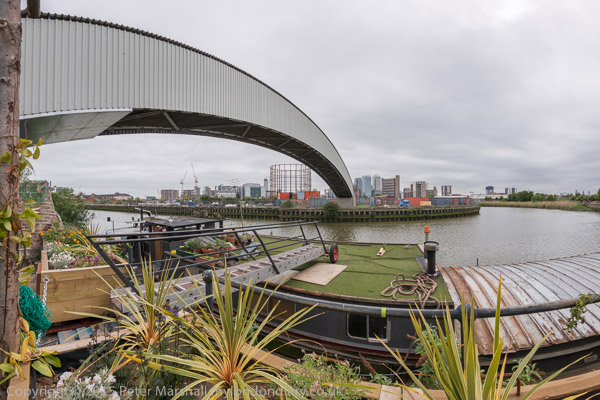
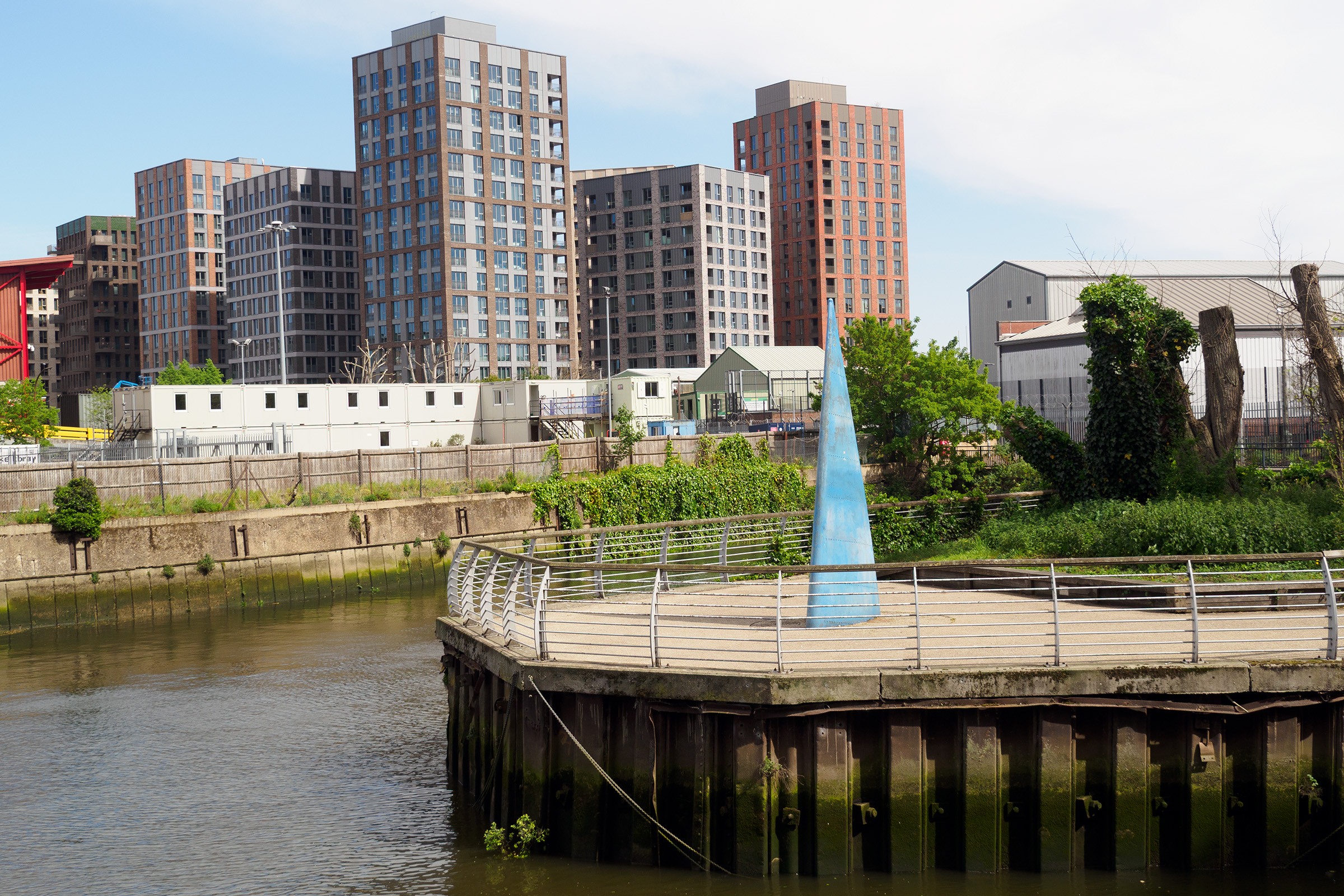
The main purpose of my visit to the Isle of Dogs was to make panoramas of scenes which I had photographed more conventionally over the years, including the black and white images that I included in my book ‘City to Blackwall‘ and more of them are now in my albums on Flickr.
I had gone back so make some panoramas in the area in the 1990s and early 2000s, using various panoramic film cameras, but the switch to digital had made creating panoramic images much simpler for me.
Perhaps the most important change was in accurate viewfinding – with my first panoramic film camera the most accurate way to see the extent of my pictures was by viewing along two arrows on the top of the body – much more reliable than its viewfinder. But of course digital also gave a wider range of shutter speeds and ISO.
And to do this, the camera needed to be firmly mounted on a tripod – and I carried a rather heavy Manfrotto around with me. This also enabled me – with the aid of a spirit level – to ensure that the camera was level. The Nikon I used for these panoramas had level indicators in the viewfinder and was easy to use handheld.
However to make these on digital I needed to use a fisheye lens – the 16mm Nikon fisheye. Not the kind that gives a circular image, but a full-frame fisheye where the image circle goes through the corners of the frame. This gives a 180 degree image across the frame diagonal, but rather less horizontally and vertical, with considerable curvature of straight lines.
Software – I then used PTGUi for these – than comes to the rescue, converting the spherical perspective into a cylindrical one which rendered verticals upright (there are several ways this can be done with slightly different results.) Later I moved to simpler software.
With the 36Mp Nikon D800E there were far more pixels than necessary even after this stretching and this was no longer a problem. I could work with single exposures rather than stitching together several images as I had done earlier with digital cameras.
Although I had mainly gone to make panoramas I also took a Nikon D700 body and made pictures with a 16-35mm Nikon zoom. Not everything is best suited by the panoramic treatment.
Again there are many more pictures at Isle of Dogs.
Class War ‘Poor Doors’ picket Week 6 – Aldgate
A police officer watches as people walk down the alley leading to the ‘poor door’ of the luxury development
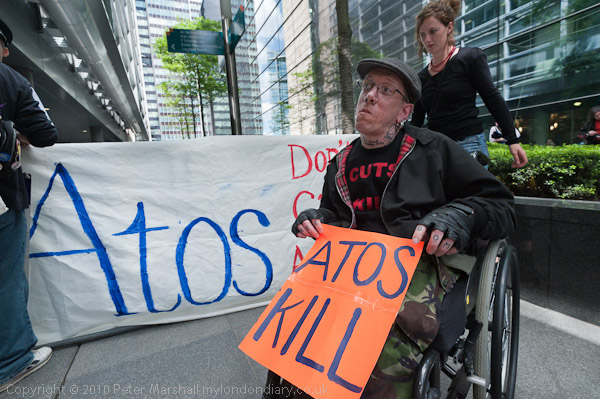
Class War and friends held their sixth weekly protest outside 1 Commercial St in Aldgate and it was a relatively uneventful one.
As the protesters arrived, two police officers came out from the building and talked with the protesters making clear that they expected the protesters not to block the doorway for people entering or leaving the building. More officers soon arrived to police the event.
There were a few heated arguments between protesters and police but nothing of any consequence. The protesters held their banner well in front of the door.
They talked and handed out leaflets to people leaving and entering the ‘rich door’ as well as to people walking past – and to at least one cyclist stopped at the traffic lights.
After keeping up the picket for an hour as intended, Class War packed up and left – until the next week.
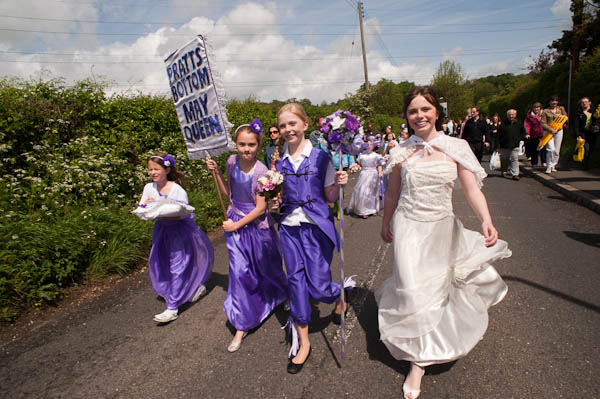
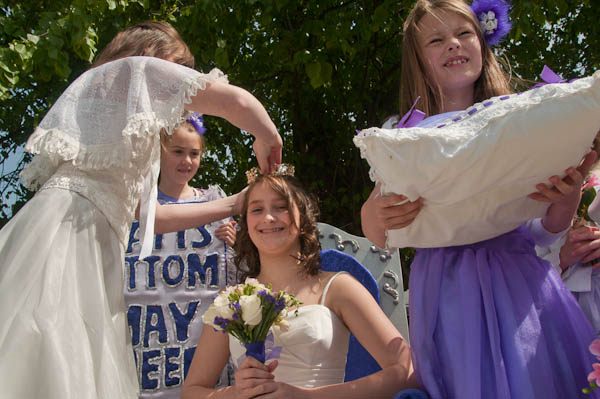
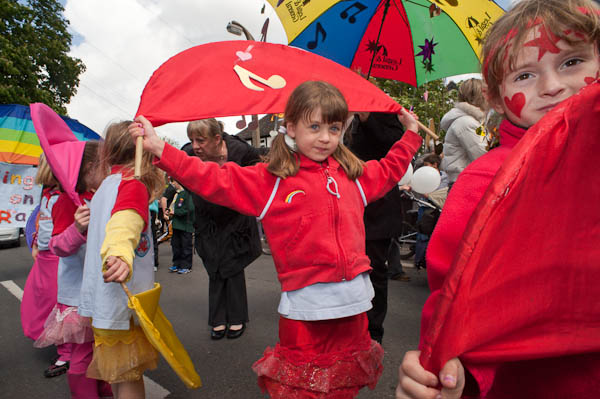
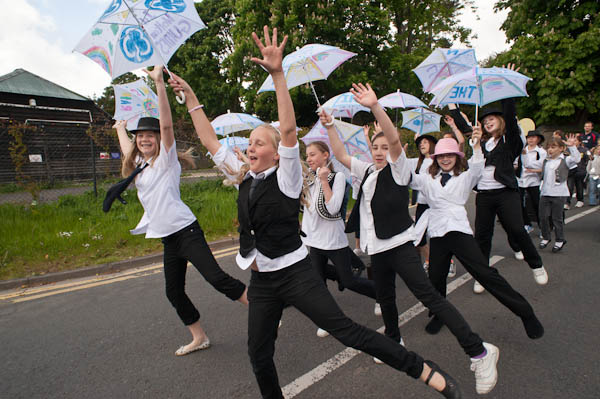
Kingston Carnival: On Sunday 2 September 2007 I went to Kingston to photograph the carnival.
Kingston is a town I’ve visited fairly often over the years, though mainly just going through it or changing buses to meet friends or go to meetings elsewhere, but I’ve never really got to know. Its an ancient town, where Saxon Kings were crowned and the street layout in its central pedestrianised areas still follows much of its complex medieval pattern. It includes several pubs worth a visit.
Kingston (officially Kingston-upon-Thames) also has a fine museum where I was pleased to be a part of a show, Another London, in January 2007 along with Mike Seaborne and Paul Baldesare – which you can still see online. Among my 26 pictures which featured in it were three made in Kingston including two from the 2006 Kingston Carnival, as well as two from adjoining Surbiton.
The museum also has a permanent exhibition of Kingston’s most famous son, photographer Eadweard Muybridge, (1830-1904) best known for his pioneering studies of animal movement beginning with pictures of the racehorse Occident owned by the former governor of California, Leland Stanford made in 1878 using a line of 12 cameras triggered by strings the horse ran through.
His work had been interrupted earlier in 1875 when he was on trial for murder after having shot his wife’s lover. His lawyer pleaded insanity presenting evidence that he had bouts of unstable behaviour caused by a severe head injury in a stagecoach accident in 1860 and the jury acquitted him recording a verdict of justifiable homicide.
The centenary of Muybridge’s death in 2004 was celebrated in Kingston including by my late friend photographer Terry King whose re-enactment of Muybridge’s work using twelve 10×8 cameras at Ham Polo Club. Modern ponies apparently refuse to run through strings thinking they are an electric fence and a different method had to be found to trigger the special shutters attached to the cameras.
Kingston’s 25th Carnival takes place on Sunday 7th September 2025, and I might just go along again, though I don’t think I’ve been to it since 2007.
I didn’t write a great deal about it in 2007, but here it is:
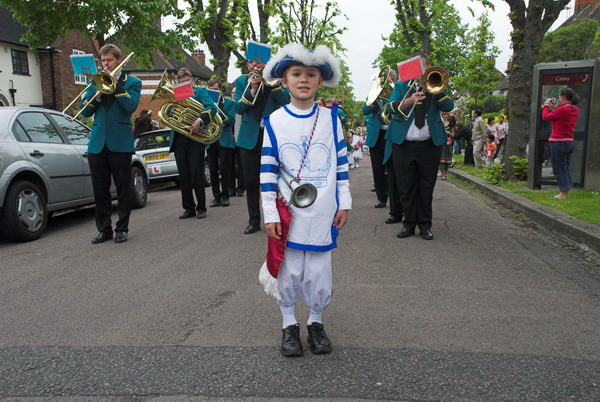
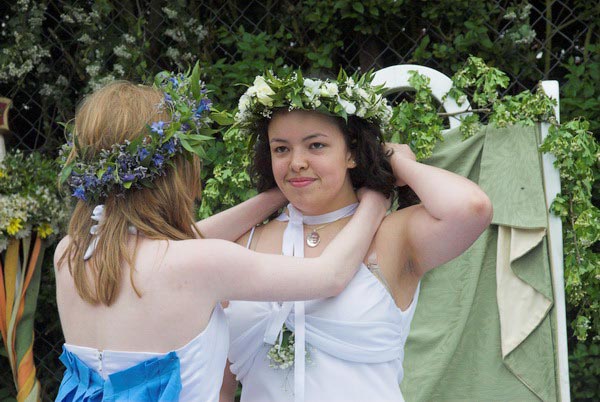
“This year’s Kingston Carnival was a much more exciting event than last year’s but there was still a large rent-a-carnival aspect to it. Kingston is an ethnically rich borough, and although there was plenty of home-grown talent on display, particularly in the performances by youth from the borough, the procession was still dominated by out of town talent.
“It’s great to encourage diversity, but I think a borough carnival has a duty to promote its local expression rather more, even if it might mean – at least until it built up more – a rather less flashy display.
“Of course it was good to see a greater diversity among the ‘foreign’ talent that paraded past the rather dazed looking shoppers along Kingston’s pedestrian streets, including even some clog dancers from Croydon, along with Caribbean groups.
“Beeraahaar Sweet Combination, based in Stamford Hill enlivened the main parade, and the elaborate larger costumes from Paddington Arts arrived later to play their part.”
Westcombe Park and Blackheath: On Saturday 20th January I got off a train at Westcombe Park station to begin another walk. Westcombe Park is in the London Borough of Greenwich and is at the east of Greenwich and north of Blackheath. Twelve years after I made this walk the Westcombe Park Conservation Area was designated in 2002.
House, 146, Humber Rd, Westcombe Park, Greenwich, 1990, 90-1h-21
Banker John Julius Angerstein (1735-1823) bought a large part of what had been parkland around a large country house to build his own house, Woodlands, now a Steiner School and the only listed building (Grade II*) in the area.
It was only when a large area of land was sold in 1876 that residential development of the area was begun – after a false start the Westcombe Park Estate Company was formed in 1878. They laid out roads, drains and sewers and offered freehold and leasehold plots for sale with only fairly loose guidelines over what could be built.
The Woodlands, 90, Mycenae Rd, Westcombe Park, Greenwich, 1990, 1990, 90-1h-23
The development from then on was piecemeal and sporadic and by 1900 much was still undeveloped – and the estate company went into liquidation and the remaining land was sold off cheaply. There are a few properties from the 1880s, rather more from the 1890s particularly in the roads close to the station from which city clerks could travel into work. Although Woodlands is the only nationally listed building in the area, there are many locally listed buildings.
The Woodlands, Mycenae Rd, Westcombe Park, Greenwich, 1990, 90-1h-24
Houses, Beaconsfield Rd, Vanburgh Park, Greenwich, 1990, 90-1h-12
These houses are in the Blackheath Conservation Area and are on the north side of Vanburgh Park, so their frontages facing south with views across the common. The road at right angles in the picture is Beaconsfield Rd. These 3 storey locally listed Victorian villas date from 1860-1866 and were designed by architect Henry William Spratt.
Tree, Bower Avenue, Greenwich Park, Greenwich, 1990, 90-1i-62
From Vanburgh Park I walked across into Greenwich Park and then went down Bower Avenue where I found this massive tree trunk.
The Grade II listed buildings of Vanburgh Terrace date from around 1840. I think this view is from somewhere near Charlton Way or Maze Hill. The terrace faces west across the parkland.
A Puzzle and More North London: My post today from my colour work in May 1994 begins with a plea for help. I’ve spent ages trying to find the location of this first picture and hope someone will recognise it and let me know.
As you can see it shows a street with some impressive houses beside a pond. Unfortunately the only information I recorded back in 1994 was on the back of the contact sheet containing this and a dozen other images:
Bounds Green / New Southgate Hendon Barnet Vauxhall : 28 May 1994
On the film this frame comes between one which I think is from Barnet and some which are clearly at Vauxhall suggesting that this may also be in or around Barnet. But I don’t know Barnet at all well and other pictures taken there at the same time do not include a duck pond like this or any of the houses here.
Although my black and white work was fairly well organised at the time – and I was selling some and putting work into libraries, colour was then simply personal projects. At the time I was also working in south London, and this picture could possibly have been taken there. I’d like to know.
Hobart Corner, New Southgate, Enfield, 1994, 94-53-62
Henlys were a major car dealer in the UK mainly for British Leyland, but here they were selling Vauxhall. The New Southgate Gas Works were first built in 1859 and closed in 1972 and this gasholder was a landmark on the North Circular Road until it was demolished in 2014. It was the largest of three on the site and had been built in 1912. It was still in use in 1994 and was only decommissioned in 2001.
Planning permission was given in 2021 for tower blocks with 182 homes on the site but the developer has now dropped these and it is expected to remain empty for several more years.
Chinese Restaurant, Edgware, 1994, 94-54-62
Chinese Restaurant, Station Road, Edgware, 1994, 94-54-64
I made several pictures of this Chinese Restaurant in the centre of Edgware. The reflection in the window shows the building on the corner of Manor Park Road and Station Road.
Northway House, High Road, Whetstone, Barnet, 1994, 94-54-66
Northway House was built in 1968-70 and was a landmark office tower development on the High Road in suburban Whetstone. Back in 1994 it still appeared well-used and in good condition but by 2015 much of it had become empty and dilapidated.
Planning permission was granted to a developer working closely with Barnet Council on a “mixed use residential led mixed use development” which retained and renovated the original building and was completed in August 2025.
Goldies, pub, 58, Regents Park Road, Finchley, 1994, 94-54-51
Formerly known as the Golden Eagle, this pub was demolished in 2002. In its place, just north of the North Circular Road is now Holiday Inn Express London – Golders Green.
There was a pub on this site in the 1930s, built by Charringtons but I think this building dated from the 1950s or 1960s. Possibly it was rebuilt following war damage or because of the conversion of the road to a much wider double carriageway
North and South – London: In May 1994 I was mainly photographing around Enfield, the most northerly of London Boroughs, but in the middle of one film there are a few pictures from Morden, the southern end of the Northern Line. I can’t remember why I made the trip there, possibly on a visit to a friends or perhaps on a family outing to Morden Park on the River Wandle.
This pub or club seems to have had an unusually large number of changes over the years and was also at various times Club X Zone’, Bar FM’, ‘Bell’, ‘Hotshots’, ‘Texas Cantina’, and more. Now a restaurant.
Shop Window, Bush Hill Park, Enfield, 1994, 94-52-61
A strange assortment of clothing on some rather odd two dimensional figures of women with holds in their heads and a line of children’s toys at the bottom of the window.
The Flower Box, Bush Hill Park, Enfield, 1994, 94-52-62
A colourful building though I was sad that parts of the mural below the windows was was obscured by almost empty display stands, one made from milk crates.
The Flower Box, Bush Hill Park, Enfield, 1994, 94-52-65
A small section of the mural from the previous picture shows a wedding couple striding across the fields.
Shops, London Rd, Morden, Merton, 1994, 94-52-44
A fairly typical suburban shopping street with a Boots, Abbey National, Holland & Barrett and at right ‘A NEW FORCE ON THE HIGH STREET’ which I’ve never heard of. The sun is clearly shining but there are ominous clouds above.
Merton Civic Centre, London Rd, Morden, Merton, 1994, 94-52-46
These buildings are still there on the corner of London Road and Crown Lane close to Morden Underground Station and are still Merton’s Civic Centre.
The Civic centre is in a triangle of land surrounded by busy roads. This view seems now largely unchanged except for the names of the shops.
Morden Court Parade, London Rd, Morden, Merton, 1994, 94-52-34
Morden Court Parade is still there a little to the south on London Road from the Civic Centre and looks in rather better condition now. But sadly those 1930s windows have been replaced by fatter plastic double glazing which although greatly more comfortable for the residents both for keeping warm and reducing traffic noise from busy A24 dual carriageway rather spoil the appearance of the building. There are also some new balconies which fit in fairly well with the building and although it has lost than ‘MORDEN COURT PARADE’ from the frontage it has been replaced rather larger on the roof.
More from the Golden Mile continues from where my previous post on my walk on Sunday 7th January 1990, Curry’s, Firestone, A Fountain & Kluwer – 1990, ended. This is my final post on this walk.
Adini, 891, Great West Rd, Isleworth, Hounslow, 1990, 90-1g-12
Just to the west of Syon Lane on the Great West Road in Isleworth is this 1933 Art Deco factory by Wallis, Gilbert and Partners built for William Burnett Chemicals. This was the furthest west of the 1930s commercial buildings on the new road and past it are residential properties in the north of Isleworth and Osterley.
Adini, 891, Great West Rd, Isleworth, Hounslow, 1990, 90-1g-12
The building is I think still in use by fashion clothing firm Adini. In 2023 Hounslow Council turned down a planning application to develop the site retaining and restoring this locally listed Art Deco building but with two six storey blocks containing 51 flats on the site. The developers appealed and I am not sure of the current state of the proposal.
Softsel, 941, Great West Road, Brentford, Hounslow, 1990, 90-1h-65
I hadn’t finished with the ‘Golden Mile’ and turned around and walked east back into Brentford along the Great West Road. 941, the occupied by Softsel was another building by Wallis, Gilbert & Partners for cosmetics company Coty.
This building is now the private Syon Clinic.
Steps, 971, Great West Road, Brentford, Hounslow, 1990, 90-1h-66
Another grand set of steps led up to the factory of Leonard Williams Ltd, who made Packard cars here from 1929. Queensway in 1990 it now leads to DFS Brentford Sofa & Furniture Store, but only these steps remain of the previous building.
Pyrene Building, Westlink House, 981, Great West Road, Brentford, Hounslow, 1990, 90-1h-51
Built 1929-1930 by Wallis, Gilbert & Partners for Pyrene, makers of fire extinguishers it is Grade II listed. The main windows here had already been altered by 1990.
Pyrene Building, Westlink House, Great West Road, Brentford, Hounslow, 1990, 90-1h-44
This grand entrance and the gate posts are perhaps the most interesting feature of the building. The building now provides tailor-made office space for companies of all sizes.
Pyrene Building, Westlink House, Great West Road, Brentford, Hounslow, 1990, 90-1h-44
I still hadn’t quite finished with the Golden Mile, but my final pictures were a set of five pictures of the remarkable former Curry’s HQ at 991 Great West Road which featured in an earlier post – you can see them starting here on Flickr.
Grand Union Canal, Great West Rd, Brentford, Hounslow, 1990, 90-1h-34
I ended my walk by with a final picture looking south from the bridge which takes the Great West Road over the here combined River Brent and the Grand Union Canal before getting away from the noise and dust of the road and walking along the canal towpath to Brentford High Street where I could catch a bus to start my journey home.
Notting Hill Carnival – Children’s Day: Lurid and largely untrue media reports had put me off from attending carnival until 1990, but after I had gone and seen for myself the two days at August Bank Holiday each year became one of my unmissable events of the year.
Each year from then on I went to photograph the revels, trying to capture the spirit of the event in my pictures, and I had some success, with publications and some small exhibitions of the work.
I saw and experience little of the criminality reports of which still often dominate press coverage, with many still trying to get carnival banned or to emasculate it as a static event in Hyde Park or something similar. Opposition to carnival, a great community event, seems at least in part driven by the same kind of racist and classist attitudes that led to Grenfell. I only once in over 20 years came close to it when I caught a pickpocket with his hand in one of my trouser pockets in a densely packed crowd. I grabbed it and pulled it out, to find it clutching an empty wallet – not mine.
Of course I took some sensible precautions, taking only the equipment I needed and keeping a close eye and hold on it. I used a small bag which in crowded areas at least was always around my neck and in front of me rather than on my shoulder, and left my wallet and credit cards at home, carrying enough cash for travel, food and drink in a zipped pocket.
Most of what mayhem there was – and given the huge number of people in the area there was relatively little of it – took place later in the day, after a day of dancing and drinking and after I had gone home, always before the light began to fade.
While I was there the streets were full of people having a good time and happy to be photographed while they were doing so. Mostly they were Londoners, and particularly black Londoners, though some people came from far away for the event. When we were in St Denis at the north of Paris one year I photographed posters advertising trips for the event.
The only real problem I had over the years was with my ears. At carnival you don’t just hear the music, you feel it as the tarmac on the streets vibrates and your internal organs jump around to the beat. For several days afterwards my ears would hurt , my hearing would be dull and my head would still be ringing. Some years when carnival came late in the month I was back teaching within a couple of days and it was hard.
Professional media crews covering the event mainly wear ear protectors, and I did try using earplugs, but found it unsatisfactory. They stopped me experiencing carnival fully and made communication with those I was photographing difficult. It was like eating wearing boxing gloves. So I just put up with being deafened and taking a day or to for recovery.
But by 2012 things were different for me. As I wrote then: “But either I’m getting too old for it, or perhaps carnival is changing, and this year I found it a little difficult. So I went on the Sunday, stayed around three hours and didn’t really want to return for the big day. So I didn’t.“
And this was the last time I went to Carnival. The next year I was away from London and in years since then I’ve thought about it, but not gone. I feel I’ve taken enough pictures of it.
You can see more of the pictures from the 1990s in two albums – Notting Hill Carnivals and Panoramas on Flickr though I’ve still to add some from later years. Many of those from this century are on My London Diary, including many more from 2012 at Notting Hill – Children’s Day.