Palestine, Pancakes, Post, Olympics & Zombies – Tuesday 24th February 2009 was a long and varied day for me and included some serious issues that are still at the forefront of current news as well as some lighter moments – and I ended the day enjoying a little unusual corporate hospitality with some free drinks for London bloggers.
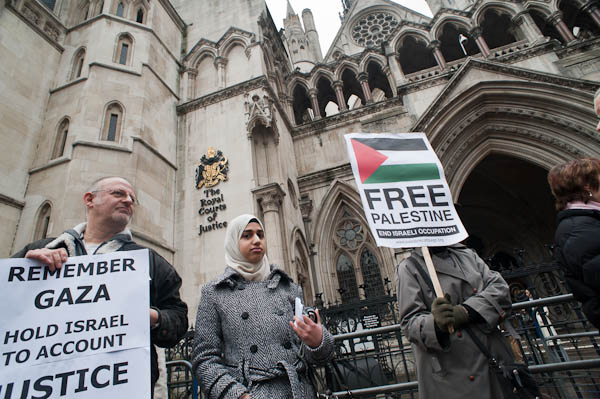
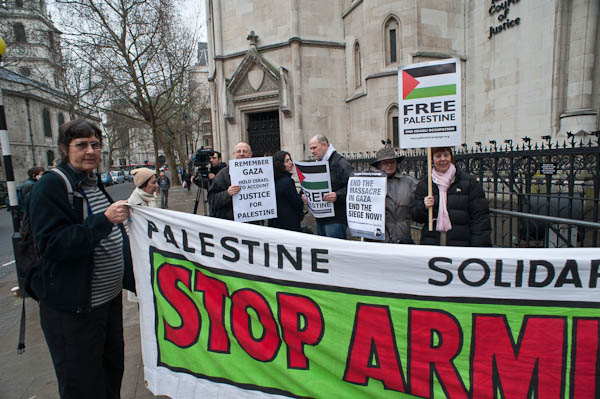
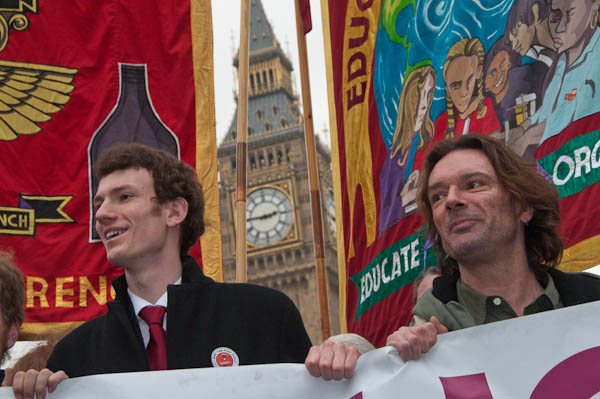
Al-Haq Sue UK Government – Royal Courts of Justice
First came Palestine, with Palestinian human rights group Al-Haq filing a claim for judicial review before the High Court of England and Wales challenging the government’s failure to fulfil its obligations with respect to Israel’s illegal activities in Palestine.
They were calling on our government – then New Labour under Gordon Brown – to publicly denounce Israel’s actions in Gaza and the continuing construction of the separation wall, to suspend arms related exports and all government, military, financial and ministerial assistance to Israel and to end UK companies exporting arms and military technology.
They also asked them to insist the EU suspends preferential trading with Israel until that country complies with its human rights obligations, and for the government to give the police any evidence of war crimes committed by any Israelis who intend to come to the UK.
Of course the court refused Al-Haq’s case, declining to deal with the UK government’s compliance with its international legal obligations and stating that their claim would risk the UK’s diplomatic “engagement with peace efforts in the Middle East“, something which seemed at the time to be absolutely zero if not negative. They also refused Al-Haq any right to bring the claim because it was not a UK-based organisation and “no one in the United Kingdom has sought judicial review of United Kingdom foreign policy regarding Israel’s actions in Gaza“.
Worshipful Company of Poulters Pancake Race – Guildhall Yard
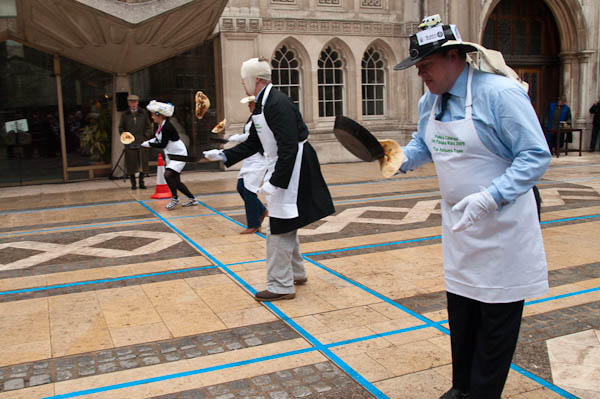
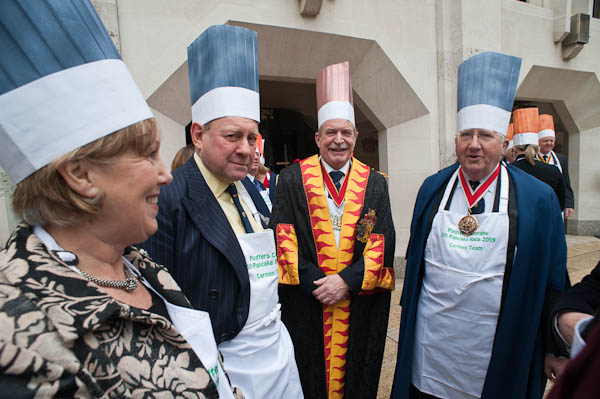
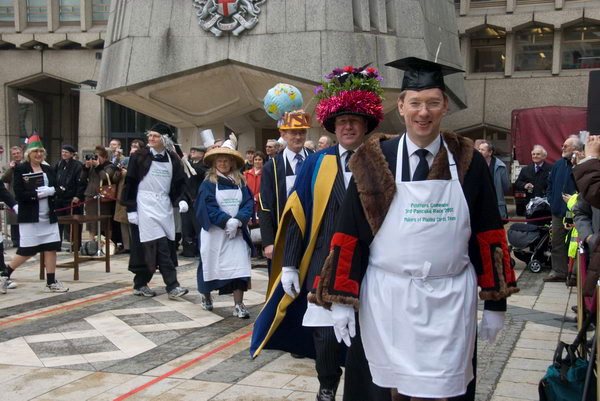
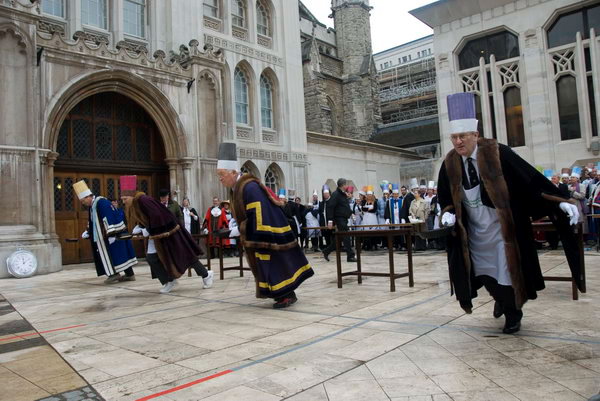
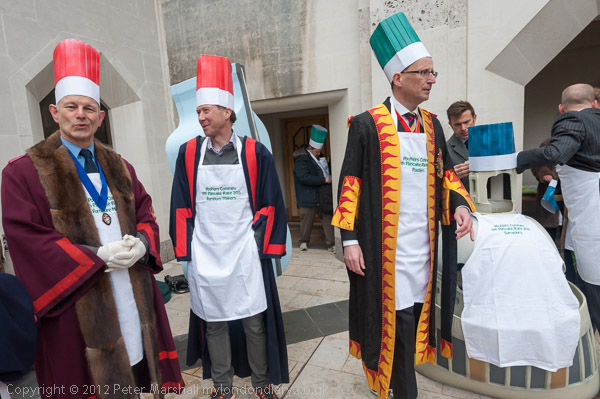
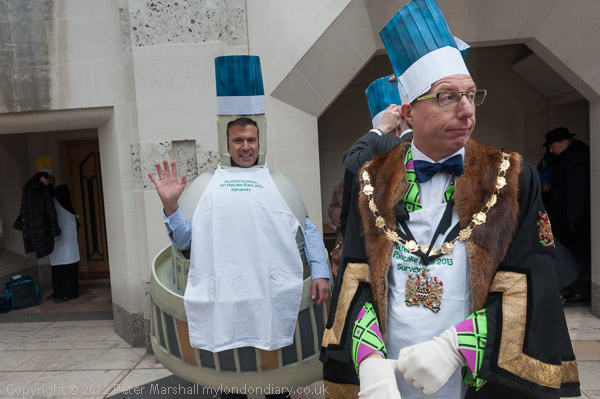
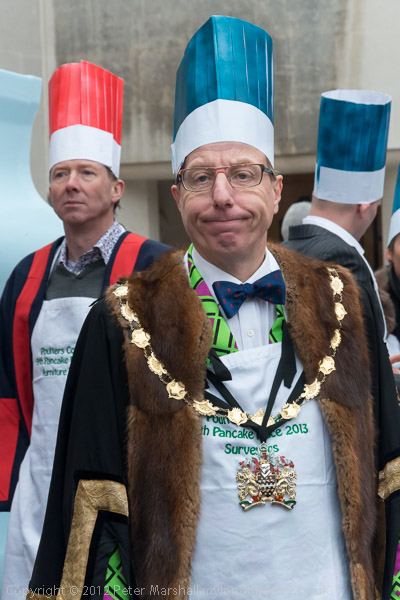
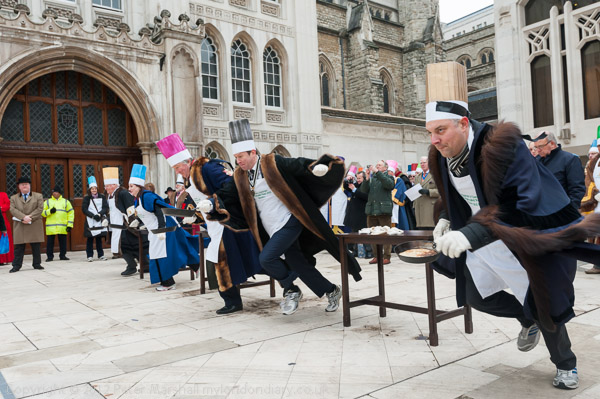
It was Shrove Tuesday and I couldn’t resist the Pancake Race organised by the Worshipful Company of Poulters, and held – with the permission of the Chief Commoner, in the Guildhall Yard.
As I said, “It’s a shame that the Pancake Race is unlikely to feature in the London 2012 Olympics, because it’s perhaps the one sport in which Britain still leads the world, and we seem to have plenty of talent in training.“
Postal workers came out from a rally in Methodist Central Hall against government plans to privatise Royal Mail. The government argued they needed to do this to protect pensions and modernise the service.
Postal deliveries had been deliberately made uneconomic by earlier measures which have allowed private companies to cream off the easily delivered profitable parts of the service, while leaving the Royal Mail to continue the expensive universal delivery service – including the delivery of its competitors post at low regulated prices to more difficult destinations.
The government picked up the responsibility for the pensions when the post was privatised and the privatised post office has been allowed to fail on its delivery obligations. We now get deliveries on perhaps 3 or 4 days a week rather than 6, few first class letters arrive on time, and the collection times for most pillar boxes are now much earlier in the day – now 9am rather than 4pm at our local box. While privatisation was supposed to result in more investment it largely seems to have resulted in large dividends and higher pay to managers and the Post Office is in a worse state than ever.
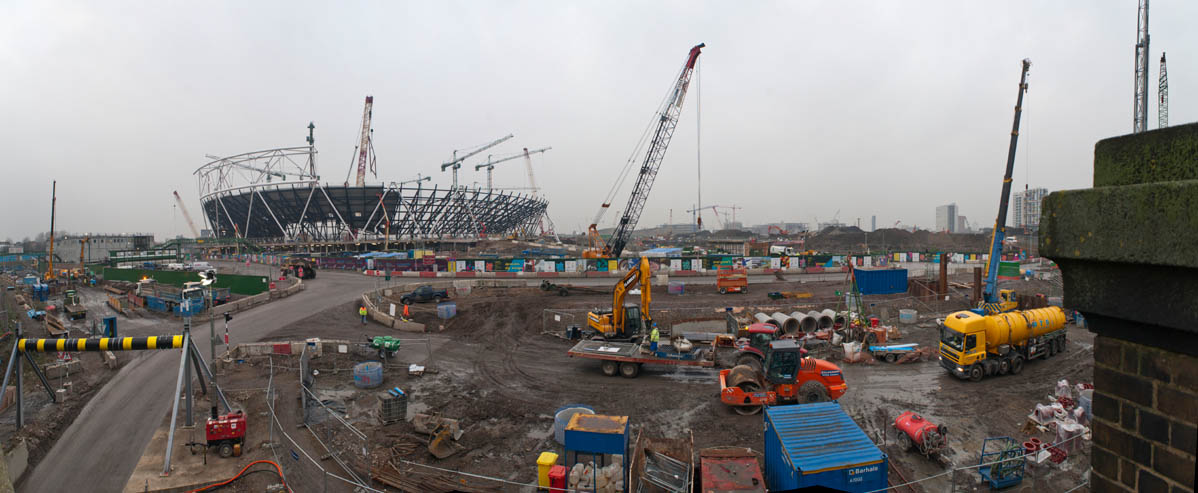
I had time for a brief visit to the publicly accessible areas in and around the Olympic site where a great deal of work was now taking place with the main stadium beginning to emerge.
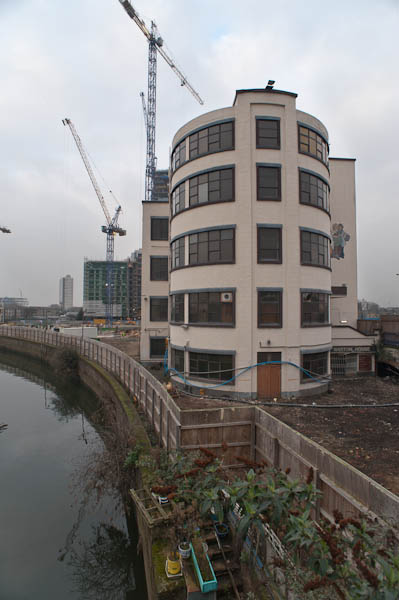
There were some reports at the time that the landmark building Warton House, once owned by the Yardley company with its lavender mosaic on Stratford High Street was to be demolished, but fortunately these turned out to be exaggerated, with only a small part at the rear of the building being lost. But all the buildings on the main part of the site had gone. Some others south of the mainline railway were also being demolished for Crossrail.
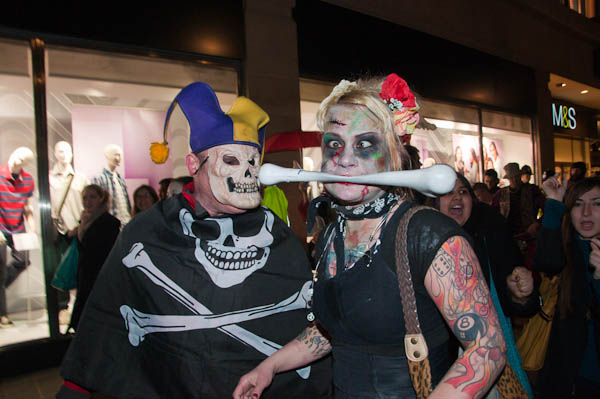
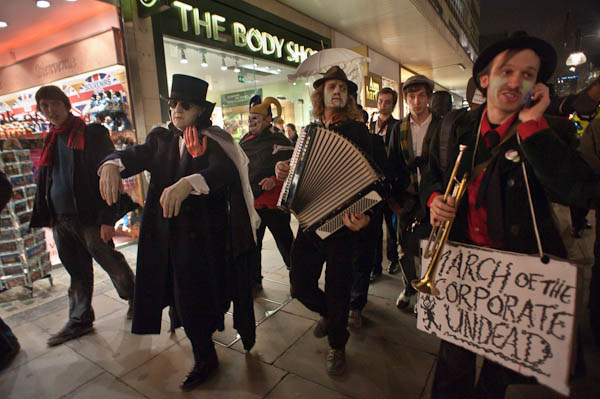
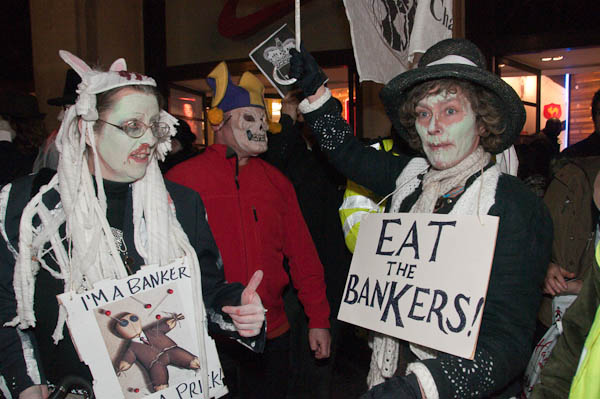
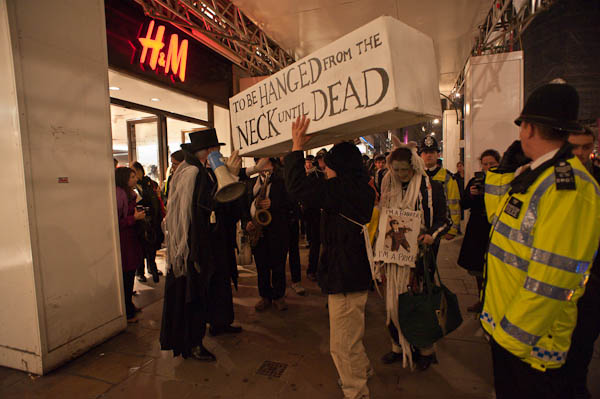
I made my way back to Oxford Circus for the ‘March of the Corporate Undead’, a Zombie Shopping Spree complete with coffins, a dead ‘banker’, posters, various members of the undead and a rather good band.
Police watched in a suitably deadpan manner (I did see one or two occasionally smile) as the group assembled and applied large amounts of white makeup before making its way along the pavement of Oxford Street, to the astonishment (and often delight) of late shoppers and workers rushing home.
We stopped off at Stratford Place, opposite Bond Street Station to toss some fried bankers brains in the frying pans and then there was a pancake race, holding up a Rolls Royce that was prevented by the police from driving through while we were there.
The parade continued, stopping for a minute or two under the bright lights of Selfridges before continuing to Tyburn, or at least Marble Arch, with more zombies joining all the time.
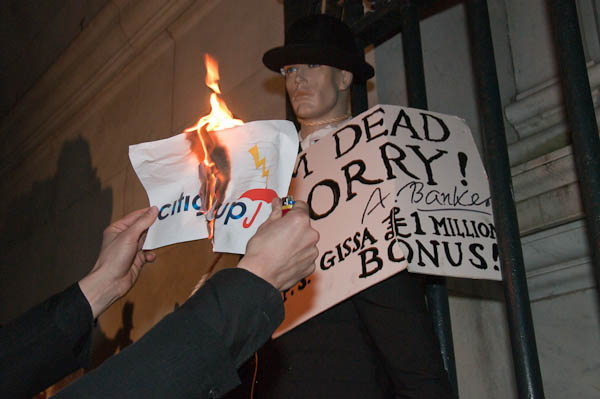
Hanging the already dead banker seemed a great idea, but getting a rope up over the arch was tricky. Eventually a severed hand gave sufficient weight to enable a rope to be thrown over the ornamental iron-work and the banker was soon hoisted up to dangle over the continuing revels below.
This was an anticapitalist event and in particular aimed against bankers and the huge amounts of cash given to them to in the aftermath of the 2007-8 financial crisis which was seen as rewarding the very people who had caused the mess the system was in. The mass of the population was having to suffer cuts in services under a severe austerity programme while bankers were still pigs in clover. The UK has become a very unequal society over the years since 1979 when Thatcher became Prime Minister. The the top 10% got 21% of the UK income, by 2010 it was around 32%.
I left to go to a meeting of London bloggers – and enjoy a few free drinks thanks to Bacardi. The blue and green Breezers seem to me just right for zombies, though I’m afraid after tasting one I went for the beer instead. But I think the zombies on Oxford Street were more alive than those in the corporate world.
House boats, Mooring, River Thames, Chelsea Wharf, Kensington & Chelsea, Battersea Church Rd, Battersea, Wandsworth, 1989 89-8b-35
The churchyard of St Mary’s Church is on the riverside and back in 1989 was the first place I could access the river in Battersea upstream of Battersea Bridge. The churchyard was closed for public burials in 1854.
The moorings here look rather crowded. At Spring Tides the river comes into the churchyard at high tide and I think people living on the houseboats here would need wellingtons, but the tide was low when I made this picture. On the west side of the churchyard is a slipway and past that was Church Wharf, part of Battersea Wharf. Immediately on the corner of the slipway until fairly recently was the Old Swan pub. Once a solid Victorian building it had been replaced in the 1960s by a strange building with much wooden planking and large windows which had become a punk venue in the 70s before closing, being squatted, and becoming derelict and then perhaps conveniently burning down. The block of expensive riverside flats which replaced the pub is named Old Swan Wharf.
St Mary’s, Church, Battersea Church Rd, Battersea, Wandsworth, 1989 89-8b-21
St Mary’s Church is a real gem, Grade I listed, built in 1775-77, architect Joseph Discon, though the painted glass in its East Window is said to date from 1631, attributed to Bernard van Linge and transferred from the previous church building on this site. The stonework around this window is even older, dating from 1379 when the church was owned by Westminster Abbey and they sent one of their masons over for the job.
Bomb damage in the 1940s gave the then vicar the chance to smash some of the “very bad Victorian stained glass” which made the interior gloomy and there are now four modern stained glass windows. One commemorates William Blake who was married here in 1842 and another J M W Turner who was rowed across from his Chelsea house each day and sat at the vestry window to paint his riverscapes. The famous 18th century botanist William Curtis is commemorated in the third, while the fourth is for the US “archetypal traitor” General Benedict Arnold, given by an American donor.
Houses, Battersea Church Rd, Battersea, Wandsworth, 1989 89-8b-24
At the extreme right of this picture is a sign pointing to the riverside walk which began next to the slipway beside the church and in the centre is the rather ugly riverside development of Valiant House, in 1971 one of the earlier blocks of luxury riverside flats. The Survey of London quotes it being described as ‘luxurious and dismal, a high security complex which afforded views of the river as well as the rubbish tips on Chelsea Reach’. It took its name from the former concrete works on part of the site at Valiant Wharf, and perhaps the only mitigating grace of the development was that it provided a narrow riverside walkway, though a little narrow.
The houses at left, probably mainly Victorian with various alterations now look rather different but the facades along the street remain.
Houses, Battersea Church Rd, Battersea, Wandsworth, 1989 89-8b-25
A few yards along the street with an attractive curve leading to Battersea Square the view here seems little changed now. You can see the Grade II listed Raven (no longer a Pub) just to the left of the traffic light.
Lamp post, River Thames, Chelsea Wharf, Kensington & Chelsea, Vicarage Walk, Battersea, Wandsworth, 1989 89-8b-13
The view across the river to Chelsea Harbour. Planning permission was granted for this huge riverside development in 1986 and building proceeded rapidly. By 1989 from across the river it seemed complete and very different to what Sands End would have looked like when Nell Gwyn lived here or when it was a coal dock for the gas works and railways. The old coal dock, became a somewhat shorter marina. The 18 storey tower was erected at a rapid pace, with at one point gaining a new floor every 4 days, and was topped out in six months.
The 310 luxury flats in the new development were marketed with prices starting at around £2 million per property and have 24 hour security patrols and porterage.
Being towed by a tug upriver are empty containers which have carried London’s rubbish away downstream and are now returning upstream to the refuse depot at Wandsworth for refilling with the barge sitting considerably higher in the water. I think this general waste now mainly goes for incineration at Crossness.
Battersea Railway Bridge was built in 1863 and has been strengthened and refurbished in 1969 and in 1992 after I made this picture.
It provides one of relatively few links between railways south of the Thames and those to the north and is used by Overground and mainline trains running between Kensington Olympia (and points north) and Clapham Junction. It is also used by goods traffic which could use Battersea’s extensive rail network to run almost anywhere in the South.
The stretch of walkway by the river leading here through the narrow Vicarage Gardens next to Vicarage Crescent had been opened up some years earlier. But there was still little access to the river beyond the railway bridge. Since then the riverside path now continues through one of the railway arches.
There are plans for a foot and cycle bridge across the Thames next to the railway bridge, but although a start has been made on this project and planning permission was given by both Wandsworth and Hammersmith & Fulham in 2013 I think funding remains a problem; but Wikipedia states ‘The forecast opening date is 2025, taking 18 months to build and audit.’
Battersea Park, Battersea, Wandsworth, 1989 89-8a-12
I’m not what was happening in Battersea Park, and perhaps I had arruved too early.
Battersea Park, Battersea, Wandsworth, 1989 89-8a-21
A tree close to the tent had a rather odd piece of fencing around it and I also photographed this, both with the tent and on its own, though I’ve not put that on-line. I walked on to the Peace Pagoda and took another three pctures – again not posted online, because it was rather better in colour – I think there are eleven images in the colour album for 1989.
Insect, Battersea Park, London, 1989 89-8c-73
And I still can’t tell you what was happening in the park, but here is a picture I think I took a little later before I decided to leave and continue my walk.
Josie 4 Arnie, Battersea Church Rd, Battersea, Wandsworth, 1989 89-8b-55
I returned west towards the centre of Battersea. Back in 1989 the riverside at Battersea was still lined with industry and there was no path west beside the river and I had to go back from the park along Parkgate Rd and then cross Battersea Bridge Road and walk along Battersea Church Road.
There my eye was caught by this rather odd graffiti – back then there was far less on walls in London. I couldn’t decode what the drawing on the wall was meant to represent and I still can’t. On one side of the dark box in the corner was a cartoon rabbit with two terms of affection ‘Hun’ and ‘Snoocums’ with more the more comprehendible message across its door with a heart and ‘JOSIE 4 ARNIE’. At right was an open gate and there were also some interesting shadows.
Rank Hovis Ltd, Battersea Church Rd, Battersea, Wandsworth, 1989 89-8b-42
On Battersea Church Road was the still busy factory of Rank Hovis Ltd although much of the other industry including the Morgan Crucible Company had already gone and its site replaced by housing, beginning at Morgan’s Walk estate in 1984.
The mill here had begun in 1788 with an unusual horizontal windmill built by Thomas Fowler to crush linseed for the oil for paints, but a few years later became used for grinding corn and barley. Around 1825 the mill was taken down and replaced by a steam engine. The mill grew and was eventually taken over by the Mayhew family in the 1890s as Mark Mayhew Mill.
Rank Hovis Ltd, Battersea Church Rd, Battersea, Wandsworth, 1989 89-8b-44
In 1914 the Mayhew’s business was bought by Joseph Rank and became run by Rank’s second son Rowland who used his father’s Hull architects Sir Alfred Gelder and Llewellyn Kitchen to reconstruct and enlarge the site. They managed to get the LCC to waive regulations on building heights to construct the largest grain silos in London so that a whole lighter full of grain could be unloaded at a time.
In 1962, Ranks acquired Hovis McDougal, becoming Rank Hovis McDougal, though by 1989 the McDougal seems to have disappeared. The mills were updated and produced up to 10 tonnes of white flour an hour, using mainly UK wheat delivered by lorry, though some came from Canada and was delivered by barge from Tilbury Docks.
The mills only finally closed around 1992, and were demolished in 1997; the site is now occupied by the tall triangle of Richard Roger’s Montevetro riverside flats, covered at some length by the Survey of London.
Dimson Hall Social Club, Battersea Church Rd, Battersea, Wandsworth, 1989 89-8b-46
Across the road to the south of the road in 1989 was the very different triangle of the Dimson Hall Social Club, part of the extensive Somerset Estate begun by the GLC in 1962 and completed by the London Borough of Wandsworth. This community centre was named after GLC councillor Gladys Dimson who was the GLC housing chair from 1973-77. A colleague of Ken Livingstone, she was also involved with both Shelter and the settlement of Toynbee Hall in East London.
Currently flats on the Somerset Estate are advertised at around almost couple of a million pounds less than their near neighbours in Montevetro.
The riverside developments on the river in Battersea although often controversial do mean there is now a riverside path along virtually the whole length. Back in 1989 there was I think no access for the public between Battersea Bridge and St Mary’s Church where the next post on this walk will begin.
The Raven, pub, Battersea Church St, Westbridge Rd, Battersea, Wandsworth, 1989 89-8a-56
Also at the edge of Battersea Square, on the corner of Battersea Church Street and Westbridge Road is The Raven pub, probably the most significant building in the area, built here in the mid seventeenth century and open as the Black Raven in 1701. Grade II listed it has had various alterations since then but is the only remaining pre-Victorian building in the area. Its value was recognised by a very early listing made in 1954, although it had been extenisvely rebuilt in 1891
Unfortunately this is no longer a pub, but Melanzana, a independent ‘bar-trattoria-deli‘ which according to Camra no longer serving any real beer. You can drink Peroni or wine with your pizza or pasta. I don’t think its interior retains anything of historic interest.
Another image about gentrification. I’d walked back east along Westbridge Road towards Battersea Bridge Road. I think this house was being converted into four flats. This was a significant area of early middle class development in the area in the 1840s with villas with long rear gardens in contrast to the much more downmarket development of what was rapidly becoming an industrial area.
This and its neighbour at 2 Westbridge Road are a pair of Grade II listed Gothic villas dating from 1845, just a few yards from the junction with Battersea Bridge Road. They are included in the Westbridge Road Conservation Area, much of which was developed by 1865. The appraisal describes them as “napped flint faced Gothic villas, quite unique in the district” and gives a further description of them along with a photograph from across the street taken in winter.
In August when I made my picture the houses were largely hidden by the leaves on the trees in their garden. But my view through the open gate does show the statue in the niche at the top of the building more clearly. The pair of houses also have an unusual front wall and gates.
Cranbourne Court, 113-115, Albert Bridge Rd, Battersea, Wandsworth, 1989 89-8a-45
A number of blocks of mansion flats were built in the 1890s on the edges of Battersea Park along Prince of Wales Drive and Albert Bridge Road, their position with views across of the park making them attractive to wealthier middle-class tenants who needed to live close to the West End. Chelsea was too expensive but this area was only just south of the river and not really in those dangerous areas where posher Londoners (and taxi drivers) feared to go. Apparently adverts for some of the new blocks gave their address as Chelsea Reach, Battersea – estate agents today are still often rather inventive in their descriptions of locations.
According to the Survey of London, almost 1,000 apartments were built here between 1892 and 1902.
The development here was suggested by architect and property speculator John Halley, who had moved south to London from Glasgow in the 1880s and had already put up blocks in Kensington. His plans were too dour for London, resembling Glasgow’s tenements, and he teamed up with another architect William Isaac Chambers who pimped them up for London tastes, though other architects made changes too as The Survey of London article recounts.
Cranbourne Court was one of the last blocks to be built, with Halley again involved along with one of his earlier co-developers, Captain Juba Page Kennerley, “a colourful character who had dabbled in a variety of dubious money-making schemes” and who was “indicted for theft and declared bankrupt” in the early 1890s. An undischarged bankrupt, he had set up a building company under an alias ‘Cranbourne & Cranbourne’ who built this block in 1895.
Albert Bridge, Battersea, Wandsworth, 1989 89-8a-31
Albert Bridge is a curious mixture, built as a modified cable-stayed bridge using the system patented by Rowland Mason Ordish and William Henry Le Feuvre in 1858. This made use of a normal parabolic cable to support the central span of the bridge but used inclined stays attached to the bridge deck and connected to the octagonal support columns by wire ropes to support the two ends of the load. Ordish’s designs, made in 1864, were only built in 1870-3.
River Thames, Albert Bridge, Battersea, Wandsworth, 1989 89-8a-35
When the Chief Engineer of the Metropolitan Board of Works Sir Joseph Bazalgette inspected in the bridge in 1884 he found corrosion of the staying rods had made the bridge unsafe and he added steel chains and a new timber deck.
In 1972 the bridge was again found to be unsafe, and the LCC added two concrete piers to support it in mid-river, turning the central section into a beam bridge, though the earlier cables and stays remain in place.
This was one of London’s earlier wobbly bridges (along with Battersea Bridge) and because of its closeness to Chelsea barracks a notice was attached to this “Albert Bridge Notice. All troops must break step when marching over this bridge.” It was feared that troops marching in unison could set up a resonance such as that which had been blamed for the collapse of the Broughton Suspension Bridge in Salford in 1831. The notices now on the tollboths date from 1965 but are said to be replacements of earlier notices on the bridge.
River Thames, Albert Bridge, Battersea, Wandsworth, 1989 89-8a-34
The view upstream from the bridge across the River Thames past Battersea Bridge to tower blocks on the 1970s World’s End Estate and the Lots Road Power Station.
I walked on into Battersea Park where the next post about my walk will continue.
Pancakes, A Farm & Another London: My working day on Shrove Tuesday, 20th January 2007 began in Guildhall Yard in the City of London, where by permission of the Chief Commoner the Worshipful Company Of Poulters were holding their annual charity pancake races. The Poulters got their charter to regulate the sale of poultry and small game in 1368, but their pancake races are a rather more recent tradition, first run in 2005.
Music for the event came from the Worshipful Company Of Musicians (1500), time-keeping was by the Worshipful Company Of Clockmakers (1631) and a starting cannon for each of the many races was provided and fired by the Worshipful Company Of Gunmakers (1637.)
Although this is a charitable and fun event it fully demonstrates the competitive spirit at the heart of the city. More pictures on My London Diary.
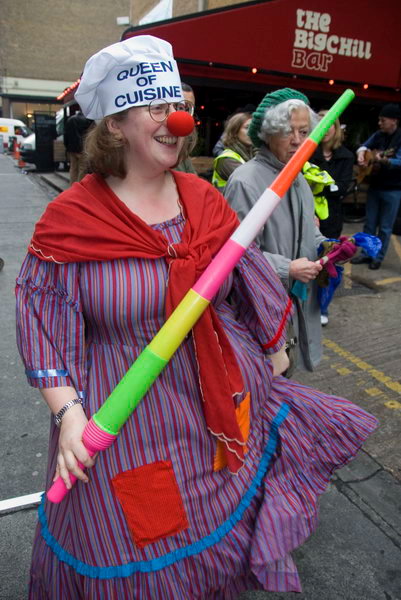
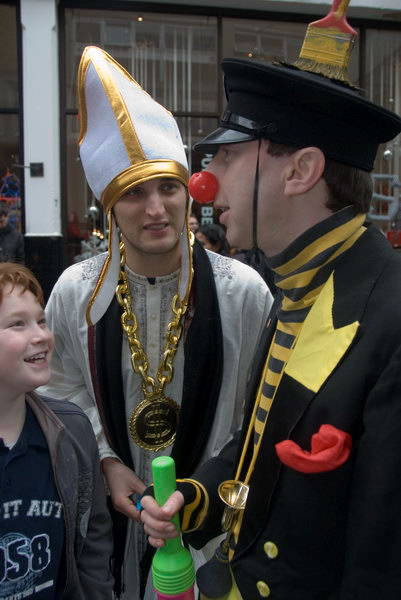
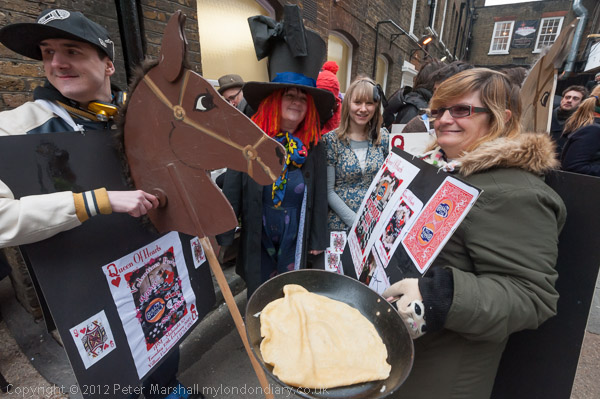
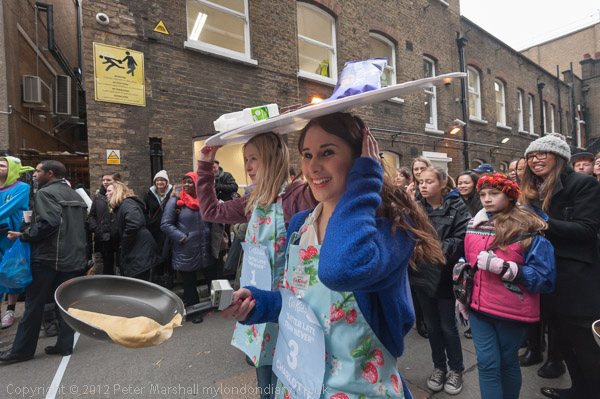
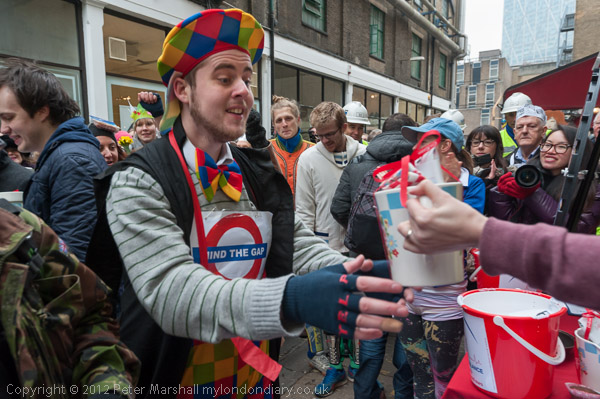
From Guildhall I rushed to another pancake event on the edge of the City, the Great Spitalfields Pancake Race at the former Trumans Brewery, arriving very out of breath just in time to see the finish of the final race and to photograph some of those who had taken part in fancy dress and the prize-giving.
As I commented, “the atmosphere was considerably less restrained than in the City.” More pictures.
From there a short walk took me on a visit to Spitalfields Urban Farm, one of a number of urban farms set up in the 70s and 80s (1978 in this case) on waste land. This area had formerly been part of a railway goods depot next to the line out of Liverpool Street. It now provides an environmental education and a great deal of enjoyment to people of all ages in the local community.
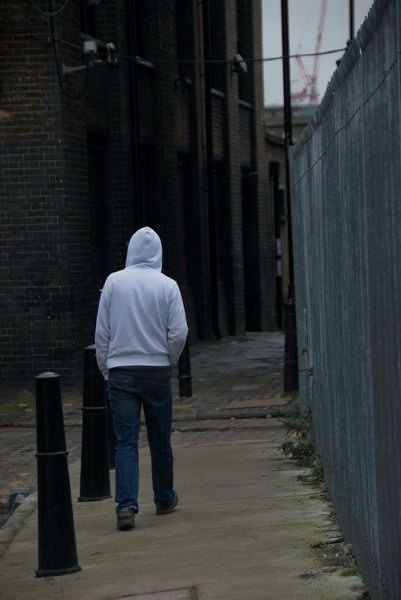
I was meeting with other photographers later in the day, and still had time to stroll in a leisurely fashion through Spitalfields to Shoreditch to catch the bus, making a few photographs on the way. Back then there was relatively little graffiti on the walls around the disused Spitalfields station and Brick Lane, but now its hard to find a square inch of wall not covered with it. I was photographing in a dark alley leading through to Bishopsgate when a hooded figure strolled past me. Despite the media stereotyping of ‘hoodies’ I couldn’t feel he was in the least threatening; if anything rather more like a monk. More pictures on My London Diary.
I met a group of photographer friends for a meal at an Italian cafe in New Malden and then we went on together to Kingston Museum, where the show ‘Another London‘ including my work along with that of Paul Baldesare and Mike Seaborne was then showing. Of course it closed years ago, but the web site featuring work from it is still on-line.
As the introduction on the site states, the show features “the London of the suburbs, of its deprived areas and of its various ethnic groups” with work by myself an Paul “in the tradition of ‘street photography‘” and Mike’s panoramic urban landscapes some “using the viewpoint offered by the front seat of London buses.”
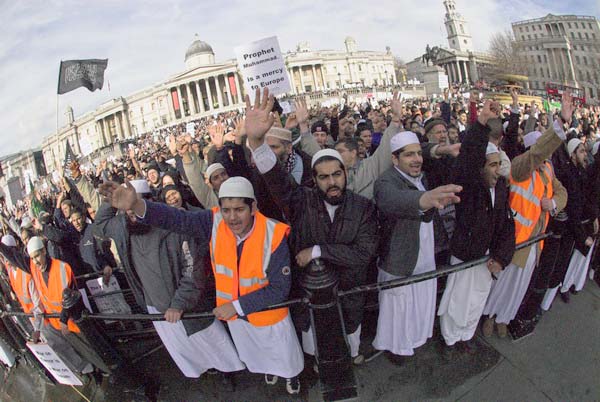
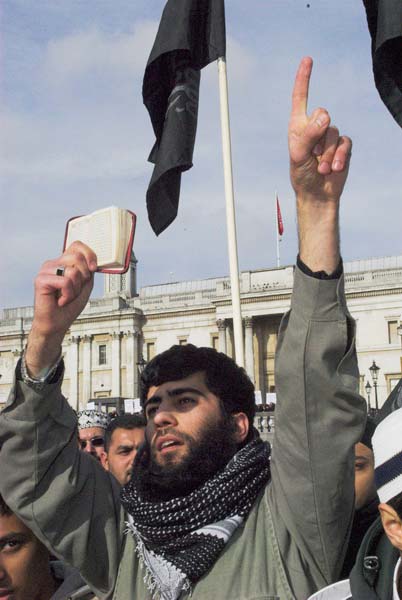
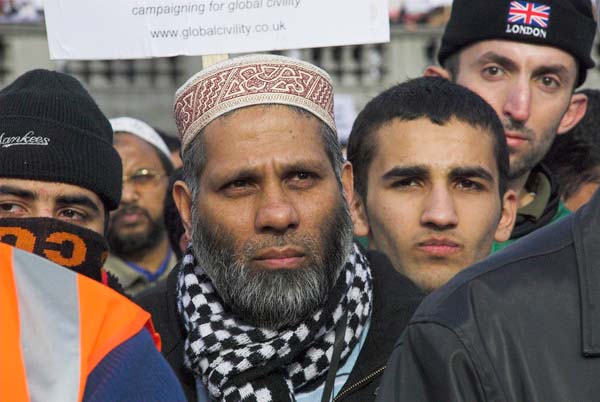
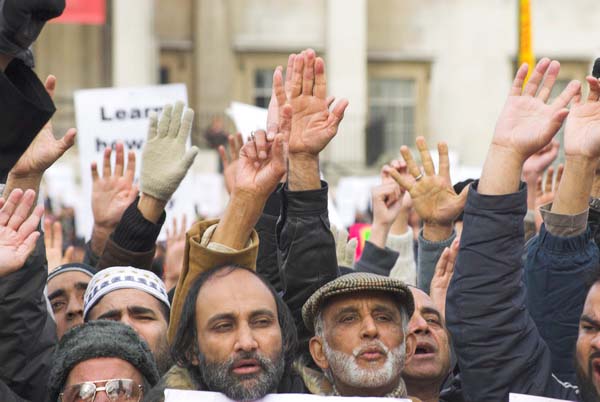
Global Civility and Stratford Marsh – On Saturday February 18th 2006 I photographed one of the continuing protests around the world which followed the publication by a Danish magazine of cartoons featuring images of the Prophet Mohammad in Trafalgar Square, then took the underground and DLR to Pudding Mill Lane station on Stratford Marsh to take more pictures of the area which was to be demolished for the London Olympics.
Proclamation for Global Civility – Trafalgar Square
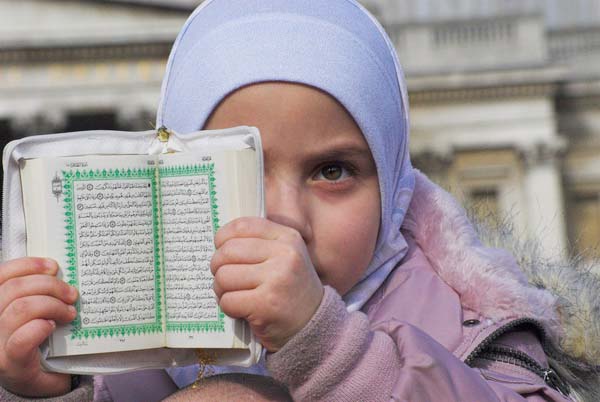
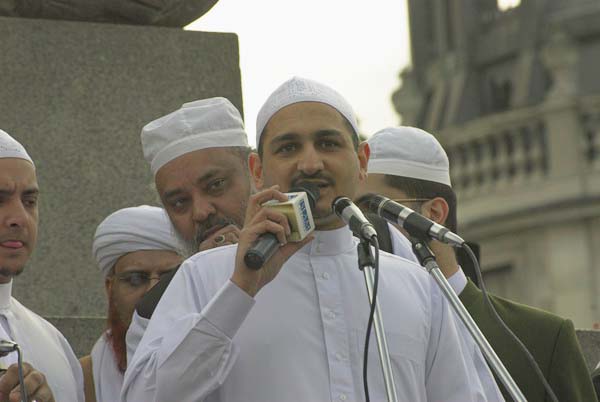
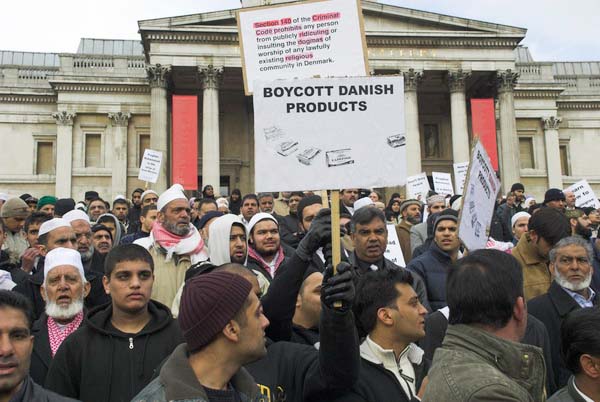
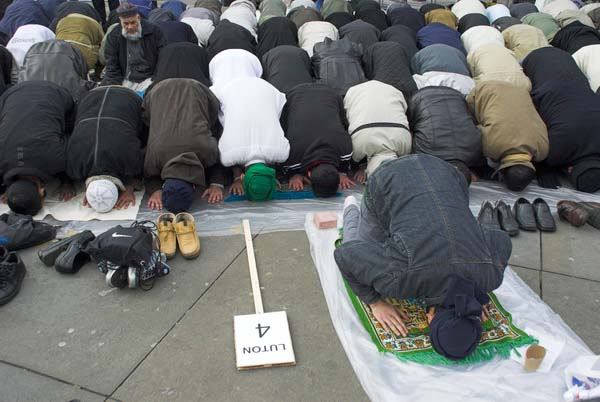
Muslim protesters packed Trafalgar Square for a protest by the Muslim Action Committee over the publication of the cartoons which they regard as blasphemous, but also to publicise a ‘proclamation of global civility‘. The key points of this were the recognition of human dignity as a fundamental right, the need to good manners and etiquette in serious debate, a desire to avoid irresponsible behaviour and to underline the significance of mutual respect for a harmonious co-existence.
The protest in London was kept in good order by stewards who remonstrated with some of the demonstrators who were in some way not behaving as they thought they should, and also moved photographers away from them and some other groups. But other protests around the world were much less restrained and news agencies that same day reported rioting outside the Italian consulate in Benghazi, Libya in which at least 10 people were killed as well as the storming and burning of Christian churches in northern Nigeria with at least 16 deaths.
“As I pointed out in my report in 2006, human dignity was recognised as vital in “the preamble to the Universal Declaration Of Human Rights, adopted and proclaimed by the United Nations General Assembly Resolution 217 of 10 December 1948. That declaration also contains a number of important safeguards such as ‘the right to freedom of opinion and expression‘ and states ‘in the exercise of his rights and freedoms, everyone shall be subject only to such limitations as are determined by law solely for the purpose of securing due recognition and respect for the rights and freedoms of others and of meeting the just requirements of morality, public order and the general welfare in a democratic society.'”
There are still many countries around the world where the principles of human rights in that declaration are not observed, including in many in the Muslim world.
Manners and etiquette are clearly very different in different societies and different religions certainly have very different views, particularly over blasphemy and apostasy. In the west we now prioritise freedom of speech and look back in horror at the Spanish Inquisition and trails for heresy and blasphemy, although in England and Wales, the ‘blasphemy’ and ‘blasphemous libel’ laws were only abolished in 2008, and in Scotland in 2021, while they are still in force in Northern Ireland.
The last conviction for blasphemy in England and Wales was in 1977 when the editor of Gay News received a suspended prison sentence after publishing the poem ‘The Love That Dares to Speak Its Name’ by James Kirkup, and in Scotland it was more than a century earlier when a bookseller was jailed for 15 months in 1843, though until 1825 it had been punishable by death.
While we may find some of the cartoons that were published offensive, it clearly does not justify the irresponsible behaviour and criminal actions of some Muslim mobs protesting against them.
Away from the stewards as I wandered through the crowd I was generally welcomed by the protesters, with many urging me to take their pictures. I left as the speeches, most of which I could not understand as few spoke in English, were finishing and people were getting ready to march,
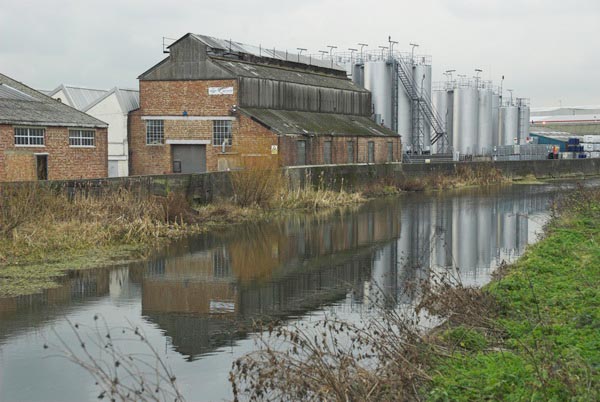
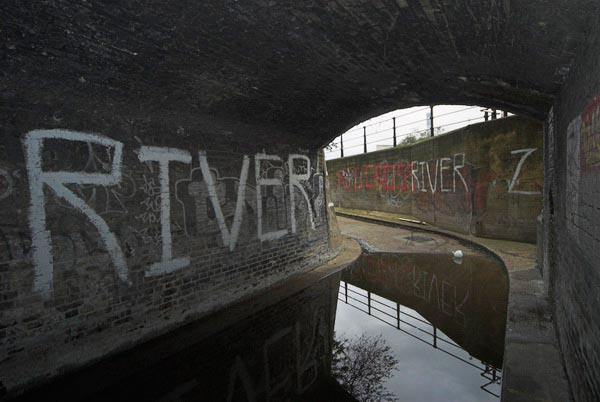
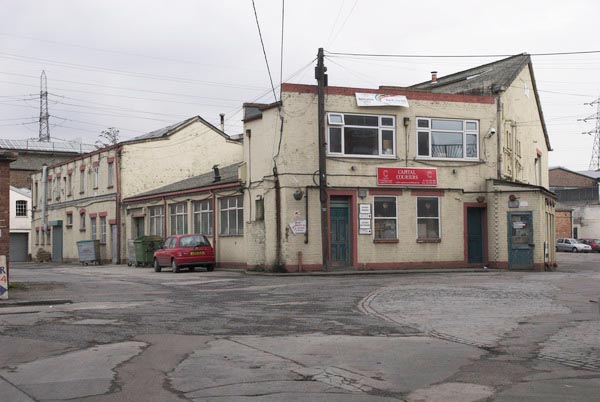
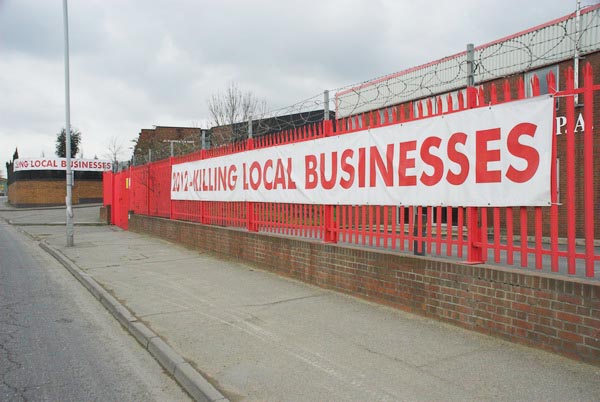
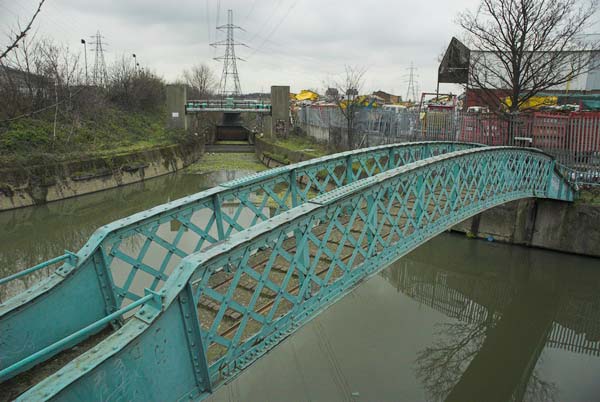
I’d first photographed Stratford Marsh back in the early 1980s as part of a wider project on the River Lea, once a large and important industrial area in London, but like most of British industry falling into decline, accelerated by the policies of the Thatcher government determined to transform Britain away from manufacturing and into services.
Stratford Marsh was then full of largely small businesses employing local people and many still remained in 2006, though already blighted both by government policies and the tax breaks given to the nearby Docklands area. Now Olympic blight had set in with the whole area to be remodelled, and there were also areas which would be demolished for Crossrail.
As I wrote back then and I think my pictures show:
It is still an intriguing area, where a few yards can take you from wilderness to industrial wasteland, from dereliction to busy workshops (though most were closed on a Saturday afternoon.) Parts are visibly closing down, with compulsory purchase orders hanging on lamposts, some footpaths closed and factories demolished.
There was one small sign of a kind of regeneration. the unusual lock between the Bow Back Rivers and Waterworks River at Baker Road, for many years derelict, at last seems to have been replaced.
My walk on Friday 4th August 1989 began at a bus stop on Battersea Bridge Road more or less opposite where I had caught a bus at the end of my previous walk
McCarthy Court is set just a few yards back from the road and I think this picture of it was possibly taken in Bridge Lane. Its two long blocks, one 4-storey and the other 2-storey were built for Wandsworth Council in 1978 with an inner garden between them and they contain 42 one bedroom flats and 36 two bedroom flats. The estate, now with a mix of council tenants, leaseholders and private tenants since 2005 has been managed by the McCarthy Court Co-operative whose board consists of estate residents with one council nominee. I assume McCarthy was the name of some local councillor or officer but perhaps someone in the area can tell me.
It had been planned, as the Survey of London recounted in 2013 as a part of a much larger development by the then Conservative government, but permission for much of this was denied by the Ministry of Housing and Wandsworth was told the houses over much of the site were sound and could be renovated. Writing about these pictures now I often wish that this survey had been available when I was photographing the area, as there were few published sources then.
Bridge Lane, Battersea, Wandsworth, 1989 89-7o-15
The first Battersea Bridge was a toll bridge which replaced a ferry across the River Thames to Chelsea and was opened to pedestrians in 1771 and to horses and carts the following year. Designer Henry Holland had been forced to cut costs and the bridge was narrow and dangerous both to users and river traffic, but with some reinforcement it lasted until 1885, the last wooden bridge over the Thames. This bridge was painted by almost every significant British painter of the age including Turner and Whistler.
Presumably Bridge Lane used to lead to the bridge, though it now stops short, and may in earlier times have led the the ferry. These houses on Bridge Lane are presumably Victorian and may have been among those saved from demolition by the Minstry of Housing in 1968, though I think these are what is now number 1 and 2 on the north side of the road, despite the number 9 in my picture and 15 on one of the doors.
Bridge Lane, Battersea, Wandsworth, 1989 89-7o-16
An interesting use of piles of bricks on top of both rectangular and cylindrical columns on the gate and steps to this house. I don’t think these have survived.
Back in the 1960s the Tate Gallery had paid Carl Andre a little over £2,000 for a pile of bricks, causing huge controversy over what many considered a waste of money. These seemed to me rather more interesting.
Bridge Lane ends at Surrey Lane and I turned west down it and then down Orbel Street. The estate here was built in the 1870s and 80s, and the northern side of Orbel Street is lined by semi-detached two storey houses with only vestigial front gardens.
You can stil see the short section of fencing between the two doorways of 70 and 72 on the street, unusually ornate for these houses, but the gate and the section fronting the pavement has gone. With the leaves from the shrub behind I felt I could almost be in the Palm House at Kew.
The House Hospital, 64, Battersea High St, Battersea, Wandsworth, 1989 89-8a-52
Not a medical establishment, The House Hospital at 64 Battersea High Street was for me symbol of the rapid and considerable gentrification of the area taking place as the industries were moving out. It offered replacement doors, at a price unspecified, fire places, baths, basins, taps etc. The site at 64-66 had built in 1975 for the factory of Allen and Ernest Lambert, who called themselves the Allen Brothers and made cigars. It later became a pipe factory for Imperial Tobacco until around 1930. According to the Survey of London “in the late 1950s they were occupied by the Ductube Company Ltd, makers of inflatable tubing for laying ducts in concrete.”
The building at right and the factory site behind has since been redeveloped as ‘Restoration Square‘. Number 64 and therather dull block at left, Powrie House, remain.
Bennett’s Brasserie, London House, Battersea Square, Battersea, Wandsworth, 1989 89-8a-55
James Bennett was a linen draper, who named his business premises very visibly ‘London House’. Originally in a Georgian building on the right of this picture he added to this in a matching fashion across the middle and left of my picture in 1866. I think the ground-floor addition of Bennett’s Brasserie is rather later. The builidng is locally listed. I think ‘London’ was perhaps a suggestion that he sold fine fabrics, not the coarser ‘Manchester’ cloth, as Battersea was clearly back then not in London.
Gordon Ramsey took over the Brasserie in 2014 as a restaurant, but this closed in 2022.
Battersea Square had more or less disappeared off the maps by the 1970s, but the name was restored and considerable work carried out on the area after it was designated as a Conservation Area – the work was more or less complete when I made these pictures in 1989.
More from Battersea in a later post about this walk.
St Valentine’s Day – Reclaim Love: St Valentine was a Roman Christian, possibly a bishop, who was known for his ministry to Christians who were under persecution by the Roman Empire and was martyred and buried near Rome possibly on February 14th 269 AD. Wikipedia has a lengthy entry which goes into the various other St Valentines and the legends associated with him.
The 14th February was established as the Feast of St Valentine of Rome by the then Pope in AD 496 and much later the celebration was also taken up by both Lutheran and Anglican churches. The day was dropped from the official Roman Catholic list in 1969.
The legends which associate St Valentine with romantic love came much later, probably beginning in the age of Chaucer in the late 14th century and invented by him and others around him. With many variations he was said to have fallen in love with the blind daughter of his jailer and shortly before he was executed to have cured her blindness and to have sent her a note. Like in the later traditions of Valentines cards this one was signed simply: “from your Valentine.”
St Valentine as well as being associated with lovers is also the patron saint of epileptics and beekeepers and those suffering mental illnesses and doubtless there are or were legends associated with these too. Parts allegedly of him are kept as relics in churches in Rome, Madrid, Dublin and around a dozen other places around Europe, including in the Gorbals in Glasgow and Birmingham Oratory.
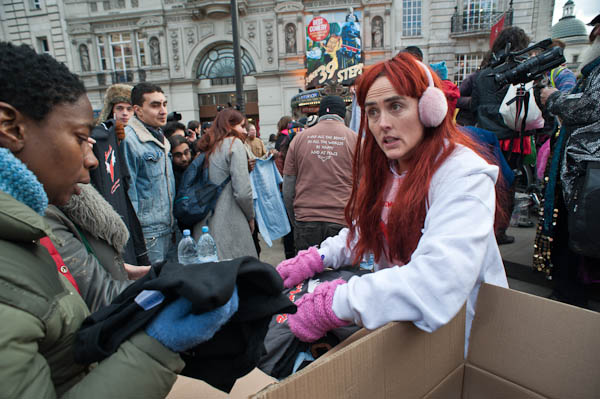
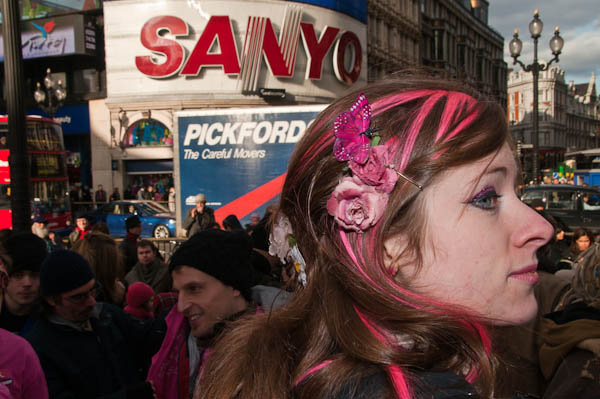
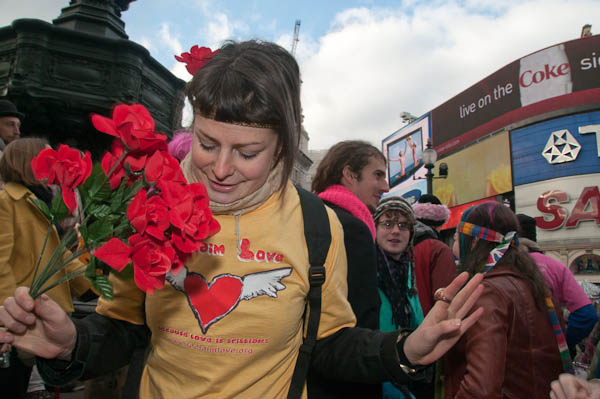
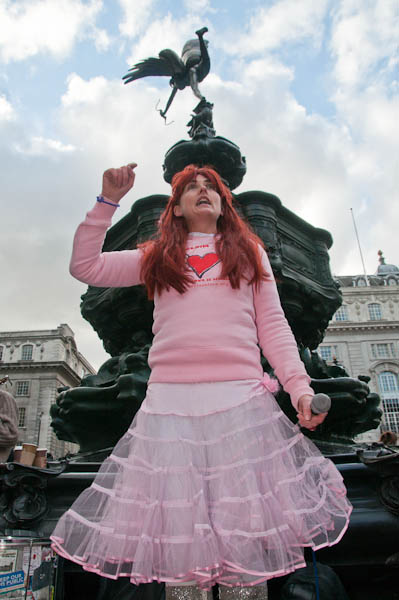
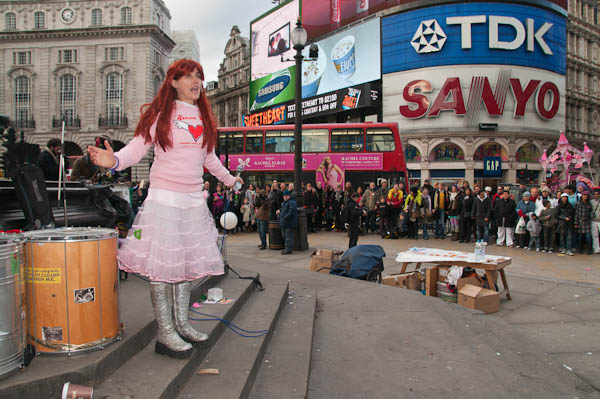
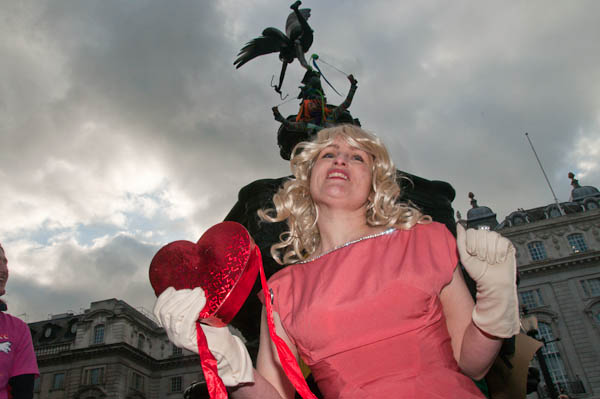
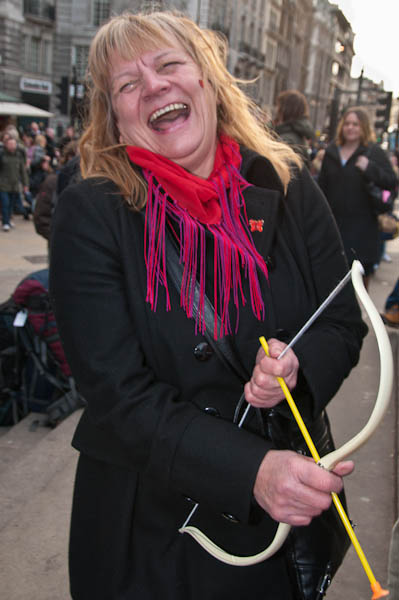
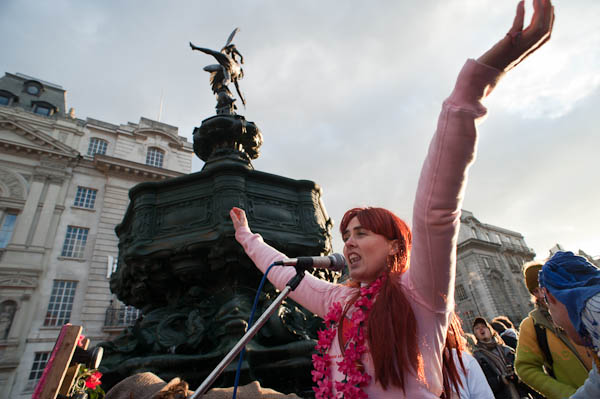
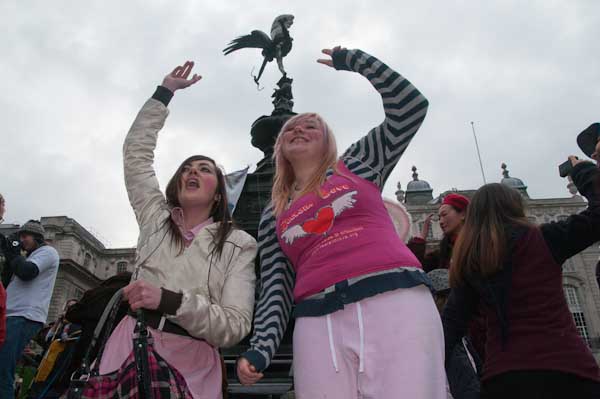
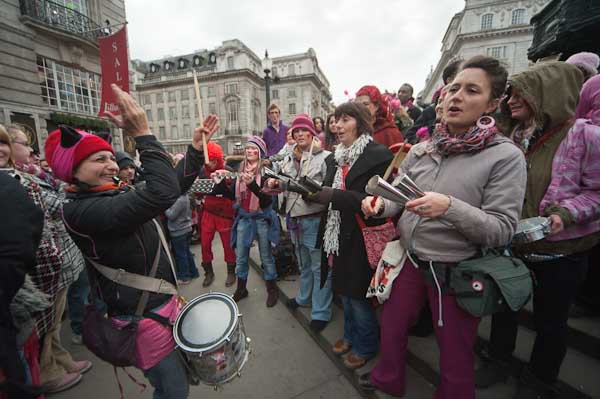
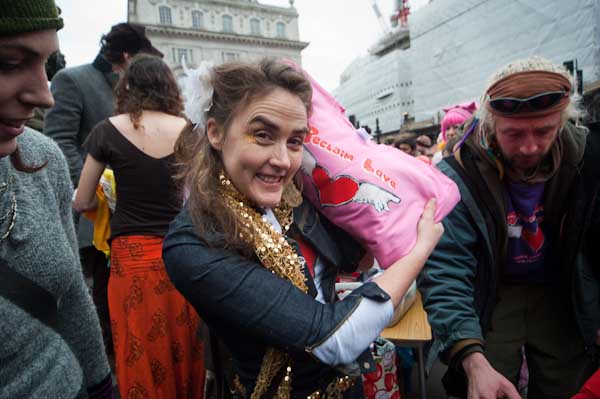
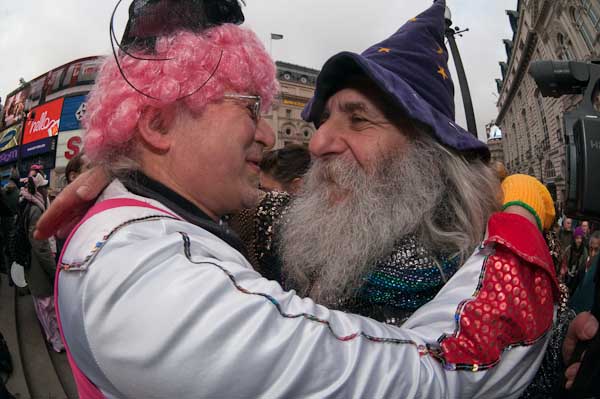
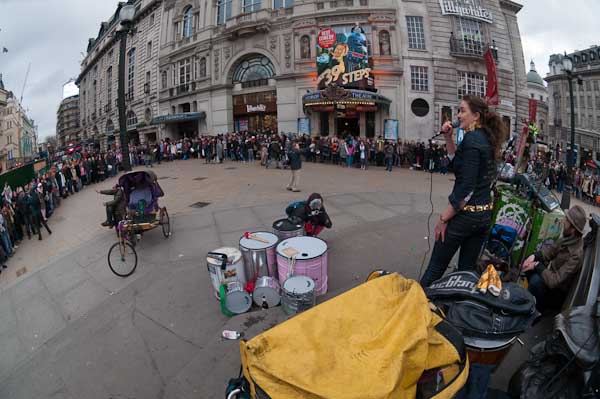
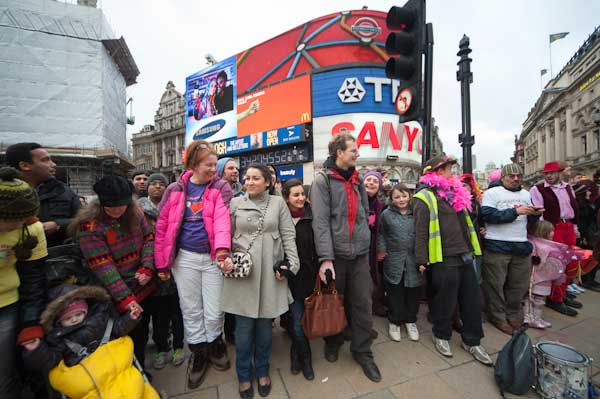
The Reclaim Love Valentine street parties around the statue we wrongly call Eros at Piccadilly Circus were started by the remarkable Irish poet and activist Venus CuMara. They took place on the Saturday closest to the 14th and in 2009 it was actually on the 14th. In this post are a few of the pictures I took on 14th Feb 2009 at the party, and the text I wrote about the event.
This was the sixth annual Valentine Party at Piccadilly Circus, around the statue of Eros, organised by Venus to celebrate “to celebrate the Greatest thing on Earth and the Greatest thing we have inside…Yes, Love!!!” and it was the largest yet, filling the area around with people.
As well as the party at Picadilly Circus, at least 15 similar events were taking place around the world, in Ireland, France, Luxembourg, Iceland, Finland, Italy, Spain, India, Pakistan, Australia, New Zealand …
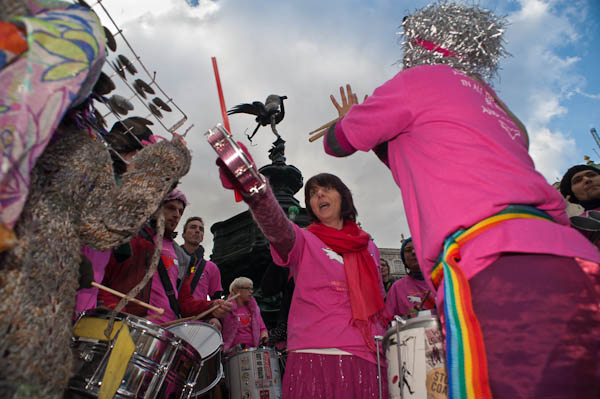
The climax to the event was when all of those present formed a giant circle linking hands in the “Historic Annual Earth Healing Circle.” But for several hours we all enjoyed ourselves, dancing to the samba rhythms of resistance and other music, and enjoying the company of other people and remembering what is really important, not just on Valentine’s day but the whole of the year.
Eros may be dominated by those huge neon advertising hoardings the other 354 days of the year, but for one day at least it was surrounded by people dedicated to showing that the best things in life really are free
There are many more pictures on My London Diary at Reclaim Love 6
Tar Sands, Iran & Valentine Party – Three very different events on Saturday February 13th 2013 on the streets of London. First an Olympic-themed protest against one of the dirtiest fossil fuel projects, then a protest by Iranians 31 years after the revolution that brought the Islamic regime to power and finally a Valentine’s Day street party against the commercialisation of the annual event and celebrating the power of love.
Canadian Tar Sands Oily-Olympics – Trafalgar Square
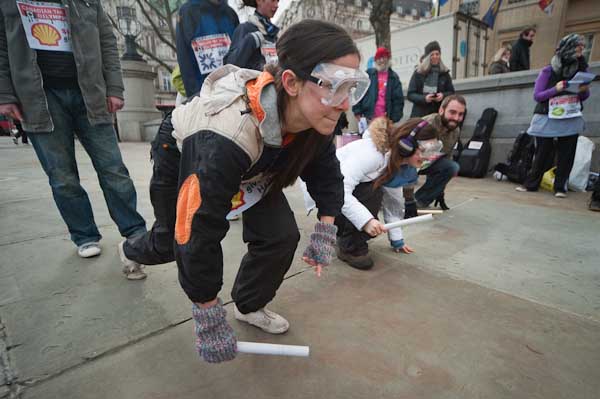
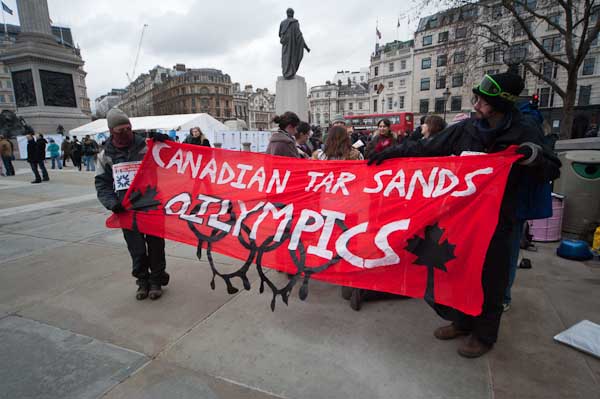
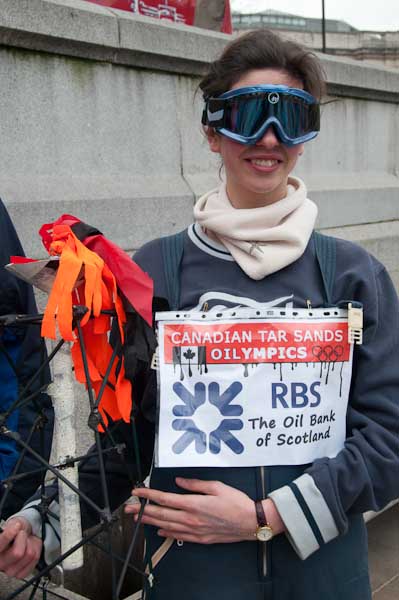
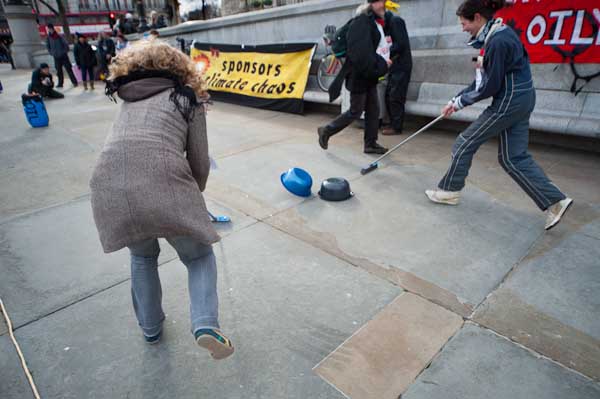
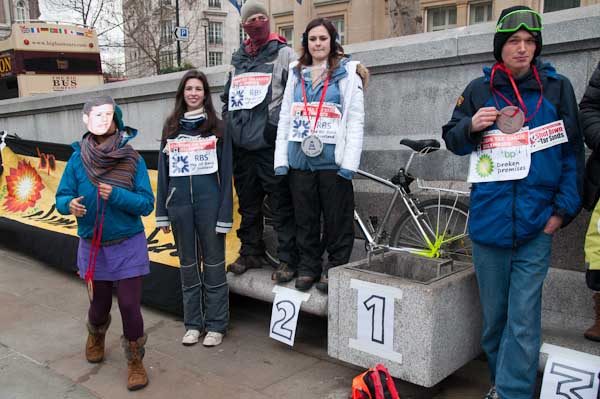
February 13th 2010 was the opening day of the Winter Olympics in Canada, and protesters took advantage of this to stage their own ‘Oily Olympics’, with teams representing BP, Shell and RBS, competing in a ‘Race For the Tar Sands’, complete with a medal ceremony next to Canada House in Trafalgar Square.
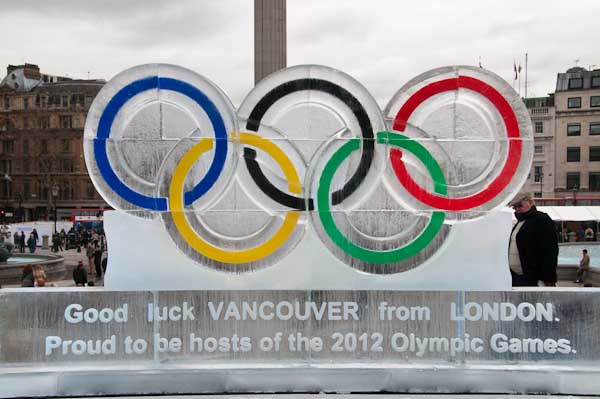
The square was in use for an event celebrating the official Olympics complete with giant screens showing ski jumping and an ice sculpture of the Olympic rings. But the protesters set up on the side closest to Canada House for their tug-of-war, a curling event and a relay race for oil.
Getting oil from the tar sands in what is oddly called ‘The Sunrise Project’ uses a process called Steam-Assisted Gravity Drainage which produces from 3-5 times the carbon dioxide of traditional oil extraction. Until recently BP considered it to be too economically and environmentally unpleasant, but high oil prices and new management had changed their mind.
As well as their huge carbon impact the UK Tar Sands Network say that extracting oil from the tar sands involves “mass deforestation, water pollution, risks to human health, a major threat to wildlife and the trampling of indigenous rights.”
The heritage wardens who patrol the square for the Mayor of London told the protesters they were not allowed to protest in the square, and called the police when they continued. Police came and talked to them but did not stop the event as it was obviously not causing any obstruction or public order problem. Some of the officers were clearly amused.
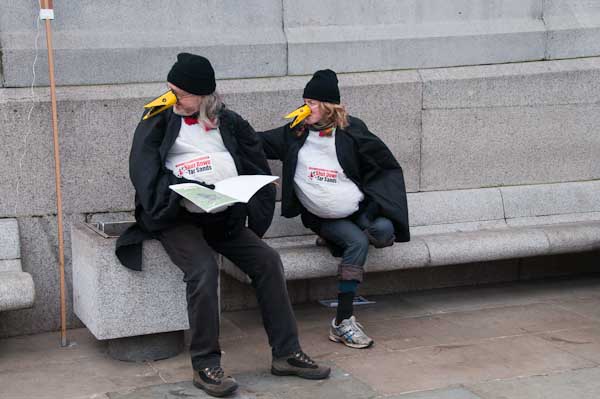
It was a fun event with a serious purpose, and most of those taking part were surprisingly competitive. I wrote: “It wasn’t at all clear on what basis the medals were awarded. For those that care about such things, BP got bronze, RBS the silver and Shell struck gold. And none of us were quite sure why there were two penguins present.”
Iran Opposition Rally in London – Parliament Square
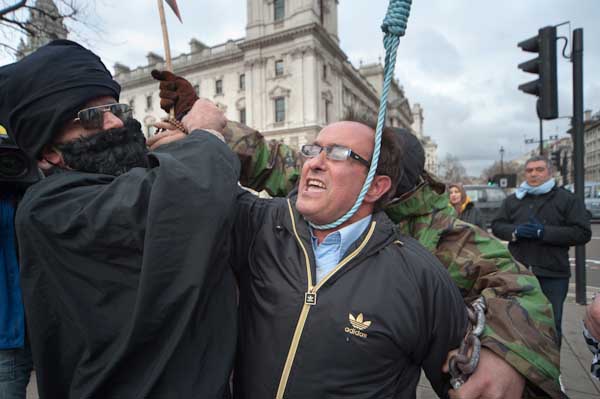
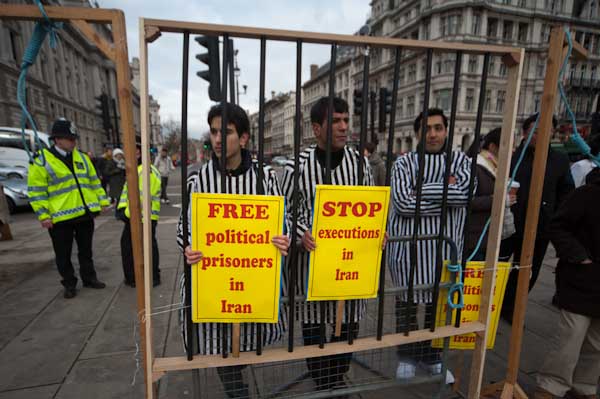
The previous Thursday had been the 31st anniversary of the 1979 Islamic revolution in Iran and had been marked there by both a large pro-government rally and also a ferocious clampdown on opposition groups by riot police, undercover security agents and hard-line militiamen.
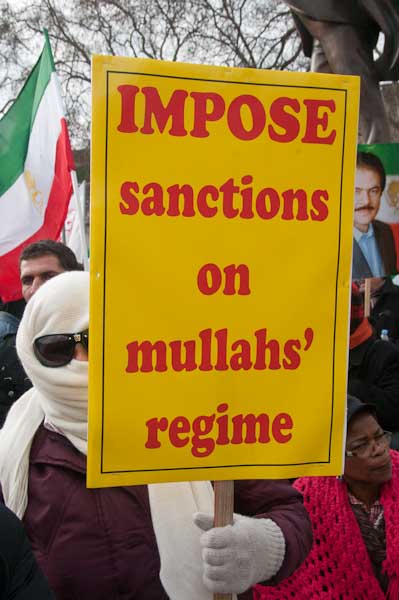
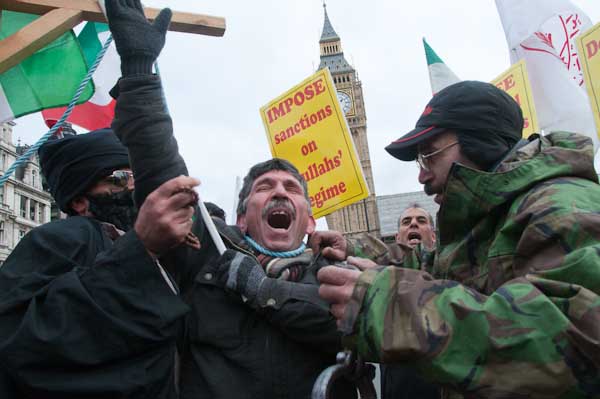
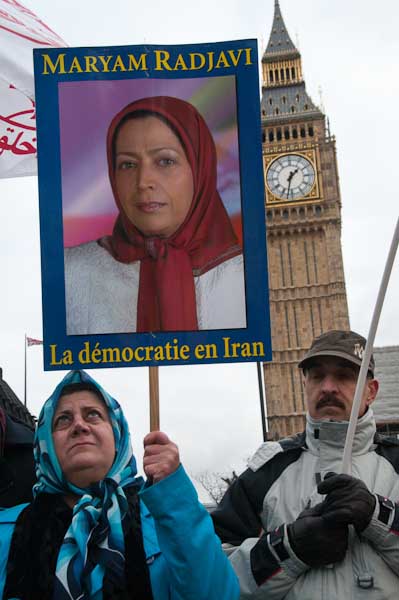
The protest in London was by supporters of the National Council of Resistance of Iran (NCRI) and the People’s Mojahedin Organisation of Iran (PMOI). The NCRI is a coalition of Iranian dissident groups but is dominated by the PMOI, which was proscribed in the UK at the request of the Iranian Mullahs in 2001; the ban was lifted against the UK government’s wishes after they lost an EU court appeal in 2009.
The PMOI were shabbily treated by the US after they signed a ceasefire agreement with them in 2003 for which they gave up most of their weapons and were confined to their camp in Iraq, leaving them at the doubtful mercy of the Iraq government when the US troops left.
In 1995 the NCRI announced their Charter of Fundamental Freedoms for Iran, which would uphold all international agreements on human rights such as “freedom of association, freedom of thought and expression, media, political parties, trade unions, councils, religions and denominations, freedom of profession, and prevention of any violation of individual and social rights and freedoms.”
They call for a republic based on popular vote, the abolition of the death penalty, gender equality, a modern legal system without cruel and degrading punishments, the recognition of private property, private investment and the market economy and a foreign policy of peaceful coexistence without nuclear weapons.
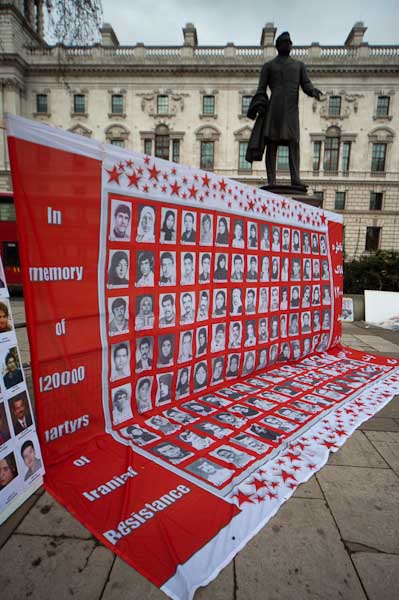
As well as many speeches the rally had a display of photograph of some of the 120,000 Iranians killed by the Iranian regime and pictures of people being attacked at demonstrations in Iraq, with a street theatre piece in which protesters were attacked by a bearded cleric and a militia man and dragged to a waiting hangman’s nooses.
Reclaim Love’s free Valentine Party around the statue of Eros in Piccadilly Circus was started by Irish poet and love activist Venus CuMara to reclaim St Valentine’s day from commercialism and to try to harness the power of love to save the world.
The event in 2010 was one of the largest, with people coming together not just around Eros where the event had begun six years earlier but there were events on this day at a total of 40 locations around the world – elsewhere in England, in Ireland, Scotland, Wales, Pakistan, India, Spain, Italy, Germany, Austria, Iceland, France, Brazil, Argentina, New Zealand, the USA, Canada and Australia – including surfers who were celebrating in the ocean off Perth, Australia.
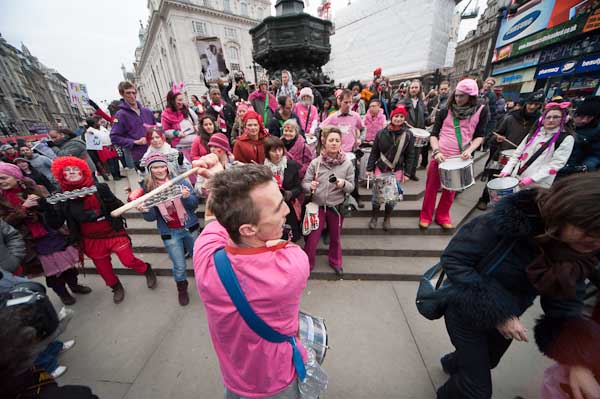
The party began with the powerful drumming of Rhythms of Resistance which attracted a great deal of attention, including many tourists in the area who stopped to watch and some danced and took part.
A large supply of free ‘Reclaim Love’ t-shirts were handed out by Venus as an expression of the “more fearless-generous-sharing-Love-centred way of thinking” behind the event and others handed out free cakes and sweets and offered free hugs.
The climax of the event, celebrated around the world at 15.30 GMT was when people joined hands in a large circle around the area in an ‘Earth Healing Circle‘ and together repeated an ancient Indian prayer for peace in their own language. The English version “MAY ALL THE BEINGS IN ALL THE WORLDS BE HAPPY AND AT PEACE” people repeated here was also on the free t-shirts.
This year there were so many people at the event that in places around Piccadilly Circus the circle was two or three deep.
Venus hoped to keep building the ‘Reclaim Love’ movement and felt it would really have a tangible effect if there were 1.5 million or more people taking part, a number she hoped it would reach worldwide by 2015. Unfortunately for various reasons it never managed to reach that critical mass. The 16th ‘Reclaim Love’ free Valentine’s Day street party which took place in 2019 was I think the last, though I could be wrong. There is still a Facebook group, but this year there is only a single post on it, “Hi lovers are we doing anything this year on the 17th is it?” which has got no reply so far.
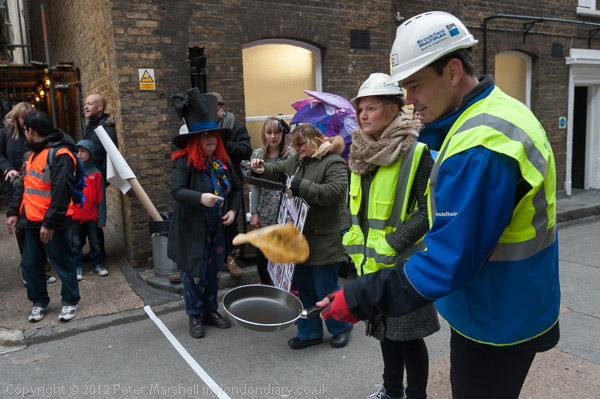
Shrove Tuesday Pancake Races – Tomorrow is Shrove Tuesday, but in 2013 it fell on Tuesday 12th February and was celebrated in several places across London with Pancake races.
Shrove Tuesday is the final day of the Christian Shrovetide or Carnival, observed in different ways around the world as Wikipedia relates. It is the day before Ash Wednesday which marks the beginning of Lent. We are perhaps rather short-changed here in the UK with pancakes, while in Venice and Rio Janeiro they have real carnivals to celebrate Mardi Gras.
Some other countries also have rather more interesting foods than our traditional pancakes. All are ways to eat up richer foods before Lent when Christians ‘fasted’ or rather ate more simply for 40 days before Easter. It was also a day when people went to priests for confession to have their sins absolved – shriven – before getting down to serious service of repentance the following day, Ash Wednesday, and some churches still ring their bells to call in worshippers.
People in the UK have been eating pancakes on Shrove Tuesday since the 16th century, and even in families which did not observe the ecclesiastical calendar almost everyone ate them on that day in my youth, even if in homes like mine they came after the standard meat and two veg. I’ve never been keen on them, and perhaps the best you can say about them is that British pancakes are rather better than crêpes.
In many towns and cities in Britain the day used to be a half-holiday and work ended before noon to be followed by some kind of riotous mob football games with hundreds taking part in the streets. But most of these ended with the passage of the 1835 Highways Act which banned playing football on public highways, though the tradition continues in a slightly more organised form in a few towns.
Pancake races are said to have begun in 1445 in Olney, Buckinghamshir when a woman making pancakes was surprised by the sound of the shriving bells and ran to church hot pan in hand, tossing the pancake on her way to stop it sticking. Whatever. But they soon became a fairly common tradition, along with various forms of begging and trick and treating now more associated with Halloween. But apart from a few particular instances – such as at Olney – these races and other practices had more or less died out by the twentieth century.
This century has seen a revival in pancake races, often raising funds for charities, including in London the Parliamentary Pancake Race between parliamentarians and press raising funds for Rehab and the City of London pancake races begun in 2004 by the Worshipful Company of Poulters to support the annual Lord Mayor’s Appeal.
I’ve photographed both these, and in 2013 made another visit to the City of London race in Guildhall Yard, then rushed from there to the Great Spitalfields Pancake Race at the Old Truman Brewery just off Brick Lane which was supporting the Air Ambulance and is a fancy dress team relay event. Races I’ve been to in other years have included those in Leadenhall Market and outside Southwark Cathedral as well as the Parliamentary race.
You can read more about both events and see many more pictures of them on My London Diary, where there are also pictures from the races in other years – put ‘pancake’ in the search box at the top of the My London Diary page to find more. Links to the 2013 races below: