Fukushima & Million Women Rise – 2017

Fukushima & Million Women Rise: Saturday 11th March 2017 was the sixth anniversary of Fukushima nuclear power plant disaster in Japan and a march called for an end to nuclear power programmes around the world including in the UK. It was also the nearest Saturday to International Women’s Day and I photographed the Million Women Rise march.


Fukushima Anniversary Challenges Nuclear Future

London

Fukushima & Million Women Rise - 2017

Six years on, radiation was still leaking from the plant which was damaged by a tsunami from the Tohoku earthquake. This destroyed most of the plant’s cooling system and created the world’s worst nuclear disaster since Chernobyl.

Fukushima & Million Women Rise - 2017

Estimates of the human cost in the long-term from the radiation leaks vary considerably, but the financial cost of cleanup up has been estimated at around $180 US.

Fukushima & Million Women Rise - 2017
Buddhist Reverend Gyoro Nagase from Battersea and Reverend Sister Yoshie Maruta from Milton Keynes

Nuclear power has never achieved the early promises of cheap energy and remains the most expensive way of generating electricity. It is now promoted as an essential backup for renewable energy when the sun doesn’t shine and the wind doesn’t blow but its importance will fade as we exploit other continuous renewable sources and cheaper storage solutions become available. And as we move away from a grid-based power system to more local generation. Should nuclear fusion ever become feasible it promises to be a much safer, cheaper and cleaner way to generate electricity.

Fukushima & Million Women Rise - 2017

Probably the UK’s nuclear programme was never really about energy, but about our nuclear weapons programme.

Fukushima & Million Women Rise - 2017

The marchers met at the Japanese embassy on Piccadilly and marched on the pavement handing out leaflets to Downing Street. I left them on the march to photograph the start of Million Women Rise and then took to tube to Westminster for the Downing Street rally.

More on My London Diary: Fukushima anniversary challenges nuclear future.


Million Women Rise Against Male Violence

Oxford St

Fukushima & Million Women Rise - 2017
Women get ready to march in Orchard St

Around two or three thousand women gathered in Orchard Street to march to a rally in Trafalgar Square.

‘Women of the World Unite Against Violence’

Many carried feminist placards and there were groups from various women’s organisations around the country, including from various ethnic communities.

This was a march for women only, but most of them were very happy for me to photograph them, but I was not able to mingle freely with them as I would on most marches, and my pictures were from the sidelines or in front of the march.

Violence Against Women is a Global Pandemic’

I was able to take many pictures, but not always as I would have liked. But I think they are an interesting set – and here are just a few of them.

I left as the march reached Bond Street station to go back for the Fukushima rally.

Many more pictures on My London Diary: Million Women Rise against male violence,


FlickrFacebookMy London DiaryHull PhotosLea ValleyParis
London’s Industrial HeritageLondon Photos

All photographs on this page are copyright © Peter Marshall.
Contact me to buy prints or licence to reproduce.


Iran & Midwives – 2010

Iran & Midwives: On Sunday 7th March 2010 I photographed a protest marking International Women’s Day organised by Iranian women over the 31 years of repression and calling for an end to the Islamic regime who marched to a rally in Trafalgar Square. I then went south of the river to Geraldine Harmsworth Park for the start of a march back to Downing Street in support of better integrated midwifery services for all women.

Iran & Midwives - 2010
Of course there were Dads as well on the midwives march

Both Iran and maternity services are now still live issues. Baroness Amos’s interim review into maternity and neonatal services in England is harrowing and two thirds of maternity services are rated either “inadequate” or “requires improvement”.

Today I will be at a protest against the illegal war by Israel and the USA on Iran. Of course few if any support the Iranian Islamic regime, certainly not among those who like me will be at the protest.

The attacks on Iran, including the assassination of Ali Khamenei, are extremely unlikely to lead to regime change – and if anything are likely to lead to even greater repression, hardship and bloodshed in a country which is being pounded into greater poverty and extreme disorder, with possibly many years of destructive multi-sided civil wars. The decision to attack now appears to have been prompted by the Israeli fears that an agreement between the US and Iran might have been imminent – and perhaps also by the US feeling that a war might improve Trump’s position in the US mid-term elections.


Support the Iranian Women’s Struggle

Iranian Embassy to Trafalgar Square

Iran & Midwives - 2010

Women and men, mainly Iranians, held a rally opposite the Iranian embassy in Kensington to mark International Women’s Day and protest against the 31 years of anti-women Islamic laws and repression and calling for an end to the Islamic regime.

Iran & Midwives - 2010

The protest was organised by the 8 March Women’s Organsiation (Iran-Afghanistan) and they marched from there to Trafalgar Square where there was a larger rally on the North Terrace with speeches and messages from the 8 March Women’s Organisation, the European Democratic Women Movement (Turkey), Hands off People of Iran, the Organisation of Women’s Freedom in Iraq and the Million Women Rise movement.

Iran & Midwives - 2010

The speches were followed by performances by a number of artists including Iranian singers and poets.

More at Support the Iranian Women’s Struggle.


Mums and Midwives Reclaim Birth

Geraldine Harmsworth Park to Downing St

Iran & Midwives - 2010
Hands off our Midwives – London Anarcha Feminist Kolektiv – Royal College of Midwives

The Albany Midwifery Practice in Peckham in South London – one of the most highly deprived areas of England – was widely regarded as a model of best practice and a centre of excellence in NHS midwifery, giving support to women throughout pregnancy, birth and the post-natal period, encouraging women to make informed choices about how and where they give birth.

But at the end of 2009, King’s College Hospital terminated their contract following a critical report from the Centre for Maternal and Child Enquiries (CMACE) which King’s claim showed “serious shortcomings” over one aspect of their work, forcing the centre to close down. This report was shown to be based on incorrect use of statistics.

King’s decision was seen as an attack on on alternative ways of maternity care that provide better overall outcomes and better meet the needs of women.

Their perinatal mortality rates were well below the national average and well under half those for those in its London Borough. And far fewer of their mothers gave birth by Caesarean section – just over half of the rate in King’s College Hospital. Perhaps at the root of King’s objection to Albany was that almost half of the women chose to give birth at home – compared to 1 in 16 for the area as a whole.

More than three quarters of Albany mothers also continued to breastfeed their babies, well over twice the national average.

The march and rally was supported by AIMS (Association For Improvements In The Maternity Services), NCT (National Childbirth Trust), ARM (Association of Radical Midwives), IM UK (Independent Midwives UK) and Albany Mums.

As well as calling for a public inquiry into the decision to end the Albany contract it also called for a move across the country to replace the current doctor-led hospital services , often un-supportive and even traumatic for mothers, with services following the Albany example which provide a much more comprehensive service with better information and fuller support for women at no greater cost.

Peckham has a record of innovative medical services, with the groundbreaking Peckham Experiment in community health which began 100 years ago in 1926 and was ended under the NHS in 1950. The case of the Albany model of care echoes this, and there approach was fully vindicated in a detailed analysis published in 2017 which concluded “consideration should be given to making similar models of care available to all women.”

More at Mums & Midwives Reclaim Birth.


FlickrFacebookMy London DiaryHull PhotosLea ValleyParis
London’s Industrial HeritageLondon Photos

All photographs on this page are copyright © Peter Marshall.
Contact me to buy prints or licence to reproduce.


Pancakes and Pickets – 2014

Pancakes and Pickets: Tuesday 4th March 2014 was very much a day of two halves for me, starting with the City of London at play in Guildhall Yard and going on to the School of Oriental and African Studies where cleaners were beginning a two-day strike demanding an end to bullying by their employer ISS and to be brought back into direct employment and treated with respect by SOAS management with equal rights to other employees.


City of London Pancake Races

Guildhall Yard

Pancakes and Pickets - 2014
It was a toss-up whose hat was silliest

It was Shrove Tuesday and The City of London’s 10th annual pancake races took place in Guildhall Yard between teams representing the livery companies, wearing guild robes, white gloves and hats.

Pancakes and Pickets - 2014

As might be expected in the City this is a highly organised event, complete with clipboards, stop-watches and judges, and with a series of rules about dress and behaviour, with points being lost for various infringements.

Pancakes and Pickets - 2014

Various of the guilds contributed their expertise: Gunmakers used a small but very loud cannon to start each heat, Clockmakers timed the races, Fruiterers provided lemons, Cutlers plastic forks, Glovers white gloves to be worn by each runner, and the Poulters, who had started the event, the eggs to make the pancakes.

Pancakes and Pickets - 2014

This event supports the annual charity Lord Mayor’s appeal, and in 2014 Fiona Woolf, the 686th Lord Mayor of London, had chosen Beating Bowel Cancer, the Princess Alice Hospice, Raleigh International and Working Chance. As well as the more formal races there is also a fancy dress competition and race with one entrant from each livery company in costumes based, some with great ingenuity, on the charities.

Pancakes and Pickets - 2014

As I commented, “competition was extremely fierce and the regulators had plenty of work to do keeping up with the infringements. If only they had paid as much attention to what the banks and other city companies were doing!”

This was an event I photographed in several years, but I think 2014 was the final time. Like many events it had become more difficult to cover as more and more photographers came to cover it, some making rather a nuisance of themselves, leading to more restrictions. In earlier years there had only been myself and a few friends and we were welcomed and able to work freely.

City of London Pancake Races


SOAS Cleaners strike for Equal Treatment

SOAS, Thornhaugh St

Cleaners dance to Colombian music on the picket line

It was the start of a two-day strike by cleaners at London University’s School of Oriental and African Studies, part of a long ‘Justice For Cleaners’ campaign to be treated equally to other staff at SOAS and to be brought back ‘in house’, employed directly by the university.

They were then employed by the outsourcing cleaning contractor ISS, a multinational company with a reputation for bullying workers. The previous day some ISS managers had assaulted students who had stopped them trying to bring in scab workers to do the work of the cleaners.

ISS director Paul Cronin had also threatened to stop paying the cleaners the London Living Wage which they gained through industrial action several years ago.

SOAS UNISON Branch Secretary and union secretary for the London Higher Education Executive Sandy Nicoll

Outsourcing always results in a poorer level of service, with employers cutting hours of work and giving workers poorer conditions of service, making high profits at the expense of low paid workers.

Reputable employers could not possibly be seen to employ people on the poor pay and conditions of contracting companies, but SOAS seemed happy to benefit from the exploitation of people who work in its building by others despite the poorer service for students and others.

And as the Justice for Cleaners campaign stated “SOAS is known around the world for promoting dignity and equality. Yet, its maintenance, cleaning, security and catering all have less rights than other workers, because they are outsourced. At the moment SOAS is built on inequality and exploitation.”

The strike ballot had an over 60% turnout out and all who voted back the strike. I was told that many had arrived by 4am to start the picket and by 6am virtually the whole normal morning shift were there taking part.

I rushed away from the pancake races to get there for the lunchtime rally, where there were speeches supporting the strike from students and trade unionists. The cleaners are members of the SOAS Unison branch.

Many students and teaching staff had refused to cross the picket line; lectures and tutorials were rescheduled, no registers were taken, and library fines and deadlines were postponed. But for the following second day of the strike the cleaners had asked students and staff to work as normal so that the effect of the building not being cleaned could be seen.

After the speeches there was music and dancing, with the event going on until the picket ended at 5pm. Then the union bar which had been closed for the strike was to open for students and cleaners to have a party. But I left much earlier.

The campaign to bring the cleaners at SOAS back into direct employment continued and after ten years they were finally brought back in house in 2018.

SOAS Cleaners Picket Line


FlickrFacebookMy London DiaryHull PhotosLea ValleyParis
London’s Industrial HeritageLondon Photos

All photographs on this page are copyright © Peter Marshall.
Contact me to buy prints or licence to reproduce.


Arbaeen in London – 2008

Arbaeen in London: On Sunday 2nd March 2008 I again photographed the Arbaeen Procession by Shia Muslims in London. It was one of various religious events on the streets of London that interested me – along with other processions and events by other major religions – Christians, Sikhs, Hindus etc in public on the streets of London, many of which you can find recorded on My London Diary.

Arbaeen in London - 2008

These pictures were a part of my celebration of the multicultural nature of London which has turned what was the rather drab post-war austerity of my youth into a much more vibrant place to live and work. Immigration has enriched our nation culturally and in so many other ways, though it has also produced a racist backlash that has poisoned much of our politics.

Arbaeen in London - 2008

Arbaeen is a major event for Shia Muslims around the world, coming at the end of the annual 40 days of mourning for the massacre of the prophet Mohammed’s grandson, Imam Hussain, together with 72 companions at Karbala. Millions take part in the pilgrimage in Karbala, Iraq which was banned by Saddam Hussein but revived after his downfall.

Arbaeen in London - 2008

Shia Muslims regard the Karbala massacre as “the greatest sacrifice make by mankind, for humanity” and the “ultimate standoff between ‘good and evil’“. Hussain had refused to pledge allegiance to the ruler – “Death in honour is preferable to life in humiliation” – and his small band of followers fought to the death against an army of 40,000.

Arbaeen in London - 2008

After the slaughter of the men, their women and children were taken captive and paraded through towns and cities on a 750 mile journey to Damascus, along with the decapitated heads of the martyrs, impaled on spears.

As a part of the procession in London there are reenactments of some of the events, prayers of mourning, and expression of grief in various ways including the beating of breasts.

Several thousand Muslims come from across the country to take part in this annual event, organised by the Hussaini Islamic Trust UK, which is the largest Arbaeen procession in Europe.

Many more pictures on My London Diary at Arbaeen Procession.


FlickrFacebookMy London DiaryHull PhotosLea ValleyParis
London’s Industrial HeritageLondon Photos

All photographs on this page are copyright © Peter Marshall.
Contact me to buy prints or licence to reproduce.


More From Wandsworth 1990

More From Wandsworth: My walk on Sunday 4th March 1990 had begun at Clapham Junction in Battersea with St John’s Road & East Hill, Battersea and I had continued into Wandsworth with the post Mont Nod and Old York Road – Wandsworth 1990, ending with a view of York Road from the platform of Wandswoth Town Station.

Wandsworth Tyre Service, Old York Rd, Wandsworth Town, Wandsworth, 1990, 90-3a-52
Wandsworth Tyre Service, 543, Old York Rd, Wandsworth Town, Wandsworth, 1990, 90-3a-52

I didn’t catch a train but came back down the stairs and on to York Road walking west along it. The Wandsworth Tyre Service was on the corner with Tonsley Hill and was one of many shops along the York Road, a kind of minor high street. There are still shops, but their character has changed greatly; this is now Pad Thai Story, the first of three authentic Thai restaurants set up by three Thai friends, here and in Battersea and Hammersmith and apparently highly recommended with, for London, reasonable prices. Back in 1990 I think the culinary peak of Old York Road was probably a fish and chip shop.

Next door, in what was then a doctor’s surgery is now a florist; there are a variety of other food outlets as well as several estate agents and a few more useful shops in a a fairly typical gentrified street.

According to various estate agents, this area, sometimes know as Tonsley for the several streets including this name, is one of Wandsworth’s most sought-after locations. An informative blog tells me “Tonsley Hall, the residence of Sir Richard Blackmore, the physician and poet who died in 1729… was pulled down in about the middle of the nineteenth century” but I cannot find why the house was given the name Tonsley.

The Grapes, Fairfield St, Wandsworth, 1990, 90-3a-53
The Grapes, 39, Fairfield St, Wandsworth, 1990, 90-3a-53

I walked down to Fairfield Street – the fair field was in the area to the north of Old York Road. Merrie England in the Olden Time published in 1841 states:

 "Wandsworth Fair exhibited sixty years ago Mount Vesuvius,
 or the burning mountain by moonlight, rope, and hornpipe-
 dancing; a forest, with the humours of lion-catching;
 tumbling by the young Polander from Sadler's Wells; several
 diverting comic songs; a humorous dialogue between Mr.
 Swatehall and his wife; sparring matches; the Siege of
 Belgrade, &c. all for three-penee!

 On Whit-Monday, 1840, Messrs. Nelson and Lee sent down a
 theatrical caravan to Wandsworth Fair, and were moderately
 remunerated. But the “Grand Victoria Booth” was the rallying
 point of attraction. Its refectory was worthy of the
 ubiquitous Mr. Epps—of ham, beef, tongue, polony, portable
 soup, and sheep's trotter memory!

 Cold beef and ham, hot ribs of lamb, mock-turtle soup that's
 portable,

 Did blow, with stout, their jackets out, and made the folks
 comfortable!"

But this was perhaps one of the last days of the fair.

The pub is still open and is Grade II listed public house described as an early/mid-19th Century building and so was probably there in the closing years of the fair a few yards away.

Gas Holder, Swandon Way, Wandsworth, 1990, 90-3a-54

According to the Wandle Industrial Museum, the Wandsworth Gas Company was established at a meeting at the the Spread Eagle Inn in Wandsworth in 1834 and was producing gas by the following year. By the 1920s it had grown into one of the largest London Gas companies, with coal being brought in barges to the canal basin close to the mouth of the Wandle. From 1906 colliers delivered coal to it on the Thames and the company produced some of the cheapest gas in London – making it particularly popular with balloonists.

At nationalisation in 1949 the company supplied an area of 160 square miles and had a fleet of six upriver colliers bringing over half a million tons of coal a year. Gas production ceased in 1970, but the gas holder continued in use for storage for many years.

Fairfield Court, Flats, Fairfield St, Wandsworth, 1990, 90-3a-55

Estate agents variously describe this building as being built between 1930 and 1949 or 1967 to 1975, but whatever its date of completion it was built in a 1930s Streamline Moderne style as my picture shows. Its a style which has attracted a large degree of architectural snobbery over the years, including in the great Pevsner Buildings of England series. I suspect it probably dates from the post-war rebuilding of Wandsworth, but would welcome correction.

Wandsworth Town Hall, Fairfield St, Wandsworth, 1990, 90-3a-42

By contrast, the to my mind rather pedestrian Wandworth Town Hall is both Grade II listed and described in detail in the listing and on other web sites. I think the architectural details are of far more interest than the overall building, built in 1935-7 to the designs of Edward A Hunt. I turned away to the east and didn’t then photograph the south side of the building on Wandsworth High Street, perhaps the buildings more interesting aspect with a fine “bas relief frieze depicting events in Wandsworth’s history by David Evans and John Linehan.”

P G Marshall & Sons, Tonsley Hill, Wandsworth, 1990, 90-3a-45

One of the main Tonsley streets, this had a particular interest for me, as although there are many Peter Marshalls, some rather more famous than me, this was possibly the first time I had been greeted by my initials when walking the streets of London. So far as I am aware this P G Marshall was no relative. But the business ‘Purpose Made Joinery‘ also had some resonance – among his many trades, before my father became self-employed he had worked as a joiner around 1920 when motor vehicle bodies were still often made of wood.

Of course the coincidence of initials was not the only reason I stopped to take this picture. The railings with their spears beside the steps and the jagged edge above the side gate also appealed.

Gate, Geraldine Rd, Wandsworth, 1990, 90-3a-24

I crossed East Hill and went down Geraldine Road admiring the brickwork and decoration of the house on the corner (my photo not digitised) which I think was then home to the probation service. I think this wrought iron gate was on the detached house on the corner of Eglantine Road which now has a rather different but still attractive fence and gate and the veranda with slim iron columns.

Houses, Geraldine Rd, Wandsworth, 1990, 90-3a-25
Houses, Trees, Rosehill Road, Geraldine Rd, Wandsworth, 1990, 90-3a-25

On the corner of Geraldine Road and Rosehill Road I found this row of harshly pollarded trees stretching down the road with the tall thin Greek Revival tower of Robert Smirke’s Grade II* listed St Anne’s Church, Wandsworth in the distance down Rosehill Road.

My next post about this walk will begin with two more pictures of this church.


FlickrFacebookMy London DiaryHull PhotosLea ValleyParis
London’s Industrial HeritageLondon Photos

All photographs on this page are copyright © Peter Marshall.
Contact me to buy prints or licence to reproduce.

Class War’s Lambeth Walk & More London – 2018

Class War’s Lambeth Walk & More London: On Saturday 24th February 2018 Class War celebrated their win in the High Court against the Qatari royal family over their right to protest outside the Shard, where ten £50 million apartments remain empty. I took the opportunity to take a few pictures around the 13 acres of London around the then City Hall, now private land owned by the State of Kuwait, the inappropriately named More London.


Class War’s Lambeth Walk for housing

Southwark

Class War's Lambeth Walk & More London - 2018

Class War and friends met at Potters Fields next to City Hall and facing Tower Bridge, for a protest celebrating their court victory and a part of their ongoing campaign for more social housing to meet the needs of the people of London.

Class War's Lambeth Walk & More London - 2018
Ian Bone, Class War

London councils have huge waiting lists for homes, private rents are hugely expensive and house prices out of the reach of those even in many professional jobs let alone most working people.

Class War's Lambeth Walk & More London - 2018
Martin Wright

But increasingly London councils – particularly in boroughs including Southwark, Lambeth and Newham but across the city are carrying out schemes with private devlopers to demolish council estates – such as the Heygate and Aylesbury estates in Southwark and replace these with expensive private developments with token amounts of affordable properties – which at up to 80% of market cost – are not affordable to the mass of London’s population.

Class War's Lambeth Walk & More London - 2018

Many properties on these new developments are sold across the world to private investors, many even before they are built, advertised and strongly promoted particularly in the Far East. The rapid increases in London property prices makes them a highly profitable investment. Many of these investment properties are left empty, or perhaps visited for a few weeks a year.

Class War's Lambeth Walk & More London - 2018

London desperately needs more housing, but not empty boxes. As the speakers at the rally in front of City Hall pointed out, what it needs is social housing that Londoners can afford.

The campaigners called for the thousands of empty buildings in London – and across the country – including those empty £50 million flats in the Shard – to be taken over and used to house the homeless.

’10 Floats at £50 Million each sit empty in The Shard. 26,000 flats over £1 Million each about to be built in London … while thousands are sleeping on the streets – NO MORE HOMES FOR THE RICH – Class War’

Class War had brought their ‘Lucy Parsons’ banner with the message from the famous American anarchist “We must devastate the avenues where the wealthy live“, but they were instead calling for them to be used to house the poor. Among those who joined them were the the RCG – Revolutionary Communist Group – with their banner banner with its message ‘HOUSING IS A RIGHT – NOT A PRIVILEGE‘.

Among the speakers was Whitechapel anarchist Martin Wright who pointed out that the coming cold snap next week will probably be “another Grenfell“, likely to kill at least 80 people of the thousands who are sleeping on the streets.

The protesters had intended to dance the Lambeth Walk from the rally at City Hall to another at the Shard, led by ukuleles, but only one ukulele player turned up and so they simply marched with banners.

Because of the cold, the rally opposite the Shard was a short one and ended with Class War amusing themselves by mounting a mock charge on the offices of Murdoch’s News UK, publishers of The Times and The Sun, pulling up sharply just in front of the row of security staff on its steps.

More pictures at Class War’s Lambeth Walk for housing.


More London?

Southwark

Property developers named the large area once occupied by warehouses and wharves a few yards upstream from Tower Bridge on the Southwark bank of the river ‘More London‘ although the site is owned by Kuwait and the public is allowed to use it, but under some restrictions they set down – as our royals do for London’s Royal Parks.

The Shard from More London

Their large real estate interests in London are run by the English sounding St Martins Property Group – it was founded in 1924 as the St Martins-Le-Grand Property Company Limited but is now wholly owned by the Kuwait sovereign wealth fund, Future Generations Fund.

Among their rules are bans on photography and protests. But with thousands or tourists walking its open pathways the photography ban is seldom enforced, though should you look too commercial you are likely to be approached by security personnel who will tell you to stop.

And while they have prevented some protests from taking place and have imposed restrictions on others, protests such as the one on this day by Class War have continued.

At least Tower Bridge is still owned by the City of London

City Hall, in More London was leased from the Kuwaitis from 2002-2021 as the former home of London government, County Hall at Westminster, had been stolen from it by the Thatcher government back in the ’80s. I wrote that I found it shameful that London did not own its own seat of government, and at least the move to The Crystal in the Royal Docks has put that right, unsuitably remote though it is.

But in 2018 I commented “Also shameful that many if not most of the government buildings in Whitehall now have overseas owners, some of them by UK tax dodgers in overseas tax havens. ‘Taking our country back’ from the EU will certainly have little effect at restoring Britain to British ownership.”

More pictures at More London.


FlickrFacebookMy London DiaryHull PhotosLea ValleyParis
London’s Industrial HeritageLondon Photos

All photographs on this page are copyright © Peter Marshall.
Contact me to buy prints or licence to reproduce.


Thames Riverside – Erith 1994

Thames Riverside – Erith: The Thames Path National Trail was only inaugurated on 24 July 1996 and then stopped at the Thames Barrier, but years before I had often walked along much of it in or near Greater London as well as much further east towards the Estuary.

It had taken a long time since 1947 when the towpath along the Thames was identified by the Hobhouse Committee on National Parks as one of six long distance and coastal recreational walking routes. Work began seriously in 1973 but there were many problems to be overcome, particularly in the upstream areas where much of the towpath had deteriorated, ferries closed and more.

The Thames Path still ends at Woolwich but it now joins the England Coast Path, but long before that it was possible to simply keep on walking beside the river – and I did along the south bank as far as Cliffe. Further on it became difficult to access using public transport.

Sheds, Crescent Rd, Erith, Bexley, 1994, 94-801-52

These pictures come from Monday 1st August 1994 when I took a train to Erith as my starting point. I began by taking black and white pictures of buildings in the town centre, then walked east out of the town as far as the saltings and Erith Yacht Club. The town has changed considerably since my visit. The first industry developed on this side of town, but I think there is now a large supermarket with huge car park in the almost all the former industrial area. In the 1930s the area in my picture above, on Crescent Road or ManorRoad was a part of the British Fibrocement Works.

Erith Yacht Club, Erith, Bexley, 1994, 94-801-53

I turned around and came back through Erith to the Riverside Gardens close to the centre of Erith and then walked upstream beside the river to Belvedere before turning around and coming back to take a few more black and white pictures on the west side of Erith before taking the train home.

Crane, Riverside walk, Erith, Bexley, 1994, 94-801-32

In the distance you can see the housing around Chandlers Drive, one of the first residential devolopmens on the river here, which had previously been highly industrial.

Riverside Path, River Thames, Erith, Bexley, 1994, 94-803-33
River Thames, Flats, Chandlers Drive, Erith, Bexley, 1994, 94-801-22
Jetty, River Thames, Erith, Bexley, 1994, 94-805-53

One of a number of jetties here, this more colourful than most, but I think no longer in use. On the opposite bank I think the hills are where rubbish has been brought out from London and tipped to build up what was previously marsh.

Jetty, River Thames, Erith Oil Works, Thames Path, Erith, Bexley, 1994, 94-801-13
Jetty, River Thames, Erith Oil Works, Erith, Bexley, 1994, 94-801-13

The jetty of the Erith Oil Works, still in business. It was set up on Church Manorway in 1908 and is the the largest vegetable oil mill in the UK. My next post in this series will have more pictures of the Oil Works and other industry on the riverside, again mainly panoramas made with a swing lens camera.

All pictures here and more from this and other walks in 1994 are in my Flickr album 1994 London colour and you can view them larger by clicking on them in this post.


FlickrFacebookMy London DiaryHull PhotosLea ValleyParis
London’s Industrial HeritageLondon Photos

All photographs on this page are copyright © Peter Marshall.
Contact me to buy prints or licence to reproduce.


March For Our Flag & Chinese New Year – 2007

March For Our Flag & Chinese New Year: Sunday 18th February 2007 was very much a day of two halves for me, photographing ‘football supporters‘ on an extreme right march and then going to Chinatown for a brief visit to the New Year celebrations. Here’s what I wrote back in 2007 about the day (with the usual minor corrections) and some of the pictures – with links to a few more on My London Diary.


March For Our Flag – United British Alliance

March For Our Flag & Chinese New Year - 2007
There were around 200 football supporters in the right-wing march.

There were perhaps just over 200 marchers in the ‘March For Our Flag’ which made its way from Westminster to Marble Arch on Sunday. Organised by football supporters, it was billed as “a peaceful march consisting of Whites, Blacks, Asians” and the invitation was clearly made for people to attend “regardless of colour or creed or firm or team.” However it was also an event that members of the National Front Youth ‘Bulldogs’ were urged to support in one of their forums with the hope of attracting new members.

March For Our Flag & Chinese New Year - 2007
Marchers at the start in Tothill St

Englishness has been officially relegated to a fringe activity, and to a great extent politically appropriated by the ultra-right. So it isn’t surprising that we get populist outbreaks such as this, under the banner of the ‘United British Alliance’. This seems to be largely an anti-Islamic movement of football supporters, many of whom seem to take a pride in their membership of noted hooligan groups (the ‘firms‘.) On its web page, UBA describes itself as “a multi-ethnic, multi-faith organisation with a passionate interest in reclaiming our once proud nation from the grip of international terror and political correctness gone-mad, with a view to re-installing some pride in our communities and way of life.”

So I was hardly surprised to find the march almost solidly white and male; I noted only one Black and one Asian face – and only three women. What was overwhelming was the drab surliness of it all, with rather few English flags in evidence – probably fewer on hats and shirts than in the average crowd, now that many England soccer and rugby fans regularly appear covered with St George symbols.

March For Our Flag & Chinese New Year - 2007

At its front was a large St George’s flag with the message ‘Tunbridge Wells Yids On Tour.’ Although generally a term of racist abuse, here it is a name Spurs fans use with pride, having christened themselves ‘Yids’ in response to the anti-Semitic chants from fans of other clubs.

Events such as this, organised by a fringe extreme right group, do represent a widespread feeling among many people that we need to do more to promote English culture and a pride in being English. Nothing prevents us celebrating St George’s Day, [but] such celebrations have never attracted the official support and funding that attend the other national saints days in the UK.

March For Our Flag & Chinese New Year - 2007

In the arts, there has been a reluctance or even a refusal to finance traditional English folk arts, while those from many other ethnic groups have often received generous support. In part this comes from the elitist snobbishness of an establishment that massively funds opera while being unable to stomach grants to Morris dancing, brass bands, folk singers and English choirs and other elements of a genuinely popular and largely working class English culture.

Even, if not especially, on the left, we have generally left official culture and the patronage it gives to be run by the champagne socialists in Islington and Hampstead rather than supporting the kind of activities that came with our roots in the co-operative movement, the Methodist and other [non-conformist] churches and the Working Mens Clubs and unions.

The police took a very obvious interest in the event, and in the few of us trying to photograph it. I was twice questioned by them, and my press card details were noted down both times, while I was photographed [by police.] There were probably more police than marchers covering the event, both at Liverpool Street, where many of the marchers had met, and also on the march itself.

March For Our Flag & Chinese New Year - 2007
Some of the marchers did not want to be photographed

The police were polite and made sure I was aware that some of the marchers resented being photographed and suggested it would not be sensible for me to attend the rally at the end of the march. I hadn’t intended to do so, although this almost made me change my mind.

[More specifically I was told that they “would not be able to guarantee my safety” if I went on to the rally.]

Just a few more pictures on My London Diary


Chinese New Year Celebrations

Chinatown, Westminster

It was the year of the pig

I’m very much in favour of London celebrating the Chinese New Year (as well as St George’s Day) but it now seems hardly worth me photographing it. Partly because I’ve done it so often that there seems to be little more to say, and in part because it is just too crowded with far too many people trying to take pictures.

Controlling crowds such as this is a tricky affair, but there never seems to be much reason in it, with police lines often blocking off relatively quiet areas and thus creating jams elsewhere. I wandered round a little and took a few pictures before going home. There are better days to come to Chinatown.

I’ve taken many pictures of the lions in previous years, so didn’t really bother this year

A few more pictures begin here on My London Diary.


FlickrFacebookMy London DiaryHull PhotosLea ValleyParis
London’s Industrial HeritageLondon Photos

All photographs on this page are copyright © Peter Marshall.
Contact me to buy prints or licence to reproduce.

Mont Nod and Old York Road – Wandsworth 1990

My walk on Sunday 4th March 1990 had begun at Clapham Junction in Battersea and I had ended my first post, St John’s Road & East Hill, Battersea – 1990 next to Trinity Road in Wandsworth.

Huguenot Burial Ground, Mount Nod Cemetery, East Hill, Wandsworth,, 1990, 90-2j-46
Huguenot Burial Ground, Mount Nod Cemetery, East Hill, Wandsworth, 1990, 90-2j-46

From 1562 to 1598 France was at civil war between Catholics, supported by the Catholic League including the Pope and Spain, and Protestants – the Huguenots – whose backers included Protestant England under Elizabeth I. Although Henry IV had become King of France in 1589 after the death of his ninth cousin once removed, Henry III, he was not recognised across the whole country.

Henry IV had been born and baptised a Catholic but brought up a Huguenot, and was the first (and only) Protestant King of France, but under pressure and to be recognised in Paris and elsewhere he converted to Catholicism in 1593, though whether he actually said “Paris is worth a Mass” is thought highly doubtful.

One of his first actions as king was the Edict of Nantes which granted the Huguenots – Calvinist protestants – the right to practise their religion while maintaining Catholicism as the established religion of the country. The Catholic authorities were never happy with the edict and Henry survived several assassination attempt before one succeeded in 1610.

Huguenot Burial Ground, Mount Nod Cemetery, East Hill, Wandsworth, 1990, 90-2j-33

The Edict gave Huguenots religious toleration in certain towns and cities in France and allowed them to play a part in civil society, including holding public office, running their own schools, organising militia, carry out some trades and professions and to travel freely in France – and to avoid the Inquisition when travelling abroad.

Over the years the various freedoms granted by the Edict were lessened and in 1685, Louis XIV, the grandson of Henry IV, renounced the Edict and declared Protestantism illegal in all of France. Ministers were given two weeks to leave the country, while others were prohibited from leaving, though as many as 400,000 did, many coming to England.

Although Spitalfields is well-known for its Huguenot population, others settled elsewhere in London becoming around 5% of the area’s population. And Wandsworth, then a small village on the outskirts attracted some, probably because there were already some French speakers there, running various small industries on the River Wandle as well as market gardens. They became involved in textile mills and as hat and dressmakers, with Wandsowth becoming famous for hat making.

Huguenot Burial Ground, Mount Nod Cemetery, East Hill, Wandsworth, 1990, 90-2j-34

There was religious persecution in England too, although the established church had broken from Rome, but protestants suffered as well as catholics. But it seems that in Wandsworth, French speakers were allowed to set up their own chapel since none of the English would understand their language. A plaque in Chapel Yard suggests that Flemish and French Protestants had set up a house of prayer there as early as 1573, when such chapels were clearly illegal.

The Huguenot Burial Site – also known as Mount Nod Cemetery – between East Hill and Huguenot Place was in use by 1687 and burials continued until 1854. In 1911 a memorial was erected – seen in two of my pictures, remembeing the contribution made by Huguenots to the “prosperity of the town of their adoption.”

The cemetery has recently been given local historic park and garden status has apparently been refurbished, though I’ve not visited it for some years, though I think may do so later this year.

Book House, 45, East Hill, Wandsworth, 1990, 90-2j-23

This Italianate locally listed building adjioinig the Huguenot Burial Ground was built in 1888 as County House for the Wandsworth District Board of Works. After the Nation Book League moved into it in 1985 it became Book House, and was also home to the Publishing Training Centre. More recently it has been converted into flats.

Houses, Fullerton Rd, Wandsworth, 1990, 90-2j-24

I left East Hill and walked up Alma Road; this area was developed between 1865 and 1895, but the north end of the street dates from soon after the Battle of Alma and appears on Stanford’s 1862 map. Alma was the first major battle of the Crimean War, when the British and the French defeated the Russians close to the mouth of the Alma, a small river which flows into the Black Sea not far from Sevastopol. The war dragged on until February 1856.

Fullerton Road crosses Alma Road and I walked a few yards down it to take this picture of a covered motorbike or scooter in front of Rose Cottage, Lansdown House and Gordon House.

Shops, Old York Rd, Ferrier St, Wandsworth Town, Wandsworth, 1990, 90-3a-64

Alma Road joins Old York Road opposite Wandsworth Town station and a few yards down to the left Ferrier Street leads off west, with a view of the Wandwworth gasholder. The superstructure of this was demolished I think over 10 years ago, but its base remains, visible from the railway.

Old York Road still exists, although the shops have shifted significantly upmarket and I’ve been to exhibition openings there, and the area around to the north and west is bristling with new towers of flats.

Shops, Old York Rd, Wandsworth Town, Wandsworth, 1990, 90-3a-63

No trace remains of the HOVIS sign on this house on the corner with Edgel Street and Lawrence’s Shoe Repairs are long gone.

The Alma Tavern, Old York Rd, Alma Rd, Wandsworth Town, Wandsworth, 1990, 90-3a-65

I went into Wandsworth Town Station and climbed the stairs to the platform to lean over and photograph the Alma Tavern. This was built in 1866 although there appears to be a pub here on the 1862 map. It was acquired by Young’s brewery – nearby in the centre of Wandsworth on the River Wandle – in 1888. Still operated by them it now has a hotel extension on the site of the former 1880s Victorian factory behind the pub in Alma Road, since 1983 occupied by Winstanley Metal Fabrications.

Old York Rd, Ferrier St, Wandsworth Town, Wandsworth, 1990, 90-3a-66

Further along the platform I took this view looking along Old York Road. This area along to what is now Swandon Way used to be Fairfield, the site of Wandsworth Fair, discontinued in the 19th century. York Road was once called Pickpocket Lane, then Slough Lane and only relatively recently becoming Old York Road. Much of the area was designated a conservation area in 2019.

My next post on this walk shortly.


FlickrFacebookMy London DiaryHull PhotosLea ValleyParis
London’s Industrial HeritageLondon Photos

All photographs on this page are copyright © Peter Marshall.
Contact me to buy prints or licence to reproduce.

Alevi, Union Flags, Fuel Poverty & Reclaim Love – 2013

Alevi, Union Flags, Fuel Poverty & Reclaim Love: Saturday 16th Feb was a busy day for me, beginning with a protest by Alevi against religious discrimination in Turkey, on to an extreme right protest in support of Belfast ‘loyalists’. Then a rally over fuel poverty which ended with a road block by disabled protesters. My day in London ended in Piccadilly Circus at the Reclaim Love Valentine Party, though I arrived there rather late.
You can read longer accounts and see more pictures of all these events on My London Diary.

Alevi Protest Discrimination in Turkey & UK

Trafalgar Square

Alevi, Union Flags, Fuel Poverty & Reclaim Love - 2013
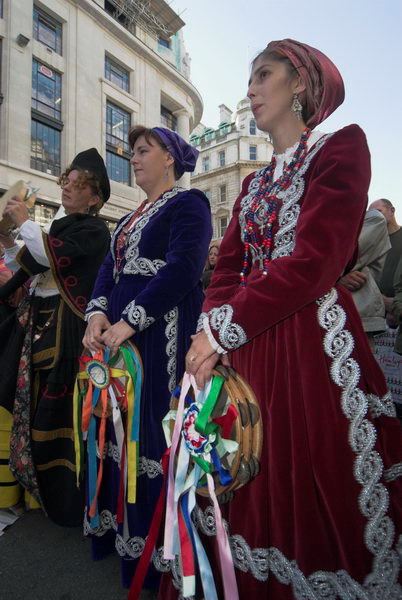
A woman in traditional costume holds a banner (Semah For Peace) in Trafalgar Square.
Estimates of the number of Alevi in Turkey vary widely but they probably make around 15% of the population, including many Kurds. Their religion is generally considered a part of Shi’ism, but they worship in their own languages, men and women together; women are not required to cover their hair, and their worship incorporates their rich traditions of poetry, music and dance – Semah.
Alevi, Union Flags, Fuel Poverty & Reclaim Love - 2013

Turkey is a country ruled and dominated by Sunni Muslims and the Alevi have suffered centuries of religious persecution – sometimes violent, and while Christian and Jewish children in Turkish schools are exempted from the compulsory Sunni Muslim religious classes, Alevi are not.

Alevi, Union Flags, Fuel Poverty & Reclaim Love - 2013

The rally called for democracy in Turkey, an end to discrimination and persecution, and an end to this compulsory religious education.

Alevi, Union Flags, Fuel Poverty & Reclaim Love - 2013

They also called for all immigrant cultures in the UK to unite and fight to remind the UK government of its responsibilities towards them, saying they face “ignorance from institutions such as the health, education, police, social and political bodies.” They call for an equal education system which considers the needs of all different cultural backgrounds.

More at Alevi Protest Discrimination in Turkey & UK


Defend the Union Flag

Westminster

Alevi, Union Flags, Fuel Poverty & Reclaim Love - 2013

Around a hundred ‘patriots’ from the ‘South East Alliance’ marched down Whitehall carrying Union Flags to a rally with speakers from Britain First in support of Loyalist Flag protesters in Belfast.

Britain First Northern Ireland organiser Jim Dowson with the man carrying the wreath

Belfast City Council had decided only to fly the Union Flag on eighteen days a year as elsewhere in the UK, resulting in series of protests outside Belfast City Hall organised by a breakaway unionist group which disagrees with the peace process.

Around a hundred people came to the protest, mostly carrying Union flags, though there were a few Ulster and Orange flags also on show.

The marchers became silent at the Cenotaph where two wreaths were laid, one by the Kent Somme Society commemorating the Irishmen who died in the Battle of the Somme. They then marched on to Old Palace Yard for a rally.

Paul Golding of Britain First, a former BNP councillor in Swanley on Sevenoaks District Council

There were speeches from Paul Golding of Britain First, Paul Pitt of the South East Alliance and Britain First’s Northern Ireland organiser Jim Dowson who had been involved in the protests there.

Paul Pitt of South East Alliance, formerly the EDL’s South East organiser.

A few photographers were threatened by protesters but I suffered only some mainly relatively friendly banter from several who recognised me from other extreme right marches I had photographed, including some who mistook me for a Searchlight photographer.

More at Defend the Union Flag.


Fuel Poverty Rally & DAN Roadblock

Department of Energy and Climate Change Whitehall

A rally organised by Fuel Poverty Action and supported by Disabled People Against Cuts, Greater London Pensioners’ Association, Redbridge Pensioners’ Forum, Southwark Pensioners’ Action Group, Global Women’s Strike and others was a part of a national day of action against fuel price rises and the government’s energy policies

Cuts and rising prices now meant one in four families now have had to choose between heating their homes adequately or eating properly. Many children were going to school hungry and we had seen a phenomenal rise in the need for food banks – now even in the wealthier suburbs, with many unable to buy food.

Fuel Poverty Action say that the government was doing everything it could to keep the big six enery companies making profts while “disabled and elderly people are forced into libraries and shopping centres to keep warm and people with cancer freeze in their homes with the heating off” as crucial benefits are slashed.

Many also suffer from benefit sanctions, losing financial support often for trivial reasons or for things beyond their control – such as a cancelled bus making them arrive late for an appointment. There seems to be a particularly vindictive approach encouraged (or mandated) at job centres towards claimants.

At the end of the rally disabled activists, many in wheelchairs went out onto Whitehall blocking the southbound carriageway. Some pensioners joined them, handcuffing themselves to the wheelchairs and others came to stand around them in the roadway. There were some more speeches from some of the protesters.

Protesters from the Disabled Peoples Direct Action Network move to block the road

After around a quarter of an hour police came and talked with the protesters asking them to leave. They were still asking 15 minutes later and by then many of the protesters were feeling they had made their point and were ready to go for a cup of tea. When they told police they would leave in ten minutes I left to rush to the Reclaim Love party which had started over an hour earlier.

Much more at Fuel Poverty Rally & DAN Roadblock.


Reclaim Love Valentines Party

Piccadilly Circus

The 11th Reclaim Love free Valentine’s Party – and the 10th organised by Venus CuMara who started the whole thing in 2004 – took place around Eros in Piccadilly Circus, aiming to spread peace and love around the world, and to reclaim love from its commercial exploitation.

I arrived late, after people had joined hands in the large circle around Eros to make their call for peace and happiness around the world, but the party was continuing and I took rather a lot of pictures – here are a few.

Venus CuMara straightens up the Reclaim Love banner
Free T-shirts – for the first time a donation was requested

I’ve written more about Reclaim Love on My London Diary over the years, and there is some more, along with many more pictures from the 2013 event at Reclaim Love Valentine Party.


FlickrFacebookMy London DiaryHull PhotosLea ValleyParis
London’s Industrial HeritageLondon Photos

All photographs on this page are copyright © Peter Marshall.
Contact me to buy prints or licence to reproduce.