Pancakes and Pickets – 2014

Pancakes and Pickets: Tuesday 4th March 2014 was very much a day of two halves for me, starting with the City of London at play in Guildhall Yard and going on to the School of Oriental and African Studies where cleaners were beginning a two-day strike demanding an end to bullying by their employer ISS and to be brought back into direct employment and treated with respect by SOAS management with equal rights to other employees.


City of London Pancake Races

Guildhall Yard

Pancakes and Pickets - 2014
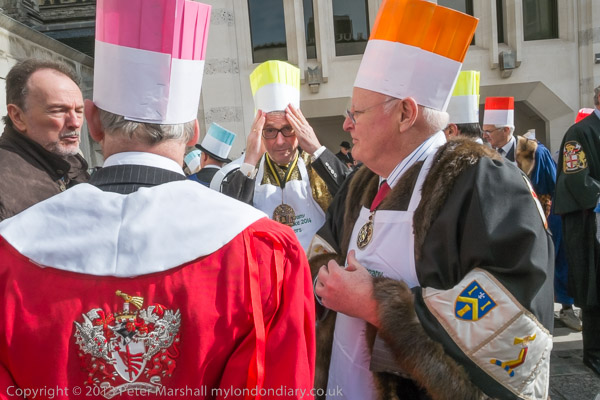
It was a toss-up whose hat was silliest

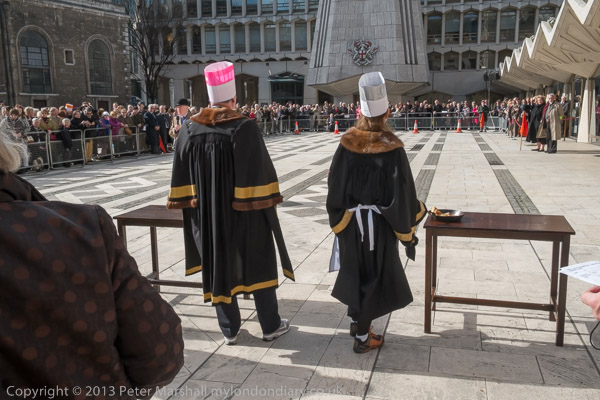
It was Shrove Tuesday and The City of London’s 10th annual pancake races took place in Guildhall Yard between teams representing the livery companies, wearing guild robes, white gloves and hats.

Pancakes and Pickets - 2014

As might be expected in the City this is a highly organised event, complete with clipboards, stop-watches and judges, and with a series of rules about dress and behaviour, with points being lost for various infringements.

Pancakes and Pickets - 2014

Various of the guilds contributed their expertise: Gunmakers used a small but very loud cannon to start each heat, Clockmakers timed the races, Fruiterers provided lemons, Cutlers plastic forks, Glovers white gloves to be worn by each runner, and the Poulters, who had started the event, the eggs to make the pancakes.
Pancakes and Pickets - 2014

This event supports the annual charity Lord Mayor’s appeal, and in 2014 Fiona Woolf, the 686th Lord Mayor of London, had chosen Beating Bowel Cancer, the Princess Alice Hospice, Raleigh International and Working Chance. As well as the more formal races there is also a fancy dress competition and race with one entrant from each livery company in costumes based, some with great ingenuity, on the charities.

Pancakes and Pickets - 2014

As I commented, “competition was extremely fierce and the regulators had plenty of work to do keeping up with the infringements. If only they had paid as much attention to what the banks and other city companies were doing!”
This was an event I photographed in several years, but I think 2014 was the final time. Like many events it had become more difficult to cover as more and more photographers came to cover it, some making rather a nuisance of themselves, leading to more restrictions. In earlier years there had only been myself and a few friends and we were welcomed and able to work freely.

City of London Pancake Races


SOAS Cleaners strike for Equal Treatment

SOAS, Thornhaugh St

Cleaners dance to Colombian music on the picket line

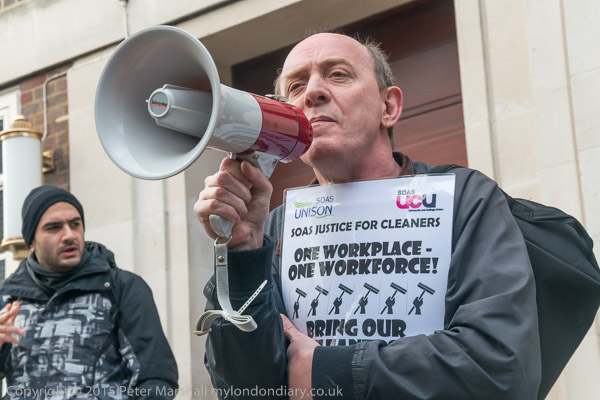
It was the start of a two-day strike by cleaners at London University’s School of Oriental and African Studies, part of a long ‘Justice For Cleaners’ campaign to be treated equally to other staff at SOAS and to be brought back ‘in house’, employed directly by the university.
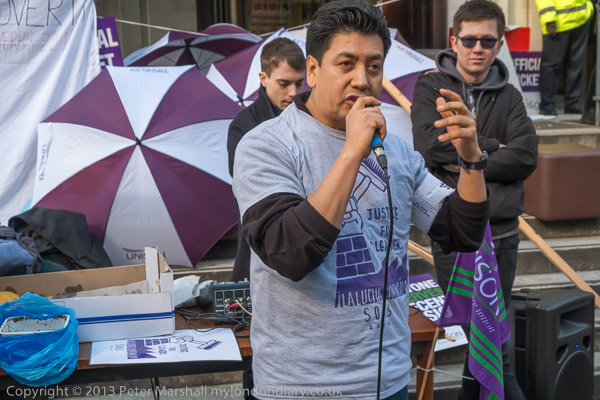
They were then employed by the outsourcing cleaning contractor ISS, a multinational company with a reputation for bullying workers. The previous day some ISS managers had assaulted students who had stopped them trying to bring in scab workers to do the work of the cleaners.
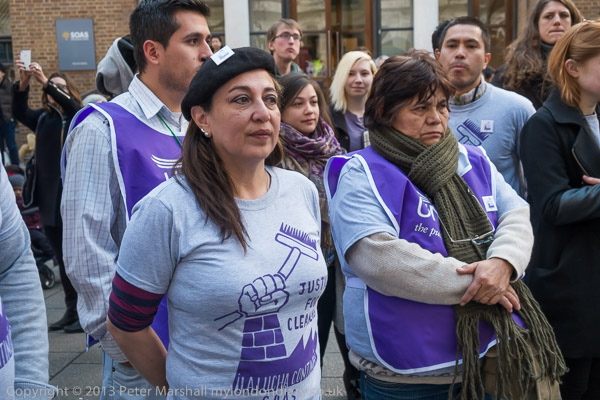
ISS director Paul Cronin had also threatened to stop paying the cleaners the London Living Wage which they gained through industrial action several years ago.
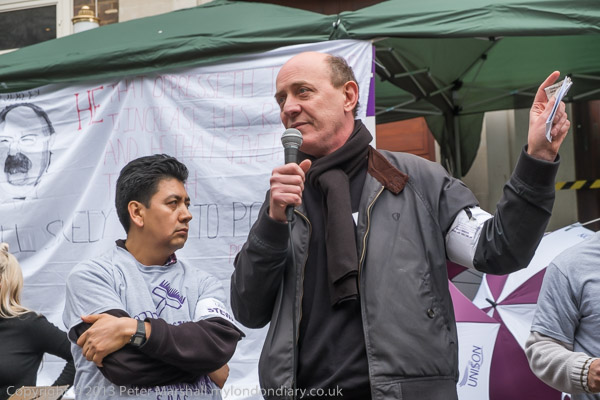
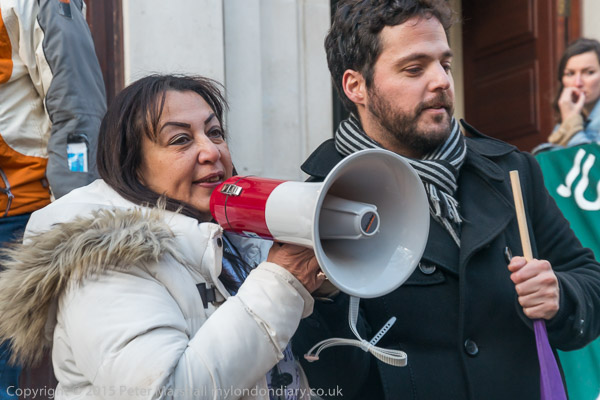
SOAS UNISON Branch Secretary and union secretary for the London Higher Education Executive Sandy Nicoll

Outsourcing always results in a poorer level of service, with employers cutting hours of work and giving workers poorer conditions of service, making high profits at the expense of low paid workers.
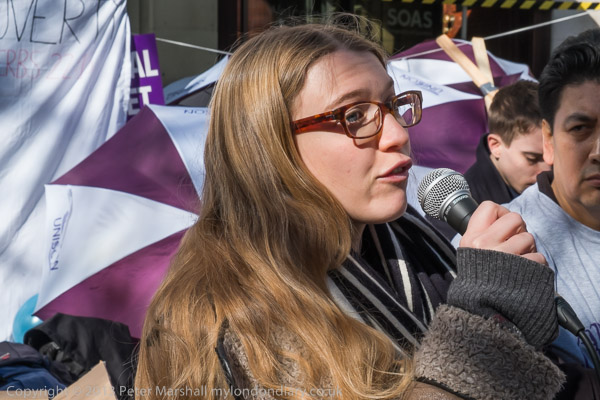
Reputable employers could not possibly be seen to employ people on the poor pay and conditions of contracting companies, but SOAS seemed happy to benefit from the exploitation of people who work in its building by others despite the poorer service for students and others.
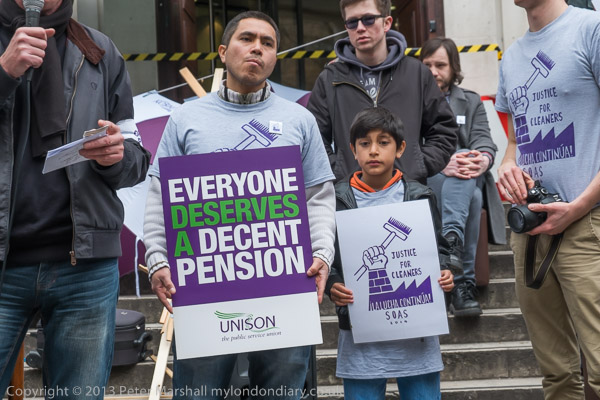
And as the Justice for Cleaners campaign stated “SOAS is known around the world for promoting dignity and equality. Yet, its maintenance, cleaning, security and catering all have less rights than other workers, because they are outsourced. At the moment SOAS is built on inequality and exploitation.”

The strike ballot had an over 60% turnout out and all who voted back the strike. I was told that many had arrived by 4am to start the picket and by 6am virtually the whole normal morning shift were there taking part.

I rushed away from the pancake races to get there for the lunchtime rally, where there were speeches supporting the strike from students and trade unionists. The cleaners are members of the SOAS Unison branch.
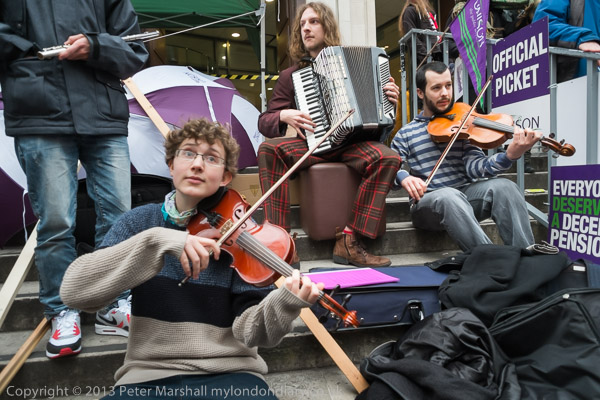
Many students and teaching staff had refused to cross the picket line; lectures and tutorials were rescheduled, no registers were taken, and library fines and deadlines were postponed. But for the following second day of the strike the cleaners had asked students and staff to work as normal so that the effect of the building not being cleaned could be seen.

After the speeches there was music and dancing, with the event going on until the picket ended at 5pm. Then the union bar which had been closed for the strike was to open for students and cleaners to have a party. But I left much earlier.

The campaign to bring the cleaners at SOAS back into direct employment continued and after ten years they were finally brought back in house in 2018.

SOAS Cleaners Picket Line


FlickrFacebookMy London DiaryHull PhotosLea ValleyParis
London’s Industrial HeritageLondon Photos

All photographs on this page are copyright © Peter Marshall.
Contact me to buy prints or licence to reproduce.
SOAS Cleaners and Denmark Street Squat

Two unconnected events on Thursday 29th January 2015.


SOAS Cleaners demand Dignity & Respect – SOAS, London University

SOAS Cleaners and Denmark Street Squat
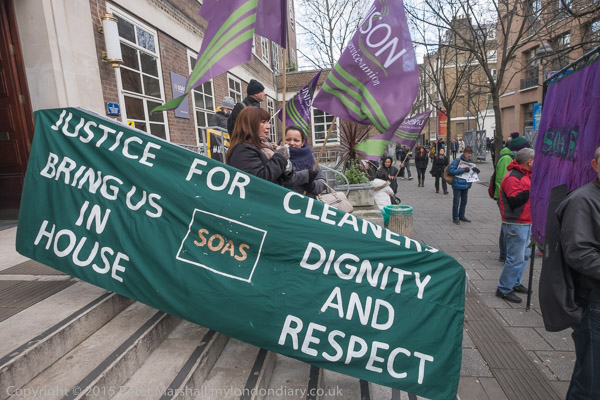
‘Justice for Cleaners – Bring us in House – Dignity and Respect’ – Unison Branch Rep Sandy Nicholl

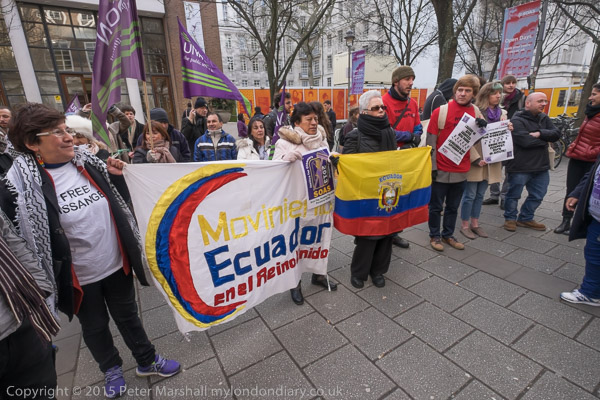
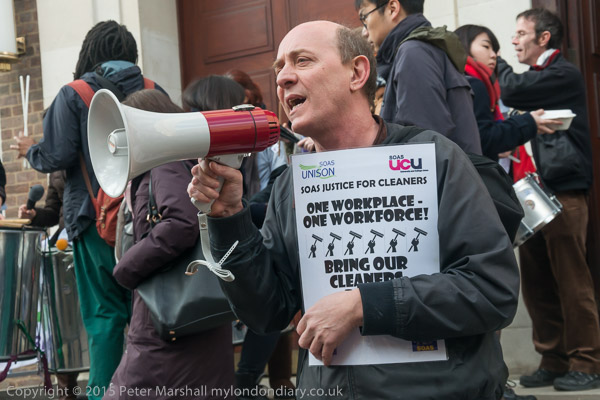
Cleaners working at the University of London School of Oriental and African Studies – SOAS – held a rally calling for improved conditions of service and an end to being treated as a second-class workforce. Supported by students and staff they continue their campaign to be employed by the University rather than cleaning contractor ISS.

SOAS Cleaners and Denmark Street Squat

SOAS is a university with an international reputation for its progressive views on political issues around the world and exposing the detrimental effects of neo-liberalism, but its management had failed to acknowledge the beam in its own eye, its disgraceful treatment of cleaners.

SOAS Cleaners and Denmark Street Squat

Most of those who keep the SOAS building clean and working smoothly are immigrants to the UK, mainly with Spanish as their first language. Instead of putting these people on the SOAS payroll and treating them as employees with similar rights to all the others who work in the same building, SOAS contracts out its cleaners. This denies them care and protection and leaves them open to exploitation and abuse by cut-price cleaning contractors.

SOAS Cleaners and Denmark Street Squat

Even worse in June 2009, SOAS management collaborated with the Home Office by calling a 6am “emergency meeting” of the cleaners which was in fact an immigration service raid, resulting in the deportation of nine cleaners. The raid came shortly after the SOAS Justice For Workers (J4W) had a successful campaign to achieve union recognition and the London Living Wage and was widely seen as a spiteful retaliation by the SOAS management following this victory.

The immigration raid is remembered at SOAS every year on its anniversary in June. The J4W campaign led by the SOAS Unison Branch continued and on 29th of January their protest for direct employment under the slogan ‘One Workplace, One Workforce’, supported by students, teaching and administrative staff as well as other trade unionists and organisations.

Eleven long years of protest, as well as work to show SOAS the advantages to the organisation of employing the cleaners directly finally resulted in a victory in 2018, when SOAS sent a letter to all staff, unions and support staff stating, ‘Our current staff in central facilities teams will be directly employed by the university. This means that they will be on equal pay and conditions with existing SOAS employees’.

More pictures at SOAS Cleaners demand Dignity & Respect.


‘Tin Pan Alley’ 12 Bar club faces eviction – Denmark St

Denmark Street is a short street linking St Giles High Street with Charing Cross Road, first developed in the late 17th century and named after Prince George of Denmark. When I first went down it in the 1970s it was a one-way back-street with little or no traffic, and both sides were lined with shops, offices and studios connected with the music industry.

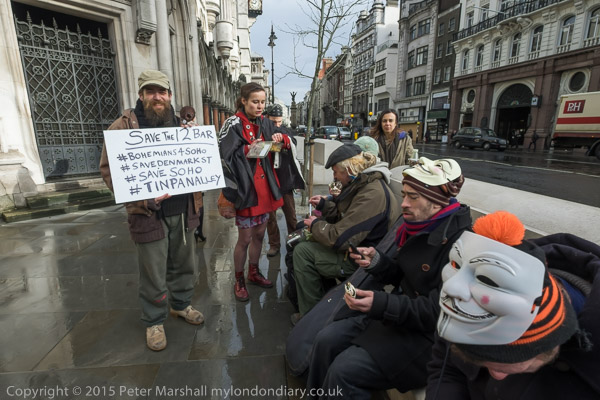
Squatters outside the Royal Courts of Justice on 28th January 2015

This was Britain’s “Tin Pan Alley” where session musicians and artists gathered, meeting each other and looking for work. The Rolling Stones recorded their first album here and David Bowie recruited his first band in a bar. The Sex Pistols lived in the street and recorded their first demos here – and so much more. It became a huge centre for musical instrument sales; I came here to look in windows full of guitars and saxophones I couldn’t afford and later came her to buy a professional Roland keyboard for my sons.

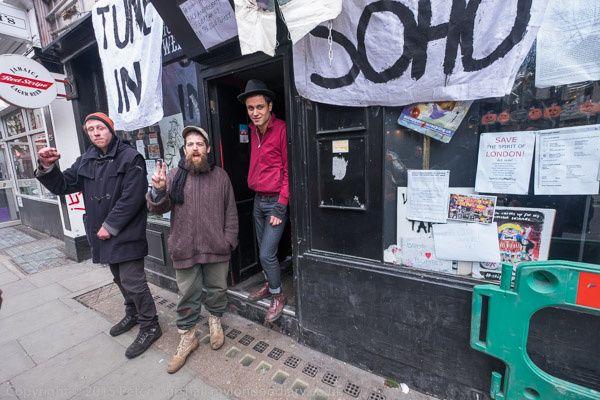
Outside the club in Denmark St, 29 January 2015

But above the mainly early 20th century shop fronts were the houses, some dating from from the original buildings of 1686-9, and others not much later. Eight were Grade II listed, two as early as 1951 and the others in 1974. The street is one of very few, if not the only, one in London with such early facing terraces on both sides.

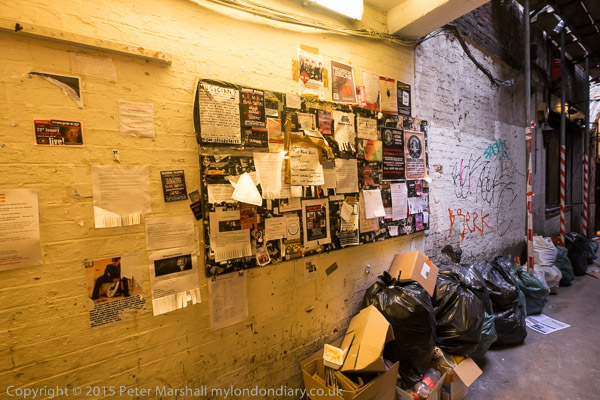
In the alley at the side of the club was a free musicians noticeboard

Listing ensured that the redevelopment of the street as a part of the Crossrail development around Tottenham Court Road would keep the facades, though much behind them is now new, and most of the old businesses have gone – many moving earlier as the music business changed and rents had rocketed. A petition with 10,000 signatures opposed the redevelopment asking for the street to be given full heritage status.

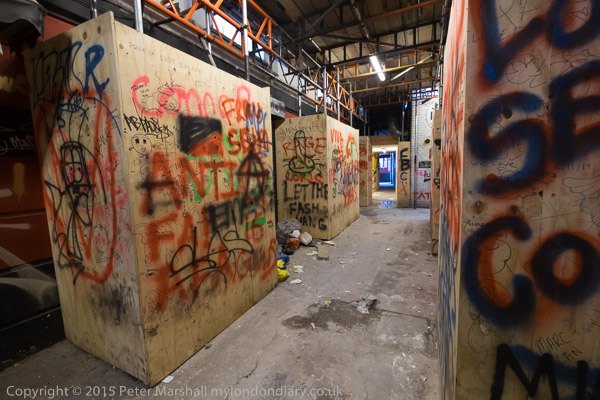
Redevelopment had already begun behind the bar

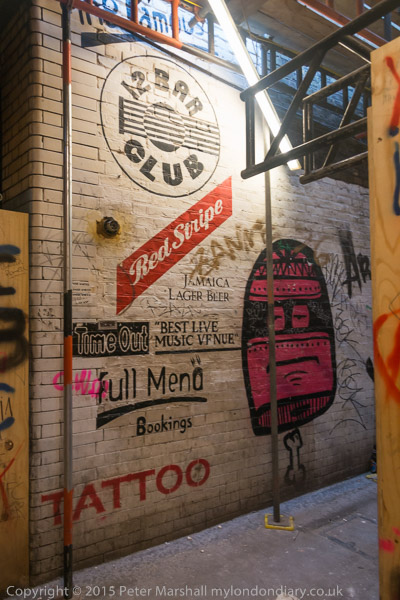
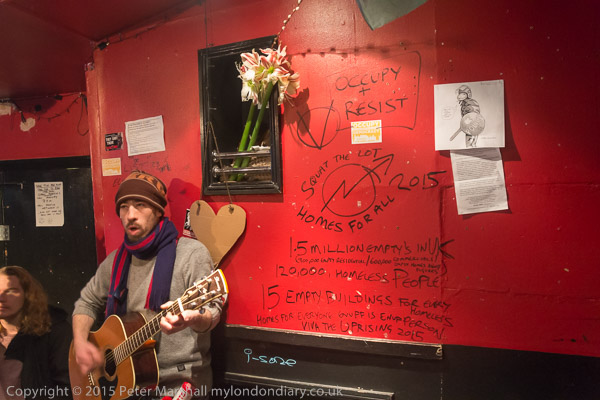
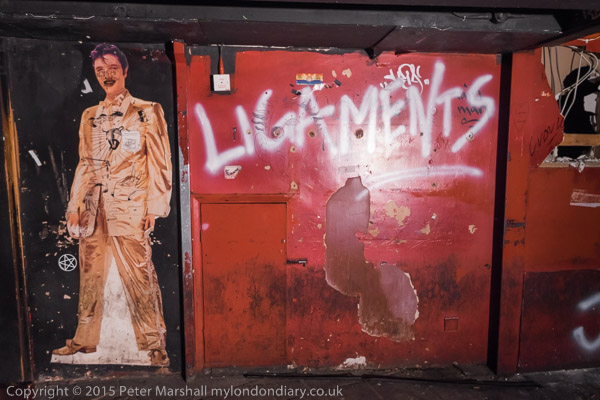
The 12 Bar Club had been running as a small live music venue since 1994 at 26 Denmark Street, in a listed building that began life in 1635 as stables but had in the early 18th century become a terraced house. The club closed in January 2015, and was then squatted by a group of musicians and supported opposed to its loss.

Everyone on the music scene at some time played at the 12Bar

I went there on 29th January when the squatters, #Bohemians4Soho had called for a street festival of resistance against their expected eviction the following day, having met and being invited by some of the squatters on the 28th as they demonstrated at the Royal Courst of Justice where a court case over their eviction was taking place.

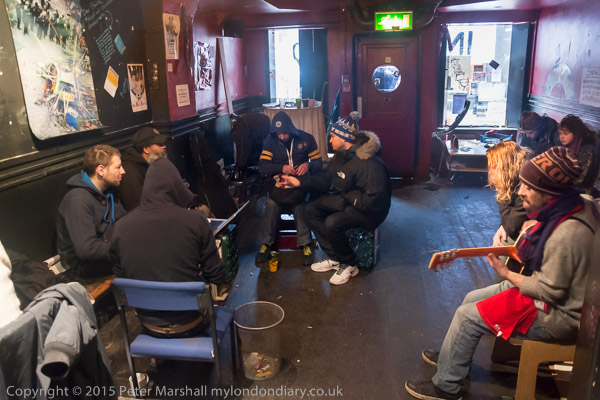
Live music in the club

Shortly before I arrived to take pictures they had been served with an IPO (interim possession order) giving them 24 hours to leave before they were committing a criminal offence. They left as the bailiffs arrived the following lunch time.

The Ligaments – Nicola ‘Nitro’ Itro, Jake Maxwell & Zel Kaute – had played the last night of the 12Bar and came back to play during the occupation

The listed building was stabilised, then lifted by crane for redevelopment to take place below it, after which it was lowered back into place. The old 12 Bar club room is now a part of a larger venue at the site.

More pictures: ‘Tin Pan Alley’ 12 Bar club faces eviction.